







Abstract
Introduction
7 January 2019, the Greek island of Lesvos: Officers from the United Nations High Commissioner for Refugees (UNHCR) walked from tent to tent in the hotspot of Moria to verify the eligibility of asylum seekers for its cash assistance programme. According to the UNHCR, the programme ‘restores dignity and empowers asylum seekers and refugees’. 1 At that time, around 7000 women, men and children were living in the crowded hotspot: ‘We have no hot water, and [in] some areas of the camp there is no electricity either. We are all becoming mad, some of us have been stranded here for one year or more’, an Iranian man told me outside of the camp. ‘Now I have to go back to my tent’, he added, ‘as the UNHCR is coming to top up my card, they informed me this morning with a text; I hope to be still eligible. It is very difficult to understand how these technologies work’ (Interview 1). This snapshot from Lesvos, where asylum seekers 2 are given prepaid cards by humanitarian actors while they are exposed to protracted precarity, is iconic of ‘techno-humanitarianism’ (Morozov, 2012). This article focuses on the Greek asylum system and investigates how asylum seekers are turned into forced hindered techno-users, whose access to protection, rights and financial humanitarian support is obstructed and mediated by different technologies and apps – such as Skype, Viber and WhatsApp. The asylum seekers are expected to act responsibly, but are kept in a protracted state of dependency on humanitarian actors and repeatedly disoriented.
The Greek refugee system is a case in point for scrutinizing the technological obstructions of asylum: indeed, asylum seekers need to navigate a series of technological mediations for interacting with both Greek authorities as well as humanitarian actors 3 and are confronted with multiple technological steps that hamper them from accessing rights. The article mobilizes a transversal approach to techno-humanitarianism and refugee governmentality, building on critical security studies, migration scholarship and critical works on humanitarianism. A growing scholarship has studied the transformations that have occurred in refugee governmentality due to the use of digital technologies (Jacobsen, 2015; Jacobsen and Sandvik, 2018; Read et al., 2016) and big data (Amoore, 2020; Metcalfe and Dencik, 2019), leading some authors to investigate the technologization of the humanitarian space (Abdelnour and Saeed, 2014) and to caution against the emphasis on techno-innovation (Scott-Smith, 2016). Here, I shift the focus from surveillance and control towards an analysis of how the forced technological intermediations in refugee camps further obstruct asylum seekers’ access to rights and financial humanitarian support. Drawing on the assumption that technology ‘loops back in the constitution of social order’ (Jacobsen, 2015: 148) and ‘is co-constitutive of the humanitarian environment it seeks to capture’ (Read et al., 2016: 1320), the piece takes into account the forced encounters between asylum seekers and technologies and advances a twofold argument. First, it contends that asylum seekers are turned into forced hindered techno-users who are governed by being disoriented: indeed, they need to keep themselves up to date regarding the frequently changing eligibility criteria, technological steps to take and deadlines to comply with. Second, the article argues that the analytics of securitization and victimization are not exhaustive for grasping how asylum seekers as techno-users are shaped and disciplined. In fact, people who seek asylum are also represented and treated as risky and as subjects of pity (Newman and Van Selm, 2003). Furthermore, an insight into the technological obstructions of asylum highlights that asylum seekers are expected to act as responsible techno-users and comply with a series of techno-bureaucratic steps, while at the same time their dependency on humanitarian actors is reiterated.
Digital technologies, it has been argued by scholars, work as mediations tools that are both tactically used by migrants to increase their self-sufficiency and enforced by state authorities to spot, identify and control migrants (Nedelcu and Soysüren, 2020). Here I speak of forced technological mediation to draw attention to the asymmetrical power relations between humanitarian and state actors on the one hand, and asylum seekers who are requested or pushed to use technologies on the other. I show how these multiplicities of technologies contribute to obstructing migrants’ access to asylum. While in critical security studies scholars have widely analysed how digital technologies are used for tracking and controlling refugees, here I investigate how the incorporation of technologies in refugee governmentality contribute to hindering asylum seekers and, thus, rendering them more precarious.
Methodologically, this article builds on empirical material collected during my research fieldwork in Athens and Lesvos, Greece between 2017 and 2020 4 and on the analysis of UNHCR public documents. During my fieldwork I interviewed Greek institutions (the Asylum Service and the Ministry of Migration), international organizations (the UNHCR in Athens and Lesvos, the International Organization for Migration and the Red Cross), international and Greek nongovernmental organizations (NGOs) (Doctors without Borders, Caritas, Pikpa) and the financial provider of the cash assistance programme (Prepaid Financial Services, which is based in London). During my participatory observation, I interviewed asylum seekers outside the hotspot of Moria in Lesvos and in the city of Mitilini, as well as in Athens, during the card distribution process at the Caritas office and in the Eleonas refugee camp. 5 Drawing on this empirical material, the article proceeds by analysing digital and financial tools in relation to the restructuring of the asylum regime, conceived as a political technology for containing, disrupting and controlling migration (De Genova, 2013; Karakayali and Rigo, 2010). It is important to stress that the hotspots, which are located on five Greek islands, 6 have become ‘cramped spaces’ (Walters and Lüthi, 2016) where asylum seekers are protractedly stranded. This is mainly the result of the geographical restrictions that had been enforced through the EU–Turkey Deal, which establishes that migrants who land on the Greek islands need to wait there until when their asylum claim is processed (Spathopoulou and Carastathis, 2020). ‘Humanitarian triage therefore provides basic needs to a captive population’ (Pallister-Wilkins, 2016), as long as migrants are trapped twice there – both in the hotspots and on the islands.
The article proceeds in three sections. It starts by discussing the multiple technological intermediations that asylum seekers are confronted with, focusing on the cash assistance programme and how asylum seekers are obstructed in accessing asylum and financial support. It explores the widespread disorientation that asylum seekers experience as they navigate un-legible techno-scripts that change over time. The article critically engages with the literature on the securitization and victimization of refugees, and it argues that asylum seekers are not treated exclusively as potential threats or as victims, but also as forced hindered subjects; that is, they are kept in a condition of protracted uncertainty during which they must find out the multiple technological and bureaucratic steps they are requested to comply with. In the final section, the article illustrates how forced technological mediations actually reinforce asylum seekers’ dependence on humanitarian actors and enhance socio-legal precarity.
The article contributes to the debates on the securitization and victimization of refugees and asylum seekers, highlighting how asylum seekers are not exclusively criminalized and controlled or protected; they are also turned into forced hindered techno-users and are governed through disorientation. The forced technological mediations reinforce asylum seekers’ protracted dependency on humanitarian actors. At the same time, they are expected to act as responsible techno-users. Thus, the article argues, a critical engagement with techno-humanitarianism involves interrogating the processes of subjectivation that are play (Foucault, 1988). By subjectivation I refer to the humanitarian narratives around refugees’ autonomy through technology on the one hand, and to the ways in which refugees are expected to act as responsible consumers and techno-users from within a condition of spatial containment on the other.
Cash assistance and disruptive technologies
Greece is the first European country with an EU-funded cash assistance programme for asylum seekers. The programme was launched in 2016 7 and implemented in 2017, as a response to the so-called ‘refugee crisis’. On paper, all asylum seekers who arrived in the country after January 2015 and who hold an asylum card are eligible for financial support. This is uploaded every month on a Mastercard-sponsored prepaid card and can be used both to pay in shops and to take out cash from ATM machines. 8 However, spatial and mobility restrictions apply, similar to other contexts where cash assistance programmes have been implemented (Coddington, 2019): only asylum seekers who agree to stay in the accommodations provided by the Greek authorities or the UNHCR are eligible for the cash assistance programme, although, paradoxically, the programme was set up as a way to strengthen refugees’ autonomy. 9 The programme is run by the UNHCR, which is in charge of collecting the data from the card beneficiaries, in cooperation with two Greek NGOs 10 that are involved in card registration and the monthly verification process on the mainland. The cash assistance programme in Greece is not a state-driven project; on the contrary, it constitutes a case in point of ‘internal externalisation’ (Heller and Pezzani, 2016). Indeed, even if the Greek authorities have endorsed it, they are not directly involved in the programme, which is in fact funded by the EU, managed by the UNHCR and supported by Prepaid Financial Services, a financial provider based in London.
The Greek refugee context serves as an interesting laboratory for EU migration and refugee policies. 11 Its salience and specificity are due to the mix of technologies in use there: widely promoted technologies, such as prepaid cards, and more ordinary ones, such as Skype, Viber and WhatsApp. In fact, even apps that refugees regularly use in daily life – like WhatsApp – can turn out to be obstacles to asylum seekers when these are used as compulsory technological mediations to claim asylum and receive financial support. For this reason, I suggest, it is key to analyse the prepaid cards that asylum seekers receive in relation to the apps that mediate the interactions between asylum seekers and humanitarian actors. The scholarship on cashless programmes focuses on the relationship between migrants, financial tools (debit cards) and humanitarian actors, and points to the forms of discrimination and surveillance that are enacted through these programmes (Jacobsen and Fast, 2019; Tazzioli, 2019; Ulrich and Lambert, 2018a).
By arguing that asylum seekers are turned into forced hindered techno-users, I echo works that stress how cashless technologies increase asylum seekers’ dependency on the state and humanitarian actors (Coddington et al., 2020; Jacobsen, 2017). Within this literature, scholars have highlighted the destitution effects associated with the implementation of cashless programmes. Importantly, Coddington has shown how the use of cashless technologies constitutes a form of slow violence towards asylum seekers: indeed, cash assistance programmes are part of broader state financial tactics which ‘have become key mechanisms in disciplining migrant populations’ (Coddington, 2019: 531; see also Culcasi et al., 2019). Such a view enables us to draw attention to modes of violence that are not restricted to blatant human right violations. Relatedly, this perspective significantly pushes the critical analysis of techno-humanitarianism beyond mechanisms of arbitrary exclusion – such as migrants being excluded from the cash assistance programme – and considers how cashless technologies shape and discipline refugees’ subjectivities. However, I suggest that a focus on state logics needs to be supplemented with an inquiry of the role played by financial and humanitarian actors and nuanced in light of the intertwining of European and national interests. 12
More broadly, an analysis of the effects of destitution allows questioning discourses on refugee empowerment through digital technologies that are widely promoted by migration agencies and the UNHCR. In particular, this scholarship challenges the idea that technologies are implemented in refugee governmentality in an inclusive way, as it illustrates that asylum seekers face discrimination when accessing cash assistance or making purchases. Yet speaking of destitute asylum seekers implies that the host country has either actively taken something away from refugees or failed to provide them with sufficient support, thus causing them to end up in a state of poverty (Allsopp et al., 2014). 13 Instead, I draw attention to how they have been obstructed and debilitated in accessing the asylum system and social rights, without necessarily being unable to meet essential living needs or being fully destitute. 14
In addition to focusing on how asylum seekers have been excluded from digital connectivity and cash assistance, I interrogate how their subjectivities are shaped by these technological intermediations with humanitarian actors. Asylum seekers are disoriented and disempowered in their ability to access humanitarian and financial support, as well as rights. In order to scrutinize the debilitating effects they have on people seeking asylum, cash assistance programmes should be analysed in relation to the other technologies that asylum seekers need to navigate on a daily basis. In Greece, the technological obstacles for migrants start when they decide to claim asylum. Indeed, since 2016 migrants who want to book an appointment with the Asylum Office to lodge their asylum application need to do this through a mandatory Skype system, which can be difficult for many to manage. Indeed, for some migrants, owning a smartphone and getting access to the internet is not so straightforward, and Skype calls can be made only during specific time slots – usually one or two hours per week, depending on migrants’ nationalities. 15 As a result, ‘the line is always busy, it took me three weeks before reaching the Asylum Office’ (Interview 2). Since the onset of Covid-19, the asylum procedure has almost entirely been done online: after pre-booking an appointment via Skype, migrants need to lodge their asylum application online on the Hellenic Ministry of Migration and Asylum website. 16
Athens, 23 April 2019: around 250 asylum seekers of different nationalities queued at the NGO Caritas office in order to register for the cash assistance programme or to submit the monthly eligibility verification. As part of this, Caritas’ officers needed to check the legal status of the card holders and where they were living; the NGO also called asylum seekers on the phone to verify they were still in Greece. However, as one officer stressed to me, ‘the main problem for asylum seekers is technology; what is supposed to facilitate them is actually a main obstacle, from the phone calls, to the compulsory Skype call to book the asylum interview, up to the Viber chat system’ (Interview 3). For instance, if asylum seekers have technical problems with their prepaid cards, or if the monthly payment is delayed, they can only contact humanitarian actors by sending a text via Viber (see Figure 1). 17 Although an emergency landline exists, this is de facto useless ‘as it is very unlikely that someone will answer the call, as we are too busy’ (Interview 4). Both the Viber number and the landline are connected to an online system, Commoncare, and the operators from the NGOs that are in charge of answering asylum seekers’ chats have access to both the UNHCR database, Progress, and that of the financial provider, Prepaid Financial Services, to check the card transactions in real time. However, asylum seekers’ personal data, which is contained in Progress, is not directly connected to the national hotline. Therefore, the operators who store calls and chats need to import the data manually from Progress into Commoncare (Interview 5).

Viber numbers that asylum seekers have to text to in order to solve technical problems with their cards
According to asylum seekers who have experienced the Viber communication system with NGOs, many messages only receive a response after several days, one reason for this being that the system is poorly designed for responding to multiple messages (see Figure 2). Even the monthly verification via phone call often turns into an obstacle for refugees – not because they do not have a phone (the vast majority do), but because many change their phone numbers and SIM cards many times. Thus, instead of claiming that apps like WhatsApp empower asylum seekers (Ulrich and Lambert, 2018b) or, on the contrary, fully destitute them, it is worth noticing that asylum seekers are repeatedly obstructed – in accessing asylum, rights and support – and ultimately disoriented by the frequent changes of deadlines, criteria and procedures. Asylum seekers’ access to prepaid cards depends on their ability to deal with other technologies – in particular apps such as Viber and WhatsApp. This happens not only when there are technical glitches to be fixed. Rather, technological mediations between asylum seekers and humanitarian actors are fully incorporated in the daily operations of refugee governmentality.
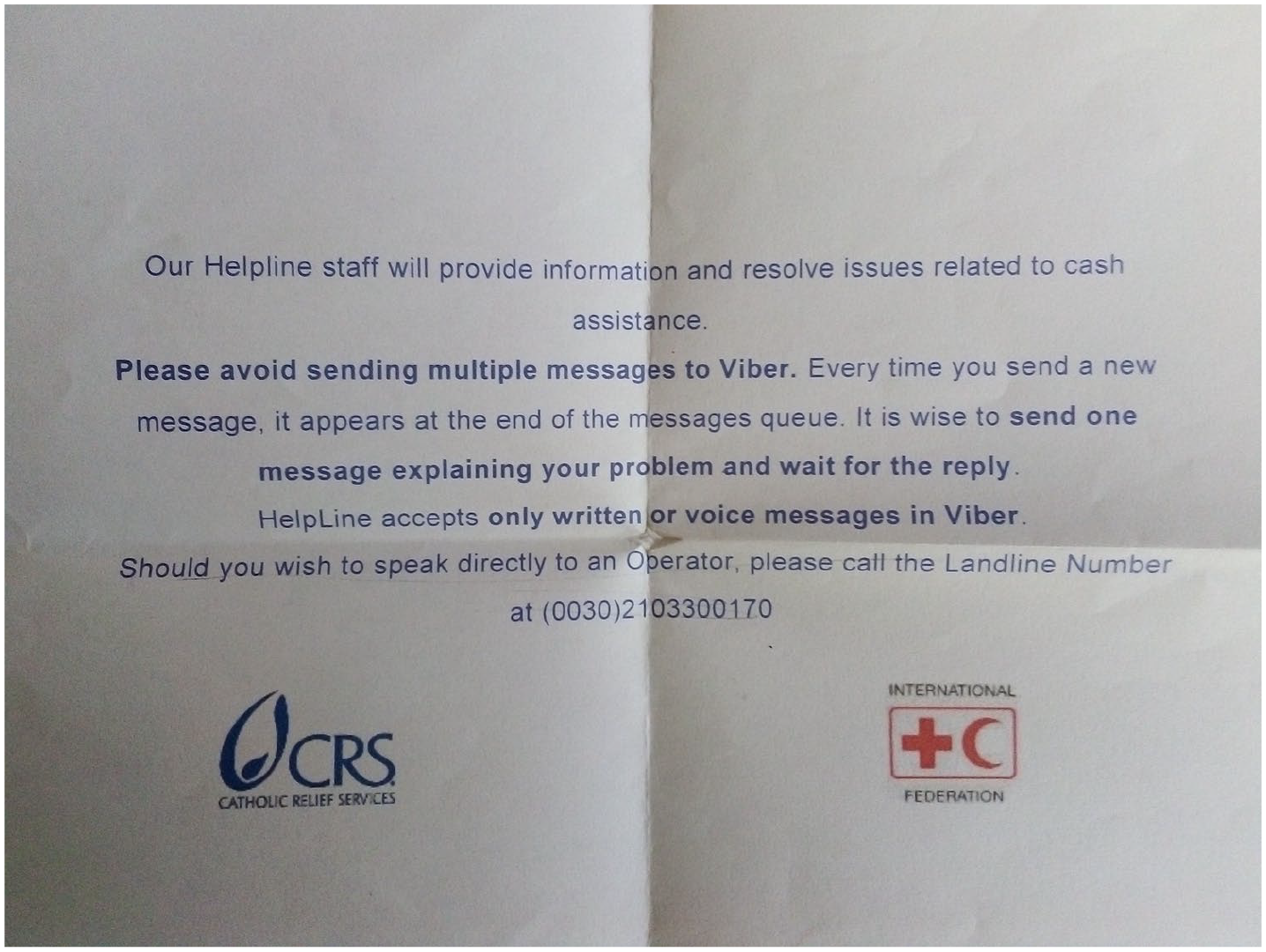
Paper found in the Caritas Office in Athens which explains to asylum seekers how the Viber chat system works
In order to perform the monthly verification procedure, the UNHCR and the two NGOs involved in the programme send multiple texts to asylum seekers at different times: the first one is sent to communicate the date of the appointment; the second one, which asylum seekers receive just the day before the appointment, indicates the exact time and location. Thus, asylum seekers must have a mobile phone, always need to be reachable and cannot change their number, although in reality they often need to do so, as mentioned above. This strategy of sending multiple texts at different times is used for ‘preventing potential turmoil and disorder’ (Interview 6) that might be caused by asylum seekers who come to the registration office outside their assigned time slots, or by others who might gather there to get financial support even if they are not eligible. Thus, asylum seekers are preventively treated as potential mobs (Tazzioli, 2017); at the same time, they are governed through a multiplicity of scattered temporal deadlines and rules they need to follow. This mix of techno-temporal rules generates widespread disorientation among asylum seekers: indeed, they are entrapped in a whirlwind of technological requirements and must pay attention to unpredictable tiny changes in deadlines and eligibility criteria. Even apps like WhatsApp or Skype that migrants use on a daily basis become actual obstacles to them in conjunction with the multiple disorienting technological steps that they need to comply with.
The fact that asylum seekers are repeatedly disoriented in their attempt to navigate the asylum system is a constitutive feature of the way in which technologies are incorporated in refugee governmentality. The widespread disorientation and confusion that asylum seekers experience is not just a side effect of the asylum system. As Aradau observes, ‘ambiguity has also been deployed both to foster non-knowledge and to (de)stabilize the assembling of ignorance, uncertainty, and secrecy’ (Aradau, 2017: 337). Similarly, modes of I have not received my monthly payment for three months, and thus I contacted the landline number I was given by Caritas, and nobody answered; so I was told by friends in the camp that I should contact them via WhatsApp, but then this stopped working and we could only use Viber. Yet, I realized only after days that you could use those numbers only for sending chats, not for making phone calls. (Interview 7)
Asylum seekers as forced hindered techno-users need to navigate
Forced hindered techno-users: Beyond victimization and securitization
An insight into the role of digital technologies in refugee governmentality enables us to engage with the transformations that have occurred in the securitization of refugees (Hammerstad, 2011; Huysmans, 2000; McCluskey, 2019; Scheel and Squire, 2014) and in the technologization of security (Bigo, 2002; Ceyhan, 2002). This article complicates the representation of refugees as
Jacobsen and Fast have noted that the use of technology in humanitarian governance ‘blurs control and care, emancipation, and domination’, as long as new technologies are tested in refugee camps ‘on the basis of improvements in care’ (Jacobsen and Fast, 2019: 156), while at the same time they introduce new modes of control. Yet security-centred analyses should be nuanced in light of asylum seekers being treated mainly as deportable subjects 18 and at the same time becoming objects of data extraction and value production (Amoore, 2020; Aradau and Tazzioli, 2020). Securitization and victimization are not exhaustive analytics for grasping the modes of subjection, extraction and control that asylum seekers are shaped and affected by. Rather, the security– humanitarianism nexus must be supplemented with an analysis of how asylum seekers are shaped as forced hindered techno-users who are deemed to misuse the refugee system – e.g. by claiming asylum in order to obtain temporary authorization to stay.
In Greece, security claims are often put forth for justifying and promoting the use of prepaid cards and digital technologies in refugee camps and hotspots: card distribution is indeed supposed to enhance asylum seekers’ security by avoiding identity fraud and potential tumults, as long as humanitarian distribution can be done in a smoother and less arbitrary way that increases the distance between asylum seekers and humanitarian actors. In reality, asylum seekers in the hotspots are partly governed by the interweaving of logics of
Therefore, security, in its multiple forms – as state security as well as refugee security – does not appear to be the main concern or justification mobilized by state authorities. In Greece, the political and social reaction to the increasing presence of women, men and children seeking asylum needs to be critically read against the backdrop of the austerity measures that Greek citizens have been affected by: the temporal conjuncture of the economic crisis and the so-called ‘refugee crisis’ in 2015 transformed the latter into a test bench for Greece (Spathopoulou and Carastathis, 2020). Indeed, the political pressure that the European Commission had put on Greece regarding migrants’ identification and hosting procedures in the hotspots contributed to asylum seekers being depicted as economic and social burdens. In addition to that, it is worth noting that Greek citizens’ perception of people seeking asylum has changed since 2015. While in 2015 migrants were in transit to other EU countries, with the closure of the Balkan route in 2016 their protracted presence in Greece was perceived as a burden to cope with – indeed, many remained stranded on the Greek islands or gave up their goal of reaching other European countries and claimed asylum in Greece. Furthermore, asylum seekers are seen as idle people who are dependent on NGOs and state aid. ‘NGOs are pampering refugees’, 21 the Greek government significantly declared in 2020, as part of a campaign aimed at discrediting both asylum seekers and NGOs. Hence, on the one hand, asylum seekers are seen as economic and social burdens and depicted as parasites of the welfare system and humanitarian aid; on the other, they are turned into forced hindered techno-users and compelled to perform a series of technological tasks, meet deadlines and navigate changes in criteria in order to get access to financial and humanitarian support. In other words, while asylum seekers are blamed for being pampered by and dependent on humanitarian and state aid, they are forced to use technological mediations.
Asylum seekers, who are constrained by multiple spatial and temporal restrictions as forced techno-users, hustle to dodge some of these obstacles (Thieme, 2017). For instance, due to technical glitches in the database, some card beneficiaries managed to receive monthly financial support twice, moving from one camp to another when the monthly top up was taking place, or by taking the prepaid cards of friends who left the country.
22
As S., an Afghan national stranded in the hotspot of Moria told me, the amount we receive every month is so minimal that we barely manage to cope with essential needs, as to get the food in the camp we have to queue for hours, so many of us prefer to buy it, and most of the time it’s not enough or it’s always the same; therefore, some people found ways of getting more money. (Interview 8)
Therefore, asylum seekers are turned into forced hindered techno-users who are rendered more vulnerable and debilitated as long as their access to financial and humanitarian support is obstructed by multiple and confusing techno-bureaucratic conditions they must meet.
The forced technological mediations between humanitarian actors on the one side and asylum seekers on the other enhance the multiple hurdles that the latter encounter in receiving protection, humanitarian support, cash assistance and even basic human rights. How are asylum seekers affected by this? What are the effects on their subjectivities? These compulsory technological steps in conjunction with deadlines and unpredictable changes in the rules and criteria generate widespread disorientation and disempowerment among people seeking asylum. Such debilitation has been fleshed out by Puar (2017) in her analysis of modes of governing by harming populations. In fact, asylum seekers are confronted with both material obstacles – such as needing to download and use certain apps – and with a series of technological requirements whose rules change frequently over time. In so doing, the compulsory technological mediations of refugee humanitarianism and the changing criteria associated with these disorient asylum seekers who, as a result, might miss a deadline or perform a procedure incorrectly. The turning of asylum seekers into hindered forced techno-users sheds light on modes of governing that do not treat migrants exclusively as potential threats, dangerous individuals or subjects in need of protection: more than being totally deprived, they are insecuritized by being kept in a condition of uncertainty and obstructed from accessing both asylum and humanitarian support.
Reinforcing dependence
Asylum seekers are often trapped in a suspended life: the protracted waiting time of the asylum procedure and deep uncertainty about the future keep them in a legal limbo (Hyndman and Giles, 2011). However, this protected waiting time is far from empty: asylum seekers are obliged to take multiple technological steps, comply with changing deadlines and understand how the asylum system works. In some cases, such as the Skype call system to book an appointment with the Asylum Office, technological steps are mandatory for entering the asylum procedure at all. In others, technological intermediations are not compulsory, but they the only way to communicate with humanitarian actors – such as the use of Viber to report technical problems with the prepaid card. How does this affect the relationships between asylum seekers as forced techno-users and humanitarian actors?
The fact that asylum seekers are given prepaid cards and compelled to use technology for navigating ‘asylum’s minefield’ (Interview 9) should not lead us to conclude that they are treated as ordinary consumers or neoliberal self-managing subjects. On the contrary, although asylum seekers are expected to act as responsible techno-users, they are the object of multiple spatial restrictions and entrapped in precarious legal conditions, and many of them might quickly become deportable. 23 A salient example is provided by the increasing use of the Viber app for communicating with asylum seekers. Initially the app was used only by the UNHCR as part of the cash assistance programme, but after the onset of Covid-19 it was adopted by the Greek authorities for updating asylum seekers and has since become the main communicative channel between Greek authorities and asylum seekers on the Greek islands. After the hotspot in Lesvos was set on fire on 8 September 2020, the Greek Ministry of Migration and Asylum launched Migration Greece Info, 24 a Viber community for sending info and updates about asylum-related matters. 25 The community chat has also been used to warn asylum seekers from contacting NGOs and threatening those who refuse to enter the new camp in Lesvos: ‘the Greek state guarantees your security. Do not believe anyone else. Your life is safe only in the new camp [. . .] From today on, water and food supplies will only be available inside the camp.’ 26
Overall, based on the chats sent every week to asylum seekers, the Viber community is used to intimidate asylum seekers or communicate important new rules and restrictions that will remain unknown to those unable to download and navigate the app, rather than to facilitate access to humanitarian services. The digitalization of asylum procedures was further enhanced in 2020, when the Greek authorities implemented a pilot project on the island of Lesvos for conducting asylum interviews remotely. As it has been documented by Greek NGOs, as part of the online asylum system, asylum seekers receive the date of their interview via text only one day before; during the interview, due to poor internet connectivity, asylum seekers need to repeat themselves multiple times, and their personal data is not ‘safeguarded through the questionable platform that is used to conduct the remote interviews’. 27
The temporary incorporation into financial circuits does not transform asylum seekers into bank clients nor into ordinary customers. This is also a result of how the cash assistance programme functions. Indeed, the prepaid cards are not associated with individual bank accounts but with the UNHCR’s unique financial wallet, and therefore recipients cannot save their own money or keep an account when they are no longer eligible for monthly financial support. Relatedly, when they use the prepaid cards, there are restrictions on purchases (for instance, alcohol and online payments, which automatically block the cards). Therefore, instead of being autonomous consumers, asylum seekers as card beneficiaries become para-consumers and forced hindered techno-users.
Taking into account the use of digital technologies in the field of humanitarianism and the UNHCR’s programmes to enhance refugees’ resilience and entrepreneurship, a growing scholarship has pointed to the affirmation of ‘humanitarianism as neoliberal diagnostic’ (Reid-Henry, 2014) predicated upon refugees’ self-reliance and autonomy (Betts and Collier, 2017; Easton-Calabria and Omata, 2018; Ilcan and Rygiel, 2015). The partial turn in humanitarian narratives from refugees being portrayed as victims or subjects to protect towards refugees as self-reliant individuals draws attention to how they ‘can (and thus implicitly should) adapt to their new circumstances, rather than facilitating demands for human rights, political change, and humanitarian support’ (Turner, 2019: 139). These analyses capture important features and transformations that have been at play in the discourses and rationale of refugee humanitarianism. Nevertheless, the stress on refugees’ self-reliance ends up representing asylum seekers as consumers and overshadows the way in which techno-humanitarianism reinforces asylum seekers’ dependency on humanitarian actors and how asylum seekers as techno-users are hampered from getting asylum.
Yet, speaking of protracted dependency on humanitarian actors does not mean that asylum seekers are just trapped in a state of indefinite waiting. Rather, as forced hindered techno-users asylum seekers are requested to comply with a series of techno-bureaucratic steps and to keep themselves up to date regarding the unpredictable changes in criteria and deadlines. Jointly, they are the object of a moral injunction, as they are expected to act as responsible consumers and techno-users from within a condition of spatial incarceration (on the islands) or while dealing with multiple spatial and social restrictions (on the mainland). The hectic techno-bureaucratic activities that asylum seekers need to perform strengthen their dependency on humanitarian actors and, at the same time, generate disorientation among migrants themselves. However, this reiterated dependency should not be confused with humanitarian support as such: in fact, asylum seekers in Greece are expected to deal with multiple technological intermediations for communicating with humanitarian actors, often while simultaneously dealing with a lack of medical, psychological and legal aid in hotspots and refugee camps (Médecins Sans Frontières, 2018).
The cash assistance scheme is promoted by the UNHCR as a financial humanitarian measure with the ambivalent goal of alleviating asylum seekers’ economic precarity and enhancing refugees’ dignity and freedom of choice. It is noteworthy that these two levels of intervention are merged into one and fostering dignity is equated with enabling asylum seekers to get by financially: ‘Cash assistance’, according to the UNHCR, ‘restores dignity and empowers asylum-seekers and refugees who can now choose how to cover their basic needs’ (UNHCR, 2020). Indeed, as UNHCR officers in Athens and Lesvos stressed to me, ‘the cash assistance is a minimal financial support which allows asylum seekers to get by, but at the same time it also enables them to choose how to best use their money’ (Interview 10).
Nevertheless, asylum seekers are not depicted as self-entrepreneurs nor as fully autonomous subjects. In fact, the European Commission envisages the cash assistance programme as a modality ‘for affected populations to meet their basic needs with choice and dignity’ (European Civil Protection and Humanitarian Aid Operations [ECHO], 2019: 11); in other words, claims to autonomy and freedom of choice are quite cautiously introduced within the vocabulary of basic needs and survival. Through the cash assistance programme, asylum seekers have not been portrayed as entrepreneurs of themselves: as forced hindered techno-users, they are expected to use the cards in a responsible way and to be aware that next month the financial support might not be renewed. ‘Asylum seekers wrongly see the cash assistance as something which is due to them, as a right’, a UNHCR officer in Lesvos told me, ‘but actually we repeatedly tell them that financial support is something they should not take for granted; it is a measure that we don’t know for how long it will last, and eligibility criteria might change over time’ (Interview 11). As Martin has remarked, asylum seekers as forced techno-users and card beneficiaries are ‘figured as particular kinds of economic subjects: benefit seeking, persuadable, but most certainly not potential workers or neoliberal entrepreneurial subjects’ (Martin, 2020: 13).
In particular, the Greek context complicates the widespread discourse on asylum seekers as entrepreneurs and self-reliant subjects: indeed, in Greece asylum seekers are requested to act as responsible techno-users and, at the same time, to abide by a panoply of spatial restrictions, temporal constraints and disciplinary rules. By providing them with prepaid cards in Greece, refugees ‘become more self-sufficient and are supported to take responsibility for their lives’, 28 an EU promotional video states. This emerges quite clearly from ea report in which the UNHCR argues that the main goals of the cash assistance programme are ‘to increase PoCs [sic] [Persons of Concern] access to basic needs and reduce their use of negative coping strategies’ (UNHCR, 2018: 33). In this evaluation report, the UNHCR admits the various problems and limits of the cash assistance programme in enhancing refugees’ autonomy. This is firstly because those who receive a regular income are ineligible for cash assistance, ‘a key factor which may affect the potential . . . to facilitate PoCs [sic] engagement in livelihoods activities towards self-reliance’ (UNHCR, 2018: 7). Secondly, the cash assistance programme does not facilitate the integration of refugees into the national labour market due to the high rate of unemployment in the country.
Upon closer inspection, even the main goal set by the UNHCR of using the prepaid cards for asylum seekers’ basic needs – such as food and clothing – is considered only partially reached: according to the post-distribution survey, ‘the majority of respondents reported spending more than the value of their MPG [multi-purpose cash grants], which indicates that the MPG transfer value may not be sufficient to fully cover PoCs [sic] basic needs’ (UNHCR, 2018: 6). In other words, the cash assistance programme is promoted as a mechanism to restore dignity and autonomy to stranded migrants on the one hand, but has been illustrated by UNHCR as an insufficient system for assisting asylum seekers in coping with basic needs on the other. Therefore, asylum seekers in Greece are the object of a moral injunction to act as responsible techno-users and consumers, while at the same time they are expected to comply with a panoply of technological steps, para-legal obligations and spatial restrictions. Disciplinary and coerced modes of governing are indeed entangled with neoliberal injunction to empowerment and autonomy (Ong, 2006).
Conclusion
With the outbreak of CovidD-19, Greece suspended asylum applications for one month 29 and asylum seekers were subjected to further mobility restrictions that also affected them as card beneficiaries. Indeed, at the end of March 2020 the cash assistance programme was suspended on the islands for a few weeks ‘to prevent people from going into nearby towns and villages and creating queues’ (Refugee Rights Europe, 2020: 5). At the same time, asylum seekers on the islands were not allowed to leave the hotspot area until 3 September 2020. In May, an ATM machine was installed outside the hotspots of Lesvos and Samos and, as confirmed by NGOs (Interview 12), asylum seekers’ prepaid cards were reset for taking cash from that machine only and during specific time slots. The financial provider Prepaid Financial Services has defined the possibility of switching the functioning of prepaid cards on and off as a ‘good and fair way of controlling refugees’ (Interview 13). Thus, both access to cash and mobility have been increasingly disrupted, also through the mediation of technology 30 and asylum seekers’ dependency on humanitarian and financial actors.
Thus, scholars have stressed the ambivalent role of digital technologies in refugee governance, showing how they are used by states and non-state actors to control asylum seekers and how, at the same time, they also empower migrants. This piece has reformulated analyses on ‘control and empowerment’ (Nedelcu and Soysüren, 2020) by pointing out how forced technological mediations obstruct asylum seekers who are debilitated and disoriented in their attempt to obtain humanitarian support and protection. Hence, the multiple technological steps that asylum seekers need to navigate enhance the socio-legal precarity of people seeking asylum by hampering them from receiving financial and humanitarian support and from accessing the channels of asylum. As part of this, asylum seekers who are turned into forced techno-users also need to keep themselves up to date about the frantic changes of disciplinary rules and bureaucratic steps they need to take. A focus on techno-humanitarianism leads us to broaden the representation of asylum seekers as either subjects to protect or security threats and, consequently, leads us to question victimization and securitization as the exclusive analytical grids for addressing how they are subjectivized. In fact, asylum seekers are not only controlled or victimized: they are treated as forced hindered techno-users who need to keep themselves up to date with compulsory technological steps, and they are targeted by the moral injunction to act as responsible para-consumers.
Building on that, this article has shown the pitfalls of neoliberal narratives that depict refugees as entrepreneurs of themselves: On the contrary, their dependence on humanitarian actors is reinforced via a particular assemblage of disciplinary rules, compulsory technologies and a moral injunction to be responsible techno-users and consumers. For this reason, it is important to situate a critical analysis of techno-humanitarianism within the exclusionary legal and political architecture of the EU’s asylum regime. Asylum seekers are shaped and targeted by ambivalent claims and political technologies: They are expected to act as responsible consumers while at the same time being constrained and stranded. Thus, how do we formulate a critical analysis of techno-humanitarianism that is not confined to control and surveillance on the one hand and refugees’ empowerment through technology on the other? How shall we come to grips with the increased precarity of asylum seekers who are obstructed from accessing rights and financial support? These questions might be at the core of a research agenda on the political economy of techno-humanitarianism that this article hints at. This would involve investigating the ‘new processes of data extraction’ (Mezzadra and Neilson, 2019: 146) and the ways in which asylum seekers are legally destitute and yet, at the same time, are turned into a source of value production.
Footnotes
Funding
ORCID iD
