







Abstract
Introduction
The overall aim of systematic reviews is to provide readers with an unbiased overview on specific topics discussed in the literature. 1,2 In the interdisciplinary field of bioethics, systematic reviews can synthesize normative or empirical literature as well as a mix of both. On one hand, systematic reviews of normative literature provide an overview of ethical issues, arguments, reasons, values, or norms surrounding ethical topics, and are mostly, though not exclusively, drawn from philosophical or generally conceptual articles. 3 On the other hand, systematic reviews of empirical literature aim at taking stock of data such as attitudes, preferences, opinions, experiences, and decision-making processes regarding the topics at hand, summarizing quantitative or qualitative social science studies.
Recent years have seen an increase in the number of published systematic or semi-systematic reviews in the field of bioethics.
4
Since nursing involves human interactions in, often difficult, care situations, ethical issues are bound to routinely arise in nursing practice and it is therefore understandable that systematic reviews on nursing ethics are increasingly popular. In an earlier meta-review on reviews of normative literature,
4
15% (n = 17) were published in journals belonging to nursing, most frequently in
Still, in bioethics, the use of this particular method of searching and synthesizing published information is relatively new when compared to other established fields such as medicine, public health, health technology assessment, or psychology. This is not only indicated by the small number of published reviews but also by the fact that its methodology is currently largely borrowed from the established fields. Methodological strategies such as choice of methods, application, reporting, and standards of quality for reporting have yet to be adapted for the specific field of bioethics. Such adaptation of existing methodological tools would need to include reflections on adequate search strategies (as, for example, “PICO” (population–intervention–comparison–outcome) is seldom useful); on the relation to normative-ethical concepts, norms, or values; on the analysis method for information units as diverse as patients’ opinions or evaluation of ethics tools; and on the discussion of the particular ethical relevance and/or implications of the findings (“ethical outcome”).
About a decade ago, Strech et al. 7 started discussing the standards guiding the search, analysis, and synthesis strategies used in systematic reviews of empirical bioethical literature. Regarding systematic reviews of normative literature, our earlier publications reported some methodological shortcomings. 4,8 In order to adapt such a methodology, it is essential to first gain an overview of the standards currently used in systematic reviews of bioethical literature, including the empirical one which has not been investigated yet.
Objective
As an intermediary step toward the goal of developing such methodology, our current study aims at reviewing selected methodological features of systematic reviews on empirical literature on bioethical topics, as well as the reporting quality of the findings. In order to map the field of systematic reviews of empirical bioethical literature, we further documented review characteristics such as year of publication or academic affiliations of corresponding authors. Thus, in a certain way, this study is a further follow-up of earlier publications where we presented the results of systematic reviews of normative literature, which is why the structure was kept approximatively the same. 4,8
Research design
Search/selection
The initial search (April 2015) for systematic reviews on bioethical topics used two PubMed searches, supported by searches in PhilPapers and Google Scholar. In total, 1393 hits were produced, and 160 finally included after title/abstract and full-text screening (only publications in English, German, or French were included). A detailed account of the original search and selection strategy can be found in Supplemental File S2 and in Mertz et al. 2016. 4 Seventy-six hits were classified as reviews of empirical literature and therefore included in the present study; the other reviews were analyzed separately. 4,8 At a later critical review of the results for the analysis, 11 hits were excluded. In an update of the search in PubMed using the same search strategy (June 2017), another 62 hits were retrieved for further inspection, of which 11 were selected for our current research. Seventy-six articles were thus included for the in-depth analysis (see Figure 1).

Selection process of reviews of empirical literature on bioethical topics.
Analysis
For the analysis, methods of qualitative content analysis were used. 9 A detailed account of the used methods for analysis can be found in Mertz et al. 2016 4 and specifically in Mertz et al. 2017. 8 Relevant text sections were identified, retrieved, if needed paraphrased or summarized, and then subsumed in main- and subcategories of an adapted version of the original coding matrix from Mertz et al. 2016. 4 The adapted coding matrix entailed both closed entries (i.e. yes/no, numbers, countries) and open entries (i.e. excerpts from original text, paraphrases, or summaries). All reviews were analyzed by Hélène Nobile and, to increase reliability of the analysis, the first 36 of them (46%) were independently double-coded by the other authors (Hannes Kahrass and Marcel Mertz). Observed agreement for the coding of closed answer modes was between 75% and 100% (average: 90%; Cohen’s Kappa average: 0.79). Disagreements were discussed to reach consensus among the three authors.
As the goal of the meta-review was to describe the way reviews on bioethical topics are conducted, we did not aim at assessing the overall quality of the included reviews. Instead, we assessed the reporting quality (see below) as part of the scope of this meta-review, and not as a criterion to exclude reviews or to assess the validity of the results of single reviews.
Synthesis
Descriptive statistics were applied for the closed answer modes. Entries in subcategories with open answer modes were summarized, sorted according to overarching themes or categories, and then counted. Some of the results were compared with items of the PRISMA guideline 10 in order to evaluate the reporting (see later Figure 3).

Publication years of the reviews.

Reporting criteria fulfillment of the reviews: details (n = 76).
Findings
Seventy-six reviews of empirical literature were included in the analysis (the full list of all included reviews, including bibliographic details, can be found in Supplemental File S1). In detail, 10 (13%) reviewed qualitative studies, 24 (32%) reviewed quantitative studies, and 42 (55%) were reviews of quantitative as well as qualitative studies.
General characteristics
Languages, publication dates, and self-labeling
All reviews included were in English and published between 1997 and 2017. Sixty-three reviews (83%) were published in the last 10 years (2007–2017) (see Figure 2). In their titles, 35 (46%) labelled themselves as “systematic review,” including variants such as “systematic literature review,” “systematic qualitative review,” “systematic review of qualitative evidence,” or “mixed-method systematic review.” 17 (22%) used “literature review” including “structured literature review,” 3 (4%) used the term “review.” The following formulations came up only once (1%): “thematic synthesis of qualitative studies,” “meta-analysis,” “cross-cultural comparative review,” “critical review of the literature,” “synthesis of qualitative evidence,” “meta-synthesis of qualitative research,” and “bibliometric analysis.” The remaining reviews (n = 9, 12%) did not use any specific terminology to characterize their research.
Journals: academic fields and titles
The reviews selected for analysis were identified as coming from 20 different fields, mainly from “Medical Ethics/Ethics” (18%), “Nursing” (17%), and “Healthcare Sciences & Services/Health Policy & Services/Public, Environmental, & Occupational Health” (16%) (see Table 1). The journal that published most of the selected reviews was
Journals (academic fields and titles) of the reviews.

JCR: journal citation reports; SCIE: science edition; SSCI: social science.
a Including six nursing journals.
Authors: number, country of origin, and affiliations
The reviews were authored by 1 till up to 10 or more researchers; however, 70% were written by groups of 2 to 4 authors (see Table 2); 48% of the first authors were located in English-speaking countries (the United States, Canada, and the United Kingdom), 41% in other European countries (excluding United Kingdom), 3% in Brazil, 1% in South Africa, and 1% in Israel (see Table 2). A large number of the authors were affiliated with an institution that can be assigned to “Medicine” (18%), “Nursing/Allied Health Professions (AHP)” (17%) or “Bioethics” (14%) while some were affiliated with institutions from “Public Health/Global Health/International Health” (10%), “Health Science” (7%), or “Social Sciences” (7%) (see Table 2).
Authors (number, country of origin, and affiliation) of the reviews.

AHP: allied health professions.
a Some first authors had more than one affiliation.
b If different from the first author or first and last author.
Reviews’ main topics
We classified the various topics covered in the reviews in three main areas of applied ethics: clinical ethics (n = 38, 50%), research ethics (n = 27, 36%), and public health ethics or organizational ethics (n = 11, 14%). The issues most often addressed in the reviews are “ethics at end of life” (17%), “ethical competence of nurses” (15%), “informed consent” mainly in research contexts (10%), and “Healthcare management/organization” (10%) (see Table 3).
Topics/subject areas of the reviews.

IRB: institutional review board.
a One review synthesized studies about informed consent in research as well as in treatment context.
Methodological characteristics
Type of information reviewed
About 21% of the selected studies reviewed “Attitudes toward or opinions about an ethical issue or several related issues” (see Table 4). Other information types such as “Possible (causal) factor(s) associated with a decision or with an outcome” or “Experiences regarding a given ethical issue” were each reviewed by 15% of the reviews. Further information types such as “Understanding of a concept/term” were retrieved by one or two reviews (see Table 4).
Type of information retrieved by the selected reviews.

The type of information summarized here refers to the
Ethical outcome from the reviews
We analyzed the ethical outcome of the reviews through the categories “ethical reflection” and “ethical recommendation.” For “ethical reflection,” we differentiated between “practical implications,” “normative implications,” and “theoretical implications.” “Practical implications” subsume reflections about observations (e.g. what is done on the ward or in research settings), ethically relevant consequences associated with these observations, and ethical evaluation of the situation observed (i.e. the reflection stays mainly on the level of the actual practice, of actions and omissions). We defined “normative implications” as justifications, critiques, or prioritization of principles, norms, values, and concepts. Such implications could also reflect discussions on observed transgressions of or adherences to norms or existing guidelines (i.e. the reflection stays mainly on the level of moral norms, values, and concepts). Finally, “theoretical implications” were defined as related to the development of specific theories or to criticisms or modifications of existing theories (e.g. “principlism” as a theoretical approach), including implications for bioethics as a field (e.g. which topics should be addressed more intensively in bioethics). For “ethical recommendations,” we excluded unspecific recommendations such as, for example, “there should be more consideration paid to issue x” or “x should be researched more in detail.” Instead, we retrieved data from the reviews that gave some substantial context-specific recommendations based on the results of the review.
In all, 72% (n = 55) of the reviews included some sort of ethical reflections on their results; 26 of these reflections can be described as “practical implications” (34% of all reviews), 25 (33% of all reviews) as “normative implications.” The remaining 4 (5% of all reviews) had “theoretical implications.” Of the 76 reviews, 59% (n = 45) included practice-oriented ethical recommendations in their discussions or conclusions. For instance, some authors discussed ways to improve specific processes or alternatives for specific practices (see some examples in Table 5). Overall, 20% of all reviews included ethical reflections as well as ethical recommendations, while 12% of all reviews did not draw any type of ethical outcome (recommendation or reflection).
Review excerpts illustrating the different ethical outcomes.

References to review methodology
Sixteen of the 76 reviews (21%) gave a reference for the review methodology they actually applied or used for guidance. Half of those reviews (n = 8) referred to handbooks, while the other half (n = 8) cited published methodological approaches in single papers or book chapters (see Table 6).
References cited as guidance for review methodology by 16 of the reviews.

References to quality appraisal methods/tools
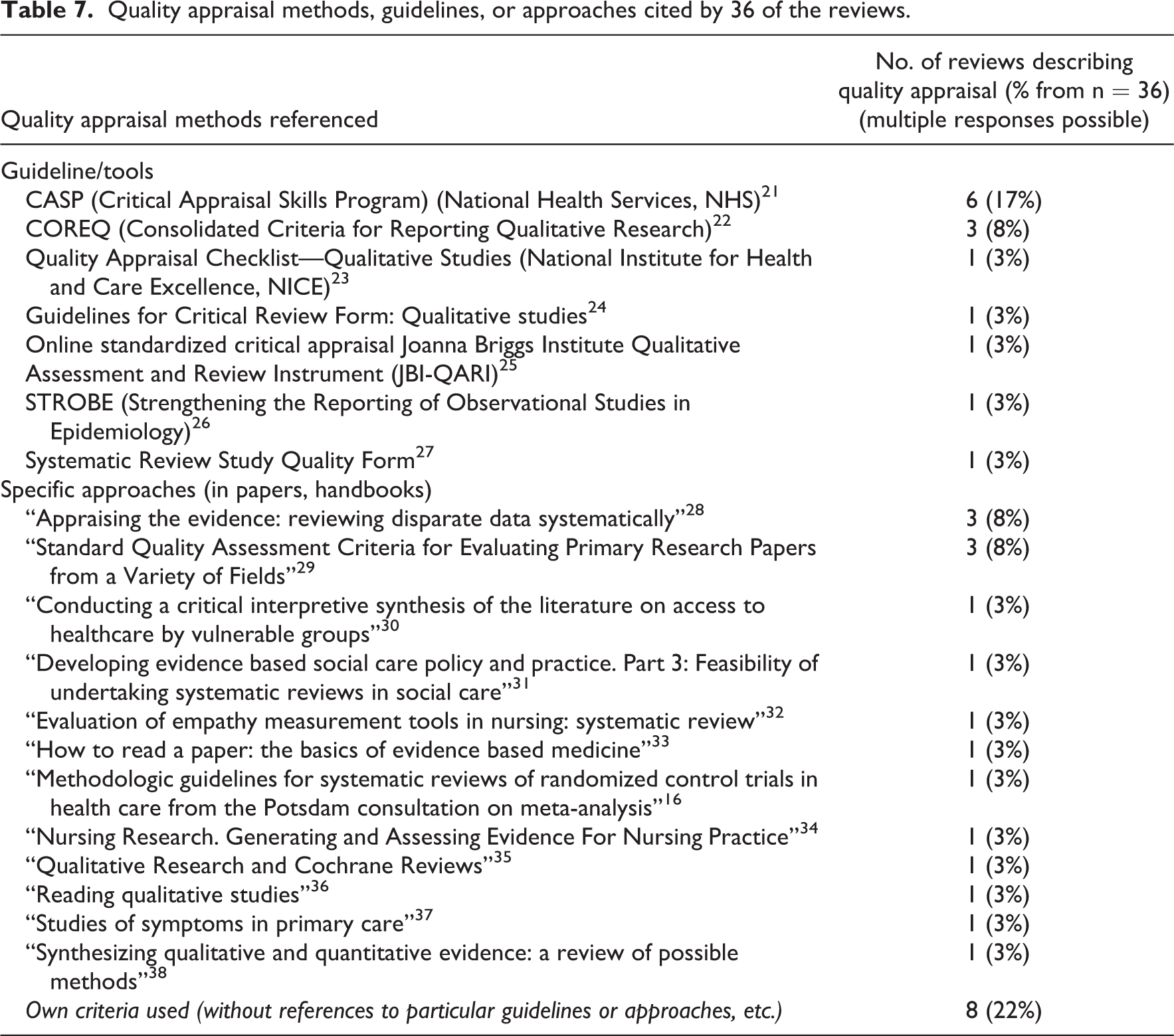
Of the 76 reviews, n = 39 (51%) included a statement regarding the quality or critical appraisal of the included studies. Although they included such a statement, three of these reviews did not provide references; neither did they describe their quality appraisal process. Of the remaining reviews (n = 36), 39% referred to guidelines or tools, 44% to specific approaches published in papers or book chapters, and 22% described their own criteria or methods (see Table 7).
Quality appraisal methods, guidelines, or approaches cited by 36 of the reviews.
Reporting quality
Of the 76 reviews, 18% referred explicitly to PRISMA for their reporting strategy (“PRISMA”-subgroup, blue pole in Figure 3) while 82% did not (“Non-PRISMA”-subgroup, red pole in Figure 3). Evaluation with the slightly adapted PRISMA checklist 4 showed that the PRISMA subgroup reported on average more comprehensively than the other group. In four categories, the difference between the PRISMA and the Non-PRISMA subgroups is over 30 percentage points, and more than 15 percentage points in another six categories (see Figure 3). The two main differences were (1) the title (66 percentage points), which according to PRISMA should explicitly refer to a “systematic review” and (2) the statement of the date/period of the search(es) (40 percentage points). The only exception was “statement of used search restrictions” where the Non-PRISMA subgroup had 18 percentage points more than the PRISMA subgroup (see Figure 3).
Generally, the reporting criteria were met differently not only in the former subgroups but also when considering the total amount of reviews (marked with a “T” (total) in Figure 3). For example, nearly all (n = 75, 99%) state the databases they used for literature search as well as the kind of information they sought (n = 74, 97%). However few reviews stated the theoretical approaches used to define the information (n = 10, 13%) or the synthesis method they applied (n = 18, 24%) (see Figure 3). Although most reviews (96%) reported the number of hits finally included, 74% reported the number of hits initially found (see Figure 3). Regarding the limitations statements, while 74% reported limitations of their review, 55% reported general limitations linked to the literature or database, and 24% reported limitations of each study included (see Figure 3).
While each of the selected reviews reported some item of the PRISMA reporting criteria, three of them gave no statements on one of the four major methodological steps (search = 1; analysis = 2) (see Figure 4). Notably the reporting of the selection process fulfilled all PRISMA criteria in 39% of the reviews selected in our study (see Figure 4).

Reporting criteria of the reviews: all or no criteria met in different method categories (n = 76).
Discussion
In our meta-review, we included 76 reviews, published between 1997 and 2017, that reviewed (i.e. searched, analyzed, and synthesized) empirical literature on specific bioethical topics. Systematic reviews of empirical literature are emerging (83% published in the last 10 years) and are represented in a variety of journals (76 reviews have been published in 51 different journals from 20 academic fields according to JCR). Nursing ethics currently plays a dominant role in this new field. Our results indicate that nursing (ethics) journals are the major publication organs (33%), first authors most prominently come from nursing departments (24%; 20 of 84 authors, see Table 2), and the topics addressed in the reviews are, in their large majority, explicit nursing issues (“ethical competence of nurses”) or closely associated with the nursing care (“ethics at the end of life”) (69% of the “clinical ethics” topics (n = 38, see table 3)).
However, the overall heterogeneity of our sample, further revealed by the variety of authors’ affiliations (n = 12), can be explained by the interdisciplinary nature of bioethics. Nevertheless, our meta-review unveiled some characteristics common to such reviews of the literature. These common features include authors’ number (groups of 2 to 4 wrote 70% of our sample) and authors’ professions (healthcare workers wrote 35% of the reviews and bioethicists or philosophers 16% of our sample). Further shared features include identifiability by the term “systematic review” or a comparable term in the title (46%); written by authors located in the United States, Canada, or the United Kingdom (48%); and topic related to a clinical-ethical issue (50%), especially the end of life (17%) and healthcare professionals’ “ethical competence” (15%). None of the information types extracted in the systematic reviews particularly stands out. However, the following six types (96%) were reviewed in similar proportions: attitudes or opinions (21%), influencing factors, experiences, instruments or tools, challenges/issues, or ethical reporting (15% each). Most of the selected reviews did not refer to established or published approaches for systematic reviews (79%) neither did they refer to reporting guidelines (82%). Still half of our sample mentioned some form of quality appraisal (51%). Most of the selected reviews included ethical reflections (71%) and more than half of them drew practice-oriented ethical recommendations from their analysis (59%).
That only about half (46%) of the selected reviews described themselves as a “systematic review” (see Figure 3) might in part depend on the acceptance of the method especially in journals of bioethics or the field of bioethics in general. However, it could also be influenced by the established perception of “systematic review” as a quantitatively oriented approach summarizing evidence related to health interventions, from which systematic reviews of empirical literature in bioethics depart. Also, in qualitative social research, there seems to be a tendency to give such literature reviews distinct names (such as “critical review,” “comparative review,” or “thematic synthesis”). 39 Nonetheless, one could have expected more reviews of empirical literature to identify themselves as “systematic reviews” as the method originally aims at finding and synthesizing empirical quantitative studies in a structured manner.
The dominance of clinical-ethical questions in the selection of topics, on the contrary, might not be so surprising given the background and affiliations of the authors. In addition, systematic literature reviews are only meaningful when there is actual scientific work available on a certain topic. As clinical-ethical topics such as “end-of-life decision-making” are very much discussed in the literature, they present a favorable ground to perform reviews.
The fact that most of the selected reviews included ethical reflections and/or recommendations may be important to distinguish them from reviews coming from other perspectives or fields such as sociology or psychology. Indeed, the latter type of studies may also include ethically relevant results but are not conducted with the
We could explain the fact that few reviews referred to established review methodology (21%) or to reporting guideline (18%) in two different ways. On one hand, the body of available guidance may be small or difficult to access. On the other hand, reporting a specific methodology for conducting systematic review may not be perceived as necessary because performing systematic reviews of empirical studies has become relatively common practice in contemporary research.
There is some truth to both points. One of the key strengths of a systematic review is its explicit orientation toward a methodology that ensures reproducibility and transparency. Referring to a given methodology may help authors to limit their description to deviations from standard procedures in order to focus on their particular issues. For reviews of empirical studies on bioethical topics, these specificities may include the ethical framing of the research question, the definition of information units, a way to analyze and synthesize information in order to facilitate an ethical assessment, or the incorporation of ethical reflections in the results. While such particularities need to be reflected upon in the methodological elaborations, they have not yet been sufficiently addressed in consented methodological and reporting standards. The lack of uniformity in the methodological and reporting standards already noticed 42 was confirmed in our meta-review in which a single reference for systematic review methodology was cited by a maximum of four reviews. So, this meta-review and the findings on systematic reviews of normative literature on bioethical topics 4,8 can serve as an inventory, providing a sound basis for discussion of best practice and reporting standards.
Finally, looking at the quality of reporting according to some selected PRISMA statements, it is striking that flowcharts are not yet common practice (51% of the reviews) (see Figure 3)—surprisingly even when the reviews referred to PRISMA (only 58% of those 14 reviews). The search is often not completely reproducible on the basis of the reporting (e.g. statement of date/period of search (38%) or statement of used search restrictions (60%), but at least 91% described the search terms or the search string (see Figure 3)). Nonetheless, it has to be noted that at least one of the criteria of the respective method categories (search, selection, analysis, and synthesis) was met by nearly all selected studies (see Figure 4). Compared to other studies that checked reporting quality according to PRISMA, it can be said that the introduction of PRISMA in 2009 has led to the improvement of the reporting quality, 43,44 and so does its explicit endorsement. 45 –47 The better reporting on average in the PRISMA subgroup versus the Non-PRISMA subgroups could be attributed to using the PRISMA checklist. However, we have to acknowledge that, in light of the small numbers of the subgroup analysis, this could also be a result of chance and it cannot be excluded that other causes might also have been relevant. On the whole, our results illustrate, once more, that reporting guidelines specific for reviews on bioethical topics would be useful, not only for systematic reviews of normative literature 8 but also for systematic reviews of empirical literature.
Systematic reviews of empirical literature versus systematic reviews of normative literature
A comparison of the results of this review on empirical literature with those of normative (including mixed) literature
4,8
shows differences and similarities. The sample (n = 84) of systematic reviews of
All systematic reviews (empirical, normative, and mixed) have in common that it is a new and emerging study type within bioethics (more than 80% published in the last 10 years) and that nursing is strongly represented both as academic field and as publishing journals. Differences (empirical vs normative and mixed) can be observed in the authors’ affiliations. There, for systematic reviews of normative literature, “Bioethics” was the leading category in total (29%), followed by “Medicine (26%) and “Nursing/AHP” (11%) (see Table 4 in Mertz et al. 2016). 4 For systematic reviews of empirical literature, “Medicine” is leading (18%), followed by “Nursing/AHP” (17%) and “Bioethics” (14%) (see Table 2). This, however, was expectable given that systematic reviews of normative literature are close to the traditional normative work of bioethics with one of its roots in philosophy. In contrast, reviews of empirical studies seem to be closer to traditional reviews and empirical disciplines such as medicine or nursing. As a hypothesis, it might additionally be that bioethicists are more inclined to conduct systematic reviews of normative literature and researchers from other disciplines, especially empirical ones, more inclined to conduct systematic reviews of empirical literature. These observations could also explain why systematic reviews of normative literature labeled themselves less often as “systematic review” (37%) compared to those of empirical literature (45%).
For quality appraisal, only 18% of the systematic reviews of normative literature reported about quality appraisal methods used in their review—another five authors (6%) explicitly wrote that they did no quality appraisal because of the lack of specific approaches. 8 In contrast, half of the systematic reviews of empirical literature reported quality appraisal (51%). Referring to reporting guidelines as a means for quality appraisal (such as, for example, COREQ or STROBE, see Table 7) can, however, be problematic, because the evaluation of the quality is restricted to the information that is actually reported, and does not necessarily reflect the overall study quality.
In general, the reviews of empirical literature reported their methodology more extensively than the reviews of normative literature (see Figure 3 and Figure 4 in this article, Table 6 in Mertz et al. 2016). 4 When comparing the report quality (systematic reviews of empirical vs normative and mixed literature), two aspects are particularly striking. First, systematic reviews of empirical literature score better on technical information, like “statement of used databases” (99% vs 93%) or representation of the search and selection procedure in a flowchart (51% vs 29%). Second, information that corresponds to the ethical dimension of the review was sparsely addressed by both groups. For example, “statement of procedure of (applying the) synthesis method” (24% vs 18%) or the theoretical background identification of the information unit (13% vs 21%). It has to be noted, though, that it would not be fair to equate “shortcomings in the reporting” automatically with “unworthy review.” Indeed, external constraints such as journal policies regarding article length may lead to the omission of some methodological information in the published article. However, evaluation of the quality of a review can only be based on what is actually reported. Notwithstanding this, the findings above allow drawing two conclusions: (1) current reporting guidelines, such as PRISMA, are more likely to be used by authors reporting on systematic reviews of empirical literature and (2) current reporting guidelines, such as PRISMA, do not yet sufficiently cover specific characteristics of reviews on bioethical topics and therefore should be adapted.
Limitations
A first limitation of this meta-review could be that it is based on the results of an initial search that primarily sought to find reviews of normative literature. Since the normative aspect of the literature could not be represented in search algorithms, the search had to be broadened to identify reviews on bioethical topics in general. The reviews so retrieved were then sorted manually into reviews of (1) normative/mixed and (2) empirical literature. The additional search we performed for the present study focused on reviews of empirical literature and, as expected, it was again necessary to search broadly and then select manually. Through this manual selection that was performed independently by two of the authors, we have actively tried to limit the potential bias in the selection process, making sure to consider thoughtfully each article retrieved for inclusion in the final analysis.
Second, and as in any study working with qualitative data, we had to sometimes paraphrase or synthesize authors’ comments for analysis purposes. We cannot deny that, in this process, we may both have missed some meaning or introduced our own interpretation of the data. The same way, in the synthesis process, we had to define our different categories and subsume the data in one of these categories. It has also to be acknowledged that there are sometimes fluid boundaries between the applied categories (e.g. the three types of ethical reflection: practical, normative, and theoretical implication). Therefore, these categorizations should be treated with some caution and might be better understood as providing “trend statements,” rather than be interpreted as exact descriptions. Furthermore, a possible resulting bias could be that we emphasized one aspect of the original findings over another one. To mitigate these possible risks, we have continuously worked as independent pairs of authors, that is, coding and synthesizing independently to then compare in order to reach a common decision. This way, we tried to make sure that our interpretation of the data was as close to the original text as possible.
Finally, it should be stressed that the conclusions of the status-quo analysis based on the reported information in reviews, for example, on “review methodology,” are only based on 16 statements (21% of the sample), which limits its significance.
Conclusion
Systematic reviews are an emerging study type for processing empirical data about ethically relevant topics. The heterogeneity currently observed is partly due to the interdisciplinary nature of bioethics, and partly due to the emerging nature of this research in the field of bioethics. The latter could also indicate the need to develop robust methodological standards. The prominent role played by nursing in reviews of normative literature can also be confirmed for reviews on empirical literature. Discussions about best practice or minimum standards are also needed for both types of reviews in the field of bioethics. The interest we appear to see in the nursing community for systematic reviews of ethics literature should resonate in a similar interest in refining its methods and discussion standards. The lack of an adapted reporting guideline also constitutes a barrier for the further development of this research method. The awareness of the importance of reporting quality should be further strengthened, so that health professionals, policy makers, and bioethicists themselves have an optimal information basis for their results’ interpretation as well as for their future research plans. We can reasonably expect that such methodological developments would result in reviews thoroughly systematic, increasingly valid and ultimately more meaningful. In turn, such high-quality reviews would be expected to positively impact (nursing) practice, may it be through better identification of ethical issues or improved dealing with these challenges.
Supplemental material
Supplemental Material, S1_-_Full_list_of_included_reviews_of_empirical_literature_on_bioethical_topics - Systematic reviews of empirical literature on bioethical topics: Results from a meta-review
Supplemental Material, S1_-_Full_list_of_included_reviews_of_empirical_literature_on_bioethical_topics for Systematic reviews of empirical literature on bioethical topics: Results from a meta-review by Marcel Mertz, Hélène Nobile and Hannes Kahrass in Nursing Ethics
Supplemental material
Supplemental Material, S2_-_Extended_Method_Description - Systematic reviews of empirical literature on bioethical topics: Results from a meta-review
Supplemental Material, S2_-_Extended_Method_Description for Systematic reviews of empirical literature on bioethical topics: Results from a meta-review by Marcel Mertz, Hélène Nobile and Hannes Kahrass in Nursing Ethics
Supplemental material
Supplemental Material, S3_-_Coding_Matrix - Systematic reviews of empirical literature on bioethical topics: Results from a meta-review
Supplemental Material, S3_-_Coding_Matrix for Systematic reviews of empirical literature on bioethical topics: Results from a meta-review by Marcel Mertz, Hélène Nobile and Hannes Kahrass in Nursing Ethics
Footnotes
Acknowledgements
Conflict of interest
Funding
ORCID iD

Supplemental material
References
Supplementary Material
Please find the following supplemental material available below.
For Open Access articles published under a Creative Commons License, all supplemental material carries the same license as the article it is associated with.
For non-Open Access articles published, all supplemental material carries a non-exclusive license, and permission requests for re-use of supplemental material or any part of supplemental material shall be sent directly to the copyright owner as specified in the copyright notice associated with the article.
