







Abstract
Introduction
Workplace stress has escalated significantly in recent years due to the compounded effects of the COVID-19 pandemic, growing economic and social pressures, and increasing technological fatigue. These challenges have led to a noticeable decline in employee well-being, contributing to rising levels of anxiety, job burnout, and emotional exhaustion (Allgood et al., 2024; Lim et al., 2024; World Health Organization, 2022). Recent evidence also shows that AI-driven job insecurity and hybrid work changes have amplified EE among employees across multiple sectors (Lanchimba et al., 2025; Zheng & Zhang, 2025). Burnout, as originally defined by Maslach and Jackson (1981), is the result of chronic, unresolved occupational stress. Recognizing its severity, the World Health Organization (2019) classified burnout as an “occupational phenomenon” in the 11th revision of the International Classification of Diseases. Among the components of burnout, emotional exhaustion (EE) is widely regarded as the core dimension, characterized by a depletion of psychological and emotional resources in response to sustained occupational demands (Maslach et al., 2001; Yavas et al., 2008).
EE encompasses persistent feelings of energy depletion and emotional fatigue, often arising from continuous exposure to intense psychological stressors (Chen & Chen, 2012; Kim et al., 2009). It is typically the first and most prominent manifestation of burnout, preceding both behavioral and affective dysfunctions (Cordes & Dougherty, 1993; Grobelna, 2021; Maslach & Leiter, 2017). As such, a deeper understanding of the emotional and physical fatigue experienced by frontline employees, and its organizational implications, is critically important (Saleh et al., 2023). This issue has gained prominence among scholars and organizational leaders alike, particularly in the context of public health crises, where EE intersects with phenomena such as compassion fatigue and change fatigue (Beaulieu et al., 2023; Chaves-Montero et al., 2025; Orgambídez et al., 2025). Moreover, EE has been linked to turnover intentions and diminished business performance across sectors, including health care, SMEs, and social work, underscoring its widespread economic and organizational impact (Chaves-Montero et al., 2025; Lanchimba et al., 2025; Zhang et al., 2025). Presently, excessive workloads, coupled with entrenched structural challenges, such as understaffing, rotating shifts, voluntary overtime, and erratic schedules, have contributed the pervasive nature of EE in modern workplaces (Woo et al., 2020).
EE is a widespread and largely unavoidable condition that affects employees at all organizational levels, from frontline staff to top management (Ejaz et al., 2025; Saleh et al., 2023). It often emerges in emotionally charged work environments where the psychological demands placed on individuals exceed their capacity to cope (Ducharme et al., 2007; Xu et al., 2017). Moreover, EE is a key antecedent to a range of counterproductive workplace behaviors, including incivility, aggression, deviant behavior, cyberloafing, and even violence (Liu et al., 2023; Wong et al., 2023). Recent research also highlights that toxic leadership, job insecurity, and lack of organizational justice exacerbate these effects, particularly in nursing and education sectors (Ahmed et al., 2024; Lim et al., 2024; Zhang et al., 2025).
From the employees’ perspective, EE is associated with a variety of physical health issues, such as frequent colds, gastrointestinal problems, sleep disturbances, headaches, fatigue, emotional depletion, and heightened irritability (Belcastro, 1982; Khan et al., 2014). It may also manifest in psychological distress, including depression, anxiety, and anger, which can, in extreme cases, lead to maladaptive coping mechanisms such as substance abuse and dependency (Burke, 1987; Kahill, 1988; Pines & Maslach, 2006). Emotionally exhausted individuals often describe a profound sense of depletion, expressing that they feel as though they have “no energy left” or are “at the end of their rope” (Schaufeli & Enzmann, 1998). The timely recognition of these symptoms is essential not only for safeguarding individual well-being but also for maintaining organizational health and performance (Cherniss, 1980; Cordes & Dougherty, 1993).
Considering the extensive psychological, physiological, and organizational consequences of EE, it is imperative to synthesize existing knowledge and identify emerging patterns within this expanding field of inquiry. Despite a surge of studies in 2024–2025 on digitalization, leadership, and moral distress as drivers of EE, the literature remains fragmented and often industry-specific (Chaves-Montero et al., 2025; Orgambídez et al., 2025; Zheng & Zhang, 2025). Consequently, this study undertakes a comprehensive bibliometric analysis to uncover the dominant research trends, thematic concentrations, and collaborative structures shaping the EE discourse. By mapping the evolution of scholarly contributions, this research aims to provide a consolidated knowledge base and a forward-looking research agenda for academics and practitioners seeking to address the escalating challenges of EE in contemporary workplaces.
The Rationale of the Study
While EE has garnered increasing scholarly attention in recent years, a consolidated and systematic understanding of its knowledge structure remains absent. Much of the existing research has been conducted through systematic literature reviews (Chaves-Montero et al., 2025; McFarland & Hlubocky, 2021; Orgambídez et al., 2025; Seidler et al., 2014) and meta-analyses, often focusing on specific occupational groups such as health care workers and educators (Edmondson et al., 2019; Kenworthy et al., 2014). More recent studies have also highlighted the rising impact of EE in the context of hybrid work models, digital transformation, and post-pandemic workplace stress (Lim et al., 2024; Zheng & Zhang, 2025). However, these studies remain fragmented and largely sector-specific, making it difficult to obtain a holistic view of the field.
Bibliometric studies have similarly addressed broader constructs such as burnout and mental fatigue but have seldom examined EE as a distinct research domain (Cecilia-Martín et al., 2020; Chen et al., 2023; Rua et al., 2023, pp. 119–149). As a result, there remains a notable gap in understanding the intellectual foundations, evolving themes, and social dynamics that shape EE research. This study aims to address these gaps by conducting the first dedicated bibliometric analysis of EE. In contrast to previous efforts, which often lack a cross-disciplinary perspective or fail to capture the field’s temporal development, this research provides a comprehensive mapping of EE’s publication trends, influential contributions, collaborative networks, and thematic clusters. By focusing on both the intellectual structure (key theories, concepts, and knowledge flows) and the social structure (author collaborations, institutional and country-level partnerships), the study offers a more integrated view of the field. It not only synthesizes past research but also identifies dominant themes and emerging research fronts, offering a strategic agenda for future inquiries. Ultimately, this study responds to the growing need for a cohesive framework to guide scholars, practitioners, and policymakers in addressing the increasing prevalence of EE in contemporary workplaces.
What are the annual publication and citation trends in EE research?
What are the most influential articles and journals in this field?
What are the intellectual and social structures in the area?
What are the key themes and possible avenues for future investigation in this area?
Methodology
This study employed bibliometric techniques to map the landscape of research on EE. Bibliometric analysis offers valuable insights into the evolution of academic domains, considering their intellectual, social, and conceptual dimensions (Zupic & Čater, 2015). Scopus and Web of Science (WoS) are among the most widely used databases for bibliometric research due to their broad disciplinary coverage (Waltman, 2016). Based on the recommendations of Donthu et al. (2021) and Mikul and Mittal (2024), this study relied on a single, appropriate database to avoid the complexities of data consolidation and reduce the potential for human errors. Data from Scopus were chosen for this analysis because it includes a wider range of subject areas and categories than WoS, making it ideal for aggregating extensive collections of documents from reputable academic journals, especially in emerging research domains (Paul et al., 2021). Formulating a well-defined search query is critical to bibliometric analysis, as it ensures clarity, reproducibility, and precision (Khatib et al., 2023). In this study, the search query emotional exhaustion (EE) was entered in the “Article Title, Abstract, and Keywords” section of the Scopus database. The analysis was limited to articles published in the subject areas of “Business, Management, and Accounting,” “Psychology,” and “Social Sciences.” The study covered publications from 1978 to 2024, aligning with the emergence of significant works on EE. To maintain a high standard of review, we excluded conference papers, book chapters, and other forms of “gray literature,” focusing solely on peer-reviewed journal articles and reviews. The search was conducted on April 21, 2024, to ensure that the most recent data from Scopus were captured without introducing bias from ongoing updates. This initial search resulted in 3,667 articles. The next step involved filtering out articles published in 1979 and 1980, as no relevant articles on EE were found in those years. After this filtering, we reviewed article titles, keywords, abstracts, and full texts to ensure the inclusion of only the most relevant works. Bibliometric methodologies can be categorized into two main types: (a) performance analysis, which assesses the roles of various research components, and (b) science mapping, which focuses on the relationships among these components (Mikul & Mittal, 2023). To perform the analysis, we used the Biblioshiny package in R (Aria & Cuccurullo, 2017) and the interactive mapping features of VOSviewer (van Eck & Waltman, 2010). The research framework is presented in Figure 1.
Framework of the Research Design.

Results
Performance Analysis
Chronological Publication Trends
An annual trend analysis of EE research, examining both the volume of publications and their influence (RQ1) from 1978 to 2024, is illustrated in Figure 2. The number of publications has risen dramatically, from just one in 1978 to 439 in 2023. The heights of the rectangular bars in the figure represent the total number of publications, which amounts to 3,667. The influence, indicated by yearly citations, is depicted as a “zigzag” line. Between 1978 and 1992, the number of published studies was relatively low. However, 2023 recorded the highest number of publications, with 439. The trend equation in Figure 2 reflects significant growth in this research area, with a high model fit (
Chronological Publication Trends.

Citation Structure
Throughout the data set (see Table 1), a total of 151,971 citations were recorded, with an average of 6,128 citations per year, translating to an annual average of 241.53 citations. The
Citation Structure.

Most Active and Influential Journals
The identification of leading journals in EE research (RQ2) is essential for understanding the dissemination and influence of EE-related studies. Table 2 provides an in-depth review of the top 10 journals in this field, highlighting their bibliometric characteristics. Notably,
Leading Journals.

The values presented in bold indicate the highest values within the respective categories.
Most Influential Works
Examining the most influential works in the field of EE (RQ2) is vital to understanding the scholarly contributions that have shaped the research landscape. Table 3 presents the top 10 EE-related articles, highlighting key citation metrics that indicate their academic impact. The study by Maslach and Jackson (1981) is the most cited article with a total citation count (TC) of 7,089, as well as the highest citation density (CD: 164.86), reflecting its enduring relevance. The article also received 265 citations in 2024 (CCY) on Scopus, and it has garnered 24,321 citations on Google Scholar (CGS), further attesting to its wide reach. In contrast, Lee and Ashforth (1996) demonstrated substantial influence through their meta-analysis, which has accumulated 1,887 citations in Web of Science (CWoS). Their work also highlights demand–resource correlates as more closely tied to EE than to other burnout dimensions. The citation metrics, including FWCI and citation counts from multiple platforms, such as Google Scholar and Web of Science, underline the varying citation patterns across databases, with Google Scholar showing a broader citation distribution. Notably, the correlation between Scopus and Web of Science citations (
Top Cited Articles.

The values presented in bold indicate the highest values within the respective categories.
Science Mapping
Bibliographic Coupling Analysis
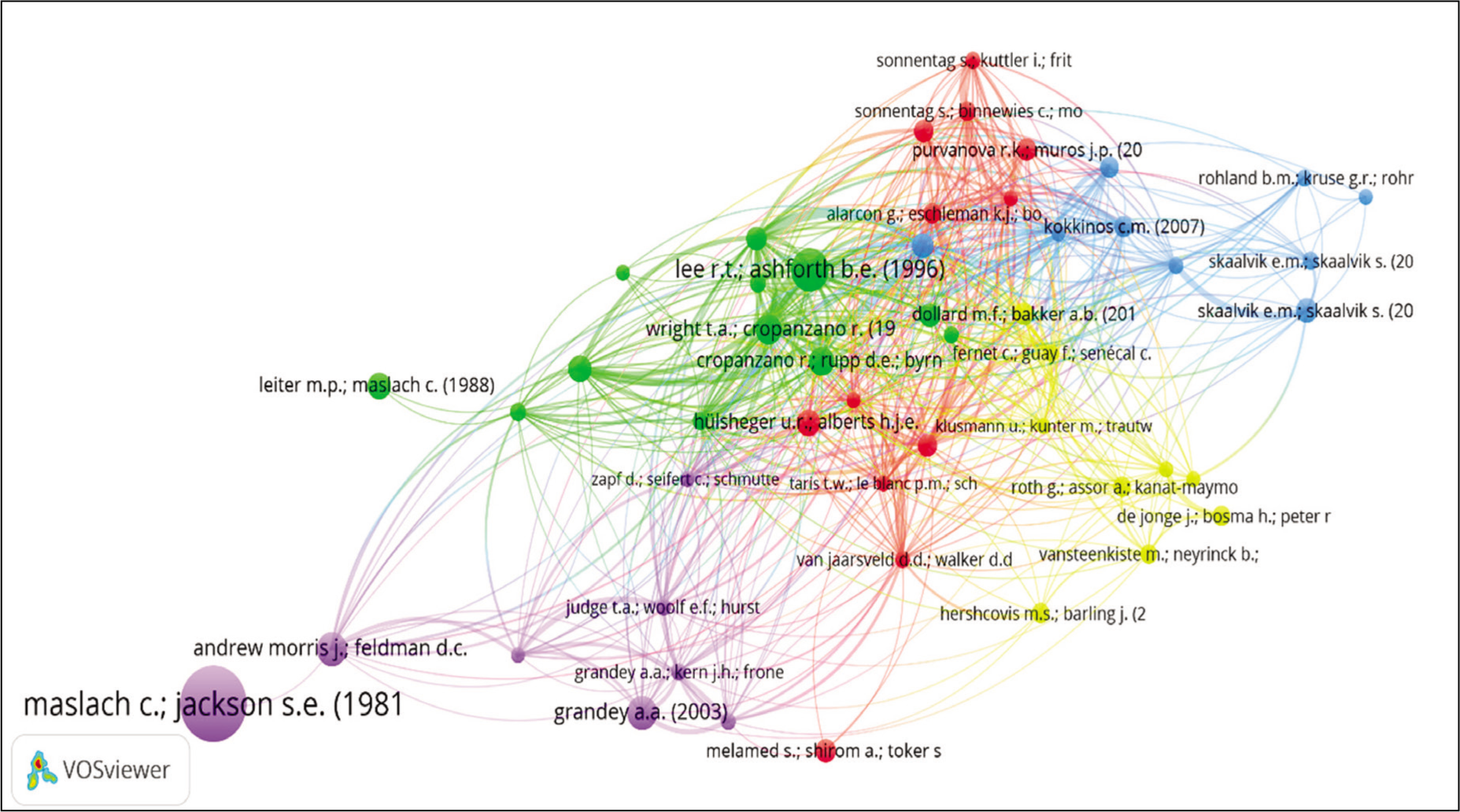
Bibliographic coupling occurs when two documents cite the same references, indicating conceptual similarity (Jain et al., 2021; Zainuldin & Lui, 2022). This method helps uncover thematic connections and the intellectual structure of a field (Koseoglu, 2016). In the context of EE research, bibliographic coupling was employed to identify knowledge clusters. Applying a minimum citation threshold of 280, five distinct clusters were identified, comprising 50 articles with a total link strength (TLS) of 1,108 (see Figure 3).
Bibliographic Coupling Analysis.
Co-authorship Analysis
Co-authorship analysis identifies collaboration patterns and social structures among researchers in a given field (Donthu et al., 2020). The growing methodological and theoretical sophistication in research has encouraged greater academic collaboration (Acedo et al., 2006). Analyzing these collaborations, including key attributes such as author affiliations and countries, offers insights into the intellectual landscape of a domain (Donthu et al., 2021). As co-authorship reflects stronger social ties than other bibliometric connections, it serves as a valuable metric in social network analysis (Zupic & Čater, 2015). To examine the collaborative structure of EE research (RQ3), a co-authorship network was generated, displaying countries with at least 14 co-authored publications (Figure 4).
Co-authorship Network of Countries.

Out of 162 countries, 44 met the inclusion threshold, forming a co-authorship network of five clusters interconnected by 375 links, with a TLS of 1,360. Country clusters were color-coded based on the similarity of their collaborative patterns. The United States, positioned within the purple cluster, emerged as the most influential node, with 41 connections and a TLS of 365. Notably, the strongest edge in the network links the United States and China (green cluster), reflecting intensive academic collaboration, particularly in higher education. China follows as the second most central node, with 31 connections and a TLS of 252. The red cluster, dominated by European countries such as the United Kingdom, Belgium, the Netherlands, and Sweden, represents the largest grouping, underscoring strong intra-European cooperation. The blue cluster includes Italy, Poland, Turkey, India, and Nigeria, illustrating cross-regional research ties beyond political boundaries. Spain, within the yellow cluster, stands out for its high productivity and collaborative intensity. The fifth cluster, also purple, features advanced economies including Australia, Austria, Singapore, and South Korea, highlighting their global influence in academia, trade, and technology. Smaller nodes across all clusters suggest untapped potential for expanding international collaboration.
Co-word Analysis
Co-word analysis is a content analysis technique that leverages the terminology used in texts to identify conceptual linkages and develop a thematic structure within a research domain (Callon et al., 1983). This method commonly employs “author keywords,” where the frequent co-occurrence of terms signifies a relationship between the underlying concepts (Zupic & Čater, 2015). To address RQ4, we conducted a co-word analysis to identify the major themes associated with EE. The analysis utilized all author keywords that appeared together at least 25 times, resulting in a simplified yet meaningful network. Out of 6,251 keywords, only 61 met this threshold. The resulting co-occurrence network, depicted in Figure 5, comprises 835 links with a TLS of 4,058 and reveals five distinct thematic clusters.
Co-occurrence Network of Keywords.

Implications
Theoretical Implications
This study contributes significantly to the theoretical understanding of EE by integrating key theories such as the JD-R model, SDT, COR theory, and emotional labor theory. By employing these frameworks, the study explores the complex relationship between work-related psychological well-being factors, such as burnout, anxiety, depression, and occupational stress, and their role in both contributing to and alleviating EE. It highlights how antecedents such as work–family conflict, perceived organizational support, role conflict, and job satisfaction directly influence EE, while consequences such as turnover intentions, organizational commitment, job performance, and life satisfaction are explored in depth. The research also sheds light on the critical role of coping resources, such as leadership, mindfulness, and well-being initiatives, in reducing EE. Furthermore, the study explores the influence of interpersonal dynamics at work, such as emotional intelligence, emotional labor, and emotional dissonance, and how they act as significant predictors of EE. This research highlights how organizational structures, leadership practices, and resource management can either exacerbate or mitigate EE, emphasizing the importance of developing tailored strategies for reducing EE in different professional contexts, particularly in high-stress sectors such as education and health care. The study also underscores the need for more targeted interventions, such as fostering emotional regulation and resilience among employees, to prevent burnout and improve overall workplace well-being. Overall, this research broadens the scope of existing EE literature by applying these diverse theoretical frameworks to understand and manage EE more effectively across different industries.
Practical Implications
This research, while rooted in scientometrics, provides significant practical implications for management, organizational leaders, and HR professionals aiming to mitigate EE in the workplace. To effectively address EE, organizations must adopt a comprehensive, proactive approach that integrates both preventive and corrective strategies. First, creating a supportive environment is critical. Job redesign, stress-reduction initiatives, and leadership support are essential in reducing job-related stress and EE. Proactive mental health care, such as offering employee assistance initiatives (EAIs), on-site counseling, virtual therapy, and mental health awareness programs, can further help employees manage the psychological demands of their roles. Second, organizations should focus on enhancing emotional intelligence among employees through training programs. This can be complemented by fostering a workplace culture with transparent communication, mindfulness practices, resilience workshops, and access to mental health resources. Implementing flexible work schedules and promoting work–life balance are also vital strategies that enable employees to manage their time and reduce stress.
Third, recognizing and valuing both individual and team accomplishments helps boost morale and motivation. Regular check-ins with employees to monitor stress levels and workload are necessary for maintaining employee well-being and ensuring clear role expectations, which foster a sense of purpose and reduce exhaustion. Fourth, organizations should cultivate a workplace where employees can express their emotions authentically, minimizing emotional dissonance. Reducing pressure to conform to inauthentic emotional expressions lessens EE. Aligning tasks with employees’ skills and career aspirations, while managing workloads effectively, ensures that employees feel valued and supported in their roles. Finally, implementing training on workplace dispute resolution enhances employees’ ability to handle interpersonal conflicts, ultimately reducing EE and fostering a cooperative team environment. By adopting these strategies, organizations can not only mitigate EE but also improve overall job satisfaction, productivity, and employee well-being.
Discussion and Conclusion
This study offers a comprehensive scientometric analysis of the EE research landscape by examining 3,667 articles published between 1978 and 2024, accumulating a total of 151,971 citations. The analysis reveals the increasing academic interest in EE, evidenced by a ‘compound annual growth rate’ (CAGR) of 21% in publications. The United States and China emerged as dominant contributors, underscoring the global recognition of EE as a pressing issue in today’s workplaces. By applying bibliometric techniques such as bibliographic coupling, the study identified five core research clusters: (a) psychological and behavioral factors, (b) mediators related to the literature on EE, (c) causes of EE in teaching and health care professions, (d) emotional labor and its relations with EE, and (e) psychosocial work stressors and coping resources. These clusters collectively capture the multifaceted and interdisciplinary nature of EE research. The leading journals,
The study also highlights key thematic areas gaining momentum in the field, such as psychological well-being, antecedents and consequences of EE, contributors and mitigators of EE, and emotional and interpersonal dynamics at work. Co-authorship analysis reveals strong international collaboration, particularly between scholars in the United States and China, opening avenues for more nuanced cross-cultural investigations. From a practical standpoint, the findings emphasize the importance of comprehensive organizational interventions. Strategies such as emotional intelligence training, stress management programs, mental health support, and work–life balance initiatives are essential in mitigating EE. Additionally, recognizing the influence of emotional labor and interpersonal stressors can inform more empathetic and supportive workplace practices. Clear job roles, fair workload distribution, and conflict resolution training are crucial to fostering healthier and more resilient work environments.
This study’s outcomes also open opportunities to link EE with other related topics from an industry perspective. Understanding how EE interacts with employee engagement, job satisfaction, retention, productivity, and workplace innovation is highly relevant for industries such as health care, education, information technology, manufacturing, hospitality, and customer service, where high job demands and interpersonal interactions often intensify emotional strain. EE has been shown to lead to absenteeism, lower service quality, and increased turnover, all of which directly impact organizational performance and profitability. Future research could adopt sector-specific approaches by comparing how EE manifests across industries and examining whether certain job characteristics (e.g., shift work, customer-facing roles, or high-stress environments) amplify its effects. There is also significant scope to explore how EE connects with emerging workplace challenges such as hybrid/remote work models, the integration of AI and digital tools, and increasing mental health risks in fast-paced industries. Further, EE can be studied alongside related organizational constructs such as leadership styles, organizational culture, diversity and inclusion initiatives, and occupational health policies to generate actionable insights for managers. Linking bibliometric findings with industry-focused case studies, longitudinal surveys, or mixed-methods research would strengthen the practical relevance of EE scholarship. Such work could help organizations design more targeted interventions, improve employee well-being, and build more resilient and sustainable workplaces across sectors.
In addition to presenting the theoretical foundations of EE research, this study underscores the importance of mapping its future trajectories. A content analysis of documents from the five bibliographic clusters revealed critical gaps and unresolved questions within the field. This informed the development of a structured research agenda addressing RQ4, future directions in EE research. By integrating insights from recent trends and emerging themes, this agenda outlines several promising avenues for scholarly exploration (see Table 4 for future directions). In conclusion, EE remains a complex and evolving challenge in organizational life. This study contributes meaningful insights to the academic literature and offers practical guidance for managerial action. By continuing to investigate the psychological, emotional, and contextual dimensions of EE, and by implementing thoughtful interventions, researchers and practitioners alike can work toward reducing its impact and fostering more sustainable work environments.
Intellectual Structure and Research Avenue.


Limitations and Future Direction
While this review provides valuable insights into EE, a few limitations should be acknowledged. First, the analysis was based only on the Scopus database. Although we removed duplicate and retracted articles, relying on a single source can result in coverage gaps. Future research could include additional databases such as Web of Science and Google Scholar to broaden the coverage and ensure a more comprehensive view of the field. Second, we focused only on a defined set of keywords related to EE. This approach may have excluded studies using related terms such as “mental exhaustion,” “emotional fatigue,” or “compassion fatigue.” Future work could broaden the search terms and even include studies published in other languages to capture a wider body of work.
Third, certain publication types, such as conference papers, books, and dissertations, were excluded. Although this ensures a more consistent quality of sources, it may leave out fast-moving or practice-oriented research. Including this gray literature in future reviews could provide a fuller picture of the field. Fourth, bibliometric indicators such as citation counts have inherent limitations. Highly cited papers are not always the most methodologically sound or relevant, and emerging studies may be underrepresented simply because they have had less time to accumulate citations. Future studies could combine bibliometric measures with peer-assessed quality indicators or altmetrics to balance these effects.
Fifth, the study relied mainly on bibliographic coupling for science mapping. Different techniques, such as co-citation or keyword co-occurrence analysis, might highlight different relationships. Future research could compare and combine these methods to gain deeper insights. Finally, this study provides a broad overview and does not focus on sector-specific applications. Future researchers could analyze EE trends within particular industries, such as health care, education, IT, or manufacturing, and link these findings to industry practices. Combining bibliometric analysis with interviews, surveys, or meta-analyses could also help translate research into actionable strategies across industries and regions.