







Abstract
Introduction
Coronavirus is a deadly, infectious and fast-spreading virus that was first observed in Wuhan, China in late 2019, and by March 2020, it had spread globally claiming over 130,000 lives and infecting over 2 million people as of 15 April 2020. As the search for a remedy is on, each country is trying to contain the spread of the virus in its own way. The fight against coronavirus disease 2019 (COVID-19) seems worse than a war. Wars bring friends closer and rev up the economy and employment. In contrast, coronavirus has led to social distancing, restrictions on trade and immigration, lockdown of the economy and a global recession. It has disrupted supply chains, overwhelmed healthcare systems and even prompted ‘hijacking’ of medical supplies meant for allies.
Many countries shut their economies to bring about social distancing to contain the virus and to reduce the peak load on the healthcare system. According to Lewnard and Lo (2020), ‘In the absence of any pharmaceutical intervention, the only strategy against COVID-19 is to reduce mixing of susceptible and infectious people through early ascertainment of cases or reduction of contact’. India did well in declaring a national lockdown: it saved lives, helped flatten an exponentially rising COVID-19 incidence curve, and contained demand for medical services. India’s move compares well with the halting response of the USA, which had the highest number of cases (more than 600,000) and deaths (more than 28,000) as of 15 April 2020. India by this date had about 12,000 cases and 400 deaths.
1
As per
The price of a national lockdown as a means to contain the infection, COVID-19, is high, as measured by mass unemployment, potential bankruptcies, large government deficits, stress on banks and businesses, isolation of the people, mental health issues, violence and abuse, suicides, desolate funerals and growing political disputes between and within nations. In a matter of weeks, the world trade and stock markets fell off the cliff, travel is at a standstill and markets for goods and services are in turmoil. In India, the virus coupled with economic inequality has tormented the poor living in crowded conditions with limited medical insurance or savings. The consequences for migrant labourers who lost their jobs are harsher (see Chadha, 2020)
2
See
Current Scenario
Corrective actions are being undertaken by innovative organisations. For instance, social distancing requires new ways to deliver services such as education, healthcare, retailing, travel and entertainment. Even industrial and agricultural production may require significant adjustments. Firms, driven by their motive to survive and compete, are doing their part. There would be a tendency towards increased automation, and thus the size of the firm. Already newspapers have TV spots to persuade readers that printing is automatic and safe. Technology firms have enhanced their web applications to enable video conferencing. Educational institutions have adopted web-based software to conduct classes. Communication on social media has grown. Other organisations may follow suit as consumers worry about contamination.
Governments across the world are taking corrective actions to stem the spread of the virus. Governments, research organisations, foundations and private companies are rushing their R&D efforts to find a remedy. Meanwhile, test kits are being arranged to isolate infected individuals, funds are earmarked to sustain the people and the economy and countries have introduced incentives for firms to retain employees on their payrolls. India too has acted to support its citizens but has been shy on several counts: test kits (mentioned above), budgetary allocation, employee retention schemes and ensuring food for the poor. In its fight against the virus, India has allocated about US$22 billion, which is less than 1 per cent of its GDP. This compares with more than 12 per cent of the GDP for USA, 15 per cent for UK and 20 per cent for Japan.
3
See
“the biggest worry right now, by far, is that a huge number of people will be pushed into dire poverty or even starvation…That is a tragedy in itself and, moreover, opens up the risk that we see large-scale defiance of lockdown orders—starving people, after all, have little to lose.”
The Indian Situation
Presently, India is still debating when to open its economy. While the lockdown is extended by over 2 weeks to 3 May 2020, discussion to open unaffected areas is ongoing. A rolling lockdown—a region-wise opening and shutting the economy based on a well thought out criteria—may offer the path ahead till a remedy to the virus is found. This article offers a framework that considers the various factors relevant to the decision. The framework applies not only at the national, but also at state and district levels.
Three points deserve special mention at this moment. First, the choice is between (a) national (or state-level) lockdown and (b) local lockdown of identified hotspots probably coupled with Bhilwara,
5
See
Second, the purpose of lockdown is to introduce social distancing to control the spread of the virus. If the population density is so low that social distancing is easy (e.g., in remote villages) or so high that social distancing is
Third, when the information about the spread of the virus is meagre, uniform distribution applies and the entire nation is locked down, it is kind of a shot in the dark. When reliable information to pinpoint hotspots is available, a stronger case for a local lockdown exists. To avoid national lockdown, testing is required to isolate the infected (including asymptomatic) individuals
Coronavirus Cases, Deaths and Tests in Selected Countries as on 15 April 2020

India looks relatively good with respect to the number of confirmed cases (columns 2, 5) and deaths (columns 3, 6). India registered 9 cases of infection per million and 0.3 deaths per million till 15 April 2020. The good news is partly offset by relative lack of testing. India’s 177 tests per million (col. 7) is pale in comparison with 9,575 for USA. It probably constrained India to adopt national lockdown because local lockdown requires granular data. Column 6 shows Germany, with 43 deaths per million, has done better than the USA (83), and much better than Spain (402) and Italy (358). South Korea attained remarkable success (4) without shutting down its economy.
A Framework for Analysis
The analysis below offers a framework wherein the costs and benefits associated with shutdown and ailments (infection) are simultaneously considered. The framework brings together multiple factors that affect the choice between nationwide and localised shutdown.
The model presented in Figure 1 is conceptual. It attempts to show how to think about the problem. The
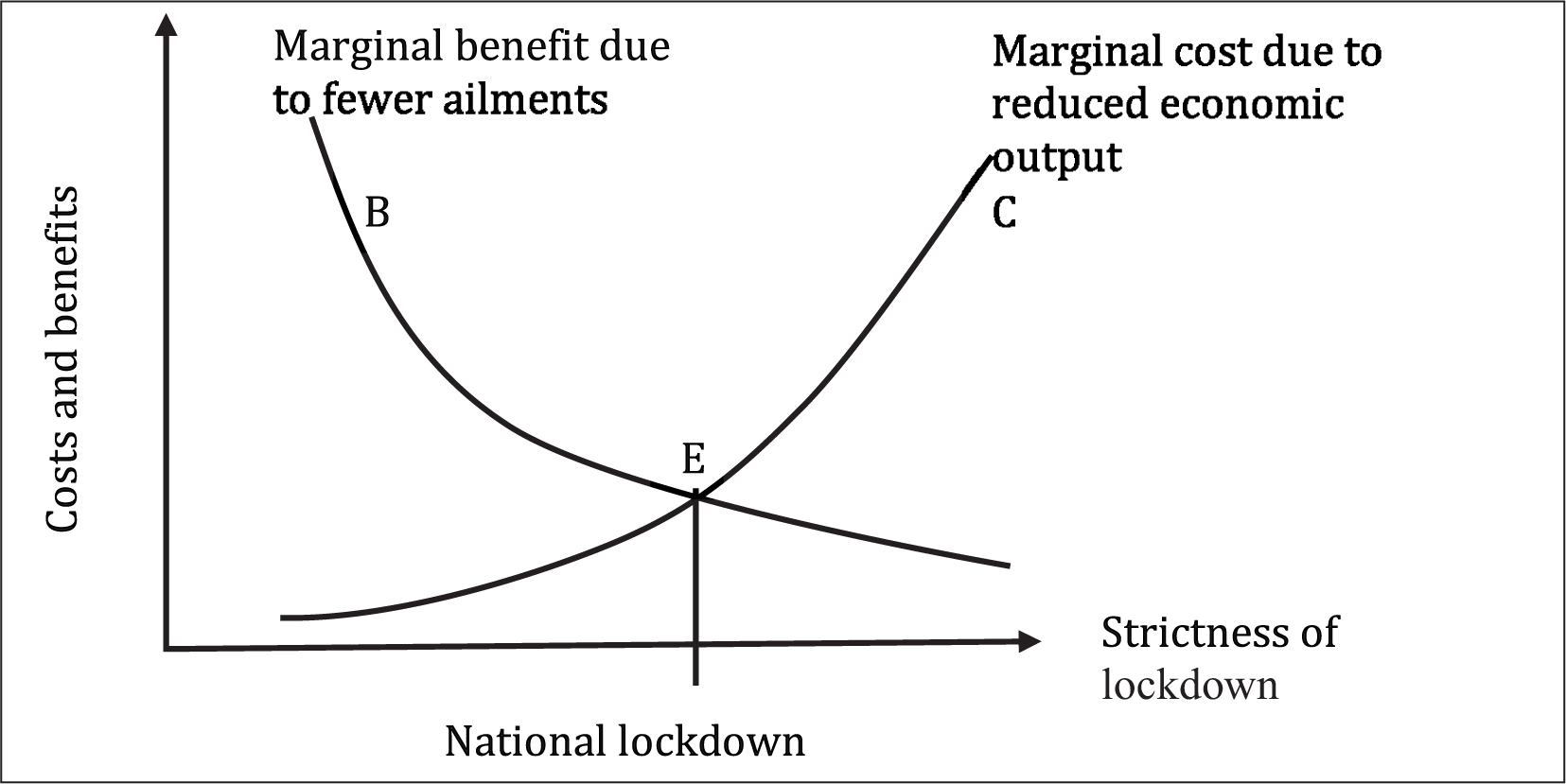
At any level of lockdown, MB is from ailments prevented and MC is from reduced economic output plus the cost of enforcing the extra unit of lockdown. It is assumed that as the strictness of lockdown increases, the MB declines and MC increases. Thus, a stricter lockdown prevents ailments, but after a point, at a diminishing rate. The cost increases at an increasing rate; a strict shutdown of essential services would be very costly indeed. The optimum level of lockdown is where MB = MC,
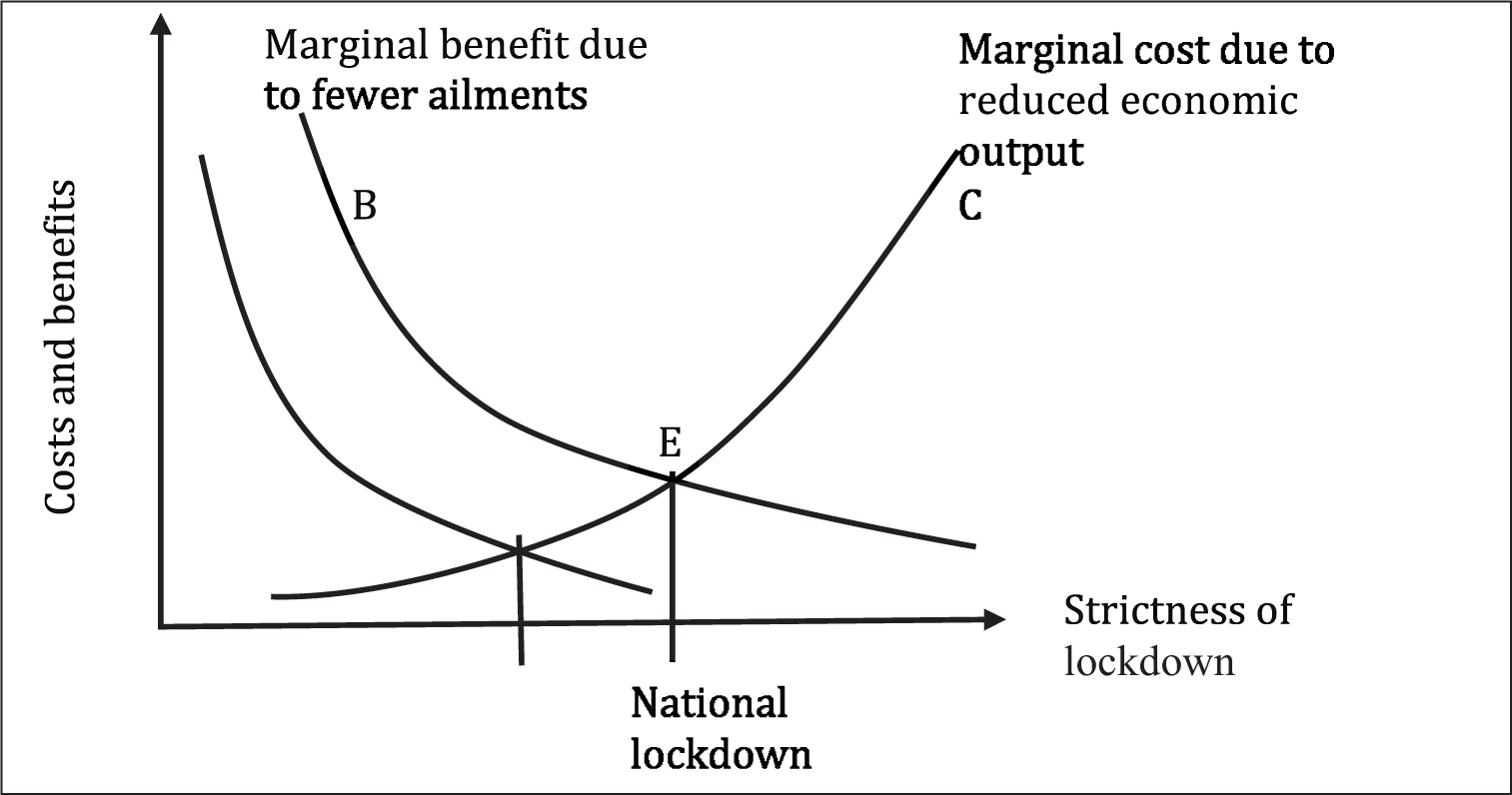
Note that a shift of the MB curve to the left (and down) means that at any given level of lockdown, the MB is lower. This could be because of the population density as discussed earlier. If the population density were very low as in a remote village, then its MB at B from any level of lockdown would be lower compared to the case when the benefit curve is B. The point of intersection of curves B and C (Figure 2) would be to the left of national lockdown. The implication is that while people in a remote village should be given all information about hygiene and social distancing, and should be protected against entry by outsiders, it is not economical to extend the lockdown to their setting. They are ‘socially distanced’ even during normal times.
Figure 3 considers a situation of rising MC curve over time. When a lockdown continues for a longer time, it hampers economic activity and the resulting loss (MC) increases. For instance, a long-duration shutdown can damage credit markets, destroy perishables, affect availability of food, cause large-scale loss of jobs and starvation, disrupt work at educational institutions, close businesses and deny hospital services to non-coronavirus patients.
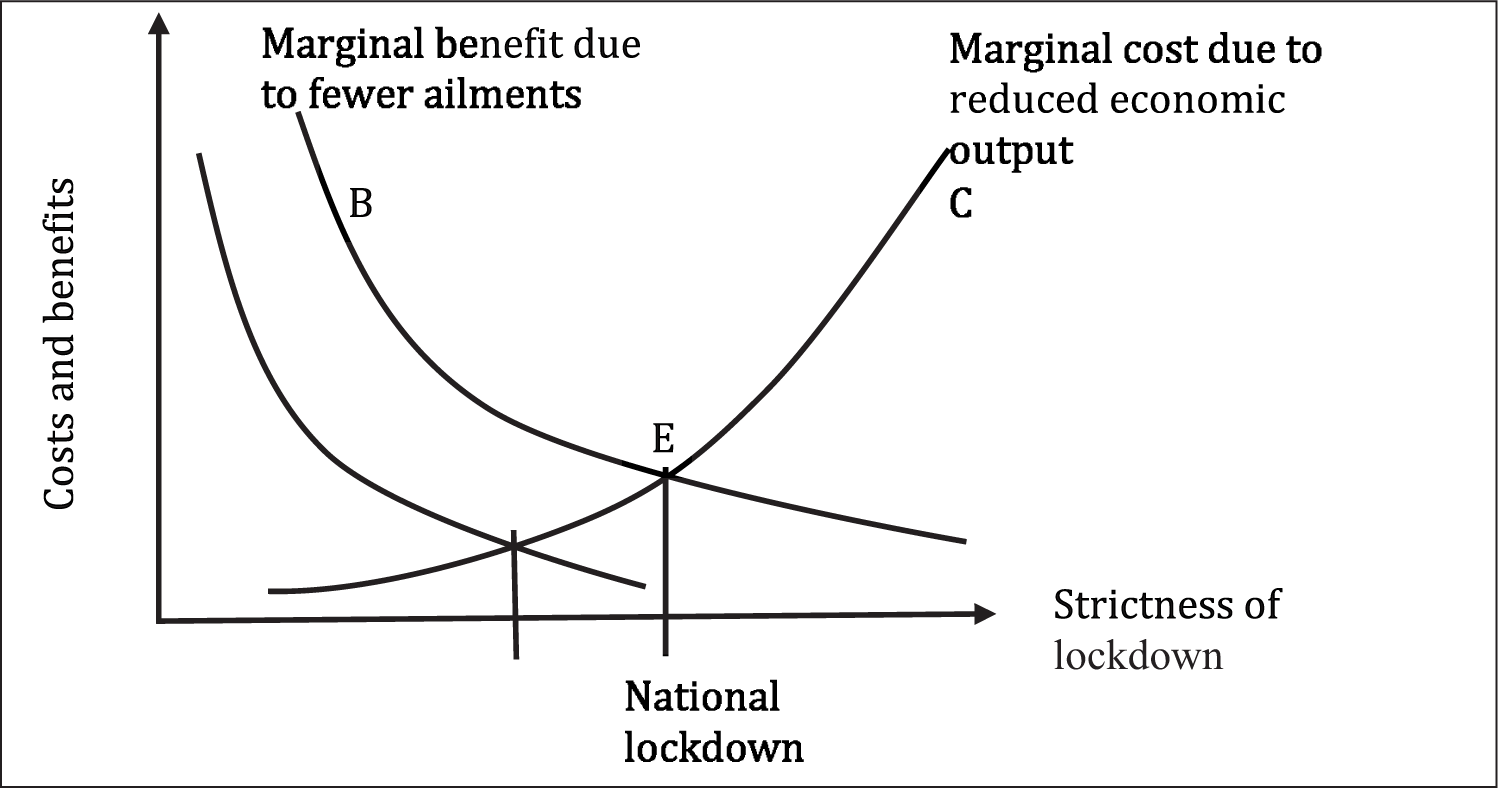
In Figure 3, the MB curve B and the MC curve C are the same as those of Figure 1. As stated before, the intersection of these two curves is at point E, where MB = MC, taken to correspond to national lockdown. Now suppose that economy is shut down at time
After local shutdown at F for certain duration, two effects are likely: (a) a rightward shift of MC curve D (implying that with the economy having been kept open for certain duration, the MC of restricting the economy would be lower), and (b) a possible flare up of the virus due to increased human interaction causing a rightward shift of the MB curve B (implying greater MB at any given level of lockdown). Both effects shift the point of interaction to the right of F, suggesting stricter control is in order.
The cycle may repeat itself from national lockdown to local, and then national again. This is the case of rolling lockdown. Another way to think of rolling lockdown is that as the government mandates social distancing, the economy suffers and the virus diminishes. The government then relaxes the rules about social distancing to help improve the economy, but the virus also grows.
All things considered, a rolling lockdown may be necessary till a remedy (a vaccine or therapy) is found. The implication is that the government can proactively make plans for a rolling lockdown, which also reduces the probability of a complete economic collapse. Using simulation, Anderson et al. (2020) provide a graphical insight into the flattening of the curve using a lockdown, then lifting it, which leads to a resurgence of the disease.
Discussion
In the framework above, it is assumed that the cost and benefit curves are for the entire country. But the costs and the benefits differ across population segments. For instance, the cost of economic shutdown is prohibitively high for the poor who lost their jobs. As pointed out by many, social distancing in urban areas is a luxury accessible only to the well off. Consequently, the rich might prefer stricter lockdown, whereas the poor might prefer a softer lockdown. Of course, if those facing the risk of infection under a softer lockdown are only the poor, it is possible that an alliance of the rich (e.g., corporations) and the poor prefers a weaker lockdown.
Some may argue that life is priceless implying that the MB curve would be higher and intersect the MC curve at a point mandating a stricter lockdown. So a decision based on cost–benefit analysis, that does not treat life as priceless, is unsatisfactory. They may also take a moral stand: if we can save lives by forgoing material goods, then why not.
For a perspective, I take the following numbers from Worldometer.info dated 15 April 2020. Coronavirus caused 422 deaths in India. Compare this with 415 See See See See See
Conclusion
Coronavirus (COVID-19) has not spared the rich and powerful: patients include the British Prime Minister, members of Royal families and celebrities across the globe. While a lockdown would help, the economic cost is huge. Even the USA is finding it difficult to bear the cost and is eager to open its economy despite being on top of the list in both the number of cases and deaths related to coronavirus. South Korea never shut down its economy, yet managed the coronavirus better than any by a decentralised approach; it even held elections in the middle of the coronavirus crisis. The issue in India is not about the first 3 weeks of shutdown lasting till 14 April or about managing hotspots with high standards. The issue seems to be shutting down the whole economy for yet another week and more.
With deaths per million of 0.3 in India and 86 in the USA (USA is 286 times more) (April 15, Worldometers.info), India has extended the lockdown instead of managing only the hotspots. Relaxation starting 20 April will be of limited help, as civilian transportation will remain suspended till 3 May 2020. The cost is huge considering that India is the world’s fifth largest economy. The cost is even greater for the weak and poor of the country.
India needs to specify the goals of its policy with due specification of the trade-off between the cost of shutting down the economy and the health risk with respect to coronavirus. India then has to adopt a plan(s) that achieves the policy at the least cost.
4
See