







Abstract
Introduction
Recent advancements in artificial intelligence (AI) have significantly impacted societal dynamics through the integration of large language models, programming assistants, and reinforcement learning, thereby underscoring the ubiquity of AI in contemporary daily life. The integration of AI technology into various aspects of life has rendered it an indispensable element, enabling expeditious access to information, fostering creativity, and promoting interconnectedness on a global scale. 1 The rising deployment of AI-driven technologies in vital sectors such as healthcare, energy infrastructure management, and transportation networks holds the potential to exacerbate existing problems in these domains.
Human thought, information absorption, learning, decision-making, and interaction with the environment are all significantly impacted by AI. It has the potential to augment cognitive abilities, optimise decisions, and boost productivity. 2 The implementation of AI in the educational sphere enables the execution of customised learning strategies by means of learner profiling, provision of timely feedback, and cognitive skill enhancement. However, concerns arise about over-reliance on AI in childhood and its long-term implications for attention, academic performance, and the role of human educators. 3
Interactions with AI-powered robots and chatbots can shape perceptions and attitudes, while also affecting interpersonal relationships and social dynamics. For example, Platforms like Woebot implement cognitive behavioural therapy principles to augment mental well-being, enhancing accessibility to therapeutic interventions. 4 This integration necessitates the concurrent employment of AI alongside traditional medical practices rather than its sole replacement
The effects of digital technology on individuals vary significantly across diverse age groups. To promote a lifelong culture of healthy digital engagement, it is crucial to gain a profound understanding of its multifaceted role within distinct developmental stages. While digital tools, interactive applications, and media may confer benefits for children, such as educational enrichment, excessive or unregulated exposure can lead to undesirable consequences, including diminished attentional capacities, compromised academic achievement, and a heightened predisposition to decision fatigue. 5 The pervasive integration of digital technology and AI in contemporary life has significantly impacted cognitive processes, habits, and perceptual frameworks.
Attention Overload
Attentional overload arises from the perpetual influx of sensory stimuli in contemporary digital environments, culminating in an individual’s diminished capacity for focused information processing.6, 7 Prolonged multifaceted distraction significantly impairs cognitive functionality and overall well-being, giving rise to deleterious outcomes such as diminished productivity, impaired memory retention, and heightened stress levels.
Multitasking can impair processing accuracy and efficiency and disrupt social relationships. The relentless requirement to respond to digital alerts and notifications can hamper deep engagement and diminish the quality of face-to-face interactions. 8 Research has demonstrated that recurrent interruptions can lead to diminished productivity, increased tension, and compromised job satisfaction. 9 Prolonged utilisation of digital technology is associated with compromised sustained attention, resulting in diminished performance on tasks that rely heavily on focused attention, as opposed to individuals with lower multitasking frequencies.
Academic Performance
Cognitive losses linked to prolonged use of digital technology, particularly in younger generations, are referred to as ‘digital dementia’.10, 11 Excessive reliance on digital devices has been associated with a decline in cognitive functioning, manifesting in impaired memory consolidation, decreased attentional capacity, and diminished proficiency in decision-making and verbal communication. Dependence on search engines (e.g., Google) as external repositories of information has been linked to reduced recall and memory retention. 12
Additionally, frequent GPS use may reduce hippocampus activity, which could affect navigation and spatial memory.13–15 The sheer amount of digital information and diversions can overwhelm the brain, making it more difficult to retain and comprehend what is being learned.16, 17 Frequent use of mobile phones has been linked to changes in brain anatomy, such as grey matter loss in the hippocampus and prefrontal cortex, as well as a shorter attention span.18–23
Effects of AI on User Perception, Attitudes and Decision-making Perception
The advent of digital technologies has precipitated a paradigm shift in decision-making processes, with significant implications stemming from the transformed capabilities in information collection, analysis, and deployment. 24 The implementation of AI-powered solutions may lead to augmented productivity, yet concurrently undermine the cognitive functions of critical thinking, creative problem-solving, and instinctual discernment. 25
The increasing incorporation of AI in educational settings has profound implications for administrative and academic decision-making processes. Nevertheless, the implementation of AI in this context is beset by ethical considerations stemming from the pervasive nature of algorithmic bias, racial discriminatory outcomes, and the erosion of accountability mechanisms. 26 Excessive online information can result in decision paralysis, hindering critical evaluation due to information overload.27–29 Automated recommendations can expedite decision-making processes; however, they may inadvertently reinforce confirmation bias by restricting access to diverse perspectives.
Decision Fatigue
The advent of AI and digital technology has significantly impacted human judgment, enhancing the expediency and efficacy of routine decision-making processes. Conversely, higher-order cognitive abilities, such as reasoning, novel problem-solving, and intuitive decision-making, may concurrently be vulnerable to diminution due to this paradigmatic shift.30–33 The deployment of AI in administrative and educational settings has raised considerable concerns regarding the devaluation of human cognitive capacity, which in turn generates moral dilemmas related to accountability and the susceptibility to biased decision-making. 34
The proliferation of digital settings can impede cognitive functioning by overwhelming information assimilation capabilities, thereby leading to decision fatigue and compromised performance efficacy. 35 The proliferation of technology-driven platforms may intensify confirmation bias and groupthink phenomena, thereby hindering the development of critical thinking abilities and diminishing the quality of interpersonal interactions and collective decision-making processes.36, 37 Furthermore, excessive technology usage and addiction have been associated with a decline in critical thinking abilities. 38 In a digital era dominated by AI, prioritising cognitive health and well-informed decision-making necessitates the integration of digital literacy, defined boundaries on technological usage, and a deliberate cultivation of critical thinking and interpersonal connections.
Methodology
The study analyses how AI anxiety and attitudes influence cognitive skills and decision fatigue in daily technology use.
Objectives
To explore how positive or negative attitudes toward AI influence the adoption of AI-integrated technologies.
To assess the level of trust and confidence users have in AI systems and identify the key factors that influence their perceptions.
To investigate the impact of AI on users’ cognitive skills and levels of decision fatigue during decision-making tasks.
To investigate the strength and direction of the relationships between long-term interaction with AI systems and cognitive-psychological outcomes.
Hypotheses
There is a relationship between an individual’s attitudes toward AI and their frequency of technology use.
Users with prior positive experiences and a basic understanding of how AI works are more likely to exhibit higher levels of trust and confidence in AI systems.
AI assistance will reduce decision fatigue by streamlining choices. Prolonged reliance on AI will more likely lead to a decline in users’ cognitive engagement and independent decision-making skills.
Long-term interaction with AI is positively associated with mental exhaustion, attention strain, and information overload, and negatively associated with self-assurance in decision-making.
Inclusion Criteria
Individuals aged between 18 and 30 years at the time of participation.
Regular users of digital technology (e.g., smartphones, computers) in daily activities.
Participants possessing a basic understanding or awareness of AI concepts.
Participants who voluntarily provide informed consent for participation.
Exclusion Criteria
Infrequent or non-users of digital technology who do not engage with technology regularly or do not have any knowledge about AI.
Surveys with incomplete data, inconsistent answers, or random responding, which could compromise data integrity.
Procedure of the Study
This study employed a quantitative survey to examine how AI anxiety and attitudes toward AI influence users’ cognitive skills and levels of decision fatigue during daily technology use. The primary data collection method involved the use of a structured questionnaire administered to participants through online and offline means.
Participants and Sampling
A convenience sampling technique was employed to recruit 500 participants between the ages of 18–30 years, from the Delhi-NCR region of India.
Data Collection
Data were collected using a self-administered survey questionnaire designed to measure key constructs such as AI anxiety, attitude toward AI, cognitive skills, and decision fatigue. The questionnaire consisted of Likert-type items, developed from pre-existing scales or previously verified, in order to quantitatively record participant attitudes and actions about AI and technology use. The participants were well informed about the goal of the study and were assured that their answers would remain anonymous and confidential. Informed consent was obtained from all respondents prior to participation.
Ethical Considerations
Participation was voluntary, and no personally identifiable information was collected. The study adhered to ethical research guidelines and ensured that all participants were aware of their right to withdraw from the study at any point without any negative consequences.
Data Analysis
The collected data were analysed using SPSS. Descriptive statistics, including mean, standard deviation, skewness, and kurtosis, were calculated to understand the distribution and central tendencies of the variables. Further inferential analyses were performed to explore the relationships among AI anxiety, attitudes toward AI, cognitive performance, and decision fatigue.
Result
The result indicates how AI influences decision-making and cognitive skills, and how AI Anxiety and attitudes affect daily technology use.
Table 1 shows the demographics of the sample comprising 500 participants (58% male, 42% female). In terms of education, 44% held undergraduate qualifications, 32% possessed postgraduate degrees, and 24% had completed matriculation or higher-secondary education. Most were aged 18–20 years (58%), followed by 21–25 years (20%) and 26–30 years (18%). Nearly half (48%) resided in urban areas, with 30% in rural and 22% in semi-urban settings. Daily digital technology usage was high, with 42% reporting >6 h/day, while 17% used digital devices for <2 h/day.
Demographic Variables.

Table 2 summarises the descriptive statistics for the key variables. AI Anxiety had a mean score of 4.62 (SD = 1.14) with skewness of −0.28 and kurtosis of −0.44, indicating a moderately high level of AI-related anxiety and a near-normal distribution. Attitudes Toward AI averaged 5.01 (SD = 1.06), suggesting generally favourable perceptions, with a skewness of −0.36 and kurtosis of −0.19. Cognitive Skills were rated relatively high (M = 3.72, SD = 0.78), with skewness (0.03) and kurtosis (−0.61) indicating a nearly symmetrical and slightly platykurtic distribution. Decision Fatigue had a mean of 3.94 (SD = 0.83), suggesting moderate cognitive strain, with skewness (−0.22) and kurtosis (−0.37) also indicating a roughly normal distribution.
Descriptive Statistics (N = 500).

The Pearson correlation between Attitudes Toward AI and Frequency of Technology Use, as shown in Figure 1, was strong (
Correlation Between Attitude Toward AI and Frequency of Technology Use (N = 500).

*

The Pearson correlation coefficients between confidence and trust in AI-related variables are shown in Table 4. Notably, as depicted in Figure 2, there was a moderate correlation found between the impression of AI recommendations as reliable and both improved productivity (
Correlation Matrix of Trust and Confidence in AI.


Dark Red/Orange = Strong Positive Correlation (closer to 1.0)
The inter-item correlations (Table 5) revealed generally low or negligible associations across most AI cognitive variables. Notably, as illustrated in Figure 3, there was a moderate positive relationship between lower self-assurance in decision making and lower attention as a result of AI exposure (
Influence of AI on Cognitive Skills and Decision Fatigue.

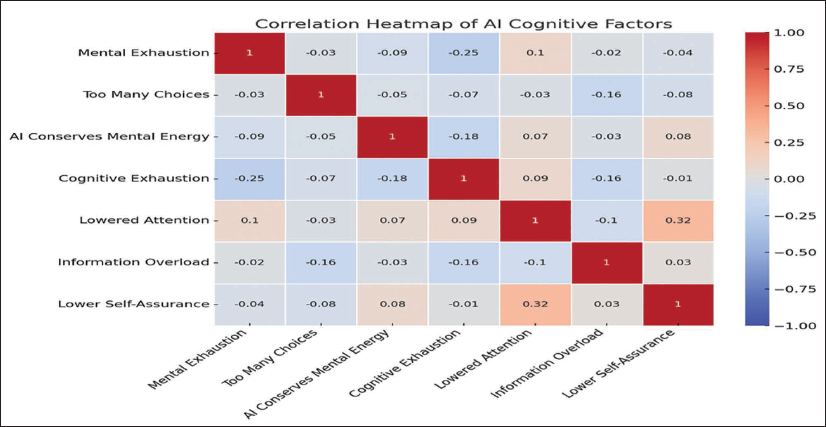
Deep red: Strong positive correlation.
Table 6 details the correlations between long-term AI interaction and various cognitive and psychological outcomes. Figure 4 depicts strong, positive correlations were observed between long-term AI interaction and mental exhaustion (
Long-term Interaction with AI Systems and Cognitive-psychological Outcomes.


Red shades: Strong positive correlations (values closer to 1.00).
Discussion
The current research elucidates the complex interrelation between AI and human cognition, concurrently illuminating its advantageous and detrimental consequences. As AI increasingly permeates everyday existence, the psychological and cognitive effects necessitate rigorous examination. The discovered outcomes emphasise the dichotomous consequences of AI integration, wherein enhanced efficiency may be offset by cognitive burden and diminished user autonomy. A comprehensive comprehension of these interrelated dynamics is imperative for harmonising AI development with the innate requirements of human cognitive faculties, thus facilitating synergies between efficacious performance and individual well-being.
The demographic information of the chosen respondents, shown in Table 1, indicates that there are 210 female and 290 male respondents. The respondent’s region is classified into three categories. (a) Urban, (b) Rural and (c) Semi-urban. Of these respondents, 110 are from semi-urban areas, 150 are from rural areas, and 240 are from metropolitan areas.
The descriptive statistics (Table 2) for the key psychological variables assessed in the study: AI Anxiety, Attitude Toward AI, Cognitive Skills, and Decision Fatigue, based on a sample of 500 participants. The mean score for AI Anxiety was 4.62 (SD = 1.14), demonstrating a moderately high level of anxiety pertaining to the use of technologies for AI. The distribution was slightly negatively skewed (–0.28) with low kurtosis (–0.44), indicating a distribution that is comparatively normal but with a propensity for certain participants to express higher anxiety levels.
Attitude Toward AI had a mean of 5.01 (SD = 1.06), demonstrating mostly positive opinions towards AI among the participants. The data were also negatively skewed (–0.36), suggesting a slight inclination towards more positive attitudes.
The mean for Cognitive Skills was 3.72 (SD = 0.78), suggesting a comparatively high degree of self-perceived cognitive functioning on a 5-point scale. The skewness (0.03) and kurtosis (–0.61) values indicate a nearly symmetrical and slightly flat distribution.
Decision Fatigue yielded a mean of 3.94 (SD = 0.83), indicating that many participants, especially in AI-related contexts, experienced moderate to high levels of cognitive strain when making frequent decisions. The distribution was approximately normal, with slight negative skewness (–0.22) and mild platykurtosis (–0.37). Overall, the data is approximately normally distributed with only minor deviations in skewness and kurtosis; Since all skewness values are between –1 and +1, and all kurtosis values are between –1 and +1.
The findings of the study (Table 3) demonstrate a strong, positive association between participants’ attitude towards AI and their frequency of technology use (
The findings highlight that participants are more inclined to use AI more regularly if they believe it to be a useful, effective, and reliable technology. This is consistent with the expanding knowledge that a person’s attitudes, perceptions and level of comfort with AI might influence behavioural outcomes related to its use. The marginal significance suggests that more research with larger and more diverse samples may be necessary to fully confirm and clarify the strength of this relationship, as individual differences in digital literacy, exposure to AI technologies, and resource availability may also have an impact on the results.
These findings partially support the proposed
The present study sought to examine (Table 4) whether users with prior positive experiences and a basic understanding of AI systems demonstrate greater trust and confidence in using AI. The results of the Pearson correlation analysis provide evidence in favour of this hypothesis and emphasise the important connections between different dimensions of trust in AI, including perceptions of reliability, task assurance, increased efficiency, preference for human judgment, and command over AI technologies.
As illustrated in Figure 2 and Table 4, a moderately strong positive correlation was found between perceived reliability of AI recommendations and confidence in task performance (
Additionally, the observed strong correlation between perceived reliability and control over AI tools (
Additionally, the findings showed that a preference for human judgment, despite being usually linked with scepticism toward AI, was positively correlated with trust-related dimensions such as confidence in tasks (
Notably, the strongest correlation was observed between confidence in tasks and improved productivity (
Taken together, these findings give empirical support for the hypothesis that users with prior positive experiences and a basic knowledge or understanding of AI are more likely to demonstrate higher levels of trust and confidence in AI systems. This has real-world ramifications for how AI tools are developed and implemented.
The present study in Table 5 and Figure 3 explored user perceptions of the influence of AI on cognitive engagement and decision fatigue, focusing on the hypothesis that AI may assist in reducing decision fatigue by streamlining choices. Prolonged reliance on AI is more likely to contribute to a decline in users’ cognitive engagement and independent decision-making skills. Results derived from descriptive analysis and Pearson correlation coefficients provide a nuanced grasp of the ways in which AI impacts different cognitive and psychological domains.
Despite the widespread assumption that AI always lessens decision fatigue, the findings of this study did not reveal strong positive correlations supporting this notion. Specifically, the relationship between the perception that AI offers too many choices and that it conserves mental energy was negligible (
Interestingly, while the participants overwhelmingly agreed that AI tools are used to conserve mental energy (100% agreement), correlations between this perception and indicators of cognitive fatigue or reduced self-assurance were weak (e.g.,
Furthermore, the weak and sometimes inverse relationships between various dimensions of AI interaction and fatigue (e.g.,
Long-term dependence on AI may in fact, impair cognitive engagement and trust in one’s ability to make independent decisions, even though the predicted decrease in decision fatigue due to simplified choices was not statistically supported. This emphasises how crucial it is to create AI systems that maintain users’ cognitive agency and critical engagement while simultaneously enhancing human capabilities.
Table 6 and Figure 4 presents the study’s results, which indicate noteworthy correlations between long-term interaction with AI systems and a range of cognitive and psychological outcomes. Long-term use of AI technology was, as expected, strongly associated with information overload, mental exhaustion, and diminished attentional capacity. These results support prior literature suggesting that prolonged interaction with AI can lead to cognitive fatigue and mental depletion (Jones et al.
45
). Notably, long-term interaction (
Similarly, AI’s propensity to overwhelm users by presenting too many choices was strongly associated with lower attention capacity (
Perhaps most notably, lower self-assurance in individual decision-making was negatively associated with long-term interaction (
Overall, these results highlight the intricate relationship between long-term AI use and its effects on cognition and psychology. The data support the hypothesis that, although AI tools can reduce short-term cognitive load, their long-term and repeated use may result in cognitive fatigue, attention depletion, and diminished self-confidence in decision-making. This emphasises a crucial factor to take into account when designing and implementing AI: striking a balance between efficiency and convenience and maintaining user autonomy and cognitive well-being. We can create AI ecosystems that promote productivity and mental well-being.
Conclusion
The findings of the study provide insight into the intricate relationship among the usage of AI, user perceptions, and cognitive-psychological effects. The study reveals despite offering benefits like improved reliability and efficiency, AI also creates evolving problems. The data confirmed that more favourable attitudes toward AI relate positively to higher engagement levels, suggesting that trust and perceptions of efficacy play pivotal roles in the adoption of AI tools (Venkatesh et al. 48 ; Zhang & Dafoe 49 ). A marginally significant trend was found, suggesting the need for further research involving larger and more diverse sample groups to confirm this association.
Consistent with prior literature (Hoff & Bashir 39 ; Schaefer et al. 40 ), according to the current study, trust is largely dependent on user perceptions and AI reliability, particularly when AI is implemented in high-impact contexts. Strong correlations between reliability, productivity, and perceived control emphasise the significance of user autonomy as a determinant of trust and engagement (Glikson & Woolley 41 ). Interestingly, a concurrent preference for human judgment emerged, suggesting that trust in AI does not imply its wholesale replacement of human decision-making but rather the establishment of a collaborative paradigm (Dzindolet et al. 42 ).
Notably, this investigation reveals that the integration of AI may induce dichotomous consequences on cognitive load, wherein it simultaneously diminishes and amplifies mental exertion. While some users perceive AI as a means to reduce mental effort, long-term exposure and repeated interactions appear to hamper attention, diminish self-assurance, and foster information overload (Shariff et al.44; Jones et al. 45 ; Schwartz 46 ). These findings indicate a significant paradox whereby AI can concurrently function as an efficiency facilitator while also contributing to cognitive debilitation, thereby supporting hypotheses regarding learned powerlessness and the erosion of intrinsic decision-making autonomy.
This research affords substantial empirical validation for the requisite of a harmonious equilibrium between the psychological benefits and drawbacks of AI in fostering sustained engagement. Future investigations should adopt a longitudinal methodology to scrutinise the enduring behavioural and cerebral repercussions of AI utilisation as these technologies evolve and assume an increasing presence in both personal and professional settings. Design interventions prioritising cognitive scaffolding, user autonomy and transparency are likely to mitigate cognitive strain and facilitate trust. Such initiatives possess the potential to cultivate AI ecologies that not only exhibit efficacy and productivity but also sustain human autonomy and cognitive well-being.
Future Suggestions
Future research should adopt a multi-method approach to further elucidate the complex interplay between AI usage and cognitive-psychological outcomes. Longitudinal studies that track changes in cognitive load, decision-making behaviour, and trust across extended periods of AI interaction are vital for understanding the long-term consequences of human–AI collaboration. Such investigations would benefit from integrating behavioural metrics, psychometric assessments, and neurophysiological measures (e.g., EEG, fMRI) to deepen our understanding of how AI influences attention, cognitive strain, and self-assurance over time.
Furthermore, designing AI interfaces and interventions that maximise trust, strike a balance between autonomy and support, and lessen cognitive fatigue can be guided by these principles. In this situation, qualitative techniques, such as focus groups and interviews, might enhance quantitative methods by offering complex viewpoints on how users feel about AI tools.
Future studies should also investigate the efficacy of design interventions such as transparency-enhancing features, user-centric feedback loops, and adaptive complexity settings to mitigate the risk of cognitive strain and ‘choice paralysis’ associated with AI platforms. Such research has the potential to inform best practices for AI implementation across diverse domains, including clinical, educational, and organisational settings, ensuring that advances in AI technologies evolve in tandem with the psychological and neurocognitive well-being of their end-users.
Footnotes
Acknowledgement
Authors’ Contribution
Declaration of Conflicting Interests
Funding
Patient Consent
Statement of Ethics
ORCID iDs
