







Abstract
Introduction
Increasing attention has been devoted to platform work, chiefly focussing on the conditions of work. These studies point out the generally poor conditions with low pay, an unsafe environment, high intensity, and unpaid hours (Mangan et al., 2023; Wood et al., 2019). This begs the question of why people do it. While still rare, there are a few comparative studies across countries or regions which have shown that the take-up of platform work tends to be higher when there are fewer outside options and can, therefore, represent a rational response to insecurity (see e.g. Zwysen and Piasna 2023). This small, but growing, body of work indicates that, rather than only being driven by intrinsic motivations, there is also structural variation in the take-up of platform work.
While increasing attention is given to how the organization and prevalence of platform work itself depends on the institutional context – particularly the organization of social safety nets and commodification of labour (Gerber 2022; Krzywdzinski and Gerber 2020), there have been no large cross-national comparative studies addressing this directly. This is particularly important however as it is through such comparisons the different key aspects of the welfare state affecting platform work can be identified. It is this context that shapes platforms’ organizational set-up and affects workers’ incentives to work through them (Vallas and Schor, 2020). Particularly, while there have been studies on the interaction between platforms and state power (e.g. Culpepper and Thelen, 2020), there has not yet been a comparative large cross-national study on the extent to which state institutions themselves affect the prevalence of platform work.
In this study, we make use of two recent cross-nationally comparative datasets on the prevalence of platform work – encompassing remote microtasks, remote professional and creative work, on-location work involving transport such as delivery or ride-sharing, and on-location work in the private sphere – to analyze the extent to which different aspects of the institutional structure affect the take-up of platform work. 1 Our focus lies on how the key characteristics of European welfare states – the relationship between welfare spending and labour market policies, fiscal structure and the tax wedge, the generosity of benefits, dualization of the labour market and labour market regulation – affect (1) the take-up of platform work; and (2) the extent to which the most vulnerable are pushed into ‘gig’ work. Our analysis shows that social spending and passive labour market policies reduce the prevalence of platform work, while stronger dualization and an insider/outsider divide are associated with its greater take-up. Relatedly, more generous social security and redistribution is associated with less socio-economic inequality between the people who do platform work, while a greater focus on activation and higher dualization widens gaps, pushing particularly the more vulnerable to platforms.
To our knowledge, this is the first quantitative study to analyze across multiple European countries how welfare state institutions affect the prevalence of gig work. It indicates that platform work is not only an individual choice but that its take-up is also determined by structural factors.
Background: Contextual drivers of platform work
Vallas and Schor (2020: 273) paint a stark picture of the platforms as ‘accelerants of precarity’, emphasizing how the gig economy has exacerbated to an entirely new level the structural labour market trends that have been underway since the late 1970s. Key shifts include the decline of ‘standard’, full-time, and open-ended employment arrangements and the retrenchment of the many social and labour market protections that workers had previously relied upon (Busemeyer et al., 2022; Emmenegger et al., 2012; Palier, 2010). Moreover, platforms have been offloading risks that firms and employers had previously been obliged to bear, putting workers in an increasingly vulnerable position (Vallas and Schor, 2020; Van Doorn, 2017; Piasna et al., 2022). This includes responsibilities for bodily injury, damage to equipment, gaps between gigs, negative ratings, and harassment (Mangan et al., 2023; Riemann et al., 2023).
A crucial aspect that may act as a barrier or enabler in influencing individual workers’ reliance on platforms is the broader institutional landscape. Institutions interact to create different welfare regimes (Esping-Andersen, 1989) or varieties of capitalism (Hall and Soskice, 2001), influencing how likely individuals are to take on platform work. However, the link between the uptake or non-uptake of platform work and institutional characteristics is a less explored aspect of the platform economy and digitalization literature.
One contextual aspect that has been studied in more detail is the role of labour market policies and conditions. Indeed, within the broader digitalization literature, several scholars have focused on the spillover effects of labour market policies and conditions on the prevalence of platform work. Zwysen and Piasna (2023), for example, demonstrate that regional economic and employment conditions can markedly influence the variability of platform work. Similarly, Huang et al. (2020) found that, in the United States, there is a significant association between local unemployment in the traditional offline labour market and the surge in gig work, suggesting that the low entry barriers of online gigs provide a vital income for unemployed individuals. Further analysis by Burtch et al. (2018) indicates that the entry of Uber X into local markets affects lower-quality self-employment sectors by offering substantial opportunities for those who are unemployed or underemployed. Analogously, Laitenberger et al., 2018 show that online gig work, microtasks, offer significant opportunities for underemployed individuals or residing in areas with limited local employment options.
Research by Farrell and Greig (2016) adds to the understanding that individuals often resort to online labour following negative income shocks. Similarly, Bergt (2015) reveals that a third of crowd workers were unemployed before engaging with platforms, and Horton (2021) identifies participation in the Russian online labour market as a response to fluctuations in exchange rates and consequent wage variations. Huang et al. (2017) employ an identification strategy centred around mass layoffs to elucidate these patterns further. These studies point to contextual factors – particularly those affecting workers’ options on the labour market – playing a role in the decision to engage in platform work. However, this body of work is limited; aside from the cross-national research on regional variation by Zwysen and Piasna (2023), most studies focus on intra-national variations within a single country.
Further, there has been excellent work, predominantly but not exclusively qualitative, focussing on the balance between social safety nets and platform work. In their comparison of the United States and Germany, Krzydwinsky and Gerber (2020) link this explicitly to the institutional set-up. Relatedly, the fairwork project compares the characteristics of different platforms across countries thereby allowing for a comparison of how the institutional set-up affects the way platforms operate. Gender inequalities on platform work is a particularly interesting case, as country differences in commodification of labour and the distribution of housework affects the extent to which women are more at risk of using platforms to supplement income and as a reaction to economic uncertainty (Adams et al., 2025; Adams-Prassl and Berg 2017; Gerber 2022). Indeed, the impact of the Covid-19 pandemic also served as a shock, increasing economic uncertainty, which lead to differences in the take-up of platform work depending on how the work was qualified and how strong the social safety net for people who lost their job was (Rani and Dhir, 2020; Ravenelle et al., 2021). These studies all indicate that greater economic uncertainty and a weaker safety net are associated with a higher risk of taking up platform work and greater inequality therein.
Our paper contributes to this growing literature by testing several institutional factors directly on both the take-up of and inequality in platform work using rich cross-nationally comparative data and considering different components of the institutional set-up. This paper then aims to address this relation directly and across different countries by analyzing how individual decisions regarding platform work are affected by the country-level context, and particularly the organization of the welfare state.
A useful analogy is found in the literature on precarious or non-standard work, which similarly examines how labour markets and welfare states shape individual employment patterns (see e.g. Bertolini, 2020). However, much less is known about the wider institutional set-up of the economy and the welfare state and how this affects the individual preferences in terms of take-up of platform work. This is likely to be crucial as it shapes workers’ outside options as well as the environment in which the platforms themselves operate. Rahman and Thelen (2019) find that institutions can, for example, create an environment that supports or even nurtures the growth of the gig economy through a permissive political-economic landscape and regulatory frameworks that encourage flexibility and lower the barriers to entry for platforms. This is particularly true for deregulated and uncoordinated systems such as liberal market economies (Hall and Soskice, 2001). Conversely, rigid access barriers and highly coordinated economies may constrain the platform economy due, for example, to strongly regulated labour markets and higher taxes and social contributions.
Besides the regulatory framework, the social safety net is likely to play a role as its organization shapes workers’ vulnerability and degree of insecurity. Indeed, in preliminary empirical work, Chueri and Törnberg (2023) study the mixture of high- and low-skilled workers working through platforms (Upwork) and find that economic factors and social safety nets are associated with the take-up of platform work. Evidence shows that welfare states, particularly in continental and southern Europe, with contributory-based social insurance such as unemployment insurance, accident insurance, and sickness benefits, do not cover the self-employed or do so only partially (De Becker et al., 2024; Picot, 2022; Spasova et al., 2022). This may act as a barrier to platform work’s appeal, as there is evidence that workers tend to prefer the security of standard employment (Datta, 2019; Piasna and Drahokoupil, 2021). It also increases risks for platform companies as they might be required to make retroactive social contributions should it be determined that they had engaged workers under the guise of bogus self-employment (Picot, 2022).
Further, in dualized labour markets, such as in continental and southern Europe, social and labour market policies are differentiated between ‘standard’ workers and those in various forms of non-standard employment with a divide in their rights and entitlements as well as in the services provided (Emmenegger et al., 2012; Palier and Thelen, 2010). Nevertheless, platform work can function as an additional source of income for workers who are already less protected (both in terms of employment protection and social safety net) and lower paid. In Nordic countries, however, decent wage floors and an encompassing social safety net may reduce labour supply to platform work (Picot, 2022). On the other hand, as pointed out by Antonucci (2024), access to these safety nets may be limited for platform workers through restrictive eligibility and assessment criteria, or through the incentives of the tax systems which can essentially juxtapose lower taxes with social security as a platform worker. As shown by Thelen (2018), in Sweden, the regulatory response to Uber was comparatively open as long as the platform giant complied with regulations and taxation. Central and Eastern European countries are characterized by a mix of liberal and corporatist elements (Myant and Drahokoupil, 2010), although the comparatively low wages and residual safety nets could prove to be determining factors in the take-up of platform work. Liberal countries can be expected to be more receptive to the gig economy given deregulated labour markets, low wage floors, high financialization, and comparatively weak collective bargaining coverage. However, less regulated labour markets may weaken the attractiveness of platform services, as labour is already flexible (Picot, 2022).
Several authors (see e.g. Collier, 2011; Picot, 2022; Pulignano and Van Lancker, 2021; Thelen, 2018) have identified that the strength of organized labour (and organized business interests) may act as a backstop that inhibits the proliferation of platform work. Although self-employed workers are not the typical members of the labour movement, unions are increasingly attentive to the rights and entitlements of gig workers. On utilitarian grounds, they are worried that platform work may replace standard employment, or rather that the periphery may threaten the core, thus making the labour market more precarious. As analyzed by Picot (2022), trade unions can act as disincentives to the proliferation of platform work for two reasons. First, when unions’ power resources are strong, they maintain public and political pressure to monitor the gig economy; and second, they may facilitate innovative, often grassroots-based mobilizations of platform workers (Tassinari and Maccarrone, 2020; Vandaele, 2020). The presence and relative strength of the labour movement largely depends on how the national economy is organized, holding greater power resources in coordinated market economies rather than in deregulated systems (e.g. Hall and Soskice, 2001).
While the literature above highlights the role of institutions in shaping platform work, the complex interplay between individual preferences and institutional settings cannot be overlooked. Drawing from the literature on precarity (see e.g. Barbier, 2004), which emphasizes how individual circumstances and broader socio-economic forces interact with institutions to create vulnerability, we argue for a more nuanced perspective (Bertolini, 2020). By recognizing individuals as active agents within these structures, we can explore the diverse ways in which institutional arrangements shape individual experiences and choices regarding platform work. Building on this understanding of the complex interplay between individual motivations, labour market dynamics, and welfare state characteristics, this paper delves into the specific mechanisms through which different welfare state and institutional characteristics shape both the supply of and demand for platform work. We argue that the decision to engage in platform work is not solely driven by individual preferences or economic shocks but is moderated by the broader institutional context. This includes the generosity of social safety nets, the design of labour market policies, the degree of labour market dualization, and the strength of organized labour. These factors influence both workers’ perceived risks and opportunities associated with platform work, as well as the strategies and competitive pressures faced by platforms themselves.
Conceptual framework and hypotheses
Platform work, like other types of precarious work, is shaped by the economic and institutional context in which it operates, but the question of how social and labour market institutions moderate the (non) take-up of platform work remains an open empirical question. The discussion above points to expected differences based on institutional features. In order to systematize this discussion, it is worth considering how the different pillars of welfare states affect the take-up of platform work and how this varies across countries. This necessitates a consideration of the mechanisms on two fronts: (1) at the level of the individual worker, which is shaped by the economic and welfare state context; and (2) the decisions of platforms themselves concerning the conditions of work and the way they operate, which itself is heavily dependent on the institutional context (Vallas and Schor, 2020).
At the individual level, the decision to work for platforms depends, of course, on individual situations, such as a preference for the flexibility offered (Berger et al., 2019; Lehdonvirta, 2018) or the low entry barriers to accessing platform work which may make it relatively easier to start working (Van Doorn and Vijay, 2024; Zwysen and Piasna 2024). However, the decision also depends on contextual push factors, such as few outside options in the traditional economy (Zwysen and Piasna 2023). We expect that platform work will be more prevalent, offering a flexible option of work with low entry barriers, where workers face higher degrees of uncertainty, as well as limited outside options. This is in line with what is found in studies on the take-up of non-standard work (see e.g. Antonucci et al., 2024). These reflect individual characteristics but also depend on the structure of the labour market and welfare state as these may result from comparatively low levels of employment protection for non-standard and precarious work, a lack of a residual social safety net, and a greater division between insiders and outsiders.
At the level of the platform, we expect that the institutional context – particularly the organization of labour, the regulatory burden, and the political climate – will affect the decision to operate in a certain market as well as the way in which platforms compete and situate themselves in the traditional economy (Pulignano and Marà, 2021). Our expectation is that, in more deregulated labour markets, there is greater scope for platforms first of all, to exist, but secondly to compete by offering fewer social conditions (Vallas and Schor 2020) thereby being attractive to workers who are already in a more vulnerable position.
These pathways are graphically presented in Figure 1, where the focus is, first, on the prevalence of platform work as determined by these major concepts: a social safety net; the tax wedge; dualization; and labour organization. These are all expected to affect the prevalence of platform work directly through the channels of providing a good environment for platforms (Vallas and Schor, 2020) and through adding greater uncertainty for workers, resulting in platform work serving as a ‘job of last resort’ (Zwysen and Piasna 2023). Second, we expect that these factors differ in their effects on more and less vulnerable workers. With a stronger social safety net and a more generous welfare state, we would expect inequality between the vulnerable and the less vulnerable – who are generally more likely to do platform work – to decline. A greater fiscal wedge may be particularly relevant for the more well-off and may widen any inequalities. In the presence of a stronger dualization of the labour market, we expect wider gaps between the more and the less vulnerable. The presence of stronger labour market institutions might go either way, but we lean towards seeing it as likely to reduce platform work, particularly for the more vulnerable. Theoretical expectations.
Although this article examines the impact of the welfare state and labour market policies on the (non) take-up of platform work, it is important to acknowledge that many other country-specific factors may drive the prevalence of platform work through affecting the demand for services provided through platforms and the supply of workers. Such factors are beyond the scope of the present paper however, as we aim to isolate as much as possible the variation between countries due to the welfare state institutions.
Data and methods
We use two recent cross-nationally comparative studies across the EU. First, the 2021 ETUI Internet and Platform Work Survey (IPWS) (Piasna et al., 2020), which is a representative survey on the prevalence of internet and platform work carried out in 14 EU member states. Second, the second wave of the COLLEEM study carried out by the Joint Research Centre of the European Commission (Urzi Brancati et al., 2020) in 2018 – this is a large cross-nationally comparative study of 16 European countries with comparable concepts to those of the IPWS and, while it is a non-probability sample that oversampled internet users, it aims to increase representativeness through its design and weightings. Table A1 shows the countries covered and sample sizes.
Both datasets are used to maximize the countries covered. We believe that the added value of covering more European countries and especially a greater geographical variation outweighs the costs of increased complexity due to the different samples and variability in the questions. Our study is primarily exploratory, aiming to maximize the variation between countries in order to test whether there is some indication of an association between platform work and institutional factors. As both datasets cover different countries, we would not necessarily expect the relationships regarding each block of drivers to be the same between them, but we consider separately whether any relationship seems to exist within each one.
In the IPWS study, work is measured through a set of questions: first, whether respondents have ever done any of six different types of activities to earn money through the internet – short microtasks, remote professional tasks, delivery work, transporting people, working on-location at people’s homes, or other tasks where they can specify what these were; and, second, whether they have done this in the past 12 months. As a follow-up, respondents were asked to name the app or website they used. The measure for COLLEEM is comparable as workers are asked whether they have ever made money from any of these similar online sources. Here, respondents were asked directly whether they did so through a platform by adding to the question, ‘Providing services via online platforms where you and the client are matched digitally, and the payment is conducted digitally via the platform’.
Our first outcome variable is whether respondents engaged in self-reported platform work in the last year. As the institutional framework is expected to affect the extent to which workers rely on platform work, we use a more restrictive second dependent variable – namely, those who had reported doing platform work in the past 12 months and where this was coded as a platform 2 in the case of the IPWS, and who earned at least 50% of their annual individual income through this work in the last year (main platform work hereafter). The restriction to those earning at least half their income means more casual platform work is not considered in these analyses. We expect the latter to be more affected by contextual factors as it is the decision to rely on platform work that is likely to be affected by the outside options. As the impact may differ, we believe it important to consider both a broad definition of platform work, and a more narrow one. One limitation here is that we only look at the individual outcome, and do not consider the household income situation. It is therefore possible that 50% of someone’s annual income still makes up a rather small share of the household income.
Both surveys provide comparable information on key demographic characteristics. These are the highest qualification level; age; sex; employment status; country of birth; and having a dependent child (under 12 in the IPWS and under 18 in COLLEEM).
In order to operationalize vulnerability on the labour market, we make use of the predicted probability of being unemployed or working in a non-standard job – meaning self-employment, temporary, and part-time contracts rather than full-time indefinite contracts in non-managerial jobs – based on demographics (age in three categories, gender, education in three categories, and country of birth in three categories) within the country as estimated from the EU Labour Force Survey (LFS) in 2021. This variable is standardized within countries.
Contextual factors are obtained from external datasets and merged by country and year. To capture the social safety net, we first use a variable on government spending on social protection as a percentage of GDP (Eurostat). To capture the degree of redistribution, we include a measure of the relative change in the poverty rate within a country after including taxes and transfers, obtained from the OECD. We include information on benefit generosity as captured by the replacement rate (the European Commission’s ‘Taxes in Europe’ database); that is, the relation that unemployment benefits for a single worker bear to earnings. We further include information on the conditions for unemployment [UE] benefits based on data from the Comparative Welfare Entitlements Project (CWEP) (see also Antonucci et al. 2024): namely, the qualifying period until benefits can be accessed, the duration of benefits, and the waiting days required before benefits are given.
We further make use of data on active labour market policy spending (assistance to workers, direct job creation, and spending), as a share of GDP, and on passive labour market policies (on income maintenance). The fiscal set-up is measured by the tax wedge for a single respondent earning 100% of the average wage.
Dualization is captured through the OECD Employment Protection Legislation data which quantifies legal agreements on employment protection separately for regular employees and for temporary ones. The expectation is that lower EPL in respect of temporary workers is associated with higher dualization. Relatedly, we capture segmentation on the labour market through a measure of the share of non-standard workers as obtained from LFS microdata: the share of workers who are in non-standard (self-employed, part-time, or temporary) jobs or unemployed rather than have a full-time, non-managerial employment contract of indefinite duration. To capture labour organization we include variables on the share of workers covered by collective bargaining agreements, and trade union density (OECD AIAS ICTWSS). All factors are decentred by the grand total, weighting each country equally, to aid interpretation. As a general control for economic conditions we include the unemployment rate by sex and age, and the GDP per capita of a country. Table A2 describes the structure of key variables, while A3 provides the descriptive statistics of the sample.
To analyze the extent to which welfare state institutions affect the prevalence of platform work, we first describe variation between countries. Second, this is analyzed more formally through a binary logistic regression
3
of doing any platform work on a contextual factor, controlling for demographic characteristics as well as unemployment rate and GDP/capita. All analyses have poststratification weights and are carried out separately per contextual factor, and separately for the IPWS and COLLEEM datasets.
In a second step we analyze the extent to which more vulnerable workers are at greater risk of doing platform work by interacting the measure of the risk of doing non-standard work with the contextual factor. Similarly, we can interact this with whether workers are highly qualified. This model includes country fixed effects to capture inequality within countries.
The outcome factors are (1) doing any platform work; or (2) doing platform work as a main job. The latter captures the extent to which workers are reliant on platform work and is notably important as this distinction also explains much of the heterogeneity in how workers experience the conditions of platform work (Schor et al., 2020). We believe the more restrictive variable of main platform work is the more informative, as this captures the extent to which economic and welfare conditions affect the take-up of platform work not just as additional income, but as a main activity. (Table A3)
Finally, we quantify the overall impact, by combining the IPWS and COLLEEM datasets to a joint model, and introducing each block of explanatory variables – social safety net, benefit generosity, dualization, labour market organization – separately, as shown in equation (3). They are combined to include all countries, and to account for variation between datasets an indicator for the data source is included and interacted with all control variables. To assess the differences between country groups the prevalence of platform work is then estimated in this joint model, using the average country values for explanatory variables for each country group. As an example, this means that the average values of different social safety net variables in the Nordic countries are used to predict the average share of main platform workers, keeping all else constant, if social safety net variables took the value they do in the Nordic countries in the sample. Table A4 shows the average values of each country grouping.
Results
Description across countries
First, it is useful to distinguish whether there is variation between countries in (1) the prevalence of platform work; and (2) who engages in it. Figure 2 shows this separately for the COLLEEM and the IPWS datasets. In COLLEEM 12.6% of workers are platform workers, with 1.2% relying on platform work for more than half their annual earnings; while in the IPWS dataset the estimate is somewhat lower, with 9.2% of workers doing platform work and 0.7% doing main platform work. In COLLEEM, we see relatively low shares of platform work in Finland, Czechia, Slovakia, Hungary, France, and Sweden; while the highest levels are found in Spain, Portugal, and Ireland, along with the Netherlands, for main platform work. In the IPWS, the highest levels are also found in Ireland, followed by Bulgaria, Czechia, and Estonia; while the lowest levels are found in Romania, Hungary, Greece, and Germany. The two datasets vary somewhat in their ranking, likely reflecting the variation in sampling. Prevalence of platform work and inequality between groups. Note: Figure shows per dataset the share of platform workers and main platform workers (left), the difference in platform work between university and lower qualified workers (middle), and the difference between those who are more vulnerable to doing non-standard work and those with higher risk (right), as a share (%). Source: COLLEEM (top) and ETUI IPWS (bottom).
Between tertiary educated and lower qualified workers within a country, both datasets report that university-qualified workers are somewhat more likely to do platform work than lower qualified ones (4-5 percentage points). This difference is particularly large in Spain in both datasets, and slightly negative or relatively low in Lithuania, Finland, and Sweden in COLLEEM while being relatively low in Czechia, Estonia, and Slovakia in the IPWS.
In terms of workers who are less vulnerable to doing non-standard work, being below the country-specific average, and those that are at a higher risk, both datasets find substantial variation between countries, although, on average, there is relatively little difference in terms of vulnerability to doing non-standard work – capturing variation by age, education, gender, and country of birth. In the IPWS the more vulnerable are indeed somewhat more likely to do platform work than the less vulnerable. In COLLEEM, a rather higher risk for the more vulnerable was particularly noted in Portugal, Spain, Czechia, and Croatia; while in the IPWS the risk was more so in Spain, France, Poland, Slovakia, and Estonia. There was no such higher risk in Hungary and Germany in the IPWS; and in the UK and Germany in COLLEEM.
To tease out the systematic variation, countries are grouped
4
in Figure 3, combining the two surveys and accounting for differences in the mean and demographic characteristics through regression controls, on the left; and the extent to which more vulnerable workers are at greater risk of doing platform work, on the right. Variation between country groups in prevalence and risk. Note: Figure shows (left) the prevalence of platform work per country group estimated through binary logistic regressions allowing for a different intercept per data source, and controlling for age, education, gender, having a child, and country of origin, which are all allowed to have a different slope per data source, and then controls for unemployment rate and GDP. On the right it shows the estimated difference between the relatively more vulnerable and the less vulnerable in doing platform work, estimated in the same way but interacting country group with being vulnerable. All analyses are weighted. Source: COLLEEM and ETUI IPWS.
On average, there is a high prevalence of platform work in southern Europe, followed by the Baltic countries, and liberal countries, which is in line with expectations based on welfare state regimes (Esping-Andersen, 1989). Prevalence is lowest in Nordic countries followed by continental and central and Eastern Europe. The right panel shows to what extent more vulnerable workers – measured as their predicted risk of non-standard work or unemployment – are also more at risk of doing platform work. This pattern, coupled with Antonucci’s (2024) findings on limited social insurance coverage for platform workers even in the ‘outsider friendly’ Nordics, suggests that vulnerability in the platform economy extends beyond traditional welfare state expectations. While platform work is less prevalent in Nordic and Central and Eastern European countries, those engaging in it tend to be the most vulnerable, as is the case in the two Baltic countries. Conversely, in Southern European countries there is a higher prevalence among less vulnerable workers, this suggests that those engaged in platform work belong intermediate position between traditional ‘insiders’ and ‘outsiders’. This category, defined by Jessoula et al. (2010) as ‘mid-siders’, while not as precarious as those at the margins, still experience significant disadvantages in terms of job security and income protection. While a potential explanation, we do not test this hypothesis directly in this paper. In contrast, within liberal welfare regimes, vulnerability appears to play a less decisive role in determining participation in platform work. These variations may reflect differences in the types of platform work prevalent in each context.
Descriptively then, there is variation between countries in the prevalence of platform work as well as in the way in which take-up differs between workers depending on their characteristics.
Prevalence across countries
To elucidate these differences further, Figure 4 shows the estimated relationship between different characteristics of the welfare state regime and the prevalence of taking up any platform work (top) or doing platform work as the main professional activity (bottom). Full coefficients are shown in Table A5, and all coefficients are shown for social spending in A6; others are available upon request. Estimated relationship between contextual factors and propensity to do platform work. Note: Figure shows the estimated relationship between a one standard deviation increase in a contextual factor on the individual probability of taking up platform work [top] or main platform work [bottom] in % points, with 95% C.I., estimated from weighted binary logistic regressions of each contextual factor separately, and controlling for education, age, country of birth, gender, age, having a child, unemployment rate, and GDP, with standard errors clustered by country. UE indicates unemployment benefits. +: 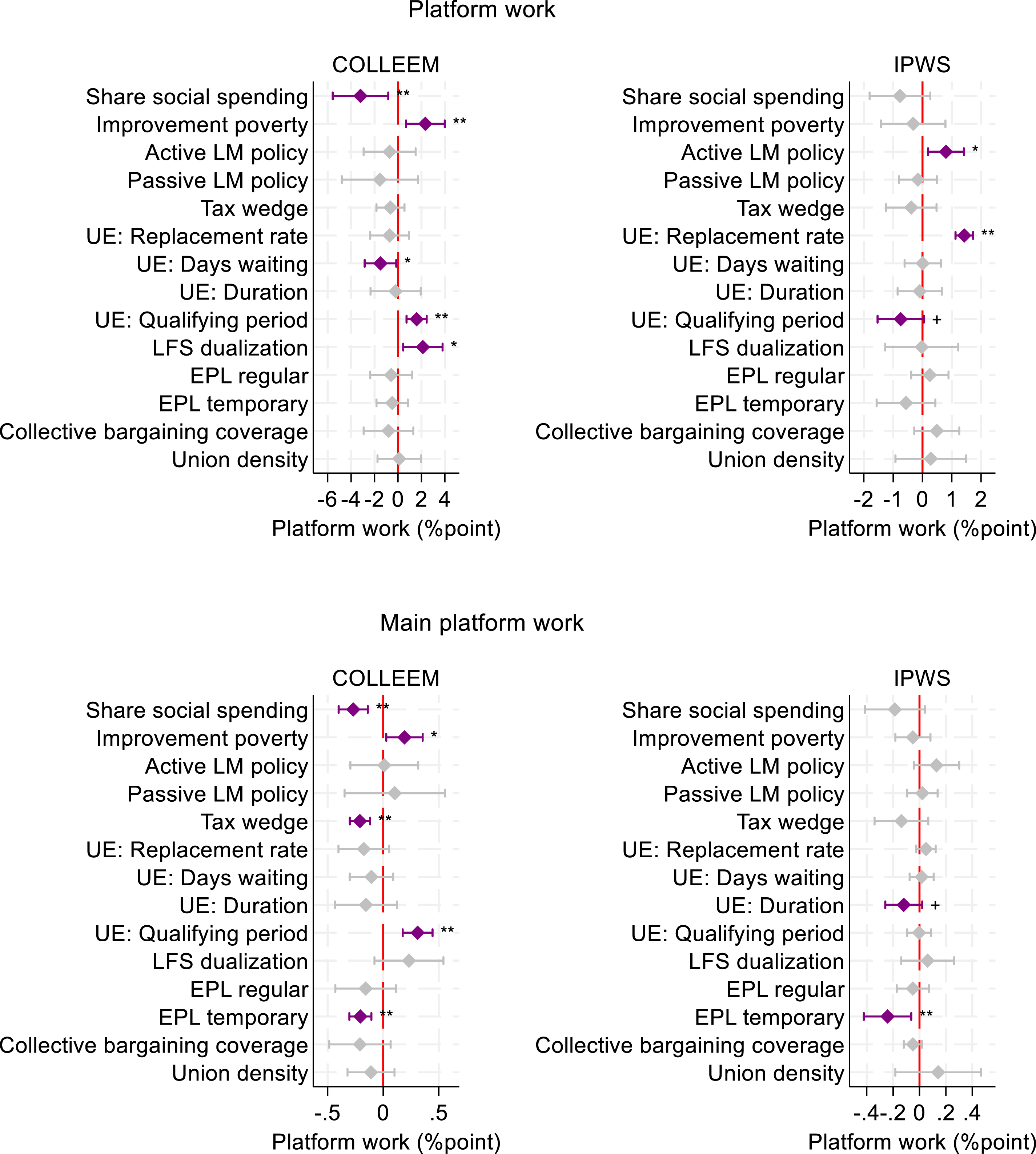
First, this shows a generally negative relationship between the share of social spending in general and doing any platform work (statistically significant [
The association of all platform work with unemployment benefits conditionality is not so straightforward. A higher replacement rate is, contrary to our expectations, associated with a generally higher take-up of platform work in the IPWS. This may, however, be an indication of the system being insurance-based, or particularly strict in terms of eligibility creating a greater division between those with access and those without. Having to wait more days before receiving benefits is associated with less platform work, which also goes against expectations. In the COLLEEM dataset on the other hand, there is a relatively strong association between a longer qualifying period and more platform work.
Finally, regarding dualization there is some indication in the COLLEEM dataset that a labour market with a greater share of non-standard workers is also associated with a higher take-up of platform work. Figure A1 in the supplementary material shows these results for different types of platform work. While there are some differences, there is no clear pattern available from this data.
The bottom panel repeats this analysis for main platform work – arguably the more relevant measure as it captures workers who actually rely for the majority of their livelihood on platforms and who are thus more heavily dependent on them. Here again there is a clear association with the share of social spending in general and with redistribution, indicating that a stronger social security net is associated with a lower rate of workers relying on platform work. In countries with a relatively higher tax wedge, main platform work is also generally lower. Where unemployment benefits last longer, the share of workers who work mainly on platforms is somewhat lower (IPWS), while a longer qualifying period before being eligible for benefits is associated with more main platform work. Regarding dualization, there is a clear negative association between higher employment protection for employees on temporary contracts – supporting the more vulnerable – and reliance on platform work. This also means that, where more vulnerable workers are relatively less protected, a higher share of workers rely on main platform work.
While these analyses are not conclusive, they do point to: (1) a generally lower likelihood of platform work where there is a more generous welfare state; (2) somewhat more platform work, particularly as the primary activity, where access to benefits is more circumscribed; and (3) a generally higher share of platform workers where there is a more vulnerable and ill-protected segment in the labour market. Interestingly, greater social spending and less conditionality in unemployment benefits, as well as lower dualization, seem related to individuals doing less platform work in general as well as less main platform work although the intensity differs between the two. This indicates somewhat similar processes seem at work relating to doing some platform work as well as relying more on it.
Are the more vulnerable more likely to rely on platform work?
The institutional context is expected not just to shape the prevalence of platform work but, more importantly, how unequally it is divided between people. For these analyses we focus on the probability of relying on platform work for the majority of income as main platform work captures dependence on these types of work as opposed to where they are engaged with more casually.
Figure 5 shows the estimated difference between a respondent who is relatively more at risk of not working or working in a non-standard job given their characteristics rather than someone who is less at risk (one standard deviation above vs one standard deviation below). A positive association means that the link between the institutional factor and reliance on platform work is more positive for more vulnerable workers; while a negative association means there is a greater shielding of vulnerable workers. (Table A6) Estimated difference between relatively more and less vulnerable workers. Note: Figure shows the estimated relationship in a contextual factor on the difference in doing platform work that makes up over 50% of annual earnings (%points) between workers at one standard deviation above the country-specific measure of non-standard risk and those at one standard deviation below, with 95% C.I., estimated from weighted binary logistic regressions of each contextual factor separately, interacted with the individual risk of non-standard work, and controlling for education, age, country of birth, gender, age, having a child, and country fixed effects. +: 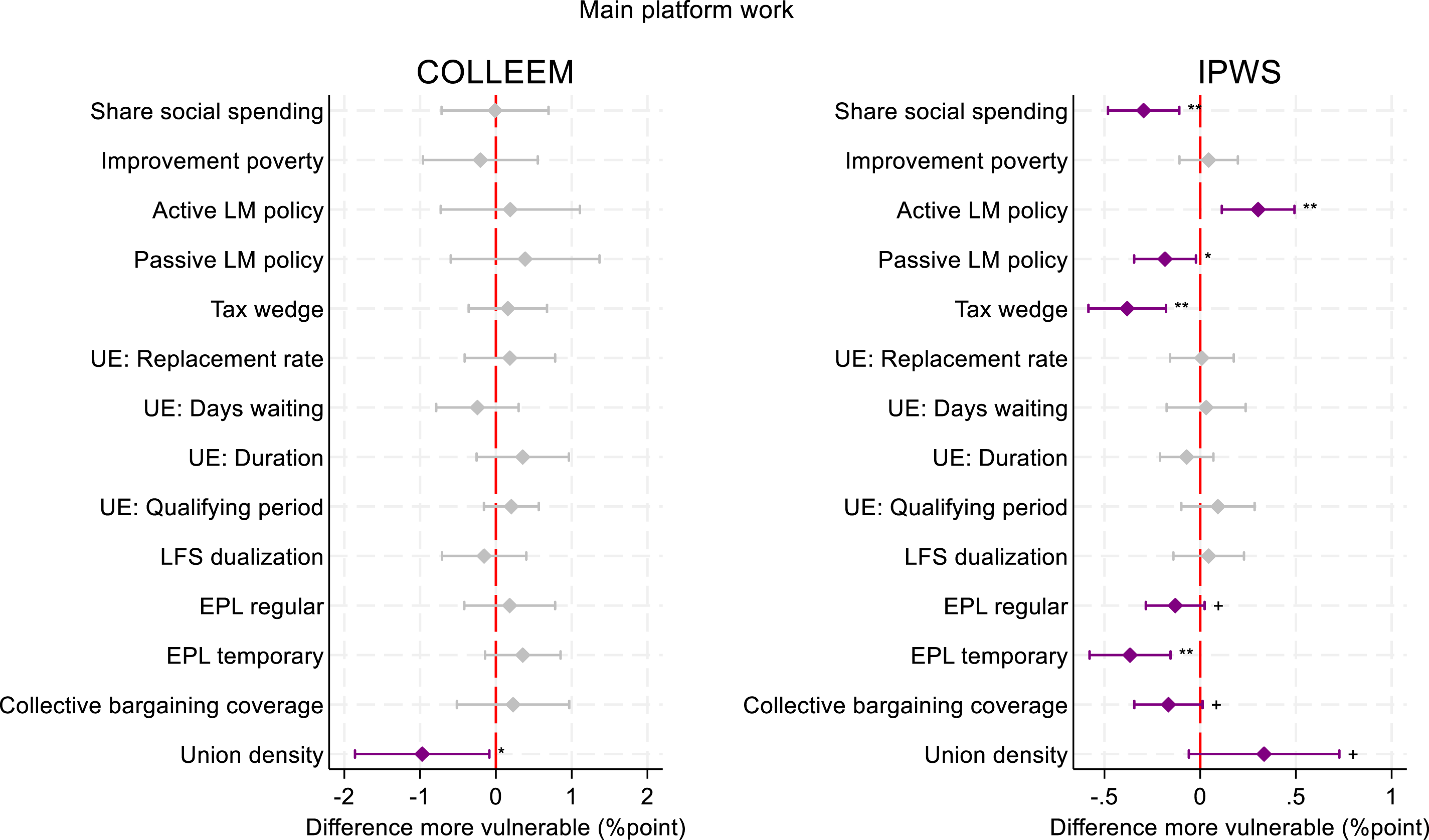
Results from the IPWS indicate that higher social spending, more spending on passive labour market policies, and higher tax wedges or non-wage compensation tend to shield more vulnerable workers. On the other hand, stronger active labour market policies are more likely to be associated with a higher share of the vulnerable relying on platform work. This points to a social safety net taking away insecurity for this vulnerable group, whereas a greater focus on activation is associated with a greater likelihood of taking up platform work. There are no clear associations with unemployment benefit characteristics. There is, however, a clear association between employment protection legislation and platform work in which higher employment protection legislation is linked to a generally lower likelihood of more vulnerable workers being more likely to rely on platform work. This is particularly the case where temporary employees are concerned, affecting these more vulnerable workers more heavily. Finally, higher collective bargaining coverage (IPWS) and higher union density (COLLEEM) seem associated with a greater shielding of vulnerable workers from platform work. Figure A2 in the supplementary material repeats this analysis when restricting vulnerability to not having university qualifications. This generally confirms the findings of the composite measure, although there is also less platform work when there is more redistribution. Figure A3 in the supplementary material plots the relationship between contextual factors and the risk of vulnerable workers to engage in main platform work in more detail for the IPWS.
These analyses point to the importance as regards reducing platform work of: (1) strong social safety nets; and (2) regulated labour markets. This is in line with earlier studies pointing to platform work as a job of last resort, when there are fewer alternative options (Zwysen and Piasna 2023).
Substantial variation between country groupings
Predicted Share of Main Platform Workers.

Note: Predicted share of main platform workers [and 95% confidence intervals] based on joint model with COLLEEM and IPWS data and based on average values for each explanatory variable in a block by the averages of those variables in country groups. Estimated through binary logistic regression model controlling for data source, interacted fully with education, age, country of birth, gender, having a child, unemployment rate and GDP. All analyses are weighted and standard errors clustered at the country level.
First, given the social safety net and fiscal structure this model would predict that on average 0.7% of workers are engaged in main platform work if the context mirrored those in Nordic countries, compared to 1.5% when values are those in Baltic countries, and 2.6% when they follow the liberal countries. Benefit generosity in the Southern countries is associated with relatively low rates of working on main platforms (0.9%) while it rises to 1.3% in liberal countries or central and Eastern European countries. When focussing on labour market dualization there is a clear distinction between on the one hand the Baltic and Central and Eastern European countries where 0.6 or 0.7% of workers respectively would be predicted to do main platform work, and the liberal (1.4%) or Nordic and continental countries (1.1% to 1.2%). Finally, the labour market organization would point to the lowest level of main platform work in Nordic (0.9%) and Southern (1%) countries, and the highest in Baltic (1.4%) and Central and Eastern Europe or liberal countries (1.3%). The largest differences between countries reflect variation in the social safety net and fiscal structure where the highest predicted value is 3.6 times higher than the lowest, followed by dualization where the ratio is 2.3. For labour market organization and benefit generosity the difference between regimes is somewhat lower with the highest predicted value being 1.4 or 1.5 times higher than the lowest. Overall, this analysis points to substantial differences in the take-up of platform work based on the welfare state organization. Second, it also shows that the hierarchy of groups differs somewhat between groups, but that controlling for compositional factors and the data source, the prevalence of main platform work is expected to be rather low in Nordic countries, and rather high in liberal and Baltic countries.
Discussion
This paper set out to analyze the extent to which the organization of the economy, through welfare state and labour market institutions, shapes the size of the platform economy. Consequently, it tested several blocks of welfare and labour market institutions using two large representative cross-national datasets, showing that there is indeed some variation in: (1) the prevalence of platform work depending on the context; and (2) the inequality between workers in terms of who carries out these jobs.
In countries with higher social spending, more passive labour market policies, and greater redistribution, the probability of working on platforms may well be somewhat lower. We find no relationship associating a greater tax wedge with a higher rate of working on platforms to avoid social contributions and taxes.
Regarding the generosity of benefits, results are more mixed. There is some indication that, where there is a longer qualifying period before receiving benefits and where benefits last comparatively less in length – indicating a more circumscribed and less generous benefits structure – there is indeed a higher reliance on platforms, but we find contrary results in terms of the replacement rate and required waiting days. We also do not find an indication that the more vulnerable are affected the most. Crucially, and as a limitation, besides the generosity it is of course also very important who gets access to these benefits, as countries may differ strongly in the extent to which social security is insurance or assistance based or a mix of the two.
Furthermore, we find support for our expectations on dualization, namely, that the probability of doing platform work is higher in more dualized societies, and especially where employment protection for the more vulnerable is comparatively lower.
Lastly, while the degree of union density and collective bargaining coverage do not affect platform work take-up, it does limit the extent to which more vulnerable workers do it.
This indicates that engaging in platform work is shaped by the institutions and the welfare state support provided. Particularly the social security safety net and the extent to which workers are protected play a role, which points to the importance of individual uncertainty and a lack of other options in pushing people towards platform work. These findings from cross-nationally comparative studies then support earlier findings showing the take-up of platform work, and the inequality therein, was higher in countries with more commodified labour markets and weaker safety nets (Krzywdzinski and Gerber 2020).
While this study highlights some intriguing associations, this is an exploratory analysis. The analysis uses two different data sources which each cover a small number of countries, 14 in the IPWS and 16 in COLLEEM, and are not completely comparable as they make use of different sampling strategies. The patterns do differ between the two datasets, which can reflect variation in sampling and concerning which the IPWS would be expected to be more reliable as it is an explicitly random survey (Piasna et al., 2022). However, differences may also reflect variation in the groups of countries covered. This exploratory nature means that we interpret an association in one of the datasets as an indication of a possible relationship, but of course, more work is needed on this. Further, there are aspects of countries that are not included in this analysis, such as their degree of tertiarization and the technological infrastructure, which could affect the take-up of platform work also in contexts with higher social welfare states. This could help explain some of the findings, regarding for instance the relatively high inequality in platform work take-up in the Nordic countries.
We strongly believe that there is benefit in combining information from both surveys to address this important question as the analyses necessitate a large sample of countries and as both surveys aim to provide a reliable estimate of the spread of platform work across Europe.
Conclusion
This paper has analyzed the relationship between welfare and labour market institutions and the prevalence of platform work. The analysis, based on two cross-national comparative studies, the ETUI Internet and Platform Work Survey and the COLLEEM study of the Joint Research Centre of the European Commission, finds that there is an inverse correlation between social spending and the take-up of platform work, highlighting that a more encompassing and generous social safety net essentially mitigates reliance on gig work.
We also find that there are nuanced associations between dualization and platform work. A greater divide between labour market insiders and outsiders is generally associated with a higher take-up of platform work. However, we also find that in countries with lower degrees of dualization, such as in the Nordics, those engaging in platform work tend to be the most vulnerable (see Figure 3). Conversely, in countries with notoriously high levels of dualization, such as Southern Europe, the risk profile of such workers is comparatively lower. This suggests that the workforce engaged in this type of work belongs to a category of workers that Jessoula et al. (2010) define as ‘mid-siders’ – those situated
Furthermore, we also establish how various institutional factors affect different segments of the labour force. Higher social spending, passive labour market policies such as unemployment benefits, and higher tax wedges or non-wage compensation tend to shield vulnerable workers from platform work, reducing their reliance on the gig economy. Interestingly, we find that, in contexts with stronger active labour market policies, this may lead to greater engagement in platform work, particularly for vulnerable individuals. This indicates that, while social safety nets can alleviate insecurity for vulnerable workers, a focus on activation can increase their dependence on gig work.
As we expected, social insurance does play a pivotal role, particularly when it comes to unemployment benefits. Unemployment benefits of longer duration are generally associated with lower rates of platform work; however, the relationship between replacement rates, qualifying periods and the take-up of platform work is more intricate, suggesting that policy design plays an important role with an impact not only on the prevalence of platform work, but also its distribution across different segments in the labour force.
To conclude, the article shows that there is an interplay between the welfare state and the take-up of internet and platform work, encompassing social safety nets, and regulated labour markets tend to reduce the reliance on platform work. It also demonstrates the importance of considering two intertwined dimensions (see Figure 1), namely, individual risks
Supplemental Material
Supplemental Material - Digital labour and welfare regimes: The impact of the institutional context on the prevalence of platform work
Supplemental Material for Digital labour and welfare regimes: The impact of the institutional context on the prevalence of platform work by Wouter Zwysen and Bianca Luna Fabris in Competition & Change
Footnotes
Declaration of conflicting interests
Funding
ORCID iDs

Supplemental Material
Notes
References
Supplementary Material
Please find the following supplemental material available below.
For Open Access articles published under a Creative Commons License, all supplemental material carries the same license as the article it is associated with.
For non-Open Access articles published, all supplemental material carries a non-exclusive license, and permission requests for re-use of supplemental material or any part of supplemental material shall be sent directly to the copyright owner as specified in the copyright notice associated with the article.
