







Abstract
Introduction
Multiple international organisations have shared similar ideas about the attributes needed to prepare individuals for their future. The current discussion refers to different concepts, such as
As a core component of the globalization of higher education, international mobility experience is supported in the literature as a mechanism to enhance participants’ knowledge, skills, and dispositions beyond the domains of their degrees (Grieb, 2023; Hartwig, 2017; Jon & Fry, 2021; Jones, 2013; Jones et al., 2023; Singh & Jack, 2018), or the hidden aspects of the curriculum (Elliot et al., 2016; Leask, 2015). Participants’ own stories and governments’ initiatives demonstrate that international mobility schemes benefit institutions, nations, and participants (Altbach & Engberg, 2014; Choudaha, 2017). However, almost no studies investigated the perspectives of early or mid-career professionals as academics of developing FFSs from engaging in mobility schemes for postgraduate degrees in Western contexts.
In Vietnam, international mobility programs, or outward/outbound mobility programs, have become one prominent initiative of internationalisation in higher education since the Open-Door period in 1986 (Nguyen, 2013; Tran & Marginson, 2018). These programs were in response to Vietnam's skills shortage, promote its economic and social development, prepare graduates to work in international and multicultural contexts, and formulate their global citizenship. It was expected that academic staff would provide higher quality education training in terms of addressing Vietnamese future graduates’ expected knowledge, skills, and attitudes (National Assembly of Vietnam, 2019). Since 2000 the Vietnamese government has promoted overseas education for staff with the state budget. Until 2010, 3000 academics and cadres had been engaged in outbound mobility programs in the United States, the United Kingdom, Australia, Japan, Europe, Korea, and other countries (Trần et al., 2014).
Built on a PhD research project conducted between 2020 and 2023 by the first author (Vo, 2023), in this article we report on the perspectives of Vietnamese academics who engaged in international mobility experience in over 10 English-speaking countries. The central questions were: To what extent did participating Vietnamese academics believe they developed their future-focused skills (FFSs)? What factors contributed to their FFSs development? Our interpretation of the findings revealed that the participants demonstrated a general understanding of FFSs and ascertained that they could develop FFSs which supported their future work, life, global connection, adaptation to a changing world, and lifelong learning. Our data analysis highlighted both personal and external factors related to the hidden aspects of the curriculum influenced their FFSs development. The results have implications for diverse stakeholders in promoting FFSs development and the richness of lived experiences for mobile academics and postgraduates in a variety of countries. The study, particularly, was designed to position Vietnam as embracing the global trend toward FFSs, rather than to impose a Western framework on Vietnamese current values, or sublimate Vietnamese cultural values.
The Conceptualisation of Future-Focused Skills
One common agenda for global policymakers, governments, and educational leaders is facilitating growth in the knowledge, skills, and dispositions for not only school-aged children, but also for adult learners. The goal is to prepare everyone for success in their future in an increasingly global environment (Schleicher, 2011, 2020). These future-focused values are referred to as
The concept of
Frameworks of FFSs Formulated by International Organisations.

These frameworks highlighted the importance of FFSs for individuals in terms of:
Gaining success in the global workforce (Germaine et al., 2016); Integrating with the future dynamic world individuals will live in (British Council, 2016); Achieving “personal fulfilment, a healthy and sustainable lifestyle, active citizenship and social inclusion” (European Commission, 2019, p. 4); Dealing with diverse people and ideas and solving complex world problems (Hipkins et al., 2014); Promoting lifelong learning (Association of Southeast Asian Nations, 2018; European Commission, 2019); Successfully acting with complex problems in uncertain and unfamiliar contexts (Ehlers, 2020), and Becoming more flexible, adaptable, and agile with uncertainty and rapid change (Koul et al., 2021)
Despite the common goals that these frameworks share, there are unique aspects of each. There is diversity in contexts, perspectives, incentives, and stages of educational reforms that can influence the process of implementation of these
International Student Experience: Outcomes and Influential Factors
Review of literature revealed the alignment of the outcomes of international mobility experience with the components in the identified frameworks of FFSs as follows:
Personal Growth
Scholars revealed that international mobility experience promoted participants’ self-awareness, self-efficacy, self-reflections, and sense of identity (Collins et al., 2017; Elliot et al., 2016; Grieb, 2023; Jenny et al., 2017; Moskal & Schweisfurth, 2018; Petersdotter et al., 2017; Raby et al., 2021; Singh & Jack, 2018) and enhanced their learning independence and recognition of personal strength in encountering challenges (Okken et al., 2019). Mobility experiences allowed students to open their minds to learn new ideas and ways to address problems (Hartwig, 2017; Jing, 2018; Jones, 2013; Leask, 2015; Zhang et al., 2022), and to promote their personal adjustments to new things (Gebhard, 2012; Jon & Fry, 2021; Zimmermann et al., 2021).
Career Preparation and Promotion
Scholars found that graduates of international mobility programs gained positive outcomes for their career prospects. The value of an alumni network could contribute to graduates’ employment opportunities and established long-term connections between their home and host countries (Collins et al., 2017). International participants of PhD programs could gain opportunities of working at leading research universities (Kuzhabekova et al., 2019). This connected PhD candidates to “a ladder to an academic career, a ticket to an academic position” (Elliot et al., 2016, p. 734).
International Understanding Enhancement
Authors from several studies revealed the relationships between study abroad experiences and a greater understanding of diverse cultures and sense of international issues, promoting graduates’ global competence (Blum & Bourn, 2019; d’Hombres & Schnepf, 2021; Jones, 2013; Tran et al., 2020). International experiences could empower graduates to think in a strategic way when they interacted with people of diverse cultures (Moskal & Schweisfurth, 2018; Jones et al., 2023). International postgraduate students could gain better sensitivity and learning of the host culture in terms of different beliefs, norms, and values (Jones et al., 2023; Singh & Jack, 2018).
Global Integration
Scholars revealed significant connections between international mobility experience and opportunities for individuals’ global engagement and their nations’ global exchanges (De La Torre et al., 2022; Jon & Fry, 2021; Jones, 2013; Pearson et al., 2022; Roffee & Burns, 2020; Roy et al., 2019; Tran et al., 2020). This included building and expanding graduates’ international networks (Collins et al., 2017), global social and professional networks (Moskal & Schweisfurth, 2018) and improving interactions with local nationals (Singh & Jack, 2018).
Our summaries of current literature indicated the following factors could influence participants’ international mobility experiences:
Unexpected Situations
The authors in two major studies found political issues had significant impacts on the global flow of international students (Bista et al., 2018; Fidler et al., 2022). These included nationalistic movements such as Brexit in the United Kingdom in 2016 or political shifts together with the travel bans against several countries from President Donald Trump's rule of law in 2017. Geopolitical tensions among countries were discussed as another impact on international students. These included the pandemic or nationalism (Goris, 2022; Tran & Bui, 2021). Discrimination and racism were discussed as significant threats to international students (Jones, 2017; Lee, 2020; Tran, 2017). Recent studies highlighted the impacts of the COVID-19 pandemic on international students’ social contacts (Mbous et al., 2022).
Characteristics of Adult Learners
There is a paucity of empirical studies of adult learners who engage in international mobility programs while in the early part of their careers. The research on adult learning more broadly reveals that the personal needs of this more mature group of professionals are different from younger learners or children. These included professionals’ prior experiences, home living situations, connection of learning to future aspirations, and personal motivation (Kwong et al., 1997; Russell, 2006; Shallenberger, 2009).
Theoretical Framework
We grounded this study on the two theories, Dewey's theory of experience (Dewey, 1963) and Bandura's social cognitive theory (Bandura, 1999) to examine the value of experiences acquired from international environments (i.e., international mobility experience) in constructing how Vietnamese academics think, leading to how they act in terms of their FFSs formation. Dewey analysed the theory of experience grounded in the two principles of
Bandura (1999) analysed human development based on social cognitive theory which is founded by a model of causation involving triadic reciprocal determinism. This model described “interpersonal factors in the form of cognitive, affective and biological events; behavioral patterns, and environmental events all operate as interacting determinants that influence one another bidirectionally” (Bandura, 1999, p. 156). Taking the view of Bandura's social cognitive theory into account, several studies of overseas study experiences fragmentarily have unveiled reciprocal interactions among determinants (Petersdotter et al., 2017; Redwine et al., 2018). Redwine et al. (2018) highlighted certain changes in participants’ behaviour and personal factors were attributed to their participation in a study abroad. Bandura's model supports Dewey's principle of
The Study
In this article, we aim to report the perspectives of Vietnamese academics who engaged in international mobility experience regarding their beliefs, engagement, and influential factors contributing to their FFSs development. To achieve this, we employed a mixed methods approach with explanatory sequential design as this design provided insights into participants’ perspectives more effectively than would either method on its own (Cohen et al., 2018; Creswell & Plano Clark, 2018). With the survey findings we aimed to gain the extent to which the participants recognized and acknowledged FFSs development from their international mobility experience. A sample of participants were purposively selected for in-depth semi-structured interviews based on their survey responses.
We recruited the survey participants using a networking approach to identify the population with the following characteristics: (1) working as an academic in the Vietnamese higher education sector; (2) seeking a post graduate degree; and (3) studying in a Western country. We received a total of 150 online survey responses of which 132 survey participants met the criteria above. We used a purposeful sampling technique to recruit the 20 interview participants. The selection was based on the percentages of the eligible survey respondents in order of priority: host countries, gender, academic disciplines, Vietnamese institutions, and qualifications. The participants’ demographic information is presented in Table 2.
Survey and Interview Participants’ Demographic Information.

We developed the survey instrument in SurveyMonkey as a confidential tool to gather pertinent information and conducted interviews via Zoom due to the COVID-19 restrictions at the time of the research. The survey took approximately 20 min, and each interview took between 45–60 min. The questions for the survey and interviews were developed to target the research questions in relation to the literature review to examine the participants’ perceptions of to what extent international mobility experiences were able to promote their FFSs development.
To analyse the data, we exported the survey results from SurveyMonkey to Microsoft Excel and the raw data were coded and transferred to SPSS for data analysis. We used thematic analysis approach to analyse the qualitative data as it provides a rich and detailed, yet complex, account of the data (Braun & Clarke, 2006). The qualitative data were inductively coded, which allowed codes and themes to emerge and develop from the data. We used both manual coding and NVivo software to analyse the qualitative data. Initial manual coding gives researchers a sense of control and ownership of their work and a basic understanding of the fundamentals of qualitative data analysis (Saldaña, 2016). NVivo software is well-known for “rapid coding, thorough exploration, and rigorous management and analysis” (Creswell, 2012, p. 243). After extracting the survey responses to open-questions and transcribing the interviews, we manually analysed the responses to establish an overview of major themes and sub-themes. Then we transferred both sources of data to NVivo (version 12 Pro) to code for further analysis. In NVivo, we utilized nodes to code every single line and apply sentence-level coding to understand the data. Then we searched themes from these codes by organizing codes into categories which fit a theme so that similar codes could be put together to form broad themes and sub-themes. We also sought patterns for coded data to put them in categories by grouping, not only similar things together, but also things whose commonality consisted of differences (Saldaña, 2016). While using inductive thematic analysis, we used the literature on international mobility experience and FFSs, key aspects in Dewey's theory of experience and Bandura's social cognitive theory, and research questions as guidance to identify codes for themes.
Findings and Discussion
Academics’ Beliefs Related to Future-Focused Skills
Vietnamese academic participants demonstrated a broad understanding of FFSs in these aspects:
Most participants (n = 86, 65.2%) were unaware of the specific term ‘future-focused skills’, but they referred to FFSs using a variety of terms that resonate with the existing concepts, such as Future-focused skills might be defined as a set of knowledge and skills that higher education prepares today's adult learners with to cope with unprecedented situations across their life trajectories. (P125)
The participants perceived the importance of FFSs in three ways which are consistent with the identified frameworks of FFSs. Firstly, they believed that FFSs are necessary for people's future work, life, and global connection. This is aligned with the values of
Academics’ Engagement with Future-Focused Skills Development
Participants ascertained that they could develop FFSs from their international mobility participation. The survey data demonstrated a high level of these participants’ agreement that they had acquired FFSs from their mobility experiences (n = 129, 97.7%). One reported: If I did not go to study abroad, I would not have paid much attention to future-focused skills or cared much about preparing future-focused skills. However, after studying in Australia, I thought about it, and after experiencing four years in New Zealand, I have found it important that I can plan everything and be ready for everything. (P021)
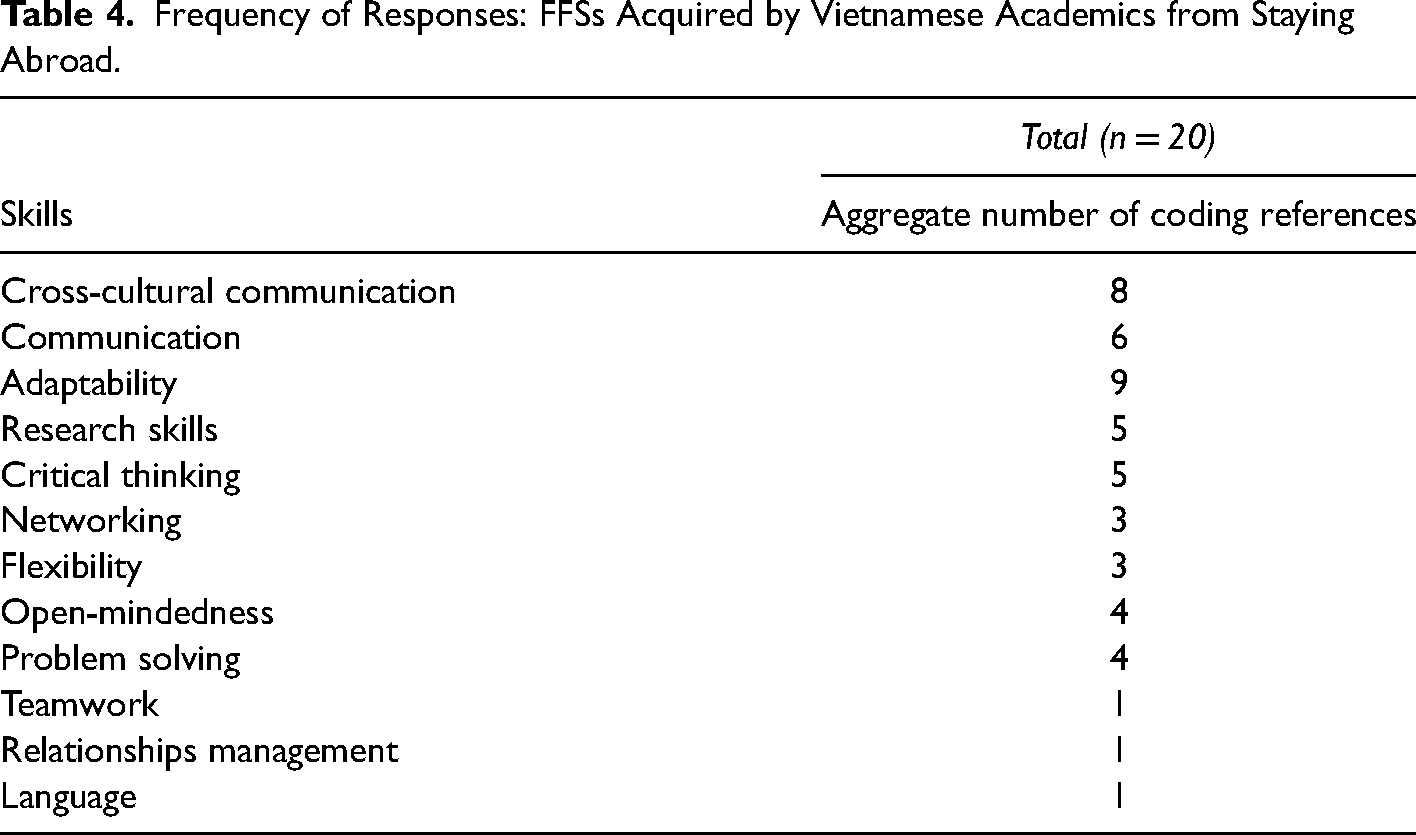
The participants referred FFSs to a set of skills which shares the characteristics of some concepts identified in the literature. The skills summarized in Table 3 and Table 4, were the top FFSs that participants believed to be important, and they could acquire from their international mobility experience.
Vietnamese Academics’ Recognition of FFSs Importance.

0 to 4 scale (0 = don’t know/ no opinions; 1 = Extremely unimportant; 2 = Unimportant; 3 = Important, 4 = Extremely important).
Frequency of Responses: FFSs Acquired by Vietnamese Academics from Staying Abroad.
Flexibility and Adaptability
Surveyed participants indicated their awareness of these skills’ importance to global future-ready citizens with the highest mean score (M = 3.67). The analysis showed that the interview participants gained When I stay in the United Kingdom, I can adapt to different cultures…when I move to the South of England, people are more polite. I think they are not as friendly as the Scots people, so I need to accept it. (P086)
Communication
Surveyed participants showed their high awareness (M = 3.42) of its importance. The analysis showed that the interview participants gained this skill (n = 6) from their opportunities of exchanging information with different people in their academic contexts but also those of their living communities during their mobility participation. As P083 said, “I found myself more proactive - trying to communicate and reaching out to others”.
Open-Mindedness
The interview participants perceived that they gained their open-mindedness (n = 4) from their positive changes whereby they were open to learn new things, acquire new knowledge, understand others, accept, and respect differences, express positive judgements, and overcome stereotypes and prejudices. Living abroad has shaped how I am today as I am more open to people and things around, less judgemental and less talk about people behind their backs, less talk about small things. Instead, I focus more on my work and build up my values. (P008) I am open to original and weird ideas as long as it does not hurt me and makes other people happy. I am much less judgemental. I do not criticise others. I try to refrain a lot from criticism. (P048)
Foreign Language Proficiency
Most interviewed participants shared their experiences in improving their skills of writing, reading, speaking and presentation in English language from their study activities, and their English-speaking skill from their daily communication. When I finished study abroad, my language ability had improved and my communication with foreigners was better. Mastering language helps me be more confident in my work and study. (P083)
Relationship Development and Networking
The interview participants reported that they established connections with international students, teachers, supervisors, and other researchers and international experts in academic networks. They reported that “I can expand my academic network in the future when I get back to Vietnam.” (P005), or “I can exchange and work with more international and Vietnamese colleagues.” (P148). Some participants revealed their relationships development with diverse people through engaging in social activities: I have a connection through social networks. I find it easy, and everyone helps each other. (P028) I felt so lonely when I went to live in another country, so I needed to enlarge my network. I started talking to Vietnamese friends, making friends with people in Belgium and Vietnamese people. (P008)
Cross-Cultural Communication
Surveyed participants showed their awareness of Living in a country and meeting people is the best way to develop cross communication skills. I had a chance to meet different people from different backgrounds, and I gradually adapted to the living environment, and I know how to talk to them…I believe that we don’t have opportunities to develop this skill if we only live in our own country. (P008)
Advanced Research Skills
Our analysis demonstrated the participants’ improvement in advanced research skills. They improved this skill (n = 5) in searching information, analysing information, presenting arguments, applying research approaches, using technological tools for data analysis, and writing papers for publication. P017 said: “I know how to have a study which meets international scientific standards.” while P065 highlighted: “If I had not studied abroad, I might not think to apply for institutional and national grants or bigger grants.”
Critical Thinking and Problem Solving
Most surveyed participants recognised the importance of these skills for global future-ready citizens, accounting for high score means (M = 3.59 and M = 3.67). The interview participants explained they could improve I learned a lot of Western knowledge and I also have a critical mind, so I don't passively absorb it. When I put it in the context of Vietnam, I explain why it is like that and why I thought like that. It helps me reflect, re-evaluate what I did and thought in the past, or why I did that way. (P015) Dealing with situations often helped me improve skills of defending myself in work and daily life, or quickly finding solutions. (P084)
Teamwork/ Cooperation
The survey data support this with a high-rate mean score (M = 3.55) which indicated the participants’ awareness of the importance of I am more confident in teamwork where I raise my hand and share my opinions. I have to agree, disagree, or defend my points of view in a very diverse team. (P048) I have good connections with the Vietnamese student union there. I was the vice-president of that union. (P004)
Our data analysis showed that these identified FFSs appeared in the existing frameworks, such as
Influential Factors Contributing to Future-Focused Skills Development
Our data analysis revealed that participants’ FFSs development arose from two aspects: (1) Personal factors, and (2) External factors.
Personal Factors
New Ways of Thinking
Our analysis revealed that the participants learned to adjust to thinking in an open-minded way. This referred to their willingness of learning new things and knowledge, accepting and respecting differences, overcoming stereotypes, or expressing positive criticism, which enhanced their
Behavioural Adaptation and Changes
The survey data recorded a high rate of responses to
Prior Accumulated Skills and Knowledge
Our analysis of the findings referred this to the participants’ understanding of living and studying and their experiences of mobility and working in another country, which facilitated their adaptation to new life and study abroad. The findings support implications of international experiences for personality development (Grieb, 2023; Zimmermann et al., 2021). This clarifies Dewey's theory regarding the value of experience based on connecting past experiences with present experiences for a person's knowledge and behaviour formation. This aligns with the views of adult learners whose life experiences are typically richer than younger adults because of their background experiences and prior learning (Caffarella & Barnett, 1994; Shallenberger, 2009). This provides another new insight of academics who engaged in postgraduate programs that few studies to this point have revealed.
External Factors
The Learning Environment
The analysis of the survey data demonstrated that the participants responded to the supports related to academic aspects with high response rates. They reported to have developed FFSs
The Living Environment
Surveyed participants agreed there were many possible ways that could enhance their FFSs development. These included situations they were required to deal with, such as
Family-Related Aspects
Nearly one-third of the surveyed participants (n = 43, 32.5%) agreed with
Our analysis of the research findings revealed the combination of Dewey's principles of interaction and continuity and Bandura's model of triadic reciprocal determinism as the frame to underscore how international mobility experience influenced the participants’ FFSs development. These also disclosed the implications of hidden curriculum aspects on building their FFSs. A summary of the interaction of these components is illustrated in Figure 1.

The interplay between personal and external factors for FFSs development.
Our work in this study demonstrated that international mobility programs provided participants and their dependents with life changing experiences, some anticipated and some more part of the “hidden curriculum”. Vietnamese academics studying in English speaking countries, often had not stopped to realize the benefits of the experiences outside the degree they were each earning, and some had not heard of prior the notion of future-focused skills. However, they each in their own way described the immersive nature of life and how their minds broadened to honour diversity, accept uncertainty, appreciate cultural differences, and more. Western culture often creates a harsh cultural side for people from non-western countries. However, the participants in this study showed their resilience and strategies not to be vulnerable to racism, bias, and prejudice that might be brought upon them as individuals or the family members who also relocated with them for these experiences.
There was a strong overlap of our findings to the literature on international mobility experience and our conceptual framework touting FFSs development as important for personal success in a global world. The results of this study can assist those who lead and promote outbound mobility ventures to enhance the ways colleagues are prepared and undertake these life-changing opportunities. The benefits of shaping future-focused skills could be made more prominent in promoting future collaborations with a broader mission related to personal development.
Our results have implications for diverse stakeholders who play equal roles in promoting not only FFSs development but also the richness of lived experiences for international mobility students. Universities who sponsor mobility programs can take on board the research presented in this article and alter their approaches to recruitment, orientation, support, and mentoring of the mobility students so that the experience can be enhanced right from the start. Outside of the bubble of university campus life, there are working class communities struggling with issues that can unwittingly negatively impact foreigners (international students) who enter those communities as places to live. These matters should be addressed with public officials and community leaders and not be left ignored. Supervisors, mentors, and staff should have an awareness of the “whole-life” experience of international mobility participants, and recognize the importance of cultural awareness and uniqueness in varied situations. Many non-English first speaking international students are already working as academics in universities in their home countries. Many involved in mobility programs are already teaching the same subjects in their home countries as are taught in the university where they are studying. However, these same individuals are not often considered as candidates to assist as tutors or lecturers part-time in their host universities. Many are forced to take part-time jobs outside the university in minimum-wage service-level roles to help with family financial needs. This is a wasted opportunity.
Conclusion
In an uncertain post-COVID world, there are generally two responses people with the opportunity to study abroad can take. One is to stay home and avoid the uncertainties of the volatile geopolitical climate. The other is to “go for it”.Our work demonstrates that those adult learners who do “go for it” receive many benefits from the experience, including an international degree. They also position themselves to be relevant in a changing professional landscape because of the growth of their future-focused skills. The future is always changing and unpredictable. I would never say international mobility experience can equip me enough, but I believe at least it gives me confidence to keep improving myself in the future. (P083)
Footnotes
Declaration of Conflicting Interests
Funding
ORCID iD
