







Abstract
Child welfare workers have a critical role in helping and supporting the needs of children and families, but few assessments clearly measure the essential elements of high-quality child welfare practice. The quality of child welfare practice is often discussed in terms of family engagement in the process (Toros et al., 2018), the use of empirically-supported practice skills (D’Aunno et al., 2014), client satisfaction (Tilbury & Ramsay, 2018; Mundy et al., 2016), and child and family outcomes (Forrester et al., 2019; Marsh et al., 2012). Excellence in practice may result in positive outcomes in these areas, but are not themselves descriptive of the quality of child welfare practice (Wells et al., 2015). In striving for excellence in child welfare service delivery, how the worker arrives at desired outcome for children and families, including the skills used, is equally as important as the outcomes themselves.
Current frameworks of child welfare practice elements include broad, comprehensive lists of work competencies (Drake, 1996) or outline general child welfare worker skills (Olin et al., 2014; Keys, 2009; Trotter, 2002; 2004). However, the abstract nature of the skills identified (e.g., empathy, listening) is often difficult to quantify and measure in direct practice with clients. Attempts have also been made to identify and measure the skills and abilities necessary to engage in high-quality direct practice with clients. In the extant literature, there are a number of measures of general social worker skills and competencies designed for specific worker populations (e.g., students, social workers; Jensen et al., 2020; Rowe et al., 2020) or environments (e.g., group work, healthcare settings; Davis et al., 2019; Macgowan et al., 2018), as well as measures that assess specific aspects of quality practice (e.g., cultural competence or relational skills; Leung & Cheung, 2013; Krentzman & Townsend, 2008; Poulin & Young, 1997).
Measures of Child Welfare Practice Skills
A review of measures related to child welfare worker skills revealed three notable scales: (1) The Self-Efficacy in Child Welfare Tasks Scale (SECWT; Ellett, 2009); (2) The Practice Skills Inventory (PSI; O’Hare et al., 1998); and (3) the Case Skills Scale, as part of a child welfare decision-making measure (CSS; Dettlaff et al., 2015). The SECWT (Ellett, 2009 measures the degree to which child welfare workers believe in their capacity to work within their agency, as well as persevere and affect client outcomes. The PSI (O’Hare et al., 1998) measures the frequency in which social workers engage in important practice elements (e.g., client support, insight (e.g., relational skills), therapeutic skills, and case management (e.g., practice skills). Finally, the CSS (Dettlaff et al., 2015) measures child welfare workers perceived skill level across a set of concrete direct practice elements (e.g., interpersonal and case management skills).
Each of these measures has unique strengths, such as clearly operationalized items of measurement (CSS; Dettlaff et al., 2015), confidence in practice skills (SECWT; Ellett, 2009), and assessment of the frequency of skill usage (PSI; O’Hare et al., 1998). However, there are also some important measurement limitations, such as a lack of coverage of cultural competence (CSS; Dettlaff et al., 2015 and PSI; O’Hare et al., 1998), a reliance on workers’ assessment of their own skill level (CSS; Dettlaff et al., 2015 and SECWT; Ellett, 2009), abstract items of measurement (PSI, SECWT and Ellett, 2009), or a focus on general social work competencies above and beyond direct practice with children and families (PSI; O’Hare et al., 1998 and SECWT; Ellett, 2009). We were unable to identify a single self-report measure that: (1) had clearly operationalized concepts, (2) measured the workers’ cultural competence, and (3) measured the workers’ direct practice activities with clients. Notably, some measures ask workers to assess their own skill level, but workers may lack the training to understand how to do so. In the present study, we discuss the development of a measure that unites the strengths of these scales and addresses their limitations, resulting in a comprehensive and concise measure of the elements of child welfare practice (ECWP) excellence.
Purpose of the Current Study
In a larger mixed-methods project examining the organizational environment and approaches to practice with Indigenous child welfare agencies, we sought to develop and test the ECWP measure, a self-report measure assessing relational skills, CPS practice skills, and cultural competence among child welfare agency workers. While this project was not an instrument development study, the process of scale development generally followed the phases outlined by Boateng et al. (2018), which included: (1) developing a conceptual framework and item development, (2) scale development, and (3) scale evaluation. In this article, we review the process of developing a conceptual framework of child welfare practice excellence, including item and scale development, discuss the administration of the measure with three Indigenous child welfare agencies in Canada, and detail the process of scale testing for internal consistency and convergent validity. Notably, while this measure was tested with workers at three Indigenous child welfare agencies in Canada, the underlying conceptual framework applies to child welfare practice across diverse populations.
Method
Conceptual Framework for ECWP Excellence
Child welfare practice excellence encapsulates two primary aspects: (1) the major tasks workers are required to perform and (2) the ability to succeed in those tasks. Workers are required to perform the tasks of working effectively within their organization in ways that align with the agency's mission, value, and vision (Drake, 1996), navigate interorganizational relationships and requirements (Drake, 1996; Trotter, 2004), and engage in direct practice with children and families (Drake, 1996; Trotter, 2004). Based on a comprehensive review and Wells et al., 2015, we developed a conceptual model related to the evaluation of the quality of direct practice with children and families. Figure 1 presents the conceptual model for child welfare practice excellence. In addition to the literature review, we used key informants in the field, including researchers at the National Child Welfare Workforce Institute, the Quality Improvement Center for Workforce Development, and the Institute for the Advancement of Social Work Research, to identify self-report measures of child welfare workers’ quality of direct practice with clients. However, the intent of this scale was not to measure all aspects of child welfare practice quality, but instead, to focus on the skills and abilities of workers engaged in practice with children and families.

Conceptual model for evaluating child welfare practice excellence.
Direct practice with children and families includes three key aspects of practice excellence related to: (1) relational skills, (2) CPS practice skills, and (3) cultural competence (Carnochan et al., 2019; Mundy et al., 2016). Relational skills refer to the worker's ability to empathize with clients and build supportive working relationships that engage children and families in services (Barth et al., 2012; Lundahl et al., 2020; Sinai-Glazer, 2020; Wampold, 2015). Workers foster trusting relationships by actively listening, empathizing with clients’ concerns, and being accessible (Barth et al., 2012; Fuller et al., 2015; Gladstone et al., 2014; Schreiber et al., 2013; Wampold, 2015). CPS practice skills directly facilitate change for clients, such as goal setting and service planning (Barth et al., 2012; Carnochan et al., 2019; Wampold, 2015). Workers must be able to define their roles and expectations, provide knowledge and resources to clients, solve problems collaboratively, and serve as coaches, mediators, and advocates (Chapman et al., 2003; Damiani-Taraba et al., 2017; Fuller et al., 2015; Gladstone et al., 2014; Olin et al., 2014; Schreiber et al., 2013; Trotter, 2002). Finally, cultural competence ensures that workers will treat each client with respect and consideration while offering culturally-appropriate services that incorporate the beliefs and customs guided by the families served (Chapman et al., 2003; Damashek et al., 2012; DeSilva et al., 2018; Wampold, 2015).
Item Development. Item development involves the identification of conceptual domains (i.e., theoretical framework) and item generation, taking into consideration the content and face validity of items. Following our examination of existing measures, a review of the literature, and consultation with child welfare experts, we developed a pool of preliminary scale items related to the conceptual framework and reduced items to fully cover concepts without being redundant. A list of practice elements and preliminary items are presented in Table 1. Items for the ECWP scale were deductively developed by the team, which included an expert in child welfare research and practice, an anti-colonial practitioner with experience working in child welfare, and an investigator with research and practice experience in child welfare, along with a team of research assistants. Items were specifically developed to align with the three main concepts identified in the conceptual framework, which served as the measure's subscales. Items were included after consensus among the investigators, with significant input from those with child welfare practice experiences.
Elements of Direct Practice Excellence and Possible Scale Items Based on the Extant Literature.

The investigators and team independently rated the full pool of preliminary items for their theoretical importance to direct child welfare practice excellence. The research team then narrowed down the item pool to items that met the following criteria: (1) items deemed most essential to child welfare practice excellence, based on empirical literature and expertise of the investigators, (2) items that could be behaviorally operationalized and were concrete enough to be commonly understood across respondents in the child welfare field, and (3) items expected to produce variability in responses. For example, identifying safety concerns are a key element of child welfare practice; thus, would be expected to show a ceiling effect and little variability. Indicators were behavioral and spanned the aforementioned framework of relational skills, CPS practice skills, and cultural competence. Elements identified have been linked to child and family outcomes, family engagement, client satisfaction, and workers’ perceptions of quality practice (D’Aunno et al., 2014; Forrester et al., 2019; Marsh et al., 2012; Mundy et al., 2016; Tilbury & Ramsay, 2018; Toros et al., 2018). Table 1 outlines the theoretical foundations of the literature review and item development for future researchers who wish to continue the development of the ECWP, and provides a list of important child welfare worker skills and abilities, literature sources, and a sample of related scale items.
Additionally, the extant literature has shown that what workers considered to be important to their practice does not always align with what they were able to do in their practice (Aarons et al., 2011). Thus, we wanted to examine which elements workers deemed to be important to their practice and the frequency with which these elements were delivered in their practice. Finally, to fully capture all aspects of practice, we wanted to include items that measured the workers’ perceptions of their practice, similar to measures of practice self-efficacy (Ellett, 2009). Of note, this self-report measure asks workers to report the degree to which elements of practice excellence are important for their practice, how often those elements are delivered, and how they feel about their practice. These items are suitable for self-report, whereas questions about skill level may present a challenge, particularly for new child welfare workers. This scale has the potential to offer the most precise picture of direct child welfare practice excellence, including the elements workers think are important to practice, the elements delivered in their practice, and the perception of their practice.
The resulting 38-item pilot measure represented a first attempt to develop and evaluate such a scale for future use with child welfare workers. This newly developed scale aimed to assess ECWP excellence among child welfare workers and includes items that address the importance of specific elements of practice (Importance Subscale), how often elements were delivered (Delivery Subscale), and workers’ perceptions of their practice (Perceptions Subscale). Responses for the ECWP scale were given on 5-point Likert-type scales. The Importance and Delivery subscale items had the same 17 elements related to practice excellence (e.g., relational skills, CPS practice skills, and cultural competence), but asked either “how important is it to” (1 =
Full ECWP Items and Responses (

Scale Development and Evaluation. The second phase of instrument development includes pre-testing questions, sampling and survey administration, item reduction, and extraction of latent factors (Boateng et al., 2018). Sampling and survey administration are discussed in detail in the procedures and participants section. To evaluate the ECWP, we conducted univariate analyses and polychoric correlations to determine the statistical utility of individual items. Items showing a ceiling effect or limited variability were considered for removal. Additionally, within scales, we examined the level of correlation to determine the redundancy of items, then used the theoretical framework to determine if the item represented a unique construct or if it should be omitted. The final phase of instrument development involves scale evaluation, which includes testing of dimensionality, reliability, and validity of scales (Boateng et al., 2018). Given the small sample size, it was not feasible to conduct a confirmatory factor analysis. Instead, we utilized polychoric correlations to examine the dimensionality of the scales and then calculated ordinal alpha as a test of reliability (Gadermann et al., 2012; Stene et al., 2020; Zumbo et al., 2007). Lastly, we examined the convergent validity of the ECWP scale with the CSS (Dettlaff et al., 2015). Although the CSS (Dettlaff et al., 2015) relies on workers’ perceptions of self and lacks measurement of cultural competence in direct practice, we elected to include it in the survey as a validation measure. The CSS (Dettlaff et al., 2015) is closely conceptually related to the ECWP and has a number of strengths, such as its operationalization of indicators of quality, strong internal consistency (Cronbach's α > 0.94), the large sample used in development (
Procedure and Participants
Participant included workers and supervisors from three delegated Indigenous child welfare agencies in Western Canada. All workers and supervisors in the agency were invited to participate in an online survey containing the ECWP scale during the site visit. Of note, the Canadian Child welfare system has the overarching goal of preventing and protecting children and youth from maltreatment and provides a variety of family support services and child protection services, including risk assessments and out-of-home placements (e.g., kinship care, foster care). Child welfare agencies in Canada are responsible for completing safety assessments, making care plans, and providing support services for families. However, child welfare service provisions in Canada are guided by policies at the provincial or territorial level and vary across the country (Public Health Agency of Canada [PHAC], 2019).
Regarding Indigenous child welfare in Canada, the rights and responsibilities for the provision of child and family welfare services were forcibly removed from Indigenous communities through the
Workers and supervisors were given paid work time to complete the survey during site visits as part of the larger mixed-methods research project examining organizational environment and approaches to practice. The online survey began with a consent form, and included the newly developed ECWP scale and the CSS, an established scale related to practice skills (Dettlaff et al., 2015), along with multiple measures of organizational environment and learning (Potter et al., 2016; Watkins & Marsick, 1997) and a demographic and worker characteristics questionnaire. Participants were anticipated to need 60 min to complete the online survey. A total of 91 participants were invited to complete the survey, with an average response rate of 62.2% (range: 51.3%–73.1%) across the three agencies.
In total, 65 workers and supervisors consented to participate in the survey, with 53 participants completing the ECWP scale. These 53 cases were used for data analysis. Participants were mostly female (84.9%) and between the ages of 30–49 (52.8%). Participants self-identified as Indigenous (45.3%), non-Indigenous (45.3%), or did not respond (9.4%). Participants included caseworkers (50.9%), agency workers (32.1%, e.g., family support workers, kinship workers), and team leaders (15.1%), with (1.9% (
Analytic Approach
First, response frequencies for the ECWP scale were assessed for missingness and lack of variability, with no items excluded based on these criteria. Polychoric correlation analyses were used to support item reduction and testing of dimensionality for the ECWP scale, with ordinal alpha and inter-scale correlations used as a test of internal consistency. Ordinal data from Likert-type items are often treated as continuous, which may lead to spurious results and the overestimation or underestimation of true relationships (Gadermann et al., 2012; Zumbo et al., 2007). To accurately estimate the relationship between items, polychoric correlations (the equivalent of Pearson's correlations) and ordinal alphas (the equivalent of Cronbach's alpha) were employed. Additionally, for smaller sample sizes, polychoric correlations and ordinal alpha are more appropriate to determine item reduction and to test dimensionality (Gadermann et al., 2012; Stene et al., 2020; Zumbo et al., 2007). Items with a polychoric correlation <|.30| were marked as weak correlations and items with a polychoric correlation >|.90| were marked as very highly correlated, indicating the items may be redundant (Cohen, 1988). For items falling into either category, the decision to retain or disregard was based on the conceptual model and discussions among the team members. Thus, in some cases, items showing very high or very low interitem correlations were not excluded based on theoretical support and the expert opinion of investigators. The ECWP subscales related to the Importance, Delivery, and Perceptions of practice were compared to each other, and also compared to the CSS (Dettlaff et al., 2015). While these scales measure different constructs, we hypothesized that the subscales would be positively correlated with each other and with the CSS. Analyses were completed in Stata/MP 15 (StataCorp, 2017) and Rstudio (RStudio Team, 2020).
Results
Item and Scale Descriptions and Reduction
In total, the ECWP measures which elements of practice were considered important and how often workers delivered those elements, specifically related to three aspects of practice: (1) relational skills, (2) CPS practice skills, and (3) cultural competence, as well as the workers’ perception of their practice. Of the original 38 items (17 importance items, 17 delivery items, and 4 perception items), all items were retained. Of note, there were no discernible missing data patterns, and it appeared items were missed at random. Little's test of missing completely at random was not suitable due to the small sample size (Harris et al., 2000). When examining the distribution of responses across items, we found that on the Importance subscale, few respondents selected the “Not at All” response, with most responses falling in the Moderate, Very, or Extremely categories. The Delivery subscale was also negatively skewed, but showed a more equal distribution across the response set. Finally, the Perception subscale had only one strongly disagree response and only a few disagree responses.
To examine the item- and scale-relatedness, we conducted polychoric correlations. The polychoric correlation matrices yielded results ranging from
Polychoric Correlations for ECWP Excellence—Importance Subscale.

Polychoric Correlations for ECWP Excellence—Delivery Subscale.

Polychoric Correlations for ECWP Excellence—Perceptions Subscale

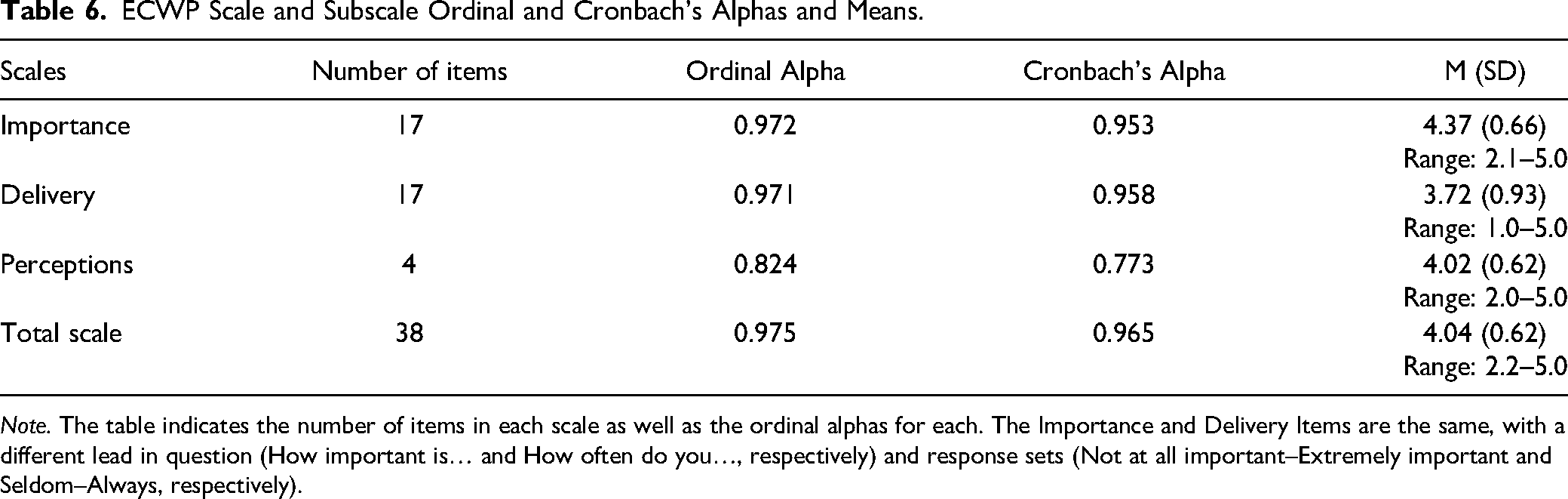
Polychoric correlations were then used to calculate ordinal alphas for the ECWP scale and its subscales. Table 6 presents the ordinal and Cronbach's alphas, as well as the ECWP subscale and total mean scale scores. Using polychoric correlations and ordinal alpha, the total scale and subscales showed excellent internal consistency (ordinal α = 0.824–0.975), which were comparable and slightly higher than the Cronbach's alphas (Cronbach's α = 0.773–0.965). We also calculated and examined the mean scale scores for each subscale and found that the Importance subscale was higher than the Delivery subscale when examining the individual items for discrepancies between responses to Importance and Delivery items. Notably, Item 14 (sees clients regularly) had 43.4% reporting this was extremely important, with 20.8% reporting they are always able to do so. For Item 3 (Take time to get to know my clients), 58.5% reported this as extremely important, with 22.6% reporting they seldom or only sometimes did this and only 28.3% reporting they do this always.
ECWP Scale and Subscale Ordinal and Cronbach's Alphas and Means.
Finally, to examine inter-scale relationships and test convergent validity, we examined the correlations between the ECWP Importance, Delivery, and Perception subscale mean scores with the CSS (Dettlaff et al., 2015) score. There was a strong positive correlation between the Importance and Delivery subscales (
Pearson Correlation Matrix for the ECWP Mean Subscales Scores and CSS Mean Scale Score

*
Discussion
The purpose of this study was to outline the development and testing of a novel measure of child welfare practice excellence. Building from an extensive literature review, we developed a measure of child welfare practice that covered items related to relational skills, CPS practice, and cultural competence, with dual scales addressing the importance of each element and how often each element was delivered as part of their practice. The scale also included four items related to the perception workers had about their practice. Overall, we found high ordinal alphas and inter-scale correlations for the ECWP, as well as convergent validity between the ECWP subscales and the CSS (Dettlaff et al., 2015), suggesting this is a promising measure of child welfare practice. We also considered the ability of the scale to identify the difference between what workers reported was important as compared to what they were doing with clients. We found that the Importance subscale tended to be negatively skewed, but did not have significant concerns with ceiling effects. This supported our initial decision to provide more response options at the positive end of the scale. However, future iterations of the scale may want to consider responses that validate the importance of each element, while also measuring the degree of importance (e.g., Least important to Most important). We also saw a trend toward negative skew in the Delivery scale, again with no concerns related to ceiling effects. Thus, it appeared the response set for the Delivery scale was well-suited with this sample. Finally, respondents mostly agreed or strongly agreed with the items in the Perception, which may indicate that workers within these agencies were confident about their abilities. However, given that this sample was small and focused on Indigenous child welfare agencies, further testing is required to support these findings, and should include focus groups with child welfare workers to ensure the meaningfulness of these scales, items, and response sets.
Limitations. This study was part of a larger mixed-methods project examining organizational environment and approach to practice and was not specifically designed to be a measurement validation study. Further, given the size of the sample, we were limited in our analytic approach for the validation of this measure. Future studies should include larger samples to enable the use of advanced psychometric statistical approaches (e.g., item response theory, factor analysis) to test the scale dimensions, reliability, and validity. Additionally, it would also be beneficial to include focus groups and consultation with current child welfare workers and agency leadership regarding the items and scales included, as well as the response sets used. Finally, while this scale was developed using a comprehensive literature review, it was tested among three Indigenous child welfare agencies from a similar geographic location in Western Canada. The scale may function differently among workers from non-Indigenous agencies outside of Western Canada, and should be tested in additional Indigenous and non-Indigenous child welfare agencies across Canada and in other countries (e.g., United States, Australia).
Discussion and Applications to Practice
In sum, the ECWP scale is a novel instrument that appears to be internally consistent and can be used to assess the ECWP excellence, including what workers considered to be important to their practice, what elements they regularly engaged in with their clients, and their perceptions of their practice. The conceptual model identified multiple constructs and items that were relevant, with items for the ECWP selected by a team with various child welfare practice and research expertise. Future studies should consider conducting focus groups with current child welfare workers and team leaders to validate or improve item selection. This measure should be tested with a larger sample of child welfare workers. Further, the ECWP scale should be tested with other measures related to child welfare practice, including the SECWT (Ellett, 2009) and the PSI (O’Hare et al., 1998). Additionally, future research may include utilizing a concept mapping approach, which allows for the brainstorming of ideas and the mapping of complex concepts related to underlying constructs (Hanson et al., 2013; Lebel et al., 2011; Trochim, 1989) or a Delphi method (Busschers et al., 2016; Hsu & Sandford, 2007) to reach consensus about elements essential to practice excellence.
A notable strength of the ECWP is the inclusion of scales that ask about the importance of practice elements, the delivery of practice elements, and worker perception of their practice. These three elements have the potential to inform how agencies assess practice and determine areas for future practice approach development. Understanding what workers believe to be important about practice can help tailor worker training programs aimed at improving practice, whereas having an assessment of what workers are doing with clients can help inform any gaps in practice. Further, the inclusion of these three subscales can enable agency leadership and workers to identify elements of practice where the reported level of importance does not align with delivery. For instance, a worker may report that they believe it is important to include the client's culture in practice, but if the service guidelines or tools do not include a space for cultural inclusions, workers may report lower levels of delivery in this area. This would provide evidence that there should be an organizational change to address the issue.
Additionally, a mismatch in importance and delivery may be related to individual worker resources, such as time limitations, access to resources, job stress, or burnout. Future research should examine differences between the importance and delivery scales, and then examine if there are any individual, team, or organizational level factors associated with any discrepancies. For example, the ECWP could be used in conjunction with a measure of organizational environment, which would include scales related to burnout, agency resources, training, caseload, peer support, etc. Used in conjunction, this would enable us to examine how external organizational and individual-level factors shape what worker see as important in their practice, the elements they regularly deliver, and how they perceive their practice. Thus, providing valuable information to ensure child welfare practice excellence. This initial measure shows promise in identifying what workers see as important ECWP, and how those elements are delivered.
Footnotes
Acknowledgments
Declaration of Conflicting Interests
Funding
ORCID iD
