







Abstract
Keywords
Introduction
Entrepreneurship has been extensively identified as a crucial driver of employment and economic development (Rauch & Hulsink, 2015). When this concept was first introduced, scholars believed that entrepreneurship was a talent or an ability that an individual inherited from their previous generations (Combs et al., 2023). Today, entrepreneurship literature acknowledges that education and training can help realize an individual’s goal of becoming an entrepreneur (Jena, 2020; Walter & Block, 2016). Therefore, entrepreneurship education has been emerging as an important research stream in entrepreneurship literature (Sundermeier & Steenblock, 2023) and has been utilized as a policy tool to enhance entrepreneurial intentions in many nations (Nwokolo et al., 2017). Although entrepreneurship education has been recognized as a predictor of entrepreneurial intentions, empirical studies on this relationship reported mixed findings as some studies found a positive effect (Karimi et al., 2016; Souitaris et al., 2007) while others found a negative effect or lack of relationship (Duong, 2022; Oosterbeek et al., 2010). Existing entrepreneurship literature does not appear to provide adequate explanations for these inconsistent findings.
To address the concerns about equivocal empirical findings that hinder our understandings of the impacts of entrepreneurship education, the current study proposed that the association between entrepreneurship education and entrepreneurial intentions can be more complex than a linear association. To go beyond the previous models, this study extended the analysis to investigate potential curvilinear effect of entrepreneurship education on entrepreneurial intentions based on the social cognitive theory (Bandura, 1986). Specifically, a theoretical model specifying a curvilinear association between entrepreneurship education and entrepreneurial intentions was developed which also considered the mediating role of entrepreneurial passion and the moderating effect of resilience.
Theorists have highlighted the importance of emotion regulation in general and entrepreneurial passion in particular on entrepreneurial intentions as well as its mediating role on the linear relationship between entrepreneurship education and entrepreneurial intentions (Uddin et al., 2022). However, empirical studies show mixed findings regarding the effects of entrepreneurship education on entrepreneurial passion: some reveal a clear relationship (Anwar et al., 2023; Porkodi & Saranya, 2023), while others indicate no substantial link (Oosterbeek et al., 2010). To explain these inconsistent effects, scholars suggested that different mechanisms occurring at different levels of entrepreneurship education might indicate a curvilinear effects (Chung et al., 2022; Hahn et al., 2017). With the inconsistency in empirical evidence regarding the capability of entrepreneurship education to cultivate entrepreneurial passion, it becomes essential to delve into examining the potential curvilinear influence of entrepreneurship education on entrepreneurial passion (Bae et al., 2014).
Furthermore, our review of the entrepreneurship literature identified very limited empirical evidence on the moderating role of resilience in the entrepreneurial process. Few studies have identified the moderators of the entrepreneurship education and entrepreneurial intentions relationship such as educational fields (Duong, 2022) and entrepreneurial alertness (Sang & Lin, 2019), rather than resilience though resilience has served as a critical factor in the entrepreneurial process (Bullough et al., 2014; González-López et al., 2019). To address these theoretical gaps and extend the research streams on entrepreneurship education and entrepreneurial intentions, this study focused on unpacking the role of entrepreneurial passion as a mediator and the role of resilience in accentuating the effect of entrepreneurship education on entrepreneurial intentions.
Overall, this study makes significant contributions to the entrepreneurship literature by identifying the antecedents of entrepreneurial intentions. Furthermore, by investigating the mediating role of entrepreneurial passion, this study advances a theoretical mechanism that can explain why low and high entrepreneurship education may produce desired entrepreneurial intentions while a moderate level of entrepreneurship education might lead to low level of entrepreneurial intentions. Third, the moderating effect of resilience on the association between entrepreneurial passion and entrepreneurial intentions is unpacked, extending the current theory which has so far ignored the role of contingent conditions of resilience on the entrepreneurship education–entrepreneurial intentions relationship (González-López et al., 2019).
Literature Review
Social Cognitive Theory
Based on the premises of the social cognitive theory (Bandura, 1986), this study investigated the impact of entrepreneurship education on students’ entrepreneurial intentions. Social cognitive theory has been adopted in several studies to examine the psychological mechanisms and determinants that affect attitudes and behaviors (Bandura, 1986). This theory proposes an inseparable triadic structure controlling individual behavior, which includes behavioral, environmental and personal determinants (Bandura, 2009). The determinants in this structure dynamically and bi-directionally interact with each other and this mutual influence occurs simultaneously and with equal strength (Bandura, 1986, 2009).
In line with prior studies that adopted the social cognitive theory to explain the association between entrepreneurship education and entrepreneurial intentions (Shinnar et al., 2014; Tantawy et al., 2021), we posited that entrepreneurship education acts as an environmental determinant to affect students’ entrepreneurial intentions, which is a behavioral determinant. Furthermore, the students’ personal factors, that is, entrepreneurial passion and resilience, were considered to provide a well-rounded view on the mechanisms of promoting entrepreneurial intentions.
Entrepreneurship Education and Entrepreneurial Intentions: A Curvilinear Hypothesis
Entrepreneurship education is a specific type of education that provides opportunities for students to not only learn from classroom-based theory, but also interact with and observe instructors, investors, entrepreneurs, and other network events (Nabi et al., 2017). On top of the classroom activities, students are provided with internships to not only obtain the entrepreneurial skills, such as creating a business plan, but also nurture a positive attitude toward entrepreneurial activities, such as its risky and uncertain environment (Souitaris et al., 2007).
Prior research proposed that entrepreneurship education is generally beneficial to students’ entrepreneurial intentions (Nowiński et al., 2019). The theoretical mechanism underlying this effect is a reciprocal social cognitive process that considers entrepreneurship education as a determinant that provides the fundamental knowledge and skills for entrepreneurial competence that learners need to translate ideas into entrepreneurial intentions (Nabi et al., 2017). However, as mentioned earlier, not all studies have consistently found positive effects of entrepreneurship education on entrepreneurial intentions. We therefore argue that the association between entrepreneurship education and entrepreneurial intentions might operate in a nonlinear form. Specifically, this relationship might be a U-shaped curve, where entrepreneurship education negatively influences entrepreneurial intentions up to an inflection point, but beyond this point, the relationship increases and becomes positive.
Bogan and Darity (2008) suggest that although educational attainment has a positive effect on self-employment, individuals who receive different levels of education develop dissimilar experiences on the likelihood of self-employment. Students who receive little entrepreneurship education (e.g., exposure to few lectures or cases on entrepreneurship) tend to rely on their own worldviews and a unified attitude toward entrepreneurship resulting from their personal experience from daily life (Kalina & Powell, 2009). They may possess a rather high level of personal curiosity about doing business (Dekker et al., 2010).
As entrepreneurship education increases from a low to moderate level, however, the conflicts between a student’s own perception and classroom-based theory occur, which affect their personal beliefs about entrepreneurial activity and thus prevent the development of a business plan (Kalina & Powell, 2009; Roxas, 2014). Therefore, as entrepreneurship education reaches moderate levels, students’ resistance to risks and uncertainties may emerge. Through a moderate level of entrepreneurship education, which increases students’ awareness of multiple barriers to entrepreneurship, such a conflict is potentially maximized and the motivation to venture a business may be undermined.
However, students who receive high entrepreneurship education could be more confident about their entrepreneurial competencies, and conflicts between their personal beliefs and academic knowledge will be reduced (Sánchez, 2013). As entrepreneurship education surpasses the moderate level, it can inculcate students’ competency, as it not only provides the students with classroom-based theory but also practical interactions with other opportunities in the environment, such as business plan competitions, internships, and accelerators (Adomdza, 2016). A student with high levels of entrepreneurship education may not be inhibited by personal bias and fear, and becomes more confident to develop a business plan (Oo et al., 2018). In line with the social cognitive theory, we posit that the processes associated with cognitive changes are fully realized within high levels of entrepreneurship education, which further enhances entrepreneurial intentions. Therefore, the following hypothesis is formulated:
Hypothesis 1 (H1): Entrepreneurship education has a U-shaped association with entrepreneurial intentions.
The Mediating Role of Entrepreneurial Passion
Entrepreneurial passion refers to the “consciously accessible, intense positive feelings experienced by engagement in entrepreneurial activities associated with roles that are meaningful and salient to the self-identity of the entrepreneur” (Cardon et al., 2009, p. 517). Entrepreneurial passion grows when the individual demonstrates intense positive feelings toward the specific entrepreneurial activities they participated in and a strong motivation to pursue those feelings (Cardon et al., 2017). On the basis of the distinct roles of an entrepreneur, Cardon et al. (2013) created the measurement of the entrepreneurial passion construct which includes three dimensions namely passion toward founding, inventing, and developing. As the goal of this study was to examine the association between entrepreneurial passion and entrepreneurial intentions of students who had yet to become entrepreneurs, only the passion toward founding dimension was investigated, which focuses on the process of creating a new business (Cardon et al., 2013; Türk et al., 2020).
We expected that entrepreneurship education would demonstrate a curvilinear association with entrepreneurial passion. In light of social cognitive theory (Bandura, 1986), entrepreneurship education represents one of the environmental factors that influence entrepreneurial passion, which is considered a personal factor. When entrepreneurship education moves from a low to moderate level, as theorized earlier, the conflict between a student’s own perception and classroom-based theory is likely to grow (Schellenberg & Bailis, 2015), which discourages them from being dedicated and making an effort to start a business. As entrepreneurship education hits a moderate level, resistance to risks, and uncertainties among students may increase. As a consequence of the difficulties linked to the moderate levels of entrepreneurship education, entrepreneurial passion may diminish, leading to the negative association between entrepreneurship education and entrepreneurial passion.
When entrepreneurship education goes beyond the tipping point and further rises, entrepreneurial passion is expected to start growing. High levels of entrepreneurship education will be able to reduce the barriers to entrepreneurial passion because students become more confident about their entrepreneurial competences, and conflict between personal beliefs and practical experiences of academic knowledge will be diminished (Arshad et al., 2018). Students who receive a high level of entrepreneurship education would not only comprehend classroom-based theory but also have practical interactions with opportunities outside the classroom, which might reduce such a conflict and thereby enhance their passion toward founding a business (Costa et al., 2018). When students put more effort into acquiring knowledge as well as learning new skills, it is also more likely that students will harmonize their personal actions and align their abilities with entrepreneurial goal accomplishments (Mwasalwiba, 2010). With more specific directions from high levels of entrepreneurship education, students may be aware of the market gap and how to interpret the market information correctly, which may enhance their entrepreneurial passion (Costa et al., 2018). In harmony with the social cognitive theory, we posited that the processes associated with cognitive changes are fully realized within high levels of entrepreneurship education, which further encourages entrepreneurial passion. Therefore, it is hypothesized that:
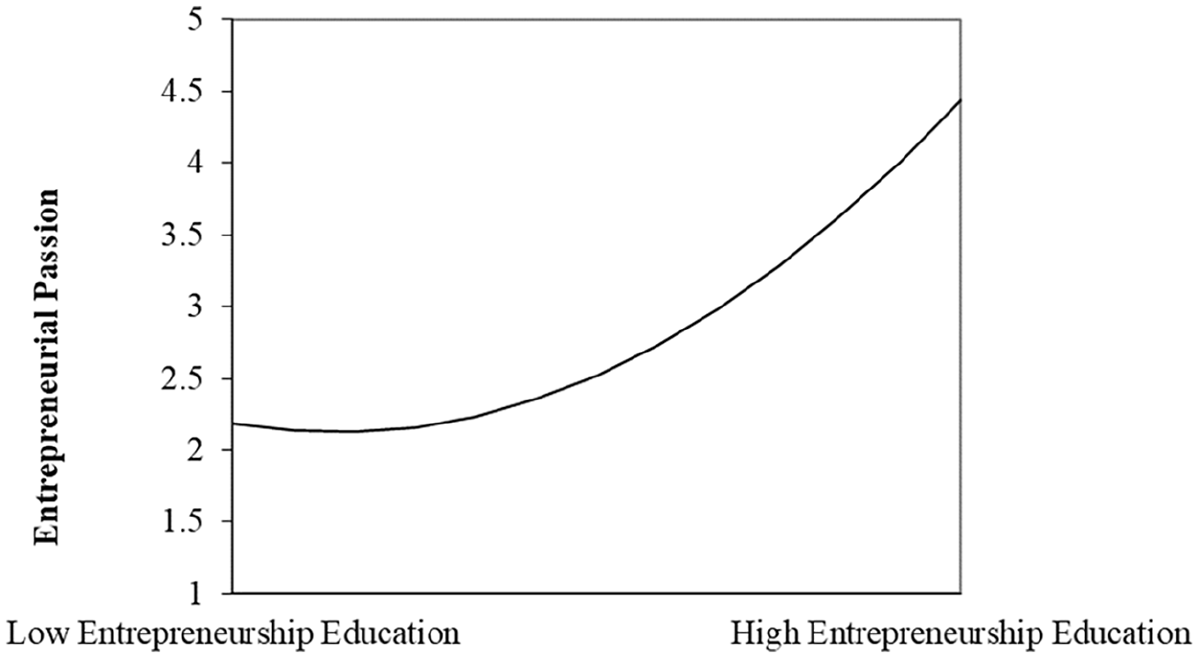
Hypothesis 2 (H2): Entrepreneurship education has a U-shaped relationship with entrepreneurial passion.
Scholars argued that entrepreneurial passion can be considered an affective state which plays the role of a personal determinant to affect the intentions to establish a new business (Biraglia & Kadile, 2017; Cardon et al., 2009). First, the passion to create values and make an impact is a vital attribute of entrepreneurs which determines their successes or failures (Fellnhofer, 2017). Entrepreneurial passion is suggested to activate the essential energy for both potential and actual entrepreneurs to overcome the difficulties and challenges during the entrepreneurial process (Cardon et al., 2009). Second, persons who possess entrepreneurial passion may consider entrepreneurial activities a hobby, meaning that they follow these activities for their own enjoyment and are willing to achieve entrepreneurial goals in a volitional way (Biraglia & Kadile, 2017). In other words, while getting involved in the entrepreneurial hobby, passionate individuals are intrinsically motivated to engage in the intentions to create a new venture, which indicate the behavioral determinant of social cognitive theory. Therefore, we argued that entrepreneurial passion enhances students’ entrepreneurial intentions and proposed the following hypothesis.
Hypothesis 3 (H3). Entrepreneurial passion is positively associated with entrepreneurial intentions.
Given that entrepreneurial passion plays the role of personal determinant, it is a crucial mechanism through which environmental determinants (i.e., entrepreneurship education) translate to behavior determinants (i.e., entrepreneurial intentions). Taken together, we expect that entrepreneurship education has a U-shaped association with entrepreneurial intentions via entrepreneurial passion. Therefore, the following hypothesis was formulated.
Hypothesis 4 (H4). Entrepreneurial passion mediates the U-shaped association between entrepreneurship education and entrepreneurial intentions.
The Moderating Role of Resilience
Although resilience is suggested to be a crucial attribute that influences an entrepreneur’s success, the entrepreneurship literature witnesses limited empirical evidence on the moderating role of resilience in the entrepreneurial process (Brewer et al., 2019; González-López et al., 2019). Resilience has been conceptualized as an effective adaptation and the ability to overcome stress, adversity, or change ( M. H.Li & Yang, 2016). Other definitions combined both notions of resilience, including surviving and thriving (Nugent et al., 2014). This means that after hard times, people who possess resilience are not only able to return to a pre-existing state (Gerson & Fernandez, 2013) but also to learn and grow (Beltman et al., 2011). In this research, resilience is defined as “an ability to go on with life, or to continue living a purposeful life, after hardship or adversity” (Tedeschi & Calhoun, 2004, p. 4). Resilience is shaped during a learning process through the interaction of an individual with the surrounding environment. Bullough et al. (2014) argue that resilience can be learned over time via an acceptance of reality, trust in the meaning of life, and a remarkable ability to cope with difficulties.
Considering social cognitive theory, resilience can be considered a personal factor that affects an individual’s behavior in a time of stress or after failure (Bullough et al., 2014; Bullough & Renko, 2013). As entrepreneurship is a challenging process, individuals who possess entrepreneurial passion may face a lot of stressful moments from the idea generation stage to actual business creation (Santoro et al., 2020). Therefore, resilience can interact with entrepreneurial passion to pursue entrepreneurial intentions, even under difficult circumstances. It can be argued that when individuals have high resilience, entrepreneurial passion will exert a stronger positive effect on entrepreneurial intentions. In contrast, when individuals have low resilience, entrepreneurial passion will show a weaker positive effect on entrepreneurial intentions because the individual tends to react in fear if they have to deal with hardship. The following hypothesis was thus proposed:
Hypothesis 5 (H5). Resilience moderates the association between entrepreneurship passion and entrepreneurial intentions, such that this association is weaker when resilience is low and stronger when resilience is high.
Current Studies
We tested the five hypotheses in two studies, which were conducted using different data samples with a 1-year time lag. In Study 1, we utilized a sample of undergraduate students studying in technology programs to test the curvilinear association between entrepreneurship education and entrepreneurial intentions. Study 2 used a sample of undergraduate students from business programs to test the mediating effect of entrepreneurial passion on the curvilinear entrepreneurship education–entrepreneurial intentions association and the moderating effect of resilience on the association between entrepreneurial passion and entrepreneurial intentions. Figure 1 illustrates the research model in this study.

Research model.
Vietnamese university students from technology and business programs were chosen for these studies for three reasons. First, prior research suggests that university students can be the most suitable for entrepreneurial intentions study due to how significant career choices are to them (Meoli et al., 2020). Second, prior studies suggest that Vietnamese students who graduated from technology and business disciplines are the most likely to be involved in entrepreneurial activities and create ventures (Vuong et al., 2020). Third, Vietnam was selected as the research context because the country is a dynamic economy in the Asia-Pacific region. In the past decade, Vietnam has become an entrepreneurial nation (OECD, 2021). Specifically, investments in tech startups in Vietnam increased eightfold between 2016 and 2019, peaking at US$861 million in 2019 (Kaur, 2021). Between 2017 and 2020, the number of Fintech startups in the country rose from only 44 to 123, proving that Vietnam could become one of the leading startup hubs in Southeast Asia (Nguyen et al., 2021).
Study 1: The Curvilinear Relationship Between Entrepreneurship Education and Entrepreneurial Intentions
Method
Data Collection
An online survey was conducted as part of the data collection efforts. Our research team initiated this endeavor by reaching out to the heads of departments responsible for undergraduate technology courses across five universities in Vietnam. We managed to secure their consent to approach their students for participation. Collaborating closely with these department heads and lecturers, we orchestrated the distribution of an email, containing both the survey link and a comprehensive cover letter, to a total of 921 students. Within this cover letter, we presented a clear overview of the research objectives and assured respondents of the utmost confidentiality and anonymity throughout the survey process. It is important to note that we emphasized the voluntary nature of participation, stressing that an inclination toward entrepreneurship was not a prerequisite for involvement in the survey. As a result of our outreach efforts, we received a substantial response, with 586 questionnaires completed by eager students, representing a response rate of 63.6%. However, in the interest of data integrity, 32 questionnaires had to be excluded due to incompleteness. Consequently, we ended up with a final dataset comprising 554 usable questionnaires, accounting for 60.2% of the initial pool.
Measures
A 5-point Likert scale was used to assess both entrepreneurial intentions and entrepreneurship education constructs. To ensure the translation quality, the back translation procedure (Brislin, 1970) was adopted to translate the original questionnaire from English into Vietnamese and then back into English.
The six-item scale created by Liñán and Chen (2009) was adopted to assess the students’
This study controlled for student demographic variables, including gender, year of study, and family entrepreneurial background, because these variables have been identified to affect entrepreneurial intentions (Hsu et al., 2019).
Analytical Strategy
Because this study used self-reported data from a single source of undergraduate students, common method variances could potentially affect the result. We thus strictly adhered to the guideline proposed by Chen et al. (2014) by applying a priori and post-hoc techniques to address the common method variance issue.
To ascertain the distinctiveness of the constructs under examination, confirmatory factor analysis (CFA) was conducted through the use of AMOS 27. In order to evaluate the model’s fitness, we applied several fit indices, including the incremental fit index (IFI), comparative fit index (CFI), Tucker Lewis index (TLI), and root mean square error of approximation (RMSEA). Hierarchical regression analysis was then conducted using SPSS 27 to test H1 by including the variables in different stages. The squared value of entrepreneurship education was used to assess its curvilinear relationship with entrepreneurial intentions (Lin et al., 2017).
Results
Common Method Variances and Descriptive Analysis
Regarding a priori approaches, we have followed these steps: (1) guaranteeing the confidentiality and anonymity of the participants and (2) pre-testing, revising, and enhancing the quality of the scales. Considering the post-hoc approaches, Harman’s one-factor was first conducted to test to assess common method variances (Podsakoff et al., 2003). Harman’s one-factor test revealed that the result of the largest unrotated factor was 39.36%, which is below the cutoff point of 50%, as suggested by Podsakoff et al. (2003). Second, the marker variable technique was applied to offer a proxy for common method variance by adding an irrelevant variable to the principal constructs in the hypothesized model (Lindell & Whitney, 2001). The correlations between the marker variable and other variables, ranging between −.025 and .059, were not significant. After removing the marker variable, all the other significant correlations remained significant (see Table 1). Thus, common method variances are not a problem of this study.
Correlations, Descriptive Analysis, AVE, CR, Cronbach’s Alpha: Study 1.

The results of descriptive statistics, correlations between variables, reliability test, and validity test are exhibited in Table 1. As presented, the Cronbach’s alpha of all the constructs surpassed .7, proving that the measures are reliable (Nunnally, 1978). In addition, the composite reliabilities (CR) estimates surpassed the minimum cutoff value at .60 (Bagozzi & Youjae, 1988), while the average variance extracted (AVE) values crossed the cutoff value of .5, indicating high internal consistency and validity of the constructs (Fornell & Larcker, 1981).
Confirmatory Factor Analysis
In line with established guidelines for model assessment (Hair et al., 2010), we considered an IFI value exceeding 0.90, a CFI value exceeding 0.90, a TLI value surpassing 0.90, and an RMSEA value falling below 0.08 indicative of a favorable model fit. The outcomes of the CFA, as summarized in Table 2, affirm the model’s robust fit to the data (χ²/
Confirmatory Factor Analysis: Study 1.

Curvilinear Effect of Entrepreneurship Education on Entrepreneurial Intentions
To test H1, hierarchical regression analysis was conducted using SPSS 27. A model, in which the entrepreneurial intentions construct was regressed on student gender, year of study, family background, and entrepreneurship education, was first estimated (Model 1,
Results of Hierarchical Regression Analysis: Study 1.


The curvilinear association between entrepreneurship education and entrepreneurial intentions.
Discussion of Study 1
The findings of Study 1 provide support for the arguments on a curvilinear association between entrepreneurship education and entrepreneurial intentions. Although the result is promising, some limitations should be acknowledged. First, Study 1 lends preliminary credence for a curvilinear influence of entrepreneurship education on entrepreneurial intentions, however we did not know the underlying mechanism explaining why moderate education can reduce entrepreneurial intentions and low and high education foster students’ entrepreneurial intentions. Second, data used in Study 1 were collected from technology students which limited the generalizability of the results to other disciplines. To address these limitations and strengthen the results of Study 1, Study 2 was conducted to investigate the underlying mechanism using data obtained from a different source (i.e., undergraduate student enrolled in business programs) to improve the generalizability of this research.
Study 2: The Roles of Entrepreneurial Passion and Resilience
Method
Data Collection
One year after Study 1, we conducted Study 2, focusing on gathering data through an online survey designed to assess various aspects of participants’ characteristics, educational backgrounds, and career aspirations. To enhance the robustness and generalizability of the findings, we directed our attention toward a diverse sample of undergraduate students enrolled in business-related academic programs, including fields such as economics, business, marketing, and finance. This survey encompassed students from nine Vietnamese universities.
Following the precedent set by Study 1, we reached out to the heads of departments responsible for overseeing undergraduate business courses at these nine universities. Our request for permission to engage with their students was met with a positive response, and they graciously extended their support in facilitating our research. Subsequently, we dispatched a comprehensive email package to 960 students, comprising a survey link and an informative cover letter. Within this cover letter, we provided a lucid exposition of the research objectives and reinforced our commitment to safeguarding the confidentiality and anonymity of all participants. We made it clear that participation was entirely voluntary and that possessing an inclination toward entrepreneurship was by no means a prerequisite for taking part in the survey. This concerted effort culminated in a noteworthy response rate, with 745 students completing the questionnaires, representing a commendable participation rate of 77.6%. Nevertheless, 24 questionnaires had to be excluded due to incomplete responses, ultimately yielding a final dataset comprising 721 meticulously completed and usable questionnaires, constituting 75.1% of the initial pool.
Measures
In line with Study 1, we used a 5-point Likert scale to assess the constructs in Study 2. The back translation was also followed in translating the original questions from English into Vietnamese and then back into English (Brislin, 1970) to secure the clarity and accuracy of the translation.
In Study 2, we also controlled for demographic variables, including student gender, year of study, and family entrepreneurial background, which have been identified to have impacts on entrepreneurial intentions (Hsu et al., 2019).
Analytical Strategy
In line with Study 1, Study 2 employed a combination of a priori techniques and post-hoc approaches to address the potential challenge of common method biases, as prescribed by Chen et al. (2014). In order to evaluate the suitability of the model and ascertain the distinctiveness of the constructs, we conducted a CFA test utilizing the AMOS 27 software. Fit indices, including IFI, CFI, TLI, and RMSEA, were used to assess the model fitness, following the suggestion of Hair et al. (2010).
Hierarchical regression analysis was conducted using SPSS 27 to investigate the relationships between the variables. We used the squared value of the independent variable to assess its curvilinear effect on the dependent variable (Lin et al., 2017). To test the indirect curvilinear effect of entrepreneurship education on entrepreneurial intentions via entrepreneurial passion (H4), we adapted the Monte Carlo method (Preacher et al., 2010) to obtain confidence intervals (CIs) using the PROCESS plug-in in SPSS. The investigation into the moderating influence of resilience on the relationship between entrepreneurial passion and entrepreneurial intentions harnessed the insights gained from both hierarchical regression analysis and graphical visualization.
Results of Study 2
Common Method Variance and Descriptive Analysis
Initially, we took rigorous measures to uphold the confidentiality and anonymity of respondent data, alongside questionnaire design and testing. Subsequently, we conducted Harman’s one-factor test, revealing that the largest unrotated factor accounted for only 45.3% of the variance, comfortably below the critical threshold of 50% recommended by Podsakoff et al. (2003). To further scrutinize and mitigate common method variance, we introduced a marker variable beside the primary constructs within the hypothesized model. Notably, the correlations between the main variables and the marker variable remained non-significant, while other significant correlations persisted even after the marker variable’s removal (Table 4). Lastly, we assessed collinearity using variance inflation factors (VIF) to evaluate the strength of correlations between independent variables (Kock, 2017). The findings demonstrated that the highest VIF value observed was 1.1, which was below the established benchmark of 3.3 (Kock, 2017). Collectively, these results support the assertion that common method variances did not introduce significant biases into Study 2.
Correlations, Descriptive Analysis, AVE, CR, Cronbach’s Alpha: Study 2.

Table 4 showcases a comprehensive presentation of our descriptive statistics, correlation analysis, as well as reliability and validity assessments. The reliability testing, consistent with Nunnally’s (1978) guidelines, indicated that all constructs boasted Cronbach’s alpha values exceeding the commendable threshold of .7. Furthermore, our examination of construct reliability (CR) surpassed the minimum cutoff value of .60 as suggested by Bagozzi and Youjae (1988), while the average variance extracted (AVE) values exceeded the recommended threshold of .5 as established by Fornell and Larcker (1981). These findings collectively reinforce the robustness of the measurement model.
Confirmatory Factor Analysis: Study 2
The CFA results, as depicted in Table 5, substantiate the model’s excellent fit with the empirical data (χ²/
Confirmatory Factor Analysis: Study 2.

Mediation Effect of Entrepreneurial Passion
H2 posits that there was a U-shaped association between entrepreneurship education and entrepreneurial passion. To test H2, we first estimated Model 1 in which entrepreneurial passion regressed on entrepreneurship education, gender, year of study, and family background (Model 1,
Hierarchical Regression Analysis Results: Study 2.


The curvilinear effect of entrepreneurship education on entrepreneurial passion.
To test the H3, we estimated Model 3, Model 4, and Model 5. In the Model 3, entrepreneurial intentions were regressed on entrepreneurship education, gender, year of study, and family background (Model 3,
Based on 5,000 bootstrap samples, the indirect curvilinear association between entrepreneurship education and entrepreneurial intentions via entrepreneurial passion was significant, and the upper and lower bounds did not contain zero (0.035, 95% CI [0.026, 0.045],
The indirect curvilinear effect of entrepreneurship education on entrepreneurial intentions.
Moderation Effect of Resilience
Hypothesis 5 (H5) posited that the link between entrepreneurial passion and entrepreneurial intentions would be moderated by resilience. To test H5, we first executed Model 6, wherein entrepreneurial intentions were regressed on variables encompassing entrepreneurship education, entrepreneurship education-squared, resilience, gender, year of study, and family background (Model 6,
Subsequently, we embarked on an assessment of a moderation model (Model 7,

The moderating role of resilience on the entrepreneurial passion-entrepreneurial intentions association.
Discussion of Study 2
Study 2 sought to examine the underlying mechanism explaining why low and high levels of entrepreneurship education enhanced entrepreneurial intentions and moderate level of education reduced entrepreneurial intentions. By constructively replicating and extending the findings of Study 1, Study 2 revealed an indirect curvilinear relationship between entrepreneurship education and entrepreneurial intentions through the mediating role of entrepreneurial passion. Furthermore, Study 2 found evidence to support the moderating role of resilience on the association between entrepreneurial passion and entrepreneurial intentions. In sum, the findings in Study 2 corroborated and extended the results from Study 1. Next, we discuss the findings of both studies.
General Discussion
Drawing upon social cognitive theory, Study 1 posits and provides evidence for the U-shaped relationship between entrepreneurship education and entrepreneurial intentions. The results of Study 2 further identify entrepreneurial passion as a mediation mechanism for such a U-shaped relationship, as well as the role of resilience in accentuating the positive link between entrepreneurial passion and entrepreneurial intentions.
Theoretical Implications
The results of our studies contribute to the entrepreneurship literature in various respects. First, the inquiry advances the stream of entrepreneurial intentions research by extending the extant understandings of how entrepreneurship education shapes students’ entrepreneurial intentions. This study lends credence to H1 concerning the U-shaped relationship between entrepreneurship education and entrepreneurial intentions. The finding indicates the presence of a tipping point, where the negative link between entrepreneurship education and entrepreneurial intentions is minimized to a point (i.e., moderate level of entrepreneurship education), and when entrepreneurship education surpasses that point, entrepreneurial intentions start to rise. Through this finding, this study bridges a critical void in the literature, in which prior inquiries have given predominant attention to the linear association of entrepreneurship education to students’ entrepreneurial outcomes in general (e.g., entrepreneurial knowledge, entrepreneurial mindset, and entrepreneurial preparation; Santoro et al., 2020) and entrepreneurial intentions in particular (Biswas & Verma, 2021; Israr & Saleem, 2018; Liu et al., 2019; Santoro et al., 2020). The negligence of prior studies on the potential curvilinear effect of entrepreneurship education on entrepreneurial intentions is surprising, as mixed results have been reported in prior research. For instance, some studies have revealed a positive link between entrepreneurship education and entrepreneurial intentions (Biswas & Verma, 2021; Israr & Saleem, 2018; Liu et al., 2019; Santoro et al., 2020), which is in line with a meta-analytic review of Bae et al. (2014), which reported a small but positive link between such variables. Contrarily, other inquiries have found a negative significant link (Vodă & Florea, 2019) or a non-significant relationship between entrepreneurship education and entrepreneurial intentions (Adu et al., 2020). The finding in terms of the U-shaped link between entrepreneurship education and entrepreneurial intentions can provide a potential explanation for these mixed findings.
With such a finding on the U-shaped effect of entrepreneurship education on entrepreneurial intentions, which is lacking in the entrepreneurship literature, the current work deviates from prior studies having mainly examined the linear linkage between these constructs such as Biswas and Verma (2021), Santoro et al. (2020), and Vodă and Florea (2019). Nonetheless, part of the current finding, namely the downward curve of the U-shaped effect, is consistent with Vodă and Florea (2019) revelation of the negative significant link between these constructs, whereas the upward curve of the U-shaped effect is similar to their positive link reported by Biswas and Verma (2021), Israr and Saleem (2018), Liu et al. (2019), and Santoro et al. (2020). Furthermore, the current study finding partly resonates with Hahn et al.’s (2017) result of the inverted U-shaped relationship between entrepreneurship education initiatives and entrepreneurial learning outcomes. Yet, contrary to this result, the present study found the U-shaped effect, rather than inverted U-shaped effect, of entrepreneurship education on entrepreneurial intentions, rather than on general entrepreneurial learning outcomes.
Second, this study provides empirical evidence for H2 in terms of the U-shaped association between entrepreneurship education and entrepreneurial passion, H3 on the positive linear link between entrepreneurial passion and entrepreneurial intentions, and H4 regarding the mediating role that entrepreneurial passion plays for the U-shaped connection between entrepreneurship education and entrepreneurial intentions. With these findings, while the current study is consistent with a few prior studies reporting the positive linear association between entrepreneurial passion and entrepreneurial intentions (Neneh, 2020), this research differs from prior studies that have primarily focused on the positive linear link between entrepreneurship education and entrepreneurial passion (Arshad et al., 2018; L.Li & Wu, 2019), rather than the U-shaped relationship between them. Additionally, albeit the current study is similar to L.Li and Wu (2019) in investigating entrepreneurial passion as the mediation path between entrepreneurship education and entrepreneurial intentions, the present study examines entrepreneurial passion mediating their U-shaped relationship, while L.Li and Wu (2019) unpacked entrepreneurial passion mediating their linear link. Moreover, the current work differs from prior inquiries into such a linear relationship that have mostly concentrated on mediation mechanisms, such as entrepreneurial self-efficacy (Nowiński et al., 2019) and entrepreneurial attitude (Yousaf et al., 2021). Hence, this investigation contributes to the field of research concerning entrepreneurship education and entrepreneurial intentions by revealing the U-shaped relationship between entrepreneurship education and entrepreneurial enthusiasm, and by highlighting the intervening role of entrepreneurial passion in explaining the U-shaped link between entrepreneurship education and entrepreneurial intentions.
Third, the data analysis supports H5 in relation to the role of resilience in strengthening the positive effect of entrepreneurial passion on entrepreneurial intentions. Through this finding, this study enhances the understanding of contingencies for the relationship between entrepreneurial passion and entrepreneurial intentions. Prior studies ( L.Li & Wu, 2019; Neneh, 2020) have indicated that the link between entrepreneurial passion and entrepreneurial intentions has hardly been examined from a contingency perspective. The current study further advances the stream of entrepreneurial intentions research by unpacking the role of resilience in accentuating the effect of entrepreneurial passion on entrepreneurial intentions. Though this finding is partially consistent with prior studies revealing the relevance of resilience to entrepreneurial intentions (González-López et al. (2019); Renko et al. (2021), the current inquiry focuses its role as a moderator, whereas prior studies, such as Bullough and Renko (2013), González-López et al. (2019), and Renko et al. (2021), have unfolded the potential of resilience as the antecedent of entrepreneurial intentions.
Last, the findings provide support for social cognitive theory, thereby extending the application of this theoretical framework in the stream of research on entrepreneurship education and entrepreneurial intentions. In line with the social cognitive perspective, entrepreneurship education serves as a contextual factor, which when surpassing an inflection point at the moderate level, can create students’ cognitive changes in relation to entrepreneurial activities in the forms of entrepreneurial passion and in turn entrepreneurial intentions. Resilience can represent a personal factor that interacts with students’ cognition to shape entrepreneurial intentions.
Practical Implications
Our studies provide practical implications for policy makers and educators. Universities aspiring to cultivate entrepreneurial intentions in their students should create educational initiatives and extracurricular offerings (e.g., competitions, entrepreneurship clubs, and summer programs) tailored to foster students’ entrepreneurial passion. This is crucial because entrepreneurial passion serves as a vital channel through which education transforms into entrepreneurial intentions (Chang et al., 2020; Costa et al., 2018). Simultaneously, while encouraging active student involvement in activities that can promote entrepreneurial passion, university instructors should also assist students in mitigating the counterproductive aspects of such passion (e.g., obsessive passion; Schultz, 2022). Addressing these counterproductive elements is essential, as they have the potential to undermine students’ intentions to establish their own businesses (Stenholm & Nielsen, 2019). In addition, educators may include particular content, such as role plays, mentoring, new venture simulations, and action learning (Karimi, 2020; Sundermeier & Steenblock, 2023) or engage the industry partners, such as business leaders and regional entrepreneurship networks (Riebe et al., 2013), in the programs to improve entrepreneurial passion.
Due to the role of resilience in moderating the entrepreneurial passion-entrepreneurial intentions association, university lecturers should build students’ competence to deal with difficult situations using methods such as design thinking and mastery experiences (Malmberg et al., 2014; Martin & Martin, 2009). In addition, students’ resilience can be trained through social and volunteering activities, such as supporting the community after a natural disaster or a pandemic (Webb et al., 2017).
Moreover, we recommend that the Vietnamese government issues policies to support students in accessing to entrepreneurship education. As indicated in this research, students who receive more than a moderate level of entrepreneurship education have strong intentions to create a venture. Therefore, the government should assist universities to design entrepreneurship programs and develop the university business incubators, which are the effective means to foster entrepreneurship (Powley & Taylor, 2014; Somsuk & Laosirihongthong, 2014). In addition, programs and incubators should have a variety of entrepreneurial activities and provide students with opportunities to commercialize their novel ideas.
Limitations and Recommendations for Future Research
Although this research has made several significant contributions to entrepreneurship education literature, there remain some limitations. First, while data were collected using a cross-sectional design which might be affected by common method variances, several priori and post-hoc techniques were adapted to address these issues. Future studies could further mitigate common method issues by collecting time-lagged data or using objective measures for entrepreneurship education (e.g., pre- and post-training measures; Yi & Duval-Couetil, 2022). Second, because cross-sectional survey design is not able prove causality, an experimental design or the use of longitudinal data can help examine the causality in the curvilinear relationship between entrepreneurship education and entrepreneurial intentions. Furthermore, the use of experimental design also has an advantage over the correlational survey design in reducing self-selection bias with a lack of control or comparison groups (Carpenter & Wilson, 2022). This concern is of importance as students who have greater interest in entrepreneurship tend to enroll in entrepreneurship related courses, or to leverage the programs they selected to maximize their entrepreneurship related knowledge/skills (Liu & Borden, 2019; Zinn et al., 2021).
Second, this research was limited to only investigating the mediating effect of entrepreneurial passion. Despite the importance of our findings, other mediating mechanisms might also be operating to channel entrepreneurship education into entrepreneurial intentions. We highly recommend further research examining other mediating mechanisms through which the entrepreneurship education-entrepreneurial intentions link operates, such as entrepreneurial alertness (Hoang et al., 2023), career optimism, and career capital (Wohlgezogen & Cotronei-Baird, 2024).
Third, the analysis of the curvilinear effect in this study is relevant to entrepreneurship education in cultural context of Vietnam. Therefore, the results could be generalized to other cultures in Asia-pacific region that share commonalities with Vietnamese culture, such as Southeast Asia or Confucian societies (Mukhtar et al., 2021; Ni & Ye, 2018). It is essential to note, however, that the impact of entrepreneurship education may operate differently in cultures with varying thresholds for what constitutes adequate entrepreneurial education (Carayannis et al., 2003). Therefore, conducting further investigations in diverse cultural settings, including Western, African, or Latin American countries, is crucial to comprehensively understand the influences of entrepreneurship education. Furthermore, Hofstede Insights’ (2024) data show that Vietnam has low uncertainty avoidance index, which means that Vietnamese people tend to be flexible and are highly adaptable and creative. This attribute could significantly favor the cultivation of entrepreneurial intentions (Bogatyreva et al., 2019; Nghia et al., 2022). Consequently, we propose that future studies account for cultural factors when examining the effects of entrepreneurship education on entrepreneurial intentions to provide a more nuanced understanding of the dynamics between entrepreneurship education and its outcomes in various cultural settings.
Last, entrepreneurship education is known for its interdisciplinary nature (Anjum et al., 2021). It is essential to note that the research sample consisted exclusively of technology and business students, which reduces the generalizability of the results to other academic settings. To enhance the overall applicability and validity of the research model, it is imperative to replicate the study with students from various majors and disciplines. By doing so, we can gain a more comprehensive understanding of how entrepreneurship education influences different student populations, leading to more robust and widely applicable findings.
Footnotes
Author Contributions
Declaration of Conflicting Interests
Funding
ORCID iD
