







Abstract
Keywords
Introduction
In academic and political debates, amplifying citizens’ voices is nowadays predominantly presented as the ultimate goal of policies, and the voice is perceived as a self-evident and inherently positive ideal; however, there is a lack of studies on how the voice is shaped in the political process (Arnot & Reay, 2007; Bragg, 2007; Gacoin, 2010). Particular attention is paid to recognizing the youth voice because it is ‘often presented as a new and progressive ideal of recent times’ (Hartung, 2017, p. 79). Such discourse and emphasis on the importance of (youth) voice are visible in many statements and documents. Former Commissioner for Education, Culture, Youth and Sport, Tibor Navracsics (in EC, 2016) thus stated: ‘Europe needs the input of its young generation to overcome the big challenges it is facing. I want to give all young people in Europe the chance to have their voice heard’. In the European Union (EU), the EU Youth Dialogue (EUYD), formerly known as the Structured Dialogue, has been set up as a ‘dialogue mechanism between young people and decision makers /…/ to ensure that the opinion, views and needs of young people and youth organisations are taken into account when defining the EU’s youth policies’ (EC, 2021b). 1 The EUYD is therefore seen as offering a space for young EU citizens to raise their voice, be heard and shape youth policy jointly with political representatives. The main aim of the article is to show how various processes shaped the voice of young people during Youth Dialogue at the EU level and how, in and through the dialogue as a political process, young people as youth delegates established the specific subjectivity of active EU citizens. Therefore, it will contribute to studies addressing the construction of the youth voice in political processes and, more broadly, to critical research on the political participation of young people in institutionalized mechanisms.
One of the key features of the EUYD definitions is that the voice of the youth is equal to other stakeholders in dialogue and is acknowledged in formulating youth policies. The Council of the EU (2012, p. 1) thus defined the EUYD as a ‘participatory bottom-up process’, where the voice of the dialogues between young people and political representatives rises from the local and national to the EU level. Furthermore, youth organizations involved in the process and implementation of dialogues establish the same representation of the EUYD as a space of equal voices. The European Youth Forum (EYF) (2021,
On the one hand, critical studies of youth political participation (Kennelly, 2011; Pickard, 2019) convincingly argue that young people are attracted to informal and alternative ways and styles of participation in political life (O’Toole, 2015) and that only a minority consider institutionalized forms and mechanisms as ‘a “real” opportunity for influence’, while for most of them they ‘are ineffective and irrelevant’ (Walther & Lüküslü, 2021, p. 195). Moreover, institutionalized mechanisms for youth participation in the EU have questionable impact on actual policy outcomes, and they also exclude a vast majority of youth in the EU since they are ‘only seeking to aggregate the voices of highly organised youth, acting through civil society organisations’ (Cammaerts et al., 2016, p. 104). On the other hand, relevant critical scholars (Bragg, 2007; Wyn & Harris, 2004) recognize that calls for advocating and celebrating the youth voice within institutionalized mechanism also prevail within youth studies, and that they pursue the ideal that the young people’s voice should be heard and reflected in political decisions. In these appeals, Hartung (2017, p. 92) acknowledges a key problem that, ‘by promoting children and young people’s voice’, researchers are predominantly not ‘exploring the ways in which the notion is shaped’. The same goes for the research of the EUYD. Existing EUYD studies address inequalities in the implementation processes and identify, among others, the different roles that young and political representatives have in dialogues (Laine & Gretschel, 2009), the difficulties of reaching different groups of young people (LSE, 2013; Williamson, 2015) and shaping the desirable and possible conduct of youth in dialogue processes (Banjac, 2017). However, most studies reflect on how to reduce inequalities to make young people’s voices more noticeable but do not address how, within the EUYD process, the voice is constructed and what this voice represents. It is clear that the intersection of research trends that mostly avoid how the voice of the youth is formed and the calls for a greater admission of their voice generally ignore that the voice of the youth is already influenced by many practices and power relations (Bragg, 2007; Gacoin, 2010). As Popkewitz and Lindblad (2000, p. 32) argue, ‘the construction of voice is an effect of power and is never outside of power relations’.
Therefore, there is a need to critically address and analyze the construction of the voice in the EUYD as one deeply embedded in the meshes of power. How the voice is established and framed through power relations can be approached through the Foucauldian analytics of government (Dean, 2010; Lemke, 2019). Analytics of government is a toolbox aimed at elucidating how power relations operate and make sense of how diverse micro-practices influence the ‘conduct of conduct’ (Foucault, 2000, p. 341) of individuals and social groups as the government is understood in the broadest sense. Within the analytics of government, dialogues are viewed as mechanisms of government (Banjac, 2017; Karlsen & Villadsen, 2008), in which power relations are engrained in formation of the voice. In line with this and contrary to prevailing political discourse, including at the EUYD level, which believes that dialogues eradicate or annul power relations, and that an equal and genuine voice is being established between participants. Karlsen and Villadsen (2008, p. 347) note that dialogue ‘does not mean the abolishment of government and power’. Quite the opposite, it represents new ways of managing the conduct of individuals and a novel regime of government that needs to be critically interrogated. For an in-depth understanding and reflection on power relations, it is valuable to study the construction of the voice through concrete practices. To this end, I conducted an ethnographic study of the EUYD at the EU Youth Conferences (EUYC), which are the key events in the implementation of the dialogues at the EU level. Taking this line of argumentation, I will first address the analytics of government approach that represent a theoretical framework for analyzing power relations and functioning of power mechanisms. This framework feeds into my ethnographic research on the EUYD, which I systematically present in the second part. In the central, analytical part, I describe and interpret the selected cases of the voice formation at the EUYC level. On the one hand, I reveal how the voice was shaped through specific techniques and practices and how the EUYD formed a part of tactful and meticulous disciplining field geared towards the youth. I will also reflect on how conferences in the sixth cycle functioned as platforms where young people were encouraged to express their problems, ideas and wishes, thus making the EUYD a space that enables youth delegates to shape their subjectivity as EU citizens.
Analytics of Government: Toolbox for Analyzing the Construction of the Voice in the EU Youth Dialogue
Analytics of government directly address the question of how power relations work and illuminate how government is exercised through various techniques and practices (Dean, 2010; Walters, 2012). It derives from Foucault’s (2000, p. 341) reflections on the government, which ‘does not refer only to political structures or to the management of states; rather, it designated the way in which the conduct of individuals or of groups might be directed’. The analytics of government refers to institutionalized mechanisms, techniques and micro-practices that guide the actions of individuals and various social actors such as NGOs in different areas, including the EU (Walters, 2002). Concurrently, the analysis of power includes individuals and means by which they conduct their own actions, which requires the disclosure of individual self-understanding and the way they establish themselves as specific subjects.
This understanding of analytics of government derives from Foucault’s (2009) reflections on power, in which he points out that power is always realized in and through relations and that it cannot be possessed or removed. However, the most important aspect of his understanding of power is the move away from an exclusively negative perception of power in terms of dominance; he also recognizes the productive and inventive dimension of power. As Foucault stated (1988, p. 12), power should not be understood as ‘something horrible and repressive for the individual’ but as ‘a relation in which one guides the behavior of others’. Research through analytics of government thus covers the intertwining of addressing the negative power relations, which are directed at disciplining, regulating and controlling behaviours and actions and the productive or positive power, which focuses on establishing the conditions for the conduct of others and the relatively free considerations and actions of individuals (Foucault, 2009; Lemke, 2019).
One of the key advantages of analytics of government is its attention to the ‘technical aspects of government’ and empirically studying ‘by what means, mechanisms, procedures, instruments, tactics, techniques’ (Dean, 2010, p. 42) the government works. As Walters argues (2012, p. 2), analytics of government ‘equips us to do something important and quite novel; to understand governance not as a set of institutions nor in terms of certain ideologies but as an eminently practical activity that can be studied’ at the level of ‘techniques and subjectivities which underpin it and give it form and effect’. Power relations can thus be examined at the level of governmental technologies, which represent a key analytical tool on how to perceive and consequently analyse government.
Within the analytics of government framework, we distinguish between disciplinary technologies and the technologies of the self. Disciplinary technologies represent the mechanisms, practices and techniques in which negative power prevails because they focus on concrete ways of controlling, regulating and framing the conduct of individuals and population. Disciplinary technology also works at the level of voice construction (Bragg, 2007), whereby it is necessary to identify various practices and techniques that limit what kind of voice is possible and desirable. In contrast, technologies of the self illuminate the processes and practices where the positive aspect of power is expressed and in which the individual self-reflects to establish their own conduct and thus form subjectivity (Besley, 2021; Lemke, 2019). Following the perspective that power is never just negative or just positive, technologies of the self work in the intertwining of the practices of subjugation and subjectivation. Moreover, one of the key features of the technologies of the self are the practices of confession (Fejes & Dahlstedt, 2013; Lorenzini & Tazzioli, 2018). These characterize the processes in which one is expected to reflect and verbalize one’s feelings, beliefs and views, through which one ‘constitutes or constructs forms of one’s self’ and shapes one’s identity (Besley, 2021, p. 250). Therefore, we must analyze the construction of the voice through the technologies of the self and practices of confession, where individuals relatively autonomously shape their visions and voice and illuminate what this voice represents or what subjectivity it constitutes.
In recent years, there has been a growing recognition that dialogues represent an important space for shaping the subjectivity of individuals (Fejes & Dahlstedt, 2013; Olsson et al., 2015). As Karlsen and Villadsen (2008, p. 359) point out, dialogues ‘require, initiate and operate through a form of self-analysis or self-reflection, which aims at producing particular kinds of self-insight and self-awareness’. It is inherent to dialogue and dialogue-based political processes that individuals reconsider their problems, desires and expectations or rethink their own positions in society and their (future) actions. Dialogues as governmental technologies thus ‘always work at both “ends” of power relations’ (Karlsen & Villadsen, 2008, p. 348), which means that a voice is shaped in dialogues, but also those dialogues always provide space for the participants to express their own perceptions. In line with this, I analyzed the construction of the voice in the EUYD through the intertwining of disciplinary technologies and technologies of the self. In this direction, I started my research by recognizing that one of the best approaches to conducting research on dialogues is the ‘observation of people as they deliberate, often combined with depth interviews of the participants’ (Delli Carpini et al., 2004, p. 328).
Methodology: Towards a Theoretical Ethnography of the (EU Youth) Dialogue
In recent years, research interest in combining analytics of government and ethnography has grown (Brady, 2014; Haikkola, 2019). As Brady (2014, p. 13) notes, these studies ‘reject the traditional reliance solely on archival sources or publicly available documents’ and by incorporating observation and interviews, provide ‘greater insights into the multiplicity of power relations and practices within the present, as well as the actual processes through which subjectivities /…/ are formed’ (Brady, 2014, p. 13). With these advantages in mind, the analysis of the construction of the voice in the EUYD is based on ‘a theoretically driven ethnography, or what can be called “theorygraphy,” in which research activities aim to modify, exemplify, and develop existing theories’ (Tavory & Timmermans, 2009, p. 244). The reflection on power relations and the operations of government through analytics of government thus provided a theoretical framework and was crucial in every dimension of research, as it has affected how I ‘devise the initial research questions, choose data collection methods, analyse the data and report the research findings’ (Golob & Giles, 2015, p. 104).
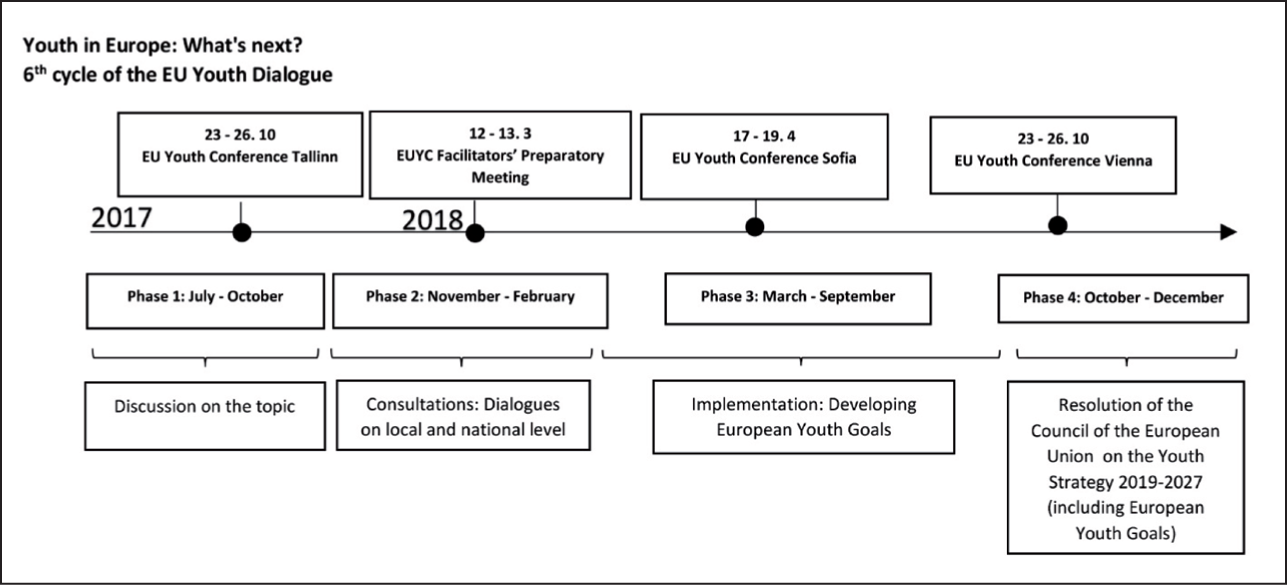
There are various studies of the functioning of the EUYD as a political process based on the analysis of documents (Banjac, 2017; Williamson, 2015). However, to investigate the (micro-)processes and practices of voice formation, which cannot be observed from a desk research, it is necessary to conduct an ethnographic research and participant observation. The field research lasted from July 2017 to December 2018 and was limited to the EUYD’s sixth cycle. Each cycle represents a completed unit with the aim of addressing one topic that is important for the development of the youth policies in the EU. While the EU does not have the exclusive competence to develop the youth policies that would replace member states’ policies, it is based on a form of soft law that does not provide a binding decision but sets a framework that influences the youth policies in the EU countries. Since the 2001 White Paper: A New Impetus for European Youth, which is predominantly considered a starting point for EU cooperation in the youth field, the European Commission has, in this regard, developed a range of measures and mechanisms to manage the cooperation of governments and other youth stakeholders. One of the most important mechanisms is the EUYD, which should ensure that the voice of the youth is acknowledged in the EU youth policies (Banjac, 2017; Pušnik & Banjac, 2022; Williamson, 2015).
Over the years, several mechanisms have been set up for implementing the process of the EUYD. At the EU level, the European Steering Committee, which consists of the representatives from the current trio of EU Presidency countries, the European Commission and the EYF, is responsible for the conduct and coordination, with the Forum formally chairing the Committee. At the member state level, the coordinating bodies are the national working groups, which most often include the representatives of ministries responsible for youth affairs and the representatives of youth organizations and are predominantly chaired by the National Youth Councils. In this framework, three EUYCs are organized in each cycle, hosted by the countries holding the Presidency of the Council of the EU. In the sixth cycle, the conferences took place in Tallinn (October 2017), Sofia (April 2018) and Vienna (September 2018). The conferences represent milestones and divide the implementation of the EUYD into three phases. In the first phase, taking place before the first conference, there is a discussion on the understanding of the topic of the cycle among the involved stakeholders to further define and finalize the content of the cycle. The outcomes of the first phase, which concludes with the first EUYC, are a common framework and questions for consultations between young people and policymakers. The second phase thus represents the implementation of dialogues in the member states and concludes with the second conference, where delegates discuss the solutions that have emerged from local and national dialogues. The last phase is dedicated to the development of recommendations for youth policies. The phase concludes with the third conference, which results in an EU Council resolution as a contribution to further development of the youth policies in the EU (EYF, 2021; EYF & EC, 2013). The sixth cycle, entitled
The field research included a preparatory meeting of facilitators in Sofia and the second and third EUYCs in Sofia and Vienna, totalling 13 days of field work at the EU level. I gained access to the EUYC through contacting major stakeholders (the ministries organizing the conference and the European Commission) and, when allowed to participate, I established rapport through informal talks and interviews with the organizers and participants. At all events, I was in the role of a researcher with moderate participation (see DeWalt, 2015): I actively participated at events, observed and made notes in the course of dialogues organized as part of each conference. However, I did not envisage a direct participation in dialogues to avoid excessive influence on the content. Before and after the dialogues, I conducted interviews with the organizers and facilitators (
Based on the theoretical insight that the construction of the voice in dialogues is always under the influence of power relations, I coded the data by identifying the power relations that influenced the voice formation in the sixth cycle of the EUYD. On the one hand, I identified the structures, processes, mechanisms and practices through which voice was shaped, that is, where the manifestation of negative power was enforced. On the other hand, I focused on the productive power, that is where and how the participants were encouraged to conduct themselves in a specific way and how they established a distinct voice. I therefore focused on how the EUYD mechanism works as a specific technology of the self that encourages certain actions and reflections of the delegates and provides a space in which individuals shape their subjectivity.
EU Youth Dialogue as a Disciplinary Technology: Searching for a Docile Youth Voice
In the sixth cycle, the framing of the voice started at the very beginning of the cycle since, with the theme
The top-down framing of the voice of young people that already implies passive and obedient youth became most apparent in the preparations for and at the EUYC in Sofia, where the main aim was to prepare the Youth Goals. The form of the Youth Goals was predetermined before the conference. As the representative of the EYF pointed out, prior to the conference in Sofia, the ‘European Steering Committee decided, how many Youth Goals, how many targets and so on’ (Nina, personal communication, 10 April 2018). This indicates that each Goal had to have a specific, prearranged structure. In the preparations for the conference, one of the facilitators briefed other facilitators delegated for facilitating the groups that prepared the Goals: ‘Please remember, really remember, each Youth goal consist of four parts: title, in two to four words, one sentence description, short explanatory note of the background of the goal and five to seven targets’ (Field notes, 16 April 2018). With the number and form of the Goals, it was thus shaped how the voice of the youth should look like. This process relates to Bragg’s (2007, p. 349) claim that the youth ‘voice is not unmediated, but guided, facilitated and supervised through specific techniques that delimit what can be said’. Within the EUYD level, the top-down prescribed form determined the voice of the youth. Furthermore, following the preparation of the Goals, it became clear that it was not just the form that determined but the content of the Goals had to be specifically formulated, too. It became apparent that this was one of the key mechanisms in the process of creating a docile youth voice.
At the conference in Sofia, the organizers and facilitators constantly emphasized that the Youth Goals are vitally important since they will really reflect young people’s perspectives and will be taken into account, thus creating a feeling that something important is happening and that the delegates have a responsible task. Therefore, to prepare the Goals, the participants at the Sofia conference were divided into eleven groups (which reflected the predicated number of Goals), with each group forming an individual Goal based on the reports from national consultations and with the help of a facilitator. Each group also had a member of the Supporting Team, an informal group set up to take care of the ‘appropriate wording and improving formulations’ (Field notes, 15 April 2018) of the Goals. The Supporting Team consisted of the members of the European Steering Committee, which decided the membership on the team, and additional persons who, as one of the conference facilitators pointed out, were ‘people who are used to write political recommendations’ (Field notes, 16 April 2018). With the establishment of the Supporting Team, the organizers assumed that the ideas and the raw voice of the delegates and especially young people are not enough and that they needed help ensuring that the goals were of sufficient quality. As a facilitator underlined: ‘Participants need a lot of help to achieve quality Goals’ (Field notes, 12 March 2018). The role of the Supporting Team was thus ‘the exercise of authority over individual and collective conduct by expertise’ (Rose, 1993, p. 283), as it operated on the assumption that the young participants at the conference did not have enough knowledge and experience and that they needed expert support. In this regard, the Supporting Team subordinated the voice of youth since linguistic adequacy also characterized the content of what can be said and, above all, what should not be said. In the group, I followed Jelena, a member of the Supporting Team, who repeatedly emphasized: ‘No specific recommendation who – people or institution – should do it’ (Field notes, 18 April 2018). This meant that the delegates were not allowed to write down which institution should implement any of the goals and targets or how they should be implemented.
Through the prism of analytics of government, it becomes visible that the voice of the youth in the form of Goals has been framed through various power relations and numerous mechanisms. Laine and Gretschel (2009, p. 193) identified a hierarchy in the EUYD process between adults and ‘“adult–young” referring to those youth representatives who got a special role’ on the one hand and ‘ordinary young people’ who are the delegates at the EUYC on the other hand. They recognized that that the first group which ‘take the positions of chair and rapporteur /…/ also own the power of the process’ (Laine & Gretschel, 2009, p. 202). Therefore, the EUYD is dominated by the interests of the organized youth (Pušnik & Banjac, 2022), which is also reflected in the composition of the EUYC: prevailing are the delegates who are members of the youth organizations. While the process of selecting youth delegates for the EUYC varies from country to country, the delegates are not elected by the young people, which diminishes the participatory and democratic aspect. Moreover, as Walther and Lüküslü (2021, p. 211) recognize, in formal participation structures like youth councils, EYF or EUYD ‘young people are invited by adults to “represent” other youth in the (institutionally) “right” way of representation’. Thus, young people who participate in those structures and mechanisms are incited to the ‘adult citizenship habitus’ that alienates them ‘from their peers and youth culture’ (Walther & Lüküslü, 2021, p. 208). It is possible to further elaborate on these insights by focusing on the construction of the voice within the EUYD. In the sixth cycle, a group of (young) experts in the Steering Committee as well as the Supporting Team had an impact on the youth voice formation by setting an implementation framework as well as controlling the formulation of the Goals. By establishing the mechanism of the Supporting Team to control language adequacy, we can see how negative power directly shapes the voice of the youth. In the words of Maarten and Hodgson (2012, p. 34), ‘[e]ach citizen of course can have his or her own interests and aspirations and is placed in a position to raise her own, personal voice; however, it is according to ruling procedures, frameworks, and vocabularies that they have to raise This voice’. In the EUYD, the voice of youth had to adhere to a specific form that was decided by the Steering Committee and, at the same time, the voice had to be precisely framed content-wise, which was secured by the Supporting Team. Consequently, the youth voice was shaped and disciplined in detail, as Foucault (2009, p. 45) stated: ‘Discipline allows nothing to escape /…/ the smallest things must not be abandoned to themselves’.
In the process of creating Youth Goals, the EUYD thus functioned as a disciplinary technology that framed the acceptable and politically correct youth voice. By determining the form of the Goals, youth delegates at the conferences thus looked for targets and not, for example, the quantified measures of how and when to implement a specific Goal. This is also evident from the finalized Goals adopted as an annex in the new Youth Strategy, as none of the Goals contains any requirements or indicators of how the Goals should be implemented and who is or should be responsible for their realization (see Council of the European Union, 2018, pp. 11–17). In the sixth cycle, the EUYD therefore functioned as a governmental technology that shaped the form and content of youth voices, we (do not) want to hear.
The EUYD working through the formation of the voice as a disciplinary technology was also evident from the statements of the delegates at the Sofia conference. Immediately after the group work, one of the delegates reflected on the content of the Goals when he looked at the goals and targets written on the board, sighed and stated that they are ‘super vague and super broad’ (Field notes, 18 April 2018). Hence, he acknowledged that the generally stated Goals correspond to the appropriate political language that was required. By framing the youth voice as non-obligatory, a political representative of one of the member states who has also participated in the previous cycles recognized the EUYD work as a process of ‘educating a group of young people to become less radical’ and continued that ‘Youth Goals are something which is impossible to implement because they are too broad’ (Tina, personal communication, 3 September 2018). Similarly, another political representative reflected that the member states could ‘calmly ignore’ Youth Goals ‘but if they need it, they will use it, because they will say: “Look, young people said that too”’ (Klemen, personal communication, 13 November 2018). They affirmed that the youth voice in the form of Goals was framed in a politically acceptable language, which is non-binding for political decision-makers, and that such voice formation required and established a docile rather than a radical youth. Through analytics of government, this represents one of the direct ‘attempts to control or govern youth behaviors’ (Besley, 2010, p. 535). In this regard, Maarten and Hodgson (2012, p. 22) argue that, in the EU, the ‘current policy discourses and related practices construct the European citizen /…/ as a “subject of voice”’. However, the sixth cycle of the EUYD framed docile voice subjects since the young delegates were not allowed to demand but could only recommend.
The conduct of the EUYD as a disciplinary technology is also evident from the perceptions of the young EUYC participants. When asked how they perceive the EUYD, the youth delegate in Sofia enthusiastically stated that the dialogue is ‘a really good idea actually. The motives are very good, including youth’ but, at the same time, he bluntly claimed that ‘the execution of it is debatable’. However, he stated that political institutions will be able to include ‘the wishes of the young much more after the youth goals are developed’ (Kevin, personal communication, 18 April 2018). A youth delegate who participated in the process for the first time emphasized that, for him, the EUYD ‘is an opportunity to be part of youth politics, to make a difference but without being forced to go into politics’ (Martin, personal communication, 18 April 2018). A youth delegate who has been involved in the EUYD for a few cycles emphasized that the dialogue is ‘a step in the right direction and it gives a platform for youth to be able to stand up and speak’ but, in the same breath, plainly stated that it ‘needs to be taken more seriously’ (Lars, personal communication, 3 September 2018). Despite criticisms of the implementation, the statements of delegates show that they concur with the form of a non-binding voice. Consequently, the ‘voice refer not only to what one says but also to what one does, the way in which one adapts his or her resources’ (Maarten & Hodgson, 2012, p. 37). The EUYD thus functioned as a technology of disciplining not only through restricting the kind of voice it allowed but also through the positive aspect of power, which gave the young people a sense of involvement in the decision-making processes. It is precisely this feeling of inclusiveness through which the voice of the young people is framed as potentially but not yet fully taken into account within the policy process. While there are several reasons why young delegates take a conforming position—among others because they experience recognition of power and status that are attached to them as delegates or because they have plans for a political career (Walther & Lüküslü, 2021, p. 208)—in the EUYD, the potentiality that their voices might be acknowledged was also one of the key triggers that shaped their expectations in the form of a docile voice.
EU Youth Dialogue as a Technology of the Self: Youth as Active and Responsible EU Citizens
By seeking the voice of young citizens, the sixth cycle of the EUYD also acted as a practice of confession as it offered the space for reflection and voicing of the views, wishes and problems of youth. They were especially encouraged to do so at the first EUYC in Tallinn which was based on the blue-sky-thinking method. This method allowed young delegates to present crucial problems and expressed their wishes and views on what kind of future they want in the EU and what the future youth policies in the EU should look like. In the conference invitation, it was stated that the purpose is ‘to examine what young people expect from the EU to allow them to live prosperous, sustainable and successful lives’ (EUYC, 2017b). In this regard, organizers emphasized that the conference will ‘offer different ways
The participants of the sixth cycle confirmed the role of the EUYD as a space for self-reflection and sharing of opinions, problems and suggestions, as well as a space for their responsible conduct in the role of youth delegates. When asked about the positives that the EUYD brings, a representative of the EYF replied: ‘it pushes up participation in the society. Like
During the sixth cycle, I recognized many practices of power through which the participants were incited towards the EU identity and towards acting in their role of youth delegates as responsible EU citizens. The very title Youth
However, the emphasis on Europe was even more emphasized than in the previous cycles due to the contribution to the next EU Youth Strategy. As a representative of one of the youth councils stressed, the main orientation of the cycle was: ‘What does Europe and the EU actually mean for them [young people]? Do they feel European?’ (Peter, personal communication, 15 March 2018). The awareness of the EU identity was also incited through various micro-practices—for example, by the EUYC anthem in Sofia, which was played at the opening and during each break and often sung by the delegates. The chorus of the anthem was as follows: ‘Europe, my love. You’re up, my love. Nobody can bring you down, Europe my love’. The most telling parts of the text, which expressed the unity and community of Europe, were the following: ‘Only the united we survive /…/ We need to believe that we are friends without borders’ (Field notes, 17 April 2018). Walters (2002, p. 107) describes such practices through the prism of analytics of government as ‘a bid to foster a positive sense of European consciousness and connection amongst the EU’s population(s)’. In line with this, we can acknowledge that, through the systematization of the EUYD as well as with the content of the sixth cycle through various ‘techniques for shaping subjectivities’ (Bragg, 2007, p. 349), the youth were encouraged to form a voice about the EU and establish an EU identity. Enabling the youth voice within the EUYC thus need to be reflected also as a mechanism that incites the youth as ‘a driving force “making us fit” for the ongoing European project’ (Olsson et al., 2011, p. 8).
The sixth cycle provides a space for the awareness of and conduct as responsible and active EU citizens can also be seen from a young delegate’s reflections on the EUYD. A youth delegate in Sofia emphasized that, for him, the most important element in the EUYD was ‘that people from all of Europe are sitting here and discussing their issues together. Not what are Bulgarian, German, and Portuguese youth issues, but what are our common youth issues’ (Kevin, personal communication, 18 April 2018). In this regard, he reflected what can be described as ‘the verbalisation techniques of confession /…/ to constitute, positively, a new self’ (Besley, 2021, p. 249) since he described the EUYD as a space for discussing through an EU perspective and thus establishing a subjectivity of an EU citizen. Claiming that the Vienna EUYC delegates came together ‘to try and find the common consensus as to how to go forward in Europe for youth /…/ to debate European issues’ (Lars, personal communication, 3 September 2018), another youth delegate indicated that he also understands himself and his role as an active EU citizen. The awareness of the common EU identity was, however, most directly expressed by a youth delegate in Sofia: ‘I mean we are all some kind of European family, a group of people who want to make living better for all of us’ (Martin, personal communication, 18 April 2018). Through analytics of government, it is therefore visible that the sixth cycle also operated through the practices of subjectivation, where the young people at the EUYC internalize and ‘constitute a shared sense of ownership and feeling of belonging’ to the EU (Maarten & Hodgson, 2012, p. 31) and hence contribute to the co-construction of the subjectivity of the responsible and active EU citizens.
Conclusion
Voice formation in dialogues is a complex process that always takes place in power relations through numerous decisions and concrete practices. In an ethnographic study of facilitation in the USA Lee (2015) shows how facilitators are contributing to the establishment of new power inequalities while claiming to reduce them. Laine and Gretschel (2009) expose how power within dialogues with youth in the EU is determined by the roles and conducts of organizers, facilitators and other (young) experts in dialogue. While Karlsen and Villadsen (2008) argue how dialogues in different settings work as political mechanisms and how power relations in dialogues are shaped through setting guidelines and goals for dialogues, the selection of participants and the analyses of voices obtained from dialogues. This article focuses on the construction of voice in the EUYD and shows that all the above-mentioned activities and practices establish power relations and that voice is always constructed in these meshes of power. Howard Williamson, a researcher I met at the Sofia conference, who was involved in the process of developing EU youth policies and, from the early beginnings, participated at several events of the EUYD in different roles, reflected on this process by recognising that within the EUYD many voices appear ‘and then you have to filter them and then you have not only filtered them but you organized them so you package them differently /…/ that’s just the reality of the process that you are going through’. And then critically reflected: ‘but let’s be a bit, not a bit, a lot more honest about the failures of this process, about the limitations of it’ (Personal communication, 19 April 2018). He thusly claimed that the voice within the EUYD is always constructed yet this remains unaddressed.
Contrary to the predominant political representations of the EUYD as a process of equal dialogue between youth and policymakers and as a space without hierarchies where young people can express their voices, the main aim of the article was to illuminate the construction of the voice in the sixth cycle of the EUYD. Based on the field research, I applied Foucauldian analytics of government in order to identify power relations and the most exposed practices and techniques where the construction of the voice occurred. Contrary to the belief that the voice in the EUYD derives bottom-up, that is from the local to the EU level, I demonstrated that the voice was shaped through various practices and techniques from the top down. Through analytics of government, I recognized not only that the framework of the sixth cycle sought the voice of youth but also that this voice had to be specifically elaborated and framed to fit the EUYD. Through instructions on how the voice should look like and concrete practices that controlled what youth delegates could articulate, it was possible to observe that they seek a non-binding and docile voice of youth, which is reflected in the main result of the cycle, the European Youth goals. In this regard, the EUYD functioned as a disciplinary technology that specifically defined what young people should or, more precisely, what they should not express. Moreover, the functioning of the EUYD as a disciplinary technology was also reflected in the responses of young people who, due to the possibility that their voice could be heard and acknowledged in the future EU youth policies, agreed to form a docile voice.
The article also addressed the often-neglected dimension of productive or positive power functioning within dialogues, that is the EUYD in the sixth cycle also acts as a space for the co-constitution of young participants’ subjectivity. With the analytics of government, I exposed that the subjectivity was predominantly established through confessional practices as the EUYD encouraged and enabled young people to present their visions, problems and solutions and thus reflect on how they see themselves and their conduct. In the sixth cycle, the EUYD primarily worked as a mechanism for co-constructing an EU identity and subjectivation of young EU citizens. The creation of an EU identity has been encouraged by the very systematization of the EUYD as a space for discussing EU issues and by various micro-practices that incited youth delegates towards the EU identity. Therefore, the EUYD in the sixth cycle worked as a specific technology of the self. Dialogues act neither merely as a new, covert form of government repression, nor as a space of complete freedom where power relations and hierarchies are annulled and where the genuine voice of (young) EU citizens is established, but as novel governmental technologies that need to be continuously analysed. The same is also true for the EUYD and other dialogues with youth at the local and national levels since there are different practices of conducting EUYD and other dialogues with youth in different EU member states as the voice in dialogues is always constructed based on the relations of power.