







Abstract
Introduction
A distinction that has in recent years become increasingly popular is the one between mainstream and niche parties. Based on Bonnie Meguid’s (2005, 2008) pioneering work, a growing literature shows how the competitive behaviour of niche parties differs from that of their ‘mainstream’ rivals. The niche party concept has been highly influential in the study of party competition and deserves much credit for enriching research on party behaviour (see, e.g., Adams et al., 2006; Ezrow, 2008; Jensen and Spoon, 2010).
Yet, research on niche parties is marked by substantial variation in defining and measuring niche parties. Meguid (2005, 2008) defines niche parties based on the salience theory (Budge and Farlie, 1977, 1983) as parties emphasizing a limited set of new issues that do not coincide with the predominant economic left–right division. In other prominent studies, the definition is based on party ideology, counting Communist, Green and nationalist parties as niche parties (Adams et al., 2006; Ezrow, 2010; Ezrow et al., 2010). These differences render conclusions about niche parties difficult because authors refer to a different set of niche parties. For example, Communist parties are sometimes defined as niche parties (Adams et al., 2006; Ezrow, 2010; Ezrow et al., 2010), while they are closer to mainstream parties in Meguid’s (2005, 2008) definition. Obviously, this creates problems when it comes to generalizing these findings.
Empirically, niche parties are often distinguished from mainstream parties using a dichotomous, static measure based on party ideology. Yet, this approach may mask important differences within and across party families. For example, it assumes that the Finnish
In this article, we aim to conceptually clarify the niche party concept and to provide a precise measure. In the next section, we focus on the conceptual core of existing definition approaches and propose a minimal definition containing only the necessary characteristics of the entity (Sartori, 1976). Based on salience theory, we define a niche party as a party emphasizing other policy areas than its competitors do. We then propose a continuous measure of the niche party concept. In contrast to the static and binary measures used so far, it captures variation over time and covers fine-grained differences in party policy programmes. This allows us to distinguish between different levels of party
The niche party concept
The niche party concept, though still young, is already well established. In her prominent work introducing the concept, Meguid (2005, 2008) 1 has used it to explain programmatic shifts of established, mainstream parties. Other work shows that niche parties differ from mainstream parties in their ability to set the agenda in parliament (Vliegenthart et al., 2011), their responsiveness to voter preferences (Ezrow et al., 2010), their mass organizational resources, internal decision-making rules, and dependence on public party funding (Meyer, 2010) and display a distinct legislative voting behaviour (Jensen and Spoon, 2010). Perhaps most significantly the niche party has become an established control variable in models of electoral competition (Adams and Ezrow, 2009; Haupt, 2010).
There are good reasons for the niche party concept’s popularity in the literature. Based on the salience theory (Budge and Farlie, 1983), it captures how parties act and interact, which makes the concept a suitable starting point for a host of interesting research questions. Moreover, the niche party concept is not restricted to specific party families. It allows us to study common behavioural patterns of parties as different as those of radical-right (Ignazi, 1996; Kitschelt, 2006) and Green parties (Müller-Rommel, 1989). Third, the niche party concept allows for temporal variation. Its basis on issue emphasis implies that niche parties may lose their status and become mainstream parties over time. Rival classifications – such as movement parties (Kitschelt, 2006) or New Politics parties (Müller-Rommel, 1989) – are less well suited to capturing these dynamics (see also Wagner, 2011).
Unfortunately, existing definitions of the niche party differ starkly. Bonnie Meguid (2005: 347 f.; 2008) defines them along three criteria: (1) niche parties reject the traditional class-based orientation of politics, (2) the issues raised by niche parties are not only novel, but often do not coincide with the existing left–right lines of political division, and (3) niche parties have been perceived largely as single-issue parties by the voters and other parties. Wagner (2011: 3) has provided a simplified definition according to which niche parties ‘compete primarily on a small number of non-economic issues’. Finally, James Adams and various co-authors state that niche parties represent ‘either an extreme ideology (such as Communist and extreme nationalist parties) or a noncentrist “niche” ideology (i.e. the Greens)’ (Adams et al., 2006: 513). This definition distinguishes parties in spatial terms and deviates from Meguid’s (2005) original concept, mainly because it rejects the notion that niche parties do not compete on the economic left–right dimensions (Communists clearly do). 2
As this brief overview shows, the niche party concept has been used differently by various authors. Although each definition is plausible in its own right and may serve the specific research purposes, the various approaches make comparisons of the main findings rather difficult and prevent more general conclusions. As for most major concepts in political science, finding a common, overarching, definition is difficult (if not impossible). This would require (1) listing all characteristics or features of an entity that (2) allow for a unique classification and that (3) all cases are classified ‘correctly’. Thinking of terms such as ‘democracy’ or ‘party’ illustrates the difficulties of such an endeavour.
To deal with the definitional problem, we follow Sartori (1976) and restrict ourselves to a minimal definition (see also Dahl, 1971). Sartori (1976: 61) suggests that ‘[a] definition is minimal when all the properties or characteristics of an entity that are not indispensable for its identification are set forth as variable, hypothetical properties – not as definitional properties’. We contend that such an approach is also appropriate for the niche party concept.
Defining niche parties: A minimal definition of its conceptual core
We take it that the niche party concept has its core in the relative issue emphasis of parties within a given party system (Budge and Farlie, 1983). While all parties aim at emphasizing issues on which they are perceived as being competent, they also need to adapt their policy emphasis to the necessities of the political market. For example, they need to stress policy areas valued by their voters and cannot fully neglect policy dimensions highlighted by rival parties (see Green, 2011). As a consequence, the importance parties attach to the different policy areas varies. Niche parties differ from mainstream parties in that they promote distinctive policy profiles. Based on this, we propose our minimal definition:
We argue that other definitional elements proposed in the literature are variable rather than definitional properties. Specifically, (1) the novelty of its issues, and (2) its ‘different’ (i.e. non-economic) ideology are not essential elements and should be seen as empirical correlates rather than defining elements. 3
The idea that niche issues are necessarily novel (Meguid, 2005: 347 f.) assumes that all attractive ‘old’ issues are occupied by mainstream parties. In effect, this assumes a political market that works perfectly. Yet, just as for other markets, this may not be the case. Parties might be able to revive old topics that have largely vanished from the policy profiles of their competitors. For example, the Swedish Christian Democrats were founded in 1963 in protest against a government decision to remove religion from the school syllabus. The party ran on a narrow niche platform based on one of the oldest issues in European politics: Christian values (Arter, 1999: 299). 4 Requiring niche issues to be ‘novel’ thus unnecessarily restricts the scope of niche parties.
It is also often assumed that niche parties are ideologically ‘different’. The original definition restricts niche parties to non-economic issues (Meguid, 2005, 2008). The implicit assumption is that mainstream parties operate on a predominant economic left–right dimension, leaving no space for economic niches. Certainly, the economic dimension has dominated political competition in Western Europe until this day, but a closer look at (European) party systems reveals that the significance of the economic policy dimension varies across time and space (Singer, 2011). Where other cleavages are important (e.g. the linguistic divide in Belgium) or new policy dimensions (such as the environment) become relevant, mainstream parties are less likely to focus solely on economic left–right issues, thereby potentially creating new ones on the economic dimension.
Parties can also ‘frame’ potential niche issues in economic terms. Framing means to emphasize certain aspects or dimensions of an issue (Chong and Druckman, 2007; Sides, 2006). The Norwegian Progress Party (FrP) in the 1970s and 1980s is an example of this strategy. In accordance with its origins as an anti-tax party, it framed the immigration issue in economic terms. It opposed immigration, arguing that financial means should rather be spent on the care of the elderly and the healthcare system than on the needs of immigrants (Andersen and Bjørklund, 2008; Hagelund, 2003; Valen and Rokkan, 1974). Accordingly, the FrP’s emphasis on economic issues was rather high. This example suggests that excluding the economic dimension by definition may lead to severe measurement error. This is why we deviate from previous approaches (Meguid, 2005; Wagner, 2011) arguing that economic issues can – in principle – also be niche issues. 5
There are three implications of our minimal definition of niche parties. First, a party’s status as niche (or mainstream) party depends on the issue emphasis of rival parties. In particular, this implies that niche parties can lose their status if rival (mainstream) parties react by emphasizing similar issues. In this scenario, the increasing overall salience of an issue transforms a former ‘niche’ into a ‘mainstream’ issue. As a consequence, a former niche party shifts closer to the newly defined party mainstream. Second, and related, the niche party concept is only substantively relevant if there are three or more parties. In two-party systems, there is only one interaction (namely that between both rivals) and this single interaction
Measuring niche parties: A dichotomous measure for a continuous concept?
In addition to conceptual differences, there have also been different attempts to measure niche and mainstream parties. Niche parties are often distinguished by party ideology. In her pioneering work, Meguid identifies niche parties based on lists of Green, radical-right and ethno-territorial parties (2008: 43–46). In contrast, Adams and his co-authors (2006) classify Green, Communist or radical-right parties as niche parties. Note that this approach restricts the universe of niche parties to these party families. Yet, it is unclear why one would a priori want to exclude other party families, in particular single-issue parties.
Moreover, a measure based on party ideology does not allow for temporal variance within party families. Although party families are the traditional way to summarize the policies a group of parties pursues, we would also expect substantial intra-group variance. The policies of Communist parties during the 1950s, for example, are arguably different from those of Communist parties today. Moreover, parties founded as ‘anti-mainstream’ parties may alter their programmes when adapting to the necessities of the political market (Meyer and Wagner, 2013) or the harsh realities of governing (Rihoux and Rüdig, 2006).
Another problem of measures based on party families is that some ideologies do not fit into the assumed mainstream vs. niche dichotomy. Agrarian parties illustrate this problem. They are not niche parties according to the classifications of Meguid (2005, 2008) and Adams et al. (2006). Yet, these parties have been (at least for some decades) single-issue parties and have focused on ‘nichy’ non-economic issues (Christensen, 1997; Linhart, 2010; Mair and Mudde, 1998: 222; Urwin, 1980). At the same time, they have been an important political force in post-war Northern Europe and frequently held the prime ministership (Müller and Strøm, 2000). Some Agrarians therefore fit the niche party definition while others are rather mainstream.
Wagner (2011) presents the most recent approach to measuring niche parties and already incorporates some of the critique mentioned. His measure is based on the parties’ relative issue emphasis, thus going beyond the classification based on party ideology. However, Wagner (2011) still adheres to a dichotomous measurement approach: A party can either have a niche to itself or not (and be mainstream).
8
Yet, this dichotomy may not be the best approach by which to capture parties’ issue strategies. Party issue salience describes how much attention a party pays to an issue and the parties’ strategies are more concerned with ‘more or less’ than with blunt ‘yes or no’ decisions. As a consequence, differences between the parties’ issue salience strategies also differ and provide us with information about the
We therefore need a continuous rather than a dichotomous measure to capture the continuity of the concept. We express this continuity by speaking of party
A continuous measure for party nicheness
Based on the discussion and the conceptual core identified above, a measure for party nicheness should capture party nicheness as a relative concept of ‘being distinct’ from the competitors’ issue emphasis; assess the degree to which a party accentuates policy areas (i.e. being continuous rather than dichotomous); allow for variation over time; and it should not restrict policy niches to specific policy areas (such as immigration or environmental protection).
For each policy dimension, our proposed measure compares a party’s policy profile with the (weighted) average of the remaining parties in the system. This average reflects the issue emphasis in a hypothetical party system excluding this party. Here, we define this ‘mean’ as average issue emphasis (weighted by party size) of all parties in the party system. Note, however, that our proposed measure can also be used with alternative specifications of the party system ‘mean’. 9 A party is at the mainstream if it has no impact on this ‘systemic salience’ (Steenbergen and Scott, 2004). This is the case if its issue emphasis equals the (weighted) mean emphasis. In contrast, a party with a distinct policy profile adds to the issue agenda in the party system. For example, Green parties typically emphasize environmental policies that would not (or to a lesser extent) be addressed if the Greens were not present. The counterfactual thinking suggested here thus identifies a party’s impact on the issues raised in the party system (for a similar approach for vote choices, see Kedar (2005: 187)).
Our measure then adds up the deviations on all relevant policy dimensions and divides by the total number of policy dimensions. Resulting values vary between two extremes: All parties might emphasize the exact same issues as the average party. This corresponds to the ideal-typical mainstream party and receives a nicheness score of zero. At the other extreme, a pure niche party does not stress any mainstream policies and only emphasizes issues completely neglected by its rivals. In between these ideal-typical mainstream and niche parties, we find the nuances of real-world party nicheness (see also Falcó-Gimeno 2012).
Formally, let N denote the number of relevant issue dimensions and P denote the number of parties in a given country. Party 
with
The nicheness scores using equation (1) express differences across party systems. If, for example, all parties in a given party system have rather similar policy profiles, the resulting nicheness scores of all parties are relatively low. In contrast, if parties in a given party system have very distinct policy profiles, the nicheness scores of all parties are relatively high. The measure in equation (1) is therefore well suited to compare parties across party systems. Yet, it may be more interesting to compare nicheness scores 
with
as party
Illustrating the new niche party measure
Table 1 provides illustrative examples of party policy profiles and the respective nicheness scores. For the sake of simplicity, the example is restricted to four policy dimensions: Economy, Social Affairs, Foreign Affairs and Environment. We calculate unstandardized nicheness
Nicheness in an exemplary five-party system.

ECO = Economy, SOC = Social affairs, FOR = Foreign affairs, ENV = Environment.
The policy profiles show that most parties put highest emphasis on economic issues. Christian Democrats tend to emphasize social issues and Green parties devote most of their policy statements to environmental concerns. Comparing the policy profiles across parties, the example suggests that Green parties have the most ‘distinct’ policy profile. This distinct emphasis is reflected in the unstandardized nicheness score
To illustrate some properties of the unstandardized nicheness measure, we modify the policy profiles in Example 2. While the policy profiles of the Greens and the Social Democrats remain unchanged, the other three parties (Liberals, Christian Democrats and Conservatives) alter their issue profiles. Compared to Example 1, the parties’ programmatic emphasis is more diverse, making it much harder to define the mainstream of the hypothetical party system. This is reflected in unstandardized nicheness scores that are (on average) about 4 points higher than the ones in Example 1. The unstandardized nicheness score captures these differences between the party systems presented in Examples 1 and 2.
As many scholars are interested in comparisons within a given party system, it is useful to use the standardized nicheness score that expresses a party’s nicheness relative to its rivals’ nicheness. The last column of Table 1 reports these values. The Social Democrats are the party closest to the mainstream in both examples. However, its effect within the party system is much higher in Example 2. Similarly, the proposed measure identifies the Greens as being the most ‘nichy’ party. Yet, its distinctiveness is much larger in Example 1 than in Example 2.
Validating the niche party measure
We measure party nicheness based on data collected by the Comparative Manifestos Project (CMP; Budge et al., 2001; Klingemann et al., 2006). 11 Using hand-coding, the CMP research group divided manifestos into ‘quasi-sentences’ and assigned each of them to one of 56 categories (plus one residual category). The resulting data describe a party’s emphasis (in percent of the manifesto) in each category (for more details, see Volkens (2001)). Rather than using CMP raw data, our measure is based on a set of policy dimensions identified by Bäck et al. (2011; see Appendix). Each represents a typical jurisdiction of a ministry and therefore constitutes a relevant, well-known and clearly identifiable policy dimension for parties and voters. Because the relevance of these policy dimensions varies over time and space (e.g. environmental policies), we regard a policy dimension as irrelevant if no party makes any programmatic statement on this dimension and exclude it from the analysis. Empirically, the number of relevant policy dimensions varies between 9 and 12.
Our sample consists of manifestos in 24 countries between 1944 and 2003. This corresponds to the full sample analysed in the original version of the CMP dataset excluding the United States (Budge et al., 2001).
12
Because our measure of party nicheness requires information on
Descriptive statistics of party nicheness.
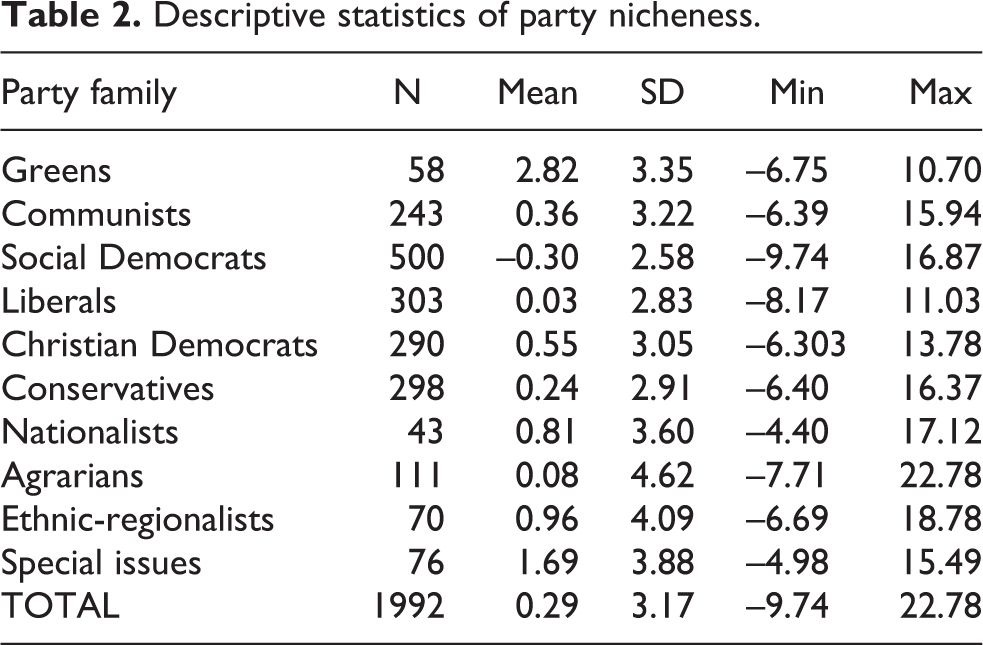
We cross-validate our proposed measure against rival measurement approaches. Our definition and measurement approach builds on the same basic ideas as previous approaches. This is why we expect to observe similarities between our proposed measure and alternative measurement approaches. What our measure adds is its appreciation of nuances and its ability to identify parties that would be mis-classified without such a more fine-grained analysis. In the following analyses, we aim to identify these differences.
Explaining nicheness with party families
Despite objections against party-family based classification, previous research (Meguid, 2005, 2008; Wagner, 2011) has shown that parties in some party families are more likely to be niche parties. Green, radical-right and ethno-territorial parties should therefore have a comparatively high nicheness. To show the validity of our nicheness measure, we compare the standardized party nicheness scores (i.e. a party’s relative stress on the policy dimensions emphasized in the party system) of different party families. Figure 1 shows the average nicheness scores and 95 percent confidence intervals by party family (N = 1992). As Bäck et al.’s (2011) policy dimensions were developed with data from 17 West European countries, we also present the average nicheness scores for Western European countries (N = 1535).

Nicheness by party families.
Green parties are the most obvious niche parties, followed by special-issue, ethnic-regionalist and nationalist parties. These findings suggest that previous research has not paid sufficient attention to special-issue parties. As the name suggests, their policy profiles focus on a few selected issues and hence should have a high nicheness, and this is adequately captured in our measure. In contrast, Social Democratic and Liberal parties mainly emphasize a similar set of mainstream issues. In the full sample, the remaining party families are in between these extremes.
These differences may to some degree also be due to the nature of the CMP coding scheme that may not capture some relevant policy dimensions of concern to ethnic-regional and nationalist parties. In this case we would underestimate the nicheness of ethnic-regional and nationalist parties. To test this, we calculate party nicheness based on data derived from the Benoit–Laver (2006) expert survey and compare the mean nicheness scores with those presented in Figure 1. The average nicheness scores are indeed similar to those presented here (
Figure 1 also shows that our findings are largely robust to different samples. When we restrict the analysis to Western Europe – the context for the identification of the dimensions employed here (Bäck et al., 2011) – most of our observed patterns prevail. Notable exceptions are Western European Agrarian parties, which are among the most heterogeneous party families in our sample: Whereas, for example, the Australian National Party has a relatively high average nicheness score (3.88), the Finnish (–1.62) and Swedish (–1.85) Centre parties are fairly mainstream. While all these parties have been in government, their roles differed substantially. The Australian National Party has been a junior coalition partner only, while Swedish and Finnish prime ministers have frequently been Agrarians. The differences between the Agrarian parties provide further evidence that classifications solely based on party families are not sufficient to classify niche parties. Figure 1 suggests that this finding can be generalized to other party families. Coding Green, nationalist and ethno-territorial parties as niche parties, for example, assumes that parties across these three party families have similar nicheness scores. As can be seen, however, Green parties have a larger impact on the policy dimensions emphasized in the party system than nationalist and ethnic-regionalist parties.
Variation in party nicheness across party families is also reflected in the co-variation with other factors, such as party size and age. Large parties (indicated by large vote-shares) exhibit lower nicheness than small parties (
Comparisons with other classifications
As a second validity test, we compare our measurement of party nicheness to Bonnie Meguid’s (2008) and Wagner’s (2011) classification. Although Meguid’s coding also partially rests on party families, she uses a more inductive approach to classify

Nicheness by Meguid’s classification of mainstream and niche parties.

Nicheness by Wagner’s classification of mainstream and niche parties.
The results demonstrate a close correspondence between our proposed measure and the two classifications of niche parties. In both Figures, the median niche party has a standardized nicheness score that is substantially higher than that of the median mainstream party.
Dynamic niche parties – evidence of changes over time
We now present evidence for our claim that a measure of nicheness must vary over time. Figure 4 shows the amount of manifesto space parties dedicate to one dimension over time. We stick to an example presented above, the Norwegian Progress Party (FrP), which has gained prominence as a populist anti-immigration party and the German Greens, which is by far the largest and most successful Green party.

Variation in salience over time.
Figure 4 plots the percentage of quasi-sentences (salience) the German Greens’ manifesto dedicates to the environment and the FrP’s manifesto to economic issues. For comparison, we also show how much all other parties stress these two issues. In its first election in 1973, the FrP mainly campaigned on economic issues and framed the immigration issue in the 1980s in economic terms. Figure 4 supports this statement, showing that the Norwegian FrP has consistently stressed economic issues more than its rivals have done (on average). As a consequence, its mean nicheness score (5.27) is relatively high compared to other parties. 17 Using the same data and excluding the economic dimension as a potential dimension for policy niches would probably lead to the conclusion that the FrP is a mainstream party. Figure 4 also shows that the party’s emphasis (on this dimension) gradually became more like the salience of its competitors, supporting the claims that the economic framing of arguments against immigration diminished.
The importance of a time-variant measure is even more evident in the example of the German Greens. The Greens have always been a niche party in the sense that they stressed the environmental dimension more than other parties did. Yet, Figure 4 also shows that the lead in issue emphasis varies from election to election. This is mainly due to the varying issue emphasis on environmental issues of the competing parties: According to the manifesto data presented in Figure 4, for example, the issue emphasis of all parties on environmental policies increased in 1990. This bump seems plausible given the developments had put the environment on everyone’s agenda in 1990. 18 The increasing issue emphasis makes the Green party more like the mainstream of the party system. Our nicheness measure captures this variation, indicating that the Greens moved much closer to the mainstream in 1990 (standardized nicheness: 0.24) compared to the other elections (mean standardized nicheness: 0.94). Attention to environmental issues waned quickly, however, and the Greens regained the environment as ‘their’ topic in 1994.
Conclusion
The niche party literature identifies a type of party that is different because it finds itself in a particular strategic situation. The concept is extremely useful, as it allows explaining differences in party behaviour for applications as diverse as electoral competition, legislative behaviour or executive politics. At the same time, definitions of what constitutes a niche party differ substantially. These differences have hindered systematic research on the effect of niche parties and have aggravated comparisons of empirical results.
Following Sartori (1976), we provide a minimal definition of the niche party that outlines its conceptual core. We argue that a niche party can be defined as a party competing on policy areas neglected by its rivals. We also provide a measure to indicate party nicheness. Compared to previous attempts to identify niche parties, our measure has several advantages: Instead of using party families as a proxy to measure niche parties, we look directly at the parties’ emphasis on various policy platforms. Thus, we are able to differentiate parties’ nicheness within (e.g. among Green parties) and across party families (e.g. comparing ethnic-regionalist and nationalist parties). Furthermore, our measure captures variance over time. Our results show that programmatic differences are more fine-grained than such dichotomous classifications would suggest. Our continuous measure makes use of this information.
Defined and measured in this way, the niche party concept points to a number of interesting research questions. If niche parties are not defined
Future research on political parties may also focus on further consequences of party nicheness. There is empirical evidence that party nicheness affects representation of specific voter groups (Adams and Ezrow, 2009; Ezrow et al., 2010) and voting behaviour in parliament (Jensen and Spoon, 2010). We may also expect that party nicheness affects coalition governance including the making of coalition agreements, the choice of control-mechanisms in government coalitions or the allocation of ministries. Moreover, the nicheness of a party is likely to be an important factor when it comes to two further (and otherwise well-studied) subjects: government formation and termination. It may be argued that niche and mainstream parties make for particularly suitable combinations in government, as they do not compete on the same topics. Such mutually exclusive policy profiles could also prolong a coalition’s lifetime. Clearly, understanding party behaviour in the electoral, legislative and governmental arenas is at the heart of comparative politics. The niche party concept may well help us understand and explain differences in party behaviour. This article provides new tools with which these questions can be tackled.