







Abstract
Keywords
Introduction
In the image-saturated realm of social media, visualizations ranging from data graphs to complex infographics are ubiquitous (Engebretsen and Kennedy, 2020; Nærland and Engebretsen, 2021). Often, they are the objects of political rhetoric, designed to convey information, underline positions in data, or delineate contingent futures (Amit-Danhi, 2022a; Allen et al., 2023). As evident by the globally ubiquitous use of curve graphs during the Coronavirus pandemic, visualizations aid audiences to tap into a collective vision of an upcoming reality. Furthermore, they may affect crucial decision-making processes, whether it be a specific vote or the choice to adhere to a new policy.
Although they are an integral part of digital public life, assuming a key role in journalistic coverage as well as political and social-change campaigns (e.g., infographic-heavy political tweets in Amit-Danhi and Shifman, 2018; advocacy campaigns in Wang et al., 2018), visuals and visualization-based rhetoric in the mediation of futures have been only marginally explored. Work on predictive digital visualizations tends to focus on use contexts (i.e., journalism, campaigning, advocacy, e.g., Bradshaw, 2017) and follow focused scholarly avenues (i.e., visualization conventions, semiotic explorations, or design effectiveness, e.g., Bryan et al., 2017; Kennedy et al., 2016; Weber, 2019). In part, this is due to the analytical challenge posed by visualizations’ complex multimodal rhetorical form. That leaves the field without an in-depth understanding of visualized future-oriented rhetoric, and how it mediates the future to a public engaged in orienting itself towards it.
In this contribution, we propose a holistic analytical framework for the exploration of predictive visualization rhetoric, addressing intertwining knowledge-brokering functions, predictive components, and rhetorical strategies. We aim to develop an approach that helps to engage with the way predictive visualizations are constructed so to mediate the future. We began by reviewing current works on predictive visualizations and highlighting the analytical issues they entail, chief among them the multimodal complexity of visualized future-oriented discourse. We then met these challenges by constructing a theoretically-based analytical framework, reliant on previous visualization research, works on predictive data journalism, and projection analysis. To strengthen, test and refine the viability of the theoretically-informed analytical framework, we performed qualitative inductive analysis on a sample of 158 future-oriented Coronavirus news and social media visualizations collected from Israel, the US, Germany and the UK. We demonstrate the framework’s usefulness by highlighting its ability to address commonly under-studied elements such as rhetorical complexity and the multimodal division of rhetorical labor, and conclude by reflecting on the methodological, normative, and deliberative implications for deeper understanding of rhetorical complexity in predictive visualizations.
Theoretical background
Predictive visual rhetoric
The notion of ‘visualizations’ denotes a spectrum of formats sharing a common purpose: to utilize attributes of visual communication in order to convey information to an audience. This spectrum encompasses data visualizations, which tend to visualize primarily numeric data and align with graphical simplicity (Engebretsen and Kennedy, 2020; Tufte, 2001), up to complex and emotive infographics (Amit-Danhi, 2022a). So far, research tends to see visualizations as an accessible shell for numerical data catered to a lay audience (Allen et al., 2023; Cairo, 2019; Kennedy et al., 2016). It assumes that data, and specifically numbers, have a truthfulness to them that visualizers should adhere to (Holthrop, 2018; Krum, 2013; Tufte, 2001).
However, studies of political visualizations have shown that infographics assume a wide variety of shapes, for which social scientists have suggested operational and thematic logics (e.g., Amit-Danhi and Shifman, 2018; Otten et al., 2015). In many cases, visualizations assume a rhetorical function (Dailey et al., 2022). When disseminated by public actors, rhetorical visualizations tend to be used to further political goals and normative re-evaluations, in parallel to conveying information. Such thematic usage forgoes graphical simplicity and employs a wide range of methods (e.g., emotionality, see Amit-Danhi and Shifman, 2022b; Kennedy and Hill, 2017) to activate audiences, promote certain norms, or political ideologies and narratives (Nærland and Engebretsen, 2021; Švelch, 2022). These ambitions are based on visualizations’ appeal: they offer informative value, attract readership, increase engagement, and reflect an ‘aura of truth’ (Kennedy et al., 2016) onto the accompanying narratives.
Those same qualities extend to visualizations that promote predictive narratives (Allen et al., 2023; Amit-Danhi, 2022a; Pentzold and Fechner, 2019). They are especially prominent in the temporal mediation work expected from journalists (Tenenboim-Weinblatt, 2013), but can also be found in candidates’ campaign materials (Amit-Danhi, 2022a), government officials’ pandemic visualizations (e.g., Allen et al., 2023), and social media content related to future-oriented topics such as climate change (e.g., Wang et al., 2018). The use of visuals in future-oriented communication may tap into a basic cognitive use of eyesight to illustrate problematic scenarios and prepare for dangers (Arp, 2008), making the response to future-oriented visual stimuli less reliant on logical thinking rather than instinct.
Having established that visualizations have unique advantages in delivering political rhetoric and predictive narratives, we note that some aspects of this genre pose considerable analytical challenges, in particular in their multimodality that is difficult to disentangle. For example, Amit-Danhi and Shifman’s (2020) work on visualization engagement converted Berger and Milkman’s (2012) engagement enhancing variable of ‘writing complexity’ into ‘informational complexity’. Though a relevant operationalization, it does not fully address the complexity of the narrative conveyed. This is due to the multiple channels that multimodal rhetoric orchestrates (Foss, 2004), leading quantitative studies to limit the scope of their investigation to either a specific aspect of visualized communication (Bryan et al., 2017; Weber, 2019), or an enumeration of its instances (Allen et al., 2023). The same challenge also bedevils qualitative ventures where thematic content analysis proves incapable of separating
These shortcomings stem from the limitations of the three prevalent analytical approaches used in visualization studies. Visualizations are often analyzed as informative vessels (how they convey a ‘correct’/’incorrect’ reading), story venues (the relationship between user and story experience), or with a focus on their visuality to the exclusion of all else. These decisions to focus on a specific venue or purpose, or to analyze visualization in places where role perceptions are normatively, professionally, or institutionally defined (such as journalistic data visualization in Pentzold and Fechner, 2019; governmental science communication in Allen et al., 2023; or advocacy campaigns in Wang et al., 2018), is entirely valid. They do, however, leave the field without a multi-layered exploration of the construction of visualization rhetoric. Visual rhetoric requires a more holistic approach that resonates their process of creation: the analysis of data into information (Allen et al., 2023), the cultivation of a story that serves an actor’s goals and role perception (Amit-Danhi and Shifman, 2018; Pentzold and Fechner, 2019), and the choice of visual modes to effectively deliver it (Cairo, 2019; Tufte, 2001).
The visual mediation of future-oriented knowledge
Future-oriented discourse provides an apt venue for developing approaches to study visualized narratives online. Its informational attributes require the elicitation of a forward-looking and somewhat speculative narrative, a story, out of data collected in other temporalities (Amit-Danhi, 2022b; Pentzold et al., 2021; Weber et al., 2018). This has been explored primarily in the context of professionality, showing that certain actors’ role perception leads them to avoid making overt predictive claims, while others see the brokering of future-knowledge as part of their normative and professional positions (Aharoni et al., 2020; Reich and Lahav, 2020; Waddell et al., 2005).
Thus, in journalism visualizations have been used frequently to deliver complex information about prognosticated trends and events, primarily in data journalistic practice (Pentzold et al., 2021; Pentzold and Fechner, 2019). They also surface in political and advocacy campaigns (Amit-Danhi, 2022a; Wang et al., 2018). The predictive story must be engaging enough to drive the collective imagination of a proposed future, gain the trust of an audience, and promote its dissemination on social media (Aharoni et al., 2023; Berger and Milkman, 2012; Milkoreit, 2017). For this purpose, the intrinsic connection between ‘seeing’ and ‘knowing’ (Drucker, 2020) proves useful, as different agents utilize visuals to
Predictive visualizations have been studied from two main vantage points: (1) as a method in which they are employed to elicit predictive insight (e.g., Palanisamy, 2022); and (2) as a part of journalistic expertise and knowledge brokerage (Diakopoulos, 2022; Pentzold and Fechner, 2019). Focusing on the rhetorical attributes of predictive visualizations, our paper builds on this second strand and seeks to provide an analytical framework that untangles the relationships between knowledge brokerage and rhetoric in future-oriented discourse. By doing so, our framework allows audiences, researchers, and practitioners to examine the articulation of each visualized predictive argument, as well as the ways in which the different components work together to carry out the message. The ability to see into and beyond the combined product of multimodal rhetoric also affords to note inaccuracies and hidden acts of obfuscation, and invites scholars to explore their effects. Such relationships are worthy of analysis due to the preemptive power of future-oriented public discourse: by creating better or worse ideations of the future, it may affect the public’s orientation towards the future, and effectively contribute to shaping it (Tenenboim-Weinblatt et al., 2022). Because of the array of rhetorical modes and professional considerations in the mediation of the future, works on predictive visualization rhetoric have focused on journalistic and scientific endeavors.
The research on predictive visualizations offers several analytical challenges, which this paper seeks to address. First, while knowledge brokerage via visualization has been explored in the context of journalism, other actors’ utilization of visual rhetoric for knowledge brokerage may manifest differently. Second, whereas attention has been given to learning how to better direct audiences towards a ‘correct’ understanding, existing tools do not address the rhetorical aspect of predictive visualization. We therefore see predictive visualizations as something of a juncture of both visualization rhetoric and predictive discourse, exacerbating the analytical and rhetorical challenges associated with both scholarly bodies. It is therefore a suitable starting point from which we can address gaps and analytical inadequacies, by formulating a holistic framework for the analysis of visualization rhetoric.
Methodological process
To develop an approach for the analysis of predictive rhetoric in visualizations, we relied on an empirically grounded, inductive procedure. This procedure was used to construct a theoretically-informed framework (Stage I). It combined components derived from three bodies of work: journalistic knowledge brokerage, visualization rhetoric, and projection analysis. This theoretically-informed framework was then tested and refined via empirical application (Stage II), first conducted in team workshops and then individually by the three authors, until we arrived at a final, consistently useful framework. In what follows, we detail the sampling and empirical elements of this process, as a precursor for the introduction of the framework. In essence, the analytical framework will help to examine the rhetorical construction of predictive visualizations, to discern its forms, and gauge its levels of complexity.
Sample
Following the construction of the theoretically-informed analytical framework (Stage I), we refined it and tested its applicability with a sample of future-oriented data journalistic pieces and social media visualizations, collected during the Coronavirus pandemic (
Thus, our sample comprised of two main clusters: (1)
Analytical workshops and empirical application
Once the analytical framework was constructed and a sample was compiled, we started testing its application using selected units from the sample. This included four empirical workshops with the authors, research assistants, and academic colleagues. The participants began by classifying visualizations individually according to the analytical framework, and then compared, discussed, and aligned congruent classifications to establish a consistent application. Following the workshops, we noted several changes to the analytical framework, reported below. We then went on to classify the entire sample, using a spreadsheet to document all connections made in the analytical framework for each unit. Finally, we returned to the analytical framework to mark consistent connections across all sample units.
Crafting an analytical framework for the analysis of predictive visualizations
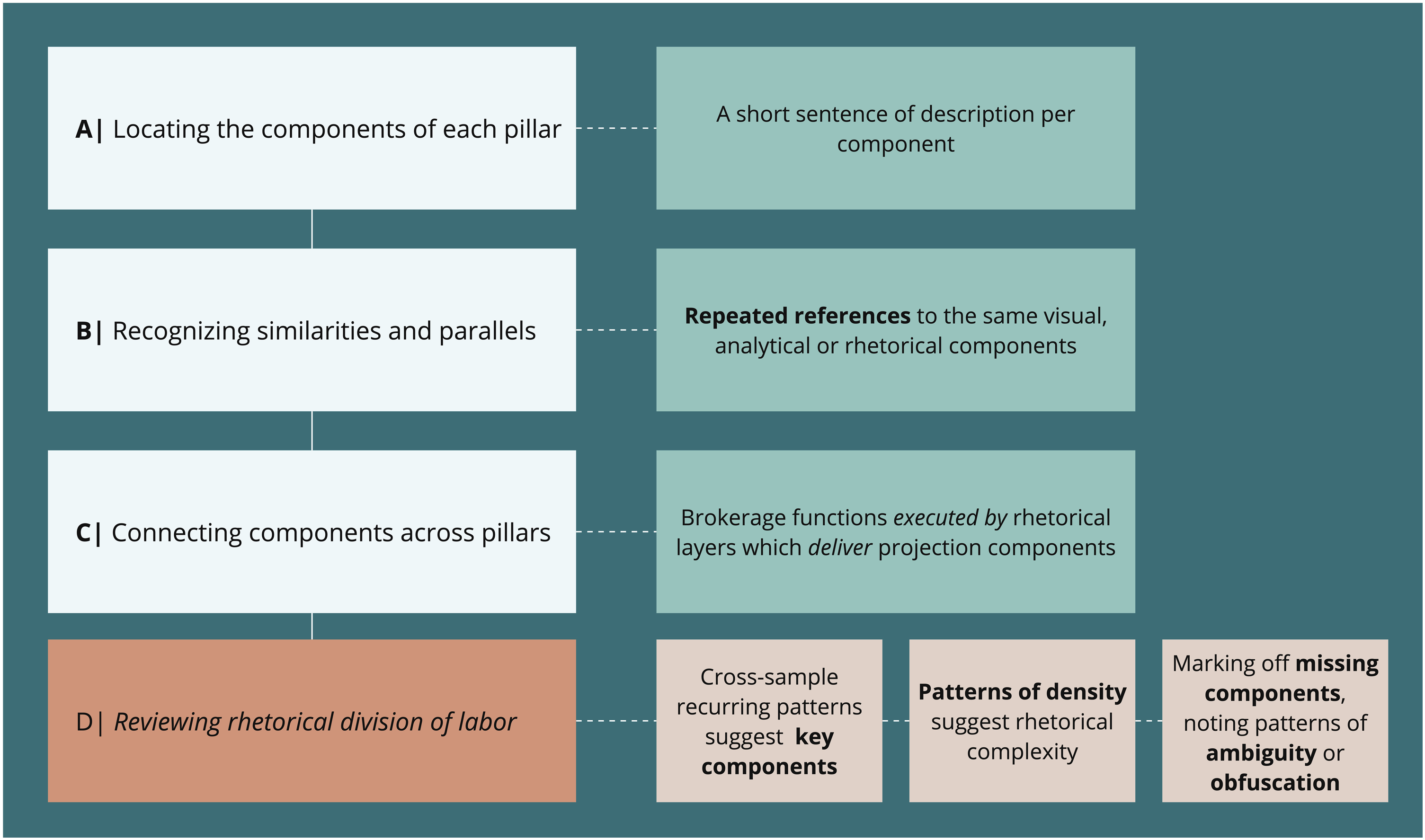
Our final framework was created in two stages. In what follows, we begin by outlining our theoretically driven framework and how we combine its three pillars (Stage I; Figure 1). We then describe the process of empirically testing and further refinement towards the final framework (Stage II; Figure 4) through an example (Figure 2; Table 1), which provides the basis for a step-wise explanation (Figure 3) of its application. Theoretically-informed analytical framework. Original ‘Flatten-the-Curve’ visualization (CDC, 2007). Application of the three approaches onto Figure 2. The analytical framework application process.



Stage I: Theoretical construction of an initial analytical framework
In the first stage, we relied on three existing contributions related to the analysis of predictive rhetoric in visualizations: (1) Amit-Danhi’s (2022b) three-layered approach to visualization rhetoric; (2) an operationalization proposed by Pentzold and colleagues (2021) for the study of knowledge brokerage functions and their execution in predictive journalistic visualizations; and (3) Tenenboim-Weinblatt et al.’s (2022) five-component framework (predicted state, evaluation, anchor, probability, and behavioral implication) for the analysis of projections. In creating the theoretically-informed analytical framework, we associated related components in the three existing tools, by interlinking possibly associated aspects in each of the frameworks so to arrive at a default setup (Figure 1).
Future-oriented knowledge brokerage
In the left column of our analytical framework (Figure 1), we propose examining the mechanisms through which each visualization brokers knowledge for its audiences. We start from a model adapted by Pentzold et al. (2021) from Yanovitzky and Weber (2018). Their approach originally highlights five knowledge brokerage functions:
Starting from the top of the left column of Figure 1, we begin with
Visualizations: rhetorical strategies.
Over the past decade, several efforts have taken on the mapping of affordances of visual rhetoric (e.g., Dailey et al., 2022; Otten et al., 2015; Weber, 2019). Due to the aforementioned limitations of each specific endeavor, in the center column of our analytical framework (Figure 1) we adopt Amit-Danhi’s (2022a) holistic approach to visual rhetoric, wherein she encourages researchers to see visualization rhetoric as comprised of three types of rhetorical actions embedded into the creation of a digital visualization: ‘
When used in analysis, this approach requires accounting for the role and composition of each rhetorical layer. First, in
Projection components.
Finally, we suggest that visualizations be explored as predictive discourse. Thus, our analytical framework adopts Tenenboim-Weinblatt and colleagues’ (2022) conceptualization of projections as typically including five components (Figure 1, right): the
We begin by defining the
Amalgamating the approaches to create a holistic framework.
Our theoretically-informed analytical framework relies on the assumption that the three approaches do not exist independently of one another: at times, they may complement, inform or even substitute each other. Thus, the framework documents visualizations’ attributes, but also how the functions, layers, and components coalesce into multimodal predictive rhetoric. Stage I was concluded by examining parallels and repetition between the approaches in search of commonalities, and highlighting relationships hypothesized based on existing literature. In the theoretically-informed analytical framework (Figure 1), we note previously proven connections with a straight line, and hypothesized connections with a broken line. A connection denotes that the knowledge brokerage function is
We begin by exploring the relationship between knowledge brokerage functions and visual rhetoric. Based on practices in visualization design (Cairo, 2019; Tufte, 2001), we connect ‘
We continue by suggesting connections between the three layers of visual rhetoric strategies with prediction components, aiming to reveal their future-oriented functionality. Here, the analytical framework depicts our informed suggestions. Based on previous works on visualized argumentation (Allen et al., 2023; Foss, 2004) we propose that the rhetorical richness of ‘
Empirical demonstration of the Stage I framework.
Emulating our workshops, we demonstrate the framework’s applicability with well-known predictive visualizations from contexts that preceded the sample’s period. Here, we use a pre-pandemic version (Figure 2) of the ‘Flatten-the-Curve’ visualization (Li and Molder, 2021), originally shared in a report about community mitigation measures for influenza-related pandemics (CDC, 2007). Following Figure 3, which demonstrates the operative logic of our framework onwards, we first demonstrate how elements from the three approaches manifest in the ‘Flatten-the-Curve’ visualization (Table 1), and then proceed to highlight parallels (colored in Table 1) and suggested links between the three approaches which informed our empirical refinement in Stage II.
We begin by noting each component of the analytical framework independently (Figure 3), as detailed in Table 1. Proceeding from the top of the left column, we start with
We then turn to note the attributes of the three rhetorical layers in the visualization in Figure 2. As for information-selection strategies, this visualization appears among text depicting previous pandemics as its evidential basis, and readers must venture beyond the visualization to find out what is the basis for the two projected scenarios. Informational choices also include such choices as narrowing data to two possible edge-scenarios, or omitting epidemiological and temporal specifics. Second, as for
Finally, we examine the visualization to discern and define each prediction component as it manifests in the visualization. We define Figure 2’s
In creating the empirically-informed framework, our goal was to identify connections between the three pillars’ components, and examine how they manifest in each visualization (Figure 3). An overview of the colored markings in Table 1 reveals several repetitions across the columns:
Stage II: Empirical refinement and arrival at the final framework
To test the viability and usefulness in empirical application, we applied the theoretically-informed analytical framework (Figure 1) as follows: we used a blank version of the analytical framework, containing the three pillars, without connecting lines. For each visualization, we first located the components independently (Figure 3, demonstrated via Table 1) and then turned to mark unit-specific similarities and connections: first connecting relevant knowledge brokerage functions to visualization rhetorical strategies
We then proceeded to collect insights and implement them back into the analytical framework’s design in two stages: First following the empirical workshops, and again following the full-sample application, until the final analytical framework was reached (Figure 4). The following changes were implemented: first, a theoretical repetitiveness between Stage II, final analytical framework.
How to use this analytical framework
Applying the final analytical framework (Figure 4) onto an empirical unit means to first locate each component by addressing its leading questions (Figure 3), and then follow the three pillars and trace connections made between each component and the components in the pillar to its left, with the notion of ‘ Classification of Spiegel_11.03.20 (Weber, 2020).
Classifying
Examining the completed classification, we are able to go beyond a descriptive analysis of rhetorical, brokerage or predictive features and venture into the relationships between the different components and how they utilize visualized rhetoric to mediate the future (Figure 3). Although Figure 5 aligns with professional standards of graphical simplicity, it executes a complex knowledge brokerage act (note the density of lines across the left side of the analytical framework), which primarily relies on the visual and storytelling rhetorical layers to construct the actual projection. In an overview of the rhetorical division of labor, the
Furthermore, our analytical framework is particularly useful in highlighting not only how the visualization’s predictive argument is constructed, but also what has been omitted from it (Figure 3). For example, Figure 5 clearly indicates that the predicted state is not given a probability of materialization. Upon further inspection, this underscores the temporal and numeric ambiguity that allows ‘Flatten-the-Curve’ to be communicated across national contexts as a generic symbol of the pandemic (Aiello et al., 2022), global meme (Li and Molder, 2021), and over-anchored public metaphor (Amidon et al., 2020). Finally, its rhetorical division of labor also reveals somewhat of a contradiction: its central knowledge brokerage functions are inherently relational to informational aspects of the predictive act, despite the projection being deliberately vague in probabilities.
Applying the analytical framework in thematic analysis
The analytical framework can also be used to conduct thematic analysis in manageable samples. In the application of the analytical framework, our team documented which components and layers were linked in each unit of the sample, in a way that enabled us to explore recurring classification structures. In such deployments, we advise following a theoretically driven pathway in trying to locate the key components related to a certain type of predictive visualization, or to follow what we call the ‘rhetorical division of labor’ across the sample (Figure 3). That is, to utilize existing literature to hypothesize which components of the framework could prove pivotal in analysis. For example, in Coronavirus predictive visualizations, we demonstrate this by highlighting
Looking at epidemiological curve graphs utilized by actors of different backgrounds, we found that with the exception of the visualization in Figure 5, all data journalism pieces that featured a curved graph operated without Data-journalistic curve graphs.
Analytical epilogue: Rhetorical complexity in predictive visualizations
While aspects of simplicity in visualizations are lauded as beneficial for visualized communication in practitioner literature and studies of visualization conventions (Cairo, 2019; Kennedy et al., 2016), complexity has generally been explored as a visual (i.e., complex graphics), or informational (large datasets, complex analyses, etc.) attribute. However, the oft-evoked notion of
Accepting the premise that all visualizations in our sample share the same task (conveying predictive narratives), the classified sample makes clear that simple visual modes (such as the curve graphs depicted in Figures 2, 5, and 6) can still carry out rhetorically complex acts. Through our analytical framework, we define rhetorically complex visualizations as those in which patterns of density in the division of rhetorical labor (Figure 3) showcase multiple rhetorical layers carrying out several brokerage functions, and communicate several predictive components (see Figure 5). In other words, when we note patterns of density in the classification of a specific unit, we find visualized rhetoric to be more complex, even if the visual form seems simplistic, as rhetorical complexity is carried out by the interaction between multiple components in the multimodal argumentation.
This, in turn, allows researchers to inductively define types of complexity typical to each rhetorical genre and operationalize them. Upon examination of the fully classified sample, we noted a recurring pattern of density around the use of
For example, in Figure 7(a), the CDC (2021) utilizes human icons to present a single projection: ‘unvaccinated people are 17 times more likely to be hospitalized’. Its classification pattern is ostensibly less dense in connections than previous classifications shown, and is thus considered rather simplistic. In Figure 7(b) Israeli mathematician Eran Segal (2020) anchors a current projection by visualizing his predictive track-record. He engages with only one projection, and rhetorically (and visibly in our analytical framework), the argument is simplistic. Unlike graphical and informational complexity, linkage-driven complexity does not necessarily contradict the conventions of design that aspire to an efficient informational transfer. These rhetorically complex visualizations are not more challenging to understand, but rather the predictive argument is intricate, making it harder to untangle in terms of verifying and evaluating. An example of linkage-driven rhetorical complexity can also be found in Figure 7(c) (Stevens, 2020), an award-winning data journalistic piece which used both Rhetorical complexity in predictive visualizations.
This conceptualization of rhetorical complexity in predictive visualizations is better suited for qualitative analysis, as it requires an initial stage in which researchers examine patterns of density in the analytical frameworks. However, it also clears away irrelevant aspects and allows for a quantitative analysis to focus attention on specific key elements. Our analytical framework allowed us to better understand predictive rhetoric in visualizations, but future ventures can shape analytical frameworks designed to untangle the workings of persuasive, emotional, and ideology-driven formulations of visualized rhetoric.
Overall, the ability to discern and explore rhetorical complexity in visualization is prudent to the deliberative nature of digital democracy. The practice of mapping the division of labor across informative, visual, and storytelling layers of visualized rhetoric provides a new avenue through which practitioners, audiences, and scholars can come to re-examine the visualizations they encounter and gauge their value normatively. Being able to examine visualizations beyond singular characteristics, audiences and practitioners, as well as scholars may adopt new practices of excellence, in pursuit of a more informative deliberative space.
Conclusion
To conclude, our paper proposes a new integrative tool for the rhetorical analysis of predictive visualizations, which highlights the roles afforded to visualizations in the predictive act, and their knowledge-brokerage functions. We began by outlining the theoretical framework which informed its creation, the three approaches it binds together, and our use of our sample of 158 visualizations in ratifying, refining and testing its suitability for qualitative applications.
This analytical exploration is limited in several aspects, which suggest a host of avenues for the study of future-oriented visual rhetoric. First, we chose to design our analytical framework with a focus on future-oriented rhetoric. While this choice served us well in tapping into the rich scholarly resources examining projections in the process of designing our analytical framework, we hope that its logic will be further tested in other settings: political campaigning, advertising and science communication. Second, our analytical framework was developed based on a sample that corresponds with a unique period of uncertainty in history, the Coronavirus pandemic. Albeit beneficial for the exploration of predictive discourse, future studies may choose to explore its application in more present-oriented times. Third, the study is limited by the choice of platforms and actors sampled. We utilized a Twitter sample collected prior to major changes in the platform’s API, from actors prominent in largely Western countries, as well as major Western news publications. Forthcoming ventures might want to explore visual rhetoric posted to additional platforms and in non-Western contexts. Finally, as a qualitative venture, this analytical framework cannot be directly applied to large-scale corpora. We thus encourage the use of this analytical framework as a preliminary exploratory stage in quantitative rhetorical analysis, in order to gain insight into typical rhetorical patterns and their application in a specific context.
This paper opens up a new, holistic approach to the study of predictive visualization rhetoric. It offers the following contributions: it provides a new integrative tool for the rhetorical analysis of predictive visualizations, which highlights the roles given to visualizations in the predictive act, their knowledge-brokerage functions, and affords a mechanism to examine their construction and predictive complexity. The analytical framework is based on scholarly and theoretical perspectives from visualizations, communication, journalism and design studies, and is further tested in the context of an international English, German, and Hebrewlanguage sample of predictive visualizations related to the Coronavirus pandemic. Beyond its methodological innovation, our analytical framework works to bridge the separation of visualization research in design, communication and journalism studies, and offers a new way for educators, campaigners, and design practitioners to re-examine their own work. In its application, the analytical framework can serve upcoming studies to examine and define styles of predictive visualization rhetoric across different national contexts, media and platforms, narrowing scholarly gaps relating to future-oriented visual communication. Furthermore, our analytical framework can be used as a preparatory stage in larger-scale quantitative research of visualization rhetoric, and its operational logic may serve to create similar task-oriented rhetorical analytical frameworks. Finally, this initial empirical application of the framework contributes a new conceptualization of rhetorical complexity in visualizations, which might serve to explore task-oriented rhetorical complexity in other contexts such as political persuasion, science communication and journalistic informational transfer.
Footnotes
Acknowledgements
Declaration of conflicting interests
Funding
ORCID iD
