







Abstract
Keywords
Introduction
Backlash is one of the buzzwords in present-day politics, reflecting a diffuse sense of crisis in liberal political systems and the international system of governance alike. The sense of crisis is fuelled by diverse and extensive attacks against norms and institutions within these systems and the rise of antiliberal movements within and across many societies. The close linkage to liberal norms and institutions, however, circumscribes the property space of the concept of backlash, limiting it to a signifier for regressive politics that aims at undoing normative progress.
This popular understanding of backlash resembles a long-standing perspective on contestation in norms research. In this perspective, contestation is not merely an analytic concept to describe an empirical phenomenon in the life cycle of norms but also transports a strong normative connotation, describing a problematic development of norms. In this view, contestation necessarily results in a reversal of achieved normative progress (Heller et al., 2012: 283; McKeown, 2009; Panke and Petersohn, 2012: 721). Contesters are conceptualised as ‘challengers’ (Rosert and Schirmbeck, 2007), as ‘revisionists’ (McKeown, 2009) or even as ‘anti-preneurs’ (Bloomfield, 2016): Put simply, contestation equals backlash. What this perspective tends to miss is that not all norms are worth preserving (think about apartheid norms) and that most normative progress proceeds by way of contestation. Finally, from an empirical point of view, not all contestation leads to a weakening of norms, some norms are hardly affected at all and others are even strengthened by contestation (Deitelhoff and Zimmermann, 2019, 2020).
This rather ambivalent nature of contestation can be studied in the context of the recurring contestation of the International Criminal Court (ICC) and the responsibility to prosecute that it enshrines in its statute: Is the contestation that the court is experiencing an expression of backlash as many observers in Europe and North America perceive it? Or is it, as many critics claim, a progressive contestation aiming at bringing African perspectives to fully bear in a global institution? In my contribution to this special issue on a politics of backlash, I draw upon contestation to the ICC to highlight the intricate linkage between backlash and normative regression. Utilising Karen Alter’s and Michael Zürn’s approach to study backlash as a concept of extraordinary contestation, I demonstrate that while such a ‘thin’ concept of backlash can be fruitfully applied to empirical cases to differentiate between different forms of contestation against norms and institutions, its added value for norms research is linked to the normative connotation of regressive politics, that is, a ‘thick’ concept of backlash.
I first discuss the developments in norms research in relation to contestation and compare those to the notion of a politics of backlash as Karen Alter and Michael Zürn describe it in their framing article in this issue. I will then use the concept of backlash to shed light on patterns of contestation of international institutions, the ICC being just one case. 1 In concluding the article, I argue that while the outlined criteria of a politics of backlash can be fruitfully applied to empirical cases of contestation, the concept is rather redundant if it is stripped of its normative baggage.
The turn to contestation in norms research
Norms research began to gain ground in International Relations upon the advent of the social constructivist research programme in the late 1980s (e.g. Kratochwil and Ruggie, 1986; Nadelmann, 1990). One of the most influential conceptualisations of international norms was based on a norm life cycle, which depicts a norm’s development from its emergence, its diffusion in the international system to its internalisation by actors. Studies on the phase of norm emergence depicted it as a conflictual process in which norm entrepreneurs attempt to win support for norms vis-à-vis alternative ones (Finnemore and Sikkink, 1998; Nadelmann, 1990; Price, 1998). This element of conflict vanished in the proposed models once the norm had reached a ‘tipping point’ (Finnemore and Sikkink, 1998: 897), that is, if a critical mass of norm supporters (most often states) had been reached. If a norm had been thus established, it was often depicted as stable (critically Wiener, 2007). Disputes over norms were only considered in the diffusion phase, when single resistant states would reject well-established (and most often liberal) norms (see Risse et al., 1999) or where states were socialised into international or regional norm systems (see, for example, Checkel, 1999; Schimmelfennig et al., 2006). If such socialisation was successful, according to norm diffusion models, norms were not even considered to be part of the public debate anymore. Instead, it was the norm’s unquestioned presence – its habitualisation and internalisation – that indicated its validity (Finnemore and Sikkink, 1998: 895–896; Risse and Sikkink, 1999: 17; critically Schwellnus, 2009: 126).
This early focus on ‘stable norms’ resulted from the particular context of emergence of social constructivism in IR. In a discipline that denied ideational factors, any independent effects on state behaviour, social constructivists were eager to demonstrate that ‘norms mattered’ (Finnemore and Sikkink, 2001: 396). Norm research has struggled hard to leave behind this implicitly progressive perspective on norms. It has turned its attention towards the contestation of norms and their potential erosion at a domestic level (Heller et al., 2012; McKeown, 2009; Rosert and Schirmbeck, 2007; Wiener, 2004, 2007, 2014) or an international level (Clark et al., 2017; Deibert and Crete-Nishihata, 2012; Gutterman and Lohaus, 2018; Panke and Petersohn, 2012, 2016). Nonetheless, most of these studies still suffer from the same bias as did early norm research. Although they argue that norm contestation does not necessarily lead to full norm decay, contestation is perceived of as necessarily weakening norms. As McKeown (2009: 11) argues ‘even if defenders are quite successful in rolling back some of the revisionists’ gains, the norms will always lose some salience
However, this understanding struggles with several problems. First, as studies have highlighted, contestation is a common feature of all international norms, still not all norms seem to be weakened by contestation. In many cases, contestation does not seem to have any negative effects on norms (Deitelhoff and Zimmermann, 2019, 2020; Wiener, 2014). This gives rise to the following question: under which conditions do contestation weakens international norms? Second, the focus on stability is not only empirically problematic. In combination with a long-standing focus in norms research on the emergence and diffusion of ‘good’ liberal norms, such as human rights, contestation is often associated with normative regression (Heller et al., 2012). Contestation is not merely utilised as an empirical phenomenon; that is, as a description of the critical questioning and/or rejection of norms or institutions in discourse. In several studies, there is also – at least implicitly – a normative assessment of such contestation as deeply problematic. Contestation is perceived of as aiming at rolling back progressive normative developments. Indeed, already the language of such studies speaks volumes to this normative bias. Authors refer to ‘norm-antipreneurs’ regarding the agents that contest established international norms (Bloomfield, 2016) or speak of ‘revisionists’ (McKeown, 2009).
This is problematic, because norm change is largely based on contestation. While technological developments at times can make certain norms superfluous or require specific changes in the normative makeup of a society, far more often, it is not only the discursive struggles about the meaning but also righteousness of norms that give rise to normative change. Thus, change in society is ultimately linked to contestation (see Park and Vetterlein, 2010; Van Kersbergen and Verbeek, 2007; Wiener, 2004, 2014). For Wiener (2010: 203), contestation has a positive connotation as it is the condition for a shared understanding over meanings of norms which can generate norm legitimacy. Thus, contestation can also be a strengthening, not only a destabilising force (also Clark et al., 2017: 3; Wiener, 2007: 56, 2010: 203). The imminent question then is when does contestation equal a form of normative regression, taking back normative progress and when is it a normative force bringing about normative change and how do we empirically distinguish between the two?
Contestation and backlash
In their framing article to this volume, Karen Alter and Michael Zürn (2020: 1) aim at stripping the popular thick concept of backlash of its normative connotation of regressive politics. They conceptualise backlash as an extraordinary form of political contestation, characterised by its retrograde objectives, as well as extraordinary goals. If contestation can be broadly defined as all instances of a questioning and/or rejection of norms and institutions in discourse, political backlash can be understood as a sub-type of contestation that is extraordinary in its claims and focused on reverting to a prior social condition (Alter and Zürn, 2020: 3).
Regarding the goals and tactics to be typically expected from backlash movements, backlash and contestation are hard to distinguish empirically. While Alter and Zürn highlight that backlash strategies typically draw on taboo-breaking behaviour and emotive appeals to achieve their mission, the same holds true for all contestation strategies. Numerous studies about norm entrepreneurs and their campaigns to change international norms have highlighted how they use any means at their disposal, from emotional storytelling to naming and shaming to arms-twisting, to advance their normative visions (Keck and Sikkink, 1998; Price, 1998). Another strategy to distinguish the two might then be to assess the severity of the two strategies. Backlash is extraordinary in its claims and means. It does not simply reject certain norms but rather the very principles and norm complexes it is drawn from (Alter and Zürn, 2020: 5; see also Madsen et al., 2018 for a similar distinction between pushback and backlash). Furthermore, as Alter and Zürn (2020: 6) highlight, backlash movements should only be called a politics of backlash once they reach a threshold, in this case, once they enter into mainstream public discourse, and hence, are perceived as ‘normal’. For sure, this would similarly highlight the threshold for norm entrepreneurs to be successful with their campaigns to change norms.
Nevertheless, in their interplay, these features might be helpful to distinguish ‘normal’ contestation from a form of political backlash, as the following section on contestation in the ICC case will demonstrate.
Contestation of the international criminal court
The ICC is usually heralded as a major normative innovation in the international system. For the first time, a permanent court was established, mandated to prosecute individuals for core crimes under international law, including war crimes, genocide, crimes against humanity and lately even the crime of aggression (Schabas, 2017: 61–65). Nevertheless, the court and the responsibility to prosecute-norm that it embodies have attracted contestation from the beginning. Already in the late 1990s and early 2000s, the court was contested by the United States. Since the mid 2000s contestation has been particularly prominent on the African continent, by the African Union (AU) and several African countries, respectively. For both instances of contestation, the one by the United States and the more recent one on the African continent, it is particularly the authority of the ICC – its ability to use coercion – that has spurred contestation.
Coercion by the ICC
Coercion by the ICC is largely based on
Despite the nearly ideal type realisation of legitimate coercion, the court has attracted contestation from the start. Already early on, the court was hit by resistance by the United States which had already tried to prevent its emergence in the first place (Deitelhoff, 2009). With the court in force and operational in 2002, the United States threatened to pull out their troops from all UN peacekeeping operations unless these troops would be granted immunity from prosecution by the court. In a further step, the Bush administration threatened to withhold military aid and other forms of assistance to others states if these would not agree to sign new status of forces agreements with the United States in which the states would grant each others’ troops immunity from the court on their respective territory (Kelley, 2007). On the heights of the US resistance, the US Congress even sponsored a bill allowing the US government to initiate a military intervention in the Netherlands if the ICC were to indict and arrest a US-American service member (American Service Members Protection Act, ASPA). The rationale behind this resistance was precisely the coercive nature of the court, that is, its ability to prosecute US citizens even though the United States had not agreed to the statute, that is, had not given consent. That could happen if a US national would commit a crime under the jurisdiction of the court on the territory of a member state of the ICC and in the case that US authorities would not be willing or be unable to prosecute that matter on their own. US contestation to the court seemed to have slowly died during the last decade with a number of bilateral immunity agreements signed and the court’s practice studied by US policy makers. However, contestation rose again with the Trump administration in office.
Contestation on the African continent
In the case of contestation of the court on the African continent, a different pattern of contestation can be observed. After initial rather modest contestation of the court’s activities in Uganda and the Democratic Republic of Congo (DRC), contestation became vocal with the referral of the situation in Darfur to the court by the UN Security Council (UNSC) in 2005. This referral was without consent of the Sudanese government (UNSC Resolution 1593, 2005).
Once the ICC prosecutor had issued an arrest warrant against Omar al-Bashir, then President of Sudan, in 2008, the AU and several African states criticised the court (and the Council) in that it would risk potential peace negotiations in the region. In consequence, the AU filed a petition to the UNSC asking it to use its powers to block the court’s investigation in Sudan (based on art. 16 of the Rome statute). The Council initially ignored this petition and then decided not to discuss it but only to ‘take note’ of it in its resolution 828 (UN Security Council, 2008). Outraged at this, the AU issued the so-called Sirte-declaration in response, requesting AU member states not to cooperate with the ICC regarding the arrest warrant on Sudan’s President, Omar al-Bashir (African Union, 2009; see also Jalloh, 2017: 204–206; Mills and Bloomfield, 2017: 10–11).
Contestation was further fuelled in the wake of the investigation by the court regarding post-election violence in Kenya in 2007/2008. The Kenya case was a case of the proprio motu powers of the ICC prosecutor who has the right to initiate investigation as long as the alleged crimes have been committed on the territory of a state party such as Kenya. However, with arrest warrants for then Deputy Prime Minister Kenyatta, contestation quickly rose. The Kenyan authorities questioned the arrest warrant stating that the case was inadmissible because of the principle of complementarity. Similarly, they argued that the court would endanger peace and security in Kenya. Finally, in 2013, after Kenyatta and Ruto had been elected as president and vice-president of Kenya respectively, the Kenyan government argued that charges against the two were inadmissible because they enjoyed immunity under international law. This was seconded by the AU that decided that: to safeguard the constitutional order, stability and, integrity of Member States, no charges shall be commenced or continued before any International Court or Tribunal against any serving AU Head of State or Government [. . .] (African Union, 2013).
While none of these arguments could convince either the court, the assembly of state parties or the UNSC, contestation intensified further, beginning to portray the court as a post-colonial instrument of power by the West. The court was framed as an anti-African court, not guided by legal principles but merely by a Western desire to dominate (Du Plessis, 2010; Jalloh, 2017: 188). On the heyday of this line of contestation, several African states even initiated their withdrawal from the statute, including South Africa, the Gambia and Burundi. While only Burundi effectively withdrew from the court in the end, there is a clear line of radicalisation of contestation of the court on the African continent during the last decade. Meanwhile, the AU has decided to establish an African Court of Justice and Human Rights (ACJHR) to side-line the ICC. 2
As this short sketch of the development of contestation highlights, the critique towards the court has common roots: it centres on the confinement of authority of the court to coerce. This has triggered the US contestation of the court which rejected the court’s possibility to prosecute the nationals of non-member states and it has equally triggered contestation on the African continent which took off with the referral of the situation in Darfur to the court by the UNSC (coercion of a national of a non-member state). Similarly, the contestation surrounding the charges against Kenyatta and Ruto in Kenya refer to the question under which conditions the court can legitimately exercise coercion (is there immunity for sitting heads of states under international law and if so does this rank higher than the statute of the court?).
Still, the development of contestation in these two cases takes very different directions. While US contestation has – until recently – slowly died during the last decade, contestation on the African continent has continually intensified as Figure 1 highlights. Drawing on a distinction in norms research between applicatory contestation that merely addresses issue about how and when a norm should be applied and validity contestation that questions the core claims of a norm or institution, i.e. its legitimacy, the figure indicates how validity contestation has enormously increased during the latter half of the 2000s. Can we frame this contestation as a backlash movement or even a politics of backlash?
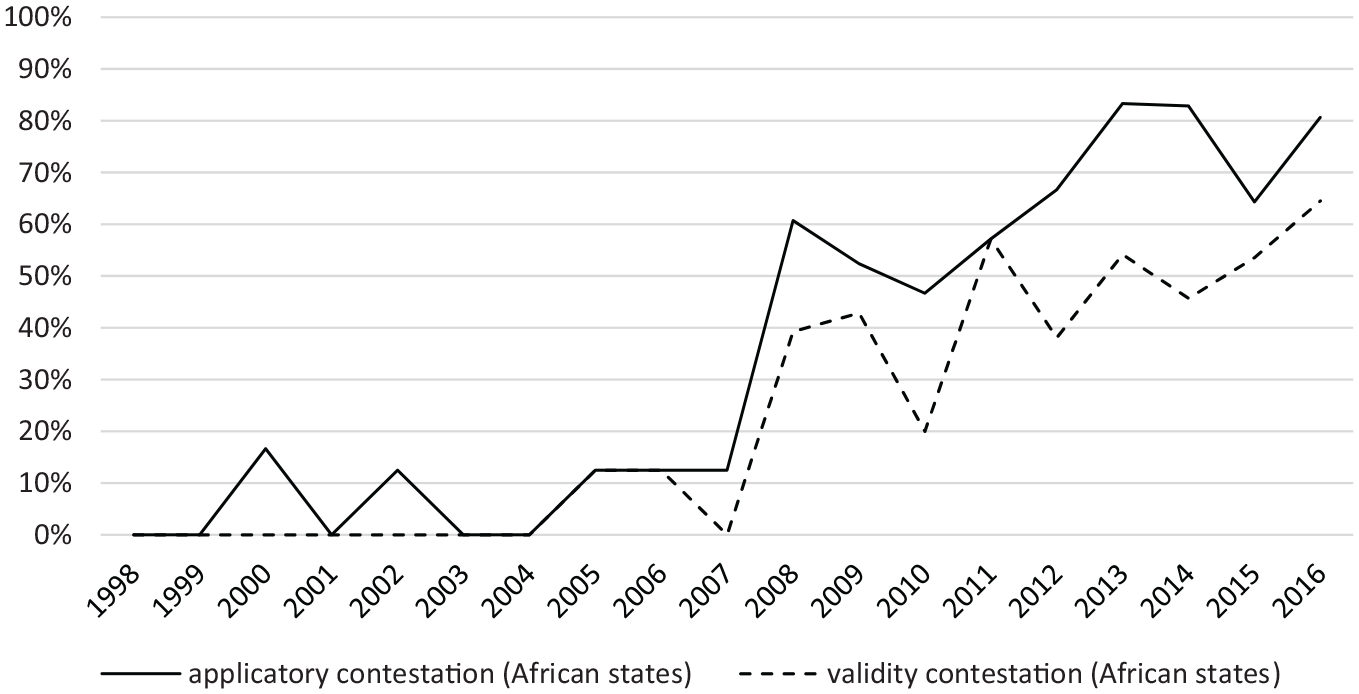
Share of statements containing applicatory and validity contestation, African states and the AU, 1998–2016.
Retrograde objectives and extraordinary claims
Looking at the contestation on the African continent, a retrograde rationale is involved: the court is criticised to overstep its competence by pressing charges against sitting heads of states without the consent of the respective states. This is perceived to violate existing customary law and a core element of national sovereignty.
3
Moreover, this is also perceived of as a specific violation of African sovereignty: it is African states and their heads of states that are on trial. The court is seen to specifically attack African states and to attempt to rob them of their sovereignty. Thus, there is a focus on reverting a prior socio-political status, that is re-gaining an equal footing with regard to national sovereignty. In line with that, Uhuru Kenyatta stated in 2015 that: we should aim to protect and sustain our independence against all negative forces and uphold the dignity and sovereignty of the African continent and our people.
4
Similarly, there is also a pattern of extraordinary claims, beginning to shift from the contestation of specific policies towards the system of international criminal law (see Figure 1). The more contestation developed on the African continent, the more it shifted from attacking specific policies of the ICC or specific norms and regulations of the Rome statute towards rejecting the Court as a whole and with it, core elements of the international regime of individual legal accountability (for instance, by re-claiming an immunity for persons holding office). 5
Taboo-breaking and emotive appeals
Taboo-breaking and emotive appeals are typical strategies of backlash movements in Alter’s and Zürn’s conceptualisation and they can be observed in the struggle between the court and the AU. This is particularly visible with regard to the attempts at withdrawal that South Africa, the Gambia and Burundi put forward which have been widely perceived as radical steps but more narrowly it can also be seen in the line of argumentation that has emerged lately. The Anti-African court, or: the ICC, despite being called International Criminal Court, is in fact an International Caucasian Court for the persecution and humiliation of people of color, especially Africans.
6
are typical phrases that completely delegitimate the court’s existence and violate the rules of engagement in the court. 7 Furthermore, these kinds of post-colonial arguments are utilised to raise memories of colonial experiences to provoke emotions of fear and resentment towards the court.
Mainstreaming in discourse
Finally, looking at the severity of contestation, as regarding these kinds of arguments in public discourse, a certain mainstreaming can be observed. While initially only very few African states have made use of a ‘post-colonial’ language in their engagement with the court, such arguments have spread through many countries lately making the ‘Anti-African court’ a standing expression on the continent. 8 This can also be inferred from the explosion in scholarly literature on the topic (see Figure 2).

Share of academic articles about the ICC, featuring the search term ‘Africa*’, 1994–2019 (web of science).
A sense of betrayal
However, all of these features have not been present from the beginning. Instead, there is a clear pattern of radicalisation of contestation on the African continent in the late 2000s. Initially, contestation centred around issues of complementarity and the weighing of peace versus justice claims. Arguments were largely based on the statute and at least on average focused on solving equivocal meanings contained in several paragraphs of the statute. This shifted following the arrest warrant against Omar al-Bashir and, more specifically, it shifted in response to the UNSC inaction regarding the request of the AU (and several others thereafter) to block prosecutions of the court in Darfur (see also Mills and Bloomfield, 2017: 109).
While contestation up to this point was still concerned with changing procedures within the court, it shifted to an attack against the heart of the court thereafter, promoting non-compliance with the court’s provisions, questioning its rationale and, finally, threatening with mass withdrawal of African countries from the court (Mills and Bloomfield, 2017: 114–116). For many African states, the inaction of the UNSC regarding the AU request for deferral created a sense of betrayal. Although they constituted the largest regional group in the court and had been instrumental in bringing the court to life in the first place (out of 121 state parties, 34 are African), their requests were simply ignored. The Council had not even officially discussed the matter but had simply ‘taken note’ of the request of the AU, making clear how important it considered the AU and its member states to be.
Contestation and backlash: The ICC case in perspective
Applying the criteria for backlash outlined by Karen Alter and Michael Zürn, we can conclude that the ICC has been the target of a backlash movement during recent years. Regarding the goals as well as the tactics, contestation shares the relevant characteristics of a retrograde objective aiming at reverting to a prior social condition and it involves extraordinary claims. It engages in taboo-breaking behaviour and emotive appeals and these strategies seem to have begun to enter mainstream public discourse lately (on the African continent at least).
Nevertheless, as I have highlighted, there was a clear shift from ‘normal’ contestation to backlash in the ICC case. Contestation changed, in particular, in response to the inaction of the Security Council regarding the AU request for a deferral. Only when contestants had the impression that their concerns were not taken seriously they began to question the court radically and started a campaign for rolling back the authority of the court and to re-instate national sovereignty with respect to international criminal law. Hence, backlash seems to have been triggered by a sense of diminishment and side-lining.
In conclusion, while the criteria of backlash can be applied quite easily to empirical analyses, what remains open is the value added of its thin conceptualisation of backlash as presented by Alter and Zürn. While it is initially plausible to increase the property space of the concept by divorcing it from its normative connotation as being regressive by nature, the question arises whether the remaining concept is not superfluous. In fact, other conceptualisations from norms research such as the distinction between applicatory versus validity contestation or from resistance research between reform and revolution or between opposition and dissidence (Daase and Deitelhoff, 2019) seem to apply to the same phenomena. They similarly highlight a form of particularly radical contestation that targets the core of a norm or institution that also relies on extraordinary means, that is, not playing by the accepted rules of the game. The remaining difference between these conceptions is merely the retrograde objective of backlash. What useful theoretical information can that generate beyond an assessment of the regressive nature of the contestation under observation? At least, this is a dimension that needs to be explored for the concept of backlash to be more than another name for a well-known phenomenon.
Alternatively, one could limit the concept of backlash to systemic challenges, that is, one could make the defining characteristics of the concept stronger by highlighting that extraordinary goals are confined to those that aim at changing the institutional order or its normative fabric at a whole. In this way, backlash would probably no longer be applicable to contestation in norms research which is primarily focused on contestation against specific norms and institutions. With this conceptual move, backlash could increase its discriminating power.
With regard to norms research, however, this move would leave open how we are to conceptualise normatively problematic forms of contestation or should we abstain from that completely? The example of contestation of the ICC highlights that while we need a separation of analytic and normative categories, this does not relieve us from a normative reflection of the implications of these categories.
On the one hand, there are clear signs that the form of contestation that has arisen lately is regressive in parts. It not only wishes to re-instate a prior social condition but it does so with the aim of taking back normative developments with regard to the effective protection of human rights and it does so in response to the experience of being subject to these norms. If we stick to a rather generic criterion to judge on the regressive nature of a movement of campaign by asking whether it aims at increasing (progressive) or limiting access to rights (regressive), then contestation is regressive.
Furthermore, the spread and intensification of this contestation, or backlash movement, has weakened the court and the norm it embodies: Non-compliance with the court has increased on the African continent and several states have attempted to withdraw and two have succeeded to do so (Burundi and the Philippines). Hence, contestation even was consequential.
On the other hand, this form of contestation of the ICC has also spurred new normative development on the African continent. Many states on the continent have strengthened their legal systems to increase their safeguards against prosecution by the court, and the AU has managed to secure agreement among member states for an African Court for Justice and Human Rights. Notwithstanding its weaknesses, the court should count as normative progress. In fact, the strengthening of national legal systems was one of the rationales behind the development of the court in the first place. The idea was always that the ICC (a court of last resort) would ideally become redundant because national states would be able to do its job in due time. The backlash might be bad news for the ICC but could still be good if unanticipated news for human rights protection. However, such conclusion might only be drawn if we stick to a thick conception of backlash.
Footnotes
Funding
ORCID iD
