







Abstract
Keywords
Introduction
Recent scholarly literature has suggested that the failure of pro-European mobilisation in the United Kingdom has, in part, resulted from the absence of a coherent strategy of how the case for European Union (EU) membership was made (see Fagan and van Kessel, 2023). Existing research focusses on the period following the Brexit referendum up until the United Kingdom’s departure from the EU in January 2020. Examining the post-Brexit landscape that followed, this article investigates the extent to which this issue persists among contemporary pro-European movements. Grounded in insights from social movement literature, the article analyses the ‘framing’ approach of the embryonic UK-based Rejoin movement revealing the discursive meaning-making processes underpinning the campaign.
Given the shortcomings of previous pro-European mobilisations, this article systematically examines the discourse of the United Kingdom’s post 2020 Rejoin movement. It asks: what are the enduring and emergent narratives of the Rejoin movement’s framing of pro-Europeanism post Brexit? And to what extent is the movement crafting a coherent narrative for re-joining the EU? In order to address these questions, this article analyses 1018 posts generated by 16 X (formerly Twitter) accounts of National Rejoin March (NRM) speakers and organisers using ‘discourse network analysis’, adapted for the purposes of this study’s focus on framing components (Leifeld, 2017). It examines different discursive frames and presents a refined conceptual approach that includes four framing components that are the focus of this study: grievances, perpetrators, solution, and strategy.
This research finds that many of the same framing strategies prominent in earlier pro-European mobilisations continue to persist, in particular the problematisation of the economy. However, amid this continuity, there is also evidence of transformative discourses emerging within the movement. These discourses reflect the new circumstances of pro-Europeans outside of the EU, their responses to the success of their opponents’ arguments, and attempt to address a number of the criticisms levelled at pro-European mobilisations before Brexit.
The next section provides an overview of the Rejoin movement and its emergence in the aftermath of Brexit. This is followed by outlining the conceptual contribution this article makes to social movement literature on framing tasks, their core components, and an overview of the methodology. The subsequent sections then analyse each of these four framing components in detail and examine the congruence between them. Drawing on the conceptual claims made in this article, I argue that on the key issues of democracy and free movement, there is a lack of coherence in how the case for EU membership is made by the Rejoin movement, limiting their capacity to mobilise consensus on these topics.
The Rejoin movement as a case study
The NRM and its eponymous flagship event was established to promote the cause of the United Kingdom re-joining the European Union ‘onto the agenda and keep it there until [they] have succeeded in [their] goal, no matter how long it takes!’. Founded in 2019 by Peter Corr and Lee Rudd, the ‘grassroots campaign action group’ at the heart of the Rejoin movement states its aims as bringing ‘pro-Europeans together to say that we want the UK to Rejoin the European Union’, for ‘“Rejoin” to become as mainstream as the word “Brexit” became’ and ‘to force Rejoin onto the agenda
The Rejoin movement represents the latest iteration of pro-European mobilisation in the United Kingdom. Its predecessors, the anti-Brexit movement, and Remain campaign now provide contemporary activism a catalogued recent history of pro-European contestation from which to emerge. Building upon the insights gained from the failures of the anti-Brexit movement documented by Fagan and van Kessel (2023), particularly the lack of ‘coherent strategy among activists about how the case for remaining in the EU would be made’ (Fagan and van Kessel, 2023: 135), this research provides new empirical evidence that despite attempts to evolve pro-European discourse, Rejoin has, to a significant extent, found itself constrained by the framing strategies employed by previous mobilisations.
Of the various organisations involved in what can broadly be described as the pro-European movement in the United Kingdom, the Rejoin movement has been chosen as the focus of this article for several reasons. First, among the notable organisations in the pro-European movement network, it stands out as the most radical in its stated goal of re-joining the European Union. As such, the movement is also driving the campaign most actively involved in making a direct case for the EU, unlike most other pro-European organisations that have shifted their attention away from addressing the core matter EU membership. Third, its emergence has been significant both in terms of size and level of activity. This combination of purpose and activity makes the Rejoin movement uniquely important in any discussion of pro-European mobilisation after Brexit but also the politicisation of the EU, and Europe more generally.
Analysing framing tasks
‘Framing’ is a concept used within social movement scholarship to refer to the dynamic and often contentious processes by which social actors engage in interpretation and meaning construction to mobilise consensus and drive action (Benford and Snow, 2000; Snow and Benford, 1988; Snow et al., 1986). For social movements, the product of these processes are ‘collective action frames’, these are the ‘action-oriented sets of beliefs and meanings that inspire and legitimate activities and campaigns’ (Benford and Snow, 2000: 614). The extent to which collective action frames are successful is partially contingent on the pursuit of three core framing tasks: diagnostic, prognostic, and motivational framing (Snow et al., 2018).
The concept of diagnostic framing refers to both ‘the identification of a problem and the attribution of blame or causality’ (Snow and Benford, 1988: 200). Meanwhile, the prognostic frame involves the articulation of ‘solutions to the problem but also to identify strategies, tactics and targets’ (Snow and Benford, 1988: 201). I focus on these two core framing tasks, diagnostic and prognostic. Following Aslanidis (2018), I have chosen to omit the third core framing task, motivational framing – ‘the elaboration of a call to arms or rationale for action that goes beyond the diagnosis or prognosis’ (Snow and Benford, 1988: 202) – because it lacks the thematic content relevant to this study’s examination of discursive meaning-making. However, it will be integrated into discussion elements of the article to provide greater insight.
The connection between diagnostic and prognostic framing tasks is alluded to in the social movement literature on framing, highlighting that ‘specific problems and causes tend to constrain the range of possible “reasonable” solutions and strategies advocated’ (Benford and Snow, 2000: 616). Contemporary studies have elucidated this relationship further (see Espinoza, 2021; Smith, 2021; Yazdiha, 2020; Zoller and Casteel, 2022). Most recently, Fagan and van Kessel have argued that the development of these tasks is ‘intrinsically connected’ to one another, and that ‘the weaknesses and limitations of one [framing task] directly curtail the other’ (Fagan and van Kessel, 2023: 40, 150). In this research, I systematically unpack this connection further through a comprehensive examination of their core thematic contents. However, I argue that the existing connection between diagnostic and prognostic frames, while apparent, is not exact and risks conflating lines of argument.
Informed by Snow and Benford’s (1988) original conceptualisation, I delineate diagnostic and prognostic framing tasks into four distinct components (illustrated in Table 1) and in doing so make a conceptual contribution to the relationship between framing tasks. First, drawing on Aslanidis (2018), I divide the diagnostic framing task into
Movement framing components.

Separating the components of framing tasks in this way allows analysis to explore the ways in which the mechanisms of movement framing complement, align, and interact with one another. Exploring these dynamics, the article not only provides valuable insights into the thematic makeup of each framing component but also offers greater complexity to the analysis of how the two framing tasks are interconnected and function within the broader context of pro-European contestation in the aftermath of Brexit. Developing understanding of the interconnected nature of diagnostic and prognostic framing tasks helps to move past Benford and Snow’s (2000) traditional conceptualisation of framing tasks as developing sequentially. Instead, this approach offers a dynamic view of framing, highlighting the need for components to be in constant dialogue with one another as part of a movement’s collective action frame in order to be effective.
Methodology
To investigate the Rejoin movement’s framing of pro-Europeanism post Brexit, this article uses discourse network analysis (DNA). Developed by Philip Leifeld (2016, 2017), DNA is an approach based on a combination of category-based content analysis and network analysis. DNA has been applied across a range of subfields in political science and public policy, from conflicts over software patents in Europe (Leifeld and Haunss, 2012), to climate politics in Italian parliamentary debates (Ghino and Steiner, 2020), and nationalist discourse in Georgian print media (Abzianidze, 2020). Building on its recent application to sovereignty claims in British pro- and anti-Brexit mobilisations (Rone, 2023), this article extends the use of DNA to analyse protest mobilisation on social media and the relationship between framing tasks.
The article examines the posts of 16 X (formerly Twitter) accounts, selected based on their author’s participation as a speaker or organiser at the National Rejoin March in London on 22 October 2022. As shown in Appendix 1, the speakers vary in their party ideological affiliation, professional experience, and place of residence and work (Brussels and the United Kingdom). Posts were collected from these accounts over a 7-month period, including the month of the march itself and the following 6 months. They were gathered using NVivo’s NCapture browser extension and then filtered on the presence of the keywords ‘rejoin’ or ‘re-join’. This keyword search strategy was chosen because of the popular hashtags used by the movement (#Rejoin, #RejoinEU, #MarchForRejoin, #DayForRejoin) and as the core message which the group of speakers had come to mobilise around. The resultant 1018 posts were transferred to the software ‘Discourse Network Analyzer’ where they were coded and converted into network data for further analysis. This data was then exported into Visone where it was used to generate two types of networks presented in this article that examine framing components individually as well as the connections between them.
The first type of network diagram, known as ‘affiliation networks’, shows the connections between concepts and the actors that use them (Figures 1, 3, 5, 7) (Leifeld, 2016: 173). In these diagrams, node size and their position on the vertical axis correspond to the weighted degree centrality of concepts (Freeman, 1978). Here, the metric represents the number of different actors that have used a concept and the frequency of its usage. In addition, line width indicates the frequency with which an actor employed a particular concept.
The second type of network diagrams used are ‘concept congruence networks’ that link concepts together through their co-use by actors within the network (Figures 2, 4, 6, 8, and 9) (Leifeld and Haunss, 2012: 397). In these diagrams, edges between concepts signify co-use by actors, with line width representing the number of actors referring to both concepts in the same way. Node size relates to the weighted degree centrality of concepts. This reveals both the connections within and between framing components. To clearly highlight the underlying structure, I follow Leifeld and Haunss’ use of the m-core approach, ‘a maximal sub-graph containing the lines with a weight equal or greater than m and the vertices incident with these lines’ (Leifeld and Haunss, 2012: 397).
In the rest of the article, I begin with an in-depth examination of each of the four framing components that are the focus of the study (grievances, perpetrators, solution, and strategy). To do this, affiliation networks of concepts and actors are used to show the dominant thematic content of each component. In addition, concept congruence networks are used to show how themes are connected within each framing component. Analysis of the most prominent themes that make up each framing component and the connections between themes is then unpacked further as it relates to the overall framing strategy of the movement and the evolving institutional context these frames emerge within.
The latter part of the article uses a concept congruence network of all four framing components to explore linkages between components and assess the extent to which the movement is articulating a coherent narrative. Through analysis of the relationships between these discursive elements, Rejoin’s framing is comprehensively evaluated in terms of its strengths and weaknesses.
Diagnostic grievances
Economy
The discursive practice of diagnostic grievance framing refers to the identification of problems, in this case with the United Kingdom in the aftermath of Brexit. Figure 1 shows that among the Rejoin speakers, grievances related to the economy and misinformation are dominant within the grievance component. The prominence of economic arguments within the Rejoin movement’s diagnostic frame reflects a continued commitment to the focus of previous pro-European campaigns (see Clarke et al., 2017; Fagan and van Kessel, 2023; Galpin, 2016) as well as the salience of economic issues facing the United Kingdom during the period studied. As shown in Figure 2, the general grievance of the economy is expanded upon in several ways and in particular has a pronounced connection with grievances around economic growth, supply chains, and misinformation. The example below illustrates how several economic grievances are often deployed alongside one another: Brexit ‘to blame for austerity budget’, as London stock-market overtaken by Paris Weak pound adding to inflation and undermining of exports and investment creating recession ‘Project Fear’ becomes our grim reality #RejoinEU Post by Molly Scott Cato (14 November 2022).

Affiliation network of diagnostic grievance framing by Rejoiners on Twitter.

M-core (with
The comprehensive way in which the economic consequences of Brexit are articulated as having a pervasive and detrimental impact on the British economy is a logical progression for pro-European discourse considering the warnings of pro-European campaigns before Brexit. It is exemplified by Scott Cato’s reference to
Some economic themes, however, have gained greater traction within the post-Brexit context. Reflecting the salience of the ‘cost of living crisis’ is its prominence among the movement’s grievances shown in Figure 1. In the following post, the tangible impacts of escalating living costs are attributed to supply chain difficulties caused by Brexit, connecting several facets of an acute and widespread problem to a specific consequence of Brexit: I think that’s just mild compared to the horrific reality this winter: crippling mortgage rises, fuel bills FAR higher than the £2,500 people seem to believe, black outs & food prices spiralling as EU suppliers de-prioritise U.K. customers further . . . let’s just #RejoinEU Post by Richard Hewison (13 October 2022).
Misinformation
As shown in Figures 1 and 2, along with economic concerns, misinformation dominates the grievance component. This pertains to both present-day and historic grievances. The former is built around criticism of Conservatives and Eurosceptic figures continued It took less than 6 years to leave based on lies. We are now staring at undeniable truth with our own eyes, and that’s our campaign (28 April 2023).
Moreover, as illustrated in Figure 2, misinformation is inherently linked with other grievances, such as economic and trade issues, as actors addressing these topics feel aggrieved about how they were dismissed by Leave campaigners during the Brexit referendum campaign. Reflecting long-standing grievances about the referendum itself, the movement’s emphasis on misinformation informs a discursive strategy built around the idea that public opinion will inevitability shift as these lies are debunked.
Democratic legitimacy
In Figure 1, democratic grievances are secondary in prominence to economic and misinformation concerns. Despite this, concerns about democratic legitimacy are still enmeshed within the core of Rejoin’s grievance frame (see Figure 2). This is unsurprising as contesting both the nature and legitimacy of British democracy have increasingly become a feature of debates over the EU (see Brändle et al., 2022). Critique of British democracy serves, in part, as a rebuttal to the common Eurosceptic framing of the EU as a limitation on parliamentary sovereignty (see Rone, 2023), and the framing by the Leave campaign of Brexit as a means to regain sovereignty and ‘take back control’ (see Menon and Wager, 2020). Highlighting the deficiencies of British democracy, Rejoiners attempt to challenge the incumbent Conservative government and undermine the democratic vision proffered by proponents of Brexit. For instance, the extent to which control has truly been taken back is debatable if there are only
Travel and ending free movement
Similarly secondary, but still of note, are grievances related to travel. Addressing travel, Rejoin implicitly engages with a key argument that has been a focal point of Eurosceptics, free movement. Historically, negative framing of free movement has been prominent within Eurosceptic discourse because of its ability to tap into both the ‘economic cost–benefit considerations regarding the benefits of EU labour mobility and appeal to citizen concerns related to security, borders and multiculturalism’ (Vasilopoulou, 2016: 219). The multifaceted nature of free movement similarly presents pro-European activism with an opportunity to problematise its loss in a way that bridges multiple concerns. Figure 2 shows that among Rejoin speakers, the problematisation of free movement occasionally intersects grievances related to travel, the economy, and misinformation though these connections are somewhat loose. There are some instances of the loss of free movement being framed directly in terms of the logistical issues that have been created for British travellers attempting to enter the EU. Guy Verhofstadt points to the effects of passport stamps and border queues as a tangible consequence: Passport stamps for Brits entering the EU was a consequence of ending free movement, a choice made by Brexiteer politicians. It was not inevitable after the Brexit vote. The easiest way to fix this is simple: #RejoinEU! Post by Guy Verhofstadt, in response to queues at the British port of Dover (26 April 2023).
The link between free movement and economic grievances is also directly expressed by Molly Scott Cato who connects it to business investment and labour market concerns: Lower business investment and tight Labour-market are both direct consequences of leaving the EU The Brexit vote led to a collapse in investment And ending free movement meant the loss of millions of workers #RejoinEU #Budget2023 Post by Molly Scott Cato (15 March 2023).
Another less pronounced link, not expressed in Figure 2, is the connection between losing free movement and restraints on the rights and freedoms of people in the United Kingdom. Comparing the temporary restrictions during the COVID-19 pandemic to the lasting restrictions put in place by ending free movement, the NRM official account combines rights-based grievances with sentiment around sovereignty: Brexit has cost the UK more than the pandemic. Not just in monetary terms – but in terms of loss of our rights and freedoms too. We were ‘released’ from Lockdown. We’re still Locked In without Freedom of Movement though. Le’ts [sic] take back control and #RejoinEU Post by National Rejoin March (21 April 2023).
Using the call to arms, of
The examples listed above capture some of the ways in which Rejoin has problematised the loss of free movement; however, as shown in Figures 1 and 2, these are not being deployed consistently across the movement, aside from a specific focus on travel concerns. From the range of ways in which ending free movement and its associated issues are problematised, it is clear that it has the potential to bridge a variety of concerns, both as a grievance and as a solution. In 2016, Vasilopoulou said of the ‘Remain’ campaign, a credible campaign ‘would need to engage directly with the question of EU freedom of movement’ to openly address Eurosceptic criticisms and make ‘a positive case about how EU citizens contribute to Britain’s growth and the welfare state’ (Vasilopoulou, 2016: 226). However, this did not materialise during the referendum campaign; instead, a ‘“defensive campaign script” on immigration’ was adopted (Clarke et al., 2017: 33). A similar narrative unfolded during the anti-Brexit campaign where ‘no sense of a clear and cogent position’ on freedom of movement materialised (Fagan and van Kessel, 2023: 135). In the case of Rejoin, the focus on travel suggests that the movement has taken some steps to problematise the issue of free movement, albeit indirectly. However, as will be explored in the subsequent sections, the extent to which grievances are accompanied by positive advocacy for free movement is pivotal in determining whether this current pro-European campaign has learned from past hesitancy.
Overall, Rejoin’s diagnostic grievances centre around a tangible sense of loss or degradation of the state of the United Kingdom. The prominence of economic grievances reflects a sustained commitment to many of the arguments present in earlier pro-European mobilisations. However, framing has transitioned from warning of the negative economic consequences of Brexit to pointing them out, with an amplified focus on the cost of living due to its salience within UK political discourse. Grievances around misinformation are similarly a continuation of concerns about the legitimacy of the Brexit referendum itself and the idea that the United Kingdom was brought out on lies, now made clear by tangible consequences. However, emergent grievances surrounding democratic legitimacy and travel, while limited, are indicative of attempts within Rejoin to address themes pro-Europeans have historically yielded to their Eurosceptic opponents. By engaging with these topics, Rejoiners are taking preliminary steps towards ‘frame transformation’, the process by which old understandings and meanings are changed and/or new ones generated (Benford and Snow, 2000: 625). Throughout the rest of the article, I argue that similar attempts at meaning-making develop concomitantly through Rejoiners’ apportioning of blame, articulation of a solution, and strategy.
Diagnostic perpetrators
The diagnostic perpetrator framing component refers to the attribution of grievances to individuals and groups. For clarity, this does not refer to actors or groups depicted as bystanders. Within the Rejoin movement’s diagnostic framing, a range of perpetrators are identified. Attribution often focusses on actors in the electoral sphere, including Conservative and Labour politicians, Eurosceptic Members of the European Parliament (MEPs), the Northern Irish, pro-Brexit and conservative Democratic Unionist Party (DUP), and elected politicians in general.
As shown in Figure 3, Conservative politicians are the most prominent perpetrators identified within Rejoin’s diagnostic frame. The party is attributed to a variety of grievances that relate to decisions made during the Brexit process and handling of its aftermath, most notably economic problems (see Figure 9), with one speaker labelling the government as the

Affiliation network of diagnostic perpetrator framing by Rejoiners on Twitter.
The second most prominent perpetrator identified in Figure 3 are Eurosceptic actors. In these cases, direct reference to specific perpetrators is avoided, with posts instead referring to an ambiguous group of Brexit supporting actors using a variety of names. Using phrasing such as The Brexiteers in the Tory Party no longer care about trying to make Brexit work . . . . . . they’re just trying to set fire to everything in an attempt to make sure Rejoin is harder to make work. #RetainedEULawBill Post by Mike Galsworthy (18 January 2023).

M-core (with
When used in conjunction with Conservative politicians, an image of a party no longer in control of itself and by extension the country is conveyed. In addition, by assigning blame to a Eurosceptic faction, a diverse range of grievances are attributed to Eurosceptic insurgents without alienating supporters of the EU who are still ideologically aligned with the Conservative Party on other issues. Overall, what Figures 3 and 4 show is that despite a relatively broad range of perpetrators identified, it was Conservative politicians, a variation of ‘Brexiteers’, or a combination of both that became the target of Rejoin’s diagnostic frame. The movement’s apportioning of blame reveals how Rejoiners have positioned themselves within the evolving post-Brexit landscape. It demonstrates an intensification of anti-Conservative sentiment compared to previous pro-European mobilisations that has informed the movement’s articulation of grievances, solutions, and most notably, their proposed strategies.
Prognostic solution
The single market, customs union, and economic growth
The prognostic solution framing component refers to the ways in which a movement articulates its goal as a solution. Sometimes it can be difficult to discern proposed solutions from strategic approaches, so with respect to the Rejoin movement, examining prognostic solution framing explores how Rejoiners depict the EU and the specific aspects they focus on. As shown in Figure 5, the most prominent aspect of Rejoin’s solution component is the United Kingdom’s return to the single market. It is at the core of the movement’s articulation of a solution and is linked by speakers to several aspects of economic prosperity including growth, trade, and inflation reduction (see Figure 6): How are you going to pay for the pay rises for the striking workers? The government’s OBR says leaving the Single Market costs us £40 billion. We’ll rejoin it. And it won’t boost inflation because it will improve supply chains at the same time Post by Femi Oluwole (8 December 2022).

Affiliation network of prognostic solution framing by Rejoiners on Twitter.

M-core (with
Oluwole’s post captures attempts by Rejoiners to frame the single market as a transformative all-encompassing remedy for various aspects of the UK economy. It reflects the movement’s prioritisation of economic recovery and stability, and the perception of the single market as a solution to deal with an interconnected set of economic problems. Often used in conjunction with the single market, the customs union is predominantly deployed as a part of a wider prognostic vision of EU membership and economic recovery as the following post by Steve Bray demonstrates: Tax rises & cuts! That is all Brexit was ever going to be! Truss & Kwarteng just accelerated a problem that we already have. We need to be back in the Customs Union & back in the Single Market, we need freedom to move & freedom to trade. Re-join the European Union Now! Post by Steve Bray (4 November 2022).
The final element at the core of how the EU is framed as a solution is the emphasis on economic growth. The promise of economic growth in the EU is used to directly contrast with the articulation of economic struggles the United Kingdom has faced in the aftermath of Brexit, as the following post demonstrates: The OBR says Brexit costing us £100 billion. The ONLY way to Growth is very clear . . . #RejoinEU Join us to tell everyone on Saturday 22nd October! Post by National Rejoin March (5 October 2022).
Despite a sustained focus on economic arguments, promises of
Horizon Europe and the scientific community
Figure 5 shows that Horizon, the EU funding programme for research and innovation, was also prominent within the prognostic solution framing component. Unlike the single market and customs union, it represented a target that was attainable in the more immediate term because the United Kingdom’s membership was expected to continue after Brexit, but for complications over the Northern Ireland Protocol (Zubașcu, 2021). As the connection between Horizon and Science in Figure 6 illustrates, Horizon bridges the rest of Rejoin’s solution component to the specific concerns of the scientific community. The following post demonstrates how re-joining Horizon was framed in a way that integrated a specific solution within a broader narrative around the United Kingdom’s relationship with the EU and the United Kingdom’s global influence: To be a #ScienceSuperpower or anything close to it, we need to rejoin Horizon enthusiastically. . . and *then* invest in conferences, meetings and new mechanisms to rapidly re-establish the UK as a European team leader. So WHAT is Rishi Sunak playing at? Post by Mike Galsworthy (3 March 2023).
Connecting re-joining Horizon to the broader narrative of fighting against national decline brought on by Brexit politicises an issue that is of more niche concern by pairing it with a national narrative. As a result, pro-Europeans have communicated a positive vision of how a closer relationship with the European scientific community can be interwoven with a narrative of national rejuvenation, one that emphasises opportunity and avoids a negative approach that focusses on mourning the United Kingdom’s departure from the programme. While not limited to the actions of individuals in this study, the case for re-joining Horizon made by pro-Europeans and the scientific community had success in September 2023, with the United Kingdom taking the steps to re-join the programme, albeit under amended terms (GOV.UK, 2023). This move was facilitated by agreement between the United Kingdom and EU on the Windsor Framework, quelling disagreements over Northern Ireland (Coates, 2023). However, re-joining Horizon still marks one of the few major success stories for supporters of the EU in the United Kingdom and potentially. Utilising a concept known as ‘frame bridging’, defined as ‘the linkage of two or more ideologically congruent but structurally unconnected frames regarding a particular issue or problem’ (Snow et al., 1986: 467), the success of the campaign to re-join Horizon represents a case study for future pro-European activism to emulate. It demonstrates how milestones might be achieved through fostering connections and linking pro-European narratives to other campaigns.
Shared sovereignty
Although not as prominent within the prognostic solution frame as economic themes (see Figure 5), Rejoiners’ use of shared sovereignty represents an attempt by some to articulate re-joining the EU as generating some sort of democratic dividend and builds on criticisms of British democracy articulated in the movement’s diagnostic framing: All 28 member states had a say in treaties & laws created by the EP, if that isn’t compromise, I don’t know what is? They allowed different countries to engage on different levels; single market, euro, schengen, etc. It’s the brexiteers who are unable to compromise Post by Madeleina Kay (31 October 2022).
The above post captures attempts made by some within the movement to positively frame democratic elements of the EU and gain issue ownership of the theme of sovereignty that has historically been subsumed within the Eurosceptic framing of Brexit (see Pirro and Van Kessel, 2018). Juxtaposing the application of shared sovereignty in the EU against the lack of agreement among the perpetrators of Brexit, Kay turns Eurosceptic framing on its head and in doing so challenges common Eurosceptic narratives on sovereignty and the EU.
Some speakers also refer to shared sovereignty in a less direct fashion and the need to have a metaphorical seat at the table at the supranational level as
Integrating the theme of shared sovereignty with what Benford calls the ‘vocabularies of motive’ (severity, urgency, efficacy, and propriety) (Benford, 1993), some within Rejoin establish a newfound emphasis within pro-European diagnostic and prognostic framing. Juxtaposed against the
Free movement
As shown in Figure 5, freedom of movement, a fundamental principal of EU membership, is similarly secondary in status to the focus on strictly economic solutions. This position is reflected in its use, usually in addendum, with little articulation as to why it is beneficial. In the below posts, reference to free movement is used by Rejoin speakers who are representatives from the Green Party and Liberal Democrats to attract support and differentiate themselves from the Labour Party who may otherwise attract pro-European voters without the presence of another party standing on a firmly pro-European platform: Starmer rules out taking UK back into single market or customs union if Labour win election Time to join @TheGreenParty? We support rejoining customs union, restoring free movement and beginning journey to #RejoinEU Post by Molly Scott Cato (22 November 2022). worst govt of most people’s lifetimes is ploughing on, pretending that it can make success of manifest disaster. Labour refuses to challenge it on biggest self-inflicted crisis of our time, tamely ruling out obvious need to rejoin SM and restore FoM Post by Sarah Ludford (30 April 2023).
These posts capture the nature in which references to free movement have occurred. There is minimal effort to convince the public as to its benefits beyond the mourning of its loss that is explored in the grievance component. Prognostic framing is targeted towards those who already support free movement as a concept. Despite what might be described as opportunistic behaviour by party representatives, the lack of attention given to articulating the benefits of free movement reflects the broader Rejoin movement analysed and corresponds with the limited problematisation of its loss in the grievance component.
To summarise, I identify evidence of a shift in several aspects of the solution framing component that is indicative of Rejoin engaging in ‘strategic adaptation’, derived from reflections on previous pro-European mobilisations (Koopmans, 2004: 30). However, this continues to be accompanied by the persistence of other more entrenched aspects of pro-European discourse in the United Kingdom. In alignment with historic arguments for European integration in the United Kingdom, the primary focus has been on highlighting the economic benefits of re-joining, with a strong emphasis on the single market. In recent times, supporters of the EU have also found greater reason to be optimistic with the success of the campaign to re-join Horizon which serves as a potential template for future campaigns. Moreover, there is unfolding evidence that Rejoin is beginning to develop robust arguments for the democratic merits of the EU by incorporating the less tangible theme of shared sovereignty. This signifies a promising evolution for pro-European activism, which has historically ceded sovereignty framing to Eurosceptics and their powerful ‘take back control’ narrative. In contrast, despite its prominence, an equally comprehensive discourse was lacking regarding free movement. Considering the historically contested nature of free movement as an aspect of EU membership, the continued lack of discussion about its advantages is surprising. The extent to which these themes are being consistently deployed as part of a coherent frame that connects grievances with solutions is explored in the final section.
Prognostic strategy
Prognostic strategy refers to the approach that a movement advocates as a means to achieve their proposed solution. In the case of the Rejoin movement, this refers to strategies to achieve their goal of re-joining the European Union, rather than how the European Union or aspects of it are articulated as a solution. There are various facets to the strategic component of the prognostic frame. These could involve intermediate targets that are not directly related to EU membership such as electoral reform or calling for general elections. Equally it may encompass the movement’s messaging or the tone of engagement with the EU, be that gradual advancement towards re-joining or a more immediate and comprehensive approach.
Referendum
The emphasis on a second referendum shown in Figure 7 builds on a long history of the use of referenda with respect to the issue of European integration both in the United Kingdom and EU more generally (see Hobolt, 2006). It also shares similarities with the ultimately unsuccessful People’s Vote campaign (2018–2020) (Fagan and van Kessel, 2023). Despite the similarities however, Rejoin’s strategic approach is fundamentally different from that of the People’s Vote campaign. First, as Figure 8 makes clear, a second referendum is no longer the sole strategic focus of the campaign, though it does have strong support within sections of the movement, in particular the NRM official account (see Figure 7). In addition, reflecting the post-Brexit environment, Rejoiners are not calling for a referendum on the terms of the agreement. Instead, calls for a referendum are based on an evaluation of the post-Brexit landscape, including an assessment of the conditions now faced by the British public, and shifts in voter attitudes. They reflect a change in the status of pro-European activism in the United Kingdom, moving from challenging the terms of the agreement to addressing actual post-Brexit conditions and outcomes. As a result, the justification of strategy is grounded in change, rather than preventing it.

Affiliation network of prognostic strategy framing by Rejoiners on Twitter.
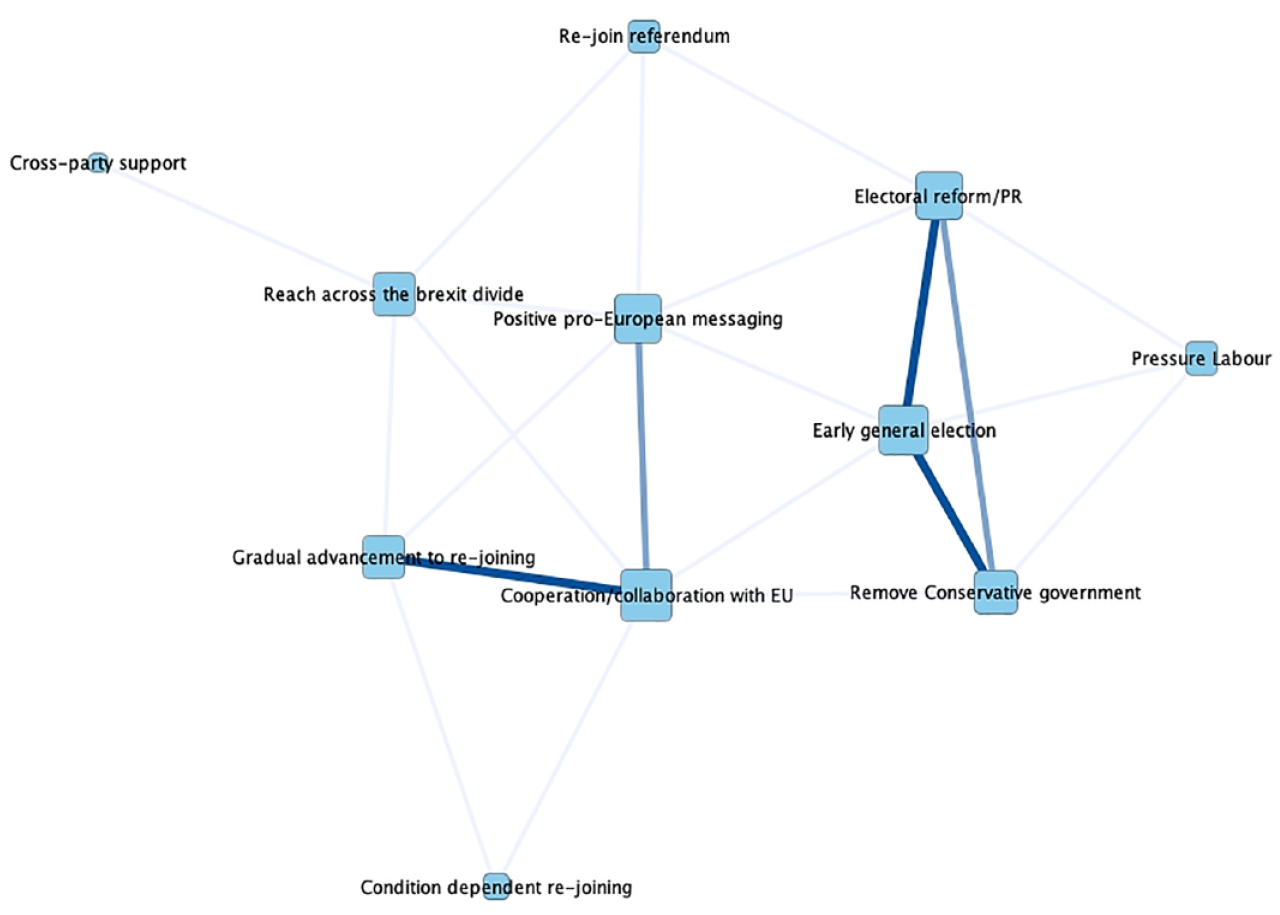
M-core (with
Incremental reintegration
Shifting focus to a more time-oriented aspect of Rejoin’s strategy, a considerable number of those involved with the Rejoin campaign have referenced a gradual advancement to re-joining whether that be articulated as a right now there is no political will to rejoin. When there is, we will reform. In fact, we will need more intense reforms than this before we can even think of rejoining now Post by Phil Moorhouse (31 March 2023).
Similarly concerned with timing, posts such as these represent a more cautious approach, emphasising the need for change before pursuing re-ascension, though there is significant ambiguity as to what the right conditions are. Both strategies acknowledge a phased approach towards re-joining. The gradual approach focusses on systematic progression, while the condition-dependent advancement is a less active strategy that relies on timing. Neither gradual nor condition-dependent strategies to re-joining are unanimously supported within the movement. The concept of intermediate targets has faced criticism within Rejoin, with some expressing concerns about
Finally, as shown in Figure 8, strongly connected to the temporal strategy of gradual advancement towards re-joining is the strategic objective of cooperation and collaboration or
Changing the electoral sphere
On the right-hand side of Figure 8 are a collection of strategies voiced by Rejoiners that focus on the electoral realm, either in terms of generating political turnover or structural change. In terms of political turnover, the focus has predominantly been on removing the Conservative government and calling for a general election. Identified as the primary perpetrator within the movement’s diagnostic frame, it is unsurprising that removing the Conservative government is similarly prominent within the movement’s strategy, while a general election is the obvious mechanism to achieve this. The emphasis on the Conservative Party as perpetrators coupled with the strategic objective of their removal captured in the following post speaks to the partisan nature of Rejoin’s pro-European contestation: Plan to get our country back: 1) General election with progressive alliance to wipe the Tories out 2) electoral reform to bring in PR and clean up politics 3) rejoin the EU Post by Siobhan Benita (14 October 2022).
Within the strategy set out by Benita and others is what McAdam and Tarrow (2010: 533) describe as ‘proactive electoral mobilisation’, where a general election is viewed as an opportunity to reshape the British political establishment in their favour. Combined with a focus on long-term structural change through electoral reform, the strategy is broken down into steps, enhancing the perceived efficacy of campaigning to re-join the EU. However, despite crafting a hypothetical pathway towards re-joining, the suggestion that a coalition of pro-European voices will bring about electoral change or that electoral reform will result in a parliament willing to bring about re-joining the EU is perhaps naive. With respect to the efficacy of electoral reform, there appears to be the belief among some that pro-European parties reflect a majoritarian view and so would be beneficiaries of a proportional voting system: @darrengrimes_ The country has cottoned on fella. The massive majority will never forgive the tories for taking us out on bullshit lies. Which is why when we have PR and have Rejoined, your far right wing take over of the conservatives is what will have destroyed it forever Post by National Rejoin March (19 October 2022).
Perspectives such as this acknowledge what the literature on the 2019 general election has suggested, that the Remain vote was fragmented while Boris Johnson and the Conservative Party were able to consolidate the Leave vote (Cutts et al., 2020). It also describes electoral reform as a safeguard against what Rejoiners view as the creeping incursion of extreme ideologies within British electoral politics. In what Gamson and Meyer (1996: 285) call the systematic overestimation of political opportunity, this perspective rests on the assumption that (1) pro-European parties would be chief beneficiaries under this system, while also neglecting the potential benefit to fringe Eurosceptic and far-right parties being provided a platform, and (2) that pro-European parties would be willing and able to form a government together. A strategy such as electoral reform, with uncertain outcomes for supporters of Rejoin and pro-Europeans more generally, must be balanced by an emphasis on constructing a positive vision of European integration through the solution component. This was not the case for the People’s Vote campaign, where the strategy of a second referendum dominated the prognostic frame (Fagan and van Kessel, 2023). The importance of this balance is amplified for a long-term strategy like electoral reform, where significant energy is likely to be expended and the result is even more uncertain for supporters of Europe.
Messaging
The last aspect of the strategic component to be addressed is the emphasis on messaging. As illustrated in Figure 7, the prominence of positive pro-European messaging and reaching across the Brexit divide are below some of the incremental reintegration strategies and electoral approaches within Rejoin’s strategic framing component. As shown in Figure 8, positive messaging is closely linked to collaboration with the EU, forming part of an inner core within the strategy component of pro-EU advocacy. This strategy directly urges activists and supporters of the pro-European cause to avoid the pitfalls of previous campaigns, frequently dubbed ‘project fear’ for their negative tone (Clarke et al., 2017). Instead, supporters are encouraged to foster optimism and be proudly and unashamedly pro-European. As one post writes, The brutal reality of Brexit is convincing people who were led astray by the lies of Brexiteers (28 October 2022).
This strategy is reflective of a response to another criticism of previous pro-European campaigns in the United Kingdom, that there was a failure to address the concerns of sections of the electorate that were otherwise critical of some aspects of the EU (see Fagan and van Kessel, 2023: 151). It is evident that pro-Europeans are increasingly recognising the need to bridge the gap at the issue level, as shown through analysis of the grievance and solution components where Rejoiners are engaging with themes that were previously ignored or avoided. This development is mirrored within the agent/agency dimension of frames where a strategy of reaching across the divide is advocated and within the perpetrator component where clear distinctions are made between those who orchestrated Brexit (the perpetrators) and those who supported it but need to be convinced.
Analysis of Rejoin’s prognostic strategy highlights a diverse array of approaches advocated by those within the movement (see Figure 7). The strategic target of a referendum on re-joining is prominent within the frame, driven by the NRM official campaign account. However, illustrated by Figure 8, emerging at the core of the framing component are two clusters of strategies. On the left are approaches that focus on incremental reintegration and gradually fostering the conditions for re-joining. On the right are a collection of strategies that relate to domestic political transformation in the electoral arena, with a particular focus on addressing those identified as perpetrators. The latter reflects a Rejoin having positioned itself in direct opposition to the ruling Conservative Party, a significant departure from cross-party mobilisations before 2016, and a trend that appears to have continued to intensify post-2020. Although the two identified clusters are loosely connected, they indicate a slight divide in the movement’s strategic reasoning moving forward.
Coherence across framing components
In the previous four sections, analysis has revealed the dominant themes within each individual framing component. Comparing these themes across framing components suggests, in line with prior scholarship (see Fagan and van Kessel, 2023; Smith, 2021), that there is a connection between diagnostic and prognostic frames. A network analysis of the connections between components reveals the extent to which a coherent and balanced framing approach is emerging within the Rejoin movement. Illustrating the connections between framing components, Figure 9 shows the concept congruence network of the Rejoin movement across all four framing components. To clearly highlight the connections between elements, the m-core with

M-core (with
Several insights can be drawn from Figure 9, both in terms of the presence and absence of links between concepts. First, in alignment with their prominence across grievance, perpetrator, and solution components, at the core of Rejoin’s framing approach are the strong linkages between the economy and Conservatives as grievance and perpetrator, and the single market as a key element of how the EU is articulated as a solution. Consistent with earlier literature on pro-European mobilisations in the United Kingdom (see Clarke et al., 2017; Fagan and van Kessel, 2023), economic arguments continue to take precedence within the Rejoin movement, with economic grievances typically attributed to the Conservative government. The Conservatives are also strongly connected with a range of other grievances: democratic legitimacy, trade, misinformation, and travel. Linked with a host of problems, the corresponding strategies strongly connected with the Conservatives as perpetrator unsurprisingly relate to their removal, an early general election, and electoral reform. Figure 9 also shows how strategies are linked with both the solution and grievance components. The single market, the most dominant aspect of the prognostic frame, is linked to a variety of strategies, indicative of a shift away from a singular strategy dominating the prognostic frame as was the case for the People’s Vote campaign where the focus on a second referendum ‘took the debate even further away from positive interpretations of the EU’ (Fagan and van Kessel, 2023: 108). Fittingly, calls for positive pro-European messaging are linked to grievances concerning misinformation. The dense set of connections between components at the core of the diagram indicates that actors are addressing all four elements.
A more surprising set of findings point to three potential framing failures within Rejoin’s core concept congruence network in Figure 9. First is the absence of a direct connection between travel-related grievances and the solution of re-joining to restore free movement. The disconnect between these two elements is reflective of Rejoin’s framing strategy not yet consistently deploying a frame that articulates a coherent narrative around free movement that integrates both framing tasks, despite both diagnostic and prognostic elements being present within the movement’s overall discourse. The absence of any established connections with diagnostic grievances is a continuation of pro-European campaigns failure to use free movement as a solution that bridges multiple concerns and directly addresses Eurosceptic criticisms (see Vasilopoulou, 2016).
The second disconnect is between grievances related to democratic legitimacy and shared sovereignty in the EU as a solution. The United Kingdom’s exit from the EU has led to a heightened focus on the country’s democratic deficiencies (see Brändle et al., 2022), a theme also observed in this study’s analysis of Rejoin’s grievance component (see Figure 1). While the theme of shared sovereignty is again notably present in how the EU is articulated as a solution (see Figure 5), Figure 9 illustrates the failure to connect these two elements as part of the movement’s collective action frame. The result is a fragmented democratic frame that misses the opportunity to deploy a cogent argument for re-joining the EU.
The failure to directly link these solutions within the EU to criticism of the post-Brexit settlement is a fundamental challenge that needs to be addressed in order to mobilise consensus around these core aspects of membership. While there is evidence of both concepts appearing in the discourse of key activists, very few are articulating both diagnostic and prognostic elements. This indicates that the Rejoin movement is yet to consistently deploy a frame on either issue that articulates a coherent narrative, limiting its effectiveness in mobilising consensus on these core issues and in advocating for re-joining the EU.
Conclusion
This article has analysed the framing of the United Kingdom’s Rejoin movement, focussing on the posts by key actors to generate new insight into how pro-European contestation is evolving in the aftermath of Brexit. It has generated several insights into the development of the United Kingdom’s latest pro-European movement and its attempt to mobilise consensus among the British public.
First, economic grievances continue to dominate pro-European discourse post-Brexit. In addition, pro-Europeans’ problematisation of misinformation lingers as the consequences of Brexit have surfaced. Travel issues caused by the loss of free movement and democratic legitimacy also feature prominently within Rejoin’s problematisation of the post-Brexit settlement.
Second, blame attribution centres around Conservative politicians. This article has argued that this is reflective of their role in delivering Brexit, their shift towards progressively more Eurosceptic stances, and consequently, Rejoin’s positioning as an increasingly anti-Conservative movement.
Third, in alignment with the diagnostic grievance component, analysis of the prognostic solutions reveals a similar emphasis on the economic benefits of the EU, particularly the single market. There is also evidence of an emergent forward-looking approach in other areas, including the successful campaign to re-join Horizon and a renewed case for shared sovereignty. However, despite tokenistic mentions, robust arguments for the advantages of freedom of movement continue to be limited.
Fourth, analysis of the various plans of attack expressed by Rejoiners show a complex picture. While a re-join referendum is a notable feature of the component, electoral strategies and calls for electoral reform suggest that a significant element of the movement perceive the route back to the EU through electoral politics. Strategies around processes for re-engagement with the EU have also emerged in an attempt to articulate a pathway to re-joining. Evidence of frame evolution is also observed in the implementation of learnings from previous campaigns that reflect calls for a more positive tone and to reach across the Brexit divide.
Alluding to the interconnected nature of framing tasks, analysis of each component reveals two general trends across framing components. First, the legacies of previous campaigns persist in shaping continuity within Rejoin’s framing approach. Conversely, there is also evidence of attempts to adapt and implement learnings from these past mobilisations. The simultaneous processes of discursive continuity and evolution, driven by inherited arguments and reflection on past mobilisations, underscore Rejoin’s emergence from the ashes of the anti-Brexit movement.
Finally, direct analysis of the connections between framing components reveals that, despite a developed and well-balanced economic frame that points to the Conservative party as chief perpetrator and a host of strategies for their removal, the movement has yet to craft a coherent narrative around some of the key issues in the debate surrounding European integration in the United Kingdom. In particular, there is a disconnect between the diagnostic and prognostic framing of both free movement and democracy. Without integrating widespread concerns about the UK post-Brexit with the solutions offered by future EU membership, it is unlikely that the movement will successfully shift momentum, either in the current parliament or the next.
These findings are a timely contribution to the growing literature on the politicisation of Europe through their insights into pro-European mobilisation after Brexit. Furthermore, they add weight to the conceptual conclusion articulated at the beginning of this article, that delineating diagnostic and prognostic framing tasks into four distinct components allows for a better understanding of the interdependent nature of framing tasks. This can be used to assess the strengths and weaknesses of a movement’s framing approach and the development of framing tasks more effectively.
Footnotes
Funding
ORCID iD
