







Abstract
How media reporting refers to different sources of information matters in terms of how questions are represented in public discourse. Different persons act as sources of information as experts, commentators, and eye-witnesses, serving the journalistic story in their own ways (cf. Boykoff, 2011; Wilson, Bonevski, Jones, & Henry, 2009). Informants with certain knowledge, values, beliefs, norms, and power positions are legitimised as experts with various outlooks on the questions discussed (Altheide, 1997; Ericson, Baranek, & Chan, 1991; Kitzinger & Reilly, 1997; Vestergaard, 2000). By providing different angles, they contribute to the overall agenda setting (McCombs, 2014), and tend to naturalise the adherence of a problem to particular fields of expertise (Fairclough, 1985). For example, if journalists only interview medical doctors about illicit drug use, then readers may start to regard it as a question best understood and treated within the medical field of expertise. If social workers dominate the public discourse, it may be assumed that it is because the question is best handled by social services (cf. Kitzinger, 2007).
This article presents a quantitative analysis of how the print press in Finland, Italy, and Poland report on addictions. The analysis concerns the sources of information employed in the coverage of addictions and addiction-related phenomena. We focus on the period from 1991 to 2011, when profound changes occurred both in the mass-media sector and in European societies at large (cf. Sparks, 2007).
Previous research has shown that media reports on addiction issues in the 1990s and the 2000s started increasingly to emphasise the individual internalised framing of the problems, and moved away from larger societal and structural understandings (Beccaria, Rolando, Hellman, Bujalski, & Lemmens, 2015; Hellman, 2010). This study may be able to show whether such a shift is visible in the frequency of different sources employed in the media. If it is the case, then one could perhaps speak of a change of question ownership. And even if there were no change in employment of sources over time, a mapping of the media sources employed in questions related to addiction would be crucial for understanding who is ascribed expertise in addiction-related questions.
Drawing on the work of Laclau and Mouffe (2001), we assume that the discourse on addiction and addiction-related disorders (from now on referred to as “addiction discourse”) is based on articulations of several competing micro-discourses, delivering various rationalities and excluding certain knowledge. This study asks what sort of trends in understandings and framing can be traced in the sources employed in the mass print media in Finland, Italy, and Poland. Changing patterns of representations of such sources have shown to offer insights into how the media legitimises and enforces certain perspectives (cf. Fairclough, 1989; van Dijk, 1989, 1993, 1997).
Our overall objective is to provide knowledge on the country-specific popular addiction discourse by uncovering who gets the opportunity to define and reflect upon addiction-related problems. We approach our material quantitatively, tracing cross-country differences in the period 1991–2011. The media constructs under study concern a broad variety of addiction-related behaviours: use of alcohol, illicit drugs, and tobacco; and gambling, eating disorders, and other activities described as addictive behaviours, such as Internet use, extensive work, or compulsive shopping. In order to group the sources in different fields, we used Boltanski and Thévenot’s (2006) theory of value worlds that justify certain angles on questions. Five main societal spheres emerged as contexts of the speakers’ categories in the texts. The sources of information spoke as private persons, as representatives of the civic sphere, or as representatives of political life, science, or the mass media (cf. Perälä, Hellman, & Leppo, 2013). Before exploring the trends in representation of media sources in addiction discourse, we will briefly discuss the three countries under study.
Country profiles
Finland, Italy, and Poland represent different approaches to governance in the areas of lifestyles and public health, depending on the level of engagement of public, private, and civic spheres in the process of decision-making and management (Ysa et al., 2014). Finland and Italy can be considered to combine comprehensive policy structures with relational management strategies focused on wellbeing (public health in general coupled with proactive policy making). Italian substance policies focus on illicit substances, whereas Finnish policies rely on regulation and emphasise the risks of legal substances such as alcohol or tobacco. Poland represents a transitional model between a traditional approach (security-oriented approach, substance-based reactive interventions) and a more comprehensive policy model, tackling legal and illicit substances separately and excluding civic actors from the process of decision-making (Ysa et al., 2014).
Finland
The Nordic countries are known for comprehensive universal welfare policies. In Finland, as in the other Nordic nations, welfare policies are based on pragmatic social dialogue between the democratic process and scientific evidence. The beginning of the 1990s, however, witnessed both an economic crisis and a crisis of the welfare state, which affected significant segments of Finnish society (Hellman, Monni, & Alanko, 2017). Market forces gained the upper hand in public speech at the expense of public-sector solutions, and individual responsibility replaced collective responsibility (Hellman et al., 2017; Järvinen, 1998). Finland, with a history of prohibition during the period 1919–1932, has a typical northern European intoxication-seeking dry drinking culture. Alcohol has traditionally been the major issue on the public agenda, but by the turn of the millennium, illicit drug use and its harmful consequences had increased rather dramatically. This came to be referred to as Finland’s second drug wave, covered extensively in the mass media at the time (Hakkarainen & Törrönen, 2003). Finland has one of the most strict tobacco policies in the world: the aim is a smoke-free society by 2040, and the smoking rates have decreased since the 1980s. Currently, only 16% of the adult population smoke daily (European Health for All Database, 2016). In recent years, gambling has become a major issue of public debate (Tammi, Castrén, & Lintonen, 2015). Eating disorders belong to a separate group of policy issues, considered mostly as problems of young women under a lot of stress and pressure. Several public institutions issue action programmes promoting healthy food and eating habits, but overeating or compulsive eating are not targeted specifically (National Nutrition Council, 2003).
Italy
The welfare state system is not the most appropriate lens through which to view Italian societal developments during the last decades. Rather, several governmental crises involving a spectrum of political parties have left their mark on the governance of the country. A major role has been played by the Christian Democratic Party, which carried out economic and social policies balancing various interests, including those of both labour and capital, until the advent of the Berlusconi government. Berlusconi held power from the mid-1990s and persisted through ups and downs until 2011. Italy has a “selective universalism” model of welfare (Baldini, Bosi, & Toso, 2002), which evolved from a traditional particularistic and patriarchal/paternalistic system. The aging Italian population and growing unemployment rates among young people have left the country vulnerable to recent economic crises. Alcohol, traditionally integrated into daily life as a part of meals and social life, had not been on the political agenda until the 1990s. While alcohol consumption had been declining for nearly two decades, alcohol now emerged as a social problem construct (Beccaria & Rolando, 2014). Illicit drug use has been a public issue since the rapid increase in heroin consumption in the 1970s, with a peak during the 1990s HIV/AIDS epidemic. The epidemic led to new ad hoc local public services and the introduction of harm-reduction approaches. Earlier influential therapeutic communities, mainly of religious orientation, had rejected the use of methadone (Beccaria & Rolando, 2013). The prevalence of tobacco smoking in Italy is below the European average (21%) (European Health for All Database, 2016). Attention to problematic gambling is quite recent; the concept of
Poland
Poland initiated a political transformation towards a multiparty system and market economy in 1989 after the collapse of communism. After a few years of sudden, often excruciating, changes the country’s openness to innovations started to wane; the new power relations petrified, and new conservatism combined neoliberal economic policies with a more conservative, religious-oriented approach to individual freedoms. This basic constellation has not changed much since Poland joined the EU in 2004. Poland, like Finland, has an intoxication-seeking alcohol culture, but lacks a strong temperance tradition. Nevertheless, alcohol was for centuries considered the most problematic substance, often referred to as a cause of numerous problems, including political oppression. Alcohol was even used as a weapon in political conflicts to discredit opponents and to win moral superiority (Moskalewicz, 1991). After political transformation, alcohol has also become a symbol of economic liberalisation and a lifestyle question (Moskalewicz, 1993; Świątkiewicz & Moskalewicz, 1994). The history of drug use in Poland is much shorter. Drug abuse first appeared as a public issue at the beginning of the 1980s and, as a result of public debate, Poland decriminalised drug possession in 1985. In the 1990s, however, drug abuse was increasingly seen as a criminal rather than a social problem, and more restrictive policies were adopted. Tobacco is the most prevalent addictive habit in Poland: a third of the population smoke regularly. The number of smokers has decreased since the early 1990s, yet it is still above the European average (European Health for All Database, 2016). Non-substance addictions have been a marginal issue until recently, but in 2009, a gambling scandal was widely covered by the media due to involvement of political figures. The Gambling Fund was established in the aftermath of the scandal, enabling scientific inquiry into behavioural addictions. Eating disorders are not considered a public health issue and are mostly treated as psychological problems among teenagers and young women (Pilecki, Józefik, Sałapa, 2012).
Material and method
Three independent broadsheet newspapers were chosen for the study:
The phenomenon and the idea of addiction has no fixed meaning in public discourse; it is a complex of several accounts representing individual experiences, political power, and medical and expert knowledge. In each country the newspapers’ electronic databases were searched using language-specific sets of terms for discerning texts from all genres (articles, interviews, letters to the editor, etc.) on the phenomenon of addiction related to alcohol, illicit drugs, tobacco, gambling, eating disorders, and other activities recently considered as addictive behaviours, such as Internet use, extensive work, or compulsive shopping (see Appendix 1 for synchronised search terms). The inclusion criteria were purposely broad, because several studies have established that the addiction concept has expanded to involve an increasing spectrum of problems (Alexander, 2008; Hellman, 2010; Orford, 2001; Reith, 2004). The common determinant in the selection of problems was a core understanding of problematic, repetitive, and potentially unhealthy behaviours – often compulsive and lifestyle-related – conceptualised as residing in individuals but with connections to systemic societal logics, which places them within the journalistic scope of the mass media.
Press materials were collected from three years: 1991, 1998, and 2011. This resulted in 258 articles in Finland, 296 in Italy, and 212 in Poland, giving a total of 766 articles. The selection of years was driven by accessibility of the data: 1991 and 2011 were the first and last complete reporting years in all archives at the outset of the study. The middle point, 1998, not only serves the study diachronically speaking, but has also shown to be a time around which “addiction” as a concept and a phenomenon, as well as an adherent individualisation of the associated problems, started to appear in the Finnish press (Hellman, 2010).
At the first stage of analysis, the texts were read and sources marked for knowledge regarding information and definitions of the problems. Coded with the Atlas.ti software, the material was examined for semantic units or meaning-based entities where the desired dimension appears (“Who is the source referred to or cited?”). Sentences containing quotations from or attributions to various actors on the addiction problem were used as units of analysis. In Finland and Poland the material was coded by one researcher and in Italy by two researchers; the differences in coding were discussed to reach consensus. At the second stage of analysis, the number of units which represented the speakers in the text was mapped quantitatively, and chi-square tests examined the rates of coverage of various addictions and the effect of the changing sources over time. Here, basic content analytical principles were followed (cf. Neuendorf, 2016; Riffe, Lacy, & Fico, 2014).
After the first identification of sources in the press material, five different spheres of society were distinguished as the speakers’ representational adherence emerging from the text. The common coding scheme was broadly inspired by Boltanski and Thévenot’s (2006) typology of worlds (or polities) of worth: private, civic, political, science, and media. Within these spheres, structural and symbolic positions can be identified of different sources of information and authorities. We regard these worlds of worth as spheres to which different types of sources of knowledge on addiction are attached in the reporting. The private sphere corresponds to Boltanski and Thévenot’s inspired world, where objects are attached to a sort of genuine experience of individual persons, as well as to the domestic world, where objects are tied to relations among individuals and traditions. In our material this category was represented, for example, by voices of addicts describing their struggles with progressing problems, and also by voices of family members concerned. The civic and political spheres are both related to Boltanski and Thévenot’s civic world, in which objects are valued by their role in attainment of goals of the public good. In the material, these two spheres comprise public/state representatives and politicians, on the one hand, and members of non-governmental organisations who want to raise awareness on addiction-related problems, on the other. The sphere of science belongs to Boltanski and Thévenot’s industrial world, in which objects are utilised within measures of science and technology. Representatives of this sphere included scientists or practitioners in the biomedical field concerned with solutions to addiction-related problems. The media and journalists represent the world of fame and public opinion, where objects attract the public attention and serve as factors of social status. The representatives of this world can also be celebrities who speak about their own and others’ addiction problems. The market world is in Boltanski and Thévenot’s theory a paradigm in which objects are assessed by their economic value, and includes business stakeholders and economic operators. Our data did not cover such sources in the representational meaning that they were ascribed in the reporting. Within these five social spheres, eight different types of sources of information on the addiction phenomenon were identified as representing different micro-discourses on the problems (see Table 1). These eight types were coded and then counted throughout the material. The results are based on the numbers of sources coded in the text (a single source was coded in accordance with the sphere it belongs to rather than the sphere referred to in the speech content). The number of sources exceeds the number of press items collected, as one article can contain many different sources. However, one type of source was counted only once for each press item.
Spheres and sources of knowledge in addiction discourse.

In order to identify the major transformations of addiction coverage and fluctuations of sources over time, we turned to van Leeuwen’s (2008) approach of tracing appearance/increase or disappearance/decrease of certain content. We assume that the sources of information may totally vanish from the journalistic text (
Results
Analysis of the broad semantic search criteria shows that alcohol and drugs were the most common addictions discussed in all three dailies during each of the sampled years. Alcohol was the main focus in both the Finnish and the Polish press, whereas the Italian press more intensely covered illicit drugs problems.
Coverage of alcohol problems which included the concepts looked for considerably decreased in the Finnish material over time: from 78% to 49% (
Compared to the alcohol and drug problem, the issue of tobacco addiction was almost neglected in Finland and Italy, and while tobacco was a frequent issue in Poland in the 1990s, its media presence decreased in the 2000s. The coverage of non-substance addictions was relatively low in all three countries. For example, problem gambling received much less coverage than did more “traditional” drug or alcohol addictions. Nevertheless, a consistent increase was identified in Italy (
It can be concluded that the decrease in the coverage of alcoholism in Finland was partially substituted by an increasing number of articles on illicit drugs and eating disorders. In Italy, drug-related reporting on the addiction phenomenon made room for coverage on eating disorders, gambling, and Internet addiction. In Poland, the alcohol problem was reported almost on the same level throughout, while a drop in the coverage of illicit drugs was substituted by reporting on tobacco in 1998. By 2011, both tobacco and drugs coverage was partially replaced by reporting on new addictions such as gambling, Internet addiction, and workaholism (Table 2).
Distribution of focus on different kinds of addiction problems as regards synchronised search terms in Finland, Italy, and Poland.

Country differences appeared not only in terms of problem prevalence but also regarding the prevalence of sources in discussing problems of addiction. All in all, Finland had the largest total number of sources at 615. The number of sources in the Italian and Polish articles was far lower: 276 and 239, respectively. This may suggest that Finnish journalistic practice involves a higher number of interview sources (cf. Hanitzsch & Mellado, 2011; Kevin, 2003). However, all three countries had a general increasing trend in the total number of sources on addiction between 1991 and 1998, and a subsequent decreasing trend between 1998 and 2011, which may reflect an overall genre change of the press content.
Table 3 shows the average shares of different sources in Finland, per year. Three sources dominate in Finland throughout the period under study, two of them – the individual (31%) and the addict (17%) – representing the private sphere. Within this sphere the addict takes a growing share (
Share and number of sources in Finland, per year (

*

Coverage of addiction type by sphere in Finland (percentages, all years).
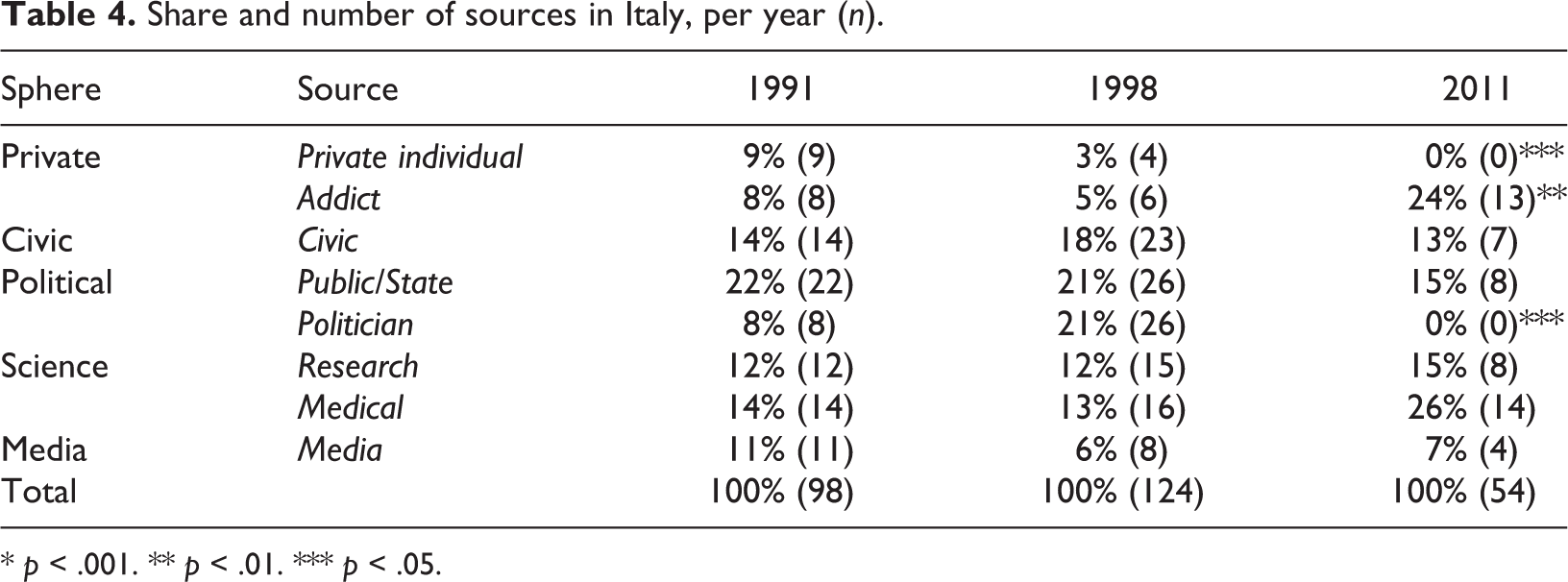
In Italy (Table 4), major sources of information were representatives of the scientific sphere, those from the medical field (18%) in particular and other researcher sources (13%). Together, they make up about one third of all sources. The public/state representatives were also cited frequently: their share in total is 19%, followed by civic sources (15%). As in Finland, addicts as sources became more common over time (
Share and number of sources in Italy, per year (
*
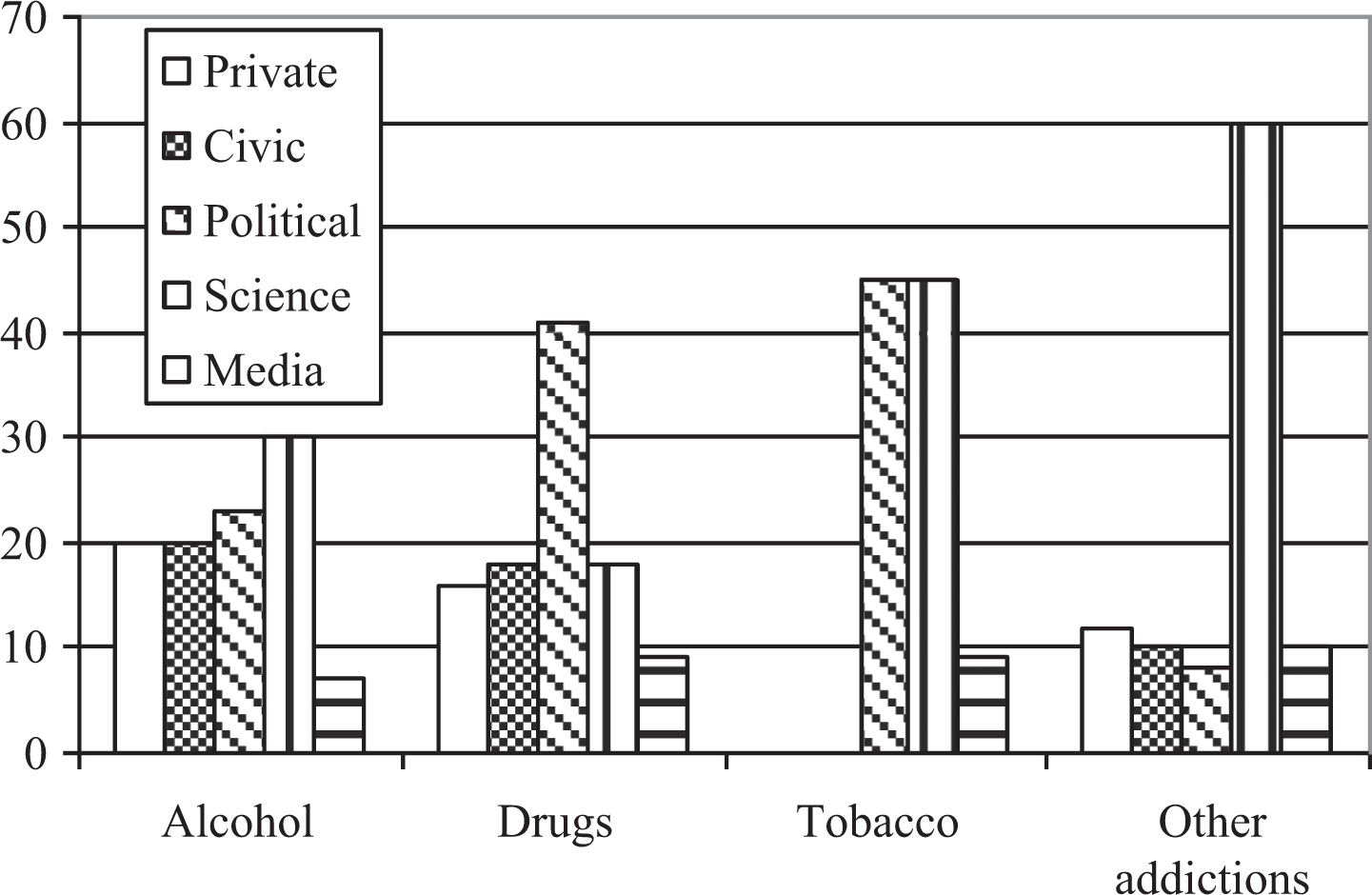
Coverage of addiction type by sphere in Italy (percentages, all years).
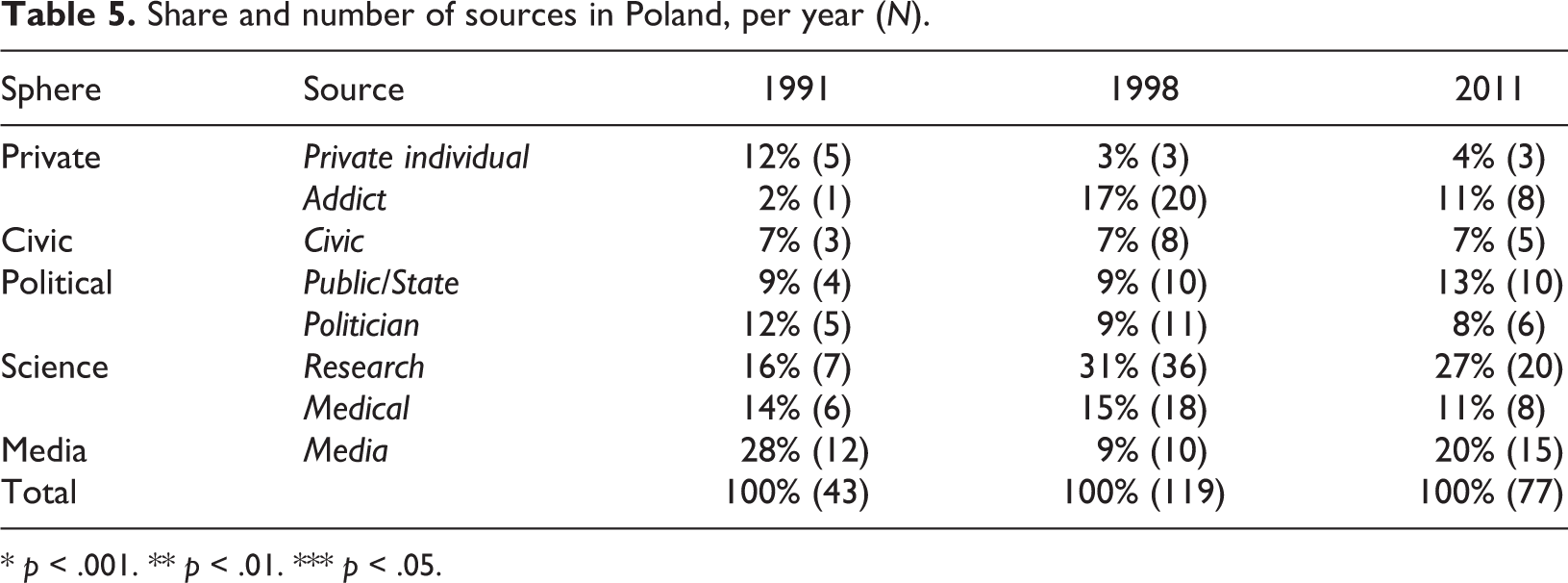
In Poland (Table 5), similarly to in Italy, the science sphere played a key role, yet the research sources (25%) were more frequent than medical sources (13%). This was mainly due to the high coverage of tobacco-related issues in 1998 and 2011 when anti-tobacco campaigns and the changes in tobacco legislation from 2010 were discussed. The media constituted a second most frequent source (19%), followed by public/state and political sources (10%). In contrast to Finland and Italy, public and state representatives in Poland held a relatively stable position across the years. Within the private sphere, the addicts’ perspective tended to increase its visibility at the expense of private individuals; addicts were mainly cited in the context of illicit drugs. Drug problems were also largely commented on by politicians and public officials. Moreover, representatives of the political sphere along with research and medical sources greatly contributed to the ongoing discussion on alcohol. In Poland, as in Finland, the coverage on new, behavioural addictions relied on media and research sources (see Figure 3).
Share and number of sources in Poland, per year (
*

Coverage of addiction type by sphere in Poland (percentages, all years).
In conclusion, three different country patterns of sources emerge from the analysis: private citizens, addicts, and the media commented on and defined addiction problems in the Finnish media material; representatives of the public sphere/state, medical expertise, and to some extent civic sources were prominent in the Italian press; and researchers and media sources were mostly referred to in Poland. We shall next discuss what these trends might imply.
Discussion
We have presented the archetypal problems ascribed to the phenomenon of addiction in three sets of press-reporting materials. The analysis confirms results of previous studies that the most commonly referred to addiction problems in the mass media relate to the traditional intoxicating substances of alcohol and illicit drugs (Caswell, 1997; Fan, 1996; Hellman, 2010; Olsson, 1994; Świątkiewicz & Moskalewicz, 1994; Törrönen, 2003). The country profiles still differ: alcoholism was the main focus in the dry drinking cultures of Finland and Poland, whereas the Italian newspaper dealt mostly with drug-related addiction. The relatively high coverage rates for alcohol in Finland and Poland can be traced to cultural traits of alcohol intoxication (Mäkelä, Tigerstedt, & Mustonen, 2012; Moskalewicz & Zieliński, 1995). The absence of alcohol coverage in the Italian material at the beginning of the study period reflects the circumstance that alcohol was not perceived as a societal problem to be covered in the media until the 1990s, when various stakeholders managed to build an arena around the issue and, in 2001, got the first framework law on alcohol approved (Beccaria & Rolando, 2014). Tobacco dependency seems to be a somewhat neglected problem in Finnish and Italian media reporting in the last 25 years, perhaps because it may have been framed as something other than “addiction”. Also, several health-promotion campaigns were launched in the 1970s and 1980s, and more restrictive tobacco control legislation led to a substantial reduction in smoking. In contrast, in Poland smoking came to be considered a major public health problem in the late 1990s, which is reflected in its relatively frequent presence in the media discourse. The decreasing number of articles on alcohol in Finland and on drugs in Italy, and partially in Poland, was substituted by an increasing number of articles on non-substance-use-related behavioural addictions such as eating disorders, gambling, and workaholism.
As to the sources employed in the reporting over time, the most dramatic changes were found in Finland, where two sources became much more marked (addicts and media) and four types of sources grew less prevalent (private individual, civic, politician, medical). In Italy, only addicts became significantly more frequent sources of information, while the space afforded to private individuals and politicians significantly decreased. The least intensive changes were found in Poland, where none of the changes among sources were significant and where reporting on addiction-related problems was the lowest.
In Finland, the dominant actors represent the private sphere: the everyday-life views of individuals and addicts were clearly valued by journalists. This is in contrast to the situation in Italy and Poland, where research and medical sources, on the one hand, and public/state sources and civic sources (Italy) and media (Poland), on the other, were among the most frequently employed. The main difference was a trend towards individualisation in terms of a growing prevalence of representatives of the private sphere. This process was the most pronounced in Finland at the expense of the political sphere. Individualisation trends were also found in Italy and, to some extent, in Poland.
While the three countries shared some commonalities, such as deep-seated political and economic transformations during the early 1990s, the variation in sources of authority regarding different addiction problems reflects political transformations as much as cultural specificities. This was evident especially for coverage on traditional alcohol and drug addictions. In Finland, the domination of individuals as sources in alcohol and drug discourse may illustrate a more general trend of replacing collective control and responsibility of the state by the notion of individual responsibility. In Poland and Italy, the preoccupation of the political sphere with morally sensitive drug issues in the 1990s may reflect public concerns and attempts to legitimise the authority of new political elites.
In terms of van Leeuwen’s framework of discourse transformation we found indications of the four major types of transformation: addition, deletion, rearrangement, and substitution. Instances of substitution were found in all three countries, for private individuals were clearly replaced by addicts as sources, setting the media image of addiction within the perspective of a person experiencing the problem. Social actors as sources of information became increasingly particularised: they were identified by names and institutional positions and were therefore easily recognisable.
The increased prevalence of the addict’s perspective can be considered an example of both rearrangement and substitution, because addicts, who were the smallest category of sources in the first year of our analysis, gained great importance over time. In fact, they became key figures in media discourse on addiction, sharing experiences and knowledge with the public. This process can be placed against the backdrop of a general increase of individualised perspectives on risk in media reporting (Kitzinger, 1999). It also resonates with the 12-step movement’s emphasis on the value of experience-based understandings (cf. Hellman & Room, 2014).
Our study shows that the mass media itself, in particular in Finland and Poland, also functions as a source on the topic of addiction. Moreover, by reporting on other sources, journalists set the agenda for public debate and highlight the importance of the issues discussed. Besides scientific expertise, the media played a significant role in incorporating new problematic behaviours into the frame of addiction and increasing public awareness of the health risks. The advent of new, non-substance addictions such as gambling, computer/gaming and Internet addiction, workaholism, shopaholism, sexaholism, and eating disorders can be considered as an instance of addition in the framework proposed by van Leeuwen.
The use of representatives of research, science, and knowledge production was more prevalent in the Polish reporting than in Finland and Italy. In Finland, scientific experts were employed to talk about alcohol, whereas tobacco was the subject of scientific expertise in Poland. In Italy, research sources were mostly employed in the context of illicit drugs. As the coverage on “traditional” alcohol and drug addiction decreased, the research and medical sources became the most common informants about new behavioural addictions. This could be explained by journalism’s need to frame a new phenomenon by referring to scientific expertise (Dąbrowska & Bujalski, 2013; Holland et al., 2011; Kitzinger & Reilly, 1997; Logan, 2001; Montagne, 2001). The prominent position of scientific sources in the Polish material appeared particularly in discussions on tobacco prevention; cancer and cardiovascular diseases have been recognised in public discussions as the leading causes of premature mortality in the country. A high level of engagement of scientists using their authority to highlight tobacco as a pressing public health problem may have helped to make health issues more prominent on the political agenda at a time of health-service reform.
Yet, the most significant instance of a rearrangement trend in the material was the marginalisation of sources from the political sphere, which may reflect a general waning of the societal framing of addiction. The trend in which addiction problems become less articulated as a matter of political expertise can be interpreted as deletion in van Leeuwen’s analytic frame. The decline in the representation of politicians, civil society, and partly also of public/state sources may reflect an overall change in the cultural position of addictions as problems to be dealt with.
The weakening of political representation and the strengthening of an individual addict’s perspective and scientific expertise mirrors a reframing of the addiction discourse. This could be interpreted as a part of a larger media content trend, such as a general tabloidisation, but it can also indicate a turn towards increased emphasis on self-control and notions of individual responsibility, as well as deregulation and cessation of government intervention. This, in turn, has been referred to as part of a neoliberalised view on the questions.
Conclusions
The study found that the media material from Finland, Italy, and Poland on addiction and addiction-related disorders gave increased prominence over time to individuals affected by addictions, and to experts from the medical sphere.
While there were some differences between the three countries, the study indicates an ongoing trend in media reporting on addiction: less authority is given to sources in the political and institutional spheres, which results in a decreased emphasis on the social sphere as a framing of addiction problems. There is a need for future research to anchor the results of this study in a theoretical context of the development of print press journalism, especially concerning the general decrease of sources during 1998–2011, when the Internet became the dominating venue for acquiring information and socialising among European citizens.
Limitations
The selection of three years apparently covering 20 years of fundamental change may represent a distorted picture, as addiction debates tend to vary in intensity and are sensitive to social transitions and the overall salience of certain political questions (e.g., changes in tobacco control legislation in Poland or the second drug wave in Finland). The study also leaves out certain media developments such as changes in the construction of news over time, and journalists’ views on the expectations of new emerging audiences, in particular on the Internet. During the study period, the informative role of the traditional press declined under Internet expansion and the popularisation of social media. Its impact on addiction discourse should be a subject of future studies. A larger sample size would also improve the validity of our findings, yet the study design enabled us to track the evolution of representation of different social actors in addiction discourse over time. The framework by van Leeuwen was found to be a useful tool for our analysis, although it proved to be a much better fit on the country level than internationally, as there were differences in the dynamics of frequency and types of sources between countries. Given the four types of van Leeuwen’s discourse transformation, we purposely applied the term “substitution” to describe changes within spheres, “rearrangement” to explain overall trends in frequency of sources, “addition” to highlight the introduction of new instances of addiction (such as Internet addiction and eating disorders), and “deletion” to describe the decline in specific types of framing of the addiction problem. The exclusion of economic aspects of addiction from the analyses may have limited prospects of interpretation of the impact of business stakeholders on the observed trends. Last but not least, this report has only presented an overview of trends in the three sets of materials. In the future, more thorough meaning-based analyses may offer answers to the generic and ideological shifts that are suggested here as explanations to the overall trends.
Footnotes
Declaration of conflicting interests
Funding
 .
.