







Abstract
On Sunday, 12 September 2021, the Greens political party in Finland voted to include as official party policy the legalisation of the use, possession, manufacture and sale of cannabis in Finland (Yle News, 2021). The policy proposal was passed by a small margin, 183 to 181. This was the first time a political party in the acting coalition government passed such a legislative proposal, and the decision received a great deal of media attention (Helsingin Sanomat, 2021; Yle News, 2021) and generated a lively discussion on different social media platforms, including Twitter.
According to Väliverronen et al. (2020), Twitter “is known to be the most central social media platform for political discussion” and thus well-suited also for cannabis discussion analysis. Twitter, as a social media platform, has developed into a public domain where topics like COVID-19 (Väliverronen et al., 2020), alcohol liberation promoted by industry (Sama et al., 2021), election campaigning (Railo & Vainikka, 2017) and general sociolinguistics (Hiippala et al., 2020) have already captured the attention of Finnish researchers, signalling its significance in the Finnish public discourse.
Social media platforms provide publicly accessible data that can be used to rapidly capture and describe various contexts and discussions about substances such as cannabis. Previously, Twitter has been used to research health-related discussions and experiences of cannabis use (Allem et al., 2020, 2022) and public reactions and sentiments concerning cannabis policy reforms (Mann et al., 2022; Najafizada et al., 2022; Thompson et al., 2015; van Draanen et al., 2020). Some research focuses on specific cannabinoid-based products such as edibles (Lamy et al., 2016) and concentrates (Daniulaityte et al., 2015, 2018), as well as others, which are concerned with how public health organisations and government agencies communicate about cannabis on Twitter (van Draanen et al., 2019).
Although cannabis is not the only drug investigated in this way (Jain et al., 2020), so far, drug research focused on Twitter has been limited to the North American context. This study is the first to analyse cannabis discourse on Twitter in the Finnish context, focusing on the period when the Finnish Greens voted to officially include cannabis legalisation into their party programme. As mentioned, this was the first time a political party that is part of the acting government of Finland proposed to reform cannabis policy to allow adult use, possession, production and sales, and thus presenting a historical point in time that can be studied with various methodologies. In this study, we use a mixed-methods approach that focuses on the Finnish cannabis discussion on Twitter during a specific period.
Cannabis in the Finnish context
Despite the criminalisation of cannabis use for over half a century (Hakkarainen & Kainulainen, 2021), the prevalence of cannabis use has increased since the 1990s, especially among young adults (Karjalainen et al., 2020). Compared to other Nordic countries, Finland has the second highest prevalence of lifetime use among people aged 15–64 years (Denmark 37.9%, Finland 25.6%, Norway 25% and Sweden 17.4%) and the highest prevalence of use in the last 12 months among 15–34-year-olds (Finland 15.5%, Denmark 12%, Norway 10.1% and Sweden 7.6%) (European Monitoring Centre for Drugs and Drug Addiction, 2022, p. 51). Cannabis counts for 60%–70% of all drug seizures in the Nordic countries, which have over time moved closer in terms of drug policy intensity (Egnell et al., 2019; Moeller, 2019).
Attitudes toward cannabis have also changed in recent years. Perceptions of risks around cannabis use have somewhat abated, and young people in particular increasingly think that cannabis use should not be punished (Hakkarainen & Kainulainen, 2021; Karjalainen et al., 2020). Support for legal access other than for medical purposes remains a minority position with great variability among age groups. In 2018, 8% of 45–69-year-olds supported legal access to cannabis for any reason, while among 25–34-year-olds, the percentage was close to 35%. Acceptance for medical use is around 70% in the general population (Karjalainen et al., 2020).
Changing public opinion, a citizens’ initiative demanding decriminalisation of adult cannabis use, growth of small scale cannabis in 2019 and increased expert, media and NGO involvement in the general drug policy discussion have arguably created pressure for drug policy changes in Finland (Hakkarainen & Kainulainen, 2021). The adoption of cannabis policy reform by the Greens party in their programme in September 2021 can be seen as a response to that pressure and requires research into various social factors involved.
This research specifically focuses on what kind of topics and issues were discussed on Twitter when the Greens proposed cannabis reform in Finland, and what arguments for and against it were conceptualised. Which arguments received more reactions (retweets, likes, comments, etc.), and what do the contents of these posts infer about public opinion on cannabis reform?
Methodology
A mixed research methodology was used for this study design. Initially, tweets were downloaded, processed and analysed for descriptive statistics. Subsequently, topic modelling was used to identify the hidden content of the discussions. Finally, thematic content analysis was applied to highly representative texts of topic modelling and the most reactions to tweets (the most retweets, liked and commented).
Data and text processing
We obtained Twitter (https://twitter. com) posts containing the following cannabis-related terms (including street names) in Finnish (including inflections, variants and conjugations): “kannabis”, “hamppu”, “lääkekannabis”, “kannabinoidit”, “THC”, “CBD”, “ganja”, “budi”, “pilvi”, “#lääkekannabis” and “#kannabis-keskustelussa” from August to November 2021, and then retained tweets during 11–22 September for the content analysis. AcademictwitteR (Barrie & Ho, 2021), an R programming package, was used for the data extraction with an API provided to the researchers by Twitter. A total of 20,159 posts contained these terms during this period. The Greens’ proposal triggered public discussions, and then the daily post ratio returned to normal after 10 days (Figure 1).

Timeline of the unique cannabis-related posts on Twitter. (A) Red dots (dashed line) represent the time frame of the study (includes only original tweets and quotes). (B) The daily average scores of three Finnish sentiment dictionaries (includes only original tweets and quotes). The Y-axis represents the daily average of sentiment scores of tweets and the X-axis is the timeline of the Twitter posts (AFINN = solid line, BING = dot line, NRC = dashed line).
The timeline of cannabis-related posts in Figure 1 shows that before the proposal, the average daily number of tweets was approximately 140. However, during the week of the proposal, there was a significant increase in tweet volume, reaching a peak of 6,600 tweets on a single day, with a daily average of over 2,700 tweets. The literature suggests that a higher volume of tweets on cannabis has historically been observed in countries (and states in the USA) with less restrictive cannabis laws (Daniulaityte et al., 2015, 2017; van Draanen et al., 2020), which indicates that a low volume of tweets is expected in countries prohibiting cannabis such as Finland. About 36% of these tweets were retweeted posts (n = 7,305), and retweets and duplicates were removed from the dataset since they would not contribute to the sentiment and topic modelling analysis (Allem et al., 2020).
We then filtered out social bots, which are automated Twitter accounts designed to generate content and engage with legitimate human Twitter accounts. Social bots may skew the data, limiting our ability to accurately describe the public attitude (Allem et al., 2020). Since the accuracy and results of the bot-detection algorithm change depended on the package and query methods, we investigated the account that had more than 10 tweets to maintain accuracy. The TweetBotOrNot (Kearney, 2018) package in the R Programme and Botometer (Sayyadiharikandeh et al., 2020) web page were used to distinguish between non-bots and social bots. This package examines the characteristics of a Twitter account and assigns it a score based on the likelihood that the account is a social bot. This method of detecting social bots is considered cutting-edge and has been used in previous studies on social bots and public health (Allem et al., 2020). By applying these programmes, we removed 353 posts. The remaining data consisted of 12,501 tweets.
We used a variety of text-processing methods to prepare tweets for data analysis, including the following:
Sentiment analysis
After providing a descriptive analysis, we applied a sentiment analysis. Sentiment analysis (also known as opinion mining) is the computational study of people's opinions, attitudes and emotions toward entities such as products, services, individuals, issues and events. The goal of sentiment analysis is to determine whether a given text or set of texts is positive, negative or neutral (Campesato, 2021).
Topic modelling
In the third stage, we use topic modelling to analyse the content of the tweets. Topic modelling is an unsupervised machine learning technique for finding topics in one or more documents (Bengfort et al., 2018). There are two underlying assumptions: each document (here a tweet) consists of a mixture of topics, and each topic consists of a collection of words (Campesato, 2021). Topic modelling assumes that the semantics of a document is governed by so-called latent variables, which are topics that are more abstract than the actual text. The goal of topic modelling is to discover these latent variables (topics) that can reveal the primary content of a document or corpus.
We used the Latent Dirichlet Analysis (LDA) topic modelling approach, which is a generative model for assigning topic distributions to documents. Here, each tweet is described by a topic distribution, and each topic is described by a word distribution (Campesato, 2021). The documents can then be represented by a combination of these topics. A distinguishing feature of LDA models is that topics are not required to be distinct, and words may appear in multiple topics. This allows for a type of topical fuzziness that is useful for dealing with language flexibility (Bengfort et al., 2018).
We performed the LDA algorithm on the data using the Gensim library (Řehůřek & Sojka, 2010) in Python. The LDA algorithm requires manual input of the number of expected topics. We ran the LDA algorithm on the data by varying the topic number from 5 through 50. Perplexity and coherence scores led us to choose 15 topics as an optimum number for our dataset (see the Appendix for word distribution scores in Table 1 and Figure 1 for the Intertopic Distance Map). Finally, we assigned the topic with the highest probability to each tweet and categorised the tweets based on the most common topics. To maintain validity, we reviewed sample tweets from each topic that had more than 90% topic percentage distribution score and examined how they are representative of each topic.
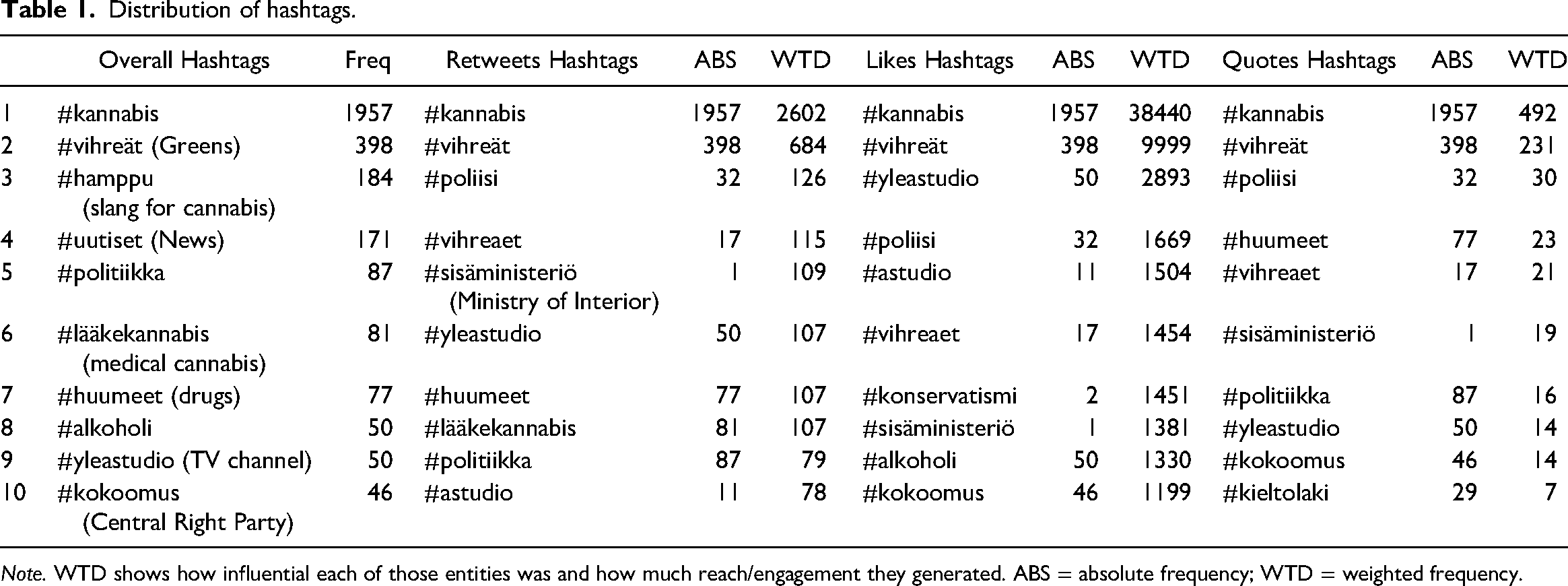
Distribution of hashtags.
Tweets that had a topic percentage distribution over 0.95 based on the topic modelling (
Thematic content analysis
In the last stage, thematic content analysis was also applied to 10% of the most reacted tweets, including liked, retweeted and commented tweets. The most reacted tweets were translated into English, and the analysis of the content was descriptive with a focus on what kinds of themes emerged and whether the tweets were for or against the suggested cannabis policy reform proposal. Based on the content, we categorised the emerging themes under broader topics around health, policy, environment, and social and criminal justice (see Table 2).
Qualitative sentiment analysis.

While Twitter content is arguably in the public domain, users of the platform may not be aware of or always agree that their content might be used for research purposes (Jules et al., 2018). Although some online discussants might want to be credited openly for their contributions (Kozinets, 2010, p. 145), only a minority of participants in an explorative study by Fiesler and Proferes (2018) wanted their tweets to be attributed to them in research publications. Therefore, in this study, we took steps to protect the anonymity of the discussants when presenting the more qualitative thematic content analysis of the most reacted tweets. For instance, we do not provide the names of the people tweeting, and the tweets have been translated from the original Finnish to English; therefore, they cannot be found by a simple quote search. None of the qualitatively analysed tweets mention personal cannabis use, and thus reporting about them does not pose potential legal harm in the Finnish context where the use of cannabis is criminalised by law.
In our view, the more quantitative analysis conducted in this study does not impose harm on any particular individual. However, we did consider it to be important to include the self-reported occupation of the Twitter users of the most reacted tweets to get a better understanding of what types of professions are engaged in the discussion that received the most reactions. While the above-mentioned concealment steps do not fully guarantee that the individual tweets analysed qualitatively and reported here cannot be traced back to the individuals doing the tweeting, we balanced between protecting anonymity and the public nature of the discussion. We acknowledge the lack of consensus on these issues (Fiesler & Proferes, 2018) as the ethical recommendations by the Association of Internet Researchers also emphasise that “no set of guidelines or rules is static; the fields of Internet research are dynamic and heterogeneous” (AoIR, 2012, p. 2).
Results
Before text cleaning, an explanatory descriptive analysis was performed to identify general trends in tweets. The top 10 hashtags show that people preferred cannabis terms (kannabis, hamppu, lääkekannabis), political party hashtags (including Greens [vihreät] and National Coalition Party [kokoomus]) and finally substance-related hashtags, such as alcohol (alkoholi) and drugs (huumeet) (Table 1). When weighted frequencies of hashtags are compared to the number of retweets, likes and quotes, the order of the top 10 lists changes. For example, although #poliisi hashtags were used only 32 times in all original tweets, it is in the most top third most retweeted list, the fourth most liked and the third most quoted message with this hashtag. Likewise, the Ministry of Interior (#sisäministeriö) also appears in the top lists of high interactions.
Similarly, the top 10 emojis also show that most of the emotional expressions are related to critical thinking, surprise and enjoyment (Table 3). This also coincides with the number of questions in tweets. Around 30% of the tweets include questions regarding the cannabis discussions. When the weighted frequencies of emojis are compared with the number of retweets, likes and quotes, the order of the top 10 lists changes. A red fire truck, an essential part of emergency services along with a police car or ambulance (red truck), and an ambulance (white truck) used to transport patients between their home and the hospital are at the top of the retweeted and liked tweet lists. A Nerd Face (a smiling yellow face with glasses), often used by people calling themselves nerds in a self-deprecating way, is also a highly visible emoji on these lists (Emojipedia, 2022).
Distribution of emojis.


 □
□ □
□Sentiment analysis
Although the research does not focus on lexicon-based sentiment analysis (not performing well for Finnish due to its structure), we briefly provide the results of the three most common sentiment dictionaries to validate their consistency, including the AFINN (Nielsen, 2011) and Bing Lexicon (Hu & Liu, 2004) dictionaries for Finnish language versions, and the NRC lexicon dictionary (Mohammad & Turney, 2013) adapted for the Finnish language (Öhman, 2022). Sentiment Scores are calculated (in R programming) by categorising and counting the negative and positive words in the text and dividing the difference between the positive and negative word counts by the total word count.
As shown in Figure 1B, during the public discussion when the Greens announced their decision to include cannabis policy reform in their party agenda, the sentiment scores of the tweets were more likely to be positive. The overall average sentiment score per day is still less than zero, indicating that the general attitude toward cannabis-related discussions is still negative, but as more people participate in discussions, more positive attitudes emerge. It is expected that those who are in favour of cannabis reform tend to express their ideas more often during this time (Mann et al., 2022), but social context also matters. For instance, public sentiment in tweets is more positive in areas where cannabis is not tightly regulated than in areas where cannabis is illegal (van Draanen et al., 2020).
Topic modelling
Based on the keywords and reviewing the sampled tweets, we labelled the 15 topics by approximate themes. Topics 2, 5 and 7 are intertwined, in that they primarily discuss the effects of cannabis legalisation on other substances, the administration of cannabis and policy practices within the criminal justice system. The other topics, on the other hand, are well-separated and represented with clear distances. The topics were described below based on Topic word distribution and Intertopic Distance results (see more details in the Supplemental file Figure 1 and Table 1).
Topic 1 more likely represents the discussions around the Greens (vihreä: “green”, puolue: “party”) initiative. The topic content included not only legalisation (“laillistaminen”) but also decriminalisation (“dekriminalisointi”) and drug (“huume”) related discussions in responding to public demands (vastustaa: “object”, tehdä: “do”). Simply put, the main discussion topics are the relevance of the initiative, the mismatch between current policy practices and public demand, and other potential policy remedies regarding the prohibition policy.
Topic 2 is more likely related to the comparison of alcohol (“alkoholi”) with cannabis and drugs (“huume”), their legal status (laiton: “illegal”, kieltolaki: “prohibition”), their usage (“käyttä”), sales (“myynti”) and its effects on people (ihminen: “human”) and young people (nuori: “young”, lapsi: “child”). Despite the government's monopoly on sales and the implementation of highly restrictive policies, alcohol consumption is high in Finland. As a result, discussions revolve around alcohol, the effectiveness of restrictions, its impacts on society and its interactions with illegal substances.
Topic 3 discusses the taxation (vero: “tax”, verotulo: “tax income”) of cannabis through government (“valtio”) regulations (laillistaminen: “legalisation”), Canada (“Kanada”) as a role model, money (“raha”) and payment (“maksaa”), problems (“ongelma”) and disadvantages (“haitta”) of this system. As a result, the discussions primarily revolve around the legalisation of cannabis, its contribution to the government as a tax and implication-related issues.
Topic 4 focuses more on the interaction of alcohol use (“alkoholi”, käyttö: “use”) with cannabis, the decrease (“vähentää”) in alcohol use with cannabis legalisation (“laillistaminen”) and its potential disadvantages (“haitto”) for youth (“nuori”). Thus, while alcohol remains the primary topic, the main emphasis is on the impact of cannabis legalisation on alcohol consumption.
Topic 5 includes the impact of legal (“laillinen”) sales of alcohol (“alkoholi”), cigarette (“tupakka”), snus (“nuuska”) on people (“ihminen”) and their interactions with illegal intoxicants (“huume”, “paihde”). The discussion focuses on how legal sales of substances affect society and whether other illegal substances could be legalised in the same way.
Topic 6 is more likely about problems (käyttö: “use”, ongelma: “problem”) after legalisation (“laillistaminen”) and involvement of police (“poliisi”) with people (“ihminen”) and discussion of other drug (“huume”) use. This includes discussions about how cannabis legalisation will affect the criminal justice system and what kinds of problems could arise.
Topic 7 discusses the interaction with alcohol (“alkoholi”) with illegal drugs (“huume”) in legalisation (“laillistaminen”) and prohibition (“laiton”, “kieltolaki”) frameworks. The topic also includes discussions related to components of cannabis (“thc”) and the comparison of coffee (“kahvia”) as a legal drink. Although the comparison of alcohol remains the primary topic, the discussion is more likely to focus on the substance content.
Topic 8 includes discussions regarding other cannabis topics and alternative products of cannabis, such as hamppu (“hemp”) or medical cannabis (“lääkekannabis”) regulation in the context of the Greens proposal (“vihreä”, puoluekous: “party meeting”). Except for the medical cannabis discussion, it is part of the first topic, but due to word preferences (hemp: “hamppu” vs. cannabis: “kannabis”, allow: “sallia” vs. legalisation: “laillistaminen”), the algorithm treated it as a unique topic.
Topic 9 is related to prohibition (“kieltolaki”), young people's use of alcohol and cigarettes (young “nuori”, “alkoholi”, “tupakka”) and their use (saada: “to get”, käyttö: “use”), and their potential participation in criminal acts (criminal: “rikollinen”) to access and use them (käyttäjä: “user”, to use: “käyttä”). These cases were also discussed in a legalisation scenario (to act: “toimia”, legalisation: “laillistaminen”).
Topic 10 focuses on the health consequences of cannabis use (“käyttää”) with regard to schizophrenia (“skitsofrenia”), psychosis (“psykoosi”) and other symptoms (“aiheutta”: to cause). However, alcohol-related health risks (“alkoholi”) and deaths (“kuolema”) among ordinary people (“ihmisen”) and youth (“nuori”) were referred to in research (“tutkimus”) and annual reports (vuosi: “year”). It seems that when opponents created their arguments around the health risks of cannabis use, the proponents highlighted the health risks related to alcohol in society.
Topic 11 discusses the physical (“elimistö”: organism) and macrolevel effects (“vaikutus”) of cannabis legalisation (“laillistaa”) in Finland (“suomi”) regarding cannabis users (“käyttäjä”), side effects (“haittavaikutus”), dependence (“riippuvuus”), discussions in other countries (“maa”) and the daily routine of life (viikko: “week”, päivä: “day”).
Topic 12 refers to being open for discussions (keskustelu: “discussion”, kertoa: “tell”) regarding cannabis use (“käyttö”) and its legalisation (“laillistaminen”). The discussions also cover wine (“viini”), cigarettes (“tupakka”), their sales (osta: “buy”, myydä: “sell”, alko, myynti: “sales”, kauppa: “store”) and their impact on youth (“nuori”, kaveri: “friend”). The topic focuses mainly on exposing the dimensions of substance use and its impact on society.
Topic 13 is more likely related to sales (osta: “buy”, kauppa: “store”, myydä: “sell”, Alko) of cannabis within the legalisation (“laillistaminen”) framework. For instance, Alko refers to a company that is Finland's national monopoly in the retailing of alcoholic beverages. It is the only store in the country that sells drinks with an alcohol content greater than 5.5%, wine (except in vineyards) and spirits.
Topic 14 refers to a broader (suuri: “big”) discussion about alcohol (“alkoholi”) and its known (tietää: “to know”) side effects on health (aiheuttaa: “causes”, elämä: “life”) and users (“käyttäjä”) that were reported in research (“tutkimus”). Its relationship with other drugs (“huume”) is also discussed within this topic.
Topic 15 includes discussions (puhua: “to talk”, keskustelu: “discussion”) about the use of cannabis (sekaisin: “spaced out”, pilvi: slang for “cannabis”, syödä: “eat”, tapa: “habit”) in their free time (“vapaa”, “aika”) and liberalisation (“vapauttaminen”).
The most discussed topic was the comparison of cannabis to alcohol and other substances (topic 7; 861 posts), which was followed by discussions about the Greens initiative (topic 8; 830 posts), problems with alcohol and cigarette restrictions for youth (topic 9; 745 posts), and policy implications of legal sales of alcohol, cigarettes, snus and their effects on other substances and health (topic 10; 745 posts) (topic 5; 705 posts). The least discussed topic, on the other hand, was demanding open discussions for legal cannabis sales such as alcohol or wine (topic 12; 466 posts), followed by problems after legalisation (topic 6; 499 posts), and the implementation framework and method of legal cannabis sales (topic 13; 509 posts). (See more details in the Supplemental file, Figure 2.)
Results of thematic content analysis
The mixed-methods approach can be especially useful because text data on Twitter can be a rich source of information that can be analysed using both qualitative and quantitative methods to gain a more comprehensive understanding of the phenomenon. For example, the quantitative methods used above allow us to analyse the volume and content of tweets. This type of analysis can provide valuable insights into how Twitter users react to specific events or issues, as well as identify patterns and trends in the data. However, qualitative methods can be used to add context and depth to the analysis by exploring Twitter users’ motivations and experiences.
A: Representative text analysis
Through the topic modelling analysis, we obtained the weight of the topic for each tweet, which enabled us to identify the most representative tweets in our corpus. To narrow down the sample size for content analysis, we selected tweets that had a topic percentage distribution over 0.95 (N=188) for closer thematic content analysis (Braun & Clarke, 2006; Stemler, 2000). These tweets were first qualitatively classified based on their positive (N=52) or negative (N=29) sentiment toward the proposed cannabis policy reform and then analysed for emerging themes. Some of the tweets were considered neutral (N=17), and the rest were categorised as
The themes that emerged from analysing the content of the tweets that were categorised as positive were harm reduction, potential tax revenue, increased use despite criminalisation (criticism of inefficient policies), support and treatment, criminalisation leads to marginalisation, cannabis is safer than alcohol, cannabis does not cause overdoses, cannabis is already available, prohibition is a failure, regulation has a positive environmental impact, decreased traffic accidents, decreased use by youth, regulation decreases prices, regulation ensures quality control, better access to medical cannabis, separation of drug markets, governmental control and free will.
Themes that emerged from analysing the content of the tweets categorised as negative were increased use, harmful effects of drugs, harmful effects of cannabis, lack of support from other political parties, gateway theory, fishing for political points, a majority against decriminalisation and legalisation, investigating drug crimes becoming difficult, increased crime, increased traffic accidents, no need for a new legal drug, harmful effects of smoking and negative environmental impact of cannabis growing.
B: Most retweeted tweets
The ability of mediated content to spread widely is related to social media virality. Viral material can spread by interaction with content, including specific user actions such as retweeting, liking and commenting. People are more likely to share information if they see that it has been shared multiple times, contributing to the virality of the content and reinforcing their own beliefs that this is what they should be doing in accordance with social norms (Jain et al., 2020). The viral posts give a variety of information about the content of the text, the credibility of users and networks, but here we focused on the content of the posts.
The top 10 most retweeted posts had a range of 22,377–77,223 retweets, and the top 10 most liked tweets had a range of 1,381–3,447 likes. Similarly, the top 10 most commented posts had a range of 15–72 comments. Our results show that the majority of the top-reacted posts in these categories were against cannabis legalisation.
Themes similar to the above were identified in most retweeted tweets. Here, we present tweets that received over 50 retweets (N=15), with a more detailed focus on what was said and by whom, with a focus on profession and political party affiliation that was self-reported in the individual Twitter handler. Politicians (three Greens, two True Finns, one Christian party, one Left Alliance and one Coalition party member), healthcare professionals and journalists were represented mainly by profession in the most retweeted tweets. While presenting the content of the most retweeted tweets, we also provide details on how many likes and comments they received, which in several tweets also overlapped with the most retweeted ones, although with some variability. For instance, the tweet that received the most comments received 72 comments at the time of data extraction, but less than 50 retweets, which was the cut-off point to include the most retweeted tweets in the thematic content analysis. Thus, the focus in terms of content is on the most retweeted ones as we were more interested in what kind of content gets shared. We included tweets in the top 10 liked and commented tweets even though they had not received more than 50 retweets. The commentary they received was left out of the qualitative analysis because the conversation would need to be reviewed to understand the context (Krauss et al., 2017).
A similar division between positive and negative sentiments toward cannabis policy reform was also found in most retweeted posts, as similar themes emerged here compared to the tweets that had a topic percentage distribution over 0.95.
The prominent theme was health, and especially the harmful effects of cannabis on mental health. For example, the most retweeted post (223 retweets) came from the chairman of a clothing brand and Children's Rights Foundation, in which he states, “
Negative mental health effects were also mentioned in the second most retweeted tweet (204 retweets, the fifth most liked tweet with 1,729 likes, and the seventh most commented tweet with 26 comments) and the third most retweeted tweet (168 retweets, 11th most liked with 1,378 likes, and in the top five most commented with 40 comments), from both healthcare professionals/political party members. The second most retweeted tweet came from a professional nurse and town councillor who represents the True Finns political party: “
The sixth most retweeted tweet, with 110 retweets, was made by a journalist (fourth most liked tweet with 1,746 likes and 12th most commented with 14 comments); here, the theme about the harmful (mental) health effects of cannabis is made by a similar general referral to risk research and an anecdotal report of an acquaintance getting schizophrenia due to cannabis, as in the above tweets: “
While the journalists in the above tweets do not directly comment on the proposed cannabis policy reform initiative made by the Greens, the sentiment in the first is clearly negative towards such reform, as the journalist focuses on the harmful effects of cannabis on mental health as her central theme, while in the latter case, the sentiment is almost neutral but leaning towards positive with the provided links focusing on psychedelic-assisted psychotherapy and comparative harms of other drugs.
Juxtaposing cannabis with other drugs, especially alcohol, was a theme in some of the tweets, with a topic percentage distribution over 0.95 that usually had a positive sentiment toward cannabis policy reform. Furthermore, in the fourth tweet with the most retweeted tweet (115 retweets, ninth most liked [1451 likes] and 19th most commented [10 comments]) from a firefighter EMT based in Helsinki, the theme – compared to alcohol, cannabis is safer – also emerged: “
A more humoristic tone regarding alcohol is found in the seventh most retweeted tweet (100 retweets, second most liked [2,414 likes], but only two comments) of a media entrepreneur / radio host: “
Perhaps more sarcastic than humorous were tweets from members of other political parties. For instance, the most commented tweet (72 comments) from a representative of the Central party stated: “
Another politician and a member of parliament representing the Christian party, whose tweet was the fifth most retweeted with 112 retweets (10th most liked [1,381 likes] and ninth most commented [19 comments]), had a more law enforcement theme: “
While tweets from political party representatives could be said in most cases to follow the “party line”, the 10th most retweeted tweet (77 retweets, eighth most liked [1,451 likes] with five comments) came from an active member of a liberal wing of the Coalition party in which he criticises a recent TV appearance by their party vice president and questions the negative sentiment theme that cannabis policy reform leads to increased use: “
Most retweeted tweets from currently active party members of the Greens were mainly about announcing the party's decision to adopt cannabis policy reform in their party programme. For instance, the eighth most retweeted tweet, with 84 retweets, stated (14th most liked [1,196 likes] and third most commented [47 comments]): “
A more senior member of the Greens, in the 11th most retweeted tweet (68 retweets, sixth most liked [1,498 likes] and 13th most commented [13 comments]), states that: “
Discussion
Previously, a qualitative study was held about public opinion on a citizens’ initiative to decriminalise cannabis use based on data extracted from the popular Finnish anonymous discussion forum Ylilauta (Hämäläinen & Lahti, 2021). The total anonymity of the platform led to more diverse and free discussions, but our study includes not only topic and thematic content analysis, but also the effects of influencers on public discussions. One of the main findings of our study shows that the most reacted tweets came from known public figures, including politicians, health experts and NGO leaders. Nevertheless, they tend to take a position against cannabis reform. Their posts were circulated and discussed during the period when the Greens voted to officially include cannabis policy reform in their party programme.
On the other hand, when analysing unique tweet contents, the sentiment scores increased, which shows that aggregated individual tweets have a more positive stance. This is due to social media platforms constituting the main hub for young people aged 18–29 years for expressing their ideas (Pew Research Center, 2021). The young generation undermines the “protective guilds”, intermediaries and institutions that control information and power (The Palo Alto Group, 2012). Images of “the war on drugs” that are demonising and narcophobic do not affect them in the same way (Parker et al., 1998). Social media platforms enhance unmediated participation and information that challenge credentialed meritocracy power (The Palo Alto Group, 2012). Although our data do not directly support the argument, some other studies suggest that the disparity between the most and least reacted posts may indicate a generational divide (Unlu et al., 2022). Younger generations have different perspectives on drugs and long-term drug policy lines than older generations who have been responsible for determining current drug policy (Hakkarainen et al., 2020). While the public figures representing the older generation tend to be against cannabis legalisation and public opinions endorse them by retweeting, liking and commenting, the younger generation has a more positive view of it (Mann et al., 2022) but sometimes lacks strong argumentation, activism and leadership for promoting their messages on social media. Particularly for people who lack either motivation or the capacity to digest the information, perceived credibility may act as a heuristic cue and affect the outcome (Jain et al., 2020).
Our results show that the discussions cover several dimensions of cannabis legalisation, including, but not limited to, relationships between alcohol, legal substances, illegal drugs and cannabis, environmental impacts of cannabis reform, impacts on society and particularly youth, experiences of other countries, impacts on the economy, safety and the criminal justice system, and criticisms of the current prohibition regime (Table 1). Similar topics were found in a Swedish online discussion analysis related to cannabis (Månsson, 2014). The polarity of the topics indicates that society (here, the online community) is aware of the different dimensions of drug policy change. Both pro and con arguments were included in each topic. However, the source and validity of the arguments need to be scrutinised more closely since moral values and political stances tend to influence the discussion. Nonetheless, this new social media discussion marks a notable change from Finnish print media writing about drugs in the 1990s and early 2000s, which were mainly about increasing drug harms (Piispa, 2001) with a tone of a “moral panic” (Törrönen, 2004). This change reflects changing perceptions towards cannabis more generally as attitudes towards cannabis have become increasingly liberal compared to the pre-social media era (Hakkarainen, 1996; Karjalainen et al., 2020).
Topic analysis shows that the majority of the topics consists of pro and con arguments for cannabis reform, as well as neutral statements. It seems that people follow discussion threads very closely and post according to their stance. It is a vivid online environment for the public to discuss a social phenomenon reflecting all sorts of ideas. Although it restricts us to draw a concrete conclusion about the general results of the discussion (pros vs. cons), as shown in Figure 1, the general attitude in cannabis-related posts is still below the zero-sentiment score, but it increased above that level for a few days in the discussion period.
Several studies focusing on the Finnish population suggest that people separate cannabis from other illegal substances and tend to see cannabis as less harmful (Hakkarainen & Kainulainen, 2021; Hakkarainen & Karjalainen, 2017; Hämäläinen & Lahti, 2021; Karjalainen et al., 2020). Our topic analysis shows that the comparison of substances still constitutes the main argument for both the pros and cons of cannabis reform (see also Månsson, 2014). Topics include discussions regarding gateway theory, relationships between alcohol, tobacco, snus (an oral smokeless tobacco product that is illegal to sell and produce in all EU countries except Sweden; however, since Finland shares a border with Sweden, importing snus for personal use is relatively common and legal) and cannabis, problematic drug use and marginalisation of people who use drugs. On the other hand, those in favour of cannabis policy reform present arguments to mitigate the mentioned harms via governmental regulation to, for instance, ensure quality control, separate cannabis from other drug markets and create potential tax revenue. On certain issues, like the environment, the consequences of cannabis policy reform are seen as leading in opposite directions, depending on the individual sentiment, as those holding a positive sentiment argue that reform will have a positive environmental impact and those holding a negative sentiment argue against it.
At the end of April 2022, the current Finnish parliament voted to reject a citizen initiative calling for the decriminalisation of adult cannabis use, possession and small-scale growth in Finland (Finnish Parliament, 2022), although there is increasing pressure for drug policy reform, and public attitudes have changed especially concerning cannabis (Hakkarainen & Kainulainen, 2021). How public sentiments in Finland develop regarding drug policy, in general, and cannabis, in particular, requires further research and monitoring in other social media, and traditional print media as social representations about illicit drug use have several individual and social consequences (Savonen et al., 2019). Other European countries, such as Germany, Malta and Luxembourg, are moving toward cannabis policy reform (Government of Luxembourg, 2022). This could also bring about new emerging themes in the Finnish discourse and social representations of cannabis, in particular, and drug policy, in general (Savonen, 2022).
Limitations
The legal status of cannabis could affect the public discussion, particularly for the supporters of the cannabis legalisation. Previous studies show that countries with less restrictive policies have more cannabis-related tweets and more positive sentiments (Daniulaityte et al., 2017). In a country where cannabis possession and use are still a classified offense, as in Finland, endorsement in the public sphere with an open identity may have some limitations and reservations. In addition, we only examined messages on Twitter. Thus, the results cannot be generalised to other social media platforms.
Even though we examined a large number of tweets, they were all posted within 10 days in response to the Greens’ proposal. The short-term analysis of the public reaction to an emerging political event has limitations in determining overall social attitudes. This snapshot is more likely to provide an insight into sometimes emotional and unstructured reflections of a certain population of in society that, first of all, is active in social media (in this case, Twitter) and felt they wanted to publicly engage in the “cannabis question”. Perhaps a more articulated and less polarised discussion developed in time with a variety of themes representing both points of view, but this would require a longer research period and analysis of the discussion that emerged by individuals engaging in the commentary of the most reacted tweets.
In addition, “the ‘Finnish Twitter’ is a diverse linguistic community that varies from one geographical location to another” (Hiippala et al., 2020, p. 35), so capturing that diversity with a focus on the Finnish language alone will inevitably be limited in scope. Further, those participating in political discussions on Twitter cannot be said to represent the society as a whole (e.g., Railo &Vainikka, 2017). The number of tweets analysed qualitatively also represents only a small portion of the overall discussion, and it is possible that more themes would emerge including a greater percentage of content in the thematic content analysis. Qualitative data saturation was not, however, our aim. Instead, we wanted to zoom in on the discussion from the wider picture provided by the computational methods. While both approaches have their limitations, when applied together, they give a more nuanced snapshot of the discussion that either one can give on their own.
Conclusions
With the Greens’ proposal on cannabis legalisation, a rapid public discussion emerged on different social media platforms in Finland. Ten days of Twitter data were downloaded and prepared for further text analysis, including sentiment, topic modelling and thematic content analysis.
According to our analysis, the discussion around cannabis policy reform on Twitter during the researched period was rather polarised, and it might be difficult for those with positive or negative sentiments to find common ground on this issue. Analysing the comments of the most reacted tweets and looking at how the sentiments potentially evolved over a longer period of time could show whether participating discussants changed their sentiments when engaging in a public conversation, but this is left for future studies to investigate.
We argue that using both quantitative computational methods and qualitative analysis can capture part of that discourse systematically and give insights into the current public sentiment and how it might develop.
Supplemental Material
sj-docx-1-nad-10.1177_14550725231171022 - Supplemental material for Twitter activity surrounding the Finnish green party's cannabis legalisation proposal: A mixed-methods analysis
Supplemental material, sj-docx-1-nad-10.1177_14550725231171022 for Twitter activity surrounding the Finnish green party's cannabis legalisation proposal: A mixed-methods analysis by Ali Unlu and Aleksi Hupli in Nordic Studies on Alcohol and Drugs
Footnotes
Declaration of conflicting interests
Funding
ORCID iD

Supplemental material
References
Supplementary Material
Please find the following supplemental material available below.
For Open Access articles published under a Creative Commons License, all supplemental material carries the same license as the article it is associated with.
For non-Open Access articles published, all supplemental material carries a non-exclusive license, and permission requests for re-use of supplemental material or any part of supplemental material shall be sent directly to the copyright owner as specified in the copyright notice associated with the article.
