The dynamic characteristics and stability of rotating viscoelastic annular sector plates are investigated. Based on the thin plate theory and the two-dimensional viscoelastic differential constitutive relation, the differential equation of transverse vibration for a rotating viscoelastic annular sector plate in the polar coordinate is established. The membrane forces involving the rotating inertial force in the Laplace domain are solved. The differential quadrature method is used to discretize the differential equation of vibration and corresponding boundary conditions. The generalized eigenvalue under different boundary conditions is calculated, and the change curve of the first three-order dimensionless complex frequencies of rotating viscoelastic annular sector plate with the dimensionless angular speed is analyzed. The effects of the ratio of inner to outer radius, the sector angle, and the dimensionless delay time on transverse vibration and stability of the annular sector plate are analyzed. The type of instability and corresponding critical speed of annular sector plate are obtained.
The annular sector plates, as a basic structure, have been widely used in many fields of engineering, such as space vehicles, missiles, and semiconductors. Many researchers have interested on dynamic characteristics of the annular sector plates due to their good mechanical behavior. Rezaei and Saidi1 built relative motion model between fluid and solid skeleton of the porous medium and studied the free vibration response of the fluid-saturated porous annular sector plates. Zhou et al.2 used the Chebyshev–Ritz method to study the three-dimensional free vibration of annular sector plates and obtained the three-dimensional vibration solutions for plates with a re-entrant sector angle and shallow helicoidal shells with a small helix angle for the first time. Mizusawa3 investigated the free vibration of isotropic annular sector plates with arbitrary boundary conditions using the spline element method. Mirtalaie4 derived the governing differential equations of motion of functionally graded sector plates in the condition of non-linear temperature distribution along the thickness direction and analyzed the effects of temperature field, volume fraction exponent, radius ratio, and sector angle on free vibrations of the plate. In recent years, some researchers have devoted to unifying the vibration modeling of circular, annular, and sector plates. For example, Shi and Wang5–7 established a unified dynamical model of revolve structures with complex boundary conditions and used spectro-geometric method to analyze free vibration of annular sector plates. Later, using the above models and methods, Zhong et al.8 analyzed free vibration of sector-like thin plate with various boundary conditions, and Guan et al.9 studied free vibration of the functionally graded carbon nanotube-reinforced composites circular, annular, and sector plates. Wang et al.7 studied free in-plane vibration for orthotropic circular, annular, and sector plates using a modified Fourier–Ritz approach. The research mentioned above have not involved the effect of the rotating angular speed on dynamic characteristics of the annular sector plate. However, rotating annular sector plates are found in several practical engineering examples, such as sector mechanism in vibration mill and sector gear in high-speed rapier loom. Rotating annular sector plate differs from a non-rotating annular sector plate in having an additional rotating inertial force on its dynamics. At present, the research of rotating annular sector plates is less.
It is well known that most engineering materials like metals, glass, concrete, and wool are not linearly elastic but have viscoelastic characteristics. Nowadays, viscoelastic materials are widely used. For example, composite sector gears with viscoelastic properties have been widely used in aerospace structures, whose dynamic characteristics directly affect the safety of space flight. Glass sector plates with viscoelastic properties at high temperature are used in liquid crystal display industry and flat panel display industry, and transverse vibration will occur and affect the quality of the plate in the case of grasping these viscoelastic plates by a rotating robot. Thus, it is necessary to research the viscoelastic properties of these sector plates. Most of these research have been confined to the viscoelastic column, the viscoelastic beam, and the viscoelastic rectangular plate.10–12 To the author’s knowledge, there are relatively few investigations on the stability characteristics of the rotating viscoelastic annular sector plate. Few papers have been studied on dynamic characteristics of the rotating viscoelastic annular sector plate, since there are two difficulties in studying this problem. One difficulty is the solution of the middle internal forces involving the rotating inertial force along the radial direction of the viscoelastic annular sector plate, and the other is the computation of the four-order partial differential equation of motion of a rotating viscoelastic annular sector plate.
Analytical method and numerical method are both included in the study of these differential equations that arise in engineering and physical problems. Some research have devoted to studying analytical method of differential equation. Talabi and Saidi13 developed a novel exact closed-form solution for in-plane/out-of-plane free vibration analysis of thick circular/annular functionally graded material (FGM) plates integrated by piezoelectric layers. Akgöz and Civalek14 used the Euler–Bernoulli beam model based on the modified strain gradient elasticity and the modified couple stress theories to calculate the critical buckling loads of carbon nanotubes. However, only a small number of differential equations can be obtained by analytical method because engineering problems increase simultaneously with the complexity of the engineering field applications, and analytical method may not be as convenient as numerical methods in cases of application to complicated problems.15 So more differential equations have been solved by numerical methods, such as finite element method (FEM), discrete singular convolution (DSC), meshless method, differential quadrature method (DQM), and so on.15,16 FEM has been usually used to investigate statics, dynamics, model, and thermal analysis.17,18 Nevertheless, the accuracy of FEM depends on mesh densities and time integration intervals, so many scholars devote themselves to study computational accuracy and efficiency in FEM.19,20 DSC method, as an effective, practical and simple numerical method, can solve the partial differential equations by using delta-type singular kernel. DSC method has the accuracy of global methods and the flexibility of local methods for solving differential equations in applied mechanics. Demir et al.21 and Mercan and Civalek22 used DSC method to investigate the buckling analysis of simply supported conical panels and boron nitride nanotube, respectively. Civalek23–25 analyzed free vibration of composite laminated conical shell, functionally graded shells, carbon nanotubes reinforced, plate, and conical panels using DSC method. Akgöz and Civalek26 analyzed non-linear free vibration analysis of thin laminated plates resting on non-linear elastic foundations. Baltacioğlu et al.27,28 investigated large deflections of laminated plates using DSC method. DQM is an efficient numerical technique and used in many engineering and mathematical physics problems. The essence of DQM is approximation of a derivative with a weighted linear combination of function values at all nodes.29,30 The key point in DQM is to determine the weighting coefficients for the partial derivative approximation, and some approaches have been proposed to determine the coefficients; however, they have some drawbacks, which restrict the application of DQM. Thus, for nearly 20 years, some new modified DQMs, such as layerwise DQM 31 and harmonic differential quadrature,32 have been developed to overcome these drawbacks. The advantage of the modified methods mentioned previously is that it is easy to compute the weighting coefficients without any restriction on the choice of grid points. In additions, some numerical methods combining DSC, FEM, and DQM are used in computational analysis and satisfactory results are obtained.24,33 Moreover, Liang17,34,35 proposed several semi-analytical methods based on DQM and obtained the three-dimensional transient response of plates. Compared with FEM, DQM has been widely used in vibration analysis due to fewer nodes and fast convergence. DQM and DSC methods have good convergence and computational efficiency so that the two methods are very suitable for vibration analysis. Considering the structure and boundary conditions of annular sector plate, this paper chooses DQM as the calculation method due to its great simplicity and versatility.
The aim of this paper is to construct the differential equation of transverse vibration of the rotating viscoelastic annular sector plate based on the thin plate theory and the two-dimensional viscoelastic differential constitutive relation. The dimensionless complex frequencies of the rotating viscoelastic annular sector plate are analyzed by DQM. The effects of the ratio of inner to outer radius, the sector angle, the dimensionless delay time on the type of instability, and the corresponding critical speed of the rotating viscoelastic annular sector plate constituted by the elastic behavior in dilatation and the Kelvin–Voigt laws for distortion under different boundary conditions are obtained.
Differential equation of transverse vibration of viscoelastic annular sector plate
Figure 1 shows a viscoelastic annular sector plate with inner radius , outer radius , sector angle , and thickness . The viscoelastic annular sector plate in the polar coordinate is rotating around an axis perpendicular to its surface with a constant rotating angular speed .
Schematic diagram of the rotating viscoelastic annular sector plate.
The three-dimensional linear viscoelastic differential constitutive equations can be given by
where the differential operator , , , , , , , and depend on the properties of the material; and denote deviatoric tensor of stress and strain; and represent spherical tensor of stress and strain.
The Laplace transform of the differential operator , , , and are represented by , , , and , respectively, which are as follows
The constitutive equations of the linear viscoelastic material in the Laplace domain can be written as36where , , , , , and are the Laplace transform of stress components, , , and , and strain components, , , and , respectively.
, , and can be given by
where , , and are the Laplace transform of radial displacement , circumferential displacement , and transverse displacement in the middle plane of the plate, respectively.
The relations between Laplace transformation of internal torque and the Laplace transformation are given by
Considering the symmetry of rotation, the stress and the strain in the middle plane of the plate produced by rotation are the function of , which is independent of , so the Laplace transformation and of the membrane forces and are given by
where and are the Laplace transform of the stresses and in the middle plane of the plate, respectively.
Because the geometric equations of small deformation viscoelastic plates are the same as those of elastic plates, the strain compatibility equation in the Laplace domain is obtained.
where and are the Laplace transform of the strains and in the middle plane of the plate, respectively.
The force balance condition in the Laplace domain is given by
where denotes the inertial force per unit area in the middle plane, and represents the density of material.
Based on equations (9) and (10), the following equation is derived by
From equation (11), the solution of can be obtained as
Based on , and substituting equations (12) and (13) into equation (15), the Laplace transform of the radial displacement can be obtained
The viscoelastic annular sector plate is clamped or simply supported at the inner radius () or outer radius (), the corresponding boundary conditions are given by
Substituting equation (17) into equation (16), and can be determined by the above boundary conditions, and then, and can be obtained as
According to Hamilton’s principle, the equilibrium differential equation of the annular sector plate can be obtained as
Applying to the Laplace transformation of equation (20), then
We assume that the material of the plate obeys the elastic behavior in dilatation and the Kelvin–Voigt law for distortion. The constitutive equations are as follows
where , , and are the viscous coefficient, shear elastic modulus, and bulk elastic modulus, respectively; denotes Poisson’s ratio.
Based on Laplace transformation of equation (23), the polynomial , , , and can be given by
Substituting equations (4) and (24) into equation (22) and carrying out the Laplace inverse transformation, the differential equation of motion of the rotating viscoelastic annular sector plate can be written as
where are shown in Appendix 1.
The following dimensionless quantities are introduced as follows
Equation (25) takes the form of
where and are shown in Appendix 1.
The solution of equation (26) is assumed in the following form
where , is the dimensionless time, and denotes the dimensionless complex frequency of the rotating viscoelastic annular sector plate.
Substituting equation (27) into equation (26), the dimensionless differential equation of motion of the rotating viscoelastic annular sector plate is obtained as
In Figure 2, the symbolism CC-CC identifies all four edges of the annular sector plate having clamped boundary conditions, and the symbolism SS-CC identifies an annular sector plate with the two radial edges having simply supported and the two circular edges having clamped boundary conditions, respectively.
Definition of the boundary conditions: (a) CC-CC and (b) SS-CC.
The dimensionless boundary conditions of CC-CC and SS-CC are given as follows, respectively.
Discretization method of vibration equation
The solution of equation (28) is obtained by the DQM. DQM37–39 approximates the derivatives of the function at the given nodes by weighted sums of the function at the total nodes. According to DQM, the weight coefficients of the derivative are obtained based on the Lagrange interpolation polynomial. The nodes of the radial direction and the circumferential direction are calculated by the following formula.
where , , is Gauss–Legendre integral point, and denotes a small distance in the method.
Choosing , equation (28) can be discretized into the following form by DQM.
Equation (32) and one of the boundary conditions (33) and (34) can be written into the matrix form
where the matrices , , , , , and involve the dimensionless angular speed, the ratio of inner to outer radius, the sector angle, and the dimensionless delay time. Equation (35) is a generalized eigenvalue problem.
Numerical analysis
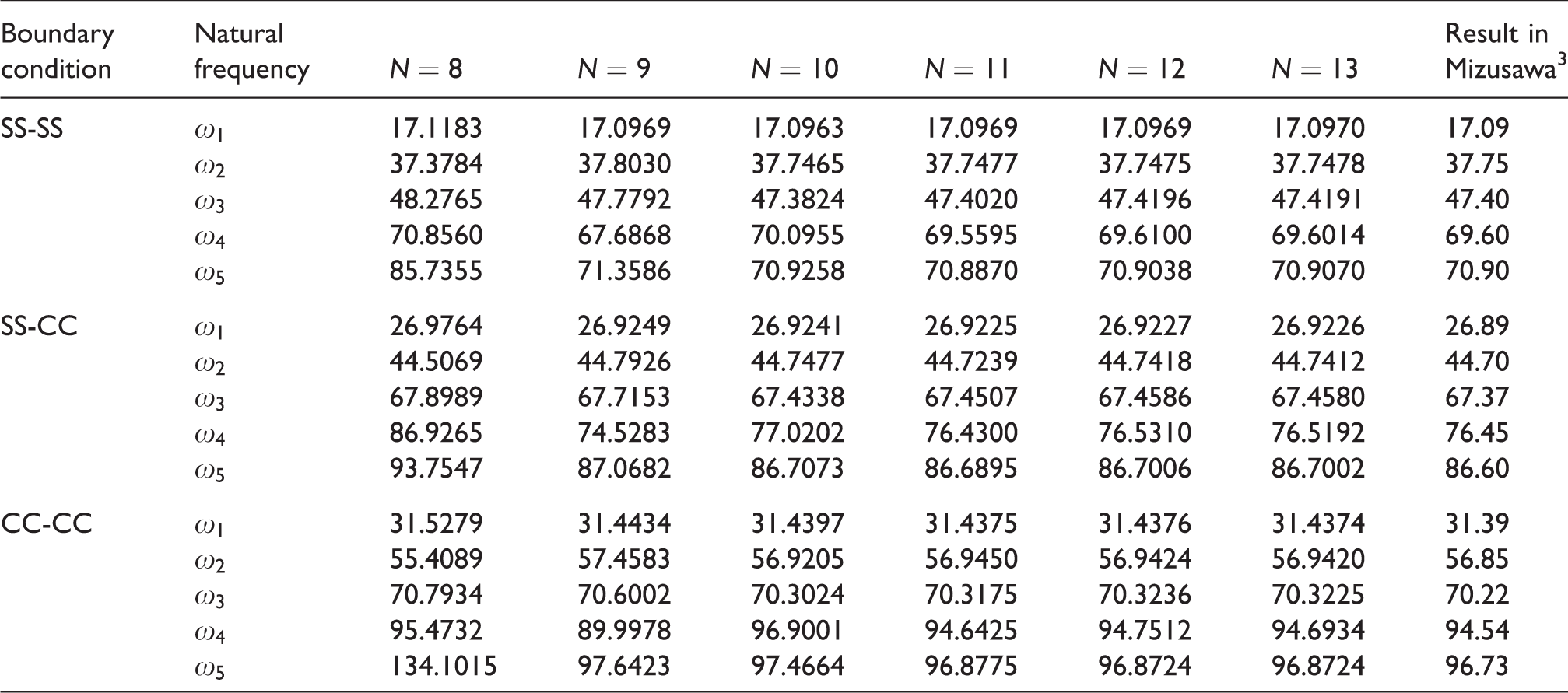
When and , equation (35) is reduced to the differential equation of transverse vibration of the non-rotating elastic annular sector plate. To validate the present theory and method, the first five-order natural frequencies of the non-rotating elastic annular sector plate with three different boundary conditions are calculated in the case of and . The frequency parameter in this study is defined by , while the frequency parameter in Mizusawa3 is . When , . The calculation results by conversing to are in good agreement with those calculated by FEM in Mizusawa3, which can be seen in Tables 1to 4. It shows when the number of nodes is greater than 11, the value of the natural frequency has stabilized. Therefore, is selected in this study by considering the accuracy and stability of DQM.
First five-order dimensionless natural frequencies of the non-rotating elastic annular sector plate (, , ).
Rotating viscoelastic annular sector plate with CC-CC
Figure 3 shows the variation of the first three-order dimensionless complex frequencies of the rotating viscoelastic annular sector plate (, ) with the dimensionless angular speed for . When the dimensionless angular speed , the first three-order dimensionless complex frequencies are real numbers. With the increase of the dimensionless angular speed, the real parts of the first three-order dimensionless complex frequency decrease, while their imaginary parts are zero. When the dimensionless angular speed reaches a certain critical speed , the real part of the first-order dimensionless complex frequency become zero, but its imaginary part has two branches. The plate undergoes the divergence instability, and the certain critical speed is called the first-order critical divergence speed. When the dimensionless angular speed increases to , the rotating annular sector plate gains restability. When the dimensionless angular speed increases to , the real parts of the first- and second-order complex frequencies merge to each other and keep positive, while their imaginary parts become two branches with positive and negative values. The result shows that the annular sector plate undergoes a coupled-mode flutter instability of the first- and second-order modes. is called the first- to second-order critical flutter speed. The constitutive equations of the rotating viscoelastic annular sector plate is differential constitutive equation of plane stress, and the corresponding differential equation of motion of rotating viscoelastic annular sector plates contains a derivative of time, which denotes damping of materials, so the plate exhibits complex frequency characteristics. In the case of certain viscoelasticity and angular speed, the annular sector plate occurs the divergence and flutter instability.
First three-order dimensionless complex frequency versus dimensionless angular speed (, , ).
Figure 4 shows the variation of the first three-order dimensionless complex frequencies of the rotating viscoelastic annular sector plate (, ) with the dimensionless angular speed for . Because of the increase of dimensionless delay time, the imaginary parts of the dimensionless complex frequencies remain positive value, and it increase with the increase of mode order. This means that the system damp increases. When increases to the critical value, the annular sector plate undergoes the divergence instability in the first-order mode, and the corresponding first-order critical divergence speed is the same as that for . The result shows that the dimensionless delay time does not have effect on the first-order critical divergence speed. When the dimensionless angular speed further increases, the annular sector plate undergoes single-mode flutter instability.
First three-order dimensionless complex frequency versus dimensionless angular speed (, , ).
Figure 5 shows the variation of the first three-order dimensionless complex frequencies of the rotating viscoelastic annular sector plate (, ) with the dimensionless angular speed for . The annular sector plate undergoes the divergence instability in the first-order mode and the coupled-mode flutter instability of the first- and second-order modes. The corresponding first-order critical divergence speed and first- to second-order critical flutter speed increase evidently in comparison with those in the case of and .
First three-order dimensionless complex frequency versus dimensionless angular speed (, , ).
Figure 6 shows the variation of the first three-order dimensionless complex frequencies of the rotating viscoelastic annular sector plate (, ) with the dimensionless angular speed for . With the increase of the dimensionless delay time, the imaginary parts of dimensionless complex frequencies remain positive value; the first- and second-order modes do not couple and the annular sector does not behave a coupled-mode flutter instability. When the angular speed increases to , the first-order mode shows divergence instability firstly and then presents a single-mode flutter instability at . When the angular speed further increases to , the second-order mode shows divergence instability; subsequently, it behaves a single-mode flutter instability at . By comparing Figure 6 with Figure 5, it is found that the increase of the dimensionless delay time changes the type of instability in the second-order mode while does not have effect on the first-order critical divergence speed.
First three-order dimensionless complex frequency versus dimensionless angular speed (, , ).
Figures 7 to 10 show the variation of the first three-order dimensionless complex frequencies of the rotating viscoelastic annular sector plate (, and ) with the dimensionless angular speed for and . For , the annular sector plate undergoes the divergence instability in the first-order mode and subsequently undergoes the coupled-mode flutter instability of the first- and second-order modes. For , the annular sector plate undergoes the divergence instability and single-mode flutter instability in the first-order mode. The increase of the dimensionless delay time does not have effect on the first-order critical divergence speed. By comparing Figures 7 to 10 with Figures 3 and 4, it indicates that with the increase of the angular angle , the real parts of the first three-order dimensionless complex frequencies decrease at , and the corresponding first-order critical divergence speed deceases too.
First three-order dimensionless complex frequency versus dimensionless angular speed (, , ).
First three-order dimensionless complex frequency versus dimensionless angular speed (, , ).
First three-order dimensionless complex frequency versus dimensionless angular speed (, , ).
First three-order dimensionless complex frequency versus dimensionless angular speed (, , ).
Figures 11 and 12 show the variation of the first three-order dimensionless complex frequencies of the rotating viscoelastic annular sector plate (, ) with the dimensionless angular speed for and . For , the annular sector plate undergoes the divergence instability in the first- and second-order modes and subsequently undergoes the coupled-mode flutter instability of the second- and third-order modes. For , the divergence instability occurs in the first- and second-order modes, and the single-mode flutter instability appears in the second-order mode.
First three-order dimensionless complex frequency versus dimensionless angular speed (, , ).
First three-order dimensionless complex frequency versus dimensionless angular speed (, , ).
Figure 13 shows the variation of the first three-order dimensionless complex frequencies of the rotating viscoelastic annular sector plate (, ) with the dimensionless angular speed for . By comparing Figure 13 with Figures 5 and 11, it is obtained that when other parameters are invariable, the sector angle increases from to , the annular sector plate does not behave the divergence instability in the first-order mode, but undergoes the coupled-mode flutter instability in the first- and second-order modes.
First three-order dimensionless complex frequency versus dimensionless angular speed (, , ).
Figures 14 shows the variation of the first three-order dimensionless complex frequencies of the rotating viscoelastic annular sector plate (, ) with the dimensionless angular speed for . By comparing Figure 14 with Figure 13, it can be seen that the annular sector plate only undergoes the divergence instability in the first-order mode because of the increase of the dimensionless delay time.
First three-order dimensionless complex frequency versus dimensionless angular speed (, , ).
From Figures 3 to 14, we can see that the first three-order dimensionless natural frequencies increase with the increase of the ratio of inner to outer radius when other parameters are invariable.
Rotating viscoelastic annular sector plate with SS-CC
Figures 15 to 18 show the variation of the first three-order dimensionless complex frequencies of the rotating viscoelastic annular sector plate (, , and ) with the dimensionless angular speed for and . For , the annular sector plate undergoes the divergence instability in the first-order mode and subsequently undergoes the coupled-mode flutter instability of the first- and second-order modes. For , the annular sector plate undergoes the divergence instability and then behaves the single-mode flutter instability in the first-order mode. It can be seen from the results of the numerical calculation that the increase of the dimensionless delay time does not have effect on the first-order critical divergence speed.
Figures 19 to 22 show the variation of the first three-order dimensionless complex frequencies of the rotating viscoelastic annular sector plate (, and ) with the dimensionless angular speed for and . For , the annular sector plate undergoes the divergence instability in the first-order mode and the coupled-mode flutter instability of the first- and second-order modes. For , the annular sector plate undergoes the divergence instability and the single-mode flutter instability in the first-order mode. The increase of the dimensionless delay time does not have effect on the first-order critical divergence speed. By comparing Figures 19 to 22 with Figures 15 and 17, it is found that the first-order critical divergence speed decreases slightly with the increase of the sector angle when other parameters are invariable.
First three-order dimensionless complex frequency versus dimensionless angular speed (, , ).
Figures 23 and 24 show the variation of the first three-order dimensionless complex frequencies of the rotating viscoelastic annular sector plate (, ) with the dimensionless angular speed for and . As shown in Figures 23 and 24, the values of the real parts of the second- and third-order dimensionless complex frequencies of the annular sector plate present declining, rising, and declining tendency. For , the annular sector plate undergoes the divergence instability in the first-order mode and the coupled-mode flutter instability of the first- and second-order modes. For , the divergence instability and the single-mode flutter instability occur successively in the first-order mode. From Figures 19 to 23, it can be seen that the first-order critical divergence speed increases evidently with the increase of the ratio of inner to outer radius when other parameters are invariable.
Figures 25 and 26 show the variation of the first three-order dimensionless complex frequencies of the rotating viscoelastic annular sector plate (, ) with the dimensionless angular speed for and . For , the annular sector plate only undergoes the coupled-mode flutter instability of the first-and second-order modes. For , the annular sector plate undergoes the divergence instability in the first-order mode.
From Figures 16 to 26, we can see that the first three-order dimensionless natural frequencies increase with the increase of the ratio of inner to outer radius when other parameters are certain.
First three-order dimensionless complex frequency versus dimensionless angular speed (, , ).
First three-order dimensionless complex frequency versus dimensionless angular speed (, , ).
First three-order dimensionless complex frequency versus dimensionless angular speed (, , ).
First three-order dimensionless complex frequency versus dimensionless angular speed (, , ).
First three-order dimensionless complex frequency versus dimensionless angular speed (, , ).
First three-order dimensionless complex frequency versus dimensionless angular speed (, , ).
First three-order dimensionless complex frequency versus dimensionless angular speed (, , ).
First three-order dimensionless complex frequency versus dimensionless angular speed (, , ).
First three-order dimensionless complex frequency versus dimensionless angular speed (, , ).
First three-order dimensionless complex frequency versus dimensionless angular speed (, , ).
First three-order dimensionless complex frequency versus dimensionless angular speed (, , ).
Conclusions
The transverse vibration and stability of the rotating viscoelastic annular sector plate with two boundaries are investigated by DQM. To validate DQM, the first five-order natural frequencies of the non-rotating elastic annular sector plate with three different boundary conditions are calculated, which are in good agreement with those calculated by FEM. This result shows that DQM has the same flexibility and accuracy as FEM in calculating the four-order partial differential equation of motion of the rotating viscoelastic annular sector plate. The effects of the dimensionless angular speed, the ratio of inner to outer radius, the sector angle, and the dimensionless delay time on transverse vibration of the rotating viscoelastic annular sector plate constituted by the elastic behavior in dilatation and the Kelvin–Voigt laws for distortion are discussed. The results are listed as follows.
When the dimensionless delay time increases from to , the coupled-mode flutter instability does not occur in the first- and second-order modes, while the single-mode flutter instability appears in the first- or second-order modes; the imaginary parts of the dimensionless complex frequencies change from zero to positive values and increase with the increase of the modes. Meanwhile, the increase of the dimensionless delay time (from to ) does not change the critical divergence speed in first-order mode.
The ratio of inner to outer radius and the sector angle affect the frequency and the type of instability of the annular sector plate. The first three-order dimensionless natural frequencies increase with the increase of the ratio of inner to outer radius when other parameters are invariable. In the case of the ratio of inner to outer radius and the dimensionless delay time , the viscoelastic annular sector plate undergoes the divergence instability in the first order and the coupled-mode flutter instability of the first- and second-order modes. In the case of the ratio of inner to outer radius and the dimensionless delay time , the viscoelastic annular sector plate undergoes the divergence instability and single-mode flutter in the first-order mode. In the case of the ratio of inner to outer radius , with the change of the sector angle, the types of instability in the annular sector plate is more complicated, which include the divergence instability in the first- and second-order modes, the coupled-mode flutter instability of the first- and second-order modes, and the single-mode flutter instability in the first-order mode.
When the rotating viscoelastic annular sector plate undergoes divergence instability in the first-order mode, the first-order critical divergence speed increases with the increase of the ratio of inner to outer radius while decreases with the increase of the sector angle.
Through the analyses above, it is found that the ratio of inner to outer radius, the sector angle, the angular speed, and the dimensionless delay time can affect stability of the viscoelastic annular sector plate. The results obtained in this paper are intended to give an improved understanding of vibration and stability of the rotating viscoelastic annular sector plate and to offer benchmark data for further research.
Footnotes
Acknowledgement
The authors thank the reviewer for a careful reading of the manuscript.
Declaration of conflicting interests
The author(s) declared no potential conflicts of interest with respect to the research,authorship,and/or publication of this article.
Funding
The author(s) disclosed receipt of the following financial support for the research,authorship,and/or publication of this article: This research was supported by the National Natural Science Foundation of China (No. 11972286) and the Natural Science Foundation of Shaanxi Province (No. 2018JM1028).
References
1.
RezaeiASSaidiAR.An analytical study on the free vibration of moderately thick fluid-infiltrated porous annular sector plates. J Vib Control2017;
24: 4130–4144.
2.
ZhouDLoSHCheungYK.3-D vibration analysis of annular sector plates using the Chebyshev–Ritz method. J Sound Vib2009;
320: 421–437.
3.
MizusawaT.Application of the spline element method to analyze vibration of annular sector plates. J Sound Vib1991;
149: 461–470.
ShiXJShiDXLiWL.A unified method for free vibration analysis of circular, annular and sector plates with arbitrary boundary conditions. J Vib Control2016;
22: 442–456.
6.
ShiDYShiXJLiWL.Vibration analysis of annular sector plates under different boundary conditions. Shock Vib2014;
2014: 1–11.
7.
WangQSShiDYLiangQ, et al.
A unified solution for free in-plane vibration of orthotropic circular, annular and sector plates with general boundary conditions. Appl Math Model2016;
40: 9228–9253.
8.
ZhongRWangQSTangJY.Vibration analysis of functionally graded carbon nanotube reinforced composites (FG-CNTRC) circular, annular and sector plates. Compos Struct2018;
194: 49–67.
9.
GuanXLTangJYShiDY.A semi-analytical method for transverse vibration of sector-like thin plate with simply supported radial edges. Appl Math Model2018;
60: 48–63.
10.
DarabsehTTGeninJ.Dynamic stability of viscoelastic columns loaded by a follower force.Proc Inst Mech Eng C J Mech Eng Sci2004;
218: 1091–1101.
11.
DingHZhuMHChenLQ.Nonlinear vibration isolation of a viscoelastic beam. Nonlinear Dyn2018;
92: 1–25.
12.
ZhouYFWangZM.Vibrations of axially moving viscoelastic plate with parabolically varying thickness. J Sound Vib2008;
316: 198–210.
13.
TalabiMRSaidiAR.An explicit exact analytical approach for free vibration of circular/annular functionally graded plates bonded to piezoelectric actuator/sensor layers based on Reddy’s plate theory. Appl Math Model2013;
37: 7664–7684.
14.
AkgözBCivalekO.Buckling analysis of cantilever carbon nanotubes using the strain gradient elasticity and modified couple stress theories. J Comput Theor Nanosci2011;
8: 1821–1827.
15.
CivalekO.Vibration analysis of conical panels using the method of discrete singular convolution. Commun Numer Methods Eng2008;
24: 169–181.
16.
LeiZXLiewKMYuJL.Free vibration analysis of functionally graded carbon nanotube-reinforced composite plates using the element-free kp-Ritz method in thermal environment. Compos Struct2013;
106: 128–138.
17.
LiangXWangZYWangLZ, et al.
A semi-analytical method to evaluate the dynamic response of functionally graded plates subjected to underwater shock. J Sound Vib2015;
336: 257–274.
18.
ShirmohammadiFBahramiS.Dynamic response of circular and annular circular plates using spectral element method. Appl Math Model2018;
53: 156–166.
19.
GaoSSLiangBVidal-SalleE.Development of a new 3D beam element with section changes: the first step for large scale textile modelling. Finite Elem Anal Des2015;
104: 80–88.
20.
GaoSSLiangBVidal-SalleE.Analysis of large displacements/small strains of enhanced 3D beam with section changes. AIP Conf Proc2016;
1769: 170015.
21.
DemirCMercanKCivalekO.Determination of critical buckling loads of isotropic, FGM and laminated truncated conical panel. Compos B Eng2016;
94: 1–10.
22.
MercanKCivalekO.DSC method for buckling analysis of boron nitride nanotube (BNNT) surrounded by an elastic matrix. Compos Struct2016;
143: 300–309.
23.
CivalekO.Free vibration of carbon nanotubes reinforced (CNTR) and functionally graded shells and plates based on FSDT via discrete singular convolution method. Compos B Eng2017;
111: 45–59.
24.
CivalekO.Nonlinear dynamic response of laminated plates resting on nonlinear elastic foundations by the discrete singular convolution-differential quadrature coupled approaches. Compos B Eng2013;
50: 171–179.
25.
CivalekO.The determination of frequencies of laminated conical shells via the discrete singular convolution method. J Mech Mater Struct2006;
1: 163–182.
26.
AkgözBCivalekO.Nonlinear vibration analysis of laminated plates resting on nonlinear two-parameters elastic foundations. Steel Compos Struct2011;
11: 403–421.
27.
BaltacioğluAKCivalekOAkgozB.Large deflection analysis of laminated composite plates resting on nonlinear elastic foundations by the method of discrete singular convolution. Int J Press Vessel Pip2011;
88: 290–300.
28.
BaltacioğluAKAkgozBCivalekO.Nonlinear static response of laminated composite plates by discrete singular convolution method. Compos Struct2010;
93: 153–161.
29.
TornabeneFFantuzziNUbertiniF, et al.
Strong formulation finite element method based on differential quadrature: a survey. Appl Mech Rev2015;
67: 020801.
30.
ZhongHYuT.A weak form quadrature element method for plane elasticity problems. Appl Math Model2009;
33: 3801–3814.
MercanKCivalekO.Buckling analysis of silicon carbide nanotubes (SiCNTs) with surface effect and nonlocal elasticity using the method of HDQ. Compos B Eng2017;
114: 34–45.
33.
WuYXingYLiuB.Analysis of isotropic and composite laminated plates and shells using a differential quadrature hierarchical finite element method. Compos Struct2018;
205: 11–25.
34.
LiangXWuZJWangLZ, et al.
Semianalytical three-dimensional solutions for the transient response of functionally graded material rectangular plates. J Eng Mech2015;
141:04015027.
35.
LiangXKouHLWangLZ, et al.
Three-dimensional transient analysis of functionally graded material annular sector plate under various boundary conditions. Compos Struct2015;
513: 284–596.
36.
FlüggeW.Viscoelasticity.
Berlin:
Springer, 1975.
37.
AlibeiglooAEmtehaniA.Static and free vibration analyses of carbon nanotube reinforced composite plate using differential quadrature method. Meccanica2015;
50: 61–76.
38.
HanJBLiewKM.Analysis of moderately thick circular plates using differential quadrature method. J Eng Mech1997;
123: 1247–1252.
39.
ShuCChenW.On optimal selection of interior points for applying discretized boundary conditions in DQ vibration of beams and plates. J Sound Vib1999;
222: 239–257.