







Abstract
If you are an active TikTok user, you have probably come across content with a text overlay similar to the examples above. The acronym PoV, which stands for “point-of-view” and predates TikTok by several decades (see Branigan, 1975), has recently experienced remarkable popularity on the platform, with the hashtag #PoV currently counting over 68 million videos. PoV memes—videos in which creators act out a sketch described in a textual overlay stating “PoV: [description]”—are one of TikTok’s most iconic genres. Since memes are digital artifacts through which users express and negotiate their shared values (Shifman, 2019), PoV memes offer a window to investigate the values central to TikTok’s platform vernacular (Gibbs et al., 2015). However, despite the popularity of the genre and its potential to exemplify key mechanisms of community building on the platform, the values and defining characteristics of PoV memes have yet to be systematically scrutinized.
Addressing this gap, this study sets off to answer the following questions: what constitutes a PoV meme on TikTok? What are the communicative values promoted by such memes? And how do such memes create a sense of community? My analysis relies on Shifman’s (2013) definition of memes as collections of texts sharing characteristics of content, form, and stance, as well as established theorizations of perspective in cinema (Branigan, 1975) and literature (Fludernik, 1994). I also draw on Shifman’s (2019) definition of communicative values as overarching norms regulating the process of communication and on recent scholarship applying this notion to investigate diverse social media genres (Trillò et al., 2022).
This paper is structured as follows. The literature review surveys studies on memes and their community-building functions, the intertwined notions of platform vernacular and platform imaginary as applied to TikTok, and the concepts of roleplay and perspective as essential tools to investigate PoV memes. After outlining the methods of analysis—a close reading of ethnographically retrieved data and a quantitative content analysis—I present my findings based on Shifman’s (2013) threefold model of memetic content, form, and stance. The discussion section reflects on the findings and outlines the contribution of this study. First, I present the concept of “echoic affiliation”: a form of ambient affiliation (Zappavigna, 2018) where users bond through memes that reproduce an audio track while backgrounding its context of origin. Second, I suggest that the peculiar narrative structure of PoV memes articulates multiple perspectives and exemplifies the key role of intersubjectivity (Zhao and Zappavigna, 2018) in TikTok’s platform vernacular. Finally, I claim that creators of PoV memes frequently invoke the communicative value of affiliation as a strategy to navigate uncertainty as they try to reach their intended audiences through TikTok’s recommendation algorithm. Taking stock of the above, I offer an updated definition of PoV memes in the concluding section.
Literature review
Memes, communicative values, and community-building
My analysis of TikTok PoV memes is grounded in Shifman’s (2013) definition of a meme as a group of digital items sharing common characteristics of content, form, and stance that are circulated and transformed by internet users. Memes are definitionally plural, featuring diverse incarnations that collectively reference the same shared “core” or template (Segev et al., 2015). Although PoV memes come in many different forms, the shared core of the genre features a “PoV: [description]” textual overlay describing a scene that creators act out in the moving images with the support of an audio track added through TikTok’s “use this sound” function.
I am particularly interested in how memes combine different characteristics of content, form, and stance to communicate values, here defined after Heinich (2020) as objects consistently regarded as worthy (e.g., technology, family) as well as the principles invoked to assign worth to objects (e.g., innovation, tradition). Heinich’s theorization highlights that values are not intrinsic to objects but created and constantly negotiated in social interaction. Thus, values can be empirically investigated by observing the subjects expressing them, the objects they are projected on, and the context of their production.
My focus in this paper is on communicative values: shared norms mandating not what we should say about the world but how we should speak about it (Shifman, 2019). In the specific case of digital memes, several studies point out that such notions of good communication are frequently invoked to construct and preserve individual-group relationships. For example, Nissenbaum and Shifman (2017) argue that specific subcultures weaponize the values of creativity and loyalty to gatekeep their communities and ridicule outsiders who can’t tell when a meme is too divorced from its template (too creative) or a repost (too loyal). Brock (2020) illustrates how popular memes on Black Twitter uphold Black respectability and promote the assimilation of Black folk into white technocultural norms. Sparby (2023) contends that queer-coded TikTok catchphrases (e.g., “I like your style”) function as “memetic screens” through which queer users establish safe spaces of communication in the absence of affordances to draw firm community boundaries. Ultimately, memes are vernacular objects through which individuals cement communal ties based on shared communicative norms.
The values of TikTok’s algorithmically mediated platform vernacular
Drawing on Shifman’s (2019) notion of communicative values, this paper scrutinizes PoV memes to uncover the norms of communication frequently highlighted in TikTok’s platform vernacular—the styles, grammar, and logic that emerge as users appropriate the affordances of a platform to produce popular genres of communication (Gibbs et al., 2015). My discussion is also informed by the adjacent concept of platform imaginaries (van Es and Poell, 2020)—the ways in which users understand a platform’s algorithms, engagement features, moderation procedures, business models, and target audience. Simply put, platform imaginaries refer to what users
Vernacular meme production on TikTok consistently gestures toward an imaginary that forefronts the role of “the algorithm” in determining what content is visualized by its users (Siles et al., 2022). While social media was traditionally organized around follower-followee networks (boyd and Ellison, 2007), TikTok’s feed is curated on the basis of users’ previous interaction with the app’s recommendation algorithm (Kang and Lou, 2022). TikTok users are thus presented with content that embodies an “algorithmized” version of their individual identities (Bhandari and Bimo, 2022) as the platform gathers their preferences and curates an endless stream of videos displayed on a feed fittingly named the “for you” page (henceforth, FYP).
While the literature on TikTok memes seldom foregrounds the lens of values, existing studies gesture toward the centrality of two communicative values in the platform’s vernacular:
The communicative value of
“PoV: You are __”: Investigating a TikTok meme template
My investigation of TikTok PoV memes is inspired by Cervi and Divon’s (2023: 4) definition of “PoV challenges” as videos in which “users implement the cinematic aesthetic of point-of-view by impersonating others to vehiculate their perspective on a specific issue.” The wiki archive
I approach the performative component of TikTok PoV memes through the lens of roleplay, here defined as a form of mimicry in which individuals temporarily try on and explore social roles that may or may not overlap with the ones they usually inhabit (Zagal and Deterding, 2018). Roleplaying takes time and space to invent scenarios where individuals set aside the “serious” real-life consequences of their actions and transform, recombine, or exaggerate otherwise functional behavior for the sake of enjoyment and self-expression (Pellegrini 2009). In the context of TikTok, roleplaying allows creators to performatively affirm their belonging to specific social groups (Cheng Stahl and Literat, 2023) and to affiliate around shared cultural practices regardless of physical proximity (e.g., make-believe karaoke bar performances; see Petrovic, 2023).
Alongside roleplay, PoV memes foreground the notion of perspective, here defined after Pauen (2012) as factors that constitute a subject’s epistemic access to an object (e.g., spatiotemporal location, state of mind). When analyzing texts, perspective is usually described through the metaphor of first-person, second-person, and third-person point of view (Rembowska-Płuciennik, 2018). First-person point of view reproduces the subjective perspective of a character in the story-world (Branigan, 1975), second-person point of view presents the viewer with an interpretation of their own perspective on the world as understood by the narrator (Fludernik, 1994), and third-person point of view offers an external perspective from which the viewer can witness the story unfold without personal involvement. The lens of perspective sheds light on the inherently relational character of (moving) images (Berger, 1972), exposing the creator’s ability to determine the viewer’s position vis-à-vis the representation through camera placement (Kress and van Leeuwen, 1996). Hence, definitionally visual user-generated genres such as PoV memes construct a triangular relationship between creators, their audiences, and the situations they are representing on screen through vernacular modes of perspective-taking.
My understanding of perspective also draws from Zhao and Zappavigna’s (2018) notion of intersubjectivity, defined as the possibility to articulate different perspectives that can be shared between creator and audience. For example, mirrored selfies enact intersubjectivity by presenting the audience with the creator’s perspective on an object—their body—mediated by two layers of technology: the mirror and the phone. Digital memes are particularly open to the enactment of intersubjectivity because of their multimodal and definitionally plural character (Shifman, 2013). This tendency is further enhanced by the context of social media, where memes are anchored to profiles and linked to other content via social tagging (Zappavigna, 2018). Thus, an image macro meme such as “One does not simply [description],” featuring verbiage imposed over a still image of Sean Bean in character as Boromir in Peter Jackson’s
Building on these premises, the first objective of this study is to isolate the core characteristics of TikTok PoV memes and provide a definition that captures their outlook. Hence, I ask:
Methods
Ethnographic data gathering
The data for this research was gathered over the course of a four-month digital ethnography (November 2022–February 2023). Inspired by Christin’s (2020) notion of “enrolling the algorithm” in ethnographic research, my process actively engaged with content featuring the “PoV” acronym in order to influence future algorithmic recommendations. At the beginning of the period of ethnographic observation, I opened a new account and logged into the smartphone version of the TikTok app. During the first browsing session, I searched for “PoV” through keyword query, went to the “videos” tab, sorted it by number of “likes,” and filtered the results to include only videos posted “this month.” This first session was concluded by “liking” the first fifty videos featuring a text overlay in English following the template “PoV: [description].”
This strategy effectively prompted the recommendation algorithm to serve me more PoV memes. However, my FYP was also influenced by other factors, including the identities and geolocation of the creators whose PoV memes appeared at the top of my initial search due to their popularity on the platform as well as my own positionality as a college-educated cisgender man from Southern Europe who recently became a father. Thus, my ethnography primarily featured videos that can be broadly defined as “sketch comedy” performed by North American creators catering to one of four main groups: Black teenagers, (mostly white) college students, heterosexual cohabiting couples, and gym goers. These were complemented by less frequent videos appealing to adjacent demographics (e.g., young parents, college athletes). Ultimately, my ethnographic experience was informed by recommendations reinforcing the viewing habits set in the early stages of the project and occasionally promoting content that relates to my own identity (cf. Schellewald, 2021).
In subsequent sessions, I browsed the FYP of my new account, searching for videos with a “PoV: [description]” text overlay. For each encounter with one such video, I opened the associated sound and checked whether the audio clip contained at least five other videos following the memetic template. Whenever this was the case, I would “like” the video originally appearing on my FYP, archive the URLs of five closely related examples, and return to the FYP for further browsing. Based on the ethical considerations foregrounded in Schellewald’s (2021) trailblazing ethnography of the FYP, no videos were downloaded or stored. Rather, I used the manually compiled list of video URLs to gather anonymous metadata through
I stopped my search upon reaching a total of fifty PoV memes with five incarnations each, resulting in a corpus of 250 videos. The sample size is within the scope of other qualitative studies of TikTok content (e.g., Cervi and Divon, 2023; Maddox and Gill, 2023; Vizcaíno-Verdú and Abidin, 2022) and was selected to be large enough to make meaningful claims regarding the character of PoV memes while remaining manageable in the context of a qualitative investigation. The final sample overwhelmingly originated from the United States (166 videos), with the UK and Canada distant seconds (respectively 24 and 11 videos) and no other country featured more than five times (29 countries in total). The videos range widely in popularity (between 33B and 248 views, median view count = 484,850) and reflect the above-mentioned orientation toward sketch comedy produced by—and catering to—Black teenagers, white college students, heterosexual couples, and gym goers.
Formal characteristics and communicative values
TikTok memes are definitionally plural (Shifman, 2013) and highly multimodal artifacts that can be analyzed across a wide range of intersecting dimensions (e.g., language, gesture, phonology), each with a wide number of potential variables (Norris, 2019). Borrowing from Nissenbaum and Shifman’s (2018) study of global meme templates, I treated each of the fifty memes in my sample as a singular unit composed of five incarnations.
The analysis followed a two-step process inspired by Schellewald’s (2021) ethnographic exploration of TikTok and by Shifman’s (2013) model for analyzing memes. In the first phase, I took extensive notes on the form of each meme based on a close reading of the material. My annotations addressed the people involved in the video, the setting, the number of shots, and the presence of effects or filters. To account for the crucial role of audio clips in TikTok memetic content, I also identified the origin of the fifty audio clips, thoroughly describing their characteristics and provenance.
Building on my annotations and the literature on the values of TikTok’s platform vernacular, the second analytical phase entailed a systematic analysis of the corpus based on a five-question codebook. Drawing upon Zappavigna’s work on YouTube ASMR roleplay (Zappavigna, 2020) and decluttering vlogs (Zappavigna, 2019), the first two questions ask which personal pronouns are used in the textual overlay (first-person singular, second-person, first-person plural, other) and whether the images are shot from a first-person or a third-person point of view. To capture the pivotal role of audio clips in bundling different incarnations of each meme (see Abidin and Kaye, 2021), the third question refers to how the sound added through the “use this sound” function supports the narrative. Coders assessed whether the audio clip is used to “lip-sync,” a practice in which a performer silently moves their lips in synchronization with a prerecorded soundtrack to create the illusion that they are themselves speaking the audio (Cervi and Divon, 2023); as a cue for “transition,” referring to artful visual edits that synchronize with the soundtrack to create optical illusions such as an instantaneous change of outfit (Abidin, 2020); or as simple background.
Going beyond a strict focus on formal characteristics, the fourth question pertains to the presence of communicative values in each meme. The ten communicative values listed in the codebook (see Table 1) were identified as part of the ERC-funded
Value-coding scheme with definitions.

Having refined and operationalized all categories and definitions through several rounds of preliminary coding on a separate practice corpus, a research assistant and I coded all units following the analytical principles of consensual qualitative research (Spangler et al., 2012). We independently coded each memetic template and then met to compare the two sets of codes, resolving any disagreements through discussion.
Findings
PoV memes creatively combine moving images, text, and audio to deliver a short sketch. They are normally a single-shot sequence featuring the creator as the main character or, less frequently, showcasing their first-person perspective on something. In the rare case of multishot montages, PoV memes feature a shot establishing the creator as the main character, followed by a cut to one or more first-person perspective shots. As PoV memes are usually acted out at home with minimal use of props, textual overlays set the parameters of the scene and provide background information. The audio clip supports the narration by providing aural cues for the creator to react to as part of their performance. The rest of this section elaborates on the characteristics of PoV memes based on the categories of form, content, and stance.
Form: Anatomy of a meme
Aural component
The majority of PoV memes in my sample reuse audio clips from cinema, television, and music. The remaining memes remediate snippets of audio from popular internet culture references or, less frequently, the audio of an original TikTok video. Somewhat surprisingly, however, almost all of the audio clips
About half of the memes feature their creator “lip-syncing” to the associated audio clips. Meme_17 1 offers a paradigmatic example. The textual overlay sets the scene by stating some version of “PoV: when your [parent] is white and your [parent] is Black” (e.g., “PoV: when your mom is white and your dad is Black”). In the images, a mixed-race couple plays with their baby while lip-syncing to Ralan Styles’ rap reinterpretation of the record-breaking children’s bop “Baby Shark.” The white parent approaches their baby while lip-syncing to a gentle, lullaby-style version of the song. After a few seconds, they are interrupted by the Black parent who pushes them aside and, turning to the camera, proceeds to lip-sync to the rap version while mimicking a gun with their fingers (Figure 1).

Example of Meme_17.
Most of the remaining memes in the sample featured sketches where creators do not move their lips but nonetheless respond to the soundtrack. For example, Meme_43 presents the audience with a single fixed-camera shot of the creator. The textual overlay reads, “PoV: you cheated on the girl who is into crystals.” In the images, the creator goes about their business until they are suddenly disturbed by a ghostly sound, recognizable as the voice of the character Skull Kid from the
Personal pronouns in the text and visual point of view
Moving to the textual and visual components, analysis of personal pronouns in the text and visual point of view gestures toward the existence of a basic narrative structure characterizing the broad genre of TikTok PoV memes. Visually, two-thirds of the memes do not use the camera eye to simulate the perspective of a character in the story world and instead adopt a third-person perspective that positions the viewer externally to the sketch being acted out. Textually, a similar two-third majority refers to the protagonist of the sketch through the second-person pronoun “you.” A cross-tabulation of the results indicates a strong overlap between the two findings, suggesting that their combination represents the most common permutation of PoV memes.
For example, Meme_3 features an overlay with variations of the text “PoV: You are a [university major] student during finals” (e.g., you are a

Example of Meme_33.
A second, less-frequent narrative structure in PoV memes still features “you” as the textual protagonist but presents visuals shot from a first-person perspective. For example, the textual component of Meme_35 states “PoV: your best friend from college takes you to their hometown.” The images feature a sequence of first-person shots taken from the passenger seat of a car moving through a small town in the rural United States. As the soundtrack plays an old-timey banjo, the viewer is presented with the subjective perspective of a city dweller visiting “middle America” for the first time (Figure 3).
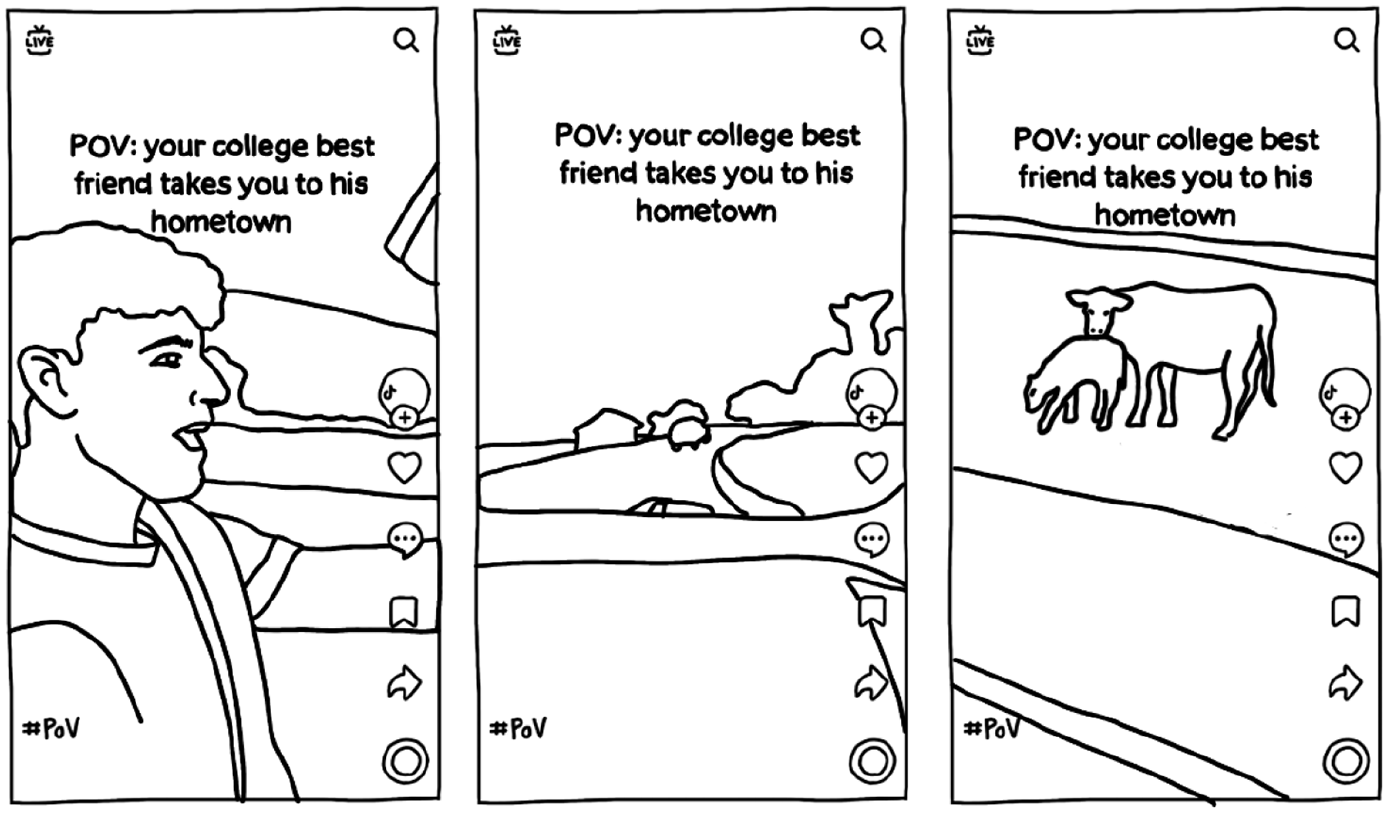
Example of Meme_35.
PoV memes occasionally mix the two forms. In such cases, the textual overlay makes a similar use of second-personal pronouns while the visual component features a shot establishing the creator as the protagonist of the sketch and a second shot showing their first-person perspective. For example, the textual overlay of Meme_6 states “PoV: you enter the gym on January 1st.” The montage opens with a shot of the creator entering the lobby of a gym and then looking at something off-screen with a face of disbelief. After the cut, the visuals resume with a sequence of first-person shots in which the creator, now posing as other gym-goers, uses the equipment in a comedically incorrect way.
Overall, my analysis of form suggests that PoV memes are complex intermodal digital artifacts. The verbiage in the textual overlay features the narratorial voice of the creator, directly addressing the audience with background information necessary to make sense of the creator’s performance. Conversely, the moving images feature the creator not as themselves but “in character” according to parameters set in the textual overlay. In most cases, these roleplaying performances resemble ventriloquist shows in which creators lip-sync or react to an audio track. The discussion section goes into further detail regarding the interplay between the different semiotic modes featured in PoV memes.
Content: Affiliation and authenticity
The vast majority of PoV memes foregrounds the communicative value of affiliation in its content. A smaller number also foregrounds the value of authenticity, understood in this context as communication that reflects one’s inner feelings. Other values were seldom invoked and usually appeared in combination with affiliation or authenticity. The rest of this subsection focuses on these two values in light of their dominance in the dataset.
The main strategy to enact affiliation involves ironizing situations and familiar feelings for members of a specific community. For example, Meme_25 features a text overlay stating, “PoV: you go to a Christian university.” The visual component of the meme is a fixed-camera shot of the creator acting out a state of panic as they pretend to speak on the phone with their mother. In their make-believe phone conversation, the creator lip-syncs to the words, “Mom, can you come get me? People are getting engaged!” Capitalizing on a shared experience of discomfort, the sketch constructs affiliation between students who feel out of place within the conservative dating culture of a religious university (Figure 4).

Example of Meme_25.
Less frequently, PoV memes signal affiliation to the fandom of specific cultural products. For example, the text overlay of Meme_44 states a version of “PoV: the [
A sizable number of memes in the sample are acted out in the company of family and friends, indicating that TikTok users leverage PoV memes to enact affiliation with broad communities

Example of Meme_21.
While affiliation was by far the most frequently invoked communicative value, a minority of posts referred to the notion of internal authenticity. In the dataset, authenticity was mostly invoked in the context of ironic reflections on poor mental health connected to romantic sorrow. For example, Meme_19 features a text overlay stating, “PoV: you got rejected by your crush.” In the first shot, we are presented with a fixed camera shot of the creator lip-syncing to a snippet from “There is no game,” a popular YouTube video in which gamer Markiplier says, “Well that’s a problem. But not my fault! I did everything I could! And you did, too.” At this point of the audio track, the camera cuts to a different perspective of the creator. A new textual overlay informs the viewer that, in this second shot, the creator is posing as a personification of “feelings for them.” In the images, the creator makes a surprised pose while the audio rolls in the background and asks, “Why are you still here?” Thus, the creator borrows the voice of Markiplier to admit that they still have feelings for their crush and makes us privy to their emotions.
Ultimately, PoV memes construct affiliation and authenticity through their peculiar narrative structure and visual outlook. The text of PoV memes directly addresses the viewer as “you” while the creator acts out what they imagine “you” would do in a given scenario, thus producing a narrative overlap between viewer and viewee that prompts identification between the two. This mechanism is further supported by the use of broad yet bounded identity labels (gym goers, college students) to describe the characters in the make-believe scenarios, suggesting that viewers and creators share membership in said communities. Authenticity materializes through different mechanisms—the confessional character of some of the memes, the ordinariness of the scenarios they portray, and the seeming spontaneity of embodied performances set in domestic environments.
Communicative values beyond affiliation and authenticity appeared only sporadically. The above-cited example of Meme_21, featuring a wife trying to convince her husband to join her skincare routine, voices the value of persuasiveness. However, no other values were invoked frequently or consistently.
Stance: (Not only) humor
PoV memes overwhelmingly adopt an ironic and humorous stance. For example, the textual overlay of Meme_48 reads, “PoV: me, taking the hottest shower ever.” The montage features a series of reverse-angle shots respectively showing the creator’s face and the first-person perspective on their hand as it moves the shower’s faucet. As the camera rolls, the creator simulates a comedically disproportionate amount of rage while lip-syncing the words “More! MORE!” from Adam Driver’s portrayal of Kylo Ren in the 2017 movie

Example of Meme_48.
This is not to say unironic or serious incarnations of PoV memes do not exist. For example, Meme_39 presents the creator’s placid reflections on their own state of happiness while on vacation, expressed in a long “PoV: [description]” textual overlay that concludes “life is good” (e.g., “PoV: you wake up to watch the sunrise in Positano, Italy. The weather is perfect. You sip your cappuccino on the balcony. Life is good”). The images show the creator’s first-person perspective as they slowly walk through their holiday destination, revealing new angles on its wonders.
Exceptions notwithstanding, PoV memes neatly embody TikTok’s well-documented playfulness while also supporting the communicative values central to the genre. The joke setup of most PoV memes corroborates the genre’s emphasis on affiliation insofar as appreciating the irony of a specific make-believe scenario usually requires resonance with one’s own life experience. Humor also provides plausible deniability and thus facilitates authentic confessions regarding one’s own mental health or discomfort with a given situation.
Discussion
My analysis of the characteristics and communicative values of PoV memes reveals what follows. Regarding their form, PoV memes primarily feature creators lip-syncing to audio remediated from pop culture and adopt a unique narrative structure that remixes second-person pronouns in the textual overlay with a third-person perspective in the moving images. The stance of PoV memes is overwhelmingly ironic, reflecting the central role of playfulness as a core characteristic of TikTok’s platform vernacular. Finally, the content of the PoV memes in my sample privileges the communicative values of affiliation, mostly expressed through the enactment of familiar situations for members of specific communities, and authenticity, expressed through admissions of poor mental health due to heartbreak. Based on these findings, I offer three interrelated observations, respectively, addressing aural modes of memetic affiliation, the intermodal construction of intersubjectivity, and the platform imaginaries revealed by the narrative structure of PoV memes.
First, as they “use this sound” to remediate speech and dance to short snippets of music, the creators of PoV memes leverage TikTok’s affordances to enact what I label as “echoic affiliation.” Echo is an aural phenomenon that reflects an original sound, reverberating and multiplying it while simultaneously indicating its spatiotemporal withdrawal (Pinchevski, 2022). Even though the remediation of an original audio clip is central to the performance of affiliation in PoV memes, the provenance of the clip is frequently obscured or misattributed (see Kaye et al., 2021). Furthermore, the pop-cultural literacy necessary to recognize the clip is not a prerequisite to understanding the punchline of the meme or participating in its reproduction. Hence, echoic affiliation departs from Ramati and Abieliovich’s (2022) notion of networked ventriloquism, described as an archival form of memory activism that preserves the common heritage of a community and uses “voices from different times and places” to cement deeply rooted identities. Instead, echoic affiliation represents a more ambient form of affiliation (Zappavigna, 2018) in which users create ephemeral bonds based on memetic performances that reproduce an audio track while simultaneously “forgetting” or even erasing its context of origin.
While many have pointed out how online communities forge their bonds through up-to-date knowledge of the memes circulated on a specific feed (Nissenbaum and Shifman, 2017), the lens of echoic affiliation highlights the primacy of meme literacy over the pop-cultural knowledge required to recognize the very material of which memes are made. This logic applies to TikTok audio-based memes as well as to veteran memes predating the platform. Returning to the example of “one does not simply [description]” image macros, it is clear that appreciating a specific incarnation of the meme does not require recognizing Sean Bean or knowing that the template references Boromir’s iconic line, “One does not simply walk into Mordor.” However, it does require familiarity with its “One does not simply [action] into [place]” template and its subcultural references to potentially obscure actions and places. Hence, echoic affiliation points out that “getting” a meme doesn’t require unpacking all the references it contains but only those tied to the vernacular of a specific subculture.
Secondly, PoV memes simultaneously communicate different perspectives through intermodal combinations of text, moving images, and remediated audio. The text features the narratorial voice of the creator and sets the parameters according to which the visuals should be interpreted, including a description of the main character as “you.” The moving images feature the creator in character as “you,” carrying out the actions described in the textual overlay and lip-syncing to words they are not actually uttering. In this complex intermodal configuration, the creator is simultaneously
The “roleplaying as you” structure of PoV memes implies that the creator-narrator has access to the inner world of the viewer and that, accordingly, the creator-performer can impersonate them on screen. Thus, PoV memes enact intersubjectivity by capturing the creator’s perspective on the creator’s performative enactment of the viewer’s life experience. In simpler terms, within the story-world of each PoV meme, the creators act as “you,” the viewer, mimicking what they imagine would be “your” actions in a given scenario. Aural remediation and lip-syncing add a layer of complexity, as the creator is not only roleplaying as “you” but also as the dummy in their own ventriloquist show. Hence, PoV memes also relay the creator’s perspective on their own body as a tool for enacting a memetic trend.
Broadening the scope, PoV memes serve as an example highlighting the central role of intersubjectivity (Zhao and Zappavigna, 2018) in TikTok’s platform vernacular. The logic of intersubjectivity applies to a wide range of popular TikTok genres in which creators impersonate multiple characters within the same make-believe scenario. In such cases, creators convey multiple perspectives through camera placement (e.g., filming oneself from different sides to simulate a conversation), simple props (e.g., a towel on the head to indicate a character’s gender as female), and the use of different TikTok functions including but not limited to “use this sound” (e.g., aging filter to play one’s parents).
Thirdly and finally, the pivotal role of affiliation for PoV memes reflects a platform imaginary in which the “algorithm” is expected to efficiently cluster members of the same community on the same “side” of the app (Maddox and Gill, 2023). Since TikTok privileges engagement with its recommendation algorithm over follower-followee networks as the core logic organizing its feed, creators cannot know who they are addressing as “you” in their PoV memes. Part of this uncertainty is negotiated with the algorithm through the use of community-specific hashtags (e.g., #GymTok, #ParentsofTikTok) and via subcultural knowledge of the audio clips that are currently trending within one’s community. However, my findings suggest that creators also circumvent uncertainty through performances that stress their affiliation with broad yet bounded communities (e.g., students, gym goers) and, in turn, their ability to impersonate other community members. Thus, PoV memes represent a peculiar example of imitation publics (Zulli and Zulli, 2021) that produce interpersonal bonds between users through imitation
Conclusion
Based on a content analysis and close reading of 250 videos, this paper argues that TikTok PoV memes enact an echoic form of affiliation that foregrounds the relationships between those using specific sounds while simultaneously backgrounding their origin in pop culture or internet culture. I also contend that the intermodal combination of second-person perspective in the verbiage, third-person perspective in the moving images, and lip-syncing to remediated audio creates a peculiar narrative situation in which creators simultaneously “roleplay as you,” the viewer, as the dummy in their own ventriloquist show and as community representatives. The result is a uniquely intersubjective encounter in which multiple overlapping perspectives are presented on screen. This complexity builds on a platform imaginary that centers the communicative value of affiliation and expects “the algorithm” to efficiently cluster users with similar interests on the same “side” of TikTok. Drawing on the above, I offer a definition of TikTok PoV memes as videos in which creators roleplay as their viewers in light of their mutual membership in a community, performatively interpreting their shared perspective on specific issues.
Despite its robust and replicable methodological procedures, my study is not without limitations. In what follows, I gesture toward two promising areas of future investigation that emerged from my discussion above. Firstly, this study does not cover the reception of PoV memes, thus limiting insight regarding the successful enactment of ingroup affiliation or the reactions that outgroup members may have to memes not intended for them. I venture that PoV memes that achieve platform-wide visibility enact affiliation between ingroup members by marking their distinction from outsiders who may appreciate the meme without really “getting” it (Nissenbaum and Shifman, 2017) and from antagonists who interact with the meme to push back against the values it displays (DeVito, 2022). I invite others to directly engage with audiences and investigate how memes produce social distinction between ingroup members, outsiders, and potentially hostile antagonists. Secondly, the data gathered for this research only allows limited speculation regarding creators’ financial motives (or lack thereof). While my dataset did not feature common commercial strategies (e.g., product placement, post sponsorship), the most viewed videos in the sample were published by established creators who may be members of TikTok’s Creator Fund, and other creators may have posted to build popularity for later monetization. Future studies could investigate these aspects by focusing on textual cues of monetization or directly engaging with creators via interviews or surveys.
Limitations notwithstanding, this study presents a robust analysis of PoV memes and uncovers the communicative values foregrounded in their form, content, and stance. Specifically, it offers an empirically grounded definition of the genre that others can use in future studies while also highlighting the pivotal role of affiliation for TikTok’s platform vernacular. Furthermore, it provides a replicable ethnographic methodology for studying TikTok memes. Ultimately, my investigation sheds light on the ways in which the values associated with a given platform shape and are, in turn, shaped by vernacular content production, thus illustrating how platform imaginaries and platform vernaculars are tightly intertwined.
Footnotes
Data Availability
Funding
ORCID iD
