







Abstract
Introduction
Events are pervasive in today’s societies and have become strongly associated with the places where they are held. They help in shaping and promoting the place, in addition to playing a central role in the way places are perceived and consumed (Zhang et al., 2021; Wise and Harris, 2019). For example, film festivals are unique events that provide an alternative to mainstream movies that dominate the global market (Bachman and Hull, 2023) and are acknowledged as offering a transformative environment and distinctive atmosphere for celebration (Báez-Montenegro and Devesa-Fernández, 2020). Today, film festivals have increased in numbers (Wang and Kao, 2023) and complexity (Park et al., 2011), and simultaneously are capturing the attention of academics in social sciences (Bachman and Hull, 2023).
Film festivals are associated with positive economic and social impacts on the places where they are held (Bachman et al., 2022; Kendall et al., 2021). People attend film festivals for several reasons including novelty seeking, entertainment, escapism, and experience sharing (Yolal et al., 2019; Báez-Montenegro and Devesa-Fernández, 2017). Although some of these motivations are shown to have a positive correlation with participants’ satisfaction (SAT from here on) towards an event (Báez-Montenegro and Devesa-Fernández, 2017; Cosma et al., 2016), existing literature lacks in describing how participants experience film festivals and how their perceived experience influences SAT towards the event. Participant’s perception of economic, cultural, and environmental impacts of film festival are linked to their SAT (Jani and Mwakyusa, 2021). In addition, participant’s perceptions of cultural/educational and community benefits are found to directly associate with subjective well-being (Bachman et al., 2022). Moreover, the formation of SAT judgements depends on the consumer's experience (Oliver, 2010; Baker and Crompton, 2000), indicating that participant’s perceived experience is a strong a predictor of SAT.
Prior research has established the experiential dimensions of consumption as one of the main research streams in the field of tourism and hospitality (Kim and So, 2022). However, there are limited studies examining experiential dimensions of complex events, such as film festivals. Park et al. (2010) used the experience economy framework and dimensions as predictors of the escapist experience and SAT towards an international film festival in Korea and analysed the effect of escapist experience and traveler SAT as mediators of the other experiential dimensions on behavioral intention. Their findings indicate that film festivals have a positive impact on visitor SAT and in experiencing escape from a daily routine. In another study, Rajaobelina et al. (2019) examined the mediating role of place attachment between affective and cognitive experience and word-of-mouth in Canadian music and film festivals. Their findings revealed a positive impact of attendees’ affective and cognitive experience on place attachment, and the positive link between affective experience and word-of-mouth. Place identity was found to play a full mediating role with respect to cognitive experience and word-of-mouth. These studies point to the complexity of experiencing film festivals. Thus, other experiential dimensions related to the film festival experience should be explored by drawing on new concepts and frameworks in the existing literature, namely the experiential dimensions of memorable tourism experience scale, such as hedonism, novelty, local culture, refreshment, meaningfulness, involvement, and knowledge (Kim et al., 2012), which have been widely used to predict SAT in different contexts, including festivals (Hosany et al., 2022).
Positive psychology (PP from here on) theories and frameworks are an alternative source for understanding perceptions of the event experience and derived psychological rewards and benefits (Filep et al., 2015). PP has received attention from tourism and event researchers (e.g., Vada et al., 2020; Filep and Laing, 2019) in a variety of contexts, such as music festivals (Saragih and Amelia, 2020; Neuhofer et al., 2020; Rodríguez-Campo et al., 2019), sports events (Armbrecht and Andersson, 2019), and LGBTQIA+ parades (Zhou et al., 2021). Few studies have been conducted in the context of film festivals. In addition, PP builds on the concept of e
Studies examining the relationship between
This study’s aim is three-fold: (1) to examine the perceived experience of participants to a film festival from a PP perspective; (2) to analyse the relations among experiential dimensions, SAT, and behavioural intentions, and (3) to examine further empirical support to construct validity for EF (Medeiros et al., 2023). Five experiential constructs are examined as SAT antecedents: novelty, local culture, nostalgia, perceived quality, and
To provide further evidence of construct validity for EF, its predictive power is examined. A step further in construct validation concerns the construct relation to an external criteria variable (AERA, 2014). A relatively well-established methodology for construct validation in behavioural sciences relates to empirically analysing the construct position in a hypothesised nomological net (Preckel and Brunner, 2017). Structural equation modelling (SEM) techniques are useful for this purpose (Preckel and Brunner, 2017). Partial least squares path modelling (PLS) is popular in the tourism and hospitality fields (Ali et al., 2018; Do Valle and Assaker, 2015), mainly because of its flexibility in dealing with variables lacking normality, its prediction orientation (Latan, 2018; Shmueli et al., 2016), and recommended application for theory development through exploratory research (Sarstedt et al., 2021; Hair et al., 2019; Latan, 2018). Thus, the PLS approach was chosen for this study. Data were gathered during the last 3 days of the
The study contributes to the existing literature on PP in tourism and event studies. Firstly, this study examines the perceived experience of participants to a film festival from a PP perspective. Secondly, it presents complementary empirical support to construct validity for EF, recently introduced in the tourism literature (Medeiros et al., 2023). Thirdly, the study points to theoretical advancements that supports the relation between
In the theoretical background section, the fundamentals for the EF construct are presented. Then, the rationale for the hypotheses of SAT antecedents and outcome is developed. The method section presents the procedures for data collection and analysis. The following section presents the results, while the last section discusses the results and suggests managerial implications and orientations for future research.
Theoretical background
Eudaimonic feelings
In its classic conception,
EF are defined as “the cognitive-affective appraisals (subjective feelings) towards self-fulfilment, authenticity, truthful social interactions, and personal meaningfulness concerning a tourism experience” (Medeiros et al., 2023: p. 2), and conceptualised at state (situational) level, i.e., considering the phenomenological category to which Eudaimonic feelings.
Feelings of recovery and relief relate to the restorative capabilities of tourism as a leisure activity, and incorporate the facet of disconnection or detachment, which allows distancing from everyday life and momentary disconnection from social roles, providing freedom to act more spontaneously (Brown, 2013; Kim and Jamal, 2007). This aspect is associated with the psychological mechanism of detachment-relaxation that enables homeostasis (Newman et al., 2013; Vittersø, 2011). In addition, feelings of recovery also capture hedonic elements, such as tension relief and relaxation, which are experienced as pleasant (Newman et al., 2014; Vittersø, 2011).
Feelings of truthful social interaction capture the social aspects of leisure activities, recognised as opportunities for socialisation, including participation in events (Morgan, 2006). Theoretical approaches on
Feelings of self-fulfilment and authenticity connect to the notion of true self, which is the core element of
According to the existential authenticity approach in tourism (Kirillova et al., 2016; Kirillova and Lehto, 2015; Brown, 2013; Kim and Jamal, 2007), feelings of self-discovery and self-fulfilment are experienced through the disconnection from daily routine and the entry into a liminal space-time that enables self-reflection, contact with the self, and self-expression. Such feelings, combined with the recognition and development of individual potential, enable meaningful life choices, which, in turn, guide a healthy formation of self-identity (Waterman et al., 2008; Waterman, 1990, 1993).
Finally, seeking for meaning is a fundamental tool for humans to impose stability on life (Baumeister and Vohs, 2002). Most psychological approaches to
Activities such as travel, learning about different cultures, meeting new people and visiting places create experiential values, excitement, and provide meaning to people lives (Sirgy and Uysal, 2016: p. 490). Tourism experiences can be perceived as personally meaningful (Liu and Kirillova, 2021; Kirillova et al., 2016, 2017; Wilson and Harris, 2006). The conceptualization of EF construct also assumes that feelings of meaningfulness and life purpose are directly connected to the other three feelings: recovery and relief, truthful social interaction, and self-fulfilment and authenticity, when they are jointly experienced (Medeiros et al., 2023).
Hypothesis development
Satisfaction
SAT is defined as “the consumer’s fulfilment response” (Oliver, 2010: p. 8). Judgment of SAT occurs through the perception that the consumption experience meets the expectation in a pleasant way (Oliver, 1999). In the context of tourism, SAT is considered as the comparison of the travel experience with pre-trip expectations (Chen and Chen, 2010). However, this purely cognitive approach evolved to the understanding that it also involves affective states (Sthapit et al., 2019; Medeiros et al., 2015). Accordingly, SAT is best defined as a “cognitive-affective state derived from a consumption experience” (Del Bosque and San Martín, 2008: p. 553).
EF is positively related to SAT
Novelty
Novelty (NOV) is described as the subjective feeling that emerges when the individual is facing something new and different from daily life, thus living an opposite experience to what is already known (Mather, 2013). Novel stimuli are essential to the tourism experience (Campos et al., 2020; Mitas and Bastiaansen, 2018; Lee and Crompton, 1992) and NOV seeking helps in interpreting tourist psychology and behaviour (Skavronskaya et al., 2020). NOV is one of the main motivations for tourism (Farber and Hall, 2007; Dunman and Mattila 2005) including film festival attendance (Yolal et al., 2019; Báez-Montenegro and Devesa-Fernández, 2014). NOV relates to the event experience (Geus et al., 2016), experience memorability (Skavronskaya et al., 2020; Kim et al., 2012), and destination SAT and loyalty (Toyama and Yamada, 2012, 2016). Based on these studies, the following hypothesis is proposed:
NOV is positively related to SAT
Local culture
Learning about local cultures (LC) and interacting with them is one of the main motivations for traveling (Coudounaris and Sthapit, 2017; Zhang et al., 2021). Interaction with LC has been found to be one of the main factors that make travel experiences memorable (Coelho and Gosling, 2018; Chandralal and Valenzuela, 2015). However, there is lack of consensus in the existing literature about the role of LC in tourism experience. Concerning the effects of LC on SAT, the literature is argumentative. Direct effects of LC on SAT were found among heritage tourists (Rasoolimanesh et al., 2022), but not among nature-based tourists (Gohary et al., 2018). In the context of a cultural festival in China, interaction with LC was the main motivator for participants (Zhang et al., 2021). These findings suggest that the importance of LC on tourism experience seems to be context dependent, including the type of the event (Crompton and McKay, 1997). It is assumed that LC may influence the festival experience and is an antecedent of SAT. Accordingly, the following hypothesis is proposed:
Local culture is positively related to SAT
Nostalgia
Nostalgia (NOST) was first used in medical studies to describe a pathological condition involving external manifestations of individuals caused by homesickness, being later expanded to describe a positive emotional experiential and spatial context (Christou, 2020). NOST is considered a multidimensional construct in which positive and negative emotions connect the past, the present and the future, depending on the individual’s personality traits and subjective perception of time as well as varying between different cultural boundaries (Han and Bae, 2022; Jain et al., 2019).When described as vicarious, NOST can be understood as a personal feeling based on experiences, autobiographical and vicarious memories, including fantasy and historical elements, but also a singular desire for an imagined past. It permeates past-oriented cognition driven by the search for authenticity (Chi and Chi, 2020).
In the context of heritage tourism, memory is related to recollections and the combination of contradictory feelings of pleasure and sadness, both provoked by various ideas about a collective past, usually idealised through places, enactments of history, cultural heritage, landscapes (Chi and Chi, 2020; Christou, 2020; Leong et al., 2015) or even sensory stimuli, like sounds or smells (Han and Bae, 2022). Moreover, external elements, and surroundings, both tangible or intangibles, such as facilities, local atmosphere that encourages participation, involvement, and socialisation can trigger NOST (Han and Bae, 2022; Christou, 2020).
Historical NOST is found to predict SAT (Verma and Rajendran, 2021) and to influence behavioural intentions (BI) by provoking positive emotions (Chi and Chi, 2020). It is expected thus that historical settings can evoke NOST, which, in turn, can influence SAT. The setting of this study is a national historical heritage officially recognized in Brazil. The focal event takes place in the heart of the city historic centre; therefore, it is assumed that historical settings may influence the festival participants’ experience. Thus, the following hypothesis is stated:
Nostalgia is positively related to SAT
Perceived quality
Perceived quality (PQ) is defined as the consumer’s assessment of the product or service performance (Baker and Crompton, 2000). There are numerous studies indicating PQ as a predictor of SAT (Chi et al., 2020; Muskat et al., 2019; Hallak al., 2018), including BI (Cole and Illum, 2006; Cronin et al., 2000; Baker and Crompton, 2000). Concerning film festivals, some PQ dimensions were found to be predictors of SAT, such as responsiveness, supportive amenities, quality of facilities, scheduling, accessibility (Park et al., 2011), and performance (Tkaczynski, 2013). In addition, SAT has a strong direct impact on BI in many sectors, including tourism and hospitality (Xu et al., 2021; Assaker et al., 2020; Chen and Jiang, 2019). Direct effects of PQ on BI have also been reported in the literature (Abdou et al., 2022; Meeprom and Silanoi, 2020). Thus, PQ is an antecedent of SAT and can explain BI. Accordingly, the following hypotheses are analyzed in this study’s context:
Perceived quality is positively related to SAT
Perceived quality is positively related to BI
Behavioural intentions
Behavioural intention refers to behaviour subsequent to an experience (Abdou et al., 2022). Analysis of future behaviour is considered critical to an understanding of how tourism destinations and tourists’ satisfaction may evolve (Afshardoost and Eshaghi, 2020), as intentions assumedly lead to future consumption responses (Jeong et al., 2019). According to Oliver (2010, 1999), loyalty is a deep commitment to a consistently preferred product or service in the future, despite situational influences and marketing efforts that can cause behaviour change. When applied to tourist destinations and events, loyalty has been linked to future BI, described by Oliver (1999) as conative loyalty. Despite criticism on method bias in measuring SAT and BI, in addition to assessing the relationship between them (Dolnicar et al., 2013), robust evidence in the literature consistently indicates the strong relationship between those constructs (Tanford and Jung, 2017). Thus, it is here assumed that SAT is an antecedent of BI. The relationship between SAT as an antecedent of BI in event contexts has been widely explored in the literature (Fytopoulou et al., 2021; Meeprom and Silanoi, 2020; Borges et al., 2020). Based on this evidence, the following hypothesis is proposed:
SAT is positively related to BI
Figure 2 summarises the conceptual framework of this study. Conceptual model.
Method
Setting
This study was conducted during the
Research design and sample
The research design included application of a cross-sectional survey using a non-probabilistic sample (Bryman, 2012). Convenience sampling was used due to its cost-effectiveness, efficiency and simplicity to implement (Sthapit et al., 2019). Convenience sampling is widely applied in many fields, such as organizational studies and other related social sciences (Bryman, 2012). Authors acknowledge that this technique has the limitation of sample representativeness and thus of findings generalizability. Data were collected during the last 3 days of the event (November 26-28, 2021). Trained interviewers selected from a group of college students approached participants and informed them about the research objectives and asked about their willingness to participate in the study. A total of 97 valid questionnaires were collected with no missing answers.
The sample size is in accordance with recommendations by Hair et al. (2017, p. 26). For the significance level (α) of 0.05, the statistical power (1-□) of 0.80, and the minimum expected R2 of 0.25, for five predictors (the number of arrows pointing to SAT; see Figure 3), the recommended sample size is 45. Considering the observed smallest significant absolute path coefficient in the model (in this case, Structural model. Note: results obtained through the PLS-SEM model evaluation (adapted from Sarstedt et al. 2021; Hair et al., 2017).

Sample characteristics.
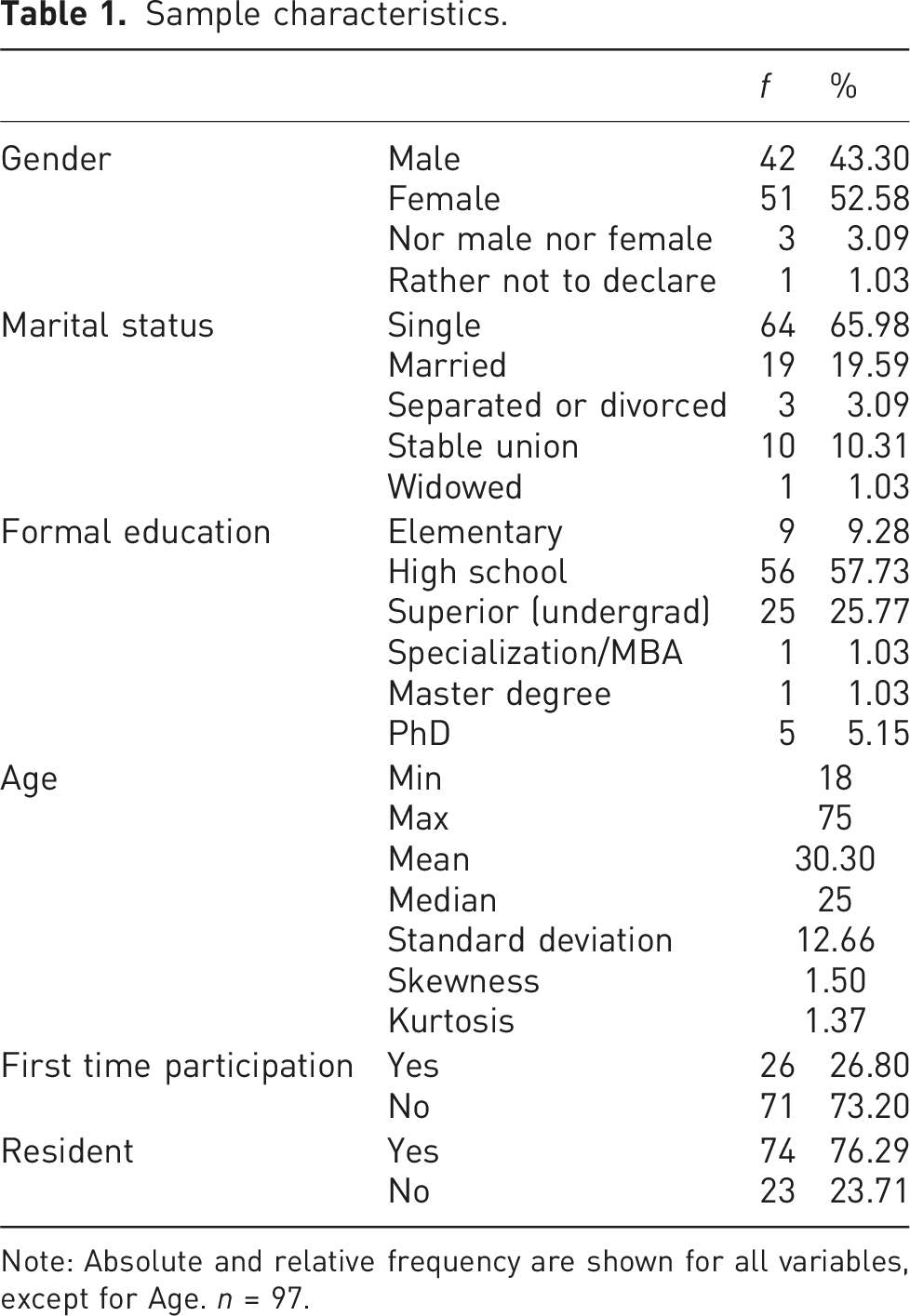
Note: Absolute and relative frequency are shown for all variables, except for Age.
Measurement
Constructs were modelled as reflective and measured using adapted items found in existing studies. A five-point Likert scale (1 = strongly disagree; 5 = strongly agree) was used to measure all items, except items related to Perceived Quality, whose 5-point response anchors were: 1 = Very bad; 2 = Bad; 3 = Average; 4 = Good; 5 = Excellent (Mondo et al., 2020). Constructs definitions are shown in Appendix 1.
Data analysis methods
Univariate non-normality was verified by Kolmogorov-Smirnov and Shapiro-Wilk tests. Therefore, multivariate normality was not assumed (Pituch and Stevens, 2016; Gnanedesikan, 1997). Mahalanobis D2 distance measure did not find multivariate outliers (Hair et al., 2014). The model was tested using structural equation modelling with partial least squares path model (PLS-SEM; hereafter PLS) because data characteristics (non-normality), and the PLS prediction orientation (Latan, 2018; Shmueli et al., 2016). Evaluation of the PLS results followed the guidelines suggested by Sarstedt et al. (2021) and others (Hair et al., 2017, 2019, 2020) as shown in Figure 4.
Results
Measurement model
Measurement model assessment.

Note: Values of reference: α ≥ 0.70; CR ≥ 0.70; AVE ≥0.50 (Sarstedt et al., 2021).
aCronbach α.
bComposite reliability.
cAverage Variance Extracted.
dHTMT values ≤0.85 indicate discriminant validity between constructs (Henseler et al., 2015).
eConfidence intervals of 95%, obtained from bootstrap procedure for 5000 resampling, with corrected bias (BCa) did not include value one for any of the constructs.
Structural model
Values, significance (t statistic and p-value), 95% confidence intervals of path coefficients and effect sizes.

Note: results obtained through the bootstrap procedure of 5000 resampling, with corrected bias (BCa).
aValues of reference: f2 < 0.02 =>
EF = Eudaimonic feelings; LC = Local culture; NOV = Novelty; NOST = Nostalgia; PQ = Perceived quality; SAT = Satisfaction; BI = Behavioural intentions.
Of the five constructs hypothesised as antecedents of SAT, only EF and PQ were significant predictors. Taken together, the antecedent constructs accounted for 56.2% (R2 = 0.562) of the SAT variance. The path coefficient EF → SAT (
In turn, SAT and PQ accounted for 56.6% (R2 = 0.566) of variance of the BI. However, only the path coefficient SAT → BI (
Model’s predictive power assessment
Cross-validation of construct redundancy a .

Note: Results obtained by blindfolding procedure, with an omission distance of 7.
aValues of reference: 0 < Q2 < 0.25 =>
bSum of Squared Observations.
cSum of Squared Errors.
Model’s out-of-sample predictive power a .

Note: Results obtained from PLS predict procedure, with 10 repetitions and 10 sub-samples.
aValues of reference: (1) Q2 prediction value for each indicator ≤0 =>
bRoot Mean Squared Error.
cMean Absolute Error.
dLinear Model.
The importance-performance map analysis (IPMA) extends the standard results reporting of path coefficient estimates by adding a dimension that considers the average values of the latent variable scores (Ringle and Sarstedt, 2016). IPMA contrasts the total effects, representing the predecessor constructs’ importance in shaping a certain target construct, with their average latent variable scores indicating their performance (Ringle and Sarstedt, 2016). The rational is to identify predecessor constructs that have a relatively high importance for predicting the target construct (those with strong total effect), but also have a relatively low performance (low average latent variable scores) so that improvements can be implemented (Hair et al., 2018). Figure 5 shows the importance-performance map having SAT as the target construct. Importance-performance map. Note: C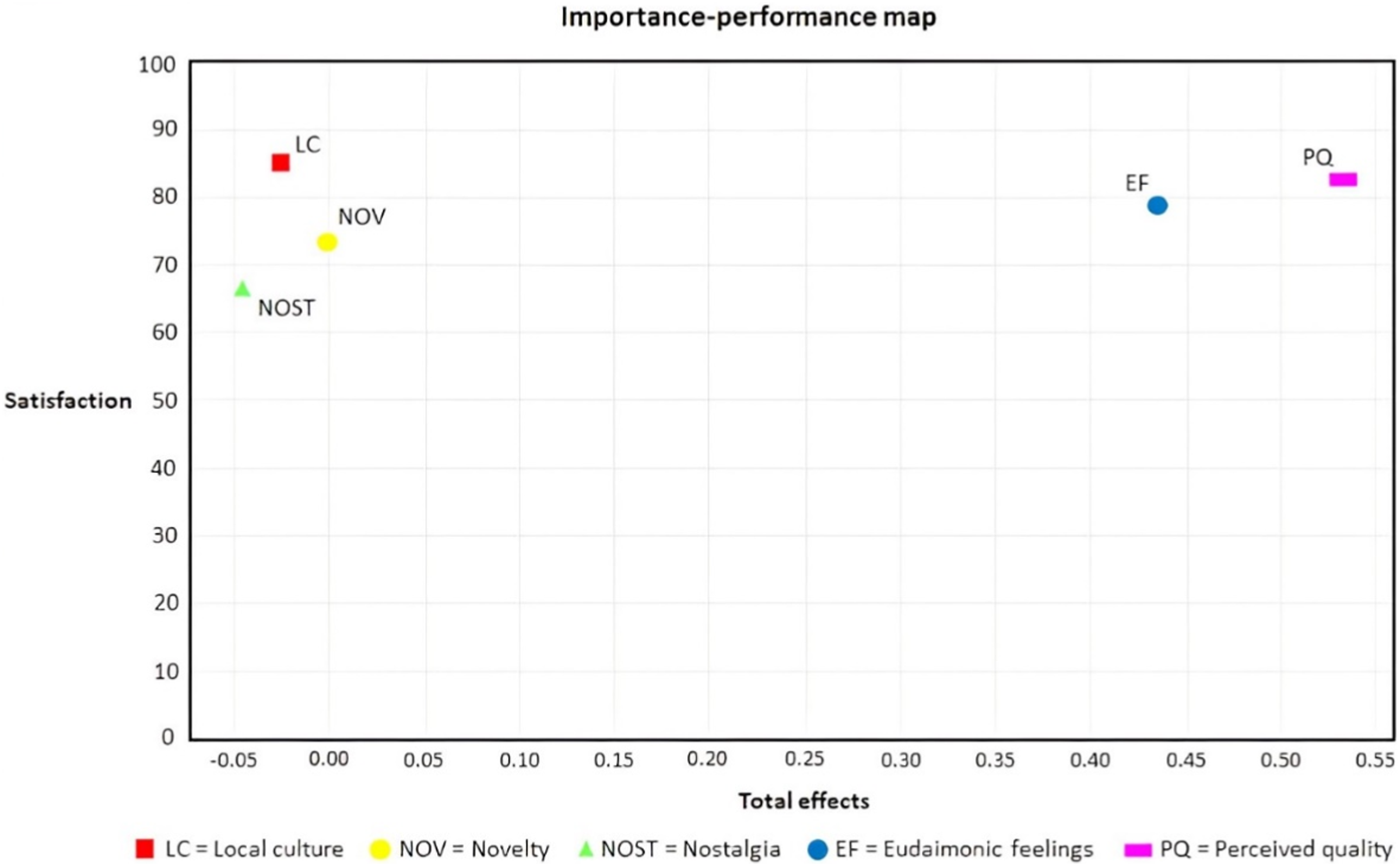
Although all constructs presented relatively high performance, only EF and PQ showed high importance in predicting SAT. Constructs’ average scores ranged as follows: NOST (
Discussion and conclusions
This study conducted on the PFC experience highlights distinctive characteristics of participants that help to understand the results obtained. Firstly, most of the participants are residents and attendees at the event in previous editions. This may explain why NOV, NOST, and LC were not found to be significant predictors of SAT. The PFC has been taking place for 11 years, being the second biggest event in the city of Penedo. In this sense, the event seems to be integrated into the daily lives of residents and is not perceived as novel for most participants in the study.
Regarding NOST, Penedo is a historic city that preserves many buildings from colonial and imperial Brazil. The event takes place in the heart of the historic centre. However, taking results into account, the feeling of NOST is not associated with evaluations on SAT towards the event. As most participants in the study were residents, i.e., people who were born, grew up and live daily in or nearby Penedo’s settings and landscapes, it is suggested that the feeling of “living in a past time” does not match their current reality. This same interpretation applies to NOV. Previous research supports the claim that both
Results suggest that LC does not impact SAT with the festival experience, which may be because, for most participants, they are part of the local way of life, preventing them from being particularly attentive to distinct aspects of LC which may be memorable only to non-local participants.
As expected, PQ is a predictor of SAT, corroborating existing studies (Chi et al., 2020; Hallak et al., 2018). In addition, results indicate that PQ does not directly lead to BI. This finding supports the existing literature that establishes SAT as a mediator between PQ and BI (Muskat et al., 2019; Žabkar et al., 2010), including in events context (Pivac et al., 2019). Therefore, PQ accounted for the judgement’s formation on SAT, which, in turn, did lead to BI.
The study’s main contribution concerns theoretical and practical implications from empirical evidence obtained for EF as a predictor of SAT. Primarily, the study presents complementary empirical support to construct validity for EF based on its predictive power. This helps to lessen conceptual noise and fragmentation in the field, in addition to offering accurateness for the measurement of
Moreover, this research showed that
Concerning EF, the results of this study also indicate that film festivals such as the PFC exceed
This study sheds light on the relation between eudaimonia and satisfaction, presenting theoretical and empirical support for considering eudaimonia as an antecedent of SAT. As practical implications, some insights follow from this study that illuminate the complexity of the film event experience and the need to pay attention more deeply to event participants’ needs and aspirations. More specifically, co-creative strategies in event design and management are increasingly capturing the attention of managers and destinations (Haanpaa et al., 2016; Crowther and Orefice, 2014). Consequently, recommendations lead to decisions on how to increase attendees’ participation and engagement. Festival planners and managers should emphasize activities that engage participants in co-creation processes, such as acting, directing, or screen playing, and in promoting group discussions about a specific movie with an appealing and social relevant theme. Additionally, the co-creative approach is also suitable to expedite participants’ involvement in the design stage of the film festival event, as their creative contributions may lead to format and activities proposition more adequate to induce EF and consequently SAT with the event. Storytelling-based activities with a co-creation orientation may include brainstorming or sketching with a purposive sample of participants (Antchack and Ramsbottom, 2020).
Lastly, to promote an image associated to positive human and community development to potential new attendees, institutional communications should explore the social bonding, self-expressiveness, and self-identity aspects of the PFC experience, showing the event as an opportunity for self-development and social-cultural interactions, in addition to the already familiar attractions. This is especially useful to induce interest in new goers and potential tourists to the city during the festival, increasing participation of non-locals in the event.
Limitations and future research
This study was limited by the fact that only a questionnaire was used for data collection. The generalizability of the results is limited because of the small sample size and the use of a convenience sample. In addition, the participants in the study were mostly residents and repeated attendees, so future studies would benefit from using a more multicultural sample base including first-time goers. These new variables expectedly may lead to different results, namely on the novelty dimension. To reach external validity, as previously suggested by Medeiros et al. (2023), larger and heterogenous samples are needed in future research. Moreover, the study participants were mostly women and on average 30 years old. Based on these considerations, future research directions include comparative studies using different types of demographics, e.g., first-time and repeat participants, domestic and international tourists, group or solo travellers could yield meaningful insights to add to those gained through the present study. Other directions are possible to increase the importance of this study’s model in the context of the research stream on the tourism and event experience, e.g. including EF in nomological nets may provide confirmatory evidence of its predictive power. Examination of antecedents of EF will greatly enhance the understanding of the eudaimonic experience. Two promising research paths follow from this study: one, the eudaimonic orientation (Huta, 2016c) and the other, the psychological traits (e.g., personality) (Anglim et al., 2020), which may contribute to uncover whether, or to which extent,
Footnotes
Declaration of conflicting interests
Funding
ORCID iDs
