







Abstract
Keywords
Introduction
The relative neglect of Tarde in the history of sociological theory including cultural sociology is easy to document. Consider sociological theory texts. For example in Ritzer and Stepnisky (2018) the major classical theorists discussed are Durkheim, Marx and Weber and the secondary ones are Simmel, Veblen, Mead and Du Bois but Tarde is not included. Thirty-three theorists are given biographical boxes but Tarde is not included. Also consider Table 1 of entries of topics in familiar scholarly data bases in which Tarde is very much under represented relative to other major 19th-century sociological theorists.
Entries in some scholarly data bases as of June 6, 2022.
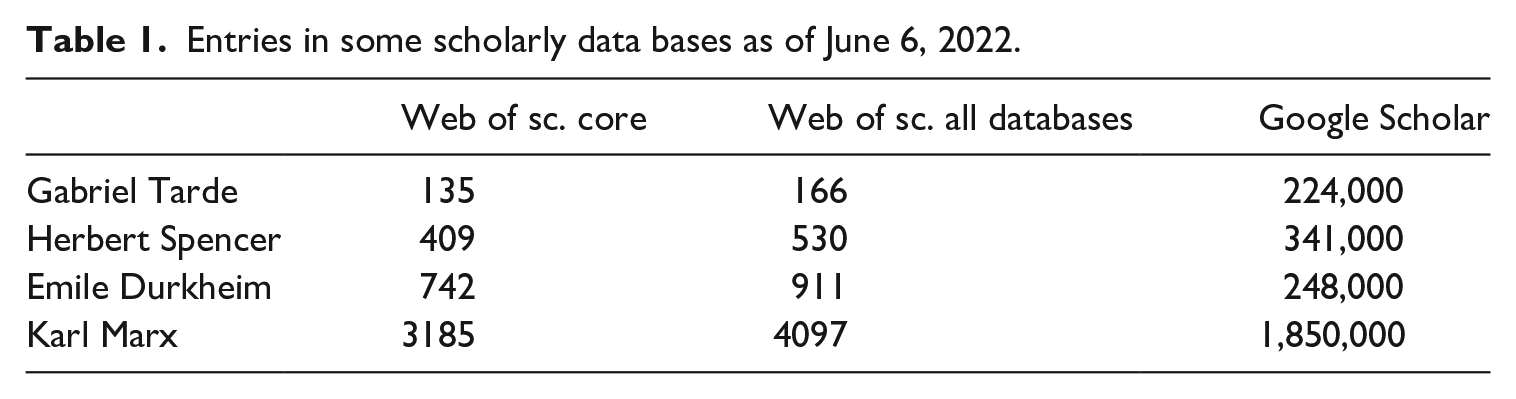
Even the Journal of Classical Sociology contains only four papers on Tarde and while it also contains only six on Spencer, it contains 45 on Marx and 89 on Durkheim.
As for culture in general in sociology, The American Journal of Cultural Sociology in its history has only contained three references to Tarde. Of course Tarde has always been recognized on the diffusion of innovations (e.g. Bail et al., 2019; Clark, 1969; Kinnunen, 1996; Rogers, 2003;) and occasionally there has been an uptick of broader interest (e.g. Abrutyn and Mueller, 2014a; Borch, 2005; Brighenti, 2010; Candea, 2010; Katz, 2006; Purikka, 2013; Sampson, 2012; Toews, 2003, 2013; Tonkonoff, 2013). Latour for example was a Tarde fan (e.g. Latour, 2005) although King (2016) has argued that he misunderstood Tarde. However, most commonly historically Tarde was said to have lost his in-person and in-print debates with Durkheim—too micro, too psychological as opposed to the macro and authentically sociological.
One of the more curious aspects of this story is that in recent times there has been a large literature on “contagion” (e.g. Kucharski, 2020) often including everything from viruses to fake news in which Tarde is largely absent. Apparently, if something viewed as good is spreading it tends to be called “diffusion” and Tarde is recognized; if something viewed as bad is spreading it tends to be called “contagion” and he is not! For an exception see Miller and Hayward (2019) on vehicle ramming attacks. While the neglect of Tarde is easy to document, the question is whether that neglect has been justified. The purpose of this paper is to argue that it has not been—that in neglecting Tarde, sociology neglected its Mendel and hence very much delayed the coming of a truly evolutionary theory applied to culture. 1
The 19th century sociological context: Durkheim and Spencer
Durkheim and Tarde agreed that sociology had a distinctive subject matter but disagreed over what that was. Durkheim (1897) was a mechanist in On Suicide. Society exercises external “constraints” on individuals, that is social forces push and pull people around although he seemed disinterested in the social-psychological process(s) involved. He was an organicist in
Spencer also used both organic and mechanistic analogies but those of the great polymath of the 19th century were both more knowledgeable about, and related to, the biological and physical sciences of his time, and more coherently integrated than were Durkheim’s (Corning, 1982; Turner, 1985). Spencer’s Quaker background and unconventional home schooling left him with a commitment to the ethical primacy of the individual and the belief that freely associating and trading individuals would create the best, that is the most cooperative kind of society possible (Spencer, 1843, 1884) which he transformed into a scientific theory (Crook, 1994). He was also influenced by the German embryologist Van Baer who described ontogeny (embryological development) as a change from homogeneity to heterogeneity (Spencer, 1852, 1904: I and II). From that, Spencer (1862, 1873, 1904) leaped to the conclusion that “therefore there is nothing unreasonable in the belief that” (1904, I) the same takes place in phylogeny, linked by Lamarck’s theory of the inheritance of acquired adaptations (Freeman et al., 1974) resulting in, of course, cooperative heterogeneity. Mechanistically he concluded that such transformations can be deduced from physical principles of the instability of the homogeneous and the unceasing multiplication of effects (1904: I and II).
Darwin presented Spencer with a dilemma. On the one hand, he regretted having missed formulating the principle of natural selection himself when considering the population problem. On the other hand he disliked it because he thought it glorified violence so while accepting it to a degree (Lenoir, 1982), he continued to emphasize his own theory of the acquisition and inheritance of cooperative adaptations, especially for modern humans (Ghiselin, 1974), although he also thought that some “re-barbarization” was taking place. To view Spencer as a biological reductionist is to go too far. The truth is that distinctions between nature and culture were blurred in his and other 19th-century minds until the invention and wider spread of the anthropological concept of culture (see section after the one on Tarde below).
Both organicism and mechanism remain with us to the present. Spencer rediscovered embryology. Parsons (1966) rediscovered Spencer. The neo-functionalists with their differentiation theory (Alexander, 1985; Alexander and Colony, 1990) rediscovered Parsons. As for mechanism, social forces à la Durkheim constitute the bulk of the positivist sociology such as Ritzer’s (1992) “social facts” tradition which fills the pages of our research journals today. With this background let us turn to Tarde.
Tarde on imitation
More so than most 19th-century sociological theorists, Tarde’s life and work were rooted. 2 His life was rooted in the town of Sarlat in southern France where he was born into an old established family, raised by his widowed mother, and went on to build a stable family life (married with three children) and a stable career (25 years on the bench as a judge and magistrate). He did not leave Sarlat until after his mother’s death when he went on to become head of the bureau of statistics in the French Department of Justice in Paris and subsequently occupied the chair of Moral Philosophy at the College de France. He was elected to the French Academy in 1900. Today the citizens of Sarlat remember him with a marble monument erected to honor one of its and France’s most distinguished 19th-century citizens. Tarde’s work was similarly rooted in his experience with, and interest in, a particular subject matter. Twenty five years on the bench convinced him that criminals learn to be criminals from other criminals, that being a criminal is ultimately a profession (on Tarde’s place in the criminological theory of his time see Beirne, 1987). Henri Bergson, who was the other candidate for the chair at the College de France at the same time Tarde was chosen, recognized the combination of creativity and single-mindedness with which Tarde pursued his central insight in the funeral oration for Tarde which Bergson delivered.
In Tarde’s view, psychology studies the intra-mental but sociology studies the inter-mental, specifically imitation. Monads including people learn from others. Unlike Durkheim and Spencer then, Tarde’s thought begins more like that of Darwin. Darwin’s theory begins with the existence of biological reproduction and heredity—organisms have offspring which tend to resemble their parents although there is also variation. In addition, inherited variations sometimes have consequences for the ability to survive and obtain mates—the consequences of the former being natural, and of the latter, sexual selection. Analogously, Tarde begins with the simple fact of cultural reproduction and heredity—imitation. People learn socially from other people.
Around the central concept of imitation, Tarde wove a social theory of great generality and complexity, a theory of which the other central concepts were inventions, oppositions and combinations. He defined an imitation cognitively rather than behaviorally as a “quasi-photographic reproduction of a cerebral image.” Multiple factors affect the level of inventions, but once an invention arises, it can spread by imitation in rays. Ultimately however imitations of an invention must come into conflict with or be opposed by imitations of other inventions, either within or between individuals. If of unequal strength one may be destroyed, if of equal strength they may combine, but such combinations (which Tarde called “adapts”) themselves can be imitated with the process then continuing, among aggregates of increasing scope. No such brief conceptual summary can do justice to the richness with which Tarde explored these simple, clear concepts—the variety of factors which can affect the level of inventions, the variety of factors which can affect whether an invention is imitated and the variety of areas of human sociocultural life he ultimately drew on for empirical examples. Tarde’s writings are unrivaled among 19th-century social theorists in their simplicity of thought and clarity of exposition combined with an unusual richness of applications. This is at least part of the reason why they have not generated as much of an industry as have others explaining what he “really” meant. Some, but not all are available translated into English (e.g. Tarde, 1893, 1899, 1903, 1912).
Obviously, unlike Durkheim but like Spencer, history was not bunk to Tarde. History, current conflicts, and current symbioses (in the form of “adapts”) are all part of his story but the key to it all is imitation or social learning. Unfortunately, Tarde rejected the analogical similarity of his theory to Darwin’s. Although he was well aware that many inventions do not spread successfully, he thought people choose rationally what ones to adopt that is his theory was somewhat more Lamarckian than Darwinian. He also thought that Darwinism emphasized conflict too much. In addition, like Durkheim, Spencer and others in the 19th century, and despite his occasional disclaimers to the contrary, Tarde was ultimately romantically attracted to the great achievements of 17th-century science and felt a need to ground his theory in some semblance of mechanics. Consequently, he classified imitation as a special case of the general phenomenon of repetition which he viewed as also including vibrations, planetary motions and life and death cycles.
Anthropology, culture, and social learning
Sociologists were not the only 19th-century theorists striving to create a new science of the human distinct not only from biology but also from the micro or individual-centeredness of psychology. Anthropologists were engaged in a similar enterprise—the major difference being that they concentrated their efforts on the largely foraging, agricultural, and pastoral societies still to be found in places like Africa and the Pacific rather than on the emerging industrial nations of western Europe. According to Edward B. Tylor, considered along with Louis Henry Morgan to be the founder of anthropology, a new science of the human was necessary because people are subject to a non-biological form of inheritance—they inherit in ways other than “through the blood.” The sum total of everything acquired by people as members of society he proposed be called “culture” (Tylor, 1851). In essence then, anthropology came up with the same answer as did Tarde to the question of why a new science was necessary. What was its unique subject matter to be? To be sure there were differences between the anthropologists and Tarde, ones mainly attributable to the different kinds of societies studied. In particular, the industrializing societies of western Europe by then exhibited much greater internal diversity than did the largely small, non-literate societies studied by anthropologists. But that difference should not obscure the fact that social learning is culture writ small, and culture is social learning writ large, a fact recognized in definitions of culture from Tylor to the present.
Over the years, many terms have been utilized for social learning. Tarde called it “imitation.” In the sociological study of rapid, small-scale social change e.g. fads and fashions, sects and cults, social movements etc. (Kerckhoff and Back, 1968) it is “collective behavior” or “emotional contagion” (Hatfield et al., 1994). In the sociological study of innovations (e.g. agricultural, medical) it has usually been called “diffusion” (Rogers, 2003). As a component of theories of deviance it has often been called “differential association” (Sutherland and Cressey, 1978) or even social learning (Akers, 1985). Under whatever rubric sociologists have from time-to-time been involved in studying it and its importance has been empirically demonstrated in the explanation of phenomena from the trivial—coughing (Pennebaker, 1980), through the everyday, to the most profound—suicide and homicide for example (Abrutyn and Mueller, 2014b; Phillips, 1979, 1980, 1983). Most of these efforts were inspired, as was Tarde, by an empirical interest in specialized topics. But unlike Tarde, as specialization became more pronounced, the emphasis on social learning, whatever the terminology employed, tended to remain confined to those specialized areas. Consistent with their glorification of Durkheim and neglect of Tarde, general sociological theorists have been virtually uniformly silent on the topic of social learning.
The long neglect of social learning in psychology and social psychology
Psychologists and social psychologists commonly define “social learning” as learning by observation in any sensory modality or by linguistic instruction whether verbal, written, electronic etc. (roughly Simko and Olick’s, 2021 “practice” versus “discourse” respectively but for a more detailed classification see Hoppitt and Laland, 2013). Unfortunately, the phenomenon of social learning suffered a long period of neglect in psychology and social psychology as well as in sociology and that undoubtedly reinforced the neglect of Tarde in sociology. The American psychologist Edward L. Thorndike initiated the study of individual learning in the English-speaking world in part as an attempt to deny the existence of social learning. While studying under the great William James at Harvard, he read anecdotes about animal behavior told by Romanes about animals learning by observation for example a horse learning to open a barn door by watching a farmer and Thorndike’s reaction was that he did not believe it. He set out to discover experimentally how animals do learn with his puzzle box which eventually evolved into the automated Skinner box and the rest is history. He formulated his famous “law of effect,” behaviors followed by reinforcement become more probable. According to his biographer, it is no accident that Thorndike appropriated the title of his famous thesis
Thorndike initiated one of the great experimental traditions in the history of science in which a vast amount of reproducible knowledge was acquired about the learning process which itself came to be widely recognized as basically analogous to evolution by natural selection, both forms of “trial and error” (for one of many discussions see Plotkin, 1994). Nothing can diminish the importance of what has been achieved in the study of individual learning—whether by habituation, sensitization, classical conditioning, or conditioned suppression (learning by association the study of which was initiated independently of the American tradition by Pavlov in Russia) or by Thorndike and Skinner’s instrumental or operant conditioning. A downside however of the preoccupation of psychology with individual learning processes right through to the 1960s (in addition to the well known neglect of actual biological evolutionary influences on the one hand and cognition on the other), was the neglect of social learning. During that long period the only major work on social learning was done by Miller and Dollard (1941) who interpreted it as reducible to instrumental conditioning. The only difference in their view was that in social learning, the signal to perform a particular behavior was somebody else performing the same behavior rather than some extraneous cue. The term “match-dependent” was therefore most commonly used to describe it—reinforcement being dependent on matching another’s response. Not until Bandura and Walters’s (1963) work stimulated in part by the question of the effects of television violence on children was it shown unequivocally that social learning by observation or instruction cannot always be reduced to forms of individual learning. Eventually a study showed Bandura to be the next most cited psychologist of the 20th century after Skinner, Freud, and Piaget (Haggbloom et al., 2002).
Of course all along,
Sociologists have sometimes invented their own psychology and social psychology rather than turning to the research and theories of those disciplines themselves to find the material with which their knowledge of the importance of the social must be integrated. However, due to the long neglect of the concept of social learning in psychology and social psychology, to the extent that symbolic interactionists, ethnomethodoligists, social constructionists and others in sociology had looked to these disciplines (which they did at times, e.g. Skinner had his followers among sociologists—Homans, 1961 among others), they were unlikely to find what they needed in the long period from Thorndike to Bandura.
The quantity and diversity of social learning and language
The recently deceased Edward O. Wilson (1975) once published a much debated book written for social scientists that we sociologists in particular largely continue to unjustifiably ignore. We have historically viewed “society” and “social forces” as our unique subject matter. However, the members of an untold number of other species live in societies. They live in a social rather than a solitary manner, in groups which differ in size and membership such as by relatedness, gender and age for example. They socially interact with other members of their society; individuals’ behaviors having consequences for society and the structure of society having consequences for individuals. Behavioral ecologists and sociobiologists have long and still study, formulate and test explanations for sociality and different forms of it. These explanations include a variety of types of cooperation and conflict as well as commonly, multiple levels of selection (Wilson and Wilson, 2007, 2008).
Of course Wilson was aiming for exclusively evolutionary biological explanations of human social behavior which the majority of social scientists rightly rejected. Instead today rather than “society” and “social forces” it is commonly accepted that what is behaviorally unique about human beings are two things. First is the
The second is the means through which we often interact and communicate—
As well as our upright posture, long-dependent offspring, large cerebral cortex etc. these are what any and all sciences of the uniquely human must begin. Whether intelligence and self consciousness should be added to this list are about as controversial among evolutionary as among other kinds of psychologists and social scientists and will not be discussed here.
Social learning or cultural transmission rather than symbolic interaction
In summary thus far, if the argument is that Tarde rather than Durkheim got it basically right, that the anthropologists rather than the sociologists got it basically right, and that social learning theorists in psychology rather than individual learning theorists or traditional social psychologists got it basically right (in the sense of the kind of learning or influence that is most important in human beings)—then surely one might conclude that all of this constitutes an argument for symbolic interactionism. That is not the case however. The great conceit of symbolic interactionism has been to believe that interaction based on symbolically-encoded information is unique to human beings. It is common for symbolic interactionists to distinguish among a stimulus, a signal, a sign, and a symbol. There is some variation from author to author in definitions of these (e.g. Hewitt, 2006). However there is virtually unanimous agreement on symbols—their meaning is shared but there is no intrinsic connection between the symbol and what it signifies (as in a green light meaning go e.g.)—the connection is arbitrary. However, the belief that only humans interact on the basis of symbols so defined is very much mistaken.
Of course the meaning of “no necessary connection” in the biological and linguistic case is substantively different. Biologists say there is no necessary physio-chemical necessity for the association of a particular genetic codon in DNA and a particular amino acid in a protein. Social scientists say there is no necessary connection—adding no biological or psychological necessity. However, the point is ultimately the same theoretically. The association between symbol and what it symbolizes is a fact of history rather than a necessity. The language in biology since the genetic code was “cracked” subsequent to Watson and Crick’s solution to the problem of the structure of DNA—the language of information, the genetic code, punctuation, transcription, translation, editing and so on is entirely justified and is widely recognized as being so (Crick, 1968). As a consequence, non-human organisms which interact socially solely on the basis of genetically-inherited tendencies are truly and literally interacting symbolically. Not only is the important difference between humans and other animals not society and not interaction then, nor even the informational or symbolically-encoded basis of the interaction. The important difference I reiterate is how most of that information is acquired—whether via biological inheritance that is to say genetically, or via sociocultural inheritance that is to say by social learning by means of linguistic instruction. In both cases the meaning of symbols is roughly shared among members of a population—biological and sociocultural populations respectively and in both cases the reason why they are shared is parallel—descent from a common ancestor—biological and sociocultural descent respectively.
Social learning and sociocultural evolution
In the end, the fact remains that sociologists widely recognized the importance of “socialization” as any reading of the classic symbolic interactionist literature or of any modern introductory text-book will attest. So why the fuss about the neglect of Tarde’s concept of imitation? Why insist (despite the fact that individuals can also influence each other’s behavior by simply interacting on the basis of individual learning processes) that the major mechanism of socialization be explicitly recognized as social learning by observation or instruction?
It matters because clarifying the fuzzy concepts of social influence and socialization as social leaning (writ small) or culture (writ large) that is as a non-biological form of reproduction and heredity
Evolution at its simplest means descent with modification. From a common ancestral species, many different kinds have descended and become altered during history. Essentially, history is a branching (and occasionally a reticulating) tree. Now the existence of descent with modification is a fact, not simply a theory about the cultural world and social world. That is the case whether we are talking about languages (any text in historical linguistics), technology (Basalla, 1988), concepts and theories in science (Blute and Armstrong, 2011; Hull, 1988) or whatever and methods drawn from biological systematics to uncover such historical relationships are currently in wide use in evolutionary social science (for a review see Blute and Jordan, 2018). For example, like biology, progress in historical linguistics in recent decades has been greatest in such at higher taxonomic levels. Languages can be classified into several hundred families revealing the historical relatedness within each. It was known, even to Darwin, that most of the languages of Europe and India are historically related by common descent from a common ancestral language, proto-Indo-European. It has also been found that some language families themselves can be grouped into supra families, and other even higher groups, revealing deeper similarities and older affinities. If by chance one is tempted to do as did the majority of Darwin’s contemporaries, go so far but no further with him—say “yes” to descent with modification in the sociocultural realm but “no” to selection—the history of biology since Darwin suggests strongly that such a response is unlikely to be successful. The basic forces currently recognized by biologists as capable of producing change in populations include mutation (innovation), migration, and drift (sampling error in finite populations) as well as selection.
To identify evolutionism in this sense with organicism, confusing the biology of populations with that of individuals as did Durkheim and Spencer is an intellectual travesty. Among other reasons, such a confusion is a travesty because it obscures from view social relations other than cooperative ones. With some exceptions relationships among parts of an organism are normally cooperative, taking the form of a division of labor in pursuit of a common objective—growth and/or reproduction. But social relationships in evolution can be of any character in this respect—competitive (− −), cooperative (+ +), selfish (+ −), or even altruistic (− +). “Functionalists” may not appreciate and understand real change and conflict but evolutionists most certainly do. In addition, to believe too that any social theory which emphasizes social learning writ small or culture writ large is inconsistent with an appreciation of social stratification as many neo-Marxists and conflict theorists do is also an intellectual travesty. Selection takes place because of the differential distribution of resources (class, status and power as Weber had it) and this differential distribution is a consequence of the “fit” or lack thereof between properties of the entities evolving and their environment that is their particular historical circumstances.
Contemporary sociological theory might look very different if Parsons had read Tarde rather than Durkheim and that had taken him to Darwin rather than Spencer. Such speculation aside, it is conceivable that sociological theory may be at risk of becoming an evolutionary dead end, displaced in its niche by traditions with a different Darwinian ancestry—by a combination of biological, cultural, and gene-culture coevolutionary theory—the latter dealing with the interactions of the biological and the cultural (e.g. Blute, 2006; Durham, 1991; Laland et al., 2010). Since genes and culture both vary, are transmitted and evolve, they can exert selection pressures on and hence coevolve in interaction with each another. If cultural transmission is vertical (parents to offspring or among closely related kin) the relationship is mutualistic (+ +) and they are favored to match. If it is oblique, the relationship is competitive (− −) and they are favored to unmatch. If it is horizontal, the relationship is antagonistic (+ −) or (− +) and one is favored to match while the other is favored to unmatch in two alternative ways (e.g. see Blute, 2006). Unfortunately however, Darwinism in its three main forms, the biological, the cultural and the coevolutionary, remain the big, bad wolf in most of Sociology.
The rest of the cultural evolution story to now
With respect to cultural evolution in this modern descent with modification rather than the vague change or old progress sense, in the last half of the 20th century, a number of theorists across a broad front in the humanities and social sciences finally took a turn in the former direction. There were scattered early articles (e.g. Blute, 1979; Campbell, 1960; Gerard et al., 1956), and even the odd book (e.g. Steadman, 1979; Toulmin, 1972) but beginning roughly in the early 1980s and forward books began to come along (e.g. Basalla, 1988; Boyd and Richerson, 1985; Cavalli-Sforza and Feldman, 1981; Hull, 1988; Plotkin, 1982 and soon there were at least eight books on memetics emphasizing the analogy with genetics (Aunger, 2000, 2002; Blackmore, 1999; Brodie, 1996; Distin, 2005; Love and Wimsatt, 2019; Lynch, 1996; Tyler, 2011) as well as the Journal of Memetics published from 1997 to 2005.
Boyd and Richerson, sometimes with others, were particularly active (e.g. Boyd, 2019; Boyd and Richerson, 2005; Richerson and Boyd, 2008; Richerson and Christiansen, 2013). However, cultural evolution continued to flourish in linguistics (Croft, 2000); in the study of technology (Essinger, 2004; Lewens, 2004; Murmann, 2003; Petroski, 1994); in that of philosophy (Arthur, 2009; Campbell, 1988; Hahlweg and Hooker, 1989; Plotkin, 1994; Rescher, 1990a, 1990b; Wuketits, 1990); in institutional economics (Beinhocker, 2006; Boulding, 1981; Hodgson and Knudsen, 2010; Nelson and Winter, 1982; Rothschild, 1990; Schlaile, 2019; and generically (Creanza et al., 2017; Distin, 2011; Fog, 1999; Henrich, 2015; Klüver, 2002; Mesoudi, 2011; Mesoudi and Thornton, 2018; Runciman, 2009; Shennan, 2002; Tang, 2020; Tomasello, 1999; Wheeler et al., 2002; Wright, 2001). Sociology was under-represented in this movement being mostly represented in particular interdisciplinary fields, notable in the study of organizations (Aldrich, 1999; Baum and Singh, 1994; Hannan and Carroll, 1992; Hannan and Freeman, 1989; McKelvey, 1982; Singh, 1990) and in criminology (Cohen and Machalek, 1988, 1994; Vila, 1994; Vila and Cohen, 1993).
The work of a sociologist, Jonathan Turner, does comes to mind. He began his journey toward evolutionism with Spencer (Turner, 1985). Recently he and co-authors (Schutt and Turner, 2019; Turner et al., 2020) have recognized correctly that multi-level or group selection could restore Spencer’s Van Baer-derived view of development and functional integration within individual units at higher levels of selection. However, strangely they recognizes only a lower level of selection biologically (genes, phenotypic traits) and only a higher level of selection socioculturally (starting with groups, not individual behaviors, norms and values, or social roles for example. in both of the above cited papers). Moreover, they view sociocultural evolution as not Darwinian anyway—rather as teleological. Unfortunately, the evidence contradicts this. Strive as we do, it shows that sociocultural like biological innovations are not prescient that is not statistically biased in the direction required for them to survive and spread further. “That is the case most obviously for stock picking and market timing, but the evidence has long been available in less obvious cases—papers being cited, patents being utilized, new businesses being founded, and new products being successfully marketed, for example” (Blute, 1979, 2017 with data references). We do agree however on the need for more evolutionary theory and research in Sociology.
The pace of book publishing seems to have slowed but articles have continued aplenty. For example, the
That is the story
Moving on from such folksy examples, more research has generally been done on the “descent” that is the historical side of cultural evolution using taxonomic methods than on the “modification” that is the selection side. Yet many principles have emerged in the evolutionary biological study of ecology and socioecology that are potentially applicable to cultural and social evolution in the social sciences—density dependence relative to resources and antagonists, frequency dependence—both positive and negative, scale dependence, and evolution under uncertainty for example. Much use has been made of positive frequency dependence in cultural evolution (sometimes it being selectively advantageous to do what the majority are doing e.g. initially Boyd and Richerson, 1985) but little or none of negative frequency dependence (sometimes it being selectively advantageous to do the opposite of what the majority are doing). Nor should learning to apply and use such principles be a great problem for social scientists. After all, the optimization and game theory models used by biologists were borrowed from the social sciences in the first place (only they lacked the selectionist perspective that makes them work!)
What of sociology in particular? The study of culture per se is flourishing in the large Sociology of Culture section of the American Sociological Association and in the American Journal of Cultural Sociology (the former tending to emphasize culture as a dependent variable and the latter as an independent variable). Unfortunately however, cultural
Footnotes
Declaration of conflicting interests
Funding
ORCID iD
