







Abstract
Introduction
The 30 most unequal countries in the world, as measured by the 2024 World Bank Gini coefficient, are situated in the Global South, and 29 of these are former colonies or protectorates in sub-Saharan Africa and Latin America (Appendix A). These 29 countries exhibit intra-national cultural differences between the working class and elites and social distance accompanies economic inequality (Blofield, 2011). The language of education and business in each case is the language of the former coloniser. We focus on South Africa, as the most unequal of these (World Bank, 2024), to examine how culture and power inform labour-leadership relations in this scenario, and to consider the implications for theory and practice in cross-cultural management.
South Africa has a skewed distribution of social and cultural capital which maps broadly to apartheid era race classifications (Branson et al., 2024). The society exhibits high cultural diversity, and a historical power imbalance results in tensions between cultures (Falkof, 2023). There is a workplace disconnect between labour and leadership, evidenced by South Africa consistently appearing at or near the bottom of global labour-employer cooperation rankings from 2009 to 2019 (Appendix B). Cillié (2022) attributes this ranking to low levels of trust between employers and employees. The low trust and associated disconnect have roots in colonial and apartheid history, manifesting along the lines of cultural differences, socioeconomic disparities, and power inequity between elites and labour classes at a societal level (Chatterjee et al., 2022; Jackson, 2015: 79, 80–81; Zulu and Parumasur, 2009). The problem we address is the absence of an integrative account of how historically embedded power relations shape cultural legitimacy, trust, and cooperation between labour and leadership in South African organisations.
South African cross-cultural research has not provided effective conceptual tools for analysing this disconnect. The South African comparative cross-cultural literature spans topics including leadership and management culture (Booysen, 2001; Booysen and van Wyk, 2012; Thomas and Bendixen, 2000), personality assessment (Van Dyk and De Kock, 2004; Vogt and Laher, 2009), and identity and self-construal (Adams et al., 2012; Eaton and Louw, 2000). We find a paradox inherent in the literature: Many authors have questioned assumptions of ethnic group homogeneity or the utility of race in cross-cultural comparisons, aligning broadly or specifically with the position that race is a socially constructed boundary (e.g., Adams et al., 2012: 387; Booysen and van Wyk, 2012 ch. 13: 6; Heuchert et al., 2000: 122–123; Oelofse, 2006: 228; Vogt and Laher, 2009: 42). However, in all the comparative studies we have examined, race (or language as a proxy for race) is the grouping variable used to define and compare population subcultures. Put plainly, race has functioned as a proxy for culture, and trait-based cultural models that overlook historical power relations and socio-economic positioning have governed frameworks of analysis (Adams et al., 2012; Beukman, 2005; Booysen, 2001; Booysen and van Wyk, 2012; Branco e Silva, 2012; Eaton and Louw, 2000; Fetvadjiev et al., 2018; GLOBE, 2004; Heuchert et al., 2000; Hofstede, 1980; Janse van Rensburg, 2017; Oelofse, 2006; Thomas and Bendixen, 2000; Valchev et al., 2013; Van Dyk and De Kock, 2004; Vogt and Laher, 2009). Recent South African inequality studies show that class is a more powerful determinant of socio-economic outcomes than race (Rehbein, 2018; Seekings and Nattrass, 2008; Webster et al., 2020). This does not negate the salience of race in the South African context but rather highlights how class increasingly mediates the reproduction of inequality. Despite these academic perspectives remaining mostly unconnected, class is inextricably connected to culture, and power shapes how culture manifests in workplaces and society (Bourdieu, 2002; Jackson, 2025; Rehbein, 2018).
We propose a link between culture and power underlying this described situation, showing how colonial Global South histories result in hegemonic power asymmetries that normalise dominant cultural schemas (Gramsci, 1971; Nkomo, 2011; Said, 1979; Spivak, 1988) and extend into the workplace (Human, 1996: 5; Jackson, 2016: 633). We position this relationship using a conceptual framework that maps the institutional reproduction of post-colonial inequality via access to cultural capital.
This article makes a contribution to critical cross-cultural management scholarship by shifting the analysis of cross-cultural differences from national, ethnic or trait-based cultural models towards an examination of how organisational culture is produced through historically embedded power relations, socio-economic stratification and cultural legitimacy. In doing so, we respond to calls within cross-cultural management for approaches that foreground post-colonial context, subaltern cultural logics and the everyday reproduction of inequality in organisations.
There is a trust deficit in labour classes pertaining to institutional power in post-colonial societies (Nunn and Wantchekon, 2011) that have experienced colonial extractive institutions (Acemoglu et al., 2001; Acemoglu and Robinson, 2013), race and class-based oppression (Decker, 2010; Levy et al., 2021), unfairly weighted economic dualism (Ali et al., 2023; Barker, 2020), and historical indigenous opposition to colonial rule. Labour collectivisation in southern African post-colonial economies has frequently resulted in adversarial approaches - a logical outcome of resistance movement attitudes and experiences which have developed over time in colonised indigenous majority populations (Makama and Kubjana, 2021; Mbiada, 2022). We position the concepts of culture and power as fundamental to the way businesses and society function in this context, while highlighting relevance for, and parallels with, other Global South environments.
Culture is central to the relationship between leadership and labour (Arshad, 2016; Schein, 2015) and spiritual beliefs feature as a fundamental element of indigenous culture in South Africa (Mndende, 1998), as they do elsewhere in the Global South (Bonfil Batalla, 1996; Gumucio, 2002; Tomaselli and Xanthaki, 2021). This aspect of culture and its effects have been largely overlooked in the business literature to date. A significant portion of South Africa’s blue-collar labour force originates from township and rural communities (e.g., Ceruti, 2013). Many of these adhere - to varying degrees - to African Traditional Religion (ATR) beliefs, which shape their worldviews and their cultural frames of reference (Bae, 2007; Masondo, 2011; Mokhoathi, 2020). These indigenous worldviews are frequently different to those of management and leadership in organisations where Western normative and behavioural cultural orientations are prevalent (Booysen and van Wyk, 2012 Ch. 13: 3; Nkomo, 2011; Theimann and April, 2007).
A long-standing hegemonic power imbalance informs the relationships between the elite classes and majority indigenous populations (Heleta and Chasi, 2023). This results in a culture-power differential spanning Western and indigenous cultural orientations which has underpinned historical and current oppression. This power asymmetry presents sustainability challenges, which we see as the interdependent ability of businesses and society to ensure their continued growth and longevity. Key to this sustainability is the way culture and power have evolved in the societies that nest these businesses. In South Africa and other Global South contexts, the way this power affected society then has informed the way in which it affects society now. We demonstrate in this review and the accompanying conceptual framework that this culture-power dynamic has a logical bearing on organisations in South Africa and elsewhere in the Global South.
We investigate the complex relationship between culture and power in South African workplaces, adopting an exploratory pragmatist approach that informs both our literature review methodology and our underlying ontological and epistemological stance on the labour-leadership disconnect. This research problematises the use of Western approaches to the study of culture in postcolonial Global South contexts, exposing their limitations and underlying assumptions. The research seeks to contribute to the understanding of the nuanced and necessarily context-specific dynamics between culture and power, while highlighting the overdetermining influence of socio-economic factors on intercultural power relations. We subsequently link the culture-power class differential to the labour-leadership disconnect.
Our review highlights how the ‘window’ of culturally acceptable worldviews varies sharply across class lines. Western corporate leadership cultural schemas and indigenous or hybrid labour belief systems present as cultural windows (i.e. schemas) that rarely overlap. They do not merely reflect a cultural ‘preference’, but present as distinct ontological realities through which work, authority, and obligation are understood. For individuals, these schemas represent ‘the way the world works’ (Oyserman, 2017; Triandis, 2007).
Our primary contribution lies in the development of the
Methodology
This review employs a critical transdisciplinary review methodology, informed by meta-narrative traditions (Greenhalgh, 2004), to interrogate and synthesise conceptual developments across multiple disciplines. It explores the evolution of relevant dominant knowledge frameworks as they relate to culture and power through a dynamic knowledge-building process (Boell and Cecez-Kecmanovic, 2015: 168). This interpretive synthesis, while not a systematic or scoping review, draws on critical review traditions to engage with key positions and debates across a range of fields: primarily business literature, cross-cultural psychology, sociology, cultural studies, postcolonial theory, anthropology, religious studies, inequality studies, and critical management theory.
Over an 18-month period, 922 articles and book chapters were identified and engaged with at varying levels of depth, depending on conceptual relevance. Searches were conducted using EBSCOhost, JSTOR, APA, ProQuest, SSRN, and Google Scholar. In addition, authoritative data sources (such as World Bank datasets and international policy reports) were consulted to contextualise and augment the conceptual positions adopted. Inclusion criteria prioritised relevance to conceptual frameworks, publication in peer-reviewed journals or academic presses, and engagement with cross-disciplinary perspectives. Thematic patterns and epistemological narratives were identified iteratively through close reading, critical synthesis, and citation mapping in order to achieve an acceptable level of theoretical saturation. The review process was shaped by a reflexive awareness of disciplinary blind spots and epistemic privilege, consistent with the critical orientation guiding our framework’s development.
Proposition
The connection which has evolved between culture and power informs a labour-leadership disconnect in South Africa, implying sustainability concerns for organisations and society.
Review structure
This article is organised as follows: First, we provide a historical and cultural background, highlighting the effects of colonisation on indigenous belief systems and cultural identity. Next, we examine the concept of culture in detail, problematising dominant measurement frameworks and their application in the South African context. We then critically review South African cross-cultural studies, evaluating their limitations. Having set the stage for a reframing of culture as dynamic and power related, we subsequently explore the intersection of culture and power through a meta-narrative synthesis. We then integrate the preceding detail with an assessment of current implications. The Divergent Ecocultural Effects conceptual framework follows, mapping how overlapping identity elements overdetermine individuals’ positions within hierarchies. This framework shows how ecocultural change, frame-switching capacity, spiritual beliefs, and resource-seeking adaptations shape access to organisational power and legitimacy. We conclude by outlining the significance of this model for trust, inclusion, and sustainability in post-colonial contexts, with broader relevance for similarly structured societies across the Global South.
Background
This section provides the contextual foundations of our argument by examining three interlinked dimensions of South African society; structural inequality, the legacy of colonisation, and the cultural worldviews of the indigenous majority.
Inequality
In South Africa 10% of the population controls 85.6% of national wealth (Chatterjee et al., 2022: 26). As evidenced by a 2024 Commission for Employment Equity (CEE) report, control of the means of production after apartheid remains predominantly in the hands of white South Africans (CEE, 2024). Structural inequality persists despite post-apartheid reforms, including Broad-Based Black Economic Empowerment (South African Government, 2004), with limited change in private sector ownership and control (Kgobisa-Ngcaba, 2023). According to the 2024 Report, only 14% of top private sector management is Black African (CEE, 2024: 19), a modest 2% increase over 3 years, despite this group comprising 81% of the economically active population (CEE, 2024: 17) and 84% of the unskilled labour force (CEE, 2024: 47). Conversely, in national, provincial and local government, Black Africans account for 75% of top management (CEE, 2024: 19), indicating divergent progress across sectors. Notably, there has been some upward mobility within middle management and professional categories (CEE, 2024: 34) alongside growth in the black middle class (Lappeman et al., 2021: 19). However, representation in top-tier leadership remains disproportionately low, underscoring the persistence of power imbalances rooted in race, class, and historical exclusion of indigenous cultural logics.
Black African culture and colonisation
South African indigenous cultural practice and belief markers.

These elements contribute to an integrated cultural worldview, orienting individuals within a moral, relational, and ecological system. With the advent and growth of colonisation in the 18th-20th centuries, colonists undermined two pillars of African cultural identity in South Africa - language and religion (Chidester, 1996; Hackett, 2015; Mndende, 1994, 1998). Colonial and missionary regimes actively repressed many indigenous cultural practices, labelling them as primitive, superstitious, or demonic (Petrus, 2009: 76; Wallace, 2015). Christianity, English, and Western epistemologies were introduced to displace indigenous modes of thought through mission schools and state policy (Adamo, 2011; Masondo, 2018), producing a cultural rupture that privileged European norms and redefined access to economic opportunity in the colonial power paradigm.
ATR concepts and beliefs are reportedly intertwined with, and inseparable from, core indigenous cultural identities and epistemologies (Mndende, 1994; Mokhoathi, 2021). The name for these beliefs and practices is ‘
Culture
This section establishes the relevance of culture in organisational contexts by critically examining assumptions about its measurement, in both South African and global contexts. We argue for a repositioning of cultural orientation frameworks to better reflect the realities of the Global South. We also explore how cultural systems interact and why these dynamics matter for business. Finally, we link cultural inequality to broader concerns about the social contract and organisational sustainability.
Culture and its relevance
Culture is the shared way of life comprising the behaviours, norms, values, and worldviews (or beliefs) of different groups of people (Berry et al., 2011: 5–7; Kitayama and Uskul, 2011; Swartz, 1997; Triandis, 1989), and its observable manifestations at societal and subcultural levels and ultimately at the level of the individual (Maznevski et al., 2002). It is an emergent property of human
In management and organisational studies, culture is examined to understand how it shapes behaviours, norms, and worldviews whether expected, predictable, or emerging (Matsumoto et al., 2022: 2; Ralston et al., 2022: 16; Schein, 2010). Cultural patterns influence individual and group interactions within and between businesses both locally and globally (Hofstede, 1980; Trompenaars and Hampden-Turner, 2012). These interactions impact organisational functioning, national business environments, cross-border operations, and ultimately, performance and sustainability (Hofstede, 1994). Although this motivation to study culture overlaps with other disciplines it differs from psychology’s focus on universals (see Norenzayan and Heine, 2005 for ‘universals’). From the business studies perspective, our emphasis should be pragmatic, prioritising context to understand culture-specific dynamics (Douglas and Craig, 2009; Kitayama and Salvador, 2024) and their impact on business interactions within a given system, while avoiding broad assumptions of national or ethnic cultural homogeneity (Nkomo, 2011).
Beyond the manner in which cultures function and interact in contemporary settings, the historical context of how cultures have formed and changed within their environments is essential to understanding their present makeup and functioning (Kitayama and Salvador, 2024: 14). To assess the influence of culture on power relationships in organisations, it is key to develop a nuanced understanding of local cultures and systems.
In today’s diverse societies, the concept of ‘national culture’ often conceals more than it reveals (Ralston et al., 2022). Is it the intersection of multiple subcultures? Does it reflect dominant socio-economic groups, or is it a hybrid of evolving cultural forms? Should indigenous worldviews define it, or those most widely practiced? These questions highlight the inadequacy of ‘national culture’ as a singular construct for understanding the cultural dynamics of polycultural societies (Jackson, 2004: 37; Ronen and Shenkar, 2013; Taras et al., 2016; Tung and Stahl, 2018; Tung and Verbeke, 2010). To meaningfully analyse culture in such contexts, researchers must move beyond national-level constructs and focus on the interplay of subcultural influences shaped by history, power, and lived experience (Leung and Morris, 2015). This requires mapping specific cultural orientations, particularly those tied to socio-economic stratification and historical marginalisation. A more grounded, context-responsive approach is required to capture the complexity of intercultural interactions in diverse and unequal societies.
Alternative approaches including convergence, crossvergence, and acculturation present culture as a fluid, evolving system (Berry, 1997; Berry et al., 2011; Jasini et al., 2024: 2; Ralston, 2008; Schwartz et al., 2010). This fluidity implies ongoing cultural change as a result of intercultural contact (Adams and van de Vijfer, 2017; Hong et al., 2003; Leung et al., 2005; Leung and Morris, 2015; Morris et al., 2015; Ralston et al., 2008; Taras and Steel, 2009; Triandis, 1989, 2007), and is seen to accelerate in the context of globalisation (Cai et al., 2019; Taras and Steel, 2009).
Positioning culture
Linking culture and power requires a workable model of local culture or subcultures. Cultural dimensions frameworks (Chhokar et al., 2007; Hofstede, 1980; Inglehart, 1997; Trompenaars and Hampden-Turner, 2012) provide useful tools for this. They enable researchers to measure norms, behaviours and values across key dimensions including Individualism-Collectivism
The frameworks – developed principally in cross-cultural psychology and business studies in the Global North – have been criticised for inadequately capturing national cultures or their differences. Two key objections are: Firstly, the trait-based approach treats culture as fixed and uniform, which limits its practical usefulness for empirical comparison in contexts where cultural traits are fluid and dynamic (Brewer and Venaik, 2010; Fiske, 2002: 81; Leung and Morris, 2015; Taras and Steel, 2009; Usunier, 1998). This results in increasingly weak validity and poor replicability (Kaasa and Minkov, 2020: 17; Oyserman et al., 2002; Shi, 2011; Taras and Steel, 2009; Triandis and Suh, 2002: 150–151). Secondly, methodological flaws and questionable assumptions often lead to inaccurate or misleading conclusions (Caprar et al., 2015; Fiske, 2002: 81, 84; Ralston et al., 2022; Shenkar et al., 2022; Taras and Steel, 2009; Tung and Verbeke, 2010). Examples of this problem are apparent in the extant South African cross-cultural research.
South African cross-cultural research
To date, South African cross-cultural studies have shown few practically significant cultural differences (Fetvadjiev et al., 2018: 477; Oelofse, 2006; Thomas and Bendixen, 2000; Vogt and Laher, 2009: 49–50) in commonly assessed behaviours, norms, and values between groups (See a summary of 14 of these studies with reported data in Appendix C).
Elsewhere, strong differences are claimed between local subcultures (Booysen, 2001; Theimann et al., 2006). All the cross-cultural studies cited in Appendix C rely on race as the basis for subcultural comparisons – an approach that has increasingly been called into question, as the reliance on outdated race-culture confluence assumptions is regarded as a form of genetic determinism or essentialism (Jansen and Walters, 2020; Kitayama and Salvador, 2024).
These studies show mostly low practical effect sizes (see Appendix C), poor replicability, and a lack of convergent validity, with effect sizes differing between studies and even reversing direction. Another shared feature is their reliance on elite samples - tertiary students, managers, and officer candidates. There are generalisability concerns relating to the existing cross-cultural research, given that 48.7% of South Africans over the age of 20 did not graduate from high school, only 12.2% hold post-school qualifications, and managers make up ∼8% of the workforce (StatsSA, 2022, 2023: 45) (see Figure 1). However, taken together, South Africa cross-cultural studies. Source: Authors/Appendix C.
The South African studies reviewed rely mainly on the previously mentioned cultural assessment frameworks developed in the Global North (Cheung, 2020; Hofstede, 1980; House et al., 2004; Kuhn and McPartland, 1954; McCrae and Costa, 1985), with some local exceptions like the South African Personality Index (SAPI) and the Basic Traits Inventory (BTI). While these tools were designed for local application, they remain anchored in Western paradigms such as the Five Factor Model and are adapted rather than emic. Without controlling for localised cultural variation, imported measures risk misrepresenting indigenous values (Kitayama et al., 2022). Indeed, the omission of core indigenous values and cultural constructs can lead us to underestimate pertinent factors and overestimate some which may be less relevant (Taghipoorreyneh, 2023: 204).
This critique reflects a broader concern: emic approaches are needed when studying African contexts (Iliescu et al., 2024; Innes, 2021; Masilela, 1988; Ngũgĩ wa Thiongʾo, 2005; Tomaselli, 1998). Developing local adaptations of Western etic measures to align with the popular pursuit of universal theories does not
Culture and beliefs
Beliefs predicated on spiritual or religious orientations have not routinely formed part of the current assessments of culture in the literature (Triandis, 2007). However, these beliefs are seen as a necessary data point for assessing cultural similarities and differences (Beyers, 2017; Martin, 2017; Matsumoto et al., 2022: 25; Sagiv et al., 2017: 633; Saroglou and Cohen, 2011; Taras et al., 2010: 435; Triandis, 2007). Though underrepresented in international business and cross-cultural management literature, religion overlaps meaningfully with culture (Gelfand et al., 2011: 7; Jensen, 2021; Matsumoto et al., 2022: 25; Saroglou and Cohen, 2011; Triandis, 2007: 72). Religion and spiritual beliefs serve as markers of cultural identity, shaped by shared, socially transmitted practices and values (Durkheim, 1995; Geertz, 1993). Saroglou and Cohen (2011) claim these belief systems help define distinct population subcultures, making them relevant for understanding group dynamics within diverse societies.
In organisational and management contexts, religion plays a meaningful role in shaping organisational behaviour (Odesola, 2025: 502), and the way individuals interpret authority, control and responsibility – often linked to locus of control frameworks (Rotter, 1954). It can also inform normative and behavioural expectations in the workplace (Barnard and Mamabolo, 2022; Ralston et al., 2022; Richardson and Rammal, 2018; Saroglou and Cohen, 2011: 1311). Furthermore, religious identity can influence how outgroup norms are perceived and enacted in social and organisational interactions (Gümüsay et al., 2020), affecting trust, inclusion and communication across teams. As noted earlier, spiritual beliefs underpin cultural orientations of indigenous majorities in South Africa. The contrast between indigenous cultural beliefs in lower socio-economic groupings and Western orientations in elite classes gives us cause to consider how adjacent cultures interact in societies.
Interacting cultures
Complex societies are characterised by multiple ingroups, with individuals often belonging to several at once (Triandis, 1989: 509). When individuals can shift fluently between cultural frames, this is described as
Polycultural individuals can ‘frame switch’ between cultural identities, allowing them to function as effective ingroup members across varied contexts, including during psychological testing (Oyserman and Lee, 2008). In contrast, monoculturals tend to operate within a fixed cultural frame (Benet-Martínez and Repke, 2020; Lee, 2024). These shifts are guided by chronically accessible cultural schemas (Cohen, 2007: 231; Hong et al., 2003) and can be activated by situational cognitive cues or ‘primes’ (Hong et al., 2000; Leung and Morris, 2015; Triandis and Suh, 2002).
Groups with low societal integration tend to show limited polyculturalism due to reduced exposure to multiple ingroups and minimal internalisation of cultural difference (Benet-Martínez and Haritatos, 2005; Berry, 1997; Ward and Geeraert, 2016). Segregated or marginalised groups are therefore less likely to develop frame-switching capacity. In contrast, higher polyculturalism – consistent with the integration hypothesis (Grigoryev et al., 2023) – supports broader societal engagement and ingroup memberships (Triandis, 1989), increasing the likelihood of frame switching (Benet-Martínez et al., 2002). This enables formerly excluded individuals to function effectively in Western-oriented environments while still maintaining heritage cultural perspectives. This cognitive flexibility has important implications for access to power structures in private sector business environments.
Cultural orientation measures within any geographically or ideologically defined social system must reflect markers that are widely adopted by the population (Gobo, 2004) and socially transmitted or constructed through group membership (Fiske, 2002: 81). Cultural responsiveness – the extent to which measurement instruments reflect the sociocultural realities of the populations being assessed (Hall and Boyce, 2023; Solano-Flores, 2019) – allows for meaningful cross-cultural comparison of differences and similarities (Matsumoto et al., 2022: 37). The list of indigenous cultural markers in Table 1 meets these requirements of wide adoption and cultural responsiveness. While none of the existing South African studies uses these cultural markers, almost all have employed a flavour of individualism/collectivism (IND-COL) to assess cultural differences and similarities between groups.
Collectivism, divergence and convergence
Hofstede’s (1980) work in the 1970’s laid the foundation for the cultural dimensions measurement approach, with IND-COL becoming the most widely used scale in cross-cultural research (Fiske, 2002; Oyserman et al., 2002; Schwartz, 1990; Vogt and Laher, 2009: 46). African cultures are widely characterised as being inherently collectivist (Branco e Silva, 2012: 25; Mamabolo and Barnard, 2019: 4; Mbigi, 1997; Sue and Sue, 1999; Theimann et al., 2006; Triandis, 1989; Van Zyl et al., 2018: 699; Vogt and Laher, 2009: 42). However, this assumption has been challenged by African academics such as Molefe (2017) and Mpofu (1994), amongst others. In South African psychology and management literature some scholars suggest that African collectivism is not merely a cultural preference (see Yamagishi et al., 2008 for an explanation of ‘preference’), but rather a ‘Characteristic Adaptation’ (cf. Jackson, 2004: 30; Laher, 2013: 215–216). That is, collectivism may emerge as a natural response to existential threats, violence, and oppression tied to group identity (Kira et al., 2017: 216–217; Schwartz, 1992: 154). When such threats subside, the collectivist orientation may shift towards individualistic behaviours (Jackson, 2004; Triandis, 1989). Another pertinent issue worth exploring is whether the collectivism portrayed is horizontal (egalitarian) or vertical (hierarchical) in nature (Triandis and Gelfand, 1998).
Western norms have increasingly shaped the values of urban, educated populations (Mpofu, 1994; Valchev, 2012: 35). Studies by Branco e Silva (2012: 88–89), Eaton and Louw (2000), Ma and Schoeneman (1997), and Odo et al. (2022), show that indigenous Africans with limited exposure to rural communities and greater exposure to education, formal employment, and urban life tend to exhibit lower levels of collectivism and higher levels of individualism or ‘westernisation’.
As societies grow more complex and urbanised, class and sociodemographic differences further complicate the cultural landscape. Among upper class and affluent groups, individualism tends to dominate over collectivism (Iacoviello and Lorenzi-Cioldi, 2019: 2; Ogihara, 2018; Triandis et al., 1990). Individuals occupying higher positions within business hierarchies are more likely to adopt individualistic thinking, often shaped by Western capitalist ideologies that increasingly influence global business practices (Kaasa and Minkov, 2020; Leung et al., 2005: 359; Ralston, 2008; Taras and Steel, 2009; Webber, 1969). Sociodemographic shifts lead to changes in learning environments which, in turn, influence cognitive development (Greenfield, 2009: 407). Higher levels of education are associated with more independent self-construal (Carley and Bencharit, 2018: 175). Individualism is also more frequently observed in societies as they become more complex with multiple ingroups (Triandis, 1989: 509, 2006: 209–210). This can be related to how worldviews in labour classes with lower status and educational attainment diverge from those of leaders.
These dynamics of geographically adjacent interacting cultures underscore limitations in the divergence perspective (Webber, 1969). From a divergence standpoint, meaningful quantitative comparisons presuppose independent, stable cultural traits (e.g., Hofstede, 1980) – a problematic assumption given issues such as Galton’s problem, where the “...computation of the significance of a [statistical] correlation requires that the data be independent, and cultural diffusion can make them nonindependent [sic]…” (Triandis, 2007: 61). Alternatively, the convergence perspective suggests that over time societies shift toward a common culture - rooted predominantly in Western capitalist values (Hills and Atkins, 2013; Ralston et al., 2008; Taras and Steel, 2009; Thomas et al., 2003; Webber, 1969). An alternative perspective is ‘crossvergence’.
Crossvergence
Crossvergence recognises that convergence and divergence can occur simultaneously when cultural systems coexist and evolve at different rates within the same society (Ralston, 2008: 28–29). Ralston’s tri-faceted model outlines three patterns:
South Africa offers a clear example of crossvergence emerging through the effects of colonisation, urbanisation, globalisation, and accompanying acculturative change (Horwitz et al., 2002; Jackson, 2002, 2004; Jackson and Haines, 2007; Leung et al., 2005; Thomas and Bendixen, 2000). Where crossvergence meets inequality, it brings into question the state of the social contract.
Social contract
In any society the functioning of the broader social contract plays a key role in shaping culturally embedded workplace expectations (Korczynski, 2023; Schein, 2015). In a South African context Theimann (2007: 98) argues that the social contracts of the workplace and society are misaligned, and Webster et al. position inequality as a threat to the social contract: In many countries in the South, and in South Africa in particular, inequality is not merely a socio-economic problem, but an
This ‘existential threat’ aligns directly with the sustainability issues we propose. The labour-leadership disconnect aligns similarly with class-based power asymmetries within and across cultural groups (Agupusi, 2011: 39). In this vein, Horwitz and Ronnie (2021: 321) call for new empirical research into “normative socio-cultural constructs” in African management and HRM frameworks. In African organisational contexts power asymmetries are essential to understanding cross-cultural intra-organisational relationships (Jackson, 2019: 633).
Power
This section explores how culture and power interact within the context of ecocultural pressures and systemic change. We demonstrate how intersecting identity elements, when aligned or misaligned with dominant power structures, overdetermine individuals’ positions within organisational hierarchies (Figure 2). Post-colonial culture-power organisational alignment. Source: Authors.
Culture and power
Culture has long been examined through the lenses of power, control, and domination. We consider these perspectives especially relevant in culturally diverse post-colonial societies undergoing ecoculturally driven change. South Africa has high ethno-cultural diversity and a history of stratification and conflict along racial, ethnic and cultural lines under colonial rule and during apartheid (Booysen, 2013; Chidester, 1996; Fearon, 2003; Heleta and Chasi, 2023). It follows that any meaningful cultural analysis must take account of power dynamics. The antecedents and effects of colonisation and oppression present a cultural landscape which has numerous power-related implications in Global South environments.
Marxist theory argues that in capitalist systems, dominant classes maintain control by shaping institutions such as capital, religion, media, and education to sustain surplus value (Fuchs, 2019; Paternotte and Verloo, 2021). These ideas have influenced South African resistance movements, from the anti-apartheid struggle to current decolonisation efforts (Mabasa, 2019; Reynolds et al., 2019). Gramsci’s neo-Marxist approach to hegemony shows that domination is maintained not just through coercion but also through the consent of the dominated (Glassman, 2009). He also introduced the concepts of the ‘war of position’ and ‘war of manoeuvre’ to describe the strategic and tactical struggles involved in challenging and gaining power (Gramsci, 1971: 238). In South Africa, the gradual establishment of cultural hegemony during colonisation and apartheid, and its persistence into the 21st century reflects this war of position (Hall, 2018: 37–38). De Wet (2007) proposes that a new bourgeoisie perpetuates cultural disempowerment through historical-structural power (see Figure 3 for the range of types of power discussed). Gramsci’s (1971: 255) notion that dominant classes co-opt subordinate or ‘subaltern’ classes, aligns with Bourdieu’s ‘symbolic domination’ - the imposition of dominant cultural norms and values on subordinate groups (Swartz, 1997: 160). This domination is achieved through positional-relational power. Seven types of power and their bases in literature. Source: Authors.
Bourdieu expands on the idea of symbolic power through his concept of cultural capital, which aligns with Gramsci’s notion of cultural hegemony (Swartz, 1997). He argues that: in a class society, all the products of a given agent, by an essential overdetermination, speak inseparably and simultaneously of his class - or, more precisely, his position in the social structure and his rising or falling trajectory (Bourdieu, 2013: 87).
His related concept of social capital is equally relevant in analysing power differences between labour and leadership, particularly in terms of access to networks and relationships that confer advantage. The interplay between cultural and social capital is key to understanding the mechanisms that enable perpetuation of colonial hegemonies in the Global South.
Foucault (1980) conceptualised power as a dispersed network of micro-strategies, operating through normative definitions and regulatory practices. His concepts of discursive power and governmentality highlight how meaning is produced, maintained, and assigned within social systems. He describes “...a process of functional overdetermination, because each effect - positive or negative, intentional or unintentional - enters into resonance or contradiction with the others” (1980: 195). In turn, Said (1979) critiques Eurocentric knowledge systems showing how dominant cultures construct skewed representations of others. The Eurocentric framing of African cultures - often produced by outsiders within colonial systems - has long shaped the etic paradigms through which African traditions and beliefs are interpreted (Mndende, 1998; Mudimbe, 1988; Ngũgĩ wa Thiongʾo, 2005; Spivak, 1988; St. Hilaire, 2023). Said argues that cultural hegemony entrenches habitual ways of thinking, normalising Eurocentric views (1979, 1994). His critique of the West’s exoticisation of foreign cultures has relevance in the South African context where cultural identity spans a spectrum from traditional African belief systems to Western norms and schemas (Chidester, 1996; Hackett, 2015; Mndende, 1998). Similar continuums exist in Latin American contexts between indigenous beliefs and languages contrasting with colonial cultural dominance (Bonfil Batalla, 1996), even after a 300-year history of colonisation.
Bourdieu, Foucault, and Gramsci draw on the concept of ‘overdetermination’ - the idea that a single effect arises from multiple, interdependent causes that cannot fully explain it in isolation (Althusser, 1969; Winders, 2009). This idea aligns with approaches such as systems thinking and intersectionality, framing culture-power interactions as the result of complex, overlapping drivers. In the South African context, these drivers include ethnicity, gender, class, language, education, income, and religion - all of which influence power dynamics within organisations (Decker, 2010; Rehbein, 2018; Wilmot, 2017). Recognising this complexity helps avoid the reductionist pitfalls of essentialism and determinism (Chao et al., 2013; Jansen and Walters, 2020: 10; Roth et al., 2023). When culture and power are considered together, their combined effects disproportionately impact working-class groups through overlapping cultural, political, economic, and educational mechanisms. In South Africa, cultural hegemony continues to reinforce inequality, sustained by structures that shape how individuals and groups view the world as they pursue socio-economic mobility through ecocultural pathways. We frame socio-economic mobility here as a culturally mediated, power-dependent process.
The interaction of these perspectives situates indigenous culture within an asymmetrical power relationship. Crossvergence has crystallised a Western-aligned management and leadership system in South African organisations, where leadership holds instrumental power (the direct power to affect outcomes) (Jackson, 2004, 2015; Ralston, 2008). Conversely, labour retains only limited forms of collective or institutional power to the extent these still protect their rights in increasingly precarious employment scenarios (Hammer and Ness, 2021).
Offshoring, informed by Transaction Cost Economics, often relocates labour functions to Global South regions where efficiency is prioritised over fair labour conditions, reinforcing existing power imbalances (Perrow, 1993). For many workers, this results in increased precarity, weakening union influence (Hammer and Ness, 2021; Mosoetsa and Williams, 2012: 5–6). This precarity, alongside power considerations, narrows the employment relationship to a transactional exchange - labour for wages, with reduced expectations of mutual obligation or long-term commitment (Rousseau, 2004).
These layered power dynamics and the entrenchment of cultural hegemony directly shape the formation and evolution of employment relations in Global South workplaces. In particular, labour classes navigating conditions of cultural domination and economic marginalisation are often required to adapt - linguistically, behaviourally, and normatively - to dominant Western business schemas to gain access to opportunity. This adaptive process reflects a form of ecocultural change, where the drive for socio-economic advancement compels individuals and groups to reconfigure their cultural positioning in response to systemic power asymmetries.
Resource-seeking ecocultural change
The ecocultural approach proposed by Berry (2018) links ecological conditions to cultural socialisation and shows how environmental factors shape cultural adaptation. Cohen et al. (2018: 98) refer to this as ‘smart change,’ where individuals strategically abandon certain cultural traits to gain socio-economic advantage. From a pragmatic ecocultural viewpoint, macro-environmental pressures guide individual and subgroup behaviour toward more beneficial outcomes (Greenfield, 2009; Innes, 2021; Rotem et al., 2024; Ward and Geeraert, 2016: 100). Drawing from the International Business literature, the term ‘resource-seeking’ (Dunning, 1993) helps explain how these linguistic, normative, and behavioural adaptations are often aimed at improving access to economic opportunities (Sekaja et al., 2022). Resource-seeking ecocultural change occurs when socio-economic considerations drive culture change in pursuit of advantageous outcomes (Figure 4). Resource-seeking ecocultural change. Source: Authors.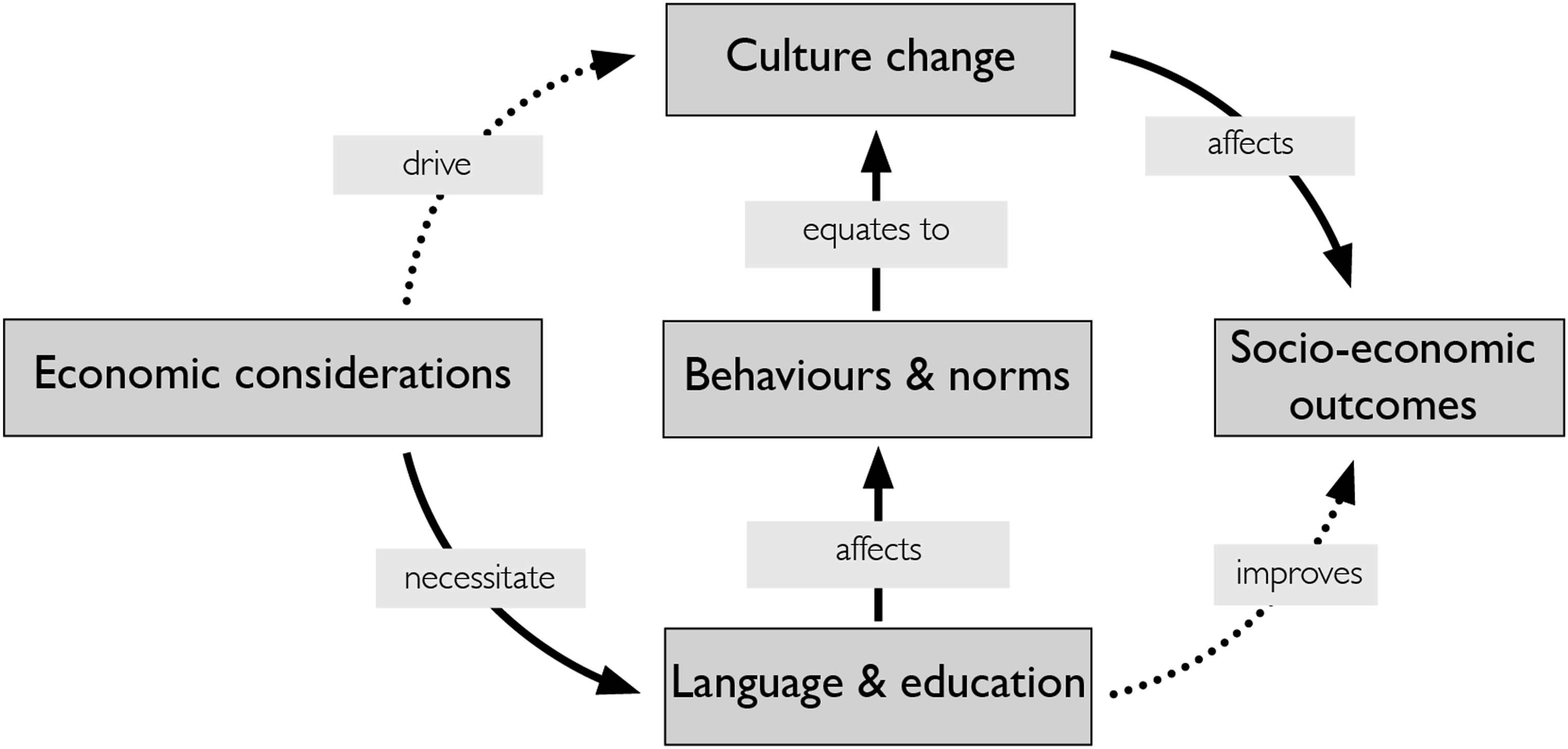
This dynamic is particularly relevant for economically marginalised majority world cultures, which are often required to develop competencies outside their cultural repertoire to access opportunities in Western-oriented business environments. This mirrors patterns observed in ecologically unequal exchange theory. Dorninger et al. (2021) describe how resource flows from poorer to richer nations fuel sustainability challenges and reinforce global power imbalances - benefitting high-consumption economies while deepening poverty elsewhere. The inequalities are not only economic but also social and environmental, driven by processes of marketisation (Burawoy, 2015). The most severe effects are felt by groups excluded from full participation in the shifting global economy (Lindert and Williamson, 2007: 263). Greenfield (2009) shows that technological advancement and urbanisation have further accelerated changes in cultural orientations, widening the gap between those with knowledge, skills, and abilities, and those without. This growing disparity deepens the labour-leadership divide in organisations, where alignment with dominant systems becomes a prerequisite for socio-economic mobility.
Current effects of hegemony
This section examines how the intersection of culture and power shapes societal and workplace dynamics in the present day, reinforcing class-based stratification, stigma, and economic inequality across the labour-leadership divide.
Language and business
In present day South Africa, like other countries in the Global South, fluency in English is a gateway to quality education (Alexander, 2008: 54; Lafon, 2009; Sekaja et al., 2022; Taylor and von Fintel, 2016) and career progression in the private sector (Casale and Posel, 2011: 22; Gordon and Harvey, 2019; Innes, 2021; Sekaja et al., 2022). Beyond language proficiency, the accent with which English is spoken also shapes perceptions of competence and acceptability, influencing both social and educational mobility (Collins, 2017; Seekoe and Uwah, 2021; Sekaja et al., 2022). As upwardly mobile black South African families increasingly gravitate towards English-medium private schools and universities, their normative and behavioural orientations shift in response to these environments (Sekaja et al., 2022: 3). This acculturative change aligns with an ecocultural model where individuals adapt to dominant cultural schemas to improve economic prospects. These patterns reflect both convergence and crossvergence theories (Kaasa and Minkov, 2020), signalling a broader shift from cultures predicated upon belief systems toward Western behavioural norms (Cowden et al., 2023: 245). Local studies support this convergence at leadership and management levels in South African business (Fetvadjiev et al., 2018; Thomas and Bendixen, 2000). Yet, this behavioural shift among leaders stands in contrast to the persistent cultural schema within labour-class contexts, reinforcing class-based divergence across the labour-leadership divide.
Spiritual beliefs
Official statistics propose that 85% of South Africans identify as Christian and 7.8% with ATR (StatsSA, 2023). However, numerous sources state that indigenous southern African Christians hold ATR beliefs in tandem with Christianity (Chidester, 1996; Hackett, 2015; Hammond‐Tooke, 1986; Masondo, 2011; Mbiti, 2016; Mndende, 1994, 1998; Mokhoathi, 2020; Mokhutso, 2023; Molobi, 2005; Pobee and Mends, 1977; Podolecka, 2021). Empirical studies show that syncretic belief systems blending Christianity and ATR are widely practiced by a majority of the population (Brittian et al., 2013; Pew Research Center, 2010: 177–181). These hybrid worldviews remain under-acknowledged in formal data, reflecting a persistent social desirability bias or stigma where individuals report socially accepted beliefs over actual practices (Brittian et al., 2013: 3; Masondo, 2011: 33), reinforcing the marginalisation of indigenous ways of knowing (epistemic marginalisation) of ATR. This reveals tensions between indigenous beliefs and dominant Western paradigms, particularly those associated with economically advantaged social classes.
The reported social desirability bias suggests a socio-economic dimension to how beliefs are distributed and maintained across classes in contemporary South African society, anchored in broader power dynamics. Existing studies report a statistical correlation between ATR practice and adverse socio-economic outcomes (Braithwaite and Haddad, 2020; Butinda et al., 2023). This correlation is further supported by a brief analysis of the 2020 Pew dataset, plotting ancestor veneration against monthly income (Figure 5), adjusted to approximate 2025 constant currency values. The Data are representative and stratified across all provinces (±3% margin of error; 95% confidence level). South Africa: Ancestor veneration by monthly income (adjusted to 2025 constant currency). Source: Pew Research Center, 2010 (file: 2020update7.31.sav).
1

There is longstanding support for viewing ATR as a unified belief system (Mbiti, 1989). Evidence suggests that its practitioners face varying degrees of oppression or limitation in freely practicing their faith, despite legislated constitutional protections for freedom of religious expression. In some rural, lower socio-economic communities, ATR is observed in its non-syncretic form, practised independently of other religious systems (Mndende, 2013). Recent information points to a renewed interest in ATR, particularly as part of broader efforts to decolonise religious practice and reclaim indigenous spiritual identity (Forster, 2024; Nweke, 2019; Nweke and Okpaleke, 2019).
This complex cultural landscape has significant implications for businesses and society in South Africa. It echoes the paradox described in Bonfil Batalla’s
Conceptual framework: Divergent ecocultural effects
This conceptual framework (Figure 6) maps the overlapping drivers of cultural dissonance, socio-economic stratification, and ecocultural change in post-colonial workplace contexts. Drawing on the principle of overdetermination, it illustrates how individual and group positioning within a historically stratified society shapes access to power, cultural fluency, and workplace inclusion. Divergent Ecocultural Effects conceptual framework. Source: Authors.
At its core, the framework positions individuals and groups according to multiple overlapping identity elements (education, income, occupation, language, religion, class, ethnicity, and gender), which together overdetermine their socio-economic position and trajectory. These variables are not isolated. They function as a system of interdependent forces that channel individuals into either high- or low-power socio-economic strata. This positioning determines individual and group exposure to, and capacity for, alignment with culturally dominant systems (Bourdieu, 2002, 2013; Rehbein, 2018).
Moving outward, the group layer distinguishes between ingroup and outgroup membership, indicating one’s relative embeddedness within institutional power structures. From a leadership perspective, ingroup members, who typically align with Western cultural schemas, experience cultural resonance with leadership expectations. Conversely, outgroup members may find their cultural ‘windows’ delegitimised or rendered unintelligible in formal organisational settings. The ability to navigate multiple cultural schemas through frame-switching is a critical but unequally distributed resource: more prevalent among socio-economically advantaged individuals and structurally constrained for marginalised monocultural groups (Benet-Martínez and Repke, 2020; Hong et al., 2000; Oyserman and Lee, 2008; Triandis, 1989).
At the contextual level, social status and power interact with perceived threat and spatial dislocation, reflecting how historical processes such as apartheid-era displacement continue to shape the material and symbolic environments in which individuals operate. Power here is not only positional but normative, embedded in which worldviews and values are considered organisationally, and indeed societally, valid (Seekings and Nattrass, 2008; Webster et al., 2020).
The cultural layer delineates a continuum from Western behaviours and norms to indigenous belief systems. Leadership groups, situated on the Western end of the spectrum, operate within normative schemas aligned with global capitalist systems, whereas labour groups are more likely to draw on spiritual and relational ontologies rooted in indigenous traditions. These orientations can be mutually illegible, sustaining the trust deficit and weakening relational interaction across the labour-leadership divide (Chidester, 1996; Jackson, 2015; Korczynski, 2023; Mndende, 1998).
At the outermost level, the framework incorporates time-based cultural change processes. Colonisation is the overriding process through which power relations were structurally formed and reproduced, while crossvergence, hybridisation, and acculturation shape and are shaped by contemporary ecocultural dynamics. These processes are asymmetrically distributed, requiring labour-class individuals to adapt linguistically, behaviourally, and cognitively to gain access to opportunity. This asymmetry gives rise to a resource-seeking ecocultural change impetus, depicted by the directional arrows at the base of the framework. (Greenfield, 2009; Nkomo, 2011; Ralston, 2008; Sekaja et al., 2022).
By mapping these interrelations, the framework portrays the layered intersecting forces that shape the labour-leadership divide in the context of hegemony. It provides a diagnostic lens for analysing how culture and power converge to produce divergent workplace expectations in post-colonial Global South contexts.
Conclusions
This review set out to examine how cultural, historical, and socio-economic factors shape the persistent disconnect between labour and leadership in South African and, by extension, Global South organisational contexts. Drawing on a critical, cross-disciplinary synthesis, we argue that cultural dissonance between leadership and labour is not simply a matter of misaligned values, but the product of historically embedded power asymmetries, ecocultural transformation imperatives, and differential access to cultural capital.
We have proposed a mechanism whereby overdetermined ecocultural positioning shaped by interdependent identity variables and belief systems affects socioeconomic outcomes by regulating access to culturally dominant organisational schemas. This asymmetry necessitates resource-seeking ecocultural change, in which individuals must adapt linguistically, behaviourally, and cognitively to gain inclusion. However, individuals experiencing monocultural frame accessibility, frequently adhering to indigenous cultural orientations, face structural barriers to such adaptation. This leaves them excluded from the advantages embedded in the culture-power nexus that underpins leadership legitimacy and organisational cohesion.
This has significant implications for cross-cultural management research and practice, showing that culturally situated organisational dynamics cannot be adequately explained through the use of national culture constructs and widely used cross-cultural values models alone. Contextually relevant factors, including historical interactions between subcultures, are instrumental in informing how leaders and employees interpret norms, legitimacy and authority in the workplace.
For cross-cultural management scholars, this review offers a critical lens and new research directions for future empirical and conceptual work. We suggest that future research could benefit from attention to: the impact of asymmetrical culture-power relations on employment relations or the psychological contract; the development of emic indigenous measures of culture to build independent research variables; cultural stratification in Global South contexts where majority populations are positioned as acculturating rather than culturally dominant groups; and processes of cultural diffusion and change, considered as moderators or mediators in organisational research. Additionally, when using culture as a variable (independent or dependent), researchers should consider accounting for polyculturalism and frame switching capacity as potential confounding mechanisms that can affect research outcomes. From a critical cross-cultural management perspective, we also caution against the continued use of race (or proxy variables for race) as a basis for cultural segmentation. These directions position the framework developed in this review as a tool for critically examining how culture is theorised and measured in cross-cultural management scholarship, particularly in socio-economically stratified post-colonial Global South contexts.
Taken together, the framework’s elements reposition culture in Global South organisational research as a dynamic and power-related phenomenon. The framework moves beyond fixed trait-based models to view culture as adaptive and fluid, shaped by historical, situational, and socio-economic factors. This allows us to account for convergence at elite levels and cultural continuity at labour levels.
Rather than treating cultural differences as surface level diversity, the framework enables power-aware cultural diagnostics, showing how intercultural dynamics express underlying inequality. In this context, frame-switching capacity emerges as a key mediating element, linking overdetermined subcultural positioning to access, legitimacy and inclusion. By incorporating emic cultural markers and recognising spiritual beliefs as a key element of cultural orientation, our framework extends existing models to reflect lived realities in post-colonial Global South societies.
These insights extend relevance beyond South Africa to other post-colonial and economically stratified societies in the Global South where similar dynamics of symbolic domination, cultural exclusion, and adaptive pressure are observed. The organisational implications of these dynamics are central to our research. We have shown that trust, legitimacy, and the employment relationship are culturally embedded constructs. When the dominant worldview is inaccessible to a large segment of the workforce, organisational cohesion suffers. Though this broader framing may not easily translate into brief quantitative reports with actionable outputs, it carries significant implications for the employment relationship, Human Resource Management policy reviews, and leadership models that recognise the role of cultural power dynamics beyond intercultural competence. Organisational transformation requires more than representation. It demands that indigenous cultural logics, belief systems, and relational modes of knowing are granted legitimacy within institutional practice. We do not offer off-the-shelf solutions, but rather a new lens which moves beyond fixes based on simplistic typologies to interrogate the deeper structures that fragment workplace relationships. By foregrounding culture-power interactions and proposing a grounded conceptual model, this review contributes to the project of building more equitable, sustainable organisational systems in the Global South.
Footnotes
Acknowledgements
We thank the two anonymous reviewers, the editor, and Professor Ruth Albertyn (University of Stellenbosch) for their useful comments and guidance.

Ethical considerations
There are no human participants in this article and informed consent is not required.
Author contributions
Andrew Grant Innes: Conceptualisation, Writing – original draft, Writing – review and editing; Armand Bam: Conceptualisation, Writing – review and editing, Supervision; Linda Ronnie: Conceptualisation, Writing – review and editing, Supervision.
Funding
The authors received no financial support for the research, authorship, and/or publication of this article.
Declaration of conflicting interests
The authors declared no potential conflicts of interest with respect to the research, authorship, and/or publication of this article.
AI statement
AI was used for spelling and grammar checks and for additional citation mapping.
Note
Inequality rankings (World Bank 2024 dataset/population > 1m)
Source: World Bank, 2024.
Country
Gini coefficient
Date
Population est.
1
South Africa
63
2014
60,442,647
2
Namibia
59.1
2015
2,630,073
3
Colombia
54.8
2022
52,321,150
4
Eswatini
54.6
2016
1,201,670
5
Botswana
53.3
2015
2,630,073
6
Brazil
52
2022
214,326,223
7
Zambia
51.5
2022
20,569,737
8
Angola
51.3
2018
36,684,202
9
Mozambique
50.3
2019
34,186,911
10
Zimbabwe
50.3
2019
16,320,537
11
Panama
48.9
2023
4,517,808
12
Rep. Congo
48.9
2011
5,876,869
13
Guatemala
48.3
2014
19,153,821
14
Honduras
48.2
2019
11,647,861
15
Costa Rica
46.7
2023
5,379,526
16
Nicaragua
46.2
2014
7,202,925
17
Paraguay
45.1
2022
7,305,843
18
Lesotho
44.9
2017
2,330,701
19
Venezuela
44.7
2006
28,250,490
20
Dem. Rep. Congo
44.7
2020
102,262,808
21
Ecuador
44.6
2023
18,333,684
22
Turkiyë
44.4
2021
85,330,000
23
South Sudan
44.1
2016
11,483,370
24
Rwanda
43.7
2016
14,094,683
25
Mexico
43.5
2022
128,455,567
26
Ghana
43.5
2016
33,790,000
27
Chile
43
2022
5,650,957
28
C.A.R.
43
2021
19,838,888
29
Uganda
42.7
2019
51,384,894
30
Madagascar
42.6
2012
32,563,444
South Africa labour-employer cooperation 2009–2019
Source: World Economic Forum Global Competitiveness Index reports 2009–2019.
South African cross-cultural studies
Source: Adapted from Innes, 2021.
Year
Author/s
System
Construct/scale
Black
SD
White
SD
Cohen
Sample
2000
Thomas & Bendixen
VSM94
No significant differences - “
Managers
2000
Eaton & Louw
TST
Abstract-specific
η2 (small)
0.03
Tertiary Students (T.S.)
“We dealt with university students, who typically are more exposed to individualism”
2000
Heuchert et al.
FFM
Neur.
49.2
7.2
51.6
10.2
0.27
T.S.
Extr.
42
8.5
47.5
11.3
0.55
Openn.
44.7
7.5
54
9.9
Agr.
46.5
11.7
50.4
11.7
0.33
Consc.
48.1
7.6
47.2
10
−0.10
2001
Booysen
Globe Sub-cultural
PO
5.04
1.13
5.28
0.28
0.29
Managers
A
4.39
1.1
4.78
1.11
0.35
FO
4.38
1.05
5.04
0.87
0.68
HO
5.36
1.05
4.24
0.93
I/C
5.4
0.76
4.36
0.66
GE
3.26
1.14
3.53
0.83
0.27
PD
4.72
1.18
4.8
0.87
0.08
UA
4.75
0.9
5.11
0.8
0.42
2004
Globe/Booysen
Globe Values
PO
4.92
6.23
+n
Managers
A
3.82
3.69
−n
FO
5.2
5.66
+n
HO
5.07
5.65
+n
Inst Col
4.30
4.38
+n
IG Col
4.99
5.91
+n
GE
4.26
4.60
+n
PD
3.65
2.64
−n
UA
4.79
4.67
−n
2004
V.Dyk/De Kock
ICIAI
IND-COL
3.63
0.56
3.39
0.61
−0.41
Officers
2005
Beukman
ICI/VSM80
IC
No statistically significant differences
Officers
UA
No significant differences
PD
No significant differences
MAS
“Africans showing more feminine tendencies”
2006
Oelofse
Globe Values
PO
3.56
1.42
4.21
1.25
0.49
T.S.
FO
3.75
1.46
4.19
1.25
0.32
HO
4.14
1.51
4.5
1.18
0.27
I/C
3.92
1.50
4.27
1.15
0.26
GE
3.86
1.63
4.05
1.28
0.13
PD
4.05
1.58
4.24
1.15
0.14
UA
3.9
1.53
4.3
1.19
0.29
2009
Vogt & Laher
BTI
IND-COL
“No significant differences found”
T.S.
2012
Adams et al.
TST/SAPI
“Individualistic self-definitions are prevalent in all ethnic groups … the ethnic groups share many similarities… concepts of independence and interdependence in western and non-western cultures are not as clear-cut as expected”
T.S.
2012
Branco e Silva
SAPI/CPAI-2
Non-W
W
T.S.
Trad. V mod.
41.94
36.91
−0.79
Approachab.
35.89
38.51
0.41
Harm. Maint.
173.30
169.68
0.21
Harm. Breach
38.48
41.63
0.38
Egoism
25.31
26.70
0.28
Hostility
84.59
88.99
0.26
Help others
3.77
3.60
0.22
2015
Valchev
SAPI
Facilitating
4.1
0.55
3.63
0.53
T.S.
Integrity
4.18
0.50
4.00
0.47
−0.37
Rel. Harmony
4.18
0.50
3.85
0.48
−0.67
BTI
Agr.
3.72
0.47
3.62
0.43
−0.22
CPAI-2
Trad. V mod.
3.22
0.56
2.55
0.48
Rel. Orien.
3.88
0.50
3.79
0.46
−0.19
Soc. Sens.
3.73
0.44
3.68
0.41
−0.12
Discipline
3.41
0.55
3.16
0.47
−0.49
2017
Janse v. Rensburg
HVIC
IND
54.76%
8.67
52.86%
8.62
−0.22
T.S.
COL
58.76%
8.11
54.53%
8.2
−0.52
2018
Fetvadjiev et al.
BFI/SAPI/TIPI
“More similarities than differences in behavior predictability and consistency… ‘failure’ to find such differences, where expected in a… framework of [IND-COL], could be seen as disappointing”
T.S.
Mean Cohen’s