







Abstract
Keywords
The concept of cultural competence has been widely debated across helping professions, including social work (SW), since its emergence in the late 1970s and 1980s (Solomon, 1976; Green, 1982; Cross et al., 1989). Early scholars in this area defined cultural competence as a “set of congruent behaviors, attitudes, and policies that come together in a system, agency, or among professionals and enable that system, agency, or those professionals to work effectively in cross-cultural situations” (Cross et al., 1989:3). Professional associations developed standards of practice for cultural competence to promote respect for cultural diversity and differences and to increase accountability and effective practice in SW and other health professions (American Psychological Association, 2002; NASW Standards, 2015). Social work scholars note that cultural competence is a central tenet of SW theory, practice, education, and research (Danso, 2018; Lum, 2003; Williams, 2006).
Despite its pervasive uptake in the SW profession, cultural competence has been fiercely criticized. For example, Dean (2001) argued that cultural competence is a myth because it is impossible to be
Amid the semantic, conceptual, epistemological, and sociopolitical debates, we wonder how different frameworks related to cross-cultural social work practice (CCSWP) have been perceived by SW students and faculty members, and how these are translated to embodied cross-cultural interactions in SW practice. In their editorial,
According to Freire (1970:126), praxis is defined as “reflection and action directed at the structures to be transformed” to liberate ourselves from the entrapments of our own thinking. In praxis, our reflection “creates projects that are constantly interrogated, revised and extended in the light of experience” and our “goal is realized” in our “own enactment” (Ablett and Morley, 2020:342). Given our experiences of struggling to understand and teach cultural competence and alternative concepts that have been contested despite their intended goals to promote better cross-cultural work, its interrogation in praxis is inevitable. A philosopher, social theorist, and psychoanalyst, Castoriadis (1984:235), offers insights on the importance of examining praxis—“praxis reveals and invites our reflection on questions about ‘what’ is being done in practice, education, program, or policy and ‘for what’ purpose.” For Castoriadis, praxis is It is based on knowledge, but this knowledge is always fragmentary and provisional. It is fragmentary because there can be no exhaustive theory of humanity and of history; it is provisional because praxis itself constantly gives rise to new knowledge … This is why the relations of praxis to theory … [are] more profound than those of any “strictly rational” technique or practice (Castoriadis, 1984:76; cited in Ablett and Morley 2020:342).
Ablett and Morley (2020:334) argue that Castoriadis’ work provides “a coherent and robust revisioning of revolutionary praxis that can help clarify and extend the revisioning of critical social work’s emancipatory potential without recourse to deterministic structural theories or the pitfalls of post-structural relativism.”
We think the critiques around cultural competence and the alternative constructs have fallen into the trap of endless theoretical debate on definitional and conceptual minutia with the potential pitfall of forgetting the vital endpoint of effective practice. Instead of falling into theoretical debates, it is important to examine the
Methods
Data and participant recruitment
Data were collected from focus groups with graduate students and faculty members from Canadian schools of SW between April and July 2021 after obtaining ethical approval from two affiliated universities. To have a wide and diverse reach of potential participants, we compiled a list of schools of SW using the list of accredited Canadian SW programs available on the website of the Canadian Association for Social Work Education (CASWE). We then contacted the MSW program coordinators or directors of all schools to disseminate study recruitment information among students. We also contacted individual faculty members from each school to recruit participants for the faculty focus groups. Our student focus groups were facilitated by SW doctoral students, and the faculty focus groups were facilitated by two SW faculty members and one diversity and equity officer at the university. The facilitators followed a semi-structured interview guide that covered topics such as cross-cultural practices and social justice in SW education, and the experiences of learning and teaching. One set of interview questions centered on cultural competence and asked about definitions of cultural competence, as well as important principles, characteristics, and practice examples of cultural competence. We conducted all focus groups using Zoom videoconferencing and audio-recorded, transcribed, and deidentified transcripts for analysis.
Analysis framework: critical discourse analysis
Among various critical analysis methods of qualitative data, critical discourse analysis (CDA) is suitable for examining praxis because both CDA and praxis bear similar perspectives that “both are modes of critical intervention into hegemonic discourses of power and privilege” and “knowledges are not apolitical, but rather are invested in structures of power and ideology” (Lazar, 2020:6). For Castoriadis, “the reflection involved in genuine praxis can never be simply analytical-empirical but is essentially creative and critical” (Ablett and Morley, 2020:342). Therefore, using CDA allows us to critically analyze how discourses have been constructed and negotiated to embody the praxis of cultural competence and alternative constructs.
We followed the recommendations of sociolinguistic and critical scholars that texts are not coincidently but structurally organized and discursively constructed to represent contexts (Sacks and Jefferson, 1995). In this framework of understanding, any use of language should be understood as political (Gee, 1999). To unveil the use of language critically, Fairclough (2013) paid attention to the mediating link between “linguistic analysis” and “social analysis.” Several social work scholars applied this analytic rigor to examine various social work conversation and interactions in practice (for details of this analytic framework in social work, see Lee and Bhuyan, 2013, Lee, 2014, Lee et al., 2019a, 2019b, 2021, 2022; Hall et al., 2013, 2020; Hall and White, 2005; Rodger, 1991; Willey-Sthapit et al., 2022). For
Data analysis process
Transcripts were managed and analyzed using Dedoose (https://www.dedoose.com/), a cloud-based qualitative data analysis tool that allows for team collaboration. Our research team consisted of three faculty members and two doctoral students, all of whom served as coders. All five team members conducted an initial open coding independently on the same transcript to identify preliminary thematic patterns. We then met as a team to discuss emerging themes (e.g., the debates of cultural competence). The first author conducted the second iteration of the coding across all transcripts of five focus groups to closely read the identified preliminary themes on cultural competence and alternative concepts such as cultural humility. This coder then located relevant segments where the words “cultural competence” or alternative terms were mentioned plus related comments on CCSWP. If one of the two conditions were missing, it was not included.
In this analysis,
Findings
Social-demographic background of participants.

The findings are organized in two sections: the student focus group and faculty focus group. Under each focus group, we report the definition of cultural competence and cultural humility or related constructs, and the embodied practice of cultural competence and cultural humility or related constructs.
Student focus group
Defining cultural competence and cultural humility
Students’ dominant discourse on cultural competence echoed the critiques of cultural competence that were articulated in the faculty member interviews. The most commonly expressed ideas were Dean’s (2001) critique of the impossibility of being competent in another culture, essentializing other cultures (Garran and Werkmeister Rozas, 2013; Sakamoto, 2007) and the power imbalance created through social workers assuming an expert position. See Segment 1. (source: Student 1).
This theme was repeated among most of the included segments. For example, another student noted cultural competence “can be counterintuitive in terms of you know you take a training course learning about some specific culture and then saying, you know, identify as being culturally competent,” “like a false sense of confidence” and “could potentially increase your biases, in terms of thinking you know something or making assumptions” (Student 6).
In Segment 1, lexical choices and use of grammar are noteworthy. Students’ perspectives (i.e., critiques) of cultural competence began sentences with “the
Another theme is that “cultural competence becomes the new racism” (Pon, 2009). This claims that structural and power inequity are omitted from a cultural competence perspective. This critique was represented in Stanza 2 (e.g., perpetuating whiteness and colonialism). This socio-politically situated critique of “cultural competence as being oppressive” was not broadly noted in the data except for this student. Contrary to this critique, two other students noted: “I often say like cultural competence like an anti-oppressive practice” (Student 10) and “when I think of cultural competence and related words, I think for myself, like being anti-oppressive is sort of more like all-encompassing in terms of what the intention behind cultural competence is” (Student 12). Both discursively equated cultural competence with anti-oppressive practice.
A dominant discourse of students’ views on cultural humility was presented in contrast to cultural competence as shown in lexicons in Stanza 3—“cultural humility
Embodied practice of cultural competence and cultural humility
A critical part of SW practice is how relevant constructs are understood and embodied. The dominant discourse of cross-cultural practice from student focus group was a preference for cultural humility to cultural competence. When asked how they would describe what “cultural humility” looks like in CCSWP, students often described general SW principles as noted in Stanza 4: “You can (source: Student 16).
This segment highlights attitudes (i.e., “being humble, open, and patient,” “person-centered,” and “putting them at the center”), skills (i.e., “[not]asking direct questions” and “engaging in conversation”), and knowledge (i.e., “getting to know people for them”) as well as valuing relationships (i.e., it
Noteworthy is how these various general practice components are discursively constructed by deploying adverb “just” right before each component: “
Then, the student criticized cultural competence because it requires insurmountable tasks within the time limits (i.e., “an endless amount to learn”) and noted the
Another theme related to the embodied practice of cultural humility was brought by one student as shown in Segment 3. (source: Student 13).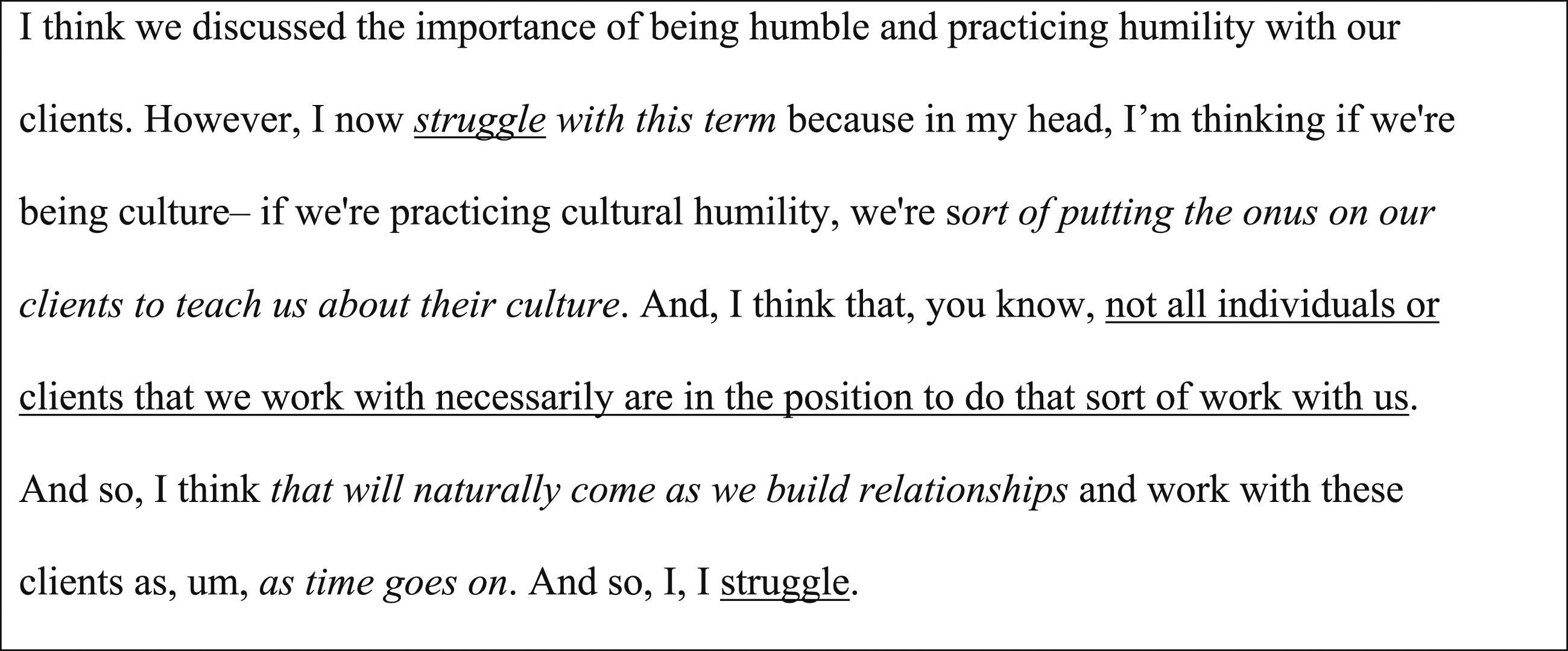
Here, cultural humility was translated into having clients “teach us about their culture,” thus “putting the onus” on the clients, which is not aligned with what cultural humility scholarship proposes. SW scholars note that cultural humility requires social workers to commit to a “process of realistic, ongoing self-appraisal of biases and stereotypes to assess the ways in which their own attitudes prevent them from learning from their clients” (Ortega and Faller, 2011) and “a cultural decentering and acknowledgment of oppression and power as our gaze shifts from our own perceptions of the world to see, instead, the reality of the other,” highlighting “other-focus” and practitioners’ “willingness to learn and to be changed” (Abe, 2020). However, this other-focus and willingness-to-learn on the part of social workers were transformed into putting the onus on the clients to teach social workers, followed by general practice components such as building “relationships.”
With a dominant discourse across the student focus groups that showed a preference for cultural humility to cultural competence, there are only a couple of comments on the embodied practice of cultural competence. One student in the mental health/psychiatry field noted the embodied practice of cultural competence as follows:
Another student noted that in practice cultural competence means “
Their descriptors of the embodied practice of cultural competence align with the NASW Standards (2015) such as, examining “their own cultural backgrounds and identities while seeking out the necessary knowledge, skills, and values” (8); acknowledging “forms of oppression, discrimination, and domination” and “their own position of power vis-a-vis the populations they serve” (10); and demanding “advocacy and activism” to “disrupt the societal processes that marginalize populations” and “challenge institutional and structural oppression” (10). These two participants noted cultural competence as “anti-oppressive practice” in contrast to the dominant discourse of cultural competence as the critique. In addition to the similar notions of the NASW Standards, Student 10 applied the framework of cultural competence to mental health fields against biomedical approaches and further positioned cultural aspects as “protective factors” rather than pathologizing and problematizing them (Park, 2005).
Another noteworthy point is that the lexical choices of these students’ cultural competence descriptors are like other students’ cultural humility descriptors (i.e., being aware, not making assumptions, and understanding their perspectives) and scholars’ notes on cultural humility (i.e., “
Faculty focus group
Defining cultural competence and related constructs
Similar to the findings of the student focus groups, dominant discourses in faculty focus groups include opposition to cultural competence and a preference for other constructs. There were some distinctive differences in the faculty focus groups from the student groups including
As descriptors of cultural competence, one faculty member used lexicons such as “myth,” “a real problem,” and “lacking accountability” as shown in Segment 4. (source: Faculty member 3).
This faculty member started their negative view of cultural competence discursively linking it as a “
Furthermore, components of cultural competence—awareness and knowledge—are reconstructed in Stanza 4. For example, cultural competence is noted as much focusing on “the On the organizational level, there are five essential elements that contribute to a culturally competent system. The system should (1) value diversity, (2) have the capacity for cultural self-assessment, (3) be conscious of the dynamics inherent when cultures interact, (4) institutionalize cultural knowledge, and (5) develop programs and services that reflect an understanding of diversity between and within cultures. These five elements must be manifested in every level of the service delivery system. They should be reflected in attitudes, structures, policies, and services.
Danso (2018) criticized the critiques of cultural competence, and one of his arguments refers to not using rigorous sources when critiquing cultural competence, which was reflected in Stanza 5.
In describing alternative constructs, cultural humility, cultural safety, and cultural responsibility were named. Three faculty members explicitly noted a preference for using
A couple of faculty members noted
Also, another noted I like to use the word cultural responsibility, cause I think it is a responsibility, an
Both participants using cultural safety or cultural responsibility and moral courage aptly reflected the related literature in Indigenous studies (Fernando and Bennett, 2019; Duthie, 2019). Their position is in line with the critique of cultural competence where systemic violence and colonial structures were little acknowledged, thus little action to disrupt them as part of cross-cultural SW. Indeed, there is no mention of disrupting “systemic violence” and “colonial structures” in NASW Standards (2015).
Interestingly, three faculty members (Faculty members 1, 4, and 5) described a temporal relationship between cultural competence and these alternative terms—at times, constructing the discourse that cultural competence is older and outdated and alternative ones are recent, updated, and thus more advanced (e.g., see Segment 5 below). At other times, all concepts were constructed as an unrealistic task for social workers (e.g., see Faculty member 1 below). (source: Faculty member 5).
Stanza 1 explicitly noted the
Another faculty member (Faculty member 1) also noted that “I I began to turn away from talking about cultural competence, and I even have questions about what, what is cultural safety? How does one determine what is culturally safe and for whom? I basically have concluded that, that social educators have taken on an
The faculty member noted the critiques of cultural competence, acknowledged alternative terms, and then questioned them altogether while constructing a discourse of all of them as “unrealistic” and “quite problematic.”
Similarly, another participant discursively connected cultural and social justice work as “fatigue.” After talking about the preference for using cultural safety, this participant noted that “I wonder if we will have the opportunity to talk about– something was raising in the discussion, uh,
Embodied practice of cultural competence and related constructs
Two faculty members noted embodied practice of cross-cultural SW: one especially related to cultural humility and the other related to the application of various terms in practice. For example, one participant said practicing cultural humility means “ (source: Faculty member 2).
Instead of taking a position with a particular term or framework, this participant noted the importance of “articulating” and being aware of “nuanced differences” in each term, and more importantly its “meaning” with respect to certain clients and social work practice, by highlighting the significance of contextualizing each construct where social workers interact with clients in Stanza 1. Using the direct practice course and teaching assessment in that class as the example, the participant underlined the importance of applying self-awareness (i.e., “uncomfortable asking” and “assumptions”), knowledge, and skills (i.e., how-to have a conversation about sex and sexuality), signaling the embodiment of three components of cultural competence in Stanza 2. Furthermore, in Stanza 3, this faculty member noted the crucial aspect of having students apply these ideas together and having faculty members create this environment where they are “prepared and able and willing to talk about what they don’t know,” signaling the embodiment of cultural humility.
Discussion
Using critical discourse analysis, we examined how SW students and faculty members described prominent frameworks in CCSWP—cultural competence, cultural humility, cultural safety, and other relevant terms, as well as their embodied practices. We also explored the discourses that were constructed in shaping praxis in cross-cultural practice contexts. The main discourses constructed from the student focus groups include the following sequence: the students critiqued cultural competence and expressed a preference for cultural humility. However, in their description of the embodiment of cultural humility (their praxis), they described general practice with an absence of cultural content or awareness. The debates of cultural competence and cultural humility were well captured. However, the dominant critiques of cultural competence rarely reflected the original and current literature (e.g., not making assumptions, being aware of one’s and others’ social locations and power dynamics, cultural knowledge, and skills in multiple levels) but rather appeared to be constructed by the embodied practice of how cultural competence has been taken up in practice (e.g., taking a certain training, then becoming competent, and no time for actual practicing), thus paradoxically locating cultural competence in both oppressive and anti-oppressive practices. Embodied cultural competence and cultural humility are described in vague and general practice terms with a notable absence of cultural awareness or sensitivity, which highlights the critical need to teach
It was intriguing to observe how paradoxically the heated debates on cultural competence and cultural humility became less meaningful as the participant moved through speaking turns across the segments. We speculate that, once culturally humble practice was understood as a general practice (i.e., humble and respectful practice such as “just being aware”), changing from cultural to non-cultural general practice (Lee and Bhuyan, 2013) and consequently differences in semantics, theories, and underlying epistemologies became less significant in the end. Underlying the changed views and (general) practice, the frameworks of CCSWP—cultural competence or cultural humility—became meaningless. This discourse from
Similar to the discourses constructed from the student focus groups, the dominant discourse of the faculty focus groups was an opposition to cultural competence. Some of the critiques of cultural competence among the faculty members are similar to the ones among the students as previously mentioned. However, there were unique critiques in the faculty focus groups including mainstreaming of cultural competence as Western knowledge and dominance and focusing on the need of social workers from culturally dominant groups to learn more or even unlearn others’/marginalized people’s culture. In the student focus groups, the alternative preference was mainly cultural humility. However, in the faculty focus groups, the critiques of cultural competence were followed by the preference of various alternative constructs (i.e., cultural safety and cultural responsibilities) and elaborated embodiment of cross-cultural SW, or by dismissing all cultural work as problematic since the alternatives are replacing the now so-called obsolete notion of cultural competence.
Overall, our findings appear to represent current scholarships in CCSWP. From our study, in both student and faculty focus groups,
Implications of the study
The findings of the study have several implications for SW practice, education, and research. Social work educators are positioned to shape knowledge in SW practice and influence the next generation of social workers. It would be important to be mindful of the implications of taking a position for certain constructs in practice and resisting the oversimplification of CCSWP, which cannot be fully captured within one construct, theory, or framework. Our findings noted that the constructed discourses around cultural competence, cultural humility, and other constructs in both groups closely reflect the current scholarships in the field. Therefore, it is critical to expand the field of scholarship shifting beyond the discussion of construct and semantic differences to embodied and situated knowledge in practice to foster everyday cross-cultural inter/actions in multiple levels from micro to mezzo to macro practice. For future research, it would be important to conduct an ethnographic study on our pedagogical approaches in CCSWP by observing how pedagogical approaches and contents are managed and delivered in class-in-action. Given the limited description of the embodied practice of cross-cultural SW by both SW students and faculty members, it would be important to do a similar study with practitioners and clients to examine how they reflect on their experience of providing or receiving CCSWP, and how they illustrate with examples of cultural competence or cultural humility in actual practice.
Limitations of the study
This study was based on a small number of participants in five focus groups who are either current MSW students or faculty members in Canada. Thus, the findings of the study are limited in their transferability and relevance to other groups of people in other contexts. Following CDA, the collected data were analyzed based on the researchers’ various epistemological, theoretical, and social locations which have shaped their understanding of CCSWP. We are mindful that our own locations and their impact on the social phenomena under study can be neither bracketed nor encouraged to do so (Tufford and Newman, 2012). During the data analysis, we explicitly acknowledged and openly discussed these limitations.
Footnotes
Declaration of conflicting interests
Funding
ORCID iDs
