







Abstract
Stories open windows onto human lives and relationships. 1 People tell, read and write stories in many different ways: on screen, in print, performances, everyday encounters and social life. 2 These storying practices can be blunt, simply recounting experiences and describing memories. They can also be more delicate, getting at subjects indirectly, for example, through fictional and allusive figures and events. Through these sometimes-circuitous routes, storying can circumvent conventions and restrictions about what can be said: where, when and by who. 3 Storying therefore has much to offer researchers, particularly those who are seeking to explore issues that tend to be seen as private and sensitive. As such, we describe and reflect upon a series of workshops in which participants learned to use animated film to story an otherwise hard-to-name area of their lives: sexual relationships. This can be difficult subject matter for many people. For Muslims, the participants in this project, it was additionally so, for cultural, religious and family reasons. Their animation illustrates how storying can get people talking about subjects they see as private, embarrassing or out of bounds. It also illustrates, and allows us to explore, the possibilities of conducting storying research collaboratively and, as we explain, doing so in critical ways.
Though not new, storying remains an innovative field of research, both substantively and methodologically. It reaches beyond storytelling, which works ‘through narration’. 4 Though storytelling is wide-ranging in form and function – ordering experiences and events, evoking mystery and awe and finding order and meaning in the world 5 – storying is broader still. It reaches beyond the most conventional storytelling media – the spoken and written word – to encompass other media including participatory film and animation. And it reaches beyond the narration of events to the exploration of ideas and images, which may be fragmentary rather than coherent. This inclusivity is generative, extending from the stories already in circulation to those that have yet to be found or created. 6
By approaching stories with a flexible mind-set and facilitating the telling of new stories, it is possible to explore personal and social experiences that are equally open and uncircumscribed. Sociologist Ken Plummer reflects that ‘[w]hatever else a story is, it is not simply the lived life. It speaks all around the life: it provides routes into a life, lays down maps to follow, suggests links between a life and a culture’. 7 If a story does not simply or necessarily represent, then as Emilie Cameron argues, its potential is to ‘play with possibilities’. 8 The workshops discussed in this article play with possibilities on two levels: through the contingencies of interaction with other people, and through the playfulness and creativity inherent in stories and storying. As a form of storying research, the animation workshops contribute to two wider developments. The first is a move towards participatory and action research, which revolves around collaboration and the co-production of knowledge. 9 Second, there is a creative turn, in which social and cultural researchers are engaging with arts and crafts including theatre, film and dance. 10
Collaborative and creative methods – of which collaborative storying is one example – are increasingly presented as ideals for social and cultural research: as intrinsically or self-evidently good. Collaboration and variants such as co-production, conceived more as ideals than realities, revolve around engaging participants from the outset, as equal partners in the research process. Ruth Raynor uses this term to describe a women’s theatre project, in which a story was ‘coproduced with women’. 11 Co-production is particularly prized in Britain, where researchers are encouraged – by impact-driven research governance – to engage with potential beneficiaries of their research. 12 More generally, methods in which researchers work jointly with participants are now widely affirmed as a better alternative to unilateral academic research. 13 This tendency is exemplified in the work of Australian researchers Louise Phillips and Tracey Bunda, which involves collaborative storying. 14 Phillips has argued that stories (1) give voice to those who are silenced and marginalised, (2) challenge hegemonic and stereotypical narratives about minorities, (3) foster the intergenerational transfer of knowledge, (4) form a bridge between the past and the present and (5) nourish mind, body and soul. 15
This commitment to creativity, collaboration and co-production is welcome, though it is not above criticism. Phillips’ picture of storying is more of an ideal than a reality, given that stories can also be vehicles for powerful individuals and dominant discourses. Her reading of storying as relational meaning-making is equally optimistic, particularly when she asserts that storying enacts collective ownership and authorship, disrupting competitive individualism. More generally, it can be productive to interrogate rather than simply celebrate collaboration and co-production, creative research and creativity. Harriet Hawkins poses the question, which may be sobering to those of us who favour creativity, of ‘how exactly these creative geographies are critical and creative, and for whom?’ 16 Oli Mould challenges the commonplace assumption that creativity is intrinsically good, prompting us to ask what creativity is for and who or what it serves. 17
Meanwhile, Bill Cooke and Uma Kothari raise broader questions about collaborative and participatory research and practice by highlighting ‘multiple and diverse ways’ in which power is expressed in participatory projects. 18 They recommend a more critical approach to participatory research. Taking up this challenge in Participatory Action Research, which they champion and practice, Sara Kindon, Rachel Pain and Mike Kesby have interrogated power relations between researchers and participants. 19 They show that the researcher’s power can be used to good effect, for example, by defining ground rules such as confidentiality and mutual respect. 20 In this vein, research collaborators and co-producers seek to bring renewed reflexivity to relationships with participants, as, for example, in Dan Mahoney’s research involving gay men, 21 Geraldine Pratt’s work with Filipino domestic workers in Vancouver 22 and Hester Parr and Olivia Stevenson’s collaborative storying involving missing persons 23 and people experiencing mental health problems. 24 These researchers are attentive to the dynamics and power relations between themselves and participants, seeking to recognise and navigate what Richa Nagar has called the ‘multiple and difficult borders’ therein. 25
Some collaborative researchers also highlight participants’ relationships with each other. Maryanne Theobald 26 observes the ways in which children interact in the course of conversational storytelling. Other investigators are more prescriptive, recommending structured forms of storytelling, for example, in planning consultations 27 and management practices, where it is important for each participant to ‘find his or her own voice’ and feel that the outcome is ‘jointly created and jointly owned’. 28
Yet, participatory and action researchers have not interrogated the dynamics between participants as closely, critically or perhaps realistically as those between researchers and participants. Seeking to achieve ‘genuinely democratic and non-coercive research with and for, rather than on, participants’, Kindon, Pain and Kesby have portrayed participants as ‘ordinary people’ working together freely. 29 Similarly, Malte Philipp Gembus presents Somali-heritage Londoners who participated in a collaborative theatre project as beyond ‘hierarchy’. 30 But inequalities exist within subaltern groups and among participants drawn from such groups. Giles Mohan challenges the assumption that participants speak as one, on behalf of ‘consensual’ or ‘harmonious’ communities. 31 It is not a given that women will have as much agency as men, or that young people will be free to speak in the presence of older relatives and community members. There is no reason to assume that power melts away when people walk onto the stage or into a collaborative arts project. As Kesby, Kindon and Pain argue, ‘rather than condemning’ participatory research ‘as a form of power, or seeking to quarantine it from power’, we should seek to understand such power and its effects on both researchers and participants. 32 Though we may seek to cultivate ‘safe spaces’ for research, 33 we should also acknowledge that these spaces are never likely to be free of power, which is better understood than wished away. And so, we bring a reflexive approach to the collaborative storying, which we present in this article.
There are two components to collaborative storying: process (working together) and content (what is produced). We elaborate on collaborative storying through workshops in which a group of young British Muslims worked together to make a short film titled
Explaining the collaborative process and content of this project, the next sections outline the workshops in which participants learned to use animated film as a medium through which to story sexual relationships, and then expand upon collaborative process and content, which the making and screening of this film brought to light.
Collaboration: introducing the storying workshops
This project involved six young British Muslims of South Asian heritage, working with Stacy Bias, an animator and artist who was commissioned to facilitate the series of workshops, in association with three academic researchers: the authors of this article, namely, Richard Phillips, Nafhesa Ali and Claire Chambers. Our different contributions and experiences are described and evaluated in this article, which draws upon the research diaries of the authors and Stacy, and also upon interviews and focus groups with the workshop participants.
The workshops were conceived through meetings between Richard, who had been impressed by an animated documentary film,
Workshop participants.

At the launch event, participants had been informed that the workshops would explore sexual relationships and that they would work together to identify and recount a story relating to this topic. Accordingly, the first workshop included group discussion about dating, led by Nafhesa. Follow-up interviews with individual participants were recorded to generate a soundtrack for the animation that the group would make. At this workshop, Stacy introduced the medium and craft of animation, explaining the steps needed to make a simple animated film. She then compiled the sound recording into a series of highlights and produced a transcript, which the group edited. Guided by Stacy, they then broke down the edited transcript into a series of scenes and brainstormed how to illustrate these. They created a draft storyboard of images that would accompany the sound recording.
At the third workshop, Stacy talked through the storylines arising from the edited draft, and the group voted on each option. The selected stories were allocated to participants, which they drew by hand on paper. In the next workshop, the participants began transferring their drawings from paper to computer using electronic pens and drawing tablets (Figure 1). Stacy introduced the Videoscribe animation software, explaining that this form of animation is relatively simple to produce and that, rather than presenting the viewer with completed images, it holds their attention by revealing visuals unfolding alongside the spoken commentary. In the fifth workshop, the group began to join words (edited audio recording) together with images (on computer). They also planned the screening event and supporting publicity, which included radio and TV appearances, as well as invitations to family, friends and community members. Team members, accompanied by Nafhesa, appeared on a regional British-Asian radio station and also on terrestrial TV (the regional news programme

Transferring words and images from paper to screen.
The research methods employed in the documentation and reporting of these workshops and in the writing of this article involve (1) diaries, kept by the facilitator and research team (the authors); (2) photographic and sound recording of events and workshops; (3) interviews conducted by Richard over the whole course of the workshops with the participants and facilitator, both individually and as a group; (4) lengthier interviews with participants, conducted by Nafhesa, delving into relationship attitudes and experiences. According to our ethical framework around informed consent, we explained to potential participants the process described above, as well as reassuring them that all these data would be anonymised for the purposes of research. Names were changed in diaries and publications, and no identifiable photographs will be published. Participants could make their own decisions about whether and how to identify with the completed animation. They did not have to work under their own names or be involved in publicity events, though in practice they all did. In doing so, they identified themselves with potentially sensitive issues such as dating and what one participant, speaking at the screening event, referred to as ‘lesbian, gay, bisexual and transgender (LGBT) issues’. Our approach was informed by Michael Richardson’s argument that where participatory research is able to create absolutely safe space, anonymity may be redundant. Although we pursued this ideal, we judged that complete transparency might limit the things that some participants might be prepared to reveal or explore. As Richardson observes, anonymity ‘
Collaborative process I: working together
Collaborative storying begins with the process of working together to find stories. In this project, we agreed, process would be as important as product: the film we would make.
38
This decision was not inevitable; it was a choice. During early planning, Stacy was concerned that the process we were sketching out might not produce a film with anything like the professionalism or ‘virality’ of her previous work,
What does the collaborative process entail? What possibilities does it open up, and what does it close down? What does it mean to work together, and what are the strengths and weaknesses of doing so? While collaborative storying varies in terms of the number and range of collaborators, it also varies in how they work, the relationships between them, and the degrees of freedom they enjoy. Participatory (and) action researchers recognise that co-production assumes a variety of forms. 40 These vary from projects that are fully owned and directed by participants to those that involve participants in more limited and prescribed ways, such as the film project led by Hester Parr, in which individuals were engaged in specific tasks. 41 Participants may not want or be able to handle too much freedom; some are attracted by the prospect of learning technical and creative skills. Such skills are not incidental or merely instrumental; they can facilitate ‘empowerment’. 42 Given its technical complexity, animation provides opportunities for participants to gain skills they find desirable and empowering.
Collaborative storying opens up some possibilities and closes others down. First, talking and listening to others allows people to develop new stories. Discussion of Triska Hamid’s ‘Islamic Tinder’ at the launch event prompted one woman to share that a friend’s boyfriend had been sent to Pakistan and returned in an arranged married to another woman. The friend had taken revenge, sending a bouquet of black roses to her ex-boyfriend’s home. She followed this up with messages and gifts expressing the desolation and anger she felt towards him and his family. This story did not make it through to the final cut because, after Stacy explained that it presented the distressed ex-girlfriend as a vengeful aggressor, the group felt it might undermine audience empathy, sending out negative messages. This ultimately discarded anecdote was part of the collaborative process of finding a story the group
Storying demands commitment, particularly with a challenging and time-consuming craft such as animation, and for many people, this may be easier to sustain when working with others. Participants were required to attend all six day-long workshops. Fortunately, the workshops proved fun, the group bonded and this project was not only productive but happy. Though some were already friends, their relationships deepened as they worked together. One participant came out as gay to the group leaders and one participant, and another revealed that he had just been married. Nafhesa’s diary of the first workshop records the camaraderie that quickly developed, enabling team members to overcome initial nervousness and freeing them to participate in creative work. Referring to their first attempts at drawing and animating, she writes, ‘They enjoyed this bit. Lots of laughter and they all felt comfortable with each other’. 44
The trust and bonhomie that developed enabled group members to take creative risks. Soon, they were not only learning and applying technical skills but also experimenting with stories, dropping inhibitions and encouraging others to do the same. Stacy observed that they were ‘[a] bit shy at first but they warmed right up as they started to feel some ownership of and investment in determining the subject matter’.
45
She also recorded the sense of playfulness that they shared with each other and with herself. ‘Much easier start this time’, she wrote in her diary for the second session; ‘people were at ease as they entered the room’.
46
She began with a free-association exercise, assuming that ‘this would be a quick exercise’ but found that the participants were soon ‘really into it’:
47
[There was] a bit of concern and self-criticism about ability to draw and we talked . . . about how I couldn’t really draw when I started, either, and how there’s a natural charm in other people’s drawings even if you can’t quite see it yourself in your own. Mostly, though, I just left them to it and they were very supportive of one another, giving advice and compliments and generally encouraging one another. There was a funny moment with one of Maryam’s drawings when someone said it looked a bit like ET, which was adorable and everyone had a good-natured laugh including Maryam. It broke . . . expectations of perfection and she ended up creating a different drawing that [was] more relevant.
48
The group dynamic was also important in setting the tone for discussions in which participants felt secure enough to express their ideas about potentially sensitive issues. The bonds between participants benefitted from compulsory attendance despite awkward journeys some had to make to the workshop venue.
Some of the roles in this collaborative research – those of the facilitator and academic researchers – were defined and differentiated from the outset. Others were explored and adapted as the project took shape, and as the group members found their feet. Regarding the central figure of the workshop facilitator, Ken Plummer disentangles the parts she or he typically plays: variously coaxing, coaching and coercing people to tell their stories. 49 In subsequent critical reflections on participatory research, Kindon, Pain and Kesby distinguish between ways in which researchers may practice and perform power relations with participants: sometimes but not always coercively. 50 Power, they explain, is not simply to be avoided; it may be enabling and productive in particular ways, which critical researchers are advised to seek to understand rather than evade. Leading the first workshop, Nafhesa and Stacy set the tone for discussions and tried to ‘coax’ the participants, providing some direction, and not simply agreeing to everything that was suggested. As Katherine Brickell and Bradley Garrett argued, it can sometimes be right for the researcher to ‘handle, and potentially even intentionally shape, stories that matter’. 51 In this spirit, Stacy saw her role as one of helping participant to find and tell a story worth telling. She ‘coached’ both the academic researchers and the participants. She asked tough questions: ‘Is there an engaging 2−3 minute story to tell?’ ‘Does the story demonstrate a truth?’ 52 Like the technical art of animation, her sense of a good story resisted easy summary, instead emerging over the course of the project. Stacy explained that a story need not necessarily revolve around the narration of events. The exploration of an idea could work equally well, converging on a truth or point. Stacy observed that the participants ‘had lots of interesting and nuanced thoughts about the topic of halal dating’ 53 and ultimately chose this for the storyline.
The decision to focus upon halal dating was consensual, but it also reflected Stacy’s steer and may have crossed the line between what Plummer refers to as coaxing and coercing. Not all of the participants were originally keen on this theme: When asked if [halal dating] would be a good storyline they didn’t feel it was and when I asked what they would prefer suggested ideas that things like first meetings, serving the tea to a potential partner and his family during an introduction . . . However, we came to the conclusion that halal dating would be a stronger storyline and we would interview people and use this audio and everyone’s range of understandings and feelings around halal dating.
54
Stacy later reflected on the parts that she and Nafhesa had played in finding the halal dating storyline, stating that ‘past a certain point democratic process is a bit problematic’ and it can be more effective for ‘one or two people who are keenly interested’ to take the lead. 55 Moreover, ‘some people had stronger opinions than others . . . but that’s just the dynamics, that’s inevitable’. 56 With these differences in mind, Stacy sought to conduct the group in a way that would define roles but also allow each person to express themselves. She ensured that ‘whomever was drawing a particular screen had creative license to make changes as they saw fit’. 57
The parts played by the team members proved fluid and evolved over time. Their relationships with each other and with the facilitator and researchers, unfolding with the project, resonated with Kye Askins and Rachel Pain’s observations of a collaborative art project, in which ‘interaction among the young people increased Each participant brought a different perspective to the tasks. The group was fairly split along gender lines, with Zarah and Safa and Yusuf and Bilal working together. Maryam was a little quiet, but she gravitated more towards the other two women. The leaders were Zarah and Safa, with Yusuf and Bilal occasionally challenging them a little. The women seemed more comfortable tracing images they found on Google, whereas the two men were perhaps a little more creative in their drawings and unafraid to do these freestyle.
60
Noticing the dynamics between more and less assertive personalities, the facilitator ‘gently prompted’ the latter and wrote ‘multiple ideas for each screen’ so that all the ‘participants [could] make their own decisions for the screens they’re assigned’. 61
The interaction between participants was generally expressed less in the dominance of some than in collective discussion, persuasion and consensus-building. This was aided by the facilitator and researchers, but primarily arrived at by participants themselves: ‘We used a democratic process with everyone voting for their favourite idea for each screen. When there was disagreement it was good-natured and compromise was reached or justifications given’. 62 When some mildly controversial issues arose, the participants listened to each other and came to joint decisions. In the first workshop, Zarah stated that younger generations of British Muslims were more educated than their elders. 63 Later, she worried that this might come across as disrespectful to her parents’ generation. The others understood her concerns but felt her point could be made in a respectful way and should be included. The group agreed that this content was appropriate because, as Stacy observed, ‘it talked about how the labour of the parents working hard after moving over to the United Kingdom created the opportunity for the younger generation to devote more time to their education’. 64 Zarah could have vetoed this decision, but she accepted the consensus. The group also made collective decisions about what they wanted to draw. 65
But this picture of democratic decision-making and group-working may gloss over some problematic aspects of collaboration. Most people who have tried to work with others will know the problems and tensions that it can bring: free-riders can leave the work to others; domineering individuals do not listen; unassertive members fail to express concerns; some people are more skilled, committed or invested than others. This particular project was mercifully free of many of these problems, but certain less positive aspects of collaboration arose.
The group’s general harmony risked a bland story: diluting content, over-qualifying messages and avoiding riskier content. The individual who came out as gay to the facilitators and to one group member did not find it possible to express this within the film, despite his allusion to ‘LGBT issues’ at the end-of-project focus group and the public screening. He told Nafhesa that that halal dating did not relate to him and potentially never would. 66 Another participant did not believe that dating could ever be halal, but she too went along with the overall storyline. Group dynamics meant that the story was neither as bold nor as inclusive as it might have been as the work of a single filmmaker, particularly if she or he were anonymous.
Working together also brought artistic compromises. Richard’s and Stacy’s decision to prioritise process over end product made it possible to accommodate the participants’ mixed artistic abilities and entry-level technical skills. Stacy noted in her diary how pleased they were with their work, its aesthetic shortcomings being compensated in other ways: ‘Yusuf said multiple times that he was surprised and pleased at how professional it looked right away, even though his drawing was stick figures’. 67 This amateur quality was not only inclusive but also helped to convey the film’s open-ended message, posing rather than answering questions. The film opens up the possibility that certain forms of dating might be halal, but also includes the suggestion that some people twist the term for their own convenience, stamping the seal of approval on things they will do anyway (Figure 2). 68

Image to suggest that some Muslims twist the term ‘halal’ for their own convenience.
In this section, we have explored collaborative storying, individual and group dynamics, and the various roles played within the project. This depiction of collaborative work says more about pleasure, harmony and democracy than about tensions and limitations. The project was perhaps unusually positive in that a range of voices were heard, contributions welcomed, and experiences and views accommodated. These dynamics were in some cases linked to broad axes of societal power in predictable ways, as, for example, where heterosexual voices predominate and marginalise others. At other times, the dynamics within the group were less predictable. More liberal voices predominated over conservative counterparts, and gender relations were expressed through something more complex than simply men speaking over women and dominating, which they did not. Group dynamics were sometimes a matter of personalities. Hence, to practice a critical approach to collaborative storying, it is insufficient simply to trace conventional lines of power. Critical collaborative storying departs from a celebratory approach, so excited by creativity or collaboration that it fails to spot its limitations. So, we have not glossed over compromises that were made, the dilution of the final story, and the shutting down of particular stories.
Collaborative content: shared stories
Though stories often revolve around individual protagonists and authors, storying is a social and cultural practice, which can bring the personal into a collective realm. 69 Since it involves forms of telling and listening, which cannot be done alone, storying is fundamentally relational. And since it works with conventions and genres, storying is socially and culturally embedded. For example, relationship stories – from coming-out narratives to anecdotes about dating – are highly derivative and repetitive, even when they appear most personal. Life may also come to imitate art: Arthur Bochner, Carolyn Ellis and Lisa Tillmann-Healy argue that relationships are experienced and constructed ‘as stories’. 70 Seemingly personal and private stories are shared, distilling and expressing the experiences or circumstances of more than one person.
The animation workshops explored a communal approach to relationships, which can be distinguished from the myth of the discrete, autonomous individual propagated by the majority of Western narratives about companionate relationships. In such fictions, two individuals fall in love and do whatever it takes to be together, if necessary breaking with family, community and society. The contours of this story, which run through published and performed love stories as well as those recounted in everyday life, 71 are well known and taken for granted. Where more than two people appear within a relationship story, as, for example, when a family or community attempt to encourage or block potential unions, Western audiences typically see a conflict between the course of true love and the obstacles or constraints it must overcome. The story told through this animation project diverges from this pattern. It is collective rather than individual, and collaborative in content as well as process. It unequivocally portrays relationships as involving more than just individuals. This is reflected both in spoken words and in visual images, including a fictional dating game show in which suitors are primarily seen as members of families (Figure 3). The participant behind this idea felt that its message – marry a man, you marry his family – would resonate among people with South Asian heritage. ‘As well as being our story’, Bilal suggested, ‘it’s applicable to a lot of people, particularly, you know, Pakistani and Indian people that will be watching’.
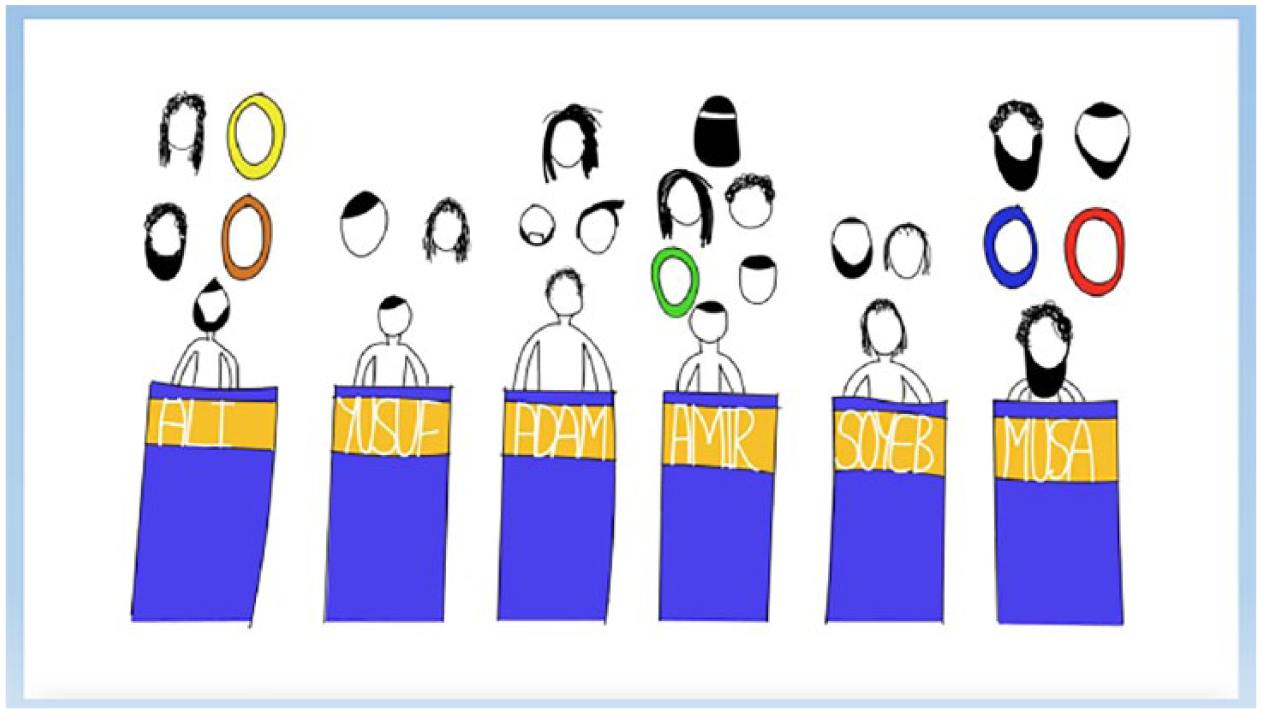
A dating game show in which contestants choose a man . . . and his family.
The shared story, which the participants explored through their film, also bespoke religious and cultural reference points that many British Muslims with South Asian heritage know and experience. These include assumptions that certain practices are halal and others haram, and that family members will play a bigger part in their relationships’ inception and development than may be the case for other individuals. The participants also expressed shared understandings of how their families and wider communities approach relationships, of their expectations and assumptions about how young people must behave and how they may behave: what Sara Ahmed calls the ‘wiggle room’ in which they might manoeuvre. 72
These individuals also recognised diversity within their communities and among themselves. This was reflected in a discussion about whether the animation should tell the story of a single couple whose appearance remained constant throughout, or whether to assemble a series of images showing a variety of characters. They favoured the latter because they wanted to show that Muslims are not all the same; singular images would have delivered a simplistic and reductive message. Instead, they wanted multiple figures with multiple voices. Men would appear with different facial hair, women with a plethora of outfits. Stacy noted a ‘good conversation about reductiveness and stereotype and how not all Muslims look the same and dress the same’. 73 The group also had to make decisions about the virtual hand which would be seen to draw the images. Would it be a single hand or many? They decided on the former, feeling there was enough going on in the film already without the distraction of multiple hands. Since all were of Asian heritage, it was easy to choose a brown hand, darker than some of the options available on Videoscribe. In relation to gender, they opted for a female hand, albeit a relatively androgynous one, without any obvious manicuring or jewellery (Figure 4). 74 Through these diverse images and voices, and with one hand to draw them, the group were able to convey a variety of experiences while underlining commonalities.

The participants chose a brown-skinned and female hand to ‘draw’ the animation.
As already discussed, working together had mixed results, opening up ideas about halal dating, but stifling stories about same-sex relationships. The latter reflected a shared experience, whereby it is often difficult or impossible for young Muslims to discuss same-sex desire and relationships within their communities. But this absence also provided an opening – a noteworthy silence – which was picked up in workshops, focus groups and the screening event.
While the group may not have been able to tell all their stories as directly as some participants wished, the film articulated ideas and experiences to which others could relate. Their common rather than individualistic story allows room for a respectful relationship with elders, whose involvement in relationship choices is not seen as an automatic obstacle to happiness and fulfilment. The protagonists of these stories – young people with large families around them – are more self-possessed, less passive and less constrained than outside observers typically assume. 75 There is a message here: individualism is not the only pathway to freedom, and family and community are not necessarily constraining − though they can be.
This understanding of a shared story may be challenging to those in the social sciences who may want to hear from everyone on equal terms. But, as Mitch Rose argues, stories should not be mistaken for ‘empirics’. He explains that when social scientists present stories as a way of communicating empirical findings, they confuse matters because their purposes differ, the storyteller accommodating a greater ‘distance between words and the world’. 76 But, as Rose also acknowledges, stories and empirics do sometimes converge, as, for example, when cultural and social researchers engage with storying as a means of gathering, distilling, interpreting and disseminating findings. Doing so, they may try to tell representative stories, perhaps by ensuring that all participants have equal airtime and trying to draw their voices together into some coherent form. This underscores the significance of questions about whose stories are told and whose are not, whose voices are heard and whose are not, how different voices may be accommodated, and what can be learned from failure. Having listened to all those who wanted to contribute to a women’s theatre project on austerity, Ruth Raynor was initially frustrated to find that their voices refused to cohere. As she put it, ‘the plot kept falling apart’. 77 This proved a meaningful finding in itself; the incoherent play reflected the women’s divergent experiences of austerity. When voices are inaudible or when they fail to gel, it may be necessary to tell a story that is less directly inclusive, less comprehensively empirical, what Hayden Lorimer calls a ‘small story’, which resonates without summarising or distilling. 78 Participants in the Halal Dating project attempted to address these challenges – and thus to be as resonant and inclusive as possible – through decisions they made about how to represent the range of views within their own group, and how to depict Muslim figures in their drawings and in the hand they chose to animate them. Where they could not find a way of representing contradictory views about halal dating, they elected to pose questions rather than present answers.
Collaborative process II: engaging with audiences
The fundamentally relational practices of storying – telling and hearing, screening and seeing, sharing and responding to stories – highlight the parts played by audiences. Recognition of audiences brings the discussion of collaborative storying back from storying’s
At their first meeting, the group had agreed that they wanted to make a film that could ‘start a conversation’, 80 avoiding anything prescriptive or judgemental. It was encouraging, then, that the first audience member to speak at the public screening – a young man who mentioned to Richard that he was looking to marry and therefore had a personal interest in the theme – acknowledged the rudimentary nature of the film but recognised that this made it accessible and left space for his own thoughts on the subject. Later, a middle-aged man questioned whether the film was advising Muslims to date. He felt such a position would be misguided, arguing that the young should not challenge traditions. This closed down discussion for a time; the filmmakers responded deferentially, but went on to explain themselves. As one put it, ‘we wanted to make like an animation to put it out there . . . because it is a concept and people do use it’ even though ‘it’s just swept under the rug’. 81 Others in the audience, responding to the provocation, recognised that the film was not trying to argue for or against halal dating, and that it was raising questions. The screening-and-discussion format has also been used in other settings in which the film has been watched and discussed, for example, a school homework club in Sheffield in 2017. Private viewings also take place when the film is watched on YouTube. Although these less formal viewings generally leave no auditable trace, they sow the seeds of questions and reflections.
Stories also impact on those telling them. Parr and Stevenson observe that when a person who has gone missing tells their story, it can have a cathartic effect, helping them to process and move on from their experiences. 82 It can be equally liberating to story one’s sexuality. 83 Plummer qualifies this optimism, however, by noting that some people have been pressurised to ‘come out’ and to do so in particular ways. 84 If the stories told here are liberating, it may because they ‘unconceal’ truths that were previously bottled up, as the participants explained. 85
We have already seen that action research may benefit the participant in practical ways. Participants in our project told us that they had been attracted by the possibility of gaining skills that they might enjoy, use again and even add to their CVs. In the end-of-project focus group, the participants agreed that they had learnt a lot, not only about filmmaking but also about working with others and overcoming inhibitions to try creative practices. They said they had developed the confidence to do seemingly small things like drawing, and bigger things like appearing on radio and TV to advertise the screening event and speaking to assembled members of their families and community about sensitive issues such as dating and ‘LGBT issues’.
Conclusion: playing with possibilities
There can be no single formula for critical collaborative storying. This article speaks to some possibilities for working together to relate stories, and for doing so critically and creatively, we have used the term ‘critical’ in two distinct ways, both of which apply to collaborative storying. On the one hand, we set this term against celebratory approaches to creative and/or collaborative research, which tend to see creativity as self-evidently good, and collaboration or co-production likewise, particularly when it means working with and listening to subaltern groups. To be critical in this sense is to discriminate and interrogate, for example, by asking what creativity is for and what difference it makes. On the other hand, we also use the term ‘critical’ more formally to draw attention to the power relations of research, taking cues from criticism of both conventional and participatory research methods. Building upon the work of participatory and action researchers, who have problematised relationships between researchers and participants, we have focussed more upon the dynamics and power relations between participants. The word collaboration also has two distinct dimensions in this context: process and content. In each case, the term ‘collaborative’ is more an approach than a
Collaborative storying opens up a ‘play of possibilities’. 87 We never know what will happen when people come together to explore, express and share stories. The participants in this project broached a subject that had already been discussed on the Internet, usually under cover of anonymity, 88 and also in private conversations between peers, but they took it further. The medium of animation – in which stories can be told without putting a speaker’s face to camera – enabled them to put their ideas forward without showing too much of themselves. The conversations they started between themselves were then carried over into other settings, such as uploading, screening and discussing the film.
We have also shown that collaborative storying has limitations and risks. There is no reason to assume that each participant has an equal say over the final product or performs equally in the collaborative process. Minority voices may be marginalised when they do not fit the story being told, as the experience of the gay participant in this project has shown. Dissenting views such as that of the individual who felt that dating could never be permissible may be watered down, giving way to a consensual but potentially insipid story. Collaboration also subjects participants to collective decisions about working methods, which may constrain them. The participants in this project collectively decided to put their names on the film credits, and thus to take responsibility for the film. This had contrasting effects: at once tempering the message’s boldness and providing participants with a shared platform on which to speak, and allowing them to take ownership of their work. 89
These reflections point to both the possibilities and the pitfalls of collaborative storying. For the young people involved in this project, the promise of such collaboration revolved around finding space in which to explore experiences and possibilities for living. Young Muslims ‘habitually experience voicelessness’,
90
both in relation to the wider society (where more is
Footnotes
 ). The authors wish to thank editors Harriet Hawkins and Dydia DeLyser and three anonymous reviewers at cultural geographies,for their generous work on our article,which has greatly strengthened it. We are also indebted to the facilitator of the project,Stacy Bias,and to the six anonymous participants who created Halal Dating,the animation we discuss here.
Funding
ORCID iD