







Abstract
It is virtually undisputed that humans exhibit territoriality, at the national, family home, or temporary (my-seat-in-the-bus) level, but the question remains how meaningful the similarities are to animal territoriality. (Edney, 1974, p. 961)
Given the limited resources and space on earth, most animals show a natural protective response to territorial incursion which can be considered an evolved response tendency intended to secure one’s perceived territory (Sobolewski, Brown, & Mitani, 2012). An important aspect of the territoriality response pattern has been suggested to be an increased testosterone secretion (Gleason, Fuxjager, Oyegbile, & Marler, 2009; Mazur, 2005) that coincides with certain nonverbal behaviors signaling to the intruders to stay away (Jansen et al., 2011). Territoriality can be defined as the occupation of an area “by an animal or group of animals by means of repulsion through overt defense or advertisement” (Wilson, 1975, p. 256). The definition by Wilson emphasizes the behavioral basis of territoriality without overemphasizing aggression—the most typical behavioral response attributed to territoriality—at the expense of other behavioral possibilities, for example, mutual avoidance based on olfactory, auditory, or visual cues.
Of particular relevance to the present research, Neave and Wolfson (2003; see also Carré, Muir, Belanger, & Putnam, 2006, for a similar line of reasoning) proposed that humans sometimes show a similar territorial response to animals and that this can be observed in the context of competitive sports. In partial support of this theorizing, they found that testosterone concentrations were considerably higher before home games compared to away games and neutral training sessions in a sample of association football (soccer) players. Although studies have shown that higher testosterone levels are associated with dominant, aggressive, and assertive nonverbal behavior (Mazur & Booth, 1998), there is currently no direct evidence that the different hormonal levels of athletes that occur depending on game location also coincide with changes in nonverbal behavior. Hence, the present research addressed the question of whether playing at home or away is associated with certain nonverbal cues associated with territoriality. If this were the case, observers should not only be able to identify whether an athlete is playing at home or away based on observations of athletes’ nonverbal behavior (Experiments 1 and 3) but also rate athletes playing at home higher on behavioral dimensions (Experiments 2 and 3) that have been linked to territoriality in the past (Dabbs, Strong, & Milun, 1997; Dyson-Hudson & Smith, 1978; Edney, 1974; Mazur & Booth, 1998; O’Connor, Archer, Hair, & Wu, 2002).
The Present Research
Although human territoriality is considered an important topic, “no particular paradigm characterizes this topic, and as yet there is no standard set of principles that can be reliably applied to problems in the area” (Edney, 1974, p. 959). Surprisingly, this has hardly changed over 40 years later. However, individual studies have proposed that the field of competitive sports seems a fruitful paradigm to investigate human territoriality. Neave and Wolfson (2003) demonstrated that home teams in competitive sports show an increased testosterone level as compared to away teams. In support of this initial finding, Carré, Muir, Belanger, and Putnam (2006) reported further evidence showing that elite hockey players had significantly higher pregame testosterone playing in their home territory as compared to their opponents’ territory. This increased level of testosterone was associated with higher levels of confidence and lower levels of anxiety when playing at home in comparison to away. Of further relevance to the present research, a different line of research has shown that increases in testosterone are linked to the nonverbal displays of dominance, aggression, and assertiveness (Mazur & Booth, 1998).
According to the ecological theory of person perception (McArthur & Baron, 1983; Zebrowitz & Collins, 1997), the perceptual abilities of humans have been shaped by their ecological utility. As a result, people have become especially attuned to perceptual cues that are of adaptive relevance to humans and afford them to behave accordingly. A line of research providing evidence for the adaptive importance of nonverbal communication—which has been termed the
Based on the evolutionary theory of territoriality and the thin slices of expressive behavior approach, it seems feasible that playing in home territory or away territory in sport competitions would result in subtle nonverbal behavioral changes associated with territoriality, which are reliably recognized by observers. To our knowledge, currently no research exists on the nonverbal expressions associated with playing at home or away during sport competitions and, more importantly, whether people can accurately interpret these nonverbal behaviors as signs of playing at home or away. In Experiment 1, we tested the hypothesis that perceivers with little knowledge of the respective sport would be able to judge who is playing at home or away in ongoing professional sport competition (UEFA Champions League in soccer) based on short observations of nonverbal behavior occurring before the game had started. Experiment 2 tested the hypothesis that soccer players playing at home would be rated higher on behavioral dimensions that have been linked to territoriality in the past (Dabbs et al., 1997; Edney, 1974; Mazur & Booth, 1998; O’Connor et al., 2002). Previous research has shown that game location affects testosterone levels of athletes and testosterone levels have shown to coincide with dominant and assertive nonverbal behavior in humans (Edney, 1974; Mazur & Booth, 1998). Further, animal studies have also shown a link between territoriality and aggression (Gleason et al., 2009; Jansen et al., 2011). Although the link between territoriality, testosterone, and aggression is not as straightforward among humans as it has been demonstrated among other animals (Carré, Campbell, Lozoya, Goetz, & Welker, 2013; Carré & Olmstead, 2015; M. V. Jones, Bray, & Olivier, 2005), recent evidence points to a clear connection between testosterone and aggressive behavior among men (Carré et al., 2016). Therefore, we hypothesized that home playing athletes would be rated relatively higher than away playing athletes in their pregame nonverbal behaviors in terms of dominance, assertiveness, and aggression. In Experiment 3, we followed a call of Fiedler (2011) for replicating studies with different stimuli by testing the above hypotheses at amateur soccer games that are not played in front of large audiences.
Experiment 1: Who Is Playing Away or at Home?
Method
Participants
A total of 80 participants without any particular soccer experience took part in the study (40 women and 40 men;
Stimuli
We selected video footage of recorded televised UEFA Champions League games (Seasons 2013–2014). The following selection criteria were implemented to assure that the chosen stimuli were suitable for testing the hypothesis that playing at home or away results in specific nonverbal behaviors that resemble evolved adaptations and are therefore recognized by observers: In order to ensure that the ratings were not influenced by game-related factors such as strategy or tactics, we chose video stimuli that only showed players before the game started. Further, the research assistant asked to sample the videos was blind to the hypothesis and only got the instruction to sample video sequences that showed home and away teams before the match started. In addition, the stimuli were not allowed to show any details of the stadium that might be recognized. As soccer teams usually have specific jerseys when playing at home or away in the Champions League, some of the observers might recognize these jerseys and use them as cues for their judgment. Therefore, we digitally modified the jerseys with Adobe After Effects CS4 (see Figure 1 for examples of single frames taken out of the video material used in Experiment 1) to circumvent this confound. We occluded all the print on the jerseys and digitally changed the jersey color. In the end, we had 39 away and 39 home clips. The videos had a mean duration of 5.3 s (

Sample image from an experimental stimuli used in Experiments 1 and 2 (left panel with digitally modified jerseys) depicting the home team. See https://osf.io/f2e3f/?view_only=None for a low resolution video stream of all the stimuli used.
Experimental manipulation (within participants)
The experimental within-groups manipulation involved whether the shown soccer players were playing at home or away.
Measure
Perceivers rated the short video scenes on an 11-point Digital Semantic Differential Scale after every video. They were asked whether they thought that the displayed soccer players were more likely to play at home or away. In order to give their ratings, perceivers moved a mouse cursor from the middle of the scale toward either pole of the scale and logged in their rating by clicking the left mouse button. The software converted the ratings into a value (with 2 decimals) between 0 reflecting the left pole of the scale with the label “away” and 1 reflecting the right pole of the scale with the label “home.” The utilized scale was continuous, ranging from 0.00 to 1.00 and was visually presented as 11 points in order to assist participants in providing a clear indication of their ratings.
Procedure
Perceivers were instructed that they had to estimate who was playing at home or away based on the video footage presented to them by moving a mouse cursor to either the “home” or “away” pole of the semantic differential scale. They were further instructed to answer as accurately as possible, while speed was not emphasized. Before commencing the experiment, perceivers filled out a questionnaire gathering demographic data. Every perceiver was tested individually on a standard 17-in. notebook placed 60 cm away from the perceivers. E-prime 2.0 professional (Psychological Software Tools, 2007) was used to present the stimuli and collect the judgments. All videos were presented silently to ensure that ratings were based on nonverbal behavior and not, for example, crowd noise. For every perceiver, the software randomly chose 20 videos from the categories home and away. Hence, every perceiver viewed 40 videos of the 78 video clip battery in random order. In other words, different perceivers were randomly assigned to different sets of videos. This approach helps to ensure that results do not depend on specific combinations of stimuli. After every video clip, perceivers had to give their rating by clicking the left mouse button on the score estimation scale described above. After completing the testing procedure, participants were informed about the purpose of the experiment.
Results
The descriptive results are displayed in Figure 2. A dependent

Mean ratings as a function of game location in Experiment 2. Error bars represent 95% confidence intervals.
Discussion
Results from Experiment 1 suggest that observers were able to distinguish between professional soccer players playing at home or away in European Champions League matches and are in line with the territoriality hypothesis which assumes that athletes change their nonverbal behavior depending on game location. As we digitally modified jersey color, perceivers’ ability to discriminate between athletes playing at home or away in Experiment 1 was most likely based on the nonverbal behavior of the displayed athletes which seems to change depending on game location. The effect size (
Experiment 2: Territoriality as a Function of Playing Away or at Home
Experiment 2 was conducted as an online study via SoSci Survey (Leiner, 2014), as we were running out of on campus participants to obtain sufficient power to detect small-to-medium effects that we anticipated based on Experiment 1. We sampled two groups of participants. One group of participants viewed the digitally modified stimulus material that did not show the original jerseys of the players (
Method
Participants
Informed consent was obtained online from every participant before commencing the experiment. Sample sizes of both groups were calculated prior to the study to have sufficient power (.8) to detect small effects (
Group with jerseys changed
A total of 102 participants took part in the study (31 women and 71 men;
Group without jerseys changed
A total of 101 participants took part in the study (60 women and 41 men;
Measure and procedure
The procedure was identical to Experiment 1, only that participants this time did not have to estimate which team was playing at home or away but instead had to rate the players in terms of aggression, dominance, and assertiveness. Perceivers rated the short video scenes on three 10-point digital semantic differential scales after every video. They were asked whether they thought that the displayed soccer players appeared aggressive, dominant, and assertive with 1 being
Results
Group With Jerseys Changed
The descriptive results are displayed in Figure 3. Including all 3 items in a reliability analysis for a combined territoriality scale resulted in a Cronbach’s α of .74 (Intercorrelations: Dominance × Assertiveness = .609, Dominance × Aggression = .638, Aggression × Assertiveness = .216). A 1 × 2 Location (Home, Away) multivariate analysis of variance (MANOVA) on the three dependent variables using Pillai’s trace revealed a significant main effect of game location on overall perceived territoriality of the targets,
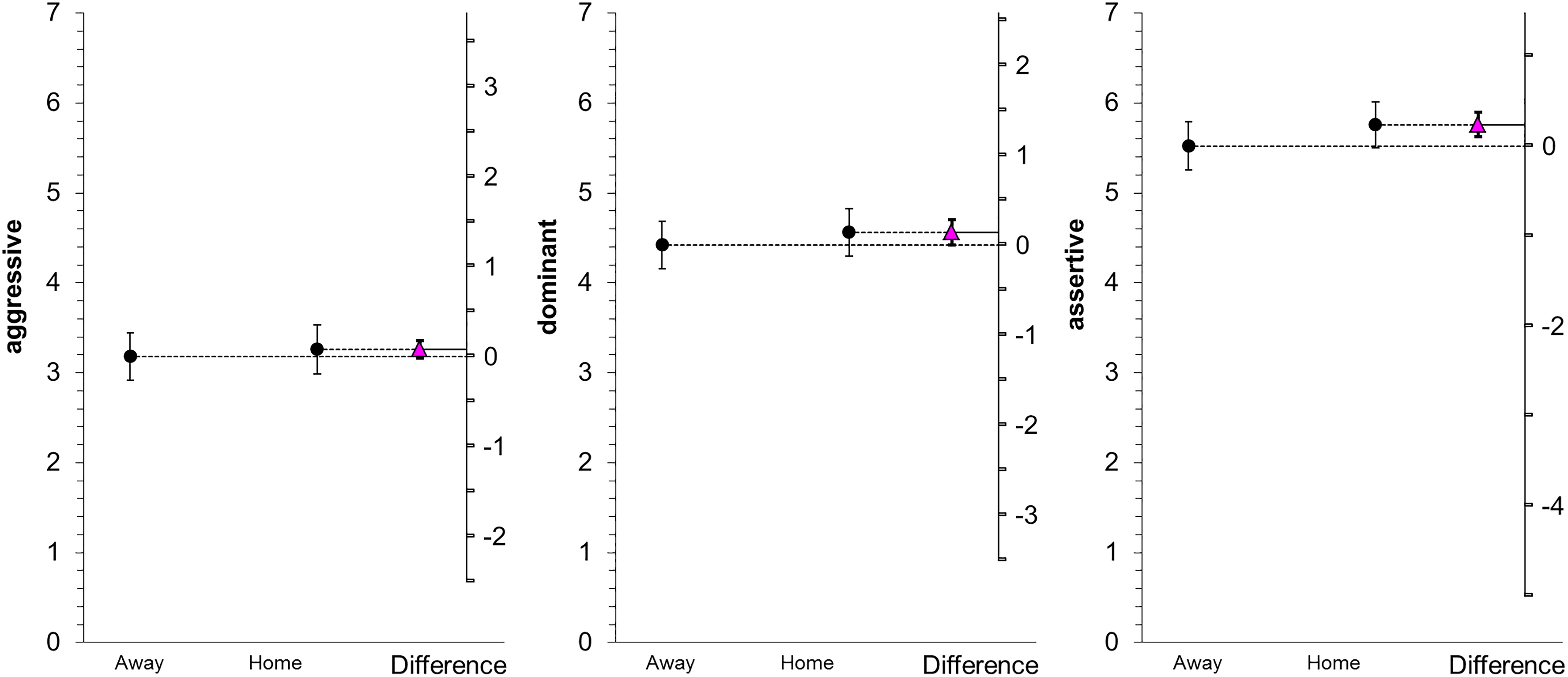
Mean aggression (left), dominance (middle), and assertiveness (right) of the group viewing digitally modified jerseys ratings as a function of game location in Experiment 2. Error bars represent 95% confidence intervals.
A 2 × 2 (Gender [Male, Female] × Location [Home, Away]) MANOVA on the three dependent variables using Pillai’s trace revealed a significant main effect of game location on overall perceived territoriality of the targets,
Group Without Jerseys Changed
The descriptive results are displayed in Figure 4. Including all 3 items in a reliability analysis for a combined territoriality scale resulted in a Cronbach’s α of .81 (Intercorrelations: Dominance × Assertiveness = .789, Dominance × Aggression = .627, Aggression × Assertiveness = .379). A 1 × 2 Location (Home, Away) MANOVA on the three dependent variables using Pillai’s trace revealed a significant main effect of game location on overall perceived territoriality of the targets,

Mean aggression (left), dominance (middle), and assertiveness (right). Ratings of the group viewing the original jerseys as a function of game location in Experiment 2. Error bars represent 95% confidence intervals.
A 2 × 2 (Gender [Male, Female] × Location [Home, Away]) MANOVA on the three dependent variables using Pillai’s trace only revealed a significant main effect of game location on overall perceived territoriality of the targets,
Discussion
Results of Experiment 2 support the territoriality hypothesis. The results of both groups (with altered jerseys and with original jerseys) were similar, although the effect of game location was larger in the group that viewed players with original jersey. Hence, home and away athletes appear to differ in their nonverbal behavior prior to a match depending on game location by showing more assertive and dominant behavior, while further appearing more aggressive (not significant in the group with changed jerseys). The behavioral dimensions of assertiveness, dominance, and aggression have all been linked to territoriality in the past (Dabbs et al., 1997; Edney, 1974; Gleason et al., 2009; Jansen et al., 2011; Mazur, 2005; Mazur & Booth, 1998; O’Connor et al., 2002). Therefore, it seems likely that the results are about nonverbally communicating territoriality and not some other dimension of nonverbal behavior, for example, coalitional behavior (Platten, Hernik, Fonagy, & Fearon, 2010)—that is, athletes feel more comfortable and friendly in front of a supportive home crowd as compared to an away crowd and this is what shows in their nonverbal behavior. If the coalitional explanation were true, we would not have expected the finding that athletes playing at home were rated as more aggressive and more dominant as this is not typical when showing coalitional behavior (Platten et al., 2010).
To gain further confidence in the territoriality conclusions drawn from Experiments 1 and 2, we tested if perceivers can distinguish between home and away athletes that are not playing in front of large crowds in amateur soccer. In this respect, Experiment 3 was in line with the call by Fiedler (2011) who pointed out the necessity of replicating effects found with one set of stimuli with different stimuli to ensure that the phenomenon of interest does not only apply to a highly specific set of stimulus material but applies generally for the phenomenon of interest.
Experiment 3: Territoriality at Amateur Soccer Games
Method
Participants
A total of 112 new participants without any particular soccer experience took part in the study (17 women and 95 men;
Stimuli
For the video stimuli in Experiment 3, a research assistant filmed amateur soccer players prior to a game of the lowest German soccer league with a telephoto lens (Canon 55–250 mm). Figure 5 shows an example image taken of one of the experimental stimuli. The selection criteria were identical to Experiment 1 and again 39 away and 39 home clips (with comparable resolution and length) were included in Experiment 3. From the total of 78 clips, the software randomly choose 20 home and 20 away clips that were presented to participants in random order (identical to Experiment 1).

Sample image from an experimental stimuli used in Experiment 3. The black bars over facial features of players were not present in the videos that participants watched.
Measure and procedure
The procedure was identical to Experiments 1 and 2, only that participants this time had to both estimate which team was playing at home or away and rate the perceived players in terms of aggression, dominance, and assertiveness. Perceivers rated the short video scenes on four continuous digital semantic differential scales after every video. They were asked whether they thought that the displayed soccer players were more likely to play at home or away. In order to give their ratings, perceivers moved a mouse cursor from the middle of the scale toward either pole of the scale and logged in their rating by clicking the left mouse button. The software converted the ratings into a value between 0 reflecting the left pole of the scale with the label
Results
The descriptive results for the home versus away ratings are displayed in Figure 6. A dependent

Mean ratings as a function of game location in Experiment 2. Error bars represent 95% confidence intervals.
The descriptive results of the aggressive, dominant, and assertive ratings are displayed in Figure 7. Including all 3 items in a reliability analysis for a combined territoriality scale resulted in a Cronbach’s α of .87 (Intercorrelations: Dominance × Assertiveness = .853, Dominance × Aggression = .706, Aggression × Assertiveness = .561). A 1 × 2 Location (Home, Away) MANOVA on the three dependent variables using Pillai’s trace revealed a significant main effect of game location on overall perceived territoriality of the targets,

Mean aggression (left), dominance (middle), and assertiveness (right). Ratings of the group viewing the amateur players as a function of game location in Experiment 3. Error bars represent 95% confidence intervals.
A 2 × 2 (Gender [Male, Female] × Location [Home, Away]) MANOVA on the three dependent variables using Pillai’s trace only revealed a significant main effect of game location on overall perceived territoriality of the targets,
Discussion
Results of Experiment 3 support the territoriality hypothesis and replicated the effects of Experiments 1 and 2 with different stimulus material. Analogous to professional soccer players playing in front of large audiences, home and away playing amateurs appear to differ in their nonverbal behavior prior to a match. Even when hardly any spectators are watching, amateur players are recognized by perceivers as playing at home or away and rated differently in terms of assertive, dominant, and aggressive nonverbal behavior. In general, the effect sizes in Experiment 3 were larger than in Experiments 1 and 2, suggesting that the effects are most likely not due to coalitional behavior (Platten et al., 2010) elicited by athletes playing in front of large supportive or opposing audiences.
General Discussion
The aim of the present study was to investigate whether soccer players display nonverbal cues that have been associated with territoriality depending on whether they are playing at home or away. Experiment 1 showed that perceivers of pregame nonverbal behavior of professional soccer players were able to detect who is playing at home or away. Thin slices of behavior (very short recordings of athletes’ behavior prior to a match) were sufficient to distinguish between athletes playing at home and away. Experiment 2 provided first evidence that this was most likely due to the fact that home playing athletes signaled relatively more assertive, dominant, and (possibly) aggressive nonverbal cues compared to playing away. The same pattern of results was evident among amateur soccer players who were not playing in front of a large audience in Experiment 3. Hence, the present research was the first to show that game location in sports is associated with nonverbal cues that might be linked to an evolved territorial response.
Edney (1974, p. 959) defined human territoriality “as a set of behaviors that a person (or persons) display in relation to a physical environment that he terms ‘his’, and that he (or he with others) uses more or less exclusively over time.” This set of behaviors seems to include showing more assertiveness, dominance, and possibly more aggression when awaiting a confrontational situation on “home turf” in competitive sports. The findings add to the growing literature on nonverbal behavior in sports. Research on nonverbal behavior in sports has shown that nonverbal behavior occurring during the game can be interpreted as cues as to who is currently leading and who is trailing (Furley & Schweizer, 2014b) and that these changes affect the confidence levels of opponent athletes (Furley & Schweizer, 2014a; Greenlees, Buscombe, Thelwell, Holder, & Rimmer, 2005), presumably because communicating status and dominance in confrontational encounters can be considered an adaptive mechanism organizing group life (Furley & Schweizer, 2016; Furley, Schnuerch, & Gibbons, 2016). In this respect, both the communication of territoriality and dominance can be considered an important adaptive mechanism promoting social order in groups and helping to avoid harmful overt aggression (Lorenz, 2002): territoriality by giving structure spatially and status and dominance hierarchies by giving structure socially (Edney, 1974). This theorizing is supported by de Waal’s (2007, p. 87) observation among primates emphasizing the importance of nonverbal communication in avoiding aggression: “About one conflict in a hundred leads to a real fight, that is, 0.4 percent of all confrontations between males. The threat of a fight is, however, always there, and it is this that makes the dominance process so tense.” According to Mazur (2005, p. 2), dominance hierarchies of group-living animals probably evolved from the impulse to defend territory: “If normally solitary animals are forced together by circumstance such as scarce food supply, then actions that usually keep them spatially separated have the effect of ranking them ‘vertically’ by power and privilege.”
The main finding of the present research is supportive of the territoriality hypothesis (Neave & Wolfson, 2003) in competitive sports which suggests that humans show a natural (evolved) protective response to territorial incursion. To date, support for this hypothesis has almost exclusively been derived from studies investigating testosterone concentrations of athletes as a function of game location, while behavioral studies have been scarce among humans. Animal studies have shown that laboratory mice show more offensive aggression in their home environments (own territory) compared with neutral or rival territory (Gleason et al., 2009; Jansen et al., 2011). Similarly, there is evidence that higher levels of testosterone also predict aggression in humans (Carré et al., 2013). The only behavioral study we are aware of in the field of sports did not find that home teams displayed more overt aggression as compared to away teams (M. V. Jones et al., 2005). Not finding more overt aggression during competition as a function of territoriality might be explained by rules preventing aggression that are implemented in various sporting context. The nonverbal behavior prior to a game, however, was rated as more aggressive, particularly among amateur soccer players. The present study is the first to show a behavioral territoriality response of athletes depending on whether they play at home or away. This finding might add on to literature on the home advantage in sport (see Allen & Jones, 2014, for a recent review). The home advantage is based on a large body of research showing that athletes and teams perform better when they compete at home compared with away. Although the home advantage is not unequivocal and is more prevalent in some sports as compared to others (M. B. Jones, 2013), “there are no sports in which athletes or teams are more successful away from their home venue” (Allen & Jones, 2014, p. 48).
The “classical model” (see Allen & Jones, 2014, for a recent review) of the home advantage assumes four main factors that contribute to the advantage: the support of the home audience, travel fatigue of the away team, familiarity with the home venue, and rules or referee decisions that might favor the home team. Alternatively, the territoriality model assumes the home advantage to be a manifestation of natural protective physiological and behavioral responses to protect one’s territory (Neave & Wolfson, 2003). Allen and Jones (2014) assume that the territoriality response (including higher levels of testosterone) contributes to the home advantage by increasing risk-taking behavior, improving metabolic rates of muscles, and by improving spatial ability (M. V. Jones et al., 2005). The present research might point to a further mechanism as to how the territoriality response contributes to the home advantage: Athletes seem to change their nonverbal behavior depending on game location prior to the game and this can reliably be recognized by observers. For example, they may enter the playing field more erect and perform their warm-up routines more assertively and dominantly. In turn, opponents might pick up these nonverbal cues and might be affected by them as has been shown in previous research which demonstrated that certain nonverbal displays affect confidence levels and outcome expectations of athletes (Furley & Dicks, 2012; Furley, Dicks, & Memmert, 2012; Furley & Schweizer, 2014a; Greenlees et al., 2005) and even behavior (Furley, Dicks, Stendtke, & Memmert, 2012). However, we acknowledge that this is speculative at present and that this assumption has to be tested directly by future research.
The present research approach has some notable strengths and weaknesses. We consider it a strength that our stimulus material shows naturally occurring nonverbal behavior before sports competitions, instead of being artificially created. In addition, different participants were randomly shown different subsets of the stimulus material from both professional and amateur soccer. This reduces the likelihood that results are dependent on one particular set of stimuli. The multistudy nature of the present research can also be considered a strength and demonstrates the robustness of the findings. Further, all studies were adequately powered to detect small effects (equivalent of
The main limitation of our research is that game location might be confounded with some variable other than nonverbal behavior. We eliminated the confound of jersey color and potential familiarity with the stadium in Experiment 3 but cannot entirely rule out other confounding variables. If game location is correlated with a variable other than nonverbal behavior, participants might use this variable to arrive at accurate game location estimates and this might have influenced assertiveness, dominance, and aggression ratings. Although we tried to make sure that stimulus selection was not biased, we cannot entirely rule out this possibility. However, some factors speak against the alternative interpretation that participants based their judgments on some other variable than nonverbal behavior. In Experiments 1 and 2, accuracy of game location estimates was not correlated with domain-specific knowledge. Furthermore, the alternative variable would have to be one that participants are able to exploit within a very short amount of time. Besides nonverbal behavior, it is hard to think of a factor that might be inherent in our stimulus material and that perceivers can use in order to correctly infer game location. A further limitation of the present study was that we used a continuous scale to have participants rate whether athletes were more likely to be playing at home or away instead of a dichotomous variable in Experiments 1 and 3. The rationale for this was to be able to detect more subtle influences of the multiple cues present in the stimulus material on participants’ ratings that might not have been influential enough to influence all-or-nothing dichotomous home or away responses. Further, the utilized measures might be considered a limitation as the specific measures used in the three experiments have not been validated. However, the measures were analogous to previous measures of nonverbal behavior (e.g., Rule et al., 2012) and were carefully chosen according to recommendations of the thin slices research approach (see Ambady et al., 2000; Carney et al., 2007). Finally, it is not completely clear whether the results reported in this study are in fact about territoriality as we have argued throughout the manuscript. For example, it remains possible that participants’ ratings in Experiments 1 and 2 might have been informed by coalitional nonverbal behaviors (Platten et al., 2010) that athletes displayed to different extends depending on whether they were playing in front of a friendly home crowd or an opposing away crowd. However, this alternative explanation is hard to reconcile with the differences in dominance and aggression ratings of Experiment 2 and by the findings of Experiment 3 that demonstrated that perceivers can distinguish between home and away athletes who are not playing in front of large crowds.
In line with the theoretical conceptualization of territoriality “as a phenomenon that links behavior to geographic places” (Edney, 1974, p. 963), the present research suggests that professional soccer players might adjust their pregame nonverbal behavior depending on game location by displaying more confidence, dominance, and aggression when playing at home as compared to away. Perceivers were well equipped to pick up these subtle changes in nonverbal behavior as they could distinguish between athletes playing at home or away based on thin slices of behavior. Given the difficulty to investigate human territoriality due to the challenge to induce territorially in a laboratory, both theorizing and empirical evidence have been scarce in the past (Edney, 1974) and remain scarce today. Therefore, we consider sports a suitable field to enhance understanding of human territoriality and, in turn, the home advantage.