







Abstract
Introduction
This article reflects on a funded participatory action research artmaking project that investigated the experience of displacement for people forced by persecution and torture to flee their homeland. The research took place during 2017–2019 within an overarching aim to improve the wellbeing of the group. We use a Deleuzoguattarian framework to reflect on the programme in order to discover insights into how the generation of new thoughts associated with past experiences, potentially enabled their reframing. Specifically, we examine the program’s potential to facilitate change for displaced people in their relationship to self and identity, and capacity to contribute to their healing.
As art and health researchers we have a specific interest in the mental health problems of migrants and refugees. We developed the project
The
The
The project is informed by a Deleuzoguattarian framework, where Deleuze and Guattari argue that knowledge is multiple, contextual and relational, and propose that meaning is constructed, or mapped, from semantical territories composed by ‘rhizomatic’ networks of connected ideas (Deleuze and Guattari, 1988). We understand rhizomatic here as non-hierarchical knowledge production, akin to the way under-ground rooted structures grow and branch horizontally, with no unified structure or centre of power. Integral to this framework is the concept of deterritorialization, seen as a disruption between an individual and experiences associated with a certain location in space and time. It describes the movement by which one leaves a territory, to constitute and extend the territory itself, involving destabilization of habitual ideas and practices, creating the possibility to journey into ‘completely new territory’ (Smith, 2016, p. 2). Thus, deterritorialization entails practices of extending the territory from where something originates, by connecting it to other territories in order to seek change. Artmaking, from this perspective is seen as a deterritorializing method (Deleuze and Guattari, 1988) to create new ways of thinking, (also see Smith (2016). We investigate deterritorialization as a vector able to effect changes in self, here in transition between participant’s original homeland and new homeland.
The artmaking workshops considered the theme of landscapes, loosely defined as places and spaces (i.e. territories) associated with safety. The intention was to engage participants in remembering past, potentially traumatic, experiences within a new creative and contained environment. We hoped this context would extend the territory and create new thinking associated with their previous experiences to enable their reframing.
Method: A Deleuzoguattarian framework leading to change
The action research method included a cyclical reflexive feedback loop of information comprised of six stages (see Figure 1) repeated over ten weekly workshops and a reflective workshop at the end of the project. In addition, participants completed a short demographic questionnaire (age, homeland and years lived there, whether family still lived there, positive associations with their homeland, any experience of artmaking) and the self-reported measure (WHO-5) Well-Being Index, establishing a base-level of each participant’s well-being at the start of the project, repeated in week five and in the final workshop in week ten. Following the workshops, we invited participants to individual 30–45 minute semi-structured interviews; and a joint interview with two of the FfT psychotherapists who were providing therapeutic support for the participants.

Table of activities.
The action research design as a cyclical reflexive feedback loop, illustrated in Figure 2 included the contribution of psychotherapists at each stage, in a clinical capacity in the individual sessions with each participant as client with their interpreters, and as a presence in the workshops. Although, for reasons of confidentiality the content of clinical sessions was not disclosed to the project team, participants and their psychotherapists noted that sessions included discussions of, and reflections on, their artworks. These sessions influenced what participants brought back into workshop sessions and was felt by them to potentially reinforce beneficial shifts in their thinking.

Diagram of cyclical feedback loop.
The co-design element empowered participants in the design of the weekly workshops, by providing opportunities to make suggestions at the beginning and at the end of workshop sessions for following workshops, and these were integrated as appropriate. For example, participants suggested in the pilot phase that they would like more modelling materials. In the next phase we provided a wider range of materials including sand and clay. In the workshop with 3 D modelling participants initiated making clay pots and pans and performed ‘cooking’ food associated with their homeland, colouring them with paint, and ‘sharing’ the food with each other. This prompted a lot of laughter and strengthened the bonds between participants, even where language was a barrier.
The action research cyclical feedback model echoes Deleuze’s core philosophical ideas about interactive dimensions of ‘three spheres of reality’ (Delanda in Buchanan and Lambert, 2005, p. 86), the ‘actual’, the ‘intensive’, and the ‘virtual’ (Deleuze, 1994). For Deleuze, both the actual and the virtual are real. Whilst, the actual has concrete existence, the virtual does not, but it is no less real for not having a concrete presence in the world. There are many interpretations of this complex notion, but a simple analogy is provided by Buchanan (2010) who suggests the virtual is equivalent to a computer screen, it may only exist in a virtual space but although its physical interactions happen at the level of hardware, its effects upon us are none the less real. Building on Deleuze’s notion, the virtual has also been interpreted as the realm of ‘ideas’ or ‘affects’ (O’Sullivan, 2001). Deleuze explains the actual as in a continual state of movement; things are continuously changed by our thoughts of them. The virtual, described as the background to the actual, holds the potentialities through which the actual is actualized.
The virtual and the actual constantly interact and modify each other through ‘intensive processes’ and, as a consequence, the world is constantly transformed. The intensive are processes that affect, for example, thoughts, memories and feelings (Drummond and Themessl-Huber, 2007, p. 435). Following O’Sullivan (2001, p. 129) we propose that the reflective processes of artmaking are intensive processes because these can actualize ideas or affects. For example, in the process of thinking of an idea, the thinking is an ‘intensive process’ that generates actual knowledge, for example in the shape of an artwork or a piece of writing. Simultaneously, that knowledge adds new elements to that idea and hence, it changes it. Therefore, virtual and actual are generative entities; the actual stems from the virtual through sensuous experiences and the virtual is a potentiality that becomes actualized. For example, memories of experiences marked by particular affects define the continually developing thoughts that shape the sensations related to those experiences. In turn, this shapes behaviour.
Taking part in the project could have re-traumatized participants, and as noted earlier we were careful to design the research to reduce this as far as possible, by encouraging a focus on the positive associations with landscape and providing a sensitive, supportive workshop environment. Our findings suggest that re traumatization was mostly averted and where there were difficult memories artmaking was helpful. From a Deleuzian perspective, the potentialities of the virtual (affects and ideas) may be modified when actualised within the reflective processes of artmaking, as new experiences are generated in the course of expressing thoughts and memories. This process, arguably, may reaffirm (more hopeful) new and different potentialities of the virtual.
Within the art workshops we invited participants to express spaces and places they had experienced as safe-havens, loosely referred to as ‘landscapes’. These might be recalled from their country of origin, experienced on their journey of migration, imagined as a place that they would like to go, or representative of their life in the UK. Participants made paintings, drawings, and collage, using acrylic paint on canvas, board or paper, crayon and pencil, felt, wool, stones, feathers, clay, and plasticine etc.
Self-expression, and finding a voice through artmaking was sometimes difficult for the participants in the early stages of the programme and sometimes involved contradictory emotions. The two examples below are typical of artworks made in the first few workshops where participants’ explored imagery associated with their trauma. Samuel’s (all names are pseudonyms) painting clearly demonstrates this, where he began painting a landscape in bright colours, depicting his mother making cassava for dinner, and then as the realisation of his image settled with him, he over-painted it in dark colours.
Workshop 3.
For several early workshop sessions Pierre was unable to find anywhere safe to depict.
Workshop 2.
There was a noticeable shift from depicting traumatic associations to imagery depicting more positive experiences whether in their past or present lives. subject-matter that expressed past events explored in early workshops to imagery that was more concerned with current experiences and present lives. This change in associations appeared to reflect transitions in thinking, and was usefully explored within the action research process by researchers, participants and their interpreters and psychotherapists in the course of the workshops.
A process of becoming
In order to capture fully the experiences of participants engaged in the
Our understanding of Barad, and Allegranti and Wyatt (2014) led us to infer the ‘entanglement’ of phenomena as one in which each of us is an observer, each bear witness to each other and to everything. Acts of observation were enacted by us all as witnesses in the room – participants, interpreters, the psychotherapists. We can see everyone as porous entities to each other, and to the phenomena encountered. We were immersed in and being produced by a process of becoming. The materials of the workshop, its layout, the building, its clinical rooms, the walls filling up with exhibited artworks, these were the fabric that contained discussions, the quietness of concentration, decisions, indecisions, disappointments, and achievements. It felt that over the duration of the weekly workshops, we became more porous to each other, and to materialities around us. The project team and participants got to know and trust each other. Participants noted that they developed confidence in our ability to help them imagine and realize places they wanted to materialize, encouraged by instruction in basic art techniques and skills. From the start the emphasis was on facilitating individual expression rather than expertise. In this way participants were empowered to decide what they wanted to do in their artwork, to determine their own pace, make suggestions on workshop content, materials used, and organization of the room. In this environment, participants began opening up to share more openly details of their stories, to each other and to us.
The project team engaged in two debriefing sessions after each workshop, first with the psychotherapist and interpreters, and second, with each other. Engaging with the participants meant we encountered their very difficult experiences leading to exile, their trauma and continuing problems. At times we were deeply affected by their experiences, particularly if they echoed our personal histories and circumstances. In week 5 of the fieldwork, when there was a break in the weekly sessions, we set up our own artmaking workshop to express some of the difficult emotions we were experiencing, and to externalise some of the deeper ways in which painful emotions had been triggered (see Figures 5 to 7). The sessions opened up lines of communication between us and levelled the distinction between us as project team members, and the clients as participants whom we observed. After our workshop we connected our participation with observation in what was significant in ourselves, each other, and the clients.
Figure 5. “As a migrant myself,

Image by Samuel, originally from Togo, Africa.
Figure 6.

Image by Pierre, originally from Central African Republic.
Figure 7.

From left to right, images by the project team.
Shifts were occurring in us, and in the participants. One of the ways this became apparent was observable in the subject-matter of participants’ artworks. As the weekly workshops progressed, the predominance of imagery in early workshops depicting traumatic events shifted to images reflecting experiences in current lives, and to experiences encountered in the workshops, including depictions of the building itself. For example, Karnou, made a painting of his national flag in workshop 4, describing the fighting that led him to leave his country “

Image by Karnou, originally from Central African Republic.
The materials of artmaking were agents for imaginative transformation as they were spilled or brushed, moulded by hands, drenched in colour or subdued into greys and blacks. Through reciprocal witnessing and supporting actions, artworks and knowledge emerged, human and non-human phenomena coming together collaboratively in a creative, experiential encounter, augmenting the Deleuzoguattarian framework of interactive spheres. Through the workshops, discussions, debriefing sessions, we created opportunities for the inexpressible to emerge, through voices and through visual imagery, to give a voice to what had been unsayable. These were reflected upon, within the workshop and in the psychotherapy, as agents in the cyclical reflexive feedback loop of reflection, action and intra-action. The intensive processes of actualization from the virtual encountered within the generation of new potentialities were seen in the form of the artmaking and reflective sharing.
Observable changes took place over the course of the workshops, as participants bore witness to testimonies and emerging artworks. Another example of a trajectory of change is evident in Ashan’s paintings; his early work depicted traumatic events that led to his exile (see Figure 9) whilst later workshops depicted more positive memories associated with his life in Sri Lanka (see Figure 10).
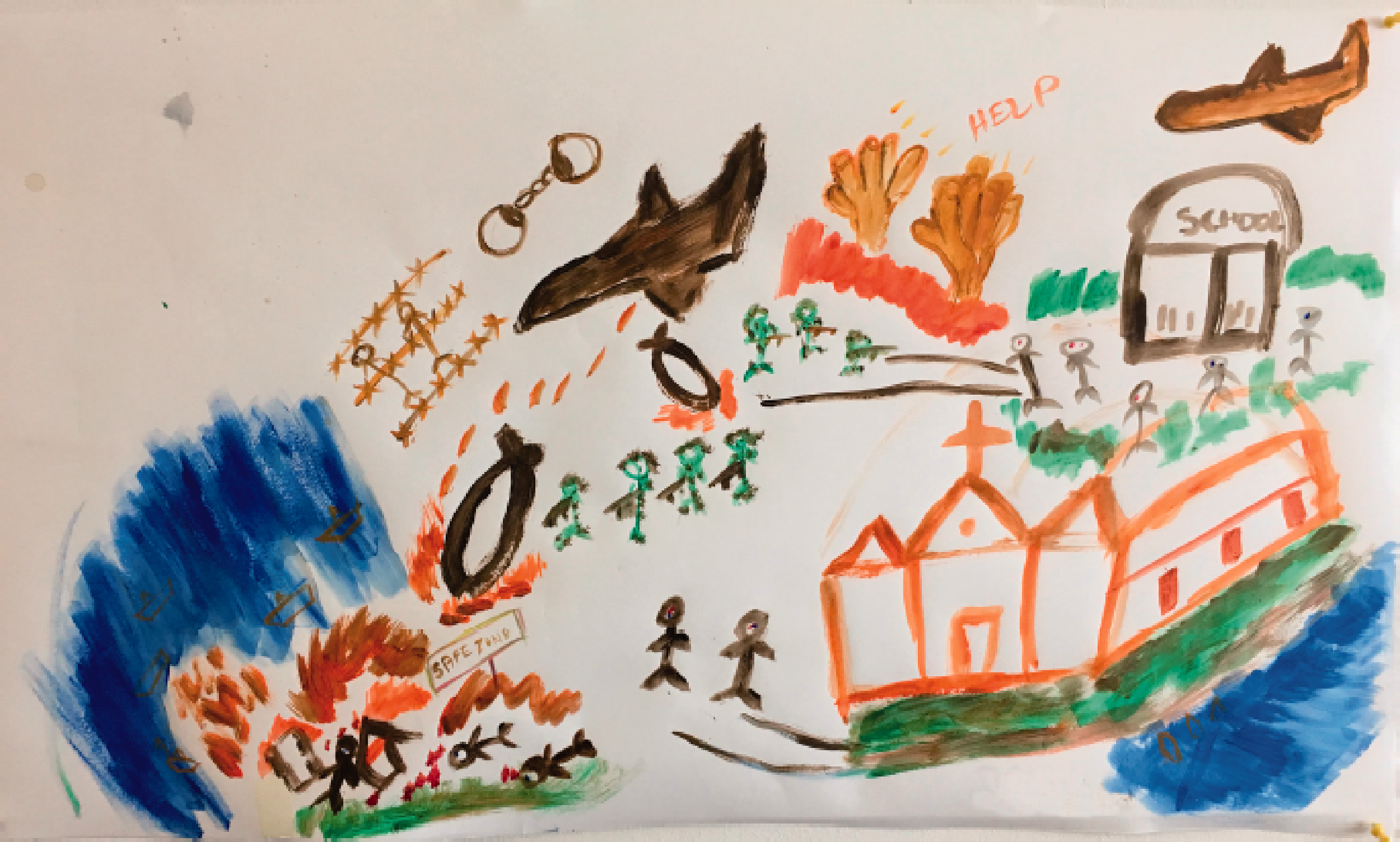
Image by Ashan, originally from Sri Lanka.

Image by Ashan, originally from Sri Lanka.

Image by Roshan, originally from Sri Lanka.
Workshop 1. The image shows the bombing of a town, a school, and a church. There are dead people in the ‘safe zone’, barbed wire and handcuffs. Ashan explained:
By Workshop 4 Ashan was able to paint this, as he recalled
Similarly, images by Roshan (see Figures 11 to 13) changed over the course of the workshops from images concerned with the reasons why he had to leave Sri Lanka, to those that evoke fond memories.

Image by Roshan, originally from Sri Lanka.

Image by Roshan, originally from Sri Lanka.
Workshop 3.
Workshop 5. Roshan described his painting:
Workshop 6. Roshan modelled his artwork in sand, clay and plasticine on card, explaining:
We have seen in the examples above how processes of change were expressed in artworks. Images moved beyond depictions of initial events related to trauma, to places associated with safety, safe places in their original homeland, and the safe place of the building within which workshops were experienced.
The next section draws on the Deleuzian concept of rhizomatic growth to explore
Lines of flight leading to change
The Deleuzian idea of rhizomatic growth (Deleuze and Guattari, 1988) offers potential in the field of action research as an alternative to what can be described as an arborescent (tree-shaped) structural model of knowledge dominant in the West. The arborescent is based on hierarchical growth with relatively limited and regulated connections established between its components (Bogue, 1989). This is based on the repetition of existing dominant models of thought, the dissemination of similarities and ‘the elision of difference’ (Bolt, 2004, p. 40). In other words, the arborescent as a framework reproduces existing dominant patterns of thought instead of promoting the creation of new knowledge and ways of thinking that could transform the current state of affairs.
In contrast, Deleuze describes a rhizomatic model, inspired by botanical structures that typically are root-like, underground stems that grow and branch horizontally. The rhizome, in Deleuzian terms, is a non-representational model of knowledge production that defines non-hierarchical and horizontal expansion, not subsumed within a unified structure or a center of power. The rhizome forms unregulated networks that generate multiplicity and heterogeneity (Deleuze and Guattari, 1988). Instead of building from doubling and reflecting, this model embraces the creation of new knowledges, through an establishment of different connections between already existent elements. In other words, the rhizome model praises difference, and sees difference as a constructive and creative tool. To imagine an experience as rhizomatic is to accept that the experience itself can grow beyond its extremities or limits. Processes of action research generated rhizomatically can be termed
Thinking about Deleuze and Guattari’s (1988) notion of ‘assemblage’ in this project we consider the identity of an individual, as an assemblage in a permanent state of becoming, constantly under construction and modified by their experiences within unfolding dialogues. Identities emerge through the intra-actions between the individual, objects and associated phenomena. Identity is conceptualized as a dynamic grouping of memories, experiences, and thoughts, not as fixed self, but as an assemblage in becoming affected and transformed by objects and all phenomena, including every new artwork (Rioseco, 2018, p. 108), and from the now extended network (rhizome) from which they constantly originate. As Deleuze and Guattari (1988, p. 8) suggest, what characterises an ‘assemblage is precisely the increase in the dimensions of a multiplicity that necessarily changes in nature as it expands its connections’.
This notion is similar but different to the model developed by Smith (2016) who also explores Deleuzian action research through artmaking as deterritorializing method (Smith, 2016). Smith understands her territory not as a static, stable entity, but a grouping of ‘objects, bodies, expressions, and qualities, localizable at a particular point in space and time’ (Smith, 2016, p. 38). She suggests that if action research is defined as a
In Figures 14 to 17, artworks by Thierry represent the process whereby new artworks grew from each other. In his case, from painfully distressing representations of the past, to images where he was able to connect with more positive memories, thoughts, and the start of a shift in his self-identity. The connection between past and present opened new potentialities, new thoughts that deterritorialized the originals, contributing to a stronger sense of self.

Refugee camp, with mother (cooking) and father (with tools), and people playing football. Image by Thierry, originally from Rwanda.

Church in the refugee camp in Malawi Africa, image by Thierry, originally from Rwanda.

Football pitch in UK, image by Thierry, originally from Rwanda.

A garden in UK, image by Thierry, originally from Rwanda.
Workshop 1. Thierry reflected:
Workshop 3. Thierry explained:
In Workshop 4 Thierry described the solitude of his life in the UK and feelings of intense loneliness caused by separation from his family:
Workshop 7. Thierry explains:
We suggest the practice of artmaking produced a deterritorialization of memory, thought, and identity over the duration of the project. Participants’ exposure to the intra-action of the phenomena they encountered, the safe space, artworks, supportive others, the past and its connection to the present, reflection and feedback etc. became relevant parts ‘entangled’ with their experiences of trauma, such that the original experiences were changed. The creation of artworks offered new agents of deterritorialization within clients’ experiences and identities-in process. This notion was reinforced during semi-structured interviews with the research team after completion of the workshops.
For example, Pierre looked again at the artworks he produced and described how in Workshop 1, he wanted to show himself
In the interviews, when looking at their artwork during the workshops, participants experienced a range of emotions from sad and difficult, to more positive. This process suggests they were able, through the artmaking to reterritorialize and connect their past memories and events associated with original homelands, with their current lives in the UK.
Karnou looking at his artwork said
An individual’s identity is understood here as a dynamic and fluid assemblage, composed by multiplicities of agents – that is, other identities, objects, bodies, experiences. The identity and the agents are constantly forming and changing, new entities emerging at particular points in space and time. This potential for constant transformation is what principally characterises an assemblage. In other words, an individual’s identity manifests in this context as an assemblage in
Similar transitions in self and identity were described by Marie, illustrated by the trajectory of her artworks (Figures 18 to 21 ). By Workshop 7 Marie was able to introduce new positive experiences in her present life (the LGBT community) from the old connections with distressing past events that led to her trauma and exile. The actualization of these new positive experiences expressed through her artworks, prompted new thoughts about her current situation “

Image by Marie, originally from Cameroon.

Image by Marie, originally from Cameroon.

Image by Marie, originally from Cameroon.

Image by Marie, originally from Cameroon.
Workshop 3. Marie describes this scene:
In Workshop 4, Marie explains:
In Workshop 5, Marie explained: “
By Workshop 7, Marie was happy to tell us:
The project team experienced changes in their thinking. For example, one of researchers said: “
The programme’s cyclical feedback loop within the Deleuzoguattarian framework suggests properties of the virtual (ideas and affects) are actualized (artworks, people, room, intra-action etc.) through the intensive practice of artmaking (creative actions driven by memory, thought and self-perception). The interaction between the actual and the virtual generated new memories and thoughts, which further change self-perception. Thus, properties of the virtual associated with those memories and thoughts were experienced differently from before, they returned differently from previously held memories and thoughts, to modify our becoming, generating change and transition in the individuals.
Conclusion
An important reflection on the research was whether the artmaking process had the potential to disrupt the pattern of continually being caught in old memories and feelings associated with a virtual sense of trauma. Did the artmaking, by facilitating the generation of new ideas and ways of thinking about difficult experiences, have the potential to enable their reframing? Exploring the Deleuzoguattarian framework gave us insight into a process of disruption, where deterritorialization extended the territory from where thoughts originated, by connecting them to other territories, initiating their change. New knowledges were achieved through a continual return of difference from the virtual to the actual, a process that took place through intensive processes of actualization embodied in the concrete practice of artmaking. The actual, or life in all its forms –artworks, memories, traumas, emotions, places, people, buildings, smells, sea, wind, thoughts, and consciousness were dynamic and in a continuous state of process, constantly being actualized through artmaking. We argue that in actualizing the virtual, the memory, thought, and identity associated with trauma, though the intra-actions with processes of artmaking, participants were enabled, to some degree (depending on the level of engagement with the workshops) to generate new experiences in association with previous experiences, modifying their process of becoming. The participants who were able to attend most if not all workshops tended to report the most change. The process generated change and transition for these participants in relation to their experiences of trauma.
For instance, Marie’s experiences in her homeland leading to her persecution, exile and separation from her children, were reframed by the artwork of the LGBT flag. The flag signalled recognition that she was now safe, and had found a supportive, accepting community, and identity within it. This helped to give new positive qualities to her identity in becoming. Pierre was able to come to terms with difficult memories from the past and concretely actualise positive elements of his present life in baking and making. Reflecting on his artworks he acknowledged his skills and formed new ideas about being able to bring joy to people, and so enjoy his life. Thierry, who could only bring himself to remember the past with great pain and sought to avoid remembering the past, found solace in recollecting being with his mum, dad, siblings, and playing football, memories he was able to bring into his present life in artworks. His artworks connected his past with his present, strengthening self and identity, and his self-reported enjoyment of things in the park, albeit that he was still alone.
Artmaking involved creative acts, bringing new experiences of artworks, people, room, intra-action etc., into imaginative visualization and realization. As they returned to the idea of the place through artmaking, there was potential for their memory, thought, and identity to be revised; the places they could barely think of for the reasons why they fled, seemed now, from here, different. The places were not quite the same anymore, because in the process they had changed,
The Deleuzian framework highlights processes of action research where knowledge is produced rhizomatically, non-hierarchically, to generate lines of flight. These new thoughts grew from reflexive practices of artmaking to form new networks of new thoughts in relation to memory and identity. Deterritorialization disrupted participants’ habitual ideas and practices, prompted by a continual process of reflection through artmaking, produced new potentialities, new knowledges, and the establishment of different connections between already existent elements. Artmaking actualized difficult associations related to homeland and trauma, from where they constantly returned from the virtual background of contingent potentialities, returning differently with new qualities. This perspective also acknowledges and embraces multiplicity and heterogeneity and the creation of new knowledge, identifying difference as a constructive tool. The cyclical reflexive feedback model understood through the Deleuzoguattarian conceptual framework, demonstrates how participatory action research can be deeply transformative.
Footnotes
Declaration of conflicting interests
Funding
ORCID iDs
