







Abstract
Keywords
Introduction
According to the World Health Organization, 1 the aging population will rise to nearly 25% of the global population in 2050, and this number can even reach 33% for the developed countries. The issues of elderly health care are becoming increasingly important, because more and more health problems occur with age, including heart disease, physical decline, and physical resilience decline. Therefore, developing intelligent elderly health care techniques is of vital importance.
The fast growing of wearable devices has brought their application in intelligent care, including smart bands2,3 and smart clothing.4–6 The wireless transmission modes include radio frequency identification device (RFID),7,8 Bluetooth, 9 and Bluetooth low energy (BLE).10,11 Great progress has been made in the field of intelligent care.12–21 Yao et al. 17 developed a low-cost interrogation system that was able to dynamically interrogate the antenna sensor and wirelessly transmit the acquired data to a smart device. Sundaravadivel et al. 18 introduced a piezo-electric-based accelerometer sensor design which helped in tracking the physical activities of family and friends. With the three-dimensional (3D) printing technique, Zhang and Amft 19 proposed a personal fitted regular-look smart eyeglasses frames equipped with bilateral electromyography recording to monitor the activity of temporalis muscles, so as to monitor chewing and eating. Daher et al. 20 developed smart tiles–based elder tracking and fall detection system, which used pressure sensors and accelerometers hidden under the smart tiles. Yao et al. 21 presented a compact antenna sensor interrogator for pressure sensing; they developed a frequency-modulated continuous wave generator to detect the resonant frequency of antenna sensors, which encoded the pressure information. However, an intelligent health monitoring system based on smart clothing, which provides integrated services such as cardiac function tracking and fall detection, is still lacking.
In this study, we designed and developed a smart clothing–based intelligent health monitoring system, which was composed of smart clothing and sensing component, care institution control platform, and mobile device. The smart clothing was used for electrocardiography (ECG) signal collection and heart rate monitoring. BLE was used for wireless data transmission.
The intelligent health monitoring system provided eight kinds of services for the elders, including surveillance of signs of life, tracking of physiological functions, monitoring of the activity field, anti-lost, fall detection, emergency call for help, device wearing detection, and device low battery warning. The system integrated our proposed Fast-EMD (empirical mode decomposition) algorithm for ECG denoising and HMM (hidden Markov model)-based algorithm for fall detection. Experiments were designed to evaluate the two proposed algorithms. Also, the proposed system was applied and evaluated in a real scenario of elderly health care.
This article is organized as follows. In section “Materials and methods,” methods are described. Experiments and results are presented in section “Experiments and results.” In section “Discussion and conclusion,” discussion and conclusions are given.
Materials and methods
System design
The architecture of the proposed intelligent health monitoring system is illustrated in Figure 1. The system was mainly composed of three parts: (1) smart clothing and sensing component, responsible for receiving data; (2) care institution control platform, responsible for health data analysis and abnormality alert; and (3) mobile device, responsible for displaying of data and warning of abnormal events, and for providing mobile services. The smart clothing collected ECG signals through four electrode patches and then transferred the analog ECG signals to the sensing component through conductive fiber. The sensing component converted the analog ECG signals into digital signals. The G-Sensor of the sensing component was used for collecting the gravitational acceleration (GC) data. The microprocessor unit (MPU) of the sensing component analyzed digital ECG signals and postures (GC) in real time using specific algorithms. The ECG and posture data were then transmitted through BLE, which were received by the BLE-to-WiFi receiver in the environment. The BLE-to-WiFi receiver transmitted the received data to the back-end management platform for analysis, where the data were finally converted into meaningful health data. The health data were presented in Web mode to the mobile device of the nurse station or the caregiver.

Architecture of the proposed intelligent health monitoring system.
The architecture of smart clothing and sensing component is shown in Figure 2. The design details of the smart clothing are illustrated in Figure 3. The smart clothing was made of conductive fiber. The four electrode patches on the smart clothing were used for collecting analog ECG signals, which were sent to the sensing component. The analog-to-digital converter (ADC) of the sensing component converted the analog ECG signals into digital signals with a sampling frequency of 250 Hz. The digital ECG signals were analyzed by the MPU of the sensing component to obtain the health data, which were sent as broadcast packets in a frequency of 1 Hz through BLE.

Smart clothing and sensing component.

Design details of the smart clothing.
The proposed intelligent health monitoring system provided the following eight kinds of services (Table 1):
Services provided by the proposed intelligent health monitoring system.

ECG signal denoising and heart rate calculation
ECG signals are strongly affected by movement artifacts, which must therefore be effectively removed.22–24 To this purpose, we used empirical mode decomposition (EMD)
25
to filter noise. Previous studies have demonstrated that EMD can reduce motion artifact and baseline wander of ECG signals.22–24 With EMD, the ECG signal,

The pseudo-code of the EMD algorithm is as follows:
Extract the 3.1.
3.2. Extract local maxima and minima of 3.3. Compute upper envelope 3.4. Compute the average of 3.5. Update: 3.6. Calculate stopping criterion: 3.7. Decision: repeat (3.2) to (3.6) until
Update residual:
Repeat (3) with
Stop when the number of extrema in
In this study, we improved the EMD algorithm to speed up the algorithm for wearable devices. First, calculation of

Flow chart of the proposed Fast-EMD algorithm.
With Fast-EMD, the denoised ECG signal,

Using the denoised ECG signal

where the

Illustration of QRS complexes and RR interval of ECG signals.
Fall detection
In this study, a fall detection method based on acceleration data and HMM proposed by our group was employed.
26
For completeness, the method is described in brief as follows. Accelerations along

Four states of a fall.
The different states of resultant acceleration are collected to build an HMM. We used the Baum–Welch (B-W) algorithm27,28 to train the HMM, which involved the following three steps:
Intercept the acceleration sampling data of about 0.5 s with a time window to obtain a data set {
In order to distinguish the different grades of the motion state, the variation range of the acceleration sampling data is divided into several sections, and the feature values of each section are defined to obtain the observing feature sequence {

The classical B-W algorithm is used for training the HMM. The major idea of the B-W algorithm is to update the probability weight of the state by recursive iteration, so that the model parameters can better explain the training sequence. We set the threshold of probability

Flow chart of the proposed hidden Markov model (HMM)-based fall detection method.
Experiments and results
Two groups of experiments were performed, experiment I: Fast-EMD evaluation and experiment II: fall detection. Ten young college students (male) were recruited (aged between 22 and 24, height ranging from 165 to 178 cm, and weight between 51 and 76 kg) to participate in the two groups of experiments. Finally, the proposed intelligent health monitoring system was applied and evaluated in a real scenario.
Experiment I: Fast-EMD evaluation
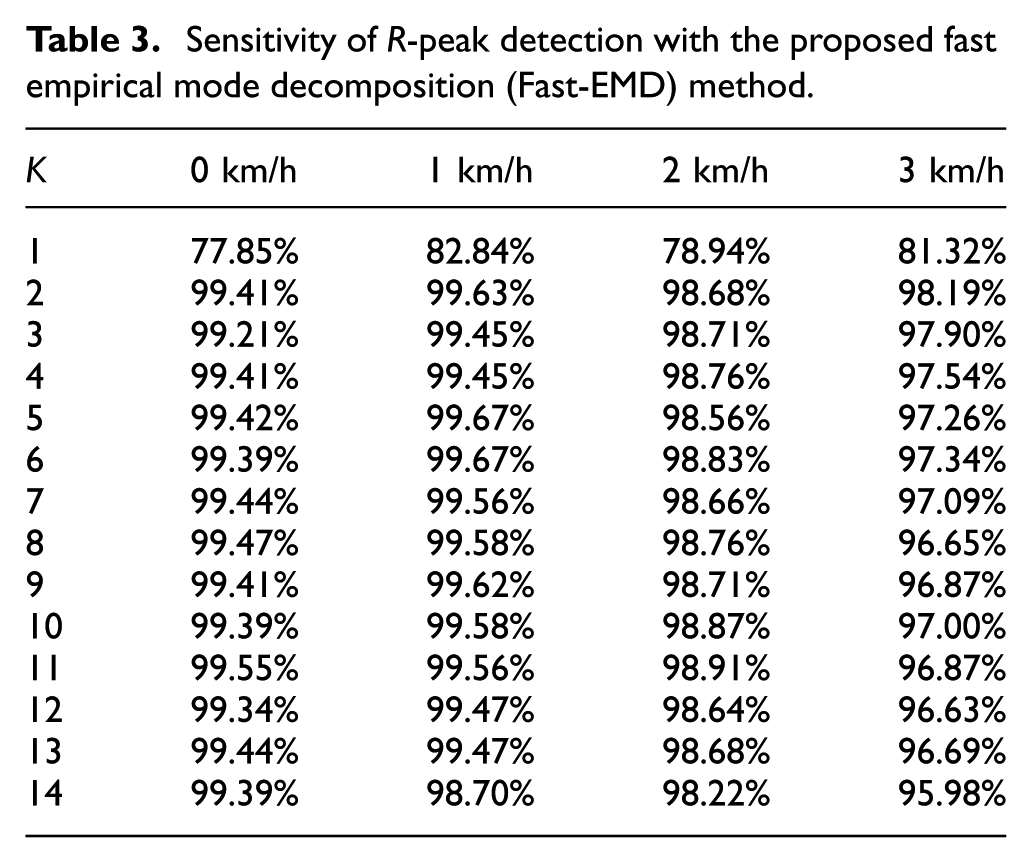
The ECG data of the participants were collected as they exercised for 5 min. They exercised at different speeds such as 0, 1, 2, and 3 km/h. Each condition was repeated twice. We compared the difference using the data with and without Fast-EMD. The accuracy and sensitivity of
Accuracy of

Sensitivity of
Experiment II: fall detection
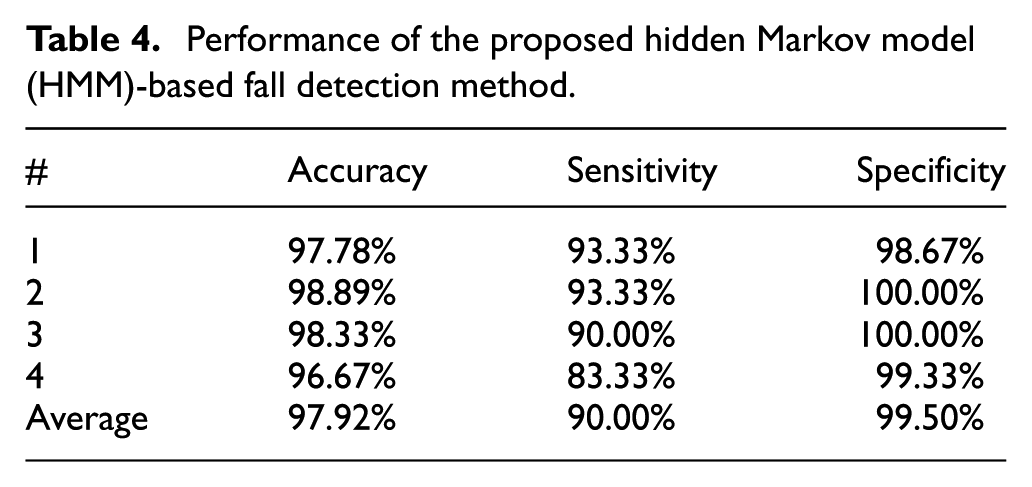
We collected 150 datasets pertaining to normal activities including walking, jogging, sitting, standing, and climbing downstairs, and 150 sets of falling data including falling forward, falling backward, falling to the side, falling when walking, and falling when jogging. Cross validation was used. The HMM was built using 30 sets of fall data selected randomly. We built four HMMs using 120 sets. The remaining 30 falling data and 150 normal activities’ data were then used as testing data. The performance of the HMM-based fall detection method is shown in Table 4. The average accuracy, sensitivity, and specificity of fall detection using the HMM were 97.92%, 90.00%, and 99.50%, respectively.
Performance of the proposed hidden Markov model (HMM)-based fall detection method.
Application in real scenario
The proposed intelligent health monitoring system has been applied in an elderly long-term care institution, that is, Yi-De Elderly Long-term Care Center, Min-Sheng Healthcare, Taoyuan, Taiwan. The elderly care institution has a room area of 9917 m
2
. The capacity is 200 people. A floor of the institution was used for experiment scenario, which was shaped like
The nurse station at the floor was equipped with a central control center. The main functions of the control center included (1) adding, modifying, and deleting personal basic data, and setting the BLE-to-WiFi receiver; and (2) monitoring the position and gait information of the subjects, and altering when an emergency event occurred; the caregiver could check at any time on the Web through the mobile device. In the environment, we used power over Ethernet (POE)-powered BLE-to-WiFi receivers. Each room was equipped with one BLE-to-WiFi receiver. There were also a number of BLE-to-WiFi receivers equipped at walkways, halls, elevators, and escape exits.
Through the sensing component, the information of subjects’ positions and gaits and component abnormity can be obtained. When a subject has an emergency, such as falling, entering into the alert area (elevator, escape exit, etc.) and pressing the emergency button on the sensing component, the caregiver can receive the alert notification and conduct real-time treatment through the central control center at the nurse station or through the mobile device.
The proposed intelligent health monitoring system collected and recorded the subjects’ data of daily events, including the times of staying in situ for over 2 h, times of approaching the alert area, times of falls, times of getting out of bed at night, times of staying in the toilet for over 15 min, times of emergency call for help, and sleep time and activities. The system conducted data analysis based on these indices to assist the caregiver in easily understanding the status of each subject, so as to improve the quality of care.
Satisfaction survey of the proposed intelligent health monitoring system was conducted to the caregivers and the subjects. The survey results showed that 95% of the caregivers would like to use the system, 97% of the caregivers thought that the system was easy to operate, 92% of the subjects would like to use the system, and 98% of the subjects thought that the smart clothing was comfortable and was willing to wear the smart clothing for a long time. In the future, the proposed intelligent health monitoring system will be applied and improved for healthy communities and home-based elderly care to achieve the purpose of elderly care in situ.
Discussion and conclusion
We have proposed a smart clothing–based intelligent health monitoring system. The system is mainly composed of smart clothing and sensing component, care institution control platform, and mobile device. The system can provide eight kinds of services for the elders, including surveillance of signs of life, tracking of physiological functions, monitoring of the activity field, anti-lost, fall detection, emergency call for help, device wearing detection, and device low battery warning. To our knowledge, such a system has not been reported in the literature.
The system has integrated our proposed Fast-EMD algorithm for ECG denoising and the HMM algorithm for fall detection. The Fast-EMD algorithm was improved based on the EMD algorithm for wearable devices to suppress motion artifacts. The HMM-based fall detection algorithm was originally proposed in our previous study. 26 However, the algorithm was implemented and evaluated in an off-line way in the study by Cao et al. 26 Compared with the study by Cao et al., 26 the improvements in this work were as follows: (1) we implemented the HMM-based fall detection algorithm in the wearable device and (2) the algorithm was evaluated in an online manner through the proposed intelligent health monitoring system. The performance of the Fast-EMD and HMM algorithms have been evaluated by experiment I and experiment II, respectively. The evaluation results demonstrate the satisfying performance of the proposed Fast-EMD and HMM algorithms.
In recent work, 29 a remote health monitoring system for the elderly based on smart home gateway was introduced, which consisted of three parts: smart clothing, smart home gateway, and health care server. Compared with the work by Guan et al., 29 we have achieved the following improvements in this work. The smart clothing–based intelligent health monitoring system in this work integrated our proposed Fast-EMD algorithm for ECG signal denoising and the HMM-based fall detection algorithm, supporting some of the eight kinds of services provided by the system. Moreover, the proposed system was applied and evaluated in a real elderly care institution, with satisfying performance.
In conclusion, we have designed and developed an intelligent health monitoring system based on smart clothing in this work. A Fast-EMD-based ECG denoising method and an HMM-based fall detection method have been proposed and integrated into the system. The system can provide eight kinds of services to the elderly. The proposed intelligent health monitoring system has been applied and evaluated in a real scenario, that is, an elderly long-term care institution. The results of the satisfaction survey show that both the caregivers and the elders are willing to use the system. The future direction of the proposed intelligent health monitoring system is elderly care in situ for healthy communities and home-based elderly care.