







Abstract
Introduction
Wireless body area network (WBAN) is an interesting sensor technology that promises remarkable prospects for healthcare applications within the range of human proximity. This technology can use both in-body and on-body biosensors. The sensors sense the patient condition based on different physiological parameters like a heartbeat, blood pressure, glucose level, and body temperature, etc. The sensed data are then transferred to the patient’s physician for further response through a central controller called hub.1–4 WBAN’s healthcare applications attracted the attention of research community to cope with the number of challenges and issues including traffic prioritization, handling of traffic heterogeneity, energy efficiency, and delay intolerant communication.5,6 For this purpose, a separate task group of IEEE 802.15.6 was time-honored by IEEE 802 to provide data communication standard for wide-range applications for healthcare monitoring. Before the introduction of IEEE 802.15.6, researchers used IEEE 802.11 and IEEE 802.15.4 as data communication standard for WBAN’s applications. However, both the standards did not meet the medical and relevant communication regulations of WBAN; therefore, IEEE 802.15 task group announced the IEEE 802.15.6 standard which is more specifically tailored and made to meet the demands of WBANs’ applications in an energy-efficient manner.7,8 A WBAN healthcare paradigm is presented in Figure 1.

WBAN healthcare paradigm. 9
The WBAN network operates in star fashion with one hop or two hops extended topology. The communication between sensor devices and the central controller is controlled by assigning the time axis/channels using superframe. The IEEE 802.15.6 superframe comprises of 256 equal-spaced time slots with fixed beacon interval. Central controller/hub is operated in three different access modes: beacon-enabled mode, non-beacon mode with superframe, and non-beacon mode without superframe.1,10
This work addresses dynamic superframe adjustment in beacon-enabled mode. In IEEE 802.15.6, the beacon-enabled mode is further composed of different access phases, as depicted in Figure 2.

IEEE 802.15.6 superframe structure.
In beacon mode, hub organizes the access phases into active and inactive phases. The active phase is furthered comprised of
Table 1 lists the access phases, traffic types, and channel access modes. The IEEE 802.15.6 defines the traffic heterogeneity in terms of different UPs range from 0 to 7, that is, 0 (lowest priority) to 7 (highest priority/urgent/emergency) as shown in Table 2.
Types of data traffic and accessing modes in WBAN.

EAP: exclusive access phase; MAP: managed access phase; RAP: random access phase; CAP: contention access phase.
IEEE 802.15.6 defined user priorities for WBAN’s traffic.

In WBAN healthcare applications, the event triggering of biosensor causes uneven generation of traffic in other sensing devices. For example, lowering the glucose level disturbs the blood pressure and heart rate. It means that the traffics of biosensors are inter-dependent for measuring and monitoring the physiological state of a patient. This inter-dependency of physiological states motivated us to introduce a novel group-based approach by accommodating the traffic of the same nature in a group and vice versa.11,12 This approach also helps to control unnecessary data traffic of the independent nodes or low priority nodes. Addition of low priority traffic in critical traffic scenario can lead to congestion at the hub which results in a drop of packets, lowering of throughput, and inhabiting delays. Dynamic adaptation of superframe structure is of utmost importance for the real-time response of sensors having data of prioritized nature and facing difficulty to access the channel due to busy schedule resulting delays and unreliable transmission to traffics. 13
In this article, the dynamic adjustment of the superframe is introduced to achieve the following objectives:
To manage the group traffic of different priorities of nodes
To allocate the time in superframe dynamically based on buffered packets and priority.
To relieve the hub by assigning handling role to relay nodes called cluster head.
The rest of the article is organized as follows: section “Related work” presents the related work; section “Research Methodology” presents system model; section “Proposed G-MAC” presents the operation of proposed group-based MAC (G-MAC), and simulation results and discussions are presented in section “Performance Evaluation,” and “Conclusion” is the last section of this article.
Related work
Extensive research has been carried out for dynamic adaptation of superframe structure in IEEE 802.15.4. However, limited work has been proposed for WBAN IEEE 802.15.6. Researchers have proposed different solutions for medium access apart from IEEE 802.15.6 for WBANs using time division multiple access (TDMA),14–16 carrier sense multiple access/collision avoidance (CSMA/CA),17–21 and hybrid approaches.22–25 In next subsection, we discuss these solutions in detail.
TDMA-based techniques
A WBAN MAC protocol proposed in Choi and Kim 26 performs channel schedule to allocate channel between the hub and sensor node. The conventional superframe structure, that is, EAP, RAP, and Type I/II have been used. However, the number of users of Type I/II is reduced to handle the energy-wasting issue. In Kim et al., 15 a TDMA directional MAC for WBAN is used to increase the capability of BAN coordinator to transmit in different directions using the same frequency at a single time slot. All other medical sensors transmit in omnidirectional mode with low power, whereas BAN-C transmits in directional mode. The adjustment of the channel schedule requires complex synchronization and consumes more energy than beacon interval adjustment techniques. In Otal et al., 16 an adaptive beaconing medium access control (AB-MAC) protocol is a TDMA approach used for both periodic and event-driven data. The superframe of AB-MAC contains guaranteed slots (GS) and standby slots (SS) in a beacon interval. The GS comprises of pre-determined exclusive time slots which deliver event-driven and periodic data without contention. The SS is further subdivided into uplink and downlink sections. The SS are also used for unscheduled data with low latency. In Khan and Alam, 27 a joint physical (PHY)-MAC realistic performance evaluation of body-to-body communication in IEEE 802.15.6 is introduced, in which, TDMA-based scheduled access mechanism with beacon-enabled superframe is used. To achieve the main goal, that is, the investigation of the impact of accurate channel modeling on MAC layer performance, the authors appended variable length MAC frame body with frame header and frame check sequence (FCS) to make physical layer service data unit (PSDU). At PHY-MAC, TDMA approach is applied to reserve the channel access.
CSMA/CA-based techniques
A dynamic duty cycle algorithm 18 uses priority-based carrier sensing. In priority-based carrier sensing method, collision is avoided using carrier sense, that is, contention window adjustment instead of using convention method like CA. Energy issues handling is made by changing the sleep duration with respect to the traffic amount under the transmission. Furthermore, a node sets its sleep schedule according to its traffic amount. It is thus called a traffic adaptive wakeup method. In Kim et al., 19 the CANet is used to monitor elderly/patients by embedding a WBAN into a walking cane (used by elderly people for support purpose). Priorities are assigned to the selected cane sensors according to their characteristics/nature for the usage of RAP period of beacon-enabled mode superframe structure.
A discrete-time Markov chain (DTMC) model 22 uses CSMA/CA-based IEEE 802.15.6 MAC that uses different UPs by focusing all CAPs. However, model complexity provides extra delays in dynamic adjustments. Random contention-based resource allocation (RACOON) in Qureshi et al. 6 is a MAC layer protocol which supports the quality of service (QoS) for multi-user mobile WBAN. The authors in Qureshi et al. 6 considered both inter-WBAN interference and inter-WBAN priorities. It has two main steps, that is, central processing node (CPN)-based negotiation and resource allocation. Negotiation is performed on random contention–based mechanism, whereas resource allocation is performed using two separate channels for inter-BAN and intra-BAN communication. A CPN is a central processing node of a WBAN which plans the resources, that is, radio centrally. Polling services is used in Fourati et al. 18 to analyze the WBAN performance under various data rates. The polling is started when nodes are connected with coordinator using CSMA. A hub always initiates a polling packet, a node upon reception of polling packet starts transmission of stored data packets. In Fourati et al., 13 an enhancement of CSMA/CA technique of IEEE 802.15.6 has been presented, in which the authors improved the retransmission and packet drop processes. For this purpose, they defined a dynamic back off bounds’ assignments according to IEEE 802.15.6 priorities and to the network life state. This approach outperformed in terms of better QoS such as reliability, throughput, and energy consumption than IEEE 802.15.6 and enhanced CSMA/CA of IEEE 802.15.6.
Hybrid techniques
MDTA-MAC protocol for WBAN presented in Hussain et al., 28 to handle the multidimensional traffic to achieve the high network performance, energy efficiency, and minimum delay. The multidimensional traffic refers to the traffic class and traffic load. Duty cycle and superframe format of IEEE 802.15.6 is used for the purpose of classifying multidimensional traffic according to packet nature such as critical data packet (CP), delay-driven data packet (DP), ordinary data packets (OP), and reliability-driven data packet (RP). In Hur et al., 29 TaMAC protocol is introduced, in which, the duty cycle is dynamically adjusted according to traffic patterns by sensors with the objective to reduce the overhearing/idle listening problems. The traffic patterns are organized by coordinator through wakeup radio. A separate control channel is used for emergency and on-demand traffic along with data channel. TaMAC uses collision-free transmission using TDMA and configurable contention access period (CCAP).
A new MAC model for WBAN called distributed queuing body area network (DQBAN) protocol is presented in Bradai et al. 23 This model is focusing allocation of collision-free time slots according to situation. In bad channel/link, the transmission is suspended. Medical emergency body (MEB) 24 MAC is proposed to minimize the delay in accessing the channel for healthcare data. Although, IEEE 802.15.6 MAC proposes an adaptable structure of superframe having contention-free and CAP. Short superframe satisfies the channel access delay but long superframe increases the latency of channel access. In order to solve this problem, MEB MAC adjusts listening window dynamically in the superframe of IEEE 802.15.6 to minimize the delay of channel access for emergency data. The different access modes specified by the standard IEEE 802.15.6 are demonstrated and observed higher packet delivery ratio (PDR) by arranging three scheduled access slots and two random slots. According to Karvonen et al., 25 the PDR is directly related to scheduled access slots. The protocol outperforms under polling access mechanism because of efficient use of wireless channel and interference reduction. An intelligent management scheme is introduced in Fourati et al., 18 which uses contention-based and contention-free access with game theory. The game theory is a mathematical model used for decision making, in which, each node takes its decision independently without knowing the decision of others. This management scheme is based on requirements of applications and channel status.
Tachtatzis et al. 3 proposed a cross-layer approach by focusing on PHY and MAC layers. The MAC layer is analyzed using slotted Aloha based on contention mode. A model for energy efficiency optimization is also developed which acts as a distance function between communicating devices and its length of the payload in forwarding error correction (FEC) code rates. In Patel et al., 30 the throughput is analyzed by fine-tuning of PHY and MAC layer with specific to the application. It uses the CSMA/CA and scheduled access for rational mobility scenarios such as running patterns. In Ullah and Kwak, 31 a hybrid approach called priority MAC (PMAC) which employs the integrated superframe structure for IEEE 803.15.4 and IEEE 802.15.6 is presented. The objectives of the hybrid approach are to address the challenges of traffic diversity, latency, and energy consumption. The data and control channels are separated. Also, priority is assigned to vital traffic (emergency traffic) only. The asleep mode is introduced to enhance network lifetime by minimizing energy consumption in idle states. The superframe structure is divided into two subfields, that is, downlink and uplink subframe which are configured adaptively to facilitate sleep mode design. This type of hybrid approach is less researched as it is based on the integration of two different standards which requires different implementation procedures and processes.
A dynamic and traffic-G-MAC algorithm for WBAN is presented in Issaoui et al. 32 to perform the best allocation of superframe time slots and to avoid congestion and energy consumption. Authors used a dynamic use of TDMA and CSMA/CA to allocate the time slots in superframe structure by considering traffic priority and buffered data. In Samanta and Misra, 33 challenges of connectivity problem and QoS in WBAN have been addressed, for which, the author proposed a cooperative scheduling and dynamic connectivity establishment scheme. For this purpose, a utility function based on price and coalition game-theoretic approach is used by applying a hybrid approach at the MAC level.
TDMA is a channel accessing technique in which the entire bandwidth is available for communicating devices for a specific/finite period. It requires careful time synchronization as the devices operate on the same frequency domain. The transmission of data in TDMA occurs in bursts and not belongs to continuous nature. 22 TDMA-based approaches are well suited for WBANs but dynamically assigning slots in each superframe asserts considerable computational overhead on the hub. TDMA protocols are adequate for supporting low data rates and require strict synchronization. The CSMA/CA-based techniques are categorized into priority-based carrier sensing and polling access method. In first, the carrier medium is dynamically adjusted using CSMA/CA according to traffic priorities, while in latter, the polling mechanism is carried out by hub to decide the medium access. The CSMA/CA-based techniques are dynamic and well suited for WBANs. However, it may consume more power and is considered to be unreliable due to more packet loss ratio.
The hybrid approaches consider the integration of TDMA and CSMA/CA techniques and the integration of standards IEEE 802.15.4 and IEEE 802.15.6. The hybrid techniques are more successful than standalone techniques as it contains the best features of both techniques. Table 3 presents the comparison of all reviewed MAC layer techniques and the performance metrics and objectives used.
Comparison of MAC layer techniques.

TDMA: time division multiple access; MAC: media access control; CSMA/CA: carrier sense multiple access/collision avoidance; RAP: random access phase; CAP: contention access phase; CFP: contention free period.
As a summary, various solutions proposed do not consider inter-dependency of WBAN’s traffic and its heterogeneity. A novel approach of categorization of same group traffic into one group has been introduced in this article in which the dynamic assigning of time slots according to traffic priority and buffered traffic positions is made by BAN coordinator for ensuring reliability and in-time delivery of packets.
Research methodology
In this section, system model and transmission of traffic/network communication are elaborated.
System model
WBAN has limited number of sensor nodes that are placed at appropriate positions on or in the body. Their characteristics in terms of data rate, position, and buffering capacity are generally known to the hub node. 3 Thus, a system model has been proposed, as shown in Figure 3. The system model is a WBAN network, in which all biosensors are deployed in such a way to communicate with a central controller called hub directly or indirectly depending upon the type of traffic and its priority. If a particular biosensor results the lower or higher rate against the pre-defined threshold, then it transmits the uneven traffic called emergency or urgent traffic (high priority) to a hub. It is also assumed that a few other sensors called dependent nodes to become active soon or that their data might be required for diagnosis. Since the emergency node is of maximum priority, therefore, it communicates directly with the hub. The rest of the traffic is forwarded to the hub using a relay node that is also referred to as cluster head in our proposed G-MAC protocol. The selection of the relay node is governed by the hub node that directs nodes to forward packets through the identified relay node. The selection of the appropriate relay node is carried out using standard procedure defined in IEEE 802.15.6. 35 Hence, the two-tier network architecture is invoked with the activation of emergency traffic in the proposed network model. In the proposed G-MAC protocol, the relay node is also referred to as cluster head.

Proposed network model.
Transmission of traffic/network communication
As three types of nodes communicating to hub directly or indirectly via relaying node/cluster head depending upon the nature of traffic, therefore, a scenario has assumed that if a node traffic has emergency traffic, then it will be sent to hub directly, else the traffic of other nodes having regular or periodic traffic will be sent to a relaying node called cluster head and then hub. The EAP of superframe shall be used by emergency node traffic, whereas the other type of traffic will be sent using MAP and CAP. The superframe structure of IEEE 802.15.6 is modified in this article, as shown in Figure 4, which is comprised of EAP, MAP, RAP, and CAP periods. EAP carries emergency traffic (highest priority traffic, i.e. P1) only. MAP (Managed Access Phase) is used to transmit dependent traffic buffered via relaying node (i.e. Rn) and P1. Both EAP and MAP are TDMA-based access phases whereas RAP and CAP are CSMA-based access phases. RAP is accessed by highest priority nodes (P1), Relaying nodes (Rn), and low priority nodes (P3), while CAP is accessed by all nodes and is of small period, used for communicating the buffer status frame (BSF) only. BSF is a frame of one octet length to inform the hub about the packets in buffer of each node. It is essential to determine the time allocation required in next superframe.
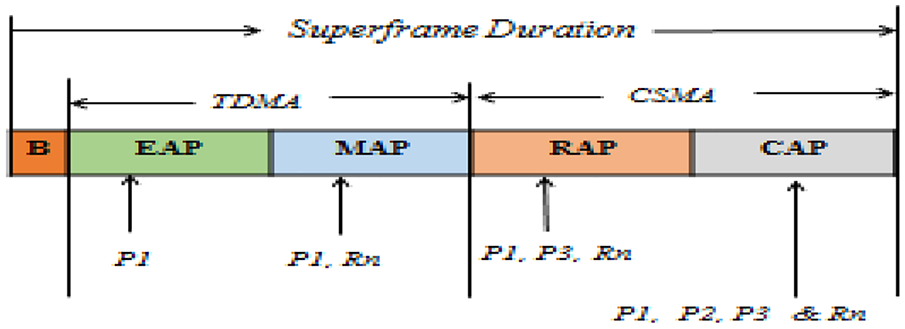
Modified superframe structure of IEEE 802.15.6.
Proposed G-MAC
G-MAC is a MAC protocol proposed in this article for WBAN network, in which the traffic of different priorities is handled in terms of energy efficiency, congestion avoidance, and reliability. For this purpose, the burden at the hub is shared by introducing a group-based approach. This approach implies that the traffic of all nodes other than emergency node is gathered at a relaying node called cluster head. A cluster head acts as a mini handler like WBANs’ hub to control the traffic of other nodes of least priority and be relieving the main controller from extra communication and allow direct dealing with emergency traffic.
Operation
Traffic categorization is the first step of G-MAC operation. WBAN’s traffic is categorized into following three categories:
Figure 5 shows clear depiction of G-MAC operation that how different categories of traffic use respective time phases in superframe structure.

Overall G-MAC operation.

Furthermore, the flow of G-MAC operation is presented in Figure 6.

Flowchart of proposed technique.
Mathematical formulation
The adjustment of superframe is handled by hub dynamically by allocating time phases of EAP, MAP, RAP, and CAP after measuring the buffered packets and priority of traffic. Each node shares buffer status through small chunk file called BSF at the end of superframe structure for allocation of time slots in next superframe structure. This section presents all the calculation/measuring techniques used by coordinator to handle the traffic heterogeneity and allocating dynamic time phases based on various parameters such as buffered packets, packet loss, and priority.
Time of WBAN’s superframe structure
Generally, the time of WBAN’s superframe structure (

where

where
Simulation parameters.

Calculation of phase time
For determination of EAP

The time of EAP, that is, TEAP can be calculated as

where Ω is the transmission rate of emergency node.
However,

where PQ is the packets in buffered/queue and PRR is the packets’ reception rate


The same procedure is adopted at Relay node to calculate the throughput, delays, and energy efficiency using the same group traffic, that is, dependent traffic and independent traffic for adjustment of MAP, RAP, and CAP phases of superframe structure. The reviewed literature showed that different MAC techniques, such as TDMA, CSMA/CA, and hybrid approaches, are used to allocate the time phases of superframe structure. However, handling of traffic heterogeneity by relieving a coordinator from extra burden for ensuring reliable reception of prioritized traffic has not been addressed. Therefore, a novel approach of group-based handling of traffic heterogeneity by relieving central WBAN’s controller from excessive communications with nodes of least concerned data at the time of emergency is introduced in this article. This approach calculates the time slots requirement in beacon interval by taking into account the buffered traffic and packet reception rate, priority, and dropped ratio.
Performance evaluation
The simulation analysis is performed in star topology–based IEEE 802.15.6 beacon-enabled network using Matlab. The proposed G-MAC technique of WBAN’s IEEE 802.15.6 is then compared with AB-MAC and PMAC. Both are the TDMA-based techniques as discussed earlier. However, the AB-MAC uses channel selection technique and PMAC follows carrier sensing for superframe adaptation. In the proposed technique, both the channel selection and carrier sensing approaches have been applied to get better performance. Other simulation parameters for analysis are given in Table 4.
The BAN coordinator called hub is placed at the middle of the network range and the nodes are randomly distributed in a 2-m coverage area. The on-body biosensors (eight in numbers) are deployed with the purpose of healthcare application requirements. The resource utilization based on healthcare application was the main focus of the proposed G-MAC.
Stability period analysis
Stability period is an important parameter of the network performance as it defines the life of network till the first node dies. The result of G-MAC shows that it outperforms instability period as compared to AB-MAC and PMAC, as shown in Figure 7.

Stability period.
The reason is that the nodes operate in low power listening as the proposed G-MAC uses a direct transmission in EAP phases at the time of event triggering of biosensor, whereas other nodes operate in low power by transmitting its traffic to cluster head, that is, relaying node which is nearby to a group of nodes and significantly provide better alive time to nodes as compared to AB-MAC and PMAC.
Delay analysis
In WBAN’s healthcare application, the delay is considered to be one of important performance metric as the WBAN’s traffic particularly emergency traffic needs the urgent or in-time delivery to the coordinator. Delay factor is always linked to the transmission. It might be propagation delays, transmission delays, queuing, and processing delays. In all such kinds, the delay at node or hub level while processing the packets is termed latency. It means that latency is the time delay between the cause and the effect of some physical change in the system being observed. Therefore, end-to-end delay is calculated by combining all types of delays, that is, transmission delay and latency. The end-to-end delay of the proposed G-MAC in comparison to AB-MAC and PMAC is presented in Figure 8.

End-to-end delay.
Overall end-to-end delay in the network of proposed G-MAC is much better than the AB-MAC and PMAC. The comparative analysis clearly shows a consistent and lower end-to-end delay of about 1 × 10⁵ ms till the simulation of 10,000 s. This is because of the avoidance of collision at the coordinator level. Also, the direct transmission by the emergency node which has burst traffic results in the minimization of delay for traffic transmission. Finally, the back triggering/controlled procedure by the coordinator through the relaying node also results to avoid congestion and retransmission of packets in G-MAC and thus outperforms the other two protocols.
Throughput analysis
Throughput analysis shows the reliability of a network as it defines the ratio of several packets received and transmitted. Reliability is vital for WBAN’s healthcare applications. It can be of two kinds, namely, node-level reliability or link-level reliability. In this article, the node-level reliability is measured at coordinator named as throughput, whereas the link-level reliability is measured through transmission loss. Throughput analysis of G-MAC IEEE 802.15.6 and AB-MAC and PMAC is presented in Figure 9.

Throughput.
The proposed G-MAC (G-MAC) outperforms AB-MAC and PMAC in throughput analysis and provides much better results because of the controlled triggering procedure and avoidance of collision through use of the cluster-based approach. The burst emergency traffic is directly transmitted to the hub while the dependent and independent traffic is handled through relaying nodes due to which energy efficiency and stability periods of the network prevails. This helps in higher throughput than other two MAC protocols.
Transmission loss analysis
Reliability of a network can be measured through transmission loss in the network. Transmission loss results in lowering the throughput and thus affecting the reliability. The transmission loss of the proposed G-MAC is much lower than the other AB-MAC and PMAC protocols, as shown in Figure 10, because of the low power operations at clustering-based approach. Also, the heterogeneous traffic is handled by applying a strategy, that is, direct transmission of emergency traffic to the coordinator and indirect transmission through relaying nodes.

Transmission loss.
Residual energy analysis
Residual energy is an important network performance metric as it defines the lifetime of the network. The residual energy of the whole network is calculated by taking the average residual energy of all nodes. Simulation analysis shows that the proposed G-MAC has higher residual energy than other AB-MAC and PMAC protocols as the time passes. The reason is that the nodes operate under controlled triggering procedure through its coordinator and relaying node and thus utilize low power for operations. Second, there is no loss of packets and thus resulting in no retransmission of packets which result in the proposed G-MAC which is an energy-efficient protocol. Therefore, the residual energy is much better than AB-MAC and PMAC protocols. Residual energy is illustrated in Figure 11.

Residual energy (j).
Conclusion
Several dynamic superframe adjustment techniques have been developed by researchers as presented in the literature section. However, no such technique was found which handles the traffic heterogeneity through dynamic superframe adjustment using a group-based approach. In this article, we proposed a group-based approach in which first WBAN’s traffic is categorized broadly into three different categories. The first category traffic is called emergency traffic and is directly transmitted by an emergency node to coordinator in EAP by relieving the coordinator from other nodes. The other two categories of traffics are dependent on traffic and independent traffic. In proposed G-MAC, both the traffics are handled through a group-based approach using back triggering/controlled traffic procedure by coordinator through relaying nodes. The G-MAC protocol does not imply any modification to the superframe structure of IEEE 802.15.6 and uses its four phases, that is, EAP, MAP, RAP, and CAP. Each phase is dynamically adjusted according to traffic nature and buffer occupancy. The analysis of G-MAC in comparison to AB-MAC and PMAC shows that the proposed G-MAC behaves more intelligently to handle the traffic heterogeneity by adjusting the nodes of the same priority in groups. Furthermore, the heterogeneous WBAN traffic is managed by accommodating the high priority traffic directly in all phases, whereas the dependent traffic is handled via relaying nodes in MAP. The low priority nodes are allowed to transmit in RAP and CAP using CSMA. The heterogeneous transmission in respective phases of superframe structure provides a fair opportunity to all nodes and also reduces the channel access contention. The simulation results show that G-MAC outperforms in terms of stability period, delay, throughput, residual energy, and transmission loss when compared with AB-MAC and PMAC protocols. In the future, the optimum relaying selection would be used in G-MAC. This would result in a more stable and energy-efficient dynamic superframe adaptation by relieving a static or constant relaying node from its responsibilities and depriving energy.
Future work
In G-MAC, the group of dependent nodes and cluster head information with regard to the excitement of particular biosensor is assumed. At future work, the cluster head selection and dynamic group formation of all nodes of a particular traffic category would be taken into consideration. Furthermore, a mechanism for handling the on-demand traffic from a specific node as supporting traffic for emergency traffic handling would be developed.
Footnotes
Declaration of conflicting interests
Funding
ORCID iD
