This article studies the physical layer security in a downlink full-duplex cognitive non-orthogonal multiple access sensor networks (FD-C-NOMA). Compared with the existing works, this article proposes a FD-C-NOMA transmission scheme with a primary user (PU) and secondary user (SU) sensor nodes in the presence of an eavesdropper. The zero-forcing beamforming design problems of FD operation are investigated subject to the practical secrecy rate and the quality of services of PU. To characterize the security reliability trade-off of the FD-C-NOMA scheme, we first derive the closed-form expressions of connection outage probability (COP), the secrecy outage probability (SOP), and effective secrecy throughput (EST) of each SU in the NOMA networks. Then the impacts of the system parameters on the COP, SOP, and EST are investigated to evaluate the security and reliability in the FD-C-NOMA networks. Furthermore, in order to further verify the security and reliability of our considered network, an OMA scheme of FD operation is provided in the simulation for the purpose of comparison. Results demonstrate that the NOMA-based cognitive sensor networks of FD operation outperforms the OMA system in terms of EST. Finally, simulations are performed to validate the accuracy of our analysis results of the proposed scheme.
The next generation wireless sensor networks call for advanced communication techniques that can achieve high spectrum efficiency (SE) and improve user throughput in support of the demand for high data rates bring by the increasing number of mobile devices.1,2 Cognitive radio (CR) and non-orthogonal multiple access (NOMA) constitute promising techniques of achieving high SE.3,4 To take full advantage of SE, cognitive sensor networks (CSNs) allow the unlicensed secondary user sensor nodes (SUs) operating on the spectrum reserved for the licensed primary user sensor nodes (PUs), while maintaining the quality of service (QoS) of the PU networks, that is, below a certain threshold of the PU. CR is generally divided into the following three spectrum sharing methods: underlay, overlay, and interweave.5 On the other hand, the spectrum resources are not utilized efficiently, and NOMA can be further applied into CSNs via the power-domain and code-domain to improve the SE.6,7 It is envisioned that applying NOMA in CSNs is capable of significantly improving the system performance of CS-NOMA networks.
In future networks, the ubiquitous connectivity makes our privacy and secrecy being exposed to radio space. Security becomes a major concern when designing communication systems. However, the open and dynamic characteristics of CS-NOMA system as well as the broadcast nature of the radio signals, CS-NOMA networks relying on wireless information is vulnerable to eavesdropping.8 On the one hand, when unlicensed SUs are untrusted or malicious, and SUs share the spectrum of licensed PUs, the risk of PUs being eavesdropped increases. Furthermore, the information transmission process is complicated and time-consuming due to encryption and decryption.9 However, NOMA can enhance SE at the expense of serious interference, which also increases the risk of communication security and confidentiality leakage. Thus, the security issue is an urgent problem to be solved and it is of great necessity to design a reasonable and secure NOMA transmission scheme. To improve the security issue, physical layer security (PLS) has been proposed as an alternative method to ensure the confidential information from eavesdropping, which has been widely investigated by scholars.10–12 In this regard, we will primarily focus on the secrecy performance of physical layer in the context of an underlay CS-NOMA networks.
Due to the aforementioned advantages, NOMA technique has been considered in CSNs to further improve SE and secrecy performance of physical layer, which has drawn significant attention recently. Specifically, the authors designed the integration of different communication schemes and technologies to study the various needs of NOMA in the wireless networks.13–15 Based on the analysis of the uplink and downlink schemes, different communication systems combining CR, NOMA and multiple-input multiple-output (MIMO) are designed, and a spectral-and interference-efficient framework which is named as MIMO-based CR-NOMA system framework is proposed.16 Some efforts have designed NOMA resource allocation scheme to improve its security in CR communication systems under half-duplex (HD) operation.17,18 The cooperative simultaneous wireless information and power transfer system for NOMA in wireless networks system of HD operation has been carried out,19,20 and HD-NOMA in a MIMO wireless networks21 setup has been investigated. However, the NOMA technique of cognitive wireless networks (CWNs) is designed in the above HD operation, the performance of which can be further improved in practice.
Recently, to improve the transmission reliability, CWNs with full-duplex (FD) operation have been widely studied.22–27 The FD sensor node can receive information from other nodes while transmitting artificial jamming signals to prevent illegal eavesdropping, which can improve the SE by simultaneously learning the radio environments and delivering data traffic of the system. The author explored how much self-interference should be suppressed to make FD-CWNs more advantageous than HD-CWNs.22 The routing and channel assignment problem in FD-based CWNs was investigated.23 The authors discussed the application of the combination of FD and end-to-end (D2D) in CWNs.24 The authors designed a joint FD-aware channel assignment and route selection protocol in FD-based CWNs under time-varying channel conditions and transmission rates, which maximizes the D2D network throughput.25 Different schemes at the FD relay were proposed,26,27 in which the secrecy outage probability (SOP) between the source and the destination was obtained to maximize the achievable secrecy performance of SU transmission link.
The above-mentioned contributions were made for CWNs with NOMA and CWNs with FD operation are applied without considering the NOMA technology that by proper design the CS-NOMA scheme of the FD operation to improve secrecy performance. Although FD technology has indeed been conceived for NOMA systems for achieving secure communications,28–31 the above research is not comprehensive enough. Security issues are not considered.28,29 The problem of PU constraints is not considered, that is, cognitive problems.30 A scheme in which the SUs and PUs are paired according to the NOMA protocol and the users share a common relay for cooperative transmission is studied.31 Due to the need to consider illegal eavesdropping by untrusted sensor users or eavesdropping users, the above work did not consider the zero-forcing beamforming (ZFB) design problems of the FD operation for improving the security of CS-NOMA system. To the best of our knowledge, few investigations have been conducted for improving the security of CS-NOMA using FD operation. Thus, in order to achieve secure communications in CS-NOMA system, the ZFB design problems of the FD operation are studied in our work.
Based on the above discussion, this study aims to develop a FD-C-NOMA scheme subject to an underlay approach. In contrast to other studies,28–31 this article studies the FD-C-NOMA with using ZFB, where a malicious eavesdropper (Eve) exists and the decode-and-forward (DF) forwarding mode is applied at user sensor node. However, the power allocation between two different SU sensor receivers (user and user ) requires further investigation when security issues are taken into consideration. The principal contributions of our article are summarized as follows:
We newly design a FD-C-NOMA scheme for enhancing secrecy performance of SUs through properly dealing with directional jamming, where SUs network share the same licensed spectrum with the cognitive PU network.28–31 In addition, the concurrent transmission of signals in a NOMA manner will also increase the risk of information leakage, so that different ZFB schemes will be designed at the FD sensor node in different transmission phases to transmit directional jamming signals to Eve while guaranteeing the QoS requirements of the PU to enhance the SU’s security. Furthermore, the SU-BS superposes the signals of user and user under NOMA protocol and ensures that the successive interference cancelation (SIC) process is performed successfully at user sensor node.
We also derive the closed-form expressions (CFEs) of the connection outage probability (COP), the secrecy outage probability (SOP), and effective secrecy throughput (EST) of secondary user transmission link in the proposed secure FD-C-NOMA scheme over Rayleigh fading channels, which show that pairing user and user sensor nodes with best power allocation can achieve better performance. In addition, the results also show that the ZFB design of user with FD operation can reduce the SOP of secondary user transmission link and increase their EST.
Finally, we explore the influences of different system parameters on COP, SOP, and EST of user and user sensor nodes, such as the number of antennas at user and user , the PU interference temperature . Furthermore, we also analyze the performance trade-off of the security and reliability by using EST performance indicator of two different SU receivers (user and user ) with the NOMA and traditional OMA system. Our simulation results show that based on using the FD-CSNs, the NOMA outperforms the OMA system from the perspective of EST. Interestingly, the simulation proved that the power allocation under FD operation can improve the performance of the SUs. Based on the above contributions, the proposed scheme in our article can be further applied to AI-enabled Internet of things (IoT) communications scenarios.
The article is organized as follows. In the second section, the system model for the FD-C-NOMA scheme is introduced. In the third section, the new CFEs for COP, SOP, and EST of the SU receivers in the FD-C-NOMA scheme are derived. In the fourth section, simulations are performed to verify the CFEs and provide unique insights into the characteristics of the system by some parameters. The final section concludes the work of this article.
System model and the proposed transmission strategy
In this section, let us consider a new secure FD-C-NOMA transmission strategy in which a SU sensor Base Station (BS) intends to communicate with one group of SUs (user and user ) sensor nodes in the presence of one primary sensor receiver (PU) and one eavesdropping user (Eve) as shown in Figure 1. Assume that the user sensor node is equipped with antennas, the user sensor node of FD operation is equipped with antennas and adopted with different beamforming schemes in different transmission phases, and all other nodes are equipped with a single antenna. Let us assume that more power is allocated to user than user , which is because user is far away from SU base station (SU-BS). Thus, the user has greater power signal, that is, the user first decodes user signal then subtracts it from the original received signal, which will give user signal with implementation of SIC. Then, the user as a relay sensor node uses the DF mode to forward the signal of the only user (at user N) to the user , like device-to-device or unmanned aerial vehicle (UAV)-based relay communication network.32–34 Our preliminary analysis only considers two SU receivers user and user , and multiple user nodes will be considered in the later research.35,36
System model.
In FD-C-NOMA networks, the channel coefficient are denoted by scalars , , and , vector , vectors and , vectors and , vectors and , matrix , and matrix . The -th is the best antenna of user . and , represent the first and second phases, respectively. For all links, Rayleigh fading is assumed where channel coefficients are quasi-static independent. These complex fading channel coefficients are the additive white Gaussian noises (AWGN) with zero mean and unit variance with , that is, are expressed as , , , and , respectively. The distance between the secondary users (user and user ) and the BS is set to .
First phase
In the first phase, the maximal-ratio combining (MRC) operation is adopted at user , and the ZFB design is considered at user . In our proposed network, the PU allows secondary transmitter BS to share the spectrum of PU in the information exchange stage. Although the QoS of SU transmitter is improved, this scheme increases the risk of leaking the superposed information of the SU’s transmitter to the undesired eavesdropping user. Thus, beamforming design problems are considered to transmit directional jamming signals to Eve, and the user is designed to direct its beam to Eve while null and PU nodes.
In this network, the BS transmits the normalized messages and to their intended users and by superposition coding, respectively, that is, . Meanwhile, the user of FD operation transmits the directional jamming signal to Eve by ZFB scheme. However, from the self-interference (SI) cancelation technology, SI is not considered at the user .37 Accordingly, the superimposed message of the BS, and the signal received at the user and Eve are given by
where the merger weight of the MRC scheme is . and are the transmit powers at the users BS and . and represent the power allocation factors for user and user , respectively, which satisfy and . and are the AWGN with zero mean and variance , where . represents the optimal weight vector. In addition, must satisfy
where denotes the interference temperature constraint at the PU, and is the maximum transmit power at BS. represents the channel coefficient between BS and PU. The optimal weighting vector should meet as follows
where the channel matrix is defined as . We also assume that the perfect channel state information (CSI) on and can be available at user .38 The optimal weight vector is given by
where represents a matrix with rank . The absolute value of the complex scalar and the Euclidean norm of the vector can be expressed as and , respectively.
According to the idea of NOMA, the strong user decodes the weak user information message and subtracts it when SIC process is performed successfully. In other words, user has to decode the message of user before recovering its own message. Thus, we adopt power allocation and transmit rates control of BS to ensure the success of SIC. Based on equation (2), the received signal-to-interference-plus-noise ratio (SINR) of message at user can be written as
According to the NOMA concept, user performs SIC by decoding and removing the message of user from the received signal to detect . After demodulating the signal of perfectly, the signal-to-noise ratio (SNR) at user is given by
In addition, the decoding vector can be optimized according to equation (5) and no detailed description here. Also, assume that Eve has strong multi-user detection capabilities and the worst-case security is considered. The and messages will not interfere with each other at Eve. Based on the above discussion, the intercepted SINR of the first phase at Eve can be expressed as
and
respectively.
Second phase
In this phase, the user as a relay node uses the DF forwarding mode to forward the signal of only user (at user N) to the user . The maximal-ratio transmission-selection combining (MRT-SC) operation is adopted at user , that is, user utilizes MRT scheme to send security information to user of FD operation, and then user selects the best -th antenna to receive information and simultaneously transmits the jamming signal to Eve by utilizing the remaining antennas with FD operation. The ZFB scheme of the FD user is designed to direct its beam to the Eve and null PU node.
Without loss of generality, according to the principle of SIC, after demodulating the signal of user perfectly, the received signal at the user and Eve nodes can be, respectively, denoted as
where is the transmit power at user , and is the transmit jamming power at the user . The transmit beamforming of the user is designed as . is designed for , which has no diversity gain for Eve. In addition, must satisfy
where represents the channel coefficient between user and PU. represents the optimal weight vector, and the optimal weight vector should meet as follows
where the optimal weight vector is given by
where represents a matrix with rank .
Hence, the received SNR of message at user can be written as
Similarly, the intercepted SINR of user at Eve can be formulated as
In the above discussion, , , , and , represent the first and second phases, respectively.
Based on Wyner secrecy code theorem,39 and are coded as and , respectively, where the encoding rates of and are and , and the secrecy rates of and are and . and denote redundancy rates of user and user , respectively. In order to simplify the calculation and derivation of the article, we define that , , , , , , , , , , , .
Performance analysis of the proposed NOMA scheme
In this section, we investigate the secrecy performance in FD-C-NOMA networks. We then analyze and derive a set of CFEs for the key performance metrics for the COP, SOP, and EST at user and user in the proposed FD-C-NOMA scheme, respectively.
COP of proposed networks
The COP is defined as the channel capacity drops below to the code word rate.40 In our proposed system, the outage event at user occurs when user cannot detect from the combined received signal. In addition, in two different phases, user adopts DF forwarding mode. Based on this event, the COPs for decoding to user and to user are formulated as
and
respectively.
At user sensor node: We first denote and . The probability function is denoted as . The expression of COP for user can be shown as
In equation (20), we let . In order to facilitate the derivation of the CFE of equation (20), we first give the cumulative distribution function (CDF) of . With the help of Islam et al.,6 is given by
From equations (20) and (21), the conditional COP at user is written as
where we set . Affected by the power constraints of the PU, the COP at user can be expressed as
Applied by Rayleigh fading channel, the probability distribution function (PDF) of the is defined as
In order to derive the , we first give the following Lemma.
Lemma 1: Substituting equation (24) into (23) and with a few mathematical manipulations, the COP of user is given by
Lemma 2: The COP of user can be written as equation (32).
Remark 1: In the above analysis, it can be easily found that connection outage would occur at user when and . This means that in order to ensure a secure NOMA system of the proposed scheme, the power allocation factor must meet the condition of , and . Eventually, based on theoretical analysis, it can be noted that there is no relation between COP and ZFB scheme of FD operation at user .
SOP of proposed networks
The SOP implies that the redundancy rate of wiretap code is less than the wiretap channel capacity.4 Thus, the SOP of user and user can be expressed as
respectively.
At user sensor node: We set . The expression of SOP for user can be written as
In equation (35), we let and . According to Rayleigh fading channels,5 and are given, respectively, as
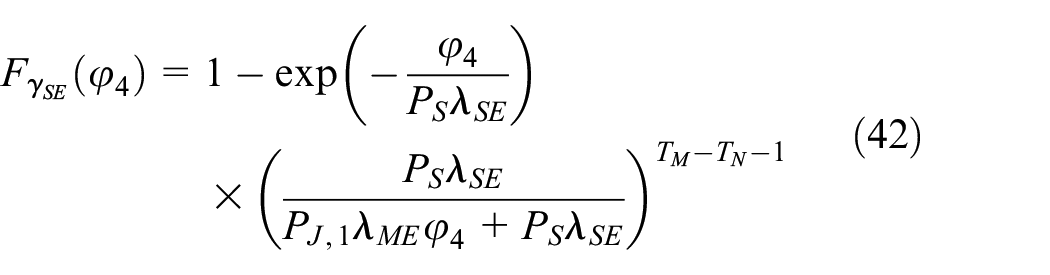
where . In order to facilitate the derivation of the CFE of equation (35), we first give the . is expressed as
Similarly, with equations (35) and (38), the conditional SOP for decoding at user can be obtained as
In order to derive the SOP for decoding at user , we first give the following Lemma.
Lemma 3: The SOP for decoding at user can be obtained as
Based on the preliminary result (see equations (42) and (45)), the conditional SOP for decoding at user can be obtained as
The solution process of the SOP at user is the same as that of equation (40), which can be rewritten as
Similarly, influenced by the power constraints of PU, substituting equations (24) and (31) into equation (47), the CFE for SOP of user is given as the following Lemma.
Lemma 4: We can use Gaussian-Chebyshev approximation to equation (47) and by using,41 after some algebraic manipulations, the SOP for decoding to user can be given by equation (48).
In equation (48), and can be obtained as equations (49) and (50), where and . and are the accuracy and complexity trade-off parameter
Remark 2: It should be noted that the expression of the SOP for decoding to user is similar to the SOP for decoding to user , which means that the priority based on , , , and influence the secrecy performance of the considered FD-C-NOMA networks. Ultimately, based on theoretical analysis, it can be noted that and are decreasing functions of the number of and .
EST of proposed networks
Based on the above analysis and derivation, COP and SOP are the metrics for reliability and security performance, respectively. The EST is adopted to holistically characterize the efficiency and security of the system. The EST of user and user can be expressed as
and
respectively.
At user sensor node: It can be easily observed that equation (51) can be rewritten as
Affected by the power constraints of the PU, applying equation (24) to solve (51), can be further expressed as
The EST of user can be derived as the following Lemma.
Lemma 5: The CFE for EST to user can be given by equation (55).
Finally, the EST of user can be derived as the following Lemma.
Lemma 6: The CFE for EST to user can be given by equation (58), where , , , and . , , and can be obtained as
where and satisfy the conditions in equation (28). , , , and also satisfy the conditions in equation (48). The proof process of is similar to that of in equation (55), and is not wrote here.
Remark 3: As can be observed from equations (55) and (58), the EST at user and user sensor nodes is an increasing function of and . In addition, the power allocation factors and of the SU receiver ( and ) are also important parameters of the system performance, which need to be carefully designed to achieve better system performance and user fairness. Furthermore, the power allocation factors of and under the and should be designed to make .
Numerical results
In this section, the numerical results are presented to evaluate the reliability and security of our considered system. Furthermore, the impact of the proposed scheme and full-duplex cognitive orthogonal multiple access sensor networks (FD-C-OMA) scheme on EST are analyzed and compared based on the numerical results. The transmission signal-to-noise ratio is denoted as SNR, that is, , . means the average channel gains between user and user nodes, and is the path loss factor. Similar to Shang et al.5 and Islam et al.,6 the reference distance is set to be unity, that is, , and the other distances are all 1. Without loss of generality, we assume that the parameters are , , , , , , , and . In addition, we also found that the simulation curve can completely coincide with Monte Carlo simulations’ results, which verified the correctness of our derivations. Based on the comparison on EST between the proposed scheme and the FD-C-OMA scheme, it is obviously demonstrated that the newly proposed scheme is better than the previous one.
Figure 2 plots the COP of SU receivers and versus SNR for different power allocation ratio , where and . The analysis points are calculated from equations (25) and (32). We observe that the COP of user and user decreases with the increasing of SNR. When SNR is high, the COP appears to be leveled, which means that the is limited by constraint value of the PU. Also, the COP of user increases when increases and the COP of user decreases as increases. This is reasonable because with the increase of at user , it will distribute more power to user and less power to user . Meanwhile, perfect SIC is performed at the user and user is not influenced by power allocation factor in the second phase. Likewise, it is verified that the COP agrees with the simulation results. This has verified the validity of our derivations.
The COP versus SNR for different power allocation ratio with and .
Figure 3 plots the SOP of SU receivers and versus SNR for different power allocation ratio , where expected secrecy rates , , , and . Specifically, Figure 3 shows the SOP at user and user from equations (40) and (48). We can see that, for a given , the SOP of user and user increase because SNR increases. This is reasonable since the eavesdropping ability of Eve under fixed coding is continuously enhanced. Also, as can be noted, the SOP of user increases when increases and the SOP of user decreases as increases. This also shows that setting a reasonable can achieve the trade-off of secrecy performance between user and user of FD-C-NOMA scheme. In addition, Figure 3 also clearly shows that the transmit power has significant effect on the SOP of FD-C-NOMA scheme in low SNR region. In high SNR region, the interference temperature constraint must be given more attention.
The SOP versus SNR for different power allocation ratio with , , , and .
Figures 4 and 5 plot the EST versus SNR with different system parameters. The EST of SU receivers and versus SNR for different is presented in figure 4, where expected secrecy rates , , , and . The analysis points are obtained from equations (55) and (58). As can be observed in this figure, the EST of user decreases as increases while the EST of user increases as increases in the low SNR regime. However, the opposite is true in the high SNR regime. In a certain range, there exists a trade-off for the EST of user and user . The reason is that user and user are affected by the power allocation factor in proposed system. In Figure 5, we set , , , and . In order to reflect the difference between NOMA and OMA systems, we set to increase the channel difference. One can observe that increasing and , the EST of NOMA and OMA system can be improved dramatically. In a certain range, there exists a trade-off for the EST of user and user . Moreover, the NOMA system is significantly better than the OMA system in terms of system EST. Note that the FD-C-NOMA scheme is more secure and reliable than the FD-C-OMA scheme in terms of system.
The EST versus SNR for different power allocation ratio with , , , , and .
The EST of NOMA and OMA system versus SNR for different and with , , , and .
Figure 6 plots the COP and SOP of SU receivers and versus SNR for different and with and . The analysis points are calculated from equations (25), (32), (40), and (48). In the first figure, we set . Our results show that the COP decreases as SNR increases, but an outage floor will appear in the high SNR regime, which demonstrates that is constrained by interference threshold . Similarly, if number of is increased, the COP of user and user nodes will drop rapidly, which mainly increases the channel gain. Similarly, if the increases, the COP of user and will also drop rapidly. In the second figure, we set . As can be observed, the curves of SOP increase faster by increasing SNR. However, in the low SNR, the SOP decreases when increasing the and . Otherwise, the increasing of the will result in an increase in the eavesdropper’s eavesdropping ability. Also, it can be observed that the SOP decreases as the number of increases. This observation confirms our analysis. The main reason is that increasing the number of antennas strengthens the channel gain of the interfering signal sent at the Eve node. Figure 6 shows that increasing the and can improve the security reliability of the two different schemes. It can be noted that simulation results in this study totally comply with theoretical derivations.
The COP and SOP versus SNR for different and with and under SU receivers and .
Figure 7 plots the EST of SU receivers and versus and with power allocation ratio , and . As can be observed, the EST of user increases faster by increasing . Otherwise, it is clearly seen that the EST of user and user nodes increase at the beginning and decrease as later. As can be observed, the trade-off of maximum EST can be found through setting different parameters, like , , and . However, user outperforms the user in terms of the reliability and security within a certain range of . The reason is that we adopt power allocation and transmit rates control of user to ensure the success of SIC. Similarly, the secrecy performance will not be improved by the increase of maximum transmit power of BS when is high enough since is still constrained by . More importantly, Figure 7 offers much easier alternative of and for achieving better secrecy performance.
The EST versus and with power allocation ratio , , , and .
Figure 8 plots the EST of the FD-C-NOMA and FD-C-OMA systems versus and with power allocation ratio , , , and . As can be observed in this figure, the EST of both NOMA and OMA systems increases as increases in the low SNR regime, but the EST deteriorate as increases in the high SNR regime. This is reasonable since the eavesdropping ability of Eve under fixed coding is continuously enhanced. Also, the EST of both NOMA and OMA systems increases rapidly as is increased. Intuitively, this observation confirms that for satisfying reliability and security in the given and regime, the trade-off of maximum EST can be found through setting system parameters and . Thus, there exists an optimal and pair maximizing EST which is showed obviously in Figure 8. It demonstrates that the joint optimizing of and can fulfill the potential of our considered FD-C-NOMA scheme. In addition, it can also be seen from the figure that when the channel difference is large, the FD-C-NOMA scheme of our considered is significantly better than the traditional OMA system in terms of reliability and security within high SNR. That is, there is an optimal value of FD-C-NOMA scheme which is better than FD-C-OMA scheme. These observations confirm our theoretical analysis.
The EST versus and with power allocation ratio , , , , and .
Conclusion
In this article, we have investigated the performance on downlink FD-C-NOMA with DF technique over Rayleigh channels, when considering eavesdropper intercepting the message of the SU transmission link. The ZFB problems of the FD operation based on C-NOMA networks are investigated. To characterize the system security and reliability, the closed-form expressions for the COP, SOP, and EST of the SU sensor receivers were first derived with Rayleigh fading channels to investigate the impact of different parameters on system performance. It was shown that, for a given SNR threshold, the COP and SOP at both SU receivers decrease significantly as the number of antennas increase. In addition, the reliability and security of CS-NOMA system can be improved by using multi-antenna and FD techniques. Moreover, parameters simulations are conducted for validating our analytic results, that is, the number of SUs antennas, the transmitted jamming signal power, interference temperature constraint and the power allocation ratio. Also, the EST of the system is investigated, which shows that the EST of the NOMA system is significantly better than that of the conventional OMA system within high SNR. Based on the above summaries, the proposed scheme in our article also can be further applied to AI-enabled IoT communications scenarios and provide theoretical support for AI algorithm design.
Footnotes
We thank Dr Guojie Hu and Dr Hao Wu for their insigutful suggestions on the mathmatical analysis of the article.
Handling Editor: Yanjiao Chen
Declaration of conflicting interests
The author(s) declared no potential conflicts of interest with respect to the research,authorship,and/or publication of this article.
Funding
The author(s) disclosed receipt of the following financial support for the research,authorship,and/or publication of this article: This work was supported by the Project of Natural Science Foundation of China (No. 61801496,No. 61771487 and No. 62071486),the Project of Science and Technology Planning of Guizhou Province (No. [2020]-030),the Project of Youth Science and Technology Talent Growth of Department of Education of Guizhou Province (No. KY[2021]230) the Defense Science Foundations of China (No.2019-JCJQ-JJ-221),and the National University of Defense Technology Youth Innovation Award Research Project (No. 23200306).
ORCID iD
Zhihui Shang
References
1.
TangXCaiYYangW, et al. Secure transmission of cooperative zero-forcing jamming for two-user SWIPT sensor networks. Sensors2018; 18(2): 331–342.
2.
XiangZYangWPanG, et al. Secure transmission in HARQ-assisted non-orthogonal multiple access networks. IEEE Trans Inf Forensics Security2020; 15: 2171–2182.
3.
XiangZYangWPanG, et al. Physical layer security in cognitive radio inspired NOMA network. IEEE J Sel Topics Signal Process2019; 13(3): 700–714.
4.
LiuYQinZElkashlanM, et al. Enhancing the physical layer security of non-orthogonal multiple access in large-scale networks. IEEE Trans Wireless Commun2017; 16(3): 1656–1672.
5.
ShangZZhangTCaiY, et al. Secure spectrum-sharing wiretap networks with full-duplex relaying. IEEE Access2019; 7: 181610–181625.
6.
IslamSMRAvazovNDobreOA, et al. Power-domain non-orthogonal multiple access (NOMA) in 5G systems: potentials and challenges. IEEE Commun Surveys Tutorials2017; 19(2): 721–742.
7.
XiangZYangWCaiY, et al. Secure transmission design in HARQ assisted cognitive NOMA networks. IEEE Trans Inf Forensics Security2020; 15: 2528–2541.
8.
KhalidWYuH. Optimal sensing performance for cooperative and non-cooperative cognitive radio networks. Int J Distrib Sens Netw2017; 13(11): 1–9.
9.
LiuYChenHWangL. Physical layer security for next generation wireless networks: theories, technologies, and challenges. IEEE Commun Surveys Tutorials2017; 19(1): 347–376.
10.
ChenZBaiPLiQ, et al. A novel joint optimization of downlink transmission using physical layer security in cooperative 5G wireless networks. Int J Distrib Sens Netw2017; 13(10): 1–8.
11.
YangWWangSXuX. Cooperative transmission for security enhancement in clustered wireless sensor networks. Int J Distrib Sens Netw2015; 11(7): 1–7.
12.
YueXLiuYYaoY, et al. Secure communications in a unified non-orthogonal multiple access framework. IEEE Trans Wireless Commun2020; 19(3): 2163–2178.
13.
MaraqaORajasekaranASAl-AhmadiS, et al. A survey of rate-optimal power domain NOMA with enabling technologies of future wireless networks. IEEE Commun Surveys Tutorials2020; 22(4): 2192–2235.
14.
XiangZYangWCaiY, et al. Secure transmission in a NOMA-assisted IoT network with diversified communication requirements. IEEE Internet Things J2020; 7(11): 11157–11169.
15.
ShangZZhangTHuG, et al. Secure transmission for NOMA-based cognitive radio networks with imperfect CSI. IEEE Commun Letters2021; 25(8): 2517–2521.
16.
ThakurPSinghG. Performance analysis of MIMO-based CR-NOMA communication systems. IET Commun2020; 14(16): 2677–2686.
17.
ThakurPKumarAPanditS, et al. Frameworks of non-orthogonal multiple access techniques in cognitive radio communication systems. China Commun2019; 16(6): 129–149.
18.
LuoLLiQChengJ. Performance analysis of overlay cognitive NOMA systems with imperfect successive interference cancellation. IEEE Trans Commun2020; 68(8): 4709–4722.
19.
YangZDingZFanP, et al. The impact of power allocation on cooperative non-orthogonal multiple access networks with SWIPT. IEEE Trans Wireless Commun2017; 16(7): 4332–4343.
20.
ZhaoWSheRBaoH. Energy efficiency maximization for two-way relay assisted CR-NOMA system based on SWIPT. IEEE Access2019; 7: 72062–72071.
21.
DingZSchoberRPoorHV. A general MIMO framework for NOMA downlink and uplink transmission based on signal alignment. IEEE Trans Wireless Commun2016; 15(6): 4438–4454.
22.
LiDZhangDZhangG. Degrees of freedom for half-Duplex and full-Duplex multi-user cognitive radios. IEEE Trans Veh Technol2020; 69(3): 2812–2827.
23.
SalamehHABEl-KhatibR. Spectrum-aware routing in full-duplex cognitive radio networks: an optimization framework. IEEE Syst J2019; 13(1): 183–191.
24.
HaiderNAliASuarez-RodriguezC, et al. Optimal mode selection for full-duplex enabled D2D cognitive networks. IEEE Access2019; 7: 57298–57311.
25.
Bany SalamehHQawasmehRAl-AjlouniAF. Routing with intelligent spectrum assignment in full-duplex cognitive networks under varying channel conditions. IEEE Commun Letters2020; 24(4): 872–876.
26.
ShangZZhangTLiuY, et al. Secrecy performance analysis of cognitive radio networks with full-duplex relaying. In: CIC/ICCC 2019-2019 IEEE/CIC international conference on communications in China (ICCC), Changchun, China, 11–13 August 2019. New York: IEEE.
27.
ShangZZhangTCaiY, et al. Secure transmission in cognitive wiretap networks with full-duplex receivers. Appl Sci2020; 10(5): 1840–1863.
28.
AswathiVBabuAV. Ensuring equal outage performance for down-link secondary users in full/half duplex cognitive NOMA systems. IET Commun2020; 14(1): 63–75.
29.
WangXJiaMGuoQ, et al. Full-duplex relaying cognitive radio network with cooperative nonorthogonal multiple access. IEEE Syst J2019; 13(4): 3897–3908.
30.
ChenBChenYChenY, et al. Secure primary transmission assisted by a secondary full-duplex NOMA relay. IEEE Trans Veh Technol2019; 68(7): 7214–7219.
31.
BabuVSDeepanNRebekkaB. Performance analysis of cooperative full duplex NOMA system in cognitive radio networks. In: WiSPNET 2020-2020 international conference on wireless communications signal processing and networking (WiSPNET), Chennai, India, 4–6 Aug 2020. New York: IEEE.
32.
YangLWuDCaiY, et al. Learning-based user clustering and link allocation for content recommendation based on D2D multicast communications. IEEE Trans Multimedia2020; 22(8): 2111–2125.
33.
YangLWuDYueC, et al. Pricing-based channel selection for D2D content sharing in dynamic environment. IEEE Trans Wireless Commun2021; 20: 2175–2189.
34.
SunXYangWCaiY, et al. Secure transmissions in millimeter wave SWIPT UAV-based relay networks. IEEE Wireless Commun. Letters2019; 8(3): 785–788.
35.
KumarAKumarK. Relay sharing with DF and AF techniques in NOMA assisted cognitive radio networks. Physical Commun2020; 42: 101–143.
36.
HuynhTPHaDHThanhCT, et al. Secrecy outage probability of a NOMA scheme and impact imperfect channel state information in underlay cooperative cognitive networks. Sensors2020; 20(3): 895–907.
37.
ZhangTCaiYHuangY, et al. Secure full-duplex spectrum-sharing wiretap networks with different antenna reception schemes. IEEE Trans Commun2017; 65(1): 335–346.
38.
ZhuFGaoFZhangT, et al. Physical-layer security for full duplex communications with self-interference mitigation. IEEE Trans Wireless Commun2016; 15(1): 329–340.
39.
WynerAD. The wire-tap channel. Bell Syst Tech J1975; 54(8): 1355–1387.
40.
YangWMouWXuX, et al. Energy efficiency analysis and enhancement for secure transmission in SWIPT systems exploiting full duplex techniques. IET Commun2016; 10(14): 1712–1720.
41.
YueXLiuYKangS, et al. Exploiting full/half-duplex user relaying in NOMA systems. IEEE Trans Commun2018; 66(2): 560–575.
42.
GradshteynISRyzhikIM. Table of integral, series and products. 7th ed.New York: Academic, 2007.