







Abstract
Introduction
Gender ideologies, defined as widely accepted belief systems and attitudes about masculinity and femininity in society, have attracted the attention of many researchers. Several scholars have paid particular attention to traditional masculinity ideologies, which reflects the dominant view of men in Western society, and cultural belief systems and attitudes toward masculinity and male roles (Pleck, 1995; Thompson et al., 1992). Gender studies in Türkiye tend to be more focused on women’s identities and femininities (Tuncer, 2025), thus exposing a need to also examine masculine norms and practices to better understand gender relations, roles, and identities.
Masculinity is a term used to describe men’s sense of gender identity, what is expected of men in society and what it means to be a man (Hearn, 2007). Masculinities, in its plural form, are a construct that recognizes the diversity of understandings for what it means to be a man across groups and life course transitions (Kimmel, 2004; Person, 2006). Researchers differentiate traditional masculinity ideology and conformity to masculine norms (Levant et al., 2015), where in ideology relates to people’s ideas about how “real” men should behave, while conformity to masculine norms is used to map the extent to which men’s behaviors adhere to these norms. Some studies indicate that these constructs may be interrelated, though not redundant (Levant et al., 2015), as men may perceive certain behaviors as socially approved while not conforming to these expectations. It is essential to note that the conformity to masculine norms framework refers specifically to hegemonic masculine norms—socially dominant expectations emphasizing emotional control, toughness, risk-taking, and power—which are conceptually distinct from broader and more fluid understandings of masculinity.
In patriarchal societies such as Türkiye, reliable and valid assessment tools are needed to study and more comprehensively understand the role of conformity to masculine norms in men’s lives. Existing inventories to measure conformity to masculinity ideology have been created in English-speaking countries. However, these measures must undergo cross-cultural adaptation to be used in other countries (German and Russian). Therefore, we tested the Conformity to Masculine Norms Inventory-30 (CMNI-30, Levant et al., 2020) in Türkiye with the goal of more effectively defining Turkish men’s attitudes about masculinity.
Conformity to Masculine Norms Inventory
Various measurement tools have been developed around the world to determine the extent to which men conform to gender roles and masculinity ideologies. These scales measure men’s behaviors, beliefs, and attitudes to assess their alignment with masculine norms. Examples of the most widely used measurement tools include the CMNI (Mahalik et al., 2003), Male Role Norms Inventory (MRNI; Thompson & Pleck, 1986), Gender Role Conflict Scale (GRCS; O’Neil et al. 1986), and Bem Sex Role Inventory (BSRI; Bem, 1974). Although each of these tools has its own strengths, they differ in the constructs they aim to capture. Instruments such as the GRCS or MRNI focus primarily on internal conflict or attitudinal endorsement of gender ideologies. In contrast, the CMNI—and especially its short form CMNI-30—is designed to assess men’s behavioral conformity to dominant masculine norms. This behavioral orientation provides a more action-based understanding of how masculinity is performed in everyday life, making it particularly suitable for use in cultures where gender roles are deeply embedded in social expectations and practices.
Of these, the original version of CMNI (Mahalik et al., 2003) was developed to assess norms of male behavior that are prevalent among men. The CMNI consists of 94 items and 11 subscales measuring men’s conformity to specific norms: winning, emotional control, risk-taking, violence, dominance, playboy, self-reliance, primacy of work, power over women, disdain for homosexuals, and pursuit of status (Mahalik et al., 2003). Later, researchers worked to produce shorter versions (e.g., CMNI-55 and CMNI-22, Owen, 2011). Changes were made to the factor structure of the inventory in the studies. In particular, the CMNI-46 consists of 9 subscales and 46 items (Hammer et al., 2018). Two subscales (dominance and pursuit of status) were omitted from the original CMNI, and the subscale reflecting negative attitudes toward gay men has been renamed “heterosexual self-presentation” (Hammer et al., 2018; Levant et al., 2015; Parent & Moradi, 2009). The CMNI-29 is grouped into eight subscales with 29 items (Hsu & Iwamoto, 2014). Compared with the CMNI-46, the Primacy of Work subscale is absent in the CMNI-29. Finally, the CMNI-30 developed by Levant et al. (2020) consists of 10 subscales and 30 items: winning, emotional control, pursuit of status, playboy, power over women, risk-taking, primacy of work, heterosexual self-presentation, violence, and self-reliance. Levant et al. (2020) used the CMNI-30 as a new short form to capture most dimensions of the original 94-item version with clarified wording and stronger psychometric properties.
Collectively, these scales provide powerful tools for studying men’s relationships to gender roles and examining the psychological, social, and behavioral consequences of these relationships.
Masculine Ideologies and Norms in Türkiye
The ideologies of masculinity in Türkiye are similar to the norms on which the traditional ideologies of masculinity for men in Western and other Eastern countries are based. However, these ideologies are also shaped by a unique configuration of traditional, religious, and cultural values embedded in Türkiye’s social fabric. While Turkish masculinity emphasizes strength, resilience, and assertiveness, its traditional foundations are deeply rooted in patriarchal values such as emotional restraint, dominance in social relationships, and the obligation to protect family honor. These elements not only determine men’s social roles but also shape their behavior and perceived social legitimacy. These expectations are not only perceived as obligatory but also serve as a means of proving and maintaining masculinity status within the community. For example, protecting the honor of the family—often tied to controlling women’s behavior—creates pressure on men to act as enforcers of patriarchal codes, reinforcing gendered power hierarchies (Sakallı-Uğurlu & Türkoğlu, 2019). This aligns with Connell’s concept of hegemonic masculinity, which emphasizes power, control, and emotional restriction, as well as with Pleck’s gender role strain paradigm that highlights the psychological burden of rigid masculine role expectations (Connell & Messerschmidt, 2005; Pleck, 1995). Recent studies has increasingly focused on hegemonic masculine norms and their potential role as risk factors for negative health outcomes. These norms are linked to issues such as aggression, substance abuse, emotional suppression, and a reluctance to seek help. The argument is that internalizing these norms pressures men to engage in risky behaviors while discouraging them from expressing vulnerability.
Although masculine ideologies in Türkiye continue to play a central role in shaping social structures and cultural identity, they have also been significantly affected by processes of modernization and social transformation. The traditional understanding of masculinity is gradually giving way to a more flexible, pluralistic, and inclusive model of masculinity (Bolak Boratav et al., 2018). In Türkiye, conformity to masculine norms varies widely across regions, generations, and socioeconomic groups, reflecting the complexity of navigating tradition and modernity.
Although masculinity has been widely examined through sociological and psychological research in Türkiye, there remains a lack of standardized and behaviorally anchored measurement tools. Several scales originally developed in the Western context have been translated into Turkish to assess masculinity ideologies and gender related attitudes. They include Bem’s Gender Roles Scale (Dökmen, 1995), Ambivalence toward Men Scale (Sakallı-Uğurlu, 2008), Male Role Norms Scale (MRNS) (Lease et al., 2009), and Male Gender Role Stress Scale’s (Türkoğlu, 2024). Within this theoretical context, gender role conflict refers to the tension between socially constructed gender role expectations and individuals’ ability or willingness to meet these expectations. In the context of Türkiye, where patriarchal norms remain dominant, this paradigm also applies to Turkish men and can generate psychological tension in their efforts to conform to societal expectations (Pleck, 1981; Sakallı-Uğurlu & Türkoğlu, 2019). However, most of these instruments primarily measure attitudinal components of masculinity rather than behavioral conformity to culturally dominant male norms. Although these measures assess attitudes toward adopted roles gender and masculine norms, they have limitations in practice: They lack comprehensiveness, some of their items are lengthy and complex, and they are inefficient to administer. Although various forms of the CMNI are widely used in international literature, there is currently no validated Turkish version available, including for the CMNI-30. The CMNI-30, as a shorter and more practical version of the full inventory, maintains strong psychometric properties and has been shown to be suitable for use across diverse research contexts. Its adaptation into Turkish not only offers methodological benefits but also provides a conceptual framework for exploring the intersection of global masculinity discourses and culturally specific male role expectations in Türkiye. In this study, the term “masculinity” is used specifically to denote the hegemonic masculine norms measured by the CMNI-30, rather than broader or culturally variant understandings of masculinity.
Aim of this Study
In this study, the CMNI-30 was translated from English to Turkish, and its content validity and psychometric properties were examined and reported. The factor structure of the Turkish version of the CMNI-30 was tested, and convergent links between the Turkish version of the CMNI-30 and the MRNS, which assesses endorsement of and commitment to masculinity ideologies, were examined. Among the Turkish tools used to assess adherence to masculinity norms, the MRNS was preferred because it closely aligns with the submasculinity ideologies targeted by the CMNI-30.
Method
This study was planned as a methodological study to examine the psychometric properties of the CMNI in Turkish men. In reporting this study, Streiner and Kottner’s (2014) recommendations for presenting the results of scale development and testing processes were considered.
Procedure
Translation Procedure
First, permission to adapt to Turkish was obtained from the researchers who developed the CMNI-30. Then, the translation–back-translation technique was used to examine the psycholinguistic properties. As recommended by Çapık et al. (2018), the original inventory was translated into Turkish by three independent professionals who were knowledgeable about the U.S. culture of the original inventory, but whose native language was Turkish (the target culture). This process ensured that the translators considered cultural, psychological, and grammatical differences in both languages (International Test Commission [ITC], 2018). The researchers reviewed the translations, and the Turkish version of the CMNI-30 was created. During the translation process, several linguistic and cultural adaptations were made in addition to direct translation to ensure conceptual and semantic equivalence between the English and Turkish versions. For instance, idiomatic expressions such as “bring up my feelings” (Item 5) and “get my way” (Item 16) were adapted to more natural Turkish phrases (“duygularımı dile getiririm” and “kendi bildiğimi yaparım”) to maintain clarity of meaning. Items referring to dating and sexual behavior (e.g., Items 12, 14, and 29) were culturally adapted by translating “date” as “flört etmek” and expressing multiple sexual partners in forms that are linguistically and socially comprehensible in Turkish. Similarly, phrases such as “men being in charge” (Items 20 and 27) and “asking for help” (Item 4) were rendered into culturally appropriate equivalents (“yetkili olmak,” “canımı sıkar”) that preserve the original construct without altering item intent. These adaptations were discussed by the research team and finalized through consensus to ensure that each item accurately reflected the behavioral dimensions of masculine norms within the Turkish cultural context. Then, to assess the content validity, the form, including both English and Turkish items, was sent to 13 experts in sociology, social work, and psychology working on men and masculinity research. The experts rated each item on the scale as “1 = item is not appropriate,” “2 = item should be fully revised,” “3 = item should be slightly revised,” and “4 = item is appropriate.” In line with these expert ratings, the Turkish text of the inventory was adjusted and finalized. It was then translated into English by two independent experts unfamiliar with the original English version of the CMNI-30. The researchers reviewed the translated texts, and an English back-translation form was created. The English form was sent to the author (Ronald F. Levant) who developed the inventory and asked to evaluate its meaning. The author suggested a minor revision in Item 16, and that was revised accordingly. Then, three Turkish language and literature experts were asked to examine the Turkish form for language and expression, and it was revised in line with their opinions and suggestions. Then, the pilot study was completed, and the Turkish version was finalized (see Appendix).
Data Collection Process
To begin the study, ethics approval was first obtained from the Noninvasive Clinical Research Committee of the Faculty of Medicine at Sakarya University (number is E-71522473-050.01.04-121342-90, dated 04.04.2022).
Data collection was carried out online via Google Form. In this way, the researcher ensured that men living in Türkiye were subjected to truly random sampling and that diverse local participants were reached. Participants were invited to participate through digital advertisements on online platforms (Facebook, Instagram, YouTube, etc.). In the first section of the form, participants were informed that their participation was voluntary and that they could leave the study at any time without consequence. A confirmation button was created on the online form to indicate whether or not the participants volunteered to participate in the study. The form was designed to ensure participants answered each question before proceeding to the next question/form as a means to avoid missing data. Participants answered the questions anonymously. To examine test–retest reliability, the form was re-administered to participants at 2–3-week intervals. Two different ways are followed in the application of this method: The preferred method in this study is the “intermittent method,” which involves applying the measurement tool at intervals of 2 to 4 weeks (Aksayan & Gözüm, 2003; Esin, 2015). At the end of the first data collection form, participants were given the option of participating in the second application. Only the Turkish version of the CMNI-30 was administered to 141 men who volunteered to provide follow-up data. To reach these participants again, their contact information was obtained, and they were asked to create pseudonyms so that we could match them with the first data collection point.
Sampling
The study population consisted of men aged 18-64-years (
Participant Characteristics
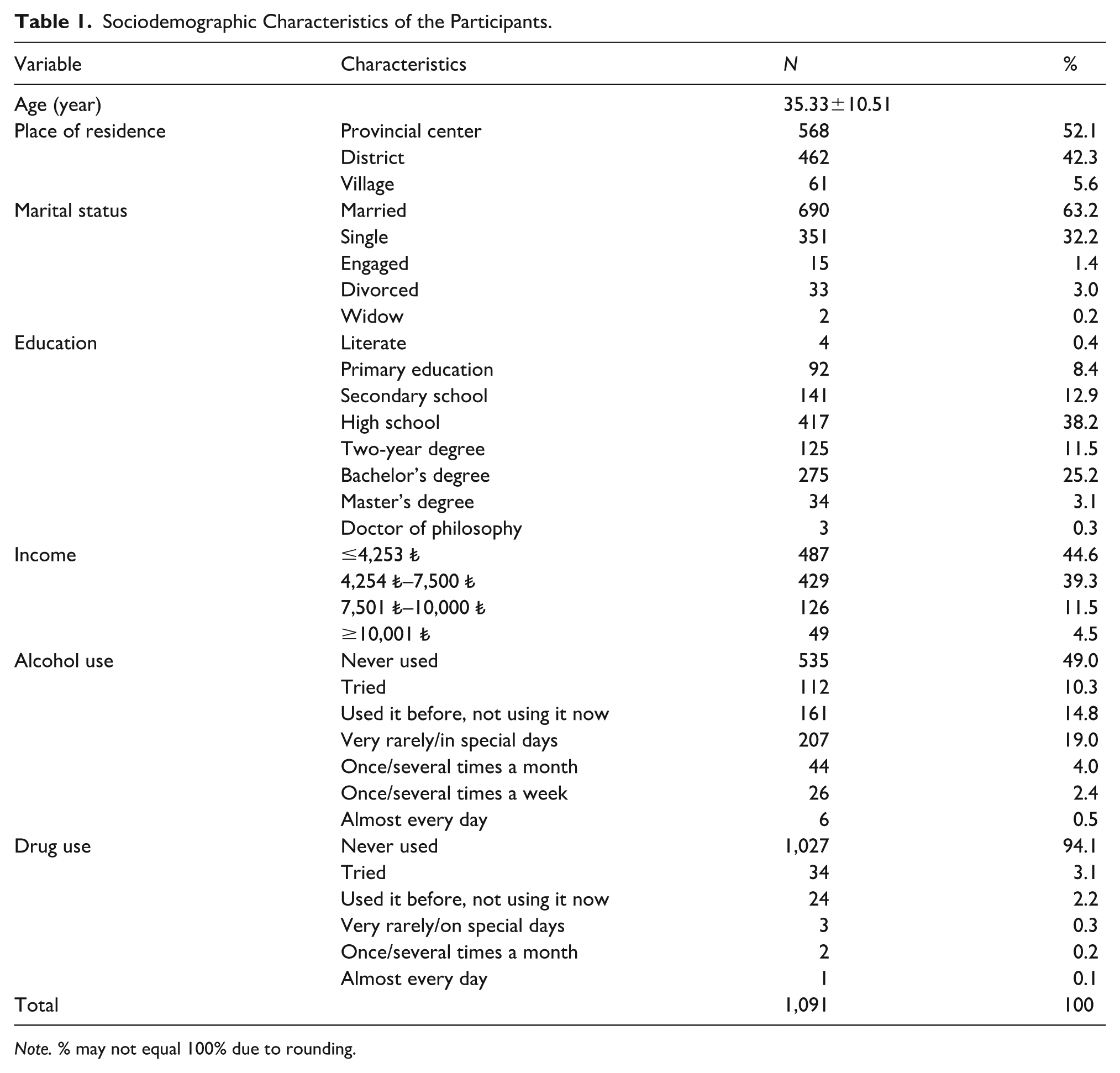
The mean age of the 1,091 men was 35.33 ± 10.51 years, 52.1% (
Sociodemographic Characteristics of the Participants.
Measurements
Conformity to Masculinity Norms Inventory-30
The CMNI-30 is a 30-item instrument to measure ideologies of masculinity, with each item representing different behaviors related to masculinity. Translated versions of the CMNI-30 have been found to be valid and reliable in German (Komlenac et al., 2023; Komlenac & Hochleitner, 2022) and Russian (Krivoshchekov et al., 2022) samples. Participants rate the extent to which these behaviors fit them or the extent to which they align on a Likert-type scale ranging from 1 (
MRNS
The MRNS is widely used to assess beliefs about appropriate behaviors and roles for men. The 26-item MRNS was developed by Thompson and Pleck (1986) and consisted of three subscales (satiety, antifemininity, rigidity). Participants rate each item on a scale from 1 (
Statistical Analysis
In the calculation of content validity, the number of experts who said “3 = the item should be slightly revised” and “4 = the item is appropriate” were summed and divided by the total number of experts to calculate the content validity average (CVA) for each item. For the Content Validity Index (CVI), the average of the content validity ratios of the items as a result of the mentioned evaluation was calculated (Alpar, 2020).
First, the data were transferred to IBM SPSS Statistics 23 and IBM SPSS AMOS 23 programs for analysis. Frequency distribution (number, percentage) was used for categorical variable data, and descriptive statistics (mean, standard deviation) were used for numerical variables. Confirmatory factor analysis was used to construct the validity of CMNI-30. The model’s fit was tested using fit index values (Hu & Bentler, 1999). These fit statistics represent how much a model improves on a general baseline model (without restriction) or how similar data generated from a model are to observed data (Tabachnick & Fidel, 2015). Discrepancies between fit statistics were examined (Lai & Green, 2016) and treated as sources of evidence regarding the appropriateness of a model.
To evaluate the model’s fit, chi-square/degrees of freedom (χ2/
In addition, Cronbach’s alpha and item-total correlation were used to test reliability, and the intraclass correlation coefficient was used for repeated tests (Alpar, 2020). Test–retest reliability for the CMNI after a 2–3-week interval was expected to be greater than 0.5 for each scale (Mahalik et al., 2003). Pearson correlation analysis examined the relationship between the total inventory and its subdimensions and the relationship between CMNI-30 and MRNS.
Results
Validity
Content Validity
Content validity, used to evaluate the appropriateness of the items in the CMNI-30, was determined using the CVI technique (Yeşilyurt & Çapraz, 2018). For all items of CMNI-30, it was decided whether each item should be included in the inventory according to the CVA and CVI criteria. As a result of the opinions of 13 experts for the content validity of the CMNI-30, since the CVA value of each item was statistically in the range of 0.85 to 1.00 (≥0.80), no item was removed (Alpar, 2020; Yeşilyurt & Çapraz, 2018). The CVI value for the whole CMNI-30 was 0.98 ± 0.045.
Construct Validity
Confirmatory factor analysis was applied to the data set to test whether the factor structure of the Turkish CMNI-30 was compatible with the factor structure obtained by Levant et al. (2020). In the first stage, a first-order CFA model with 10-factor dimensions as latent variables and the statements constituting the factors as indicator variables were created (see Figure 1). To estimate parameter values, a value of 1 was assigned to one of the paths drawn from the latent variables to the observed (indicator) variables (factor loading equal to 1) or a value was assigned to the variance of the latent variable (usually 1) (Hair et al., 2005).

First-Order CFA Model of CMNI-30 With 10 Subdimensions.
In the second stage, the maximum likelihood method was used to estimate the model, including the errors of the observed variables, the variances of the latent variables, and the regression coefficients related to the paths drawn from the latent variables to the observed variables (Tabachnick & Fidel, 2015).
The fit indices were examined for the 10-dimensional first-order CFA model in the last stage, indicating χ2 = 1,704.15,
Convergent Validity
Convergent validity was also tested to examine the same concept or other parameters similar to it and the original (Alpar, 2020). The convergent validity of the CMNI-30 was tested using the MRNS, indicating a statistically significant positive correlation between the CMNI-30 and the MRNS (
Reliability
Internal Consistency
Cronbach’s alpha coefficient for CMNI-30 was 0.871 (≥0.70) (Nunnally & Bernstein, 2010). Item-total correlation was used to evaluate internal consistency and ranged between .253 and .541 (Table 2). Those below 0.30 were removed from the scale (Alpar, 2020). An item-total correlation coefficient of .30 and above was interpreted as good for reliability (Alpar, 2020; Şencan, 2005). In this study, the item-total correlation of items 25 and 28 was below .30. However, since Cronbach’s alpha value did not change significantly when the items were removed from the inventory in the item analysis, it was decided to leave them in (Table 2). To assess internal consistency, the correlation between the subdimensions and total scores of CMNI-30 was examined (Alpar, 2020), and there was a statistically significant correlation between subdimension scores and total score of CMNI-30 (
Item-Total Correlation, and Cronbach’s Alpha.

Relationship Between Total and Subdimensions of CMNI-30.

Test–Retest
The test–retest method was used to determine the ability of the Turkish CMNI-30 to provide consistent results, its invariance over time, and its reliability (
Discussion
This study presents methodological evidence for the validity and reliability of the 30-item, 10-factor CMNI-30 developed by Levant et al. (2020) in Turkish men. In Western societies, the CMNI is an effective tool for mapping multiple dimensions of masculine norms in men’s lives. This short version of the CMNI will help to fill the knowledge gap in assessing Turkish men’s conformity to masculinity norms. In what follows, the content validity, construct validity, convergent validity, and reliability findings obtained in this study are discussed.
Validity
Content Validity
Content validity assesses whether a scale and its subdimensions accurately measure the targeted characteristic and whether it covers unwanted concepts (De Vellis, 2012; Tabachnick & Fidel, 2015). The CVI is determined by calculating the consensus among experts (De Vellis, 2012). To understand whether these opinions are consistent, the item-content and scale-CVIs should be >0.80 (Alpar, 2020). In our study, the item-CVI was between 0.85 and 1.00, and the scale-CVI was 0.98. Therefore, these results indicate that the level of agreement between the experts was high, and the content validity of the CMNI-30 for the Turkish sample was adequate. In the studies in which the Russian (Krivoshchekov et al., 2022) and German (Komlenac et al., 2023; Komlenac & Hochleitner, 2022) versions of the inventory were analyzed, the back-translation method was used in a similar way to this study, and they reported similar features to those in our study. As a result, it was shown that the CMNI-30 adequately measured the subject matter in English, Russian, German, and Turkish, and content validity was achieved in the Turkish sample.
Construct Validity
Confirmatory factor analysis is used to assess the appropriateness of the construct that the items aim to measure (Nunnally & Bernstein, 2010). In this study, chi-square was significant for CFA fit index results, while GFI, AGFI, RMSEA, and SRMR were within acceptable ranges. However, TLI, IFI, and CFI did not meet recommended thresholds. These results are broadly in line with findings reported in the U.S. sample by Levant et al. (2020), although direct comparisons are limited due to differences in model parameters and sample characteristics. While RMSEA and SRMR values in our study appeared somewhat higher, they still fell within acceptable thresholds for model fit. Since GFI and AGFI results were not reported in the original study (Levant et al., 2020), no comment can be made regarding those indices. Partial scalar invariance was confirmed for the 10-factor model among Turkish men. Krivoshchekov et al. (2022) examined the validity and measurement invariance of the Russian CMNI-30, tested the fit indices for the structure obtained by Levant et al. (2020), and found that it showed a poor fit. In addition, Anghel et al. (2023) examined the measurement invariance CMNI-30. They reported the model fit was acceptable according to all fit values except χ2. Komlenac et al. (2023) found that the 10-factor model of the German version of CMNI-30 had satisfactory fit indices for the entire research sample group. In this study, GFI, AGFI, RMSEA, and SRMR fit indices for the 10-factor structure of the Turkish CMNI consisting of 30 items were found to be acceptable. This means that the psychometric properties of the CMNI-30 are consistent in the current sample. In addition, the standard regression coefficients of all items were greater than 0.30 (Alpar, 2020; Meydan & Şeşen, 2011; Şencan, 2005; Tabachnick & Fidel, 2015). The results of the study by Levant et al. (2020) could not be compared because the standard regression coefficients of the items for the candidate model were not reported. On the contrary, Komlenac et al. (2023) examined standardized factor loadings, and it was seen that they ranged between 0.52 and 0.93. Therefore, the 10-factor structure of the Turkish version of CMNI-30 is acceptable.
Convergent Validity
The results indicated that the CMNI-30 had convergent and discriminative features in 10 domains of masculinity in Turkish men (Alpar, 2020; Şencan, 2005). Krivoshchekov et al. (2022) reported that the Russian version of CMNI-30 subscales correlated with stereotypes about men, ambivalence toward men, and MRNI-SF. Komlenac et al. (2023) reported moderate to significant positive correlations between the German version of CMNI-30, GRCS-SF, and MRNI-SF. In this study, statistically significant correlations between the Turkish version of the CMNI-30 and MRNS, similar to the studies mentioned above, support convergent validity and indicate that the measures are conceptually related. Therefore, the CMNI-30 factors (emotional control, winning, playboy, violence, heterosexual self-protection, status-seeking, work priority, power over women, self-sufficiency, and risk-taking) show these structures and characteristics related to masculinity in Turkish men, providing a foundational understanding of the cultural conceptualization of masculinity.
Reliability
Internal Consistency
Internal consistency is an important criterion to assess a scale’s homogeneity and reliability. Cronbach’s alpha is one of the most frequently used values. Cronbach’s alpha coefficient is classified as “not reliable” between 0.00 and 0.40, “low reliability” between 0.40 and 0.60, “highly reliable” between 0.60 and 0.80, and “high reliability” between 0.80 and 1.00 (Seçer, 2018; Tabachnick & Fidel, 2015). This study results indicate that the Cronbach’s alpha coefficient for CMNI-30 is highly reliable. These results were similarly obtained in a U.S. sample by Anghel et al. (2023) (overall Cronbach’s alpha reliability was .83). This showed that the Turkish version of CMNI-30 possessed strong internal consistency.
The item-total correlation value was “good” for items scored between .30 and .40 and “very good” for items above .40 (Aksayan & Gözüm, 2002). In this study, the correlation coefficients of the 25th and 28th items were below .30, while the correlation coefficients for the other items were good or very good. There was, however, no change in the total Cronbach’s alpha value, and all 30 items were retained in the Turkish version of the CMNI-30. Accordingly, it can be said that CMNI-30 is well-discriminative and reliable in Turkish culture. In addition, when the correlation between the CMNI-30 total score and its subdimensions was examined to evaluate internal consistency, a significant relationship was observed. Levant et al. (2020) and Anghel et al. (2023) did not report the item-total score analysis, so a comparison could not be made. The results of this study show that the CMNI-30 items have a high correlation with the construct measured, the items have a sufficient correlation with the total score in their subdimensions, the 10 subdimensions have a structure with item reliability, and the Turkish version is reliable.
Test–retest refers to the capacity of a measurement tool to give consistent results in different applications and shows its invariance over time (Aksayan & Gözüm, 2003; Esin, 2015). The test–retest reliability results of the CMNI-30 administered at intervals of 2 to 3 weeks indicated a positive correlation in this study, which is consistent with the results of the German version by Komlenac et al. (2023). Although our result shows the consistency and reliability of the measurement tool over time, the correlation value was lower than anticipated. While one might expect high stability in conformity to masculinity norms, the moderate test–retest correlation suggests that some variability may exist. This fluctuation may reflect the context-dependent nature of masculine norm endorsement, which can shift in response to short-term changes in social interactions, emotional states, or situational demands. Although we cannot identify specific reasons based on our data, factors such as changes in participants’ psychological state, social context, or interpretation of items may have contributed to variability. Future research should explore potential moderators of temporal stability, including time interval length, sample characteristics, and contextual influences.
Limitations
Several limitations need to be addressed in this study. First, participants from crowdsourcing platforms include those with computer and Internet access, which limits the scope of the socioeconomic groups surveyed. Developing alternative methods to include participants who do not have access to technological facilities may provide additional information about Turkish men. It is important, therefore, to emphasize that the participants had Internet access and the literacy to complete the survey. Second, the sample consisted of men who self-identified as heterosexual. This limits what can be known about the structure’s validity among participants who identify as sexual minorities including bisexual and gay men.
Third, the sample size in the second application was relatively small, similar to that in the study of a German sample (Komlenac et al., 2023). It is important to cautiously interpret findings based on such highly motivated and self-selected samples. Like most survey studies, self-report is a limitation.
Last, although most model fit indices are within the acceptable range, this research has some limitations due to the low TLI and CFI values. Although modification indices were examined, no significant improvement in the fit was achieved as a result of the application. In addition, some factor loadings were low, especially in F9 and weaker-than-expected loadings were observed in F2, F6, and F8. This situation was addressed with exploratory factor analysis (EFA) applied to the data set during the analysis process. However, a factor structure suitable for the theoretical framework could not be created. As a result, the analyses were conducted on the original model, and these limitations were considered factors that may affect the generalizability of the study results.
Conclusion
The findings support the 10-factor structure of the CMNI-30 that was originally reported by Levant et al. (2020). In other words, the results of our study indicate the CMNI-30 is a usable measurement tool for assessing masculinity norms in Turkish society and across time among men. The CMNI-30, valid and reliable in this study, has an array of applications. Specifically, researchers have increasingly recognized the impact of masculinity on men, their mental health, and willingness to seek and receive professional help (Beel et al., 2018). Longitudinal and experimental studies might help evaluate the clinical outcomes of men who receive gender-responsive tailored care.
Footnotes
Appendix
Erkeklik Normlarına Uygunluk Envanteri (ENUE-30)
Lütfen her bir ifadeye ne ölçüde katıldığınızı gösteren rakamı daire içine alarak bu anketi doldurun. Her bir ifade için yalnızca bir yanıt verin.
| Kesinlikle Katılmıyorum | Katılmıyorum | Biraz Katılmıyorum | Biraz Katılıyorum | Katılıyorum | Kesinlikle Katılıyorum | ||
|---|---|---|---|---|---|---|---|
| 1 | Duygularımı başkaları ile paylaşma eğilimindeyim. (T) | 1 | 2 | 3 | 4 | 5 | 6 |
| 2 | İnsanlar, eşcinsel olduğumu düşünseydi sinirlenirdim. | 1 | 2 | 3 | 4 | 5 | 6 |
| 3 | Şiddetin hiçbir türünden hoşlanmam. (T) | 1 | 2 | 3 | 4 | 5 | 6 |
| 4 | Yardım istemek zorunda kalmak canımı sıkar. | 1 | 2 | 3 | 4 | 5 | 6 |
| 5 | Başkalarıyla konuşurken duygularımı dile getiririm. (T) | 1 | 2 | 3 | 4 | 5 | 6 |
| 6 | Benim için iş her şeyden önce gelir. | 1 | 2 | 3 | 4 | 5 | 6 |
| 7 | Benim için dünyanın en iyi hissi kazanmaktır. | 1 | 2 | 3 | 4 | 5 | 6 |
| 8 | Risk almayı severim. | 1 | 2 | 3 | 4 | 5 | 6 |
| 9 | Önemli biri olmaya çalışmanın zaman kaybı olduğunu düşünüyorum. (T) | 1 | 2 | 3 | 4 | 5 | 6 |
| 10 | Hayatımdaki kadınlar bana itaat etmelidir. | 1 | 2 | 3 | 4 | 5 | 6 |
| 11 | Biri eşcinsel olduğumu düşünse öfkeden köpürürüm. | 1 | 2 | 3 | 4 | 5 | 6 |
| 12 | Mümkün olsa cinsel partnerimi sık sık değiştiririm. | 1 | 2 | 3 | 4 | 5 | 6 |
| 13 | Duygularım hakkında konuşmaktan hoşlanırım. (T) | 1 | 2 | 3 | 4 | 5 | 6 |
| 14 | Aynı anda birden fazla kişiyle flört etmekten hoşlanırım. | 1 | 2 | 3 | 4 | 5 | 6 |
| 15 | Şiddete başvurmak benim için asla kabul edilemez. (T) | 1 | 2 | 3 | 4 | 5 | 6 |
| 16 | Genel olarak kendi bildiğimi yaparım. | 1 | 2 | 3 | 4 | 5 | 6 |
| 17 | İnsanların eşcinsel olduğumu düşünmeleri feci bir şey olurdu. | 1 | 2 | 3 | 4 | 5 | 6 |
| 18 | Statü sahibi olmak benim için önemli değildir. (T) | 1 | 2 | 3 | 4 | 5 | 6 |
| 19 | Kendimi riskli durumlara sokarım. | 1 | 2 | 3 | 4 | 5 | 6 |
| 20 | Erkekler yetkili olduğunda işler daha iyi olma eğilimindedir. | 1 | 2 | 3 | 4 | 5 | 6 |
| 21 | Önceliğim iş olduğunda kendimi iyi hissederim. | 1 | 2 | 3 | 4 | 5 | 6 |
| 22 | Önemli biri olsam bundan nefret ederdim. (T) | 1 | 2 | 3 | 4 | 5 | 6 |
| 23 | Kazanmak için her şeyi yaparım. | 1 | 2 | 3 | 4 | 5 | 6 |
| 24 | Şiddetin bazen gerekli olduğunu düşünüyorum. | 1 | 2 | 3 | 4 | 5 | 6 |
| 25 | Asla yardım istemem. | 1 | 2 | 3 | 4 | 5 | 6 |
| 26 | İşime başka şeylerden daha fazla öncelik vermeye ihtiyaç duyarım. | 1 | 2 | 3 | 4 | 5 | 6 |
| 27 | Erkeklerin kadınların başında olması hoşuma gider. | 1 | 2 | 3 | 4 | 5 | 6 |
| 28 | Yardım istemekten utanmam. (T) | 1 | 2 | 3 | 4 | 5 | 6 |
| 29 | Birçok cinsel partnerim olsaydı kendimi iyi hissederdim. | 1 | 2 | 3 | 4 | 5 | 6 |
| 30 | Risk alırım. | 1 | 2 | 3 | 4 | 5 | 6 |
Toplam puan elde edilen puanın madde sayısına bölünmesi sonucu elde edilir. Alt ölçek puanlarını elde etmek için o ölçek için maddelerin ortalaması hesaplanmalıdır. Bunlar ölçekte görünen numaralarla aşağıda belirtilmiştir.
1. Duygusal Kontrol = (1 + 5 + 13) / 3
2. Kazanma = (7 + 16 + 23) / 3
3. Playboy = (12 + 14 + 29) / 3
4. Şiddet = (3 + 15 + 24) / 3
5. Heteroseksüel Kendilik Koruması = (2 + 11 + 17) / 3
6. Statü Arayışı = (9 + 18 + 22) / 3
7. İş Önceliği = (6 + 21 + 26) / 3
8. Kadınlar Üzerinde Güç = (10 + 20 + 27) / 3
9. Kendine Yeterlik = (4 + 25 + 28) / 3
10. Risk Alma = (8 + 19 + 30) / 3
Authors’ Note
This article was derived from the doctoral dissertation titled “Men’s Experiences of Depression from the Perspective of Cognitive-Behavioural Approach: A Mixed Method Grounded Theory Study” conducted by the first author (Bedia Tarsuslu) at Sakarya University, Türkiye.


Ethical Considerations
Ethics approval was obtained from the Noninvasive Clinical Research Committee of the Faculty of Medicine at Sakarya University (resolution number E-71522473-050.01.04-121342-90, dated April 4, 2022).
Informed Consent
Informed consent was received by all participants.
Author Contributions
Conceptualization: [Bedia Tarsuslu], [Gulgun Durat]; Methodology: [Bedia Tarsuslu], [Gulgun Durat]; Formal analysis and investigation: [Bedia Tarsuslu], [John L. Oliffe]; Writing—original draft preparation: [Bedia Tarsuslu], [John L. Oliffe]; Writing—review and editing: [Bedia Tarsuslu], [John L. Oliffe], [Gulgun Durat], [John S. Ogrodniczuk], [David Kealy]; and Supervision: [Gulgun Durat], [John L. Oliffe], [John S. Ogrodniczuk], [David Kealy].
Funding
The authors received no financial support for the research, authorship, and/or publication of this article.
Declaration of Conflicting Interests
The authors declared no potential conflicts of interest with respect to the research, authorship, and/or publication of this article.
Data Availability Statement
Data may be made available upon reasonable request.