







Abstract
Keywords
The physical and mental health of men has been subjected to a series of discussions in published literature. Women live longer than men in all countries of the world, and the differences are greatest in high-income countries (Baum et al., 2021). It is known that male blue-collar workers have a shorter life expectancy than women, mostly due to preventable diseases and injuries (Kolmet et al., 2006). The factors responsible for gender differences in life expectancy have not been thoroughly investigated. Therefore, it is important to understand more on the experiences of men in both white-collar and blue-collar jobs. Many social, physical, and psychological factors contribute to the stresses men experience at their various workplaces. In a study, mental health and wellbeing issues were inherent among blue-collar workers (Mclean, 2012). Men are the overwhelming majority in blue-collar jobs due to their physical strength. Research investigating blue-collar work and life issues has been sparse (Cowan & Bochantin, 2011).
The perception of male characteristics such as stoicism, endurance, competitiveness, and emotional suppression in various societies also blinds men to their realistic limitations. The norms of hegemonic masculinity rendered men vulnerable when their physical and mental strength was treated as an inexhaustible resource. To live up to the societal expectations, some men suppress their emotion and endure physical pain while working long hours and lifting heavy objects to meet the financial demands of families (Koekemoer et al., 2019). The process of hiding pains in conformity with the societal norm compromises their long-term wellness. Some men in blue-collar jobs who are breadwinners find it difficult to take a leave of absence when not feeling well for the fear of financial losses (Cillekens et al., 2024). An absence due to illness costs them money and not being able to work for a longer period can have severe financial consequences. As a result, self-employed workers were more likely to make short-term decisions, such as working long hours and continuing to work despite not being fully recovered after a period of sickness (Cillekens et al., 2024).
Men who seek work flexibility to cope with stressors or other family demands are judged harsher than women as they are seen as less manly, because putting in long hours at work continues to signal the elite status of hard-working men (Iztayeva, 2024). In a study, 24% of work absences were due to mental and behavioral disorders (Cillekens et al., 2024). A research study indicated men avoid help-seeking because such behavior is inconsistent with male behavioral traits (Eldred et al., 2022). In white-collar men, low-role clarity was associated with greater rate of extended absences than high-role clarity (Schreuder et al., 2008). White-collar-men face higher psychological demands at work (Schreuder et al., 2008). Low fairness in the division of labor also predicted a greater rate of extended absences in blue-collar male workers (Väänänen et al., 2004).
According to Schreuder et al. (2008), white-collar workers reported higher psychological job demands, and blue-collar workers reported higher physical demands. Pain in the upper extremity, neck pain, and irritated eyes were frequently mentioned by white collars (Schreuder et al., 2008). A research study pointed to the role of psychosocial stressors in the workplace, such as reduced control over work, monotony of work, high psychological demands, and their relationship with suicide (Matthews et al., 2021). A lack of perceived organizational justice affects not only the attitudes of employees toward their organization but also their health and wellbeing, likely due to the experience of unfairness, which creates a source of distress (Herr et al., 2020). A systematic research study demonstrated the relevance of mental health in 50% of construction industry workers’ suicides (Tyler et al., 2024). The rate of completed suicide is higher in men due to limited circle of trust and emotional suppression (Matthews et al., 2021). It has been stated that men’s use of mental health support is still strongly associated with stigma, as some men feel reluctant in seeking help when in need (Mathews et al., 2021).
The objective of this systematic review is to identify, appraise, and meta-synthesize qualitative evidence regarding the experiences and perceptions of men in both white-collar and blue-collar jobs.
Specifically, this systematic review was guided by the following research questions:
Method
Because we were interested in interpretative experiences of men in both white-collar and blue-collar jobs, a systematic qualitative literature review was conducted using a meta-ethnographic approach, and the review was reported according to the PRISMA guidelines (Page et al., 2021). This systematic review attempts to identify, appraise, and synthesize all the empirical evidence that meets prespecified eligibility criteria to answer the above research questions. Researchers conducting systematic reviews use explicit, systematic methods that are selected with a view aimed at minimizing bias, to produce more reliable findings to inform decision-making (The Cochrane Collaboration, 2025). The study was approved by the University’s Institutional Review Board (IRB2025-241).
Study Design
Study synthesis was conducted using the meta-ethnographic method described by Noblit and Hare (1988). Meta-ethnography is concerned with the translation of individual qualitative studies into one another, through the re-interpretation and transformation of their analytic and theoretical concepts (Noblit and Hare, 1988). This approach, and the meta-ethnography reporting guideline (France et al., 2014), provides seven phases: (1) formulating the research question; (2) identifying and selecting studies; (3) repeated reading of selected studies; (4) determining how studies are related through coding and comparing conceptual content; (5) translating the studies into one another; (6) synthesizing the translations; and (7) expressing the synthesis.
Search Methods
The systematic review of qualitative studies searches was conducted in MEDLINE, Scopus, EBSCohost, ProQuest, CINAHL, and PsycINFO of articles published between 2005 and 2025 to ensure information is current and relevant to modern practices and to analyze trends and the evolution of a research field over a significant period of 20 years. The search strategy included a combination of Smart Texting searching of the three main concepts being examined in this review (experience/perception, pressure at work, and coping strategies). Study quality was evaluated using the Critical Appraisal Skills Program tool (2024). Qualitative data were analyzed using a meta-ethnographic approach, comprising reciprocal syntheses of participants’ experiences in both white-collar and blue-collar jobs.
Eligibility Criteria
Studies were included if they were qualitative and addressed men in both white-collar and blue-collar jobs, published in English, and involved qualitative data collection and analysis. The University Librarian guided article selection. We considered studies conducted in any country and setting. Studies focusing on economic status and level of education were excluded. Materials not formally published through traditional academic or commercial channels were also excluded.
Selection Criteria
Study selection followed PRISMA guidelines (Figure 1). Two reviewers independently screened 10% of the abstracts, and Cohen’s kappa statistic was used to assess inter-rater reliability (
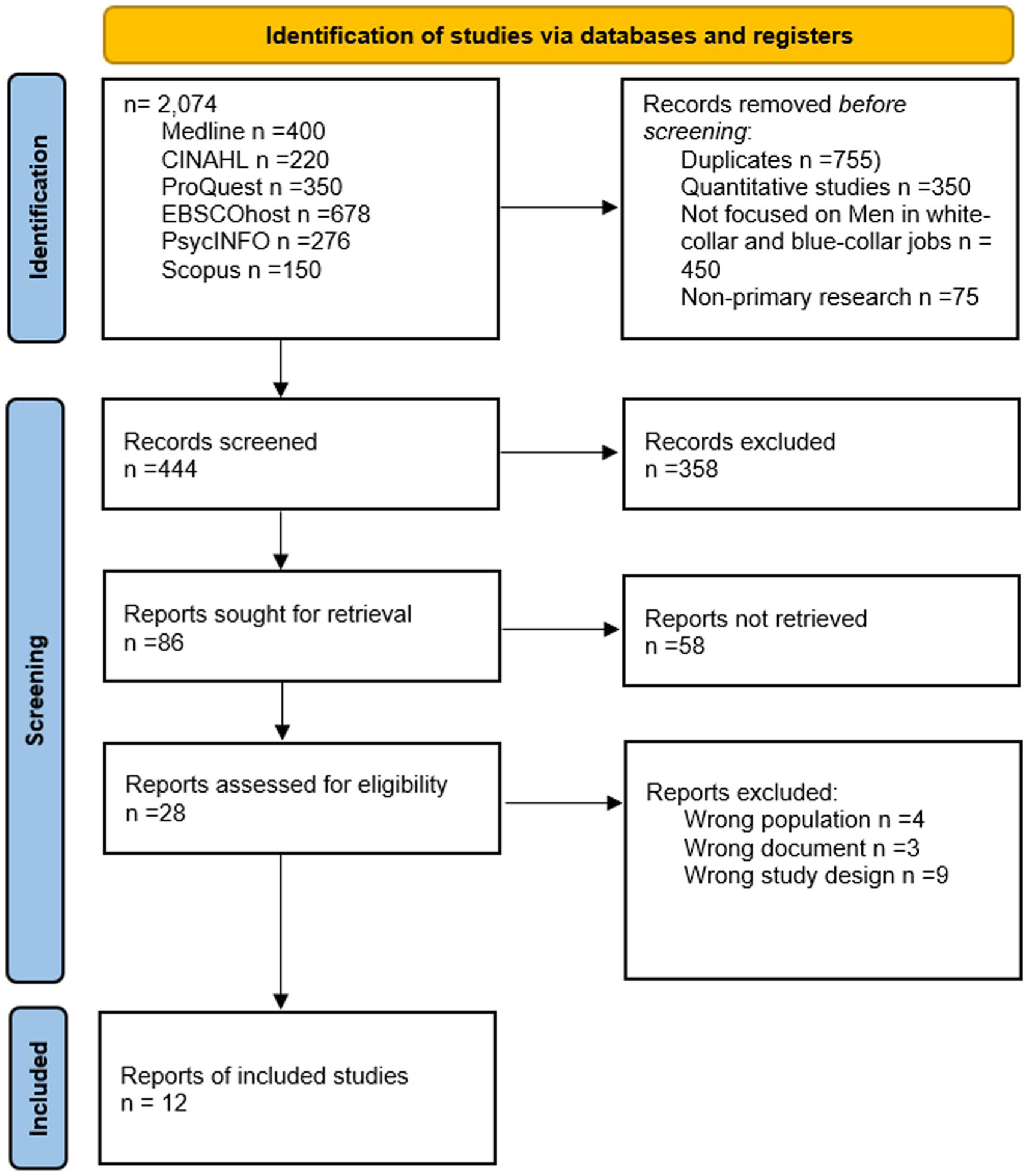
PRISMA Flowchart of Study Selection process for the systematic literature review: CINAHL, Cumulative Index to Nursing and Allied Health Literature; Medline; Proquest; EBSCOhost; PsychINFO; Scopus.
Critical Appraisal
To assess study quality, the Critical Appraisal Skills Program (CASP) qualitative research checklist was used (Critical Appraisal Skills Program, 2024). This tool has been previously used by published reviews of qualitative studies (van Oorsouw et al., 2024). All studies were critically appraised, and each study was assigned a numerical score out of 10, where a higher score correlated with higher quality. The two highest-ranked studies were used as index studies and were the first studies from which concepts were translated into other studies, thereby shaping the analysis (Iztayeva, 2024). This process was carried out independently by two authors, and scores were discussed to check for consistency. Disagreements were resolved through discussion. No studies were excluded due to quality of appraisal because none of the studies were rated as being very low; conversely, most of the studies were rated as high quality. Most studies reported on the methodological framework used and provided detailed descriptions of the data analysis methods.
Data Collection and Synthesis/Analysis
The authors applied a prespecified sampling frame to purposefully sample a variety of eligible studies. This sampling approach allowed us to capture conceptually rich studies that described the viewpoints of men working in both white-collar and blue-collar jobs. Using the framework synthesis approach, we developed a framework representing experiences/perceptions, work environment factors, and coping strategies, which guided data extraction and synthesis. We assessed the methodological limitations of each study using an adapted version of the Critical Appraisal tools for qualitative studies (Critical Appraisal Skills Program, 2024).
The meta-ethnographic stages include getting started, deciding what is relevant to the initial interest, reading the studies, determining how the studies are related, translating the studies into one another, synthesizing the translations, and expressing the synthesis (Noblit & Hare, 1988). Synthesis began with repeated readings of the studies to identify key categories and to determine relationships between individual studies. A list of key categories was thus generated and used as the basis for comparing and sorting interpretations, examining similarities and differences, and then integrating these in a new (“third order”) interpretation that applies across the studies, referred to as a “line-of-argument” (Noblit & Hare, 1988; Sattar et al., 2021). Sattar et al., (2021) distinguished between different levels of interpretation, citing research participants’ interpretations as “first order,” researchers’ interpretations in the primary studies as “second order,” and the interpretation provided through a synthesis as “third order.” For this synthesis, second-order interpretations were extracted against the list of key categories identified, and these were used as a foundation for exploring translations between the studies. Much of the detail of the second-order interpretation was retained at this stage, to help preserve context and meaning. Comparisons were then made across the studies to determine the extent to which concepts proposed in one study related to those expressed in another study, a process known as reciprocal translation (Noblit & Hare, 1988). Differences were pursued as rigorously as similarities, and comparisons across concepts and contexts were continuously made by authors, for instance, exploring the extent to which an emerging interpretation was relevant across men in white-collar and blue-collar jobs.
The translated concepts were then used to identify third-order interpretations that transcended the individual accounts (van Oorsouw et al., 2024). As third-order interpretations emerged, they were systematically tested by looking across all the studies and the second-order interpretations; these third-order interpretations were discarded or developed further as required. Reciprocal translation continued until no further third-order interpretations emerged. Two researchers undertook database searching and preliminary study selection. Subsequent stages of quality appraisal, final selection, data extraction, and analysis were undertaken by a single researcher. To ensure alternative perspectives were advanced and discussed with a view to enriching the analyses, this was undertaken in consultation with all four researchers. Organization of the review was managed through RevMan 9, a Cochrane online software tool (The Cochrane Collaboration, 2025). A protocol used to guide the review is available from the authors on request.
Results
Study Characteristics
Twelve studies were included (Table 1). Most participants were men in both white-collar and blue-collar jobs. Three studies from Australia consisted of 101 male participants, four studies from the United States consisted of 126 men out of 132 participants, two studies from South Africa consisted of 290 men, two studies from the Netherlands consisted of 31 male participants, and one study from the United Kingdom had 2 men. These studies were published between 2006 and 2024. The demographic characteristics of participants (Table 2) illustrate the ethnicity, country, region, and age range of participants. Cowan and Bochantin, (2011) omitted the ages of participants, but all the 14 participants had an average of 9 years of employment, 10 married, and all 14 had children.
Study Characteristics.

Demographic Characteristics of Participants in the Studies.

The following sections show reciprocal translations of men in white-collar and blue-collar job studies with emphasis on their experiences and perceptions, pressure in the work environments, and coping strategies, followed by a lines-of-argument synthesis (see Table 3 for reciprocal translation of findings).
Reciprocal Translations for Men in White-Collar and Blue-Collar Jobs.

Reciprocal Translation of Men in White-Collar and Blue-Collar Job Studies
Reciprocal translation of key concepts extracted from the men in white-collar and blue-collar job studies synthesized six third-order constructs: need for openness and better collaboration, financial responsibility, self-awareness and self-esteem, need for quality lifestyle outside work, cultural perception of men to be strong, and staying healthy physically and mentally.
Need for Openness and Better Collaboration
Participants felt that they had a limited circle of trust (Mathews et al., 2021). Trust is necessary to have confidence in others. In the absence of trust in other workers, participants always felt uncomfortable to discuss personal issues, thereby making them embarrassed to seek help (Mathews et al., 2021). Participants kept issues to themselves until things became worse. The lack of trust also created lack of affinity between two ethnic groups as evidenced by whites not relating well with blacks. Study participants worked together but did not identify as friends.
Financial Responsibility
Men in both white-collar and blue-collar jobs resonated very well with financial responsibility. As breadwinners, most men strongly considered the importance of finance in their lives. Solid personal finances reduce stress, and it is important to navigate life’s major milestones such as making provisions for family. It did not matter what kind of job, provided they were earning wages, and participants believed they must work for the money (Elliott & Roberts, 2022; Koekemoer et al., 2019). Insurance coverage was possible if the individuals had employment (Cillekens et al., 2024). Without insurance coverage, medication refills to deal with ailment becomes problematic.
Self-Awareness and Self-Esteem
Self-awareness was apparent in men in white-collar and blue-collar jobs. The awareness of aging, knowing that a time will come when most of their physical activities become limited. Staying away from injuries becomes important as the body takes longer to recover (Cillekens et al., 2024). Even when the body is failing, they do not want to stop working until over 67 years and it is an indication of dignity. The concept that every job is important, and someone must do it drives home the importance of self-esteem. In the sense that no job is menial for men, either digging ditch or being a president (Lucas, 2011).
Need for Quality Lifestyle Outside Work
All participants had concerns about quality of lifestyle outside of work. In the opinions of participants, it indicates that most work environments consider women as the sole carers for family but do not consider men’s responsibility in family care. Men have big roles to play and want to be involved in family care (Iztayeva, 2024; Kolmet et al., 2006; Suleiman et al., 2021). Others stated work was difficult and getting in the way of life because of long hours of overtime with limited vacations (Cowan & Bochantin, 2011).
Cultural Perception of Men to Be Strong
In many societies, men are notable to have bigger muscles, thereby considered in workplaces to be stronger than women. Many instances showed harder tasks being assigned to men by the nature of physical strengths. The connotation that men can easily do most of these tasks, coupled with long hours of work, had resulted in many devastating injuries (Kolmet et al., 2006). Men attempted to live up to these expectations at the risk of developing physical and mental problems.
Staying Healthy Physically and Mentally
Most men in white-collar and blue-collar jobs have profound awareness of aging and want to stay healthy physically and mentally on their jobs. Stress reduction and the importance of exercise resonated with this group (Cillekens et al., 2024; Mclean, 2012). The hours spent at work were not regarded as exercise. There were instances of men using painkillers to suppress pain so that they can work (Cillekens et al., 2024).
Lines-of-Argument Synthesis
The syntheses of men in white-collar and blue-collar job studies in this review revealed that men’s experiences and perceptions are essentially unique. Men in white-collar and blue-collar jobs take family responsibilities with seriousness and commitment. The interest in finance resonated well in all men to put food on the table for families. In the quest to fulfill these responsibilities, no job type is out of consideration, and men perform their jobs with great sense of dignity (Lucas, 2011). Even with the hegemonic masculinity construct, pervasive in many societies, men continue to do the most difficult parts of the job tasks no matter what physical and psychological pains they might experience. In most cases, men do not have a circle of trust because any expression not in consonance with stoic behavior makes the individual less manly from the organization’s views (Mathews et al., 2021). The consequence for this is that men keep feelings to themselves, using pain medication and suffering in silence (Cillekens et al., 2024). It is obvious that men suffer more injuries at work, and the rate of completed suicide is higher in men (Matthews et al., 2021).
In addition, most organizations have not taken enough consideration of the supportive role of men in health family. Some men want to be more present with their families by participating in child care, keeping the company of their spouses, going for grocery shopping, cooking, and having quality time with their families rather than working overtime and spending long hours at work both during the week and on weekends (Iztayeva,2024). It means that most work environments need to critically investigate the conditions of men and make some policy changes to make the lives of men better. Openness and collaboration are very important in any work setting. Openness and collaboration at workplace are possible only through pervasive trust among the workforce (Mathews et al., 2021). The lack of trust invariably leads to poor communication and embarrassment to ask for help (Mathews et al., 2021). Men feel embarrassed to ask for help when unsure how others will respond. In most cases, the privilege to talk with coworkers and express feelings can be therapeutic and prevent undue stress and depression.
Financial responsibility came into greater focus among the participants. The task of keeping the family together and comfortable becomes impossible without the much-needed financial resources (Koekemoer et al., 2019). Some men do go to any length such as menial jobs, working long hours, and forfeiting their vacation for cash rewards to achieve financial stability (Cillekens et al., 2024; Elliott & Roberts, 2022; Koekemoer et al., 2019). In all these, most men are aware of their commitments to family lives. Most work environments do not recognize that men do get involved in taking care of their families, ranging from child care, taking children to after-school programs, having quality time with family, grocery shopping, cooking, and even giving support to their spouses (Iztayeva, 2024; Kolmet et al., 2006; Suleiman et al., 2021). The absence of men from home due to long hours at work constitutes a threat to marriage (Suleiman et al., 2021).
In many cultures, men are often viewed as strong due to their larger physical build and greater muscle mass. This hegemonic masculinity embraced by many societies often leads to negative consequences. The hegemonic masculinity is a socially constructed concept characterized by traits such as aggression, stoicism, dominance, and emotional suppression. Although the concept is not representative of all men, it serves to uphold and reinforce male dominance. The negative consequences for men included tasking them to carry big weights that usually led to injury, working long hours that separated them from families and other recreational activities, and hiding their pains that usually made their condition worse in the process of satisfying the societal expectations (Kolmet et al., 2006).
Men’s self-awareness and self-esteem are based on the premise of hard work. A man digging a ditch does not consider himself inferior to a president or anyone in an executive position. The progression of age is evident to all men, but at same time, they want to stay engaged at work. To do that, self-preservation cannot be overemphasized in ensuring no injuries occur. An injured person cannot work productively, and in addition, healing takes longer as men age (Cillekens et al., 2024; Lucas, 2011). The need to stay healthy physically and mentally was agreed upon by most participants by using medications as prescribed, going out of the work environment for shooting game, or participating in any sorts of activities (Cillekens et al., 2024; Mclean, 2012).
Discussion
Summary of Results
This meta-ethnographic synthesis highlighted the unique experiences/perceptions, work environment factors, and coping strategies of men in white-collar and blue-collar jobs. There is the need for openness and better collaboration as evidenced by the lack of trust and limitation of circle of trust. Some men feel embarrassed asking for help either due to lack of trust in fellow workers or the hegemonic masculinity social construct that values stoicism and emotional suppression (Mathews et al., 2021). The hegemonic masculinity construct has negative consequences such as injury, limited family time, and pain suppression that usually made their condition worse for lack of timely intervention (Kolmet et al., 2006).
Some men want a quality lifestyle outside work. Going to work to accomplish certain tasks is hard enough; therefore, men need some time away from work environment to be happy and productive. Some men want to be involved and spend quality time with their families (Cowan & Bochantin, 2011; Iztayeva, 2024; Kolmet et al., 2006; Suleiman et al., 2021).
The dignity in men was evident based on their self-awareness and self-esteem. Most men want to continue working if they are healthy, taking every precaution to avoid injuries, commitment to exercise, and using other coping strategies such as recreational activities, and prescribed medications to maintain physical and mental health (Cillekens et al., 2024; Mclean, 2012). Men do have an onerous obligation to support their families financially. Therefore, it is within the priority needs of men to put food on the table for their families (Cillekens et al., 2024; Elliott & Roberts, 2022; Koekemoer et al., 2019). The evidential presence of heteronormality in the findings is mindful of the importance of other sexual and marital relationships in various societies.
Strengths and Limitations
The strength of meta-ethnographic approach offers a greater description of methods and higher-order interpretation (an overarching explanation of a phenomenon that goes beyond what the study parts alone imply), compared to a conventional narrative literature review (Sattar et al., 2021). A meta-ethnography should be interpretive rather than aggregative, thereby taking the form of reciprocal translation of studies into one another (Noblit & Hare, 1988). The articles included within this review were identified using a systematic approach, which enabled the identification of all relevant studies published within the area of men in white-collar and blue-collar jobs. Although a comprehensive systematic search was undertaken, it is possible that not all the relevant studies were retrieved. The necessary inclusion of studies from different countries could be considered a further limitation, as each country has different culture and workplace policies, thereby making the transferability of findings difficult. However, the commonalities among the 12 studies across five countries and four continents were very strong, as the whole world has become a global village. Therefore, it can be argued that the literature represents the views and cultural perspectives of various continents, namely Europe, Africa, North America, and Australia. The four authors do have biases, but having two male and two female authors co-wrote an article brought in innovation, creativity, and diverse perspectives to the study as consensus was achieved.
Implications for Communities
Many societies are built on paternalistic concept that created the obvious male dominance culture in several communities and organizations today. The trend of time continues to show that not all men fit into this category of hegemonic masculinity. Although hegemonic masculinity varies across time and contexts, it is typically understood to be embodied by a White, heterosexual man who is “strong, successful, capable, reliable, in control” (Ralph-Morrow, 2022). A general understanding that men embrace masculine ideologies and practices in a bid to shore up gender identity is strongly suggested by both laboratory and field research (Ralph-Morrow, 2022). The social construct of hegemonic masculinity provided certain privileges, but it has created more physical and psychological challenges for men. When any society, community, or organization values stoicism, dominance, and emotional suppression as the hallmark of a man, doing otherwise is to become less of a man. In addition to the lack of trust, the attitude of cultivating inner strength and emotional suppression to fit into societal values also enforced men to keep their feelings to themselves instead of expressing them to others (Mathews et al., 2021). Every community should take the lead in educating men that expressing emotions is a sign of strength, not weakness. Organizations must recognize that men, too, experience vulnerability—that tears do not diminish masculinity, and physical strength does not equate to invincibility. By embracing this understanding, we can significantly reduce the rates of severe injury, premature death, and suicide among men.
Most men continue to take financial responsibility to their families with all seriousness; all organizations need more awareness of this by reducing the tasks given out at some points to reduce the onerous burden that can impact their physical and mental health. Men go to any length working long hours, and no job is too dirty or menial to put food on the tables for their families (Cillekens et al., 2024; Elliott & Roberts, 2022; Koekemoer et al., 2019). In addition, organizations should continue to have resources available for men to exercise and to remain physically and mentally healthy (Cillekens et al., 2024; Mclean, 2012).
Policy changes need to be initiated in many organizations to give men their equal right of place. Most men want to be more involved with their families (Cowan & Bochantin, 2011; Iztayeva, 2024; Kolmet et al., 2006; Suleiman et al., 2021). In the past, family care was the prerogative of feminism, but things are in a trajectory now as men want to see themselves caring for their wives when pregnant and when babies are born, assisting with cooking, and taking children to schools and other recreational activities. Many marriages are the verge of collapse because male figures are always at work doing extended hours during the week and weekend (Iztayeva, 2024). Therefore, any policy changes giving equal chances for men to participate and be present in their family lives should be in the right direction.
Conclusion
This is the first qualitative meta-ethnography of men in white-collar and blue-collar jobs. Our findings suggest that men in both white-collar and blue-collar jobs have enormous challenges often overlooked by many societies due to an ingrained societal construct that views men as a strong gender. The hegemonic masculinity has been evident in many societies, but it should be noted that not all men fit into this category. The position of some men made financial responsibility quintessential for the welfare of family. Some men want organizations to give more privileges that will allow more quality time with family.
In addition, the circle of trust is very thin with some men, as they do not freely discuss their physical, mental, and psychological challenges with others. The lack of trust together with hegemonic masculinity made it difficult for men to communicate and seek help for any prevailing problems. Most men prefer enduring both physical and psychological inconveniences until things get out of hand. To many men, seeking help from others may make them less of a man because men should not show signs of weakness either by crying or telling others where it hurts, either physically or mentally. The rate of completed suicide is higher among males compared to females, perhaps due to the failure of some men to express their minds and seek help on time. Therefore, it is important that organizational policies, training, and guidance reflect these challenges faced by men in white-collar and blue-collar jobs.
Footnotes
ORCID iD
