







Abstract
Keywords
Introduction
Grounded theory (GT) is in many fields an established approach for empirically based theory development. The GT approach emerged out of the empirically based sociological theorizing by Glaser and Strauss (1967). It is now a widespread approach for analyzing (mainly) qualitative data in the social science field. GT has systematized the (often difficult) stage of analyzing and abstracting empirical data into categories and theoretical constructs. Over the years, GT has developed into different “dialects.” A controversy evolved between the two originators after Strauss had written a book on GT together with Corbin (Strauss & Corbin, 1990, 1998). Glaser (1992) attacked this variant of GT for reneging on the basic principles. This has been observed and discussed by several scholars (e.g., Annells, 1997; Babchuk, 1997; Gasson, 2004; Kelle, 2005; Kendall, 1999; Mills, Bonner, & Francis, 2006; Smit & Bryant, 2000; Urquhart, 2001).
In its orthodox form GT prescribes a strict inductive way of generating categories from empirical data. “Grounded theory is derived from data and then illustrated by characteristic examples of data” (Glaser & Strauss, 1967, p. 5). Different coding processes are performed, which implies abstracting and relating categories to each other in the data analysis. Strauss and Corbin (1998) labeled the coding processes as open coding, axial coding, and selective coding. The use of established theoretical categories should be avoided during coding. One main objection from Glaser (1992) against the Strauss-Corbin version seems to be that it is not sufficiently strict concerning the inductive way of analyzing data. Glaser stated that the conceptualizations should emerge instead of being forced through the use of preexisting categories.
However, GT has been criticized for this purely emergent procedure. We find the inductive way of working with data a major strength of GT, but we also conceive of it as a weakness. We claim that the reluctance in GT to bring in established theories implies a loss of knowledge. In certain stages of the process of theory development, the use of preexisting theories might give inspiration and perhaps also challenge some of the abstractions made. There is a potential to compare and contrast the empirical findings and abstractions with other theories. In a pure inductive abstraction, on the other hand, there is an obvious risk of knowledge isolation. We claim that theory development should aim at knowledge integration and synthesis. This means that extant theories can be used actively, aiming at a knowledge synthesis of such extant theories and new abstractions arrived from the coding of new data.
The purpose of this paper is to challenge some of the cornerstones of Grounded theory and propose a partially alternative approach for theory development which we call
empirical grounding,
theoretical grounding, and
internal grounding.
The discussion on the use of prior theories during GT theory development is not new. Already in Glaser and Strauss (1967) there are discussions about influences of existing theories. The originators write the following about this situation: “Our position, we hasten to add, does not at all imply that the generation of new theory should proceed in isolation from existing grounded theory” (p. 6). However, the strong exhortation to avoid studying extant literature before initial data collection and analysis has been a recognizable trait of GT. This exhortation (p. 37) will be quoted below in the next section. Several GT users have used and argued for more influence of prior theories in data analysis and theory generation (cf., e.g., Bruce, 2007; Kelle, 2005; and Seaman, 2008). Bruce has argued that “qualitative studies also have theoretical expectations that guide collection and analysis stages” (p. 2). Seaman has combined GT with an active the use of activity theory. The activity concept (e.g., Engeström, 1987) has been the dominant conceptual organizer of data collection and data analysis. Seaman argued that “the use of extant theory should expand rather than restrict analytic possibilities” (p. 14).
GT is now a mature approach although differentiated into not only the two variants emanating from its originators but also other variations and transformations, as noted by Bryant and Charmaz (2007). It is in this context that our paper should be interpreted: as another transformation of the grounded theory approach. Our proposal, however, challenges some of the GT cornerstones in such a way that it is questionable whether this is just to be seen as a variant of GT. We have realized that there are reasons for relabeling what we have accomplished; therefore, as mentioned above, we call our approach multi-grounded theory. We will return to the discussion on labeling the proposed approach in our concluding section.
The authors have several years of experience working with GT; as researchers using GT, 1 as teachers of GT, and as supervisors for many doctoral candidates using GT and variants of it. These different experiences have been a useful basis for developing this alternative approach, which we label multi-grounded theory and have used in several qualitative studies. Some of these are mentioned below, although the purpose of this paper is not to present such studies or any specific empirical grounding of MGT. For such empirical grounding, for example, see Cronholm (2004, 2005) and Lind and Goldkuhl (2006).
The paper is structured as follows: In the following section we analyze strengths and weaknesses of GT. This analysis forms a basis for the articulation of our proposed approach, multi-grounded theory, which is described in the section entitled Toward Multi-Grounded Theory, which is the main part of this article. In the section that follows this we give references to applications of the MGT approach. Here we also say something about the development of MGT. The paper ends with a summary and conclusions.
Strengths and weaknesses in grounded theory
The grounded theory approach to knowledge creation has gained widespread recognition since its inception. It has been widely used in qualitative research. There have been several debates concerning its merits and shortcomings; see, for example, Bryant (2002) and Charmaz (2000) for critical analyses.
We will go through some strengths and weaknesses of GT as a basis for our proposal of a revised approach (presented below). These strengths and weaknesses are found from our reading of major GT sources as Glaser and Strauss (1967), Glaser (1998), and Strauss and Corbin (1998) as well as our uses of the approach. We have also performed a minor empirical investigation among novice GT users (Cronholm, 2002). Below we present some of the most important strengths and weaknesses for data analysis and theory generation.
Data analysis
One important strength of GT is the systematic procedure of data analysis. This means that the method supports the ordering of data and this order offers traceability between the data and the categories (Pries-Heje, 1992). Further, the category development is supposed to be unprejudiced. It is emphasized that the analysts should be open minded. Data analysis is not a routine-like process. It is a creative and iterative process including both categorization and validation. GT gives good support for discovering new ideas and relations among categories and properties. This experience of using GT is also in line with Orlikowsky (1993), who claimed that the ability to incorporate unique insights during the course of the study is one of the benefits of a GT. Strauss and Corbin (1998) have also claimed that open coding is a creative phase and that open and axial coding are not discrete phases.
Another strength is the theoretical sampling process, whereby new data are gathered that enrich the evolving theory. This is a process aiming at discovering variations among concepts and to enrich the categories in terms of their properties and dimensions. In the GT methodology there is an encouragement for seeking variation among concepts and condensing categories.
There might be a risk that collected data are taken for granted, however. The information from an interviewee is always the result of the interviewee's interpretation. As researchers we should always be critical toward information and try to go beyond what has been said or find alternative information sources that can confirm the data. There might also be a tendency in GT toward “slavery to the data” and an attitude that what has been espoused by informants is the “truth.” There is a need for a critical stance toward empirical data within GT usage. Theoretical sampling provides an opportunity not only to enrich categories but also to triangulate in order to validate or to achieve an improved and deepened understanding of earlier utterances.
Further, there is also a risk that the data collection could be too unfocused. If you are too open minded in the data collection phase, you will probably end up with a large and diverging amount of data. In line with our experiences, this often results in frustration because there are no clues about where to start the categorization. This is especially valid for novice users (Cronholm, 2002). We consider that there is a need for defining a relatively explicit research question that supports and governs you in the data collection. Of course, the research question should not be too restricted. There must be possibilities for refining the formulations of the question in the progress of the study.
To be unprejudiced in data collection and data analysis is an imperative of GT. This can mean being uninformed, and we believe that in such cases there is a risk of being too naïve and even ignorant when entering the empirical field.
Theory generation
One of the most important strengths in GT is that building theory from data “automatically” grounds the theory in empirical data. This implies that there is a good traceability between data, categories, and theory (e.g., Pries-Heje, 1992). It also means that there are good possibilities for a transparent process. A transparent process increases the credibility of the study. There are scholars who have added more techniques to enhance transparency from data through analysis to theory results (cf., e.g., Eaves, 2001; Scott & Howell, 2008).
One problem and controversy is the exhortation that GT users should rid themselves of presumptions so that the “true nature” of the field of study will come through. A practical implication of this is that GT researchers should avoid reading pertinent literature until the study is finished (Glaser & Strauss, 1967; Rennie, Phillips, & Quartaro, 1988). This exhortation goes back to a formulation in the originators' earlier writings: “An effective strategy is, at first, literally to ignore the literature of theory and fact on the area under study, in order to assure that the emergence of categories will not be contaminated by concepts more suited to different areas” (Glaser & Strauss, 1967, p. 37). This issue of influence from existing theories has been discussed widely among GT users since then (cf., e.g., Bruce, 2007; Kelle, 2005; Mills et al., 2006; Seaman, 2008).
If one ignores existing theory, there is a risk of reinventing the wheel. As researchers we often build new knowledge on existing knowledge. An isolated theory development also means that there is a risk for noncumulative theory development. We believe that it is important to relate the evolving theory to established research during the process of theorizing. Existing theory can be used as a building block that supports the empirical data forming the new emergent theory.
Besides generating theory, there is also a need for grounding the theory. We think that the differentiation between generation and grounding is conceptually unclear. As said above, a strength in GT is that building theory from data “automatically” grounds the theory in empirical data. A naïve or novice, however, might interpret this principle as meaning that there is no need for a critical review of the actual grounding. The act of generation has one aim, and the act of grounding has another. Therefore, it is analytically important to distinguish between these two processes. Furthermore, there is an interplay between generation and grounding, given that they run parallel. One way of viewing the interplay is by using the concepts of foreground and background. When working with generation of categories (foreground), there is always a parallel grounding process in the background. When needed, there is a shift between background and foreground; that is, the grounding process will take place in the foreground and the generation process is moved to the background. For example, when a researcher is comparing and judging a theory, new insights can emerge that could improve the theory. The process of generating and grounding theory is both a creative and a checking process. The process is therefore multifunctional as it has dual aims.
One of the major issues in GT controversy is the encouragement to use an action-oriented paradigm model in the phase of axial coding (Strauss & Corbin, 1998). Some scholars find this an important strength of GT (e.g., Kelle, 2005) because it supports the possibility in achieving a well-structured theory. Others mean that this distorts the theorizing process and that it is a deviation from true GT. This seems to be the core point in Glaser's (1992) critique of Strauss and Corbin. Glaser has received support in this critique from several others; for example, Kendall (1999) and Urquhart (2001).
Toward multi-grounded theory
Drawing on the discussion above, we will now elaborate an alternative approach. In a dialectal fashion we will build on GT but try avoid some of its weaknesses and also incorporate some opposing views. GT favors a strict empirically driven analysis: Start with the empirical data and then abstract and categorize is the motto. GT is like a pure inductive approach in contrast with a theory-driven deductive analysis (Figure 1). The main criticism from Glaser (1992) against the elaborated GT approach of Strauss and Corbin (1998) should be understood as a proclamation not to renege from the purely inductive way of analyzing data.
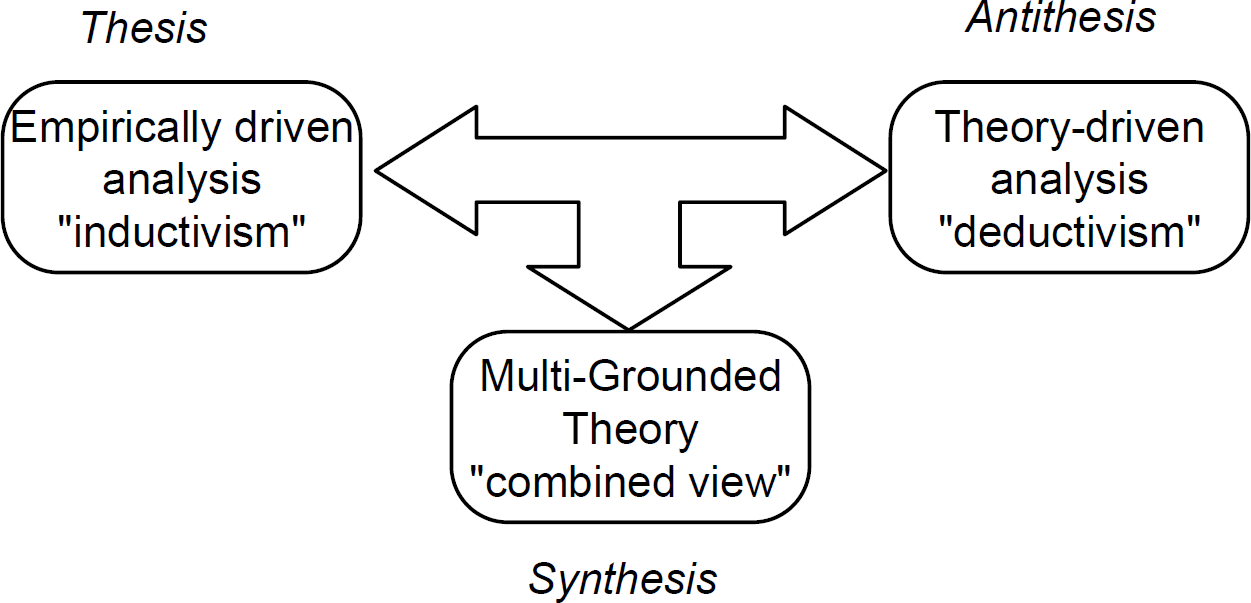
Multi-grounded theory as a dialectical synthesis between inductivism (GT) and deductivism
In the approach we present here, multi-grounded theory (MGT), we have tried to combine certain aspects from inductivism and deductivism. 2 In a dialectical spirit we try to abolish oppositions through avoiding weaknesses and incorporating strengths in each approach (see Figure 1). This kind of dialectical procedure (mainly Hegelian) has been described by many scholars (e.g., Popper, 1940).
There is a large portion of GT in our MGT approach. We would like to see it as an extension to or modification of GT. We think that Strauss and Corbin (1998) have taken important steps away from a pure inductivist position. We will continue this move away from pure inductivism. This should not be interpreted as a rejection of an empirically based inductive analysis as it is performed in the coding processes of GT. An open-minded attitude toward the empirical data is one of the main strengths of GT, and this is also incorporated in MGT. We have added a more systematic use of preexisting theories in our approach. Two explicit grounding processes (theoretical and internal) have also been added besides the empirical grounding. These different grounding processes are separate processes in the MGT working structure, which will be described below. They also represent the enhanced grounding perspective in MGT: A multi-grounded perspective. 3 We mean that a multi-grounded theory is a theory grounded in
empirical data (preferably mainly through an inductive approach)—empirical grounding;
preexisting theories (well selected for the theorized phenomena)—theoretical grounding; and
an explicit congruence within the theory itself (between elements in the theory)—internal grounding.
These different grounding aspects are illustrated in Figure 2. The focused theory is related to its different knowledge sources. These kinds of knowledge are both sources for theory generation and warrants for its validity.

Three complementary grounding sources for a developed theory (adapted from Goldkuhl, 2004b)
One criticism we have raised was that GT-based analysis can be too unfocused both in the empirical and the theoretical phases. The research questions might be too vague. According to MGT, it is important to be continuously reflective on the research interest of the study. It is possible to be rather open in the research questions, but it is also possible to work with a fairly sharp research purpose. In a pragmatic spirit we think that it is often reasonable to think through one's research questions at some depth for a start. It is, however, also important to be open minded during the research process and let empirical observations and theoretical insights influence the research interest. It is fully acceptable to let the research questions evolve through the empirical and theoretical work. Therefore, we emphasize the role of theories and research interest more than classical GT theorists do. We stress that the research interest (operationalized in research questions) should develop over time and that one should use external theories in a constructive way throughout the research process (Figure 3).
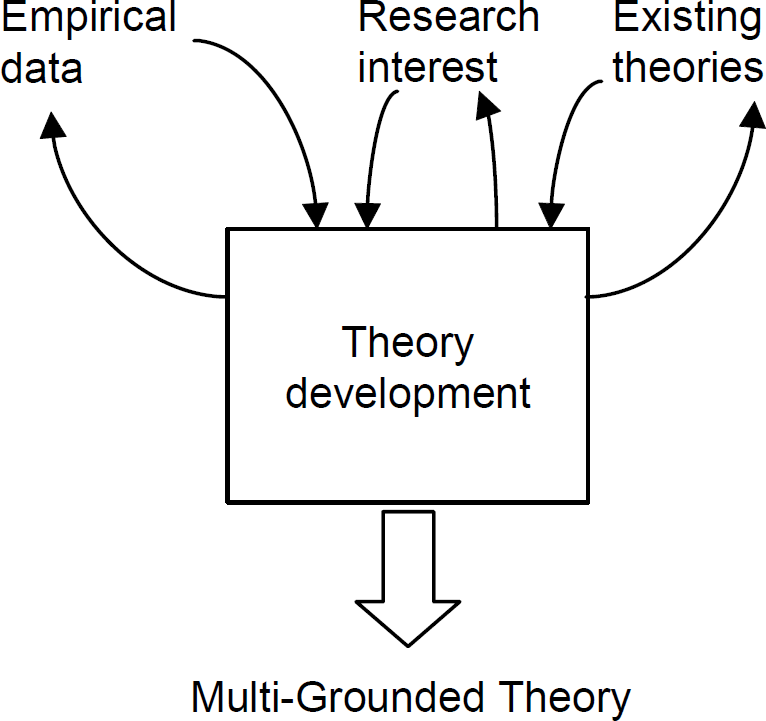
Empirical data, research interest and existing theories informing the development of a multi-grounded theory
MGT is an approach for theory development. The process of theory development is divided into three kinds of work:
theory generation,
explicit grounding, and
research interest reflection and revision.
Theory generation
We have argued above for introducing different grounding processes and a continual research interest reflection. We will deepen this argumentation below. First we will describe the work of theory generation, which consists of
inductive coding,
conceptual refinement,
pattern coding, and
theory condensation.
Inductive coding
Inductive coding corresponds to open coding in GT both in the working procedure and in the basic view toward the role of data. We emphasize that this initial work should be done inductively with an open mind and be as free as possible from precategorizations. Let the data “speak”! It is harder to introduce an open mind later if one has explicitly used some precategories early in the process of the interpretation of data. Therefore, we argue that the first analysis of the data should be as free as possible from preconceptions of the researcher. There is a risk of destroying the freshness of the data if theories and categories are used too early in the process. If there is anything to be discovered, then let the conditions be as good as possible for such a discovery. It is harder to discover something if predefined categories are obtruded on the data. We argue here for an adherence to the basic principles of GT: the inductive way of working with data. This includes both procedures as, for example, conceptual labeling and the conceptual apparatus (categories, subcategories, properties, dimensions, etc.).
Conceptual refinement
In our next step, conceptual refinement, we start diverging from GT. Conceptual refinement means working with the categories in a critical and constructive way. This involves a critical reflection on empirical statements. It is important not to take the formulations of the empirical statements for granted. Data can and should be challenged. As mentioned earlier, there might be a tendency in GT for slavery to the data. What is said by interviewees is always the result of their interpretations. As researchers we should take a critical stance toward what has been expressed by different informants. We should be cautious concerning the linguistic formulations in the empirical statements. This has to do with the quality assurance of our empirical data. To start building categories on vague formulations in data will not render any valid theories. We think that many researchers adopt such a critical stance toward their empirical data; we stress it here as we have not found such an emphasis in GT.
Conceptual refinement 4 means actively working with clarifying the used concepts. Concepts can evolve during different phases of the MGT process. Important concepts need to be assessed and continually refined during theorizing. Conceptual refinement means working with different questions concerning the categories. We have identified six essential questions that need to be posed to have a clear understanding of a conceptualized phenomenon:
What is it?: content determination
Where does it exist?: determination of ontological position
What is the context of it?: determination of context and related phenomena
What is the function of it: determination of functions and purposes
What is the origin of it?: determination of origin and emergence
How do we speak about it?: determination of language use
A determination of conceptual content is the most fundamental question: What is this phenomenon? Content determination is an attempt to grasp the essence of the conceptualized phenomenon. It may also specify different components of the phenomenon; that is, what the phenomenon consists of.
A social phenomenon has an origin. It emerges from some kind of situation. How has the phenomenon originated? Why was it created? Is it created intentionally or unintentionally? Questions can be posed concerning the initial occurrences of this type of phenomenon: When and how did it appear at first? In the determination of origin and emergence we can also pose questions about how instances of this kind of phenomenon regularly emerge.
Linguistic determination (Goldkuhl, 2002, 2004a) is concerned with how we speak about the concept. Different scientific concepts are always linguistically codified. Do we speak about something as a separate entity (usually in noun form)? Or do we speak about a quality of something (essentially an attribute)? Or do we speak about some activity or process (essentially a verb)? There should be an adequate correspondence between the category and its word form. Is this (linguistically codified) category a separate entity, an attribute, a state of an entity, or some process?
This kind of conceptual refinement should be performed in full iteration with other parts of the theory generation process (inductive coding, pattern coding, and theory condensation). Conceptual refinement means creating a comprehensive definition of categories. To define concepts should be seen as a pivotal task in qualitative analysis and theory development. However, definitions do not seem to be conceived as particularly important in a qualitative tradition. For example, it is interesting to see that the over 1,000 pages long
There are, of course, attempts to clarify concepts in a GT analysis; but the methodological approach seems to be heading toward clarifying categories in relation to the data. For example, Scott (2004) and Scott and Howell (2008) have developed and used a Conditional Relationship Guide, including questions of what, when, where, why, and how to link categories more clearly to the data. This type of data-oriented conceptual clarification can complement the type of conceptual refinement we have presented here. Our conceptual refinement entails a focus on the emergent concepts per se.
Pattern coding
The next stage is pattern coding, which corresponds mainly to axial coding in GT. At this stage categories are combined into theoretical statements. We agree with Strauss and Corbin (1990), who asserted that “Grounded theory is an
We use the term
Theory condensation
The stage of theory condensation corresponds to selective coding in GT. We do not, however, raise the same claim for one single core category. We agree concerning a need for densifying the theory, but this must not lead to just one main category. Theory condensation is a concluding stage in MGT. It should be preceded by three different explicit grounding processes.
Explicit grounding
We distinguish between three types of explicit grounding processes:
theoretical matching,
explicit empirical validation, and
evaluation of theoretical cohesion.
When we talk about grounding, we mean an analysis and control of the validity of the evolving theory. The concepts of validity and grounding are not only related to direct empirical truth. There are different validity claims concerning theories. The concept of validity claim is developed and used by Habermas (1984) in relation to his communicative action theory. We use it here with partially different meanings. What we mainly use from Habermas is the idea that there might be different validity claims, and these can be challenged and vindicated in different ways. See Goldkuhl (2004b) for a deeper discussion on validity claims in relation to the grounding of knowledge. The three grounding processes correspond to the following three kinds of validity claims:
Theoretical validity means that the theory is in accordance with other theoretical abstractions.
Empirical validity means that the theory is in accordance with empirical observations of the world.
Internal validity means that the theory is considered to be a coherent way of talking about the world.
When working with the control of these different types of validities, one is concerned to bring forth warrants for the theory; that is, to check that there are internal and external congruencies. The external congruencies are, as already stated, concerned with relations to the empirical world and to other theories. These grounding processes will, however, have other consequences than only explicating warrants. When comparing and judging theoretical elements and warrants, insights may emerge that the evolving theory does not fit these warrants. As a secondary result, these grounding processes will often lead to modification and further development of the theory. The grounding processes will not only have validity controlling functions; they will also have a generative function concerning the contents and structure of theory. Theory grounding implies theory generation and vice versa: Theory generation (as described above) is partially also theory grounding because GT is an inductive way of building theory from data. The theory will emerge as an empirically grounded theory.
Explicit empirical validation
If GT contributes with building an empirically grounded theory, why is there in MGT a need for the proposed stage of explicit empirical validation? In the coding processes of theory generation, the purpose is to create categories. Explicit empirical validation means that one changes this primary focus on generation towards control and test of validity. We claim that there is a need for a comprehensive and systematic check of the theory's empirical validity. This need is operationalized in our approach at this separate and explicit stage.
Theoretical matching
We claim that it is not sufficient to ground the evolving theory in data. Grounding means more than empirical grounding. Theoretical matching means that the evolving theory is confronted with other existing theories. The evolving theory and its categories are compared to other theories. These other theories should cover or in some way relate to the studied phenomena. The MGT researchers must select relevant matching theories. Sometimes it will be relevant to use a theory on a very general and abstract level and use it as a matching basis. In such cases, the question will be if the evolving theory can be seen as a specialization of the more general theory.
Theoretical matching does, thus, imply theoretical grounding. References can be made to external theories and abstractions with the purpose of providing theoretical warrants. Theoretical matching may lead to revisions of the evolving theory. Categories from other theories can be proven to be more adequate and they can replace some previously formulated categories.
Outside theories and categories can through this theory matching process be brought into the theory development in a much stronger way than is the case in orthodox GT. Other theories can be used in active ways. Theories can be used for interpretation of data or generated categories (cf., e.g., Walsham, 1995). They can also be used to structure the analysis process into different themes; that is, existing theories and concepts might have an organizing function to the analysis process and the evolving theory (Bowen, 2006). Theories can also be used in hypotheses testing purposes towards the generated data. We claim that not only the evolving theory but other theories, too, should inform theoretical sampling, which is the later, more focused parts of data generation, according to GT (Strauss & Corbin, 1998).
In theory matching we let deductivism take over. In the initial phases of data analysis and theory generation, we apply an inductive way of working, but now it is time to actively use other theories.
Theoretical matching can also render effects on the external theories. The collected data and the constructed theory might contradict what was earlier claimed by other theories. The comparison might evoke comments or substantiate criticism toward other theories.
Theoretical matching can therefore lead to three types of results (cf. also Figure 4):
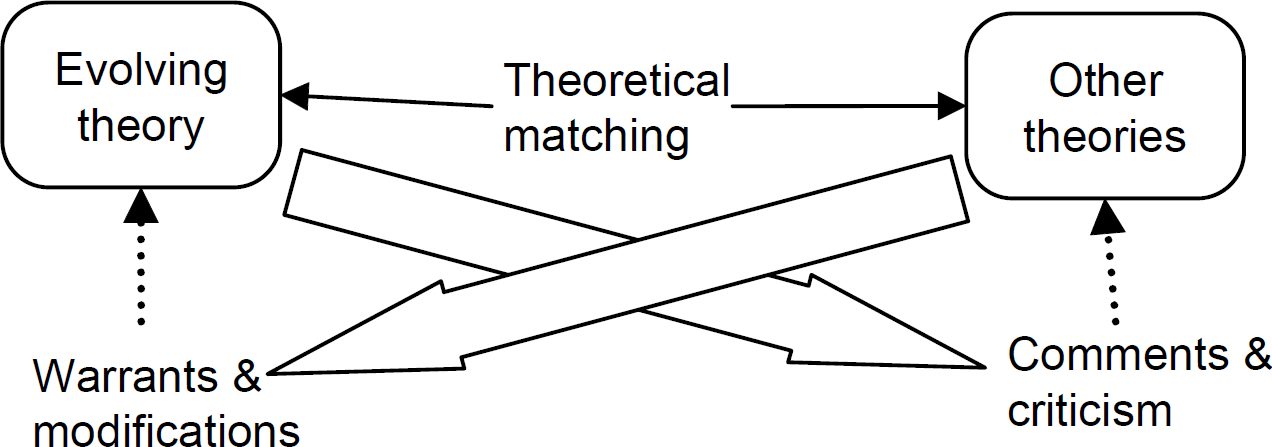
Theoretical matching
adaptation of evolving theory,
explicit theoretical grounding, or
Comments and/or criticism toward existing theories.
Evaluation of theoretical cohesion
Evaluation of theoretical cohesion implies an explicit internal grounding. It is a systematic investigation of the conceptual structure of the evolving theory, where consistency and congruency are checked. There might be a need for good illustration of the theory for such an internal validation. We propose the use of graphic illustrations (different kinds of diagrams) besides textual presentations. The use of appropriate diagrams for describing conceptual structures is not only important for internal grounding reasons. We consider this important in the construction process as well and also for presenting the theory to others.
Evaluation of theoretical cohesion means that a focused part of the theory (one or several concepts and possible relations) is assessed in relation to other parts of the evolving theory. The theory itself is used for its grounding. The purpose is to arrive at a theory that is conceptually clear and sound.
MGT overall working structure
The working structure of MGT is depicted in Figure 5. Theory generation is divided into two parts, separated by the three grounding processes. During the process of theory development, there will be needs, now and then, for shifting the focus towards the research interest (i.e., research purposes and questions) to possibly redirect the empirical and/or theoretical orientation. As we said above, the research process will start with some idea about what scope and aspects to study empirically, a research interest that may gradually evolve and change during the research process.
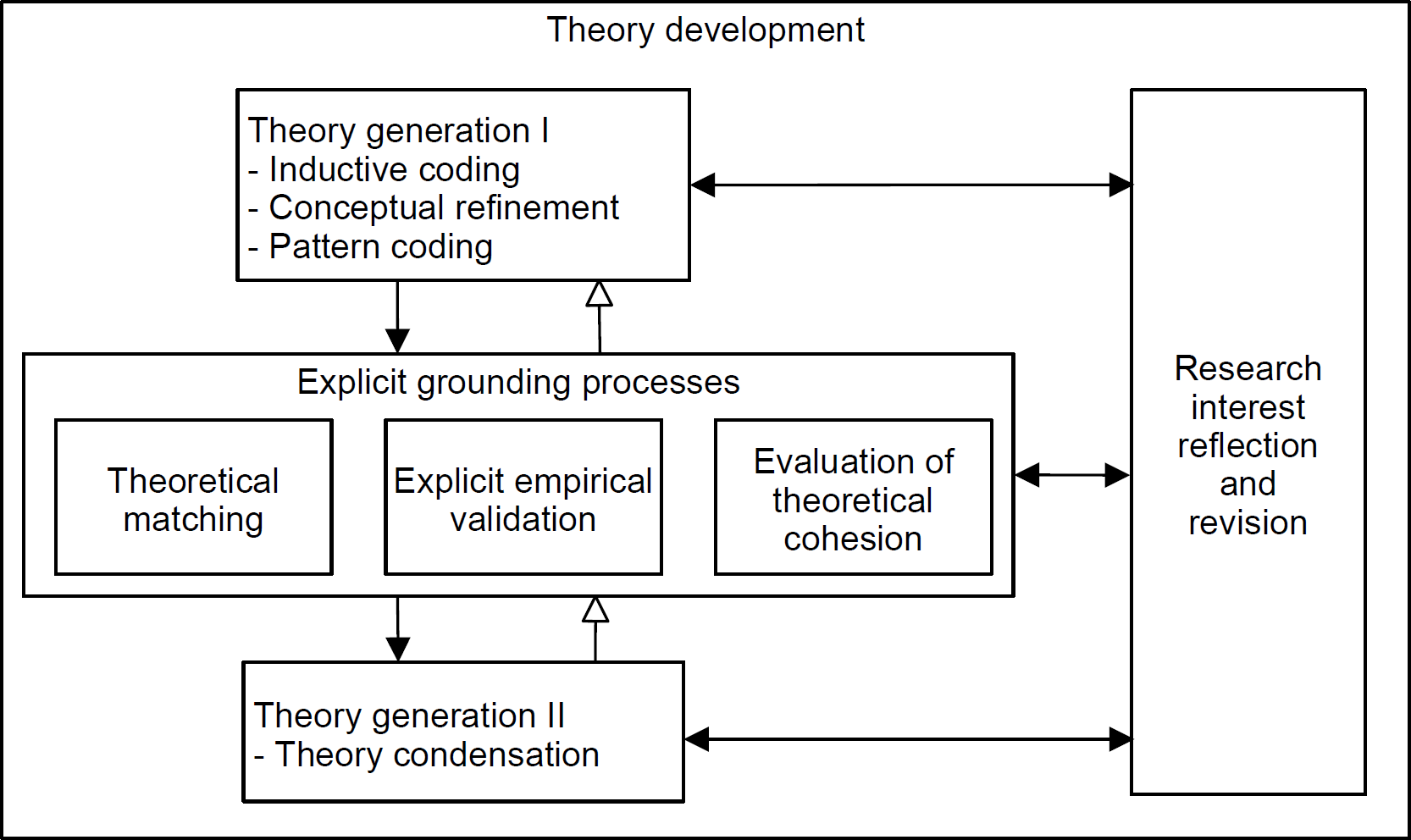
Working structure of the MGT approach
We have structured the different tasks in a procedure in a certain order. It should be stressed that in spite of this structured order, the way of working with analyzing data and developing theory according MGT should be pursued flexibly, alternating and iterating between different tasks.
A table comparing the different phases of MGT and GT (according to Strauss & Corbin, 1998) is shown in Table 1.
Comparison of GT and MGT concerning theory development

Development and application
This approach for multi-grounded theory has evolved from several years' research. The idea of multi-grounding was introduced by Goldkuhl (1993) and later refined in Goldkuhl (2004b). The GT approach has been used, and sometimes enhanced, by the multi-grounding perspective by ourselves and close research colleagues in several projects. Eventually we moved away from pure inductivism toward this combined approach of data- and theory-based construction of theories.
The evolving MGT approach has been applied (with different variations) in several research studies. Examples of such studies employing MGT are methods for organizational change (Lind & Goldkuhl, 2002), usability of software tools (Ågerfalk, 2004; Cronholm, 2004), method configuration (Karlsson, 2005; Karlsson & Wistrand, 2006), knowledge management (Braf, 2004), medical technology safety (Dinka, Nyce, & Timpka, 2006), structuring of business processes (Lind & Goldkuhl, 2006), IT use in eldercare (Hedström, 2007), software engineering (Borg, Patel, & Sandahl, 2007), enterprise modeling (Rittgen, 2007), communication and coordination (Taxén, 2007), information systems stability (Axelsson & Goldkuhl, 2008), police work (Holgersson, Gottschalk, & Dean, 2008), and development of personal assistance to disabled persons (Goldkuhl & Lind, 2010).
We also claim that we have applied the same principles for MGT when developing MGT, as a kind of meta grounding. This means that we have been governed by an effort for empirical, theoretical and internal grounding of MGT. We claim that such different warrants exist, although it is far beyond the scope of this paper to present a comprehensive grounding including these respects.
Conclusions
In this paper we have been both appreciative of and critical toward GT. We build on several features of GT, but we have also added several others. The GT claim for congruence between data and theory has not been challenged; on the contrary this is one feature of GT to be sustained. But a new theory should not only be grounded in empirical data. We claim that it should also be grounded in already existing theories. Much of what is done in social research, supported by GT, is based on case studies. There is of course a risk, even if we strive toward analytic generalization (Yin, 1989), of overgeneralization from the cases used. Using preexisting theory should reduce the risk of overgeneralization from only a few cases. Integrating or relating the evolving theory to other theories may increase the possibilities for adequate generalizations.
Through theoretical grounding we want to avoid an isolated knowledge development. When performing pure GT, there is a risk of introvert theorizing. It is important to acknowledge and use other theoretical sources. Such other conceptualizations may have a function of adjusting the inductively created abstractions. Furthermore, science evolves through cumulative knowledge development. We claim that there is an imperative for a researcher to try to build on earlier work and not to “reinvent the wheel” by him- or herself. Working in a cumulative way does not mean being uncritical and taking earlier theories for granted. On the contrary, the imperative for cumulativeness includes a critical dimension: a distinction between what is usable and what should be refuted in the existing literature. Preexisting theories may also contribute, through their explanatory power, in condensing the theory, which is one explicit aim in GT. As a consequence of these arguments, we have added theoretical grounding to the grounded theory approach.
When we have presented this revised multi-grounded approach to different scholars, we have occasionally received the objection that what we describe is the actual way of doing Grounded theory, so why call it something else (like MGT)? We believe that many GT users actually use existing theories widely during their theorizing processes and that they check their evolving theory against such theories. However, this is not the ideal-typical way of describing GT; especially not following Glaserian GT (Glaser, 1992, 1998). We claim that theoretical grounding should not be something implicit in GT theory development. It should not be something that GT users feel ashamed of and do not speak about publicly. We claim that theory development should benefit from both open-minded data analysis and from confrontation with other theories. Since our conception of GT is that theoretical grounding (and internal grounding) is not seen as grounding processes on equal footing with empirical grounding, we have added these grounding procedures to GT, and as a consequence of this we have renamed our proposed approach multi-grounded theory. This name reminds us to let such theories go through procedures of grounding in different knowledge sources. Otherwise, we might forget this and adhere to plain empirical grounding.
Other objections are that we should not at all use the term
Footnotes
1.
 ).
).2.
). We will not use this concept in our text. It is important to be explicit when an inductive versus a deductive strategy is applied.3.
).4.
.5.
),where the use of ‘grounding’ is marginal. It is only described as the grounding of formal theories in substantive theories.