







Abstract
Background
The production and adoption of evidence, credible knowledge derived from a variety of sources (Higgs et al., 2001), is critical to inform healthcare practice and policymaking. This evidence can be generated across a wide range of scientific inquiries and research methods, including experimental, interpretive, and action research approaches. Nonetheless, there are increasing calls for the use of theoretical research approaches such are realist-informed methodologies—studies informed by various forms of Transcendental realism, especially critical realism and scientific realism—to capture complexity in health policy and systems research (Van Belle et al., 2017).
Complexity-based theorizing requires the adoption of theoretical interpretive approaches as the main analytical strategy (Åsvoll, 2014). These theoretical interpretive approaches make use of various combinations of exiting inference-making methods to form syllogisms to capture the complexities. While some literature identifies three main logics of inference making; induction, deduction, and abduction/retroduction—abduction as synonymous with retroduction (Åsvoll, 2014), others identify four, distinguishing abduction from retroduction (Danermark et al., 2002, 2019). Retroduction is identified by some authors, mostly realist-oriented researchers, as the fourth approach to inference making (Danermark et al., 2002).
Inference Making Methods
Inference making is the process of concluding based on what is already known, and is central to obtaining sound evidence to inform evidence-based practices. Such conclusions are drawn without complete certainty, but with some degree of probability relative to the evidence on which it is based (Lavrakas, 2012). In quantitative inquiry, inference making usually takes place at the initial stages of constructing a conceptual framework and these inferences take the form of assumptions or hypotheses to test these inferences (Morse, 2006). Inference making in qualitative studies informed by interpretivism allows the researcher to make linkages between constructs, recognize new instances of a case, and categorize codes to create categories and themes (Morse, 2006). Similar to qualitative research informed by interpretivism, realist-informed qualitative or mixed methods inquiries occur throughout the research process.
Inductive reasoning involves projecting from what we know to what we do not know and starts with a specific observation to make broad generalizations and predictions (Hayes & Heit, 2018). In deductive reasoning, on the other hand, the researcher moves from the general (the theory) to the specific (the observations). Deductive reasoning, as applied in positivist-informed research, is used to explain causal relationships, measure concepts quantitatively, and generalize findings to a certain extent. In interpretivist-informed research, deduction is used to provide explanations or contextualize a phenomenon drawing from a pre-identified guiding theory or perspective (Braun & Clarke, 2006).
Inductive and deductive forms of inferencing, whether informed by positivist or interpretivist/constructivist paradigms are predominantly applied to describe, explain, generalize, and predict based on specific (empirical) observations. Inductive reasoning is predominantly applied to identify patterns in some observations and draw conclusions based on these patterns to non-studied cases (Eastwood et al., 2014). From observed co-variates and associations (positivist paradigm) and identified themes (constructivist paradigm), conclusions are drawn about law-like behaviors, and preliminary relationships can be identified respectively. Therefore, inductive reasoning allows quantitative researchers to make predictions and insinuations (Hayes & Heit, 2018) and qualitative researchers to develop and modify theory (Morse, 1992). Induction is more open-ended and exploratory, especially at the beginning, while deductive reasoning is narrower and is concerned with testing or confirming hypotheses.
The term abduction was first coined by Charles S Peirce (1839–1914) to capture an approach to inferencing geared towards the formation and acceptance of an explanatory hypothesis (Bellucci, 2018). All observations involve some form of interpretive abductive process for the observed phenomenon to have any meaning, which is considered a provisional hypothesis (Peirce, 1960). Abductive reasoning typically begins with an incomplete set of observations and proceeds to obtaining the likeliest possible explanation for the set. By interpreting and re-contextualizing observed actions and events, the researcher moves from some observations to the “best explanation” of those observations (Downward & Mearman, 2007). Abductive reasoning is thus characterized by a lack of completeness in the evidence that the data provide (Mukumbang et al., 2020). This aspect of abduction reveals its theory formulation properties.
Umberto Eco (1932–2016) later conceptualized four types of abduction: over-coded, under-coded, creative, and meta-abduction (Dobson et al., 2012), which are useful at different stages in realist retroductive theorizing (Mukumbang, 2021). Over-coded abduction consists of spontaneous interpretations, whereby the underlying hypothesis is seemingly obvious based on existing knowledge. Under-coded abduction relates to a situation of having more than one possible explanation and the researcher has to select the most plausible one in a specific case. The third type of abduction, creative abduction, is characterized by being unique and innovative and moving to a frame of alternative interpretations or which opposes conventional interpretations (Bellucci, 2018). Finally, meta-abduction refers to a series of mini abductions to explain observed happenings. While abduction to a less extent is a “type” of theory formation inference-making approach, it is most often applied as an “aspect” of all theory formation (Chiasson, 2001; Veen, 2021). Abduction and abductive reasoning combining logic and cognition, therefore, offer a generative reasoning form for engendering and evaluating new ideas and hunches towards theory formulation.
Informed by Peirce’s instrumentalist view, abduction, deduction, and induction are commonly combined to form interpretative strategies—mostly represented as abduction–induction–deduction, abduction–deduction–induction, and deduction–induction–abduction syllogisms (Åsvoll, 2014). Abduction, therefore, is at the heart of theory development in association with both induction and abduction (Veen, 2021). Retroductive theorizing, as an overarching interpretive strategy, also adopts a pluralistic approach requiring an interplay of abduction, deduction, and induction but these are inextricably intertwined with both the developing theory and the data. With transcendental realism—the existence of causal powers governed by universal laws of nature—accentuating an overarching epistemological framework for realist-informed theoretical explanations, abduction provides a suitable approach to inferencing providing leverage for retroductive theorizing (Mukumbang, 2021).
Some Notes on Transcendental Realism
Methodological approaches adopted in realist-informed research are intricately linked to their ontological foundation. To understand the application of abduction and retroduction as relevant and applies to realist-informed research, we should describe (in brief) the ontological perspectives of transcendental realism. Ontologically, transcendental realism, as opposed to positivism and interpretivism, proposes a stratified reality: the real, the actual, and the empirical (Bhaskar, 1975)—Figure 1. The “real” describes the existence of structures with generative powers—having the potential to produce/cause something. When these causal powers existing in the “real” are activated (mechanisms), events happen (Kazi & Spurling, 2002). The “actual” domain represents the portion(s) of those events that take place in the “real” that Three ontological levels of reality—Adapted from Hoddy (2019, p.3).
Epistemologically, realist-informed research is predominantly based on identifying underlying mechanisms to explain observations or outcomes. Broadly speaking, mechanisms are defined as causal entities that generate or trigger observable events (Danermark et al., 2002; Sayer, 1992). Danermark (2019) suggested six kinds of mechanisms: (i) physical, (ii) biological, (iii) psychological, (iv) psycho-social, socio-economic, (v) cultural, and (vi) normative mechanisms. Constructs identified within these different mechanism groups may be necessary for understanding whether and how some types, or aspects, of policies and programs work (Westhorp, 2019) and for capturing complexity. While the identification of mechanisms is critical in realist research, these mechanisms alone do not explain when an event occurs. Realists emphasize that the effects of a mechanism are contextual because different contexts have the potential to change the process by which the outcome occurs by (dis)activating or counteracting the mechanism(s) (Wong, et al., 2013). Therefore, variations in outcomes are likely to occur in different contexts, a notion described by Smith (2008) as
Two forms of transcendental realism seem to inform most realist methodologies: Critical realism and Scientific realism. These two forms of realism are similar in that they are underpinned by the notions of ontological depth and mechanism-based theorizing. As such, they share similar tenets relating to the existence of a mind-independent reality, the existence of the unseen, upward and downward causation, stratified reality, emergence, the embrace of multiple methodologies, and the importance of theory in science (Brekke et al., 2019). The premise of Critical realist research is that there are many aspects to our reality that are beyond the design of transparent empirical testing and data scrutiny. Therefore, Critical realist theorizing offers freedom to explore theories that lack direct empirical correspondences for testing in a research process. Scientific realism, conversely, offers a methodologically stringent approach, focusing on retroductively constructing derived program theories and comparing such theories against the best available evidence. Scientific realism is, therefore, understood to underpin methodological inquiries such as realist evaluation (Pawson & Tilley, 1997) and realist synthesis (Rycroft-Malone et al., 2012). In this review, we considered papers informed by either Critical realism or Scientific realism referring to them as realist-informed research.
Retroductive Theorizing
Retroduction or retroductive theorizing is the process of devising a theory, which requires moving from an observation of concrete phenomena to reconstruct the basic conditions for these phenomena. Applying retroductive theorizing to realist evaluation, for example, involves starting with a program's effects, and working backward to think about the conditions of reality that are necessary for such effects to manifest (Jagosh, 2020:129). It is a method of conceptualizing by identifying the circumstances without which a phenomenon cannot occur (Meyer & Lunnay, 2013). Retroduction, thus, is a form of retrospective theorizing, which entails building models using cognitive material and operating within the ambit of analogy and metaphor, to uncover structures ad mechanisms, which if were to exist and act as postulated, would account for the phenomenon under consideration—transcending the social construction of facts and evidence. In this way, retroduction entails moving (backward) from a surface phenomenon captured at the “Empirical” domain to a deeper causal understanding situated at the domain of the “Real” through interpreting and re-contextualizing particular actions and events situated in the “Actual”—Figure 2. It is, therefore, focused on identifying the basic characteristics of the general structures and mechanisms defining an observed phenomenon (Danermark et al., 2002). Illustrating the application of different inferencing approaches to exploring ontological depth - retroductive theorizing.
While induction, deduction, and abduction each refer to a distinct form of logical inference, retroduction describes an overarching logical approach that incorporates abduction, deduction, and induction for its full performance (Chiasson, 2001). Although induction and deduction can be applied to obtain relevant evidence and formulate theories to inform practice and enhance the uptake of evidence (Bottorff et al., 2015), they contribute little to the development of contextually embedded causality-focused explanatory theories, feats that can be successfully achieved realist-informed approaches (Greenhalgh & Manzano, 2021). According to Jagosh (2020:122), inductive and deductive forms of inference in the absence of retroduction assume a static view of ontology, thus inadequately captures the complexities and explanatory power that retroduction offers. Abduction and retroduction have, therefore, been identified by realist researchers as complementary inference-making approaches to improve the formulation of such contextual-linked theoretical evidence (Danermark et al., 2002; Ritz, 2020).
A primary objective of scientific research conducted within the realist philosophy of science is to develop explanations for the way things act and how they are capable of so doing (Wynn & Williams, 2012). Transcendental Realism offers a transcendental approach to elaborating causality through the identification and conceptualization of mechanisms. In such mechanism-based theorizing, retroduction seeks to “theorize and test these hidden mechanisms, while abduction is that inventive thinking required to imagine the existence of such mechanisms” (Jagosh, 2020:122). Therefore, retroductive theorizing is typically associated with the different forms of abductive reasoning as the researcher moves back and forth between deductively and inductively obtained evidence (Mukumbang, 2021). In tandem, abduction and retroduction contribute to formulating theoretical explanations in realist-informed research based on evidence obtained using various relevant research methods. To this end, abductive and retroductive inferences are required to move from a social phenomenon to a theory, which can account for that phenomenon.
Most realist researchers strive to achieve realist explanations using heuristic tools while others provide these explanations without such tools. Pawson and Tilley (1997) proposed the use of context-mechanism-outcome (CMO) configurations for realist evaluation. Demetriou (2009) argues that to transcend from observations to explanatory mechanisms, it is reasonable to remain within a heuristic orientation rather than adopt an empiricist approach. While Pawson and Tilley (1997) concur with the notion of applying heuristic tools, they suggested that these heuristic tools are “ugly circumlocution” with their parts dependent on the whole. Therefore, while applying these models to analyze social situations or programs, researchers should consider their true value (Mukumbang, 2021). Most realist-informed heuristic analytic frameworks have elements of Interventions (for intervention evaluations) and social structures possessing activated generative powers—mechanisms, or the reasoning (mechanism) of targeted actors, observed outcome(s), and context elements.
Retroduction is the way to dive beyond the measurable elements of observations through events to identify the structures, context, and mechanisms that explain the observation. Therefore, while using heuristic tools to achieve realist explanations, abduction and retroduction underpin the process (Danermark et al., 2002; Downward & Mearman, 2007; Eastwood et al., 2016; Meyer & Lunnay, 2013). For instance, applying retroductive thinking to the CMO configurations postulates how programs activate mechanisms (M) among whom and in what conditions (C), to bring about alterations in behavior or event or state regularities (O) (Pawson & Tilley, 2004). Similarly, the Intervention-Context-Actor-Mechanism and Outcome configuration (ICAMO) heuristic tool supposes that when an intervention (I) is implemented, an outcome (O) is generated by a mechanism (M) through an actor (A) in a particular context (C) (Mukumbang et al., 2018a, 2018b). Structure-Context-Mechanism-Outcome (SCMO) and Context-Intervention-Mechanism-Outcome (CIMO) configurations have also been applied in other studies (Eastwood et al., 2016; Mukumbang, 2021). Irrespective of the analytic approach applied, it should be guided by abductive thinking to postulate how they identify mechanisms that generate the observation. Through retroduction, realist researchers link the identified constructs to formulate mechanism-based explanatory models (Mukumbang et al., 2020).
Of course, not all realist-informed inquiries apply retroductive theorizing through the explicit adoption of heuristic tools. Drawing from a critical realist-informed qualitative study of Canadian farm women’s experiences with agricultural policy, Fletcher (2017) suggested a flexible approach to retroductive theorizing without the obvious use of a heuristic tool. To provide clarity to the process, Thapa and Omland (2018) proposed the following steps: (1) exploring the events around the phenomenon; (2) identifying the entities and associations that characterize the phenomenon and related outcomes and collect data about these entities; (3) searching for different theoretical perspectives and different explanations—abduction; and (4) hypothesizing the mechanisms and conditions that might have activated the generation of the phenomenon—retroduction. Despite these suggestive steps, it should be emphasized that the retroductive theorizing process is non-formulaic.
Study Rationale
While data analysis and synthesis in positivist- and constructivist-informed studies have received scrutiny to improve their trustworthiness and rigor, studies informed by the realist paradigm have received considerably lesser examination. Marchal et al. (2012) explored if realist evaluation studies remained faithful to realist principles and found important gaps that needed to be addressed regarding the reporting of such studies. In response to their findings, while following the tradition of developing guidelines for reporting different types of studies, RAMESES I and II guidelines were developed to improve transparency in reporting realist evaluation studies and syntheses (Wong et al., 2013, 2016). These RAMESES guidelines suggest that realist evaluation studies must report their data analysis and synthesis processes, specifying what realist heuristic tool was used and how it informed the data analysis and synthesis.
Realist researchers need to document all analytical operations from (1) identifying relevant variables or codes and themes from the data (induction and/or deduction) to (2) developing the relevant retroductive theorizing constructs through abduction, and (3) linking these constructs to formulate explanatory models—retroduction (Bygstad et al., 2016). Similarly, the steps of conducting a realist synthesis as illustrated by Rycroft-Malone et al. (2012) involve concept mining and framework formulation, searching for and scrutinizing the evidence, extracting and synthesizing the evidence, and developing the narrative, including hypotheses. Nevertheless, it is unclear to what extent abductive and retroductive inferences are applied and described in realist-informed studies and syntheses towards formulating the explanatory models or theories expected of realist-related studies.
Abductive and retroductive inferences are, therefore, considered innovative tools of analysis to develop realist-informed explanatory theories (Meyer & Lunnay, 2013). Although abduction and retroduction are identified as the most suitable forms of inferencing in realist-informed studies (Danermark et al., 2002; Downward & Mearman, 2007), their application within such studies has hardly been explicitly described and illustrated. To this end, we sought to explore to what extent abduction and retroduction are applied and described in realist-informed studies in health policy and systems research. We acknowledge that it is challenging to describe inferential logic in the abstract. As such, we are arguing that realist researchers should make their retroductive theorizing an explicit activity rather than it being obscured merely as moving “back and forth,” “iterative,” “combining induction and deduction” etc. Our goal, therefore, is to create awareness on the explicit application and description of abduction and retroduction—retroductive theorizing— to improve the transparency required while reporting realist-informed studies and consequently their trustworthiness.
Aim
To examine the extent to which realist-informed studies report on abductive and retroductive inference toward theory formulation—retroductive theorizing.
Objectives
The following objectives will be addressed
• Identify the rate at which abduction and retroduction are applied in realist-informed studies in the field of health policy and systems research. • Discuss the extent to which abductive and retroductive inferencing is described in realist-informed studies in the field of health policy and systems research.
Methods
We conducted a scoping review with narrative synthesis (Popay et al., 2006) in which we adopted the four steps for conducting a scoping review described by Arksey and O'Malley (2005): (1) Framing the question; (2) Identifying relevant work; (3) Summarizing the evidence; and (4) Interpreting the findings. According to Peters et al. (2015), scoping reviews are used to clarify working definitions and conceptual boundaries of a topic or field, which suits our goal of exploring the extent to which abduction and retroduction are applied in realist-informed studies.
Review Question
The review sought to address the following question: To what extent are abductive and retroductive inference-making tools applied in realist-informed studies in health policy and systems research?
Identifying Relevant Work
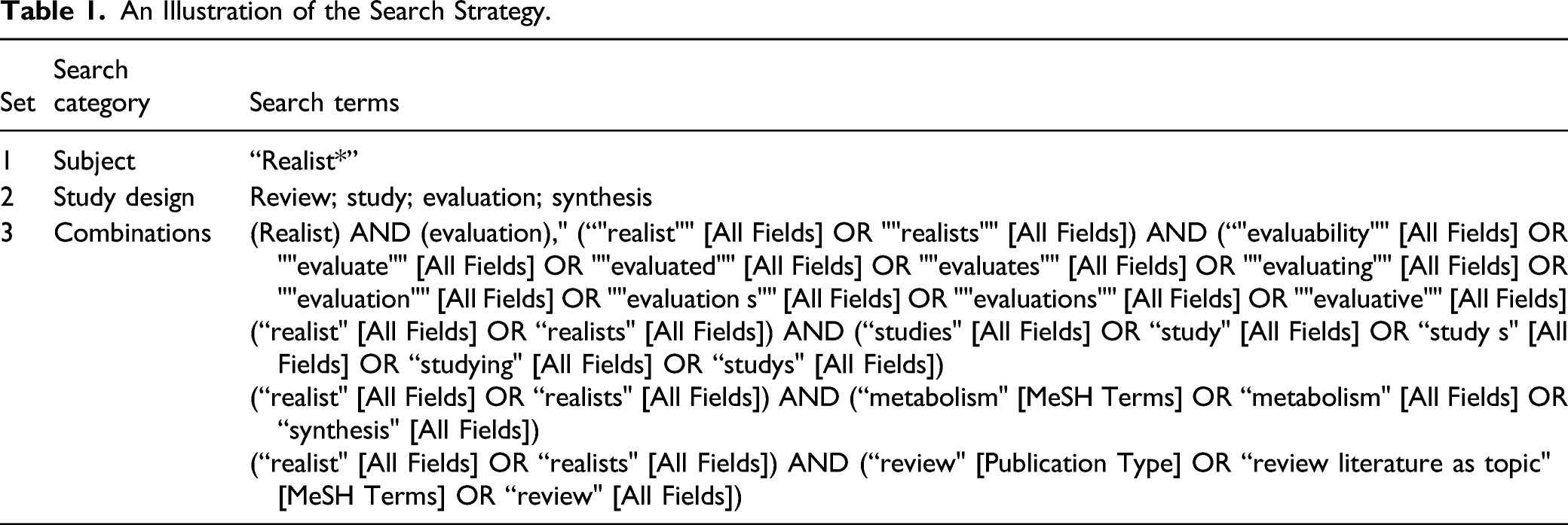
An Illustration of the Search Strategy.
Searched Databases, Boolean Combinations, and Number of Hits.

aWord variants.
Inclusion criteria
- Empirical or methodological studies informed by realist philosophy, epistemology, or methodologies. - Primary research, realist-informed reviews, and methodological papers. - Studies identified to fall within the field of health policy and systems research.
Exclusion criteria
- Commentaries, theoretical papers, and editorials - Not considered to be in the field of health policy and systems research - Is not identified to be informed by realist methodological principles - If the full text could not be identified.
The database searches yielded 6,029 articles. After removing duplicates, 5,172 articles were retained for screening. After screening by titles and abstracts, 4,600 articles were excluded and further two articles were excluded because we could not access the full articles. Further, 259 articles were excluded after screening the full articles with 311 articles retained for analysis. Details of the screening process are illustrated in the PRISMA diagram (Figure 3). PRISMA diagram illustrating the article selection process.
Summarizing the Evidence
The evidence on the application of retroduction and abduction was achieved by charting the identified terms. At this stage of the study, an Excel form was designed to electronically capture data from the identified studies. The electronically designed data charting form had the following fields: Author/year, Methods (qualitative, quantitative, or mixed), Study aim or intervention, induction, deduction, and application of abduction, and application of retroduction and realist heuristic tool used. A preliminary test of the appropriateness of the newly developed charting form was done using five randomly picked articles. This step helped us to determine the suitability of the data collection tool for capturing the required data. Feedback obtained from the preliminary test conducted on the charting form was used to improve the quality and accuracy of the form in capturing the required data.
Data were analyzed using qualitative content analysis, which entails applying various levels of interpretation such as using the quote or word frequencies to qualify and quantify common trends in data (Vaismoradi & Snelgrove, 2019). Specifically, the summative content analysis involving counting and comparisons of keywords or content followed by the interpretation of the underlying context was adopted (Hsieh & Shannon, 2005). The goal of the data analysis was to identify words and phrases signifying the application of deduction, induction, abduction, and retroduction. For example, a mention of “abduction” or “abductive thinking” was considered a mention of the abduction method of inference making. Similarly, a mention of “retroduction” or “retroductive thinking” signified a mention of the inference-making approach. The identification of these words was achieved through the word search function provided by the Adobe© Reader software program. The same process was repeated for deductive and inductive inferences. To confirm the “application—how the authors used the inference approach,” and the context within which it was used, we read the entire paragraph containing the identified inference word. Further, the entire methods section of each of the 311 articles were read to capture how the inference approach was applied and conceptualized.
In addition to the inference-making methods, we also explored the use or non-adoption of a heuristic tool during the data analysis and synthesis process. This was important because, in some realist-informed research, heuristic tools underpin the process of theory development and consequently could indicate to what extent the inference-making tools were used toward theory construction.
We then obtained the frequency of the mention of each of the inference-making approaches and computed their frequency based on their mentions in the total number of articles included in the review. Using the frequencies and percentages, we could compare and contrast the application degree of application of the different inference-making approaches in realist-informed studies.
Results
A Summary of the Study Findings

Our study indicates that induction remained the most prominent [31/311 (10.1%)] inference-making approach adopted in realist-informed studies. The application of induction was more in original studies [21/150 (14.0%)] compared to reviews [10/161 (6.2%)]. This is followed by the application of deductive reasoning [22/311 (7.1%)]. Similar to induction, deduction was applied in more original studies [16/150 (10.7%)] compared to review studies [06/161 (3.7%)]. Induction and deduction were mentioned in combination in [15/311 (4.9%)] of the identified studies in fairly equal amounts; original studies [03/150 (2.0%)] and reviews [03/161 (1.9%)].
Abductive reasoning was reported in 09/311 (2.9%) of the studies but more studies reported the application of retroduction [21/311 (6.8%)]. The reporting of abduction was slightly more in original studies [05/150 (3.3%)] compared to reviews [04/161 (2.5%)]. A similar observation was made regarding the application of retroduction; 12/150 (8.0%) for original studies in contrast to 11/161 (6.8%) for reviews. A combined application of abduction and retroduction was reported in 06/311 (2.0%) of the selected studies. A combination of all four forms of reasoning was reported in only one study.
Regarding the use of heuristic tools to guide the theory formulation process in the identified studies, CMO configurations were used in 198/311 (63.7%) of the studies; slightly more in reviews [107/161 (66.5%)] than in original studies [91/150 (60.7%)]. Almost a third of the studies did not mention the use of a heuristic tool [96/311 (30.9%)]. More original studies did not make use of a heuristic tool [49/150 (32.7)] compared to reviews [47/161 (29.2)]. Other modifications of the original CMO configurations were also identified. For example, ICAMO was reported in 11/311 (3.5%) of the identified studies. SCMO and CIMO received even lesser applications; 03/311 (1.0%) and 04/311 (1.3%) respectively.
Discussion
While realist epistemologies are noted to be non-restrictive regarding their methods and inference-making approaches, the tools and approaches applied in realist-informed studies should be delineated from well-established positivist and relativist epistemologies. Lipscomb (2011) advises that when employing research approaches traditionally informed by other paradigms, realist researchers should be cognizant of the potential of encountering “identity crisis,” suggesting that such approaches should be disentangled from the strict interpretation of their epistemological context.
Our study found that most studies that adopted realist-informed methodologies employed standalone inductive and deductive inferencing approaches. According to Jagosh (2020) standalone inductive and deductive inference have deficiencies related to their inability to identify and conceptualize generative mechanisms, which propose a flat ontology—assumptions that reality is only what can be seen and understood at the empirical level. Saether (1999) argued that the dualism between standalone inductive and deductive research processes can be overcome by introducing retroductive theorizing.
Even fewer of the studies included in this review considered using a combination of inductive and/or deductive inferencing during the data analysis phase and abductive and retroductive inferencing for data synthesis toward theory formulation. The use of various combinations of inference-making methods to form syllogisms is encouraged in theoretical interpretive approaches (Åsvoll, 2014). In realist-inform studies, such combinations should go beyond Peirce’s instrumentalist view mostly illuminated by abduction–induction–deduction, abduction–deduction–induction, and deduction–induction–abduction syllogisms. While retroductive theorizing is considered the most favorable inferencing approach for realist-informed studies, the idea of combing induction, deduction, and abduction should be aimed at retroductive theorizing. Therefore, inductive, deductive inference, and, indeed, abductive thinking must be applied in tandem during retroduction theorizing (Jagosh, 2020). The application of abduction and retroduction in this process allows the researcher to move from descriptions of the concrete to the abstract and back to the concrete.
Similarly, while the stages of realist synthesis include concept mining and framework formulation, searching for and scrutinizing the evidence, extracting and synthesizing the evidence, and developing the narrative, including hypotheses (Rycroft-Malone et al., 2012); most authors of realist reviews failed to exclusively describe their retroductive theorizing process in developing their explanatory theories. Their theories are usually presented (if they are) without an explicit illustration of how they moved from the identified constructs of their selected heuristic tools or constructs to inform the theory or explanations that were presented. Abductive and retroductive thinking are critical at this stage of the realist theorizing process whereby the mechanism-based causal explanations are formulated. Most of the realist-informed studies that we identified in this review are missing this critical step in their realist theorizing, a feat that distinguishes realist-informed studies from constructivist- or positivist-informed theorizing—Peirce’s instrumentalist view. The idea is that abduction and retroduction should be applied to move from the configurational formulaic stage to the configurational explanatory analytical stage (Greenhalgh & Manzano, 2021).
Most of the realist-informed studies identified in the review used a heuristic tool to guide their theory development process. As identified by De Weger et al. (2020) and as confirmed by our review, most studies adopting a realist-informed approach remain faithful to the original CMO configurations proposed by Pawson and Tilley (1997). Also, as recognized by De Weger et al. (2020), we observed that other authors made some adaptations to Pawson and Tilley (1997) CMO to suit their research aim and capture other aspects of their phenomenon under investigation. Interestingly though, is that a good portion of the studies that we identified did not mention the use of a heuristic tool to inform their theory development. We noticed that within these studies that did not apply a heuristic tool, the authors focused on the inductive and deductive approaches to inference making with no mention or indication of applying abduction and retroduction. To this end, our observation was that such studies were more data-focused than theory-inclined. Manzano (2016) had also made this observation when she reported on the approaches that were adopted towards data treatment in realist studies. We argue that whether a heuristic tool is adopted or not, the research strategy and inference approaches adopted in realist-informed studies and realist syntheses should allow the researchers to be able to identify and hypothesize specific mechanisms in action (abduction), provide explanations of how mechanisms and context interact, and also provide descriptions of the context within which mechanisms operate (retroduction).
Most of the studies reviewed illustrated how they inductively or deductively identified the constructs that correspond to the heuristic tool adopted for the theory formulation or the constructs required for their theory formation but failed to illustrate how these identified constructs were transformed into mechanism-based causality theories. It was found by Marchal et al. (2012) that in attempting to specify the CMO configurations while formulating realist program theories, some authors fail to demonstrate the explanatory nature of the realist logic. In realist evaluation, for example, authors often come up with exhaustive fragmented “catalogs” of plausible contexts, followed by other lists of mechanisms and another list of outcomes as opposed to illustrating a properly structured and interconnected relationships between program context, its mechanism, and outcomes (Mukumbang et al., 2018a, 2018b). For example, in a realist evaluation study conducted by Bartlett et al. (2017), this is what they wrote to capture the data analysis:
Data analysis from a realist perspective, to specify contexts, mechanisms, and outcomes. We grouped mechanisms into “resource” and “reasoning” mechanisms, as willingness and ability to change depends on the resources available and the reasoning behind the choices people make (Bartlett et al., 2017: 2).
In reporting the findings, the authors followed the CMO heuristic tool and reported thematically on the context, mechanism, and outcomes. The authors then attempted to link these elements to formulate a program theory but all they wrote to indicate this was “The following programme specification was developed from the CMO analysis” (Bartlett et al., 2017:8), providing a figure to indicate their program theory. The assumption at this point is that based on the elements the authors obtained from thematically distilling the different elements of the CMO heuristic tool, they applied abduction and indeed retroduction to come up with their final program theory. At this point, we can only assume as the authors did not explain what was done. The Bartlett et al., (2017) paper typifies how data analysis is described in most realist-informed studies—very little detail on exactly how retroductive theorizing was achieved. Paradoxically, the lack of explication on how the authors moved from the CMO elements to the program theory that they obtained constitutes an analytical “black box.” While realist-informed research is purported to open the “black box” on how social phenomena, programs, and policies unfold in open systems (Salter & Kothari, 2014; Van Belle et al., 2017), they seem to have a “black box” on how this is achieved.
While retroductive theorizing is gaining traction as an approach to formulating context-sensitive mechanism-based causality evidence to improve our understanding of how social phenomenon unravels and how and why policies and programs would work or not, as a practical process, its application has received very little attention. Maybe retroductive theorizing entails a lot of iteration that researchers prefer not to report the processes and their back and forth movements. Analytic processes that entail the integration of the duality of induction and deduction have been successfully illustrated in detail such as in thematic analysis. Illustrative stepwise approaches to reporting such thematic analysis have been developed and streamlined (Braun & Clarke, 2006). Recently, iterative processes to thematic analysis involving back and forth movements while capturing the thought process of the researchers have also been conceptualized to encourage adoption (Morgan & Nica, 2020). If such approaches of reasoning are widely recognized and have been successfully practicalized when reporting data analyses, then retroductive theorizing should also receive such attempts to guide its application and reporting. Gilmore et al. (2019) illustrated in detail a process of data analysis and synthesis in a realist-informed study, elaborating how inductive and deductive thinking informed their data coding and reduction process and how abductive and retroductive thinking informed the process of collating evidence and refining the developing theory. They illustrated their retroductive theorizing in a detailed manner from coding the data to generating the relevant theories. This is what they wrote regarding the coding:
Coding occurred when an observable “context–mechanism–outcome” was found in the data. Once a CMO was found, it was coded to an appropriate node—that is, CMOs were linked to the relevant IPT/PTs [Initial program theory]. Once a whole data source was thoroughly read and coded, all the nodes that had new coded data were reviewed. Coded material within specific nodes was subjected to in-depth exploration, one code (CMO) at a time (Gilmore et al., 2019, p. 5).
While coding can be achieved through different methods, Gilmore et al. (2019) decided to use an approach that entails capturing all the CMO elements within the data. In this way, the authors applied Eco’s over-coded abduction, which consists of spontaneous interpretations, to start confirming or refuting their initial program theory. One important activity that the authors carried out is memoing—recording reflective notes about what the researcher is learning from the data (Birks et al., 2008). Memoing allows the researcher to document their thought processes as informed by the coded data and consequently their abductive thinking towards retroductive theorizing. This is what they said regarding the usefulness of memoing in their retroductive theorizing: Within the memo, each new CMO was subjected to review … whereby the contents of the memo were placed under the following headings: context, mechanism, outcome, potential CMOC, supports/refutes/refines, how/why/decision-making processes, links to other IPTs, and additional notes. This process was done for each new CMO, across each of the memos (that are linked to the nodes). This memo, therefore, served as a tool for analysis, allowing for greater transparency for how the CMOCs were generated (Gilmore et al., 2019, p. 5).
A common reason why data analysis and synthesis processes in realist-informed studies are not sufficiently described is because of ‘word count’ limitations offered by journals. For the sake of transparency in research, reporting the memoing process can be described in an additional file. Another way of overcoming such deficiency in explicating retroductive theorizing and to illustrate the roles of induction, deduction, and abduction is by using causal loop diagrams. Using causal loop diagrams, realist investigators can identify and represented relevant contructs (contexts, mechanisms, and outcomes, for instance), illustrate the links between them, and annote the signs on the links (which show how the variables are interconnected) and the sign of the loop (which shows what type of behavior the causal relationship is indicating). Realist researchers can also overcome such challenges by providing specific examples of how and why a specific mechanism was linked to particular context elements to explain the observed behavior (Mukumbang & van Wyk, 2020). Such steps can be used to improve the transparent reporting of retroductive theorizing in realist-informed studies thus improving their credibility.
Study limitations
The findings of our study must be considered in light of some limitations. First, we only considered two databases for the selection of articles. Although PubMed/Medline and Academic Search Complete are considered comprehensive databases especially for the indexing of publications in the field of health systems and policy research, we might have missed some relevant publications. We might have missed more because we only considered papers published in the English language and those whose full texts we could obtain after contacting the corresponding authors and requesting interlibrary loans.
Second, our initial approach to search for keywords such as “induction,” “deduction,” “abduction,” and “retroduction” may harbor limitations in that while authors may implicitly employ these inference-making approaches during their data analysis and synthesis, they might not have explicitly identified these approaches. We might have also missed out on the explications of the different forms of inference-making as not all authors would have identified their inference-making approach during their data analysis. Although we tried to read through thoroughly to identify such explications, there is a possibility that some might have been missed. We think that many realist researchers apply retroduction and abductive thinking while looking for the mechanism but are not aware of it or do not make it explicit.
Conclusion
While there are strong calls that realist-informed studies should remain faithful to the realist paradigm and methodologies, this review unearthed that other paradigms (positivism and constructivism) continue to heavily influence the processes of data analysis and synthesis in realist-informed research. Focusing on the approaches to inference-making in realist studies, we uncovered that abduction and retroduction that are particularly relevant to realist-informed research are seldom explicitly applied in such studies; and that deduction and induction, while they should support abductive and retroductive thinking, continue to dominate the process of theory formulation in such studies. This study, thus, highlights further methodological inadequacies within realist-informed studies. We suggest, therefore, that to improve the trustworthiness and rigor of realist-informed studies, authors applying realist methodologies should remain faithful to the principles guiding such studies notably in the appropriate application and explicit description of their retroductive theorizing approach.
Supplemental Material
sj-pdf-1-ijq-10.1177_16094069211053516 – Supplemental Material for Examining the Application of Retroductive Theorizing in Realist-Informed Studies
Supplemental Material, sj-pdf-1-ijq-10.1177_16094069211053516 for Examining the Application of Retroductive Theorizing in Realist-Informed Studies by Ferdinand C Mukumbang, Eveline M Kabongo and John G Eastwood in International Journal of Qualitative Methods
Footnotes
Acknowledgments
Declaration of Conflicting Interests
Funding
Ethical Approval
ORCID iDs

Supplemental material
References
Supplementary Material
Please find the following supplemental material available below.
For Open Access articles published under a Creative Commons License, all supplemental material carries the same license as the article it is associated with.
For non-Open Access articles published, all supplemental material carries a non-exclusive license, and permission requests for re-use of supplemental material or any part of supplemental material shall be sent directly to the copyright owner as specified in the copyright notice associated with the article.
