







Abstract
Background to the Study
Accuracy is a well-established and accepted concept in qualitative research (McMullin, 2023, p. 141) and is associated with a study’s rigor or ‘methodological integrity’ (Boswell & Shannon, 2022, p. 206). Lincoln and Guba (in Boswell & Shannon, 2022, p. 206) present 4 main components of accuracy: 1) credibility, 2) transferability, 3) dependability and 4) confirmability. Credibility, ‘the truth value of data and data analysis’, can be ensured by taking the data and its analysis back to the participants of a study and experts in the area. Transferability refers to the applicability of findings in different situations which is done through a ‘thorough description of the sample, data and setting’ to convince the readers about its viability. It replaces generalizability of the quantitative paradigm. The next is dependability which is achieved through audit trails that can be reconstructed by anyone wanting to see how the research process was carried out. Confirmability concerns itself with keeping the study free from researcher’s bias and can be done through member checking, peer reviews, debriefing, prolonged engagement and consistent observation, etc. This kind of focus on accuracy in qualitative research is useful for studies that do not conceptualize. The grounded theory method (GTM) whose end product is a theoretical formulation needs to adopt an approach towards accuracy that recognizes its importance yet does not let it impede the process of conceptualization.
The current study uses the concept of accuracy to interrogate the reasons for the lack of attention given to formal grounded theory (FGT) which is a part of the GTM and is considered to be the ‘ultimate end of grounded theory research’ (Gasson, 2003, p. 84). The term accuracy is variously used as accurate descriptions and empirical evidence in this essay following the grounded theory literature. GTM introduced by Barney Glaser (1930-2022) and Anselm Strauss (1916-1996) in 1967 as a part of the broader qualitative paradigm generates two middle-level theories, substantive and formal, by using empirical data (1967, p. 177). Formal grounded theory is more general than substantive as it covers more areas. Glaser’s later writings (2001; Glaser, 2002a, 2002b; 2004; Glaser, 2007a, 2007b) present a steady stream of argument opposing what he labels the dominance of the ascendant qualitative data analysis (QDA) methodology in grounded theory practice which leads to an excessive focus on producing a research site’s accurate description impeding the conceptualization process (2007a, p. 37; 2007c, p. 122; Lichtman, 2006, p. 80).
Glaser also holds the accuracy-based remodeling responsible for ‘the scant attention’ (2007b, p. 98) shown by grounded theorists towards FGT as it (FGT) does not fit ‘the typical QDA methodological model and so much GT is remodeled by QDA that the next step is not in view or just not there to take’ (Glaser, 2007b, p. 98). Glaser’s point of view on accuracy is contested by grounded theorists like Anthony Bryant (2007; 2009; 2017), Kathy Charmaz (2004; 2006; 2008; 2014; 2016; 2017) and Margaret Kearney (1998; 2007). Anthony Bryant, while underscoring the importance of accuracy in a grounded theory study (2017, p. 110), points out to the ambiguity in Glaser’s conceptualization of the said term as it does not adequately address how GT terms like ‘fit and relevance’ which are dependent on ‘accuracy or propriety with regard to some criteria or baseline’ can be enacted. Charmaz (2004, p. 986) declares she is ‘all for accuracy’ in grounded theory studies equating it to being faithful to the research project they are pursuing. Kearney (2007, p. 144) advocates for an inclusion of ample empirical evidence using verbatim data in studies as FGT’s quest for higher abstractions makes it appear too remote from the context being studied with the result being that scholars decide not to use it. However, Charmaz’s and Kearney’s support and advocacy for accuracy does not translate into a clear-cut methodology that can be used in FGT specifically or GTM generally.
My essay delves into this debate and offers a novel methodological concept called
The Grounded Theory Method
The grounded theory method was presented in 1967 as a qualitative inductive method to generate fresh and relevant theory from empirical data. The originators Barney Glaser (1930-2022) and Anslem Strauss (1916-1996) responded to the logico-deductive reasoning vogue in the 1960s. As deduction progresses from general to specific, starting with established theoretical concepts and aims to find relationships between them using empirical data (Kathy Charmaz, 2006, p. 17; Odu Kelle, 2019, p. 82; Zaidi, 2022, p. 2), it is generally more suitable for quantitative research that seeks to predict, generalize and replicate. Glaser and Strauss rejected the deductive approach by labeling the matching of data with extant concepts as ‘forcing’ which has ‘dubious relevance to the data’s meaning’ (1967, p. 98). As the purpose in grounded theory is to generate new theoretical renderings (theories) to explain social issues, data’s meaning is emergent or as Charmaz (2006, p. 17) puts it ‘research is locked into (…) original concepts’ that are generated over the research process and cannot be predicted beforehand. As will be shown later on in the paper, Charmaz (2005), the originator of a key GT variant called constructivist grounded theory, goes a step forward than induction and introduces abduction for grounded theories as ‘abductive reasoning aims to account for surprises, anomalies, or puzzles in the collected data’ and ‘invokes imaginative interpretations’ (Charmaz, 2008, p. 157). Charmaz’s constructivist GT relies on the concept of theory/reality being co-constructed by a researcher and participants as opposed to Glaser, with positivist leanings, believes in theory being discovered. Charmaz (2006), despite having this key difference with Glaser, uses the tools/strategies as suggested by Glaser & Strauss in the seminal text (1967).
FGT and Reasons for its Unpopularity
Formal grounded theories are higher-level theoretical formulations based on the ‘general implications’ (Glaser, 2007a, p. 4) of core categories drawn from substantive grounded theories (SGTs), and are abstract of time, place and people. As mentioned elsewhere, both formal and substantive grounded theories are middle-range theoretical formulations; FGT has more scope as it covers more areas. Glaser, 2007b, p. 100) further clarifies that an FGT has ‘no predetermined level of abstraction’ and is ‘emergent’ ending up according to the data and resources available. FGT is distinct from sociology’s grand theory which is generated ‘from logical assumptions and speculations about the "oughts" of social life’ (Glaser & Strauss, 1967, p. 35; Strauss, 1987, p. 242) as opposed to an FGT that is based or grounded in empirical data.
FGT has not acquired popularity with grounded theorists like SGT despite their emergence at the same time (Glaser and Strauss, 1967, p. 224). This has resulted in the nonfulfillment of what Vivian Martin calls the ‘promise of grounded theory methodology’ (Martin, 2019, p. 229). The lack of attention given to FGT has been noted and remarked upon by not just the founders, Glaser and Strauss (Glaser, 2007a, 2007b; Glaser & Holton, 2004) but others also (for example, Kearney, 1998; Urquhart, 2019; Martin, 2019). Glaser, 2007b, p. 98) expresses his dissatisfaction at not finding a single mention of formal grounded theory in 25 qualitative books that he went through. Strauss declares that many theorists are ‘content’ (1987, p. 141) with generating SGTs and never go beyond. Kearney (2007, p. 141) uses computerized academic citation databases to corroborate Glaser’s claim of grounded theorists ignoring FGT.
Dwelling on the reasons of FGT’s unpopularity, Glaser holds QDA responsible as its concern with ‘accuracy, truth, trustworthiness or objectivity of the data’ (Glaser & Holton, 2004, para 2) becomes a ‘descriptive baggage’ for GTM hindering abstractions required for theorizing (para 5). Kearney (2007, p. 144) arguing from a totally different perspective gives two reasons for theorists not pursuing formal grounded theory. The first, as mentioned elsewhere, has to do with the paucity of empirical references which makes an FGT’s reapplication difficult as many practitioners prefer verbatim data to understand a situation better. She advocates for evidence based meta-summaries (problematized later on in this essay) of substantive grounded theories as substitutes of the Glaserian version of FGT. The second reason is that, in her opinion, not many researchers are trained in formal theorizing which can simply be addressed as pointing out that more and more methodological studies on FGT can make the approach easier to adopt.
Kearney, however, along with other grounded theorists acknowledge the place and importance of FGT. Formal grounded theorizing has the potential to go ‘beyond the current theoretical understandings’ (Wuest, 2001, p. 167). An FGT that is ‘socio-politically and historically informed’ can ‘pry open oppressive structures of thought and practice, and may even enable us to conceptualize alternative paths’ (Kearney, 2007, p. 148). The element of ‘pluralistic dialoguing’ (Glaser, 2007b, p. 104) or ‘incessant’ dialoguing (Bryant, 2017, p. 349) present in formal grounded theorizing enables it to ‘take on the knowledge far more boldly’ (Martin, 2017, para 2) than substantive grounded theorizing and is the logical way forward from an SGT.
‘The Worrisome Accuracy Onslaught’?
The title of this section is taken from an article by Glaser, 2007c, p. 125) who uses the term ‘worrisome accuracy’ extensively in his works to highlight the inappropriate level of importance conceded to accuracy in GTM (see for example, 2002, para 2; 2003, p. 130; 2004, para 4) which ultimately results in interference with the GTM conceptualization process; analyses with detailed accounts of empirical evidence, as mentioned elsewhere, form an essential quality of the QDA procedures. While Glaser problematizes the practice of accuracy in GTM, other grounded theorists like Charmaz and Kearney find value for the concept but their definitions fall short in practicalities. Below I analyze three formulations of accuracy, first Glaser, second Charmaz (2004; 2006; 2016) and third Kearney (1998; 2007, p. 167). Glaser dwells on the concept of accuracy in the context of both SGT (Gasson, 2003; Glaser, 2002a, 2002b and FGT (Glaser, 2007a, 2007b, 2007c without differentiating between the two levels. Charmaz comments mainly with respect to SGTs and Kearney FGT. I attempt to show that in the absence of a well-defined methodological guidance on how to use accuracy in FGT, there is a need for pragmatic accuracy that rests on the premise that accuracy is not an absolute but a product of construction, influenced by a researcher’s decisions.
Taking Glaser’s formulation first: he cautions the grounded theory practitioners by claiming that the more influential QDA method can ‘bury’ (2007c, p. 130) GTM within itself by erasing the latter’s distinct character through remodeling. Glaser’s definition of qualitative accuracy broadly concurs with that of Lincoln and Guba’s (in Boswell & Shannon, 2022, p. 206) as mentioned elsewhere in this essay, and has two angles. Firstly, with the help of ‘lengthy descriptions’ and ‘audit trails’ etc., an attempt is made to describe and reproduce a research site as much accurately as possible (Glaser, 2007a, pp. 37-39). There is an effort to present what ‘is’ (Glaser, 2002c, p. 25) as QDA is concerned with describing time, place and people whereas GTM (both substantive and formal) is ‘abstract of time, place, and people’ (Glaser, 2007b, p. 100). Secondly, accuracy is used to interpret and reconstruct context that is acceptable to qualitative participants (Glaser, 2002a, p. 25).
The QDA cautioning against generalizing results in GTM practitioners missing ‘the pressure to generalize’ (Glaser, 2007a, p. 42), and if at all, they decide to follow it, their descriptive generalizations fail to be ‘transferred to other substantive areas’ (2007a, p. 37) producing theories that lack modifiability when applied in broader contexts. The QDA descriptions produce descriptive generalizations which are ‘stale-dated’ (2007a, p. 53; 2007b, p. 100) and are therefore avoided by QDA researcher. For FGT, Glaser recommends conceptual generalizations ‘with a narrow or broad application to context depending on the data considered to expand the core category’ (2007b, p. 42).
Accuracy, according to Glaser, also plays a contestable role in bringing another QDA concept into GTM practice and that is the personal distance between the researcher and their participants. While Glaser finds personal distance not useful for GTM (both levels), it is considered as an ‘essential’ quality in qualitative research (Garrels et al., 2022, p. 9). Using proximity to get accurate descriptions is not a GT ‘goal’ (Glaser, 2002a, p. 25) which instead focuses on conceptualizing data that ‘transcends the descriptive data’. This qualitative research protocol (proximity) results in ‘mutual interpretation’ (2002b para 8) as co-constructed by the researcher and the participant in GTM. Glaser labels this co-construction of meaning as ‘an unwarranted intrusion of the researcher’ and a researcher’s bias. If, in any study, this proximity cannot be avoided, then it needs to be accorded the status of one of the emerging variables that can only become part of the final theoretical rendering after undergoing the GT compulsory process of constant comparison.
When Glaser reminds us that FGTs are ‘grounded’, have ‘content references that are fit and relevant, and thus can be applied’ (2007a, p. 12), it is important to consider how he uses and endorses them. A read through
Charmaz (2004) who offers a second revision of the concept of accuracy declares that she is ‘all for accuracy’ (p. 986). She elaborates her rebuttal to Glaser’s accusation as he directly holds her responsible for remodeling GT onto a QDA method by focusing on accurate descriptions and thus compromising GT’s conceptualization power (Glaser, 2002c; para 24). Although, this response is done with reference to SGT, the same hold true for FGT also as Glaser does not differentiate between the two levels when it comes to discouraging descriptive accuracy. What makes Charmaz’s approach towards accuracy different from Glaser’s is her introduction of abductive reasoning in GTM to supplement the GTM’s original inductive reasoning of generating theories from empirical data as it (inductive reasoning) discounts the frames of inquiry that a researcher brings to a research site (Charmaz, 2005, p. 510; 2008, p. 168; 2019, p. 8; 2016, p. 3). The abductive reasoning as derived from Charles Pierce’s Pragmatism (as cited in Charmaz, 2016), allows a researcher to apply ‘imaginative interpretation and reasoning about experience’ to emerging categories (2008, p. 167). It is also about a researcher taking responsibility of pragmatically reconstructing a research site by not only deciding which data to select but by ‘detecting and dissecting’ their own viewpoints and those of their participants cutting across ‘power, identity, subjectivity and marginality’ (2016, p. 3). Charmaz also clarifies that (2016, para 26) she is not advocating for ‘absolute accuracy’ prevalent in qualitative research rather it is about realizing that our analyses are an interpretation ‘coming from a position’ (2006, p. 14).
Charmaz’s methodological self-consciousness can be exemplified with the help of the following few sentences. For ‘an interpretive understanding’ (2004, 2017, p. 5), she uses verbatim language taken from her participants in tune with her belief on the ‘pivotal’ role of language (Charmaz, 2017, p. 5) to understand and construct research sites as pragmatically accurately as needed. Charmaz’ interpretation of Cynthia’s account, who was suffering from Parkinson, when she had an auto-accident resulting in injuries to her neck runs as follows: ‘Although Cynthia’s view of her past body may, in fact, have been a reconstruction, not a reproduction, of her earlier view, it stood in stark contrast with how she viewed having a diagnosis of Parkinson’s disease’ (2004, p. 990). Charmaz’ use of ‘may have been’ in her interpretation shows that these are not Cynthia’s words per se but what she (Charmaz) understands from them. When Charmaz gives verbatim data, she recognizes that her final conceptualizations are abductive, pragmatic reconstructions and not an exact reproduction of the site. Charmaz’ approach towards the issue of accuracy is useful as she explicitly acknowledges the role of researchers and their participants in abductively constructing a research site. However, Charmaz’ method is limiting also. GTM with its broader applicability needs a more defined stance on accuracy and the use of empirical evidences.
The third conceptualization of accuracy is by Kearney (1998; 2007). In her opinion, FGTs due to their higher abstractions cannot address local issues of ‘partiality, power and control, and voicing and narrative’, and need some solid ‘verbatim data’ as practice-based disciplines prefer ‘evidentiary basis’ (2007, p. 144) for every concept generated. Kearney advocates for metasynthesis or meta-summaries which ‘stop short’ of having a ‘broader scope’ (2007, p. 145) associated with the original FGT. A meta-summary stands for the collective wisdom of related substantive theories. It has an audit-trail and requires verbatim data for verifying its accuracy. Kearney also advises for article-length higher theorizing rather than book-length as the former can ‘capture all the relevant conditions and particularities’ (2007, p. 145) while remaining focused. Meta-summaries are able to ‘retain complexity’ yet include enough empirical references for contextualization. Additionally, according to Kearney, these meta-summaries compensate for the deficiency in high-level theorizing training witnessed in contemporary researchers.
Stance on accuracy.
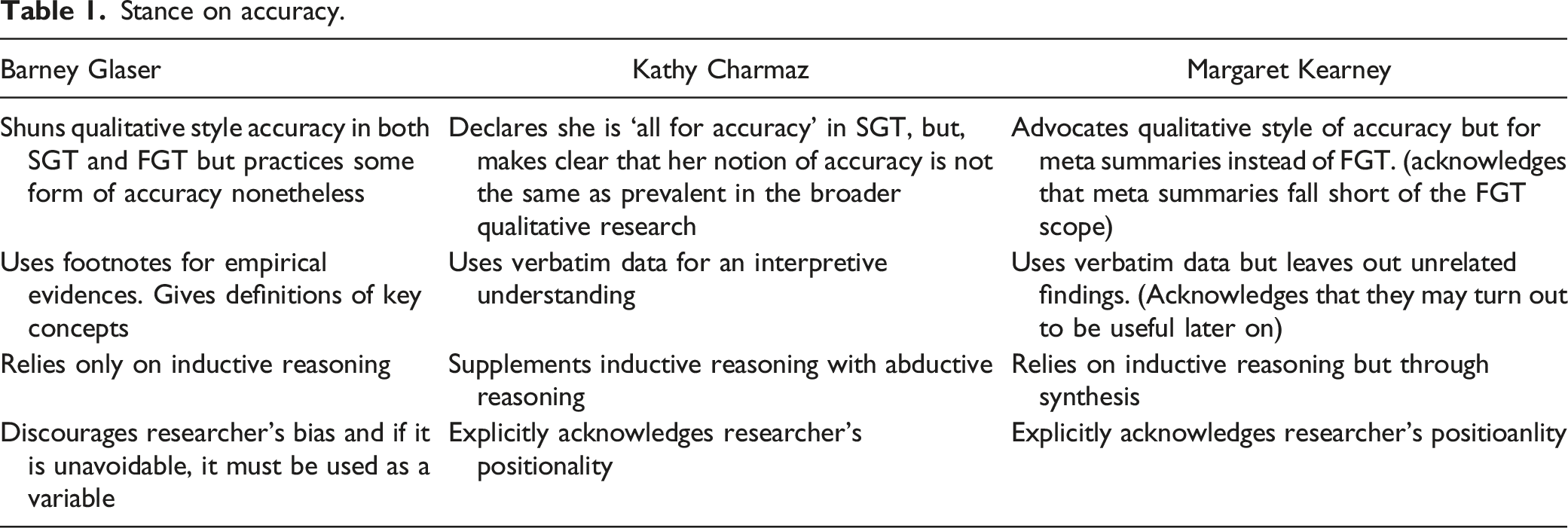
The three responses to the problem of accuracy have their advantages as well as disadvantages. Glaser in his theorizing on accuracy comes across as a harsh critic. He holds it as the pivot point in the GTM remodeling along the QDA-design. This remodeling leads to FGT being ignored as descriptive generalizations’ with their failure to be transferred to other areas, produce dated accounts with little or no utility beyond the immediate contexts. However, as mentioned above, the formal grounded theory Status Passage generated by Glaser and Strauss, seems to accommodate a use of empirical evidence and verbatim data if deemed fit by a researcher acknowledging their positionality. Glaser and Strauss do recognize the importance of empirical evidence when they use the term ‘temporary relief’ (1971, p. 11) for references that can cut down the monotony of high abstractions. Although they use empirical evidences and explanatory definitions as a relief providing tactic, it is much more than this. Glaser and Strauss’ use of empirical evidence helps in understanding and absorbing the emerging theory and are an integral part of the FGT methodology. Charmaz’ (2004, p. 989; 2008, p. 167; 2016, p. 3) self-methodological approach with its reliance on abductive reasoning seems to be broadly useful for FGT. However, there is a need for more methodological preciseness required as to the use of empirical evidences in higher abstractions. Kearney’s (1998, p. 183; 2007, p. 144) approach of meta-synthesis allows for verbatim data but it lacks room for novel and creative insights as she does not base her model on abductive reasoning unlike Charmaz. Kearney’s (2007, p. 145) suggestion for generating FGTs article long as against book long is restrictive as the decision for the length should be left to the topic and the researcher.
Keeping the insights drawn from the above three analyses in mind, some views from another researcher, Sandelowski (2006) are in order as they help find a solution to the accuracy problem in GTM. Although Sandelowski works in a purely qualitative (non-grounded theory) paradigm, her claims are aligned with Charmaz’s (2016) methodological self-awareness. Sandelowski’s intends to points out weaknesses in Kearney’s conceptualization of meta synthesis which she calls as a ‘thrice removed jeopardy’ (2006, p. 10) and offers a replacement ‘thrice-told-tales’ based on the notion of ‘alternative views’ (p. 13). She writes that the effort to produce ‘faithful accounts’ needs to be strengthened by ‘alternative readings’ (2006, pp. 13-14). She suggests dominant ‘language and social practices’ that underlie data to be made visible (2006, p. 13). This recognition of ‘discursive processes at work in their production’ can come from researchers who are methodologically self-consciousness and self-aware and are able to covert ‘the subjectivity inherent in all inquiry’ from ‘problem to opportunity’. They realize and ‘accept that truth is inescapably socially constructed’ (Sandelowski, 2006, p. 13). Turning our gaze inwards and assessing our own views and standpoints and those of our participants’, is how accuracy or truth are constructed.
Pragmatic Accuracy
Keeping the above discussion in view, I replace worrisome accuracy with a more practical pragmatic accuracy for formal grounded theory. Pragmatic accuracy considers all viewpoints expressed above viz Glaser (1971), Charmaz (2004; 2005; 2008; 2016; 2017; 2019), Kearney (1998; 2007) and Sandelowski (2006). It also brings in views by Kelle (2019) and Wuest (2001) for a deeper understanding. Pragmatic accuracy is defined by two key features: methodological self-consciousness informed by GTM’s version of abductive reasoning, and the use of empirical evidence. Both of them rest on the premises of Charles Peirce’s pragmatism which views ‘truth understood as meaning’ (Charles Peirce in Samuels, 2000, p. 213) emphasizing that any pursuit of perfect truth is destined to fail. The nomenclature of pragmatic accuracy seeks to elucidate the researcher’s judgment regarding the level of accuracy deemed sufficient.
A key aspect of pragmatic accuracy is the use of abductive reasoning and which is different as well as similar to the way Karl Popper and Peirce use it (Bryant, 2009, para 94). As mentioned elsewhere, Charmaz (2008, p. 167) uses the concept only to the extent where a researcher uses an intuitive and imaginative understanding to arrive at an interpretation. She does not differentiate Peircean way of defining abductive reasoning from that of GTM. It is Bryant (2009, para 94), however, who differentiates the GTM abduction from Popper and Peirce’s which is based on a conjecture followed by hypotheses to test them. GTM’s abductive reasoning is ‘far more grounded and linked to data, observations, or other forms of evidence’. This is supplemented by ‘theoretical sensitivity’ (2009, para 94) which Bryant deems an integral part of GTM abductive reasoning.
Theoretical sensitivity for an FGT requires extensive reading in the core category and related fields for more generality (Strauss, 1987, p. 300). Abduction without attention to theoretical issues in the data can make the analysis lapse back into induction. Bryant defines induction as merely ‘a recasting’ of existing data by raising the abstraction level. Samuels (2000, p. 214) concurs with Bryant by pointing out the limiting aspect of induction when he writes ‘[i]nduction only applies to a particular domain [data-set]’. This may hamper the generality of a formal grounded theory. Moreover, abductive inferences can be used at ‘every aspect or stage of the process of the production of knowledge’ (Samuel, p. 215). As decisions about accuracy are not reserved for any one stage of formal grounded theorizing, but, take place at every stage, abductive reasoning is more useful. Abductive logic does not exclude ‘alternate explanations’ Kelle (2019, p. 81) which is a part of methodologically self-consciousness advocated by both Charmaz (2016) and Sandelowski (2006).
Taking the first of the two features of pragmatic accuracy, methodological self-consciousness, in FGT, pragmatic accuracy rests on methodological self-awareness that leads a researcher to minutely investigate their own assumptions and standpoints and those of their participants’ (past and/or present, as the case maybe). As Charmaz (2017, p. 6) puts it, this strategy ‘pierces the taken-for- granted individualism in our methods and in our consciousness’. It also allows a researcher to co-construct the research site with the collaboration of research participants while keeping an eye on conceptualization.
The second component is the use of empirical evidence. There is a need to weave in the content with the emerging theory (Udo Kelle, 2019, p. 86). A general theory with low empirical concepts might have ‘less power’ to influence crucial policy development (Judith Wuest, 2001, p. 171). Staying close to data when theorizing (generalizing) enhances a theory’s applicability in similar conceptual areas. The toolbox of pragmatic accuracy accepts Glaser’s (Glaser & Strauss, 1971) approach of using footnotes in a developing theory as long as there is an acknowledgement of researcher’s own viewpoints braided in with those of the participants. Charmaz’ manner of taking excerpts from data and explicitly relating them to emerging categories is equally valid.
Kearney’s (2007, p. 144) view of using ‘verbatim data’ need not be dismissed either. The final decision pertaining to the incorporation of empirical references is left up to the researcher’s methodological self-consciousness. A researcher who is writing an article-length formal grounded theory may want to keep empirical references to the minimum with a nod to the relevant contextual (socio-historical) factors. Whereas for a book-length formal grounded theory, detailed excerpts may be included as need be. Additionally, a researcher may decide alter the length of their FGT, turning article-length FGT into a book-length one or vice versa, adding or removing empirical descriptions.
Formal Grounded Theory Informed by Pragmatic Accuracy
A formal grounded study follows almost the same procedure as a substantive grounded study, i.e., coding, memo-writing, theoretical sampling, theoretical saturation and constant comparison. Glaser in his writings on FGT (Glaser, 2007a, 2007b, broadly refers to the following 4 characteristics that differentiate an FGT from a standard SGT: 1) starting with an already theorized SGT, 2) deciding whether there is a main worry/issue to be resolved or not, 3) choosing substantive theories from theoretically similar social areas, and 4) the level of generalization for the FGT. These characteristics are exemplified below in the context of pragmatic accuracy and an over extension of each concept is also provided for further clarification. The characteristics and the ways of avoiding the over extension of each are presented as strategies by providing a goal and a way of achieving it. A consideration that underpins each of these 4 stipulations is the length of the formal grounded theory, whether it is article long or book long. As mentioned in the previous section, the length of an FGT depends on the topic, aim and resources at the disposal of a researcher and the length may be altered by relying on empirical descriptions.
The first stipulation of an FGT is that it starts with either an SGT core category (Charmaz, 2006; Glaser, 2007a, 2007b; Glaser & Strauss, 1967; Martin, 2019) or an idea taken from anywhere (e.g. official document, a newspaper, a personal experience, etc.) as long as a researcher sees potential for its general implications (Strauss, 1987, p. 241). The goal of pragmatic accuracy is to ensure that a researcher’s personal stances are made explicit in the selection of a core category so that a conflict of interest or any other issue bearing on the theoretical rendering may be made explicit. This can be done by acknowledging the personal and professional stances at the beginning of the study. For example, as Glaser points out, and endorses, that a researcher who is already working in an area is bound to see it everywhere. Glaser likens it to a ‘core fever’ (2007b, p. 99). He cites Hans Thulesius’s whose work on ‘balancing in palliative care leads him to see balancing everywhere’ (Glaser, 2007b, p. 99). Pragmatic accuracy can also help avoid the overextension of the concept by ensuring that all would be to start with two or more ideas and not being able to integrate them at some point or clearly articulate which is the core focus of the study.
The next characteristic of an FGT is whether it is mandated to resolve a main issue/worry or not that is the focal point/core category of the SGT. Glaser seems to accept both options here as is evidenced in two of his writings that is of resolving (or extending) the main concern of the SGT (Glaser, 2007a, pp. 80-1) or letting a new issue emerge (2007b, p. 103). As pragmatic accuracy recognizes that a certain adherence to the main issue needs to be retained by extending the general meaning of the core category, it ensures that it is stated in a study early on and clearly. For example, Wuest (2001, p. 168) states her objective of generating the FGT right at the beginning of her work. Her purpose is the ‘development of a health and social policy that is responsive to women’. To this end, pragmatic accuracy agrees with Charmaz (2004, p. 986) in that ‘we take a measured stance about the data we select to show. It means choosing excerpts and anecdotes that represent larger issues’. An over extension of the pragmatic accuracy concept would be to choose only ‘the juiciest stories’ to use Charmaz’ words (2004, p. 986) which needs to be avoided.
The third stipulation is about the theoretical relatedness of all selected substantive theories (or ideas). Glaser gives us an option when he writes that data can be from the ‘same substantive area and [in] other substantive areas’ (2007a, p.99). Charmaz’s (2006, p. 180) statement is vague in this regard as she only writes about more data. The issue regarding the range or as Martin says ‘across a number of disciplines and specialties’ has to be chosen carefully so that the main issue of the core category can be resolved and a hotchpotch of contradictory concepts is avoided. As pragmatic accuracy agrees with Kearney (1998, p. 181) that the areas may be ‘distinct yet [from] theoretically similar, social situations’, it ensures that all selected areas have something in common. For example, Strauss, (1987, p. 244) starts his formal grounded theory with four concepts intertwined: the first is awareness of dying and is from an SGT that he and Glaser generated (1965), the rest are based on his readings on spies, the gay world, passing, and how to handle stigmatized diseases such as leprosy. He makes it clear that his principal or overarching focus is on ‘all awareness phenomena’ (1987, 244). The over extension would be to not make informed decisions regarding the theoretical sensitivity of the data and end up with an account that may not properly grounded in the relevant literature. Pragmatic accuracy can ensure this by keeping a sustained focus on relevant literature.
The last stipulation concerns the level of generalization for a theory to be declared an FGT. A clarification is in order here: Glaser uses the term generalization and abstraction sometimes interchangeably (2007b, p. 106) and other times separately (2002a, p. 34) for emphasis’ sake. He writes that ‘an FGT’s generalizations about a core category are abstract of time, place, and people until their application’ (2007b, p. 100). Pragmatic accuracy uses the two terms interchangeably. As for the desired level of generalization or abstractness of an FGT is concerned, FGT is a middle-range theory (Glaser & Strauss, 1967, p. 177; Glaser, 2007b, p. 101; Strauss, 1987, p. 242) and ‘will end up at the level of abstraction that the data and studies bearing on the core category (and the energy and resources of the theorist) will allow it’ (Glaser, 2007b, p. 100). A distinction made by Kearney (1998, p. 183) is useful here and aligns with pragmatic accuracy. She offers two types of FGTs in terms of abstractness or generalization. One is ‘generated for practice’ and the other for ‘social or psychological understanding’. For the first the level of abstraction is determined by its usefulness for practice and may be stopped if it is getting too general. The second type is a higher-level abstraction and may be dependent on a researcher’s decisions. Pragmatic accuracy can help avoidance of the over extension of the concept by ensuring an adherence to Kearney’s distinction between the two levels.
Recommendations for Future Research
The novel concept that I introduce in this study, pragmatic accuracy, has been necessitated out of the ambiguous and contradictory use of accuracy in grounded theory literature dealing with both substantive grounded theorizing but specifically formal grounded theorizing. In the latter, the added significance is due to the fact that grounded theorists choose not to generate FGTs by ending their studies at the generation of SGT. This results in the logical end of grounded theory research being compromised (Gasson, 2003, p. 84). In a world marked by inter-,multi- and trans-disciplinarity, FGTs provide the much-needed answers to sociological inquiries through their power of generalizations.
Three main theoretical formulations viz Glaser’s (for example see 2007a, etc.), Charmaz’ (for example 2008, etc.) and Kearney’s (1998; 2007) are used to revisit and reconfigure the concept of accuracy. I attempt to show that although it is Glaser who has been labeled as both ‘confusing’ and ‘confused’ (Bryant, 2017, p. 159), Charmaz and Kearney who explicitly embrace the use of empirical evidence for accuracy, are no less methodologically viable either when it comes to practicalities. Glaser for all his opposition to empirical descriptions does provide an opportunity to be re-read when he (along with Strauss) calls empirical evidence as a ‘temporary relief’ (1971, p. 11) in a read full of high abstractions. I interpret it as a call for including empirical descriptions judiciously and in line with pragmatic accuracy.
Although my study develops the concept of pragmatic accuracy for formal grounded theorizing that uses qualitative data, it may be used in its present form for grounded theories (substantive and formal) that use a combination of qualitative and quantitative data or just quantitative data. These may be critical or non-critical studies. Pragmatic accuracy can also be used in GTM studies that use multi-lingual data and some form of translation (Nurjannah et al., 2014). As pragmatic accuracy is shown above to have some similarity with Sandelowski’s concept of ‘thrice-told-tales’ (2004, p. 13), purely qualitative studies which do not intend to generate theories can still use and extend it. Lastly, studies that aim to influence policy development in any under-developed area (Wuest, 2001) are expected to have some measure of accuracy, can also benefit from the concept of pragmatic accuracy.
Footnotes
Acknowledgement
Declaration of Conflicting Interests
Funding
ORCID iD
