







Abstract
Keywords
Introduction
Autoethnography was new to me, notwithstanding my substantial experience in conducting applied research before pursuing a doctoral degree. I relished the opportunity to be a research participant, contributing to a chosen field of study with full control over how I interpreted the social problem I identified. Autoethnography was the only approach that could fulfil this objective, despite the numerous drawbacks I encountered while exploring the approach. To a greater extent, I wanted to employ an approach that would facilitate the impact of my research to extend beyond the changes within me and highlight the possibilities of wider change within the social group. The rules of applying other research approaches, such as grounded theory and a case study I considered neither aligned with using a personal account nor the purpose of my research. I valued the supposition that society presents a universal framework for creativity and relative experiences determined by subjective perceptions of objects within the confines of space and time (Charmaz, 2014). However, I did not consider myself multifaceted enough to conform to theoretical sampling or tell my story to saturation. Conversely, devising propositions to shape a case study inquiry (Yin, 2017) would have been rather pretentious for a study based on a personal narrative with an ending I was well familiar with.
I was determined to maintain the autoethnographic research focus, but I also wanted to circumvent the loud critiques of indulging myself in an armchair inquiry. Questioning what research with social value comprises, rather than my ineptitude in crafting beautiful stories, influenced my struggles and final approach to the autoethnographic research I accomplished. Often referred to as avant-garde (Stahlke Wall, 2016), unique, mysterious (Cooper & Lilyea, 2022) and/or different (Poulos, 2021), the autoethnographic research approach and its scholarly contribution are challenged. A universally agreed-upon definition for autoethnography does not currently exist, as its meaning and application continue to evolve (Chang, 2016). Some attempts to clarify autoethnography as a narrative approach to research offer characteristics (Adams et al., 2017; Anderson, 2006; Hughes et al., 2012), which tend to be long-winded as they seek to encompass the evocative and analytic camps of autoethnography. Ellis and Bochner (2000) present autoethnography as an umbrella term that encompasses a range of writing styles, which may not necessarily be research oriented. I appreciated the simple definition of autoethnography as the analysis of personal experiences connected to a social context (Chang, 2016). However, little seeks to draw the line between writing an autoethnography and undertaking autoethnographic research. Through the prism of my doctoral research, I employ some of the outstanding criticisms of autoethnography as a qualitative research approach to make this differentiation.
Evocative, Analytic or Autoethnographic Research?
Autoethnography can be applied using one of the approaches comprising evocative, analytic or autoethnographic research. Evocative autoethnography is a style of writing that employs thick and enticing descriptions of personal experiences, using techniques that lure readers into the experience without relying on dialogue (Ellis et al., 2011). Evocative autoethnography encourages the autonomous use of language to enrich ideas in a way that draws readers into the story. Anderson’s (2006) analytic autoethnography advocates for a more systematic approach to penning narratives to transcend emotional accounts. Anderson (2006) defines analytic autoethnography as “work in which the researcher is (1) a full member in the research group or setting, (2) visible as such a member in the researcher’s published texts, and (3) committed to an analytic research agenda focused on improving theoretical understandings of broader social phenomena” (Anderson, 2006, p. 375).
At first, analytic autoethnography seemed somewhat suitable for achieving the purpose of my study because transformative writing is more concerned with elucidating problems experienced by social groups than the aesthetics of representation (Ebert, 2009). Anderson’s (2006) distinction of a full member alienated my retrospective account of cultural practices that I had relinquished, which did not make the experience less than my own. Retrospective studies examine outcomes that have already occurred at the time of the study’s inception (Song, 2010). Additionally, Anderson’s (2006) binary distinction of converts and opportunistic full members paints a rosy picture for researchers who convert to espouse the cultural practices they set out to study. Besides the impalpable bias, some social problems such as addiction and homelessness do not readily lend themselves to converts.
Structure and struggle repeatedly materialized on the pages of my autoethnographic researcher’s diary. Some guidance for undertaking autoethnographic research with rigor now exists (Chang, 2016; Cooper & Lilyea, 2022; Poulos, 2021). Moreover, most suggestions are based on preserving creativity amidst rectifying the struggles of maintaining consistency to generate impactful results. Cooper and Lilyea (2022) and Poulos (2021) integrate evocation in their guidance, which Chang (2016) denounces. While all authors offer data collection guidance that incorporates the analytic approach, data analysis is typically presented as a stage that is distinct from writing the personal account in the research process. Analysis in autoethnographic research occurs throughout the writing process to facilitate the presentation of only those accounts relevant to the phenomenon being examined. Similarly, I considered the systematic coding of my retrospective account, as Chang (2016) suggests, to be an overextension of the impression of rigor, because researchers have the liberty to edit the language used in personal accounts.
I sought a methodical approach for undertaking autoethnographic research once I discovered that analytic autoethnography was not amenable to retrospective narrative analysis. I could have leaned on Grant’s (2024) work to guide a doctoral research project without inventing another camp of autoethnography, had I discovered it in time. My research aimed to de-commodify managing self-diagnosed insomnia in a mixed economy. Healthcare consumers in mixed economies utilize both public and private sector goods and services, with multiple options available on the market to meet the needs and expectations of self-care (WHO, 2021). De-commodification thus seeks to develop independence from market forces that drive natural processes, which humans are inherently entitled to (Gerber & Gerber, 2017). My purpose in writing an autoethnography therefore, focused on narrative research, aiming to emancipate the primary insomnia consumer tribe from the commercial dealings of sleep, which is innate to humans.
Narrative research entails exploring in-depth the meaning that individuals attach to social experiences of the phenomenon under investigation (Josselson, 2010). However, relying on personal narratives does not necessarily qualify autoethnography as a form of narrative research. Terms autoethnographic research, autoethnographic study and autoethnographic inquiry are used interchangeably in the literature. The growing use of the term ‘autoethnographic research’ instead of ‘autoethnographic work’ seems to have originated from the challenges of presenting autoethnography as a qualitative research approach with confidence. Raab (2013) likens autoethnographic studies to memoirs about traumatic or melodramatic events, which, in my opinion, remain contained in an individualized box of self-discovery, awareness and/or sense of empowerment. Earlier researchers (Hayano, 1979; Maydell, 2010; Mitra, 2010; O'Byrne, 2007) who portrayed autoethnography as research had to either address methodological dilemmas or critically reflect on good practices for undertaking widely acceptable autoethnographic research. While autoethnographic work encompasses every aspect of autoethnography including research (Ellis & Adams, 2020), autoethnographic research delineates autoethnography as a qualitative research approach. Beautifully crafted memoirs about the wider social, historical and/or cultural interests of one’s life history (Hatch & Newsom, 2010) differ from combining analysis with synthesis of narrative experiences of phenomenon in a specific context.
Narrative Research or Legacy Memoirs?
Travers (2006) questions whether auto ethnographers’ sole capacity is to present personal traumas and/or life changing events without any room for everyday life events. Equally, autoethnographic research is frequently assessed as a lazy, self-indulgent, biased and a rigor omitting approach leading nowhere (Poerwandari, 2021). Autoethnography relies on personal narratives to accomplish what Ellis et al. (2011) refer to as a process and product. However, Individuals who write about themselves in a cultural setting without making sense of the context blur the distinction between writing legacy memoirs and conducting autoethnographic research (Carspecken, 2023). Schoepflin (2009) is an example of an analytic autoethnography that integrates theory about being degraded in public, without emphasizing its broader societal implications. The distinction of ‘writing to retaliate instead of writing to right’ (Grant, 2024) may suit the mode of writing where the author fails to contextualize the life examined. In my opinion, a conceptual framework incorporating a network of theories around moral psychology and self-identity could have accentuated the intended purpose of Schoepflin’s (2009) work.
Narratives in general terms may not be research oriented and can be assigned to any text describing a phenomenon (Creswell et al., 2007). Shepherd’s (2011) earnest memoir about the challenges and beauty in the Cairngorm Mountains of Scotland is a masterwork for people interested in Britain’s nature and landscape. While I found the chapter on sleep (Shepherd, 2011, Chapter 10) informative about the influence of altitude on sleep onset, expressions of literal and cognitive views of reaching the top of a mountain may intrigue poetry students. Personal narratives are therefore not synonymous with autoethnographic research, unless they carry a research focus with a sociocultural connection that the writer directs (Wall, 2008). The end component of an autoethnographic account thus sets the tone justifying the intent of the auto ethnographer. As Carspecken (2023) notes, books based on true stories can be inspirational, informative and/or directional. The social value attached to this form of writing differs from the function that qualitative research in social sciences is set to fulfil (Hammersley, 2024).
While personal narratives of any form can elicit perceptions of activism for social justice or overlooked truths, as highlighted by Carspecken (2023), the result of a memoir is worth considering. A mere handful of the readership may share the activists’ values, wherein a methodical approach showing the logic of ideas is omitted. Memoirs written simply to draw readers in can serve as secondary sources of data (Vandrick, 2013). This is when a research focus is methodically appended to the memoir to go beyond readers’ impressions, such as ‘that was brave’, ‘how absurd’ or ‘incredible’ to fulfil the purpose of undertaking research. In social research, relationships and patterns are mapped through testing theories or using established theories to generate explanatory statements that enhance modes of dealing with social problems (Flick, 2020). I bought and used numerous sleep commodities during my search for good night-time sleep, a measure of which was subjective. What does this mean to people in a similar context shaped by social interactions in general?
Connecting the Self to Cultural Practices of a Social Group
A research approach may encounter rules specific to the training and practice concerning a particular discipline (Kuhn, 2012). Similarly, autoethnographic research necessitates an analysis of the cultural practices of a social group. Culture is a nebulous concept that does not simply refer to customary practices of an ethnic or anthropological group. For example, pigeon hunters may constitute a social group with shared practices forming their culture. The key question here is – so what? In autoethnographic research, the storyteller is the focal point in analyzing the culture of a specific community of practice (Chang, 2016). This does not imply that the autoethnographic researcher is the sole unit of analysis, but rather a channel through which social concerns are identified and addressed. Culture therefore constitutes the context within which the group associated with the culture navigates the intricacies of everyday life (Draper, 2015). The excerpt from my narrative encompasses analyses of the physiology of human sleep, possible causes of night-time sleep disturbances and the dynamics of contributing to social reproduction.
I struggled to connect what I considered at the time to be a biological malfunction with a cultural tradition. My interaction with the night-time sleep searching community of practice had involved reading and writing reviews of my trials and errors when self-managing the so-called insomnia. I found my niche in the tales of safe spaces for feminist cyberethnographers, citing opportunities the digital age convened for conventional or alternative forms of community interactions different to the corporal face to face (Gajjala, 2006). I coined the term ‘primary insomnia consumer tribe’ to represent the group of people entwined in the world of buying and using sleep commodities paraded freely on the market with guaranteed results. I assumed that the tribe comprised a large proportion of the adult population given that the exponentially growing sleep market (Statista, 2024) has acquired a status of sincerity among people who tussle night-time sleep into compliance.
While the autoethnographic researcher’s link to a culture can be challenging to distinguish from the numerous social interactions, focusing on the purpose of the cultural analysis throughout the autoethnographic research process is essential. The analysis of family traditions that Chang (2016) accomplishes may culminate into an autoethnographic memoir without a synthesis highlighting health risks or a susceptibility to trauma. On the other hand, the evocative focus on the pursuit for hermeneutic perfection and the ability to thrill may obstruct the capacity to unmask deeper and core elements when autoethnography is presented as research. In their autopsy of analytic autoethnography, Ellis and Bochner (2006) attempt to narrate with emotion the suffering of a black man who lost everything during Hurricane Katrina. Wrapped in the melancholy of predictable language, the comfort states of a more privileged social class drive the moral obligation to show empathy and care.
Adams (2016) posits that empathy in a capitalist world is an assumption on the internal experience with little bearing on caring. The capacity to put oneself in another person’s shoes is often founded on varying thoughts, mostly engrained in the lived experiences of individuals. Different readerships may understand autoethnographic stories differently, depending on whether specific readers are more familiar with the context than others (Squire et al., 2014). The imaginary storm in the Florida Gulf Coast in Ellis and Bochner (2006) is far from relatable to actual events of the devastating hurricane that occurred more than 6000 miles Northwest in New Orleans. Distinguishing between the functions of social science research and the artistry in writing autoethnographies is thus essential for upholding essence of undertaking research (Hammersley, 2024). In addition to the proposed standards in Chang (2016a), autoethnographic researchers should aim for purposeful knowing to transcend delivering emotional tales that risk missing the mark. As Stahlke Wall (2016) and Grant (2024) observe, any research approach, including autoethnography when undertaken with a research focus should not be presented in a vacuum. Research results ought to have social significance that encompasses community interactions.
Self-Indulgence And/or Self-Victimization
The ongoing struggle for autoethnographic researchers is to produce knowledge considered authentic in academic circles, as the muddle between self-indulgence and self-knowing often becomes appealing to overzealous critiques (Freeman, 2015). Personal accounts are repeatedly evaluated as vindictive devices for soliciting pity (Bruner, 1994, 2004). While it is through narratives that we understand human experiences of the world (Moen, 2006), questioning autoethnographic research somewhat corrodes the credibility of any form of narrative research. Bruner’s work (1991, 1994, 2004) on the conception of the ‘self’ portrays personal narratives as pursuing a vendetta against oppression in constructing meaning. This may be the result of autoethnographies that are put forward as research without a paradigm that accentuates views of social reality and how authors go about establishing truths. Narrative analysis in autoethnographic research is context-bound, centered around research questions, and eliminates tales the researcher considers irrelevant to the meaning attached to the experience (McAlpine, 2016). Conversely, autoethnographic writing may incorporate a lot of detail to help readers linger in the journey of the lived experience instead of its destination (Ellis & Bochner, 2006).
Reflexivity facilitates the constant awareness of influences from experiences of interacting with a culture or possessing a specific cultural identity (Ellis et al., 2011). Bruner (1987) contends that writing reflexively may misrepresent what the storyteller may have in mind when a criterion of self-rightness is enforced on inner perceptions. From Bruner’s (1987) viewpoint, truth is alienated from narratives because people acquire knowledge and understanding through reflecting on and interpreting their life experiences. The self may constantly reconstruct to adapt to cognitive developments and the environment. However, the meaning individuals may attach to some events is so distinctive that any other life experiences cannot taint it. My narrative analysis exposed the obsession with using various sleep commodities to get the perfect night-time sleep, the anxiety and despair that accompanied trying a myriad of products. This was in the context of social order and the factors that dictate the material conditions of life. Autoethnographic research presupposes a lack of objective truth, but simply the existence of narrative truths (Mayor, 2016), particularly when the links to social norms are synthesized logically.
Is one Account Sufficient for Autoethnographic Research?
Autoethnographic researchers often seek additional data to escape the entrapment in personal accounts (Wall, 2008). Anderson (2006) recommends pursuing accounts from other people to circumvent the self-absorption reproach and enhance the link of a personal account to a broader social phenomenon. On the contrary, collaborative autoethnographies seeking to pluralize the meaning of personal accounts do not necessarily make scholarly contributions without connecting with wider social science research systems of generating knowledge with significance (Chang, 2016). Wall (2008) argues that the excessive pursuit of hard data in autoethnographic research mirrors a positivistic era of thought, wherein information is objectified to hold value.
Causal thinking mediates tales into narratives, aiming to impart knowledge to be acted upon instead of providing entertainment. The concept of ‘self’ and individual perceptions of the self are not isolated from the range social interactions that frame our experiences. While a personal account offers a stronger perspective than those inferred (Wall, 2006), a range of elements to which individuals are oblivious can contribute to events and the way they are experienced. On the question of whether the self is sufficient without seeking the community construction of truth, Jackson and Mazzei (2008) reckon secondary interpretations deform pluralized meaning. Bhaskar and Danermark (2006) also note that the social constructivism’s assumption of generating knowledge through mutual social interactions has gaps in the knowledge about associations of the causes of consequential experiences. Jackson and Mazzei (2008) instead propose handling personal accounts as fallible at some point in the research process to surpass perceiving written experiences as self-evident foundations of knowledge.
Employing both narrative analysis and synthesis in the research process unlocks logical explanations of mechanisms underpinning behavior and/or outcomes in specific contexts. While narrative analysis is embedded in the personal account of experiences or practices within a social group (Holman Jones et al., 2016), narrative synthesis integrates the analysis into a logical conceptual framework to connect personal experiences to the broader society in a systematic manner. Experiences of individuals are usually context bound. However, others in the same social realm may draw links when a conceptual framework is used to explain what society offers its dwellers. The critical realism framework for synthesis, with a priori categories of stratified levels of reality (Fletcher, 2017), was a practical approach to building the overall framework that facilitated my narrative synthesis. Stratified reality encompasses three levels: the empirical level, where experiences are observed; the actual level, where events occur irrespective of whether they are observed; and the real level, which consists of mechanisms with causal powers (Eastwood et al., 2014). I substituted the phrase ‘real level of reality’ with ‘material level of reality’ to emphasize the influence of material conditions of life on sleep patterns.
I drew on Booth and Carroll’s (2015) notion of a best fit framework for synthesis to enhance my conceptual framework. I integrated the adaptive control of thought -rational (ACT-R), a unified theory of the mind (Anderson et al., 2004) and the base and superstructure framework from Marxian analysis (Blackledge, 2018) with the critical realism framework. Anderson et al.'s (2004) ACT-R theory explains how the mind uses four key components (goal module, perceptual motor system, declarative memory module, and procedural memory) in developing skill to solve a particular problem. Marxian is a metatheory explaining domains of existing socially through which we contribute to reproducing society biologically, economically, psychologically, politically, ecologically, and so forth. Marxian’s base and superstructure framework accentuates the influential relationship between forces of production (capital means and relations of production) and ideological conceptions of political entities to which social forms of thought correspond (Marx, 1889). The mode of production in the economic base shapes political systems that influence social values and beliefs. The superstructure therefore constitutes aspects of human endeavors that support the accelerated multiplicity of profits accruing to owned capital. Daytime sleepiness is considered disordered (Zucconi & Ferri, 2014) because society expects individuals to be contributing to social reproduction processes, even if that involves actively consuming the products of others, such as Netflix.
I nested my network of theories within the critical realist framework for synthesis (Fletcher, 2017) to explore cause and effect relationships in managing self-diagnosed primary insomnia. Cause and effect represent the relationship between two phenomena, where one phenomenon presents the reason why the other exists (Wahed & Hsu, 2010). For example, sleeplessness can lead to fatigue, wherein sleeplessness is the cause and fatigue is the effect. Nevertheless, the cause-and-effect relation needs a mechanism to qualify the sleep-fatigue causal relationship. Mechanisms are parts that, when put together, produce consistent cause-and-effect relations (Brady, 2011). The pieces of evidence for my study included a personal account, visual inspirations, and a targeted critical review of the physiology, psychology and economic aspects of human sleep. A targeted review is a non-systematic approach with the core objective of providing information instead of comprehensive knowledge on a subject (Huelin et al., 2015). The photographs I took of the marketplace and my online consumption activity simply authenticated the context of an existing primary insomnia consumer tribe, contributing to the growth of the sleep market. Incorporating evidence from the literature about the inefficacy of sleep commodities in restoring night-time sleep did not achieve the objective of the study without a synthesis that illuminates the ‘how’ of their inefficacy.
Narrative Synthesis in Autoethnographic Research
Emerald and Carpenter (2017) suggest that using a theoretical lens in autoethnography is the turning point from navel-gazing to research that can be applied to others in a similar context. I argue that narrative analysis framed by theory still focuses on the auto ethnographer if not integrated into a conceptual framework to systematically map patterns that link the self to a social group within social interactions. A conceptual framework plots the direction of the research, the relationship between qualitative variables and the key concepts comprising the theoretical framework, facilitating a visual representation of the mechanisms underpinning the phenomenon under study (Grant & Osanloo, 2014). Wall (2006) provides a good analysis of autoethnographies that incorporate theory yet represent a kind that continues to vie for scholarly acceptance. Sparkes (1996) is what Chang (2016) would refer to as descriptive or performative storytelling. In my opinion, Sparkes (1996) falls short of providing a specific lens for synthesis as aspects of class, gender, self-identity and embodiment in a modern society cloud the interpretative lens of the social problem presented.
Narrative synthesis takes narrative analysis beyond practice like findings to map mechanisms influencing the cultural practices of the social group of interest in a holistic way. Narrative synthesis is not merely about aggregating information. It is about bringing together and triangulating different pieces of evidence to develop an understanding of the phenomenon holistically (Noblit & Hare, 1988). Ebert (2009) and Maxwell (2004) advise using explanatory synthesis to generate credible statements grounded in the theoretical understanding of the causal inferences of the phenomenon examined. For example, locating agency and structure in my framework for synthesis was crucial for discerning the dynamics of rational thought in buying sleep commodities. While agency and structure are mutually influential, one’s capacity to think rationally in making choices differentiates agency from structure (Porter, 2015). Political and social ideologies often change the context in which individuals make decisions without questioning the logic behind practices that society accepts as norms. I bought teas, balms, pills, gadgets, meditation apps, ergonomic pillows, potions, books, etcetera, to realign my night-time sleep with social expectations. My mind was sensitized to evaluating the performance of sleep commodities every night, and I only experienced the joy of deep sleep at dawn when the alarm clock signaled the arrival of yet another day.
The narrative synthesis building on my narrative analysis involved triangulating and integrating the various forms of knowledge to generate results that I considered to be more meaningful than presenting each form of knowledge separately. I included the analysis of my visual inspirations in the narrative analysis.
Using the Conceptual Framework for Autoethnographic Research
Syntheses build onto analyses, and each analysis consequently needs a synthesis to be evaluated against any experiences recounted (Ritchey, 1991). The enhanced conceptual framework provided an overview of the study’s scope, which spanned physiological, psychological, and socioeconomic elements of human sleep. I used the conceptual framework to organize aspects of the literature review on human sleep, generate explanatory statements about mechanisms underpinning the consumer behavior of the primary insomnia group and to structure my findings. With a nonlinear disposition, a critical realist framework for synthesis involves steps that comprise identifying demi-regularities, abduction, and retroduction (Fletcher, 2017). Demi-regularities are events that cannot be explained solely based on their frequency or tendency to occur (Jagosh, 2019). The themes derived from my narrative analysis therefore comprised the demi-regularities. I developed explanations for observed patterns in the behavior of the primary insomnia consumer tribe through abduction and retroduction.
Abduction
Mapping Narrative Themes Into the Conceptual Framework (Abduction)


The physical element of primary insomnia assumed the empirical level of reality, while I positioned the psychological element alongside the actual level. However, psychological and physiological elements closely intertwine in the display of behavior. Positive thoughts can manifest externally as a smile. The conditions presenting at the first, second, and third levels of reality comprised sleep difficulties, the range of commodities or options on the sleep market, and the emergent sleeper, respectively. I located agency and structure strategically in the framework to demonstrate the influence of each on the respective level of reality and the conditions necessary for the consumption behavior to occur.
Themes categorized under the goal module of the ACT–R theory involved the physical aspects of performing a natural function, including circumstances where sleep was manipulated. The ability to initiate different responses to problem solving is contingent on the knowledge of the goal and one’s ability to sustain logic to achieve the goal. I considered the range of options available on the sleep market, as ideologies and thus located these in the superstructure. The perceptual motor system of the ACT–R theory facilitates the focus on options through which the perceptual motor system request identifies the location of a particular option. The perceptual motor system links cognition and action as members of the primary insomnia consumer tribe pursue the perfect night-time sleep through trial and error with sleep commodities.
The declarative memory component of the ACT–R theory carried themes about the consumer’s capacity to store information, enabling coherence in problem-solving situations. On the other hand, the procedural component facilitated generating the rule with the most valuable use, such as ‘experience shows that nothing works’, using the knowledge stored in the declarative memory component. I considered the aptness of theory in explaining the images within respective themes while linking verbal accounts and visual inspirations to theory.
Retroduction
Retroduction unveils the causal mechanisms for specific contextual conditions through generating logical explanations of the conditions necessary for outcomes to manifest in the manner that they do. (Fletcher, 2017). One of the features of the critical realist synthesis framework pertinent to my study was the transitive temperament of knowledge. Misconceptions about and partial understanding of a phenomenon change as entities and the associated knowledge, misgivings, or ignorance change (Haigh et al., 2019). I distinguished gains and losses stemming from the moving parts of the change. I interrogated my assumptions about sleep being innate to humans to make grounded claims in line with my experiences. The law of contradictions is not a law of thought, but a valid thought of the way reality presents itself (Wild, 1947). Marxian’s dialectical materialism was therefore resounding in examining whether primary insomnia was an extension of social relations of production, a consequence of the material world or a health condition vying for mystical intervention. Figure 1 is a visual representation of the conceptual framework that I used to map links and patterns in my sources of evidence. Applying Retroduction Using the Conceptual Framework for Synthesis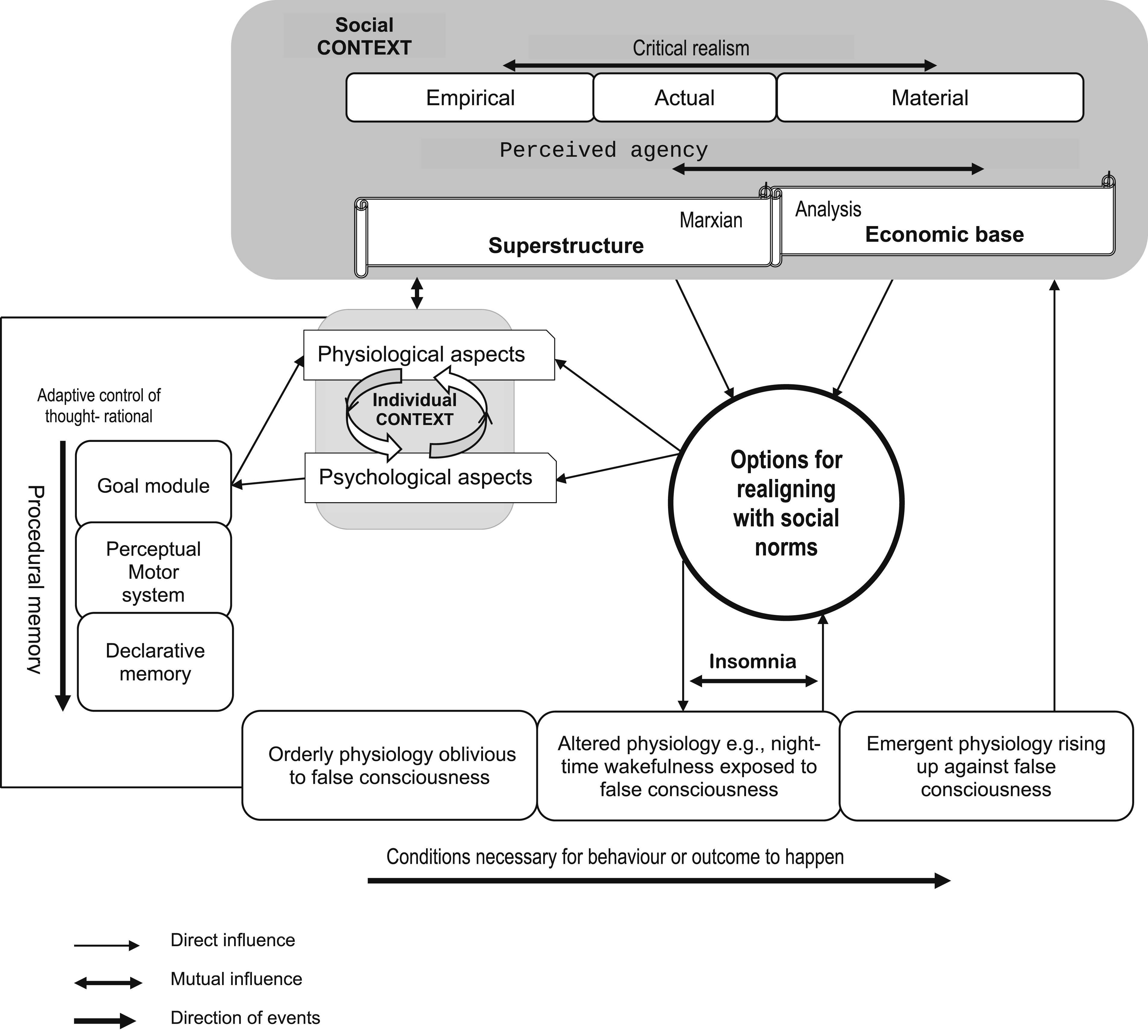
I observed tendencies in occurrences, differences in them and/or the absence of links in events within the behavioral context of the primary insomnia consumer tribe. I triangulated explanatory statements I generated with the critical literature review to strengthen explanations of the mechanisms that underpinned behavior and to identify contradictions and gaps in the existing evidence about sleep in humans.
The conceptual framework integrates critical realism’s levels of reality, modules of the adaptive control of thought-rational, Marxian base-structure analysis, agency and structure, and the physical and psychological aspects of the individual in a social context.
The conceptual framework comprises the social and individual contexts at the core of which rest the options society provides individuals to conform to social norms to avoid exclusion. Critical realism and Marxian analysis are embedded within the social context, whereas ACT-R involves both physical and psychological aspects of the individual. Social interactions frame common beliefs and individual behaviors that entrepreneurial minds prey on to reinforce those ideas. The options linked to beliefs and the mode of social reproduction often carry physical, psychological and financial effects on individuals or groups. For instance, gyms, dieticians, personal trainers and fitness apps sculpt us to appear a certain way, while fast foods and over-the-top streaming services make room for sedentary lifestyles.
What Does a Conceptual Framework Contribute to Autoethnographic Research?
To the best of my knowledge, using a conceptual framework that links theory, current evidence, and a personal narrative to social relations is a novelty that advances the quality and credibility of autoethnographic research. My conceptual framework may be useful to auto ethnographers synthesizing tales about normative social influences, illness, violence, commodified human health and healthcare, among other topics. Critical realism’s flexibility in establishing causality facilitates a case-by-case synthesis of underlying mechanisms of a social phenomenon (Bhaskar & Danermark, 2006). However, displays of a specific causal power are similar because the same power must bear the same law of action, whether the law of action causes a determined or probable display (Ellis, 2000). Historical or external factors that shape the identities of individuals do not change their intrinsic properties as human beings. Hence, decoding human thought opens possibilities for influencing behavior and the experiences of social phenomena. For critical realists, what is real is not reducible to what we know because our knowledge of what is real is only a small fraction of what can be known about the phenomenon (Fletcher, 2017). A conceptual framework is therefore an essential conduit for distinguishing the composition of elements that interact to manifest behavioral patterns and the trends of experiences of various social phenomena.
Practical Implications for Undertaking Autoethnographic Research
Like most qualitative research approaches such as grounded theory and phenomenology, undertaking autoethnographic research is not a linear process. However, each piece of information about the researcher included in the writing process should be relevant to the explicative context of the study. The number of schools I attended is irrelevant information if it did not influence my sleep patterns in adulthood. Engaging in prolonged self-observation, mentorship and peer debriefing to check the research process enhances the quality of the research (Lincoln & Guba, 1985).
Study designs may differ contingent on the purpose and context of the research. Nevertheless, declaring human behavior as a product of individual instincts influencing how reality is perceived to steer preferences (Morselli, 2014) is one-dimensional due to the significance of context in narrative synthesis. Structures shape individual agency and collective agency influences structures to adapt and continue surviving. For my study, individualism alone could not readily explain the behavior of the primary insomnia consumer tribe as instinctual in determining preferences. The cycle of social problems is primarily generated through social beliefs and human activities geared towards fulfilling them. Consuming material things tied to social ideologies often comes before questioning the logic behind the ideas. Autoethnographic researchers can adapt the conceptual framework for studies that aim to challenge the status quo.
A personal narrative without synthesis is confined within the limits of the auto ethnographer’s knowledge of the experiences. A conceptual framework clarifies the context linking the social group to the researcher’s experiences. It provides a broader perspective of the meaning of the phenomenon rooted in social interactions to illuminate action(s) for change.
I discovered that the components of a best fit conceptual framework for synthesis cannot be assumed. Demonstrating how each piece of the puzzle fits together is crucial for developing credible causal links within the diverse range of social interactions. For my study, Beckert’s (2009) analogy of the order of markets elucidated the coordination required between market agents and behavioral responses expected of consumers to allow marketplace exchanges to occur. While ideologies actively shaped the realities of my night-time sleep difficulties, the order of the sleep market aligned its actions with the anticipated consumption habits of forcing block night-time sleeping into submission.
Critical paradigms such as Marxian analysis embrace the obscurity and imperfections in human knowledge of a phenomenon as a starting point for inquiry into that phenomenon. A mere narrative analysis of practices of managing self-diagnosed insomnia in a mixed economy is an epistemic fallacy because it does not address the deep-seated mechanisms influencing the behaviors of the primary insomnia consumer tribe. Applying the narrative synthesis step addresses the evocative versus analytic debate for auto ethnographers aiming to present personal narratives as research.
The conceptual framework provides direction, clarifies the scope and purpose of the research, and promotes coherence in connecting the researcher’s experiences to the cultural practices that a single account represents. However, clarifying the assumptions underlying the context of the cultural practices of the identified social group facilitates the development of rational statements about the mechanisms that influence observable events. For instance, the primary insomnia consumer tribe constitutes active agents in creating the value of sleep commodities. Besides the evidence of the growing sleep market, membership in the primary insomnia consumer tribe is self-selecting and the purported free will influences espousing and relinquishing the group’s identity.
Conclusion
Autoethnographic research more readily accommodates a personal account than other qualitative research approaches. However, the controversy between autoethnography and autoethnographic research offers solid ground for the never-ending criticisms of a valuable qualitative research approach. Personal narratives about experiences of social pathologies can be informative, but they are not fully understood without examining the meaning of their context within social relations. The conceptual framework provided a definitive structure, accepting a personal narrative as ample for synthesis to represent myself logically and the social group characterized by comparable experiences. The narrative synthesis I accomplished located autoethnographic research within the broader systems of social science research to contextualize one of society’s growing concerns. Evaluating night-time sleep quality unceasingly against sleep commodities traps the primary insomnia consumer tribe in a hyperarousal consumption-evaluation cycle, until they realize the futility of the commercial dealings of sleep. As Karl Marx (1818 –1883) would say, our consciousness is often tardy as we plunge headfirst into the material form of things.
Footnotes
ORCID iD
