







Abstract
Introduction
It has been argued that the type of research method influences directly and significantly the quality, validity and generalizability of business research (McGrath & Brinberg, 1983). Further, innovation and creativity in research design and methodologies have contributed considerably to the development of the field of international business (IB) (Kogut, 2001). Notwithstanding, many experienced international business scholars argue that most empirical research in international business relies on questionnaire survey and/or secondary data which involve vital problems as regards to the profundity and richness of understanding the strategy subjects in IB. Accordingly, they have called for rich analytical qualitative case studies to gain comprehensive understanding of many complicated, cross-cultural and strategy-related phenomena which cannot be attained via the dominating quantitative research methods (e.g., Boddewyn & Iyer, 1999; Craig & Douglas, 2001; Piekkari et al., 2009). A claim made by (Ghauri & Firth, 2009) asserts that it is extremely useful and highly recommended to use the case study research method in investigating many vital topics in international business strategy.
Additionally, it has been found that the literature on research methodologies in IB has mainly focused on generalizability of the findings of cross-cultural research and ignored the issue of qualitative and case study research design and processes (Yang et al., 2006). Observably, many IB scholars have a great deal of awareness and knowledge of the value of and importance of qualitative and case study research methods in international business.
Nevertheless, very little qualitative case study research was carried out in the process of international entrepreneurship, in emerging and developed markets in a comparative setting considering the cross-cultural dilemmas. Although there are few qualitative case studies in international entrepreneurship research, there is a notable gap in the literature providing a structured, step-by-step guide for conducting them. This lack of guidance makes it challenging for researchers, particularly those new to qualitative methods, to navigate the difficulties and challenges of designing, conducting, and analyzing such studies. As a result, this paper intends to fill this evident gap in international entrepreneurship literature by illustrating how to design and conduct case study research in international entrepreneurship using the example of the authors’ previous research on the internationalization and foreign market selection processes of Arabian and Western firms. By doing so, this paper makes significant methodological and theoretical contributions through enhancing qualitative case study research in international entrepreneurship by providing a detailed methodology. It offers a practical protocol and step-by-step guide for conducting future case studies, contributing to both the methodology and theory of this research area. The paper’s focus is on offering a structured approach to qualitative case study research, which can be particularly useful for researchers and business practitioners exploring the complexities of international entrepreneurship.
This research protocol paper is built on the authors’ practical reflections as a method of inquiry by analyzing previous and recent experiences in conducting in-depth multiple case studies on the foreign market entry in international entrepreneurship. Practical reflections refer to the process of critically examining past experiences, actions, or knowledge to gain a deeper understanding and improve future performance (Velleman, 1985). Incorporate practical reflections in academic research delve deeper into researchers’ experiences, thoughts, and perspectives, offering readers insights into their creative process and personal growth (Greenfield, 2011). Furthermore, the integrative literature review approach (ILR) (Torraco, 2005) was adopted in discussing the case study methodological aspects. We relied on past empirical and theoretical relevant literature to provide a greater comprehensive methodological understanding of qualitative case study research design.
In particular, the paper discusses methodological aspects of qualitative case study research design and data collection and analysis. First, the paper justifies the choice of qualitative and case study method. The second main part of the paper details the case study design and case selection. The third main section explains the data collection and analysis methods and techniques. The fourth section discusses quality issues related to the case study research design. Finally, the conclusion and implications are provided at the end of the paper.
Justification for Research Paradigm and Qualitative Method
The term ‘research paradigm’ is defined as a system of philosophical beliefs or worldview that leads and governs an investigation or individuals respecting their position in that world and the range of possible relationships to it and its parts (Guba & Lincoln, 1994). Accordingly, the research paradigm shapes the entire research process and provides valuable directions and principles concerning the approach, methods and techniques for conducting research within its philosophical setting (Guba & Lincoln, 1994; Ticehurst & Veal, 2000). The literature on research methodology indicates wide and continuous debate concerning the best approach to carry out research (Patton, 1990). Generally, two leading research paradigms are acknowledged by methodologists in social science and other disciplines, i.e., the positivist and the interpretive or the phenomenology paradigm (Kivunja & Kuyini, 2017; Patton, 1990, 2002; Pawson & Tilley, 1997).
The positivist paradigm is rooted in natural science with an emphasis on experimental scientific observations to explain and test cause-effect relationships of an event (Kivunja & Kuyini, 2017) hence, the society and the people can be studied in a natural scientific manner (Cavana et al., 2000). As a result, this epistemological standpoint relies heavily on statistical evaluation in reasoning the phenomena being investigated (Hughes, 1995). Conversely, the interpretive paradigm is founded on the humanities with an emphasis on holistic and qualitative information to provide rich insights into components of a social phenomenon (Husen, 1988). The interpretive theorist views that the social world possesses an ‘uncertain ontological status’ and the truth is socially constructed (Ticehurst & Veal, 2000); therefore, the best way to understand the social world is from the point of view of the investigated participant (Hassard, 1993). In view of that, the interpretive approach pursues to understand meanings of particular situations (Schwandt, 1994), thus, acquiring a rich and empathetic understanding of social life aspects and experiences (Smith & Heshusius, 1986; Yeung, 1995).
With regard to the paradigm decision, the existing literature on the research paradigm and methodology suggests that paradigm and methodological selection decisions are influenced by the nature of the examined event (Ellram, 1996; Morgan & Smircich, 1980). Similarly, Patton (1990, p. 39) agreed with that line of research by asserting that the paradigmatic and methodological decisions revolve around the aim of the research, the nature of research questions and the accessibility of research resources, he stated: The issue then becomes one of not whether one has uniformly adhered to prescribed canons of either logical positivism or phenomenology (interpretivism) but whether one has made sensible methods decisions given the purpose of the inquiry, the questions investigated, and the resource available. The paradigm of choices recognizes that different methods are appropriate for different situations. Situational responsiveness means designing a study that is appropriate for a specific inquiry situation.
The research problem “how do” and the main question “what are” are descriptive rather than prescriptive, which require a theory-building approach (inductive) rather than a theory testing one (deductive) (Perry, 1998). Accordingly, the interpretive paradigm (inductive) is more suited than the positivist paradigm (deductive) because the research is concerned with picturing the actual world of investigated phenomena rather than providing statistical details about the cause-effect relationships between variables within the examined phenomena. Furthermore, the investments decisions are risky and complex due to the dynamic business environment (Abdeldayem & Aldulaimi, 2024), and the internationalization of entrepreneurship as a strategic decision requires a consultive decision-making process (Al Qur’an, 2025) and deep understanding and analysis (Al Qur’an, 2012, 2024, Oviatt & McDougall-Covin, 2005; Carla, 1994). Consequently, the authors’ previous studies were designed to gain a rich and comprehensive picture concerning critical success factors and phases involved in the decision processes undertaken by entrepreneurs in selecting foreign markets. Therefore, the best way to recognize and uncover the extremely complex components of this process is getting inside the minds of the organizations’ decision-makers and understanding the process from their viewpoints (Hassard, 1993) and experiences (Smith & Heshusius, 1986).
The goal of qualitative research is to collect rich information which assists researchers to comprehend the difficulty, density, difference or setting of a phenomenon and it is appropriate for small sampling size and does not generalize from numbers as in quantitative study (Abdeldayem & Aldulaimi, 2023; Bataineh et al., 2024). The qualitative method is the most useful way of gaining access to top executives and their mindsets because it offers intensity and richness in the collected data that could avoid and overcome the common barriers of validity and reliability in a social and organizational study. Moreover, it is more relevant when the research objective is to explore deeply the processes and mechanisms of international business (Yeung, 1995), as was the goal of the authors’ previous studies. The qualitative approach enables the researcher to understand the personal experiences of humans more deeply and clearly than does the positivist approach (Gummesson, 2003; Patton, 1987; Spencer et al., 2003). Its use fitted with the relatively small number of cases examined and was recommended when information obtained from each subject was expected to differ in complex ways and each interview was a story in its own right (Ticehurst & Veal, 2000).
Justification for Case Study Approach
The case study as a research method is described as “an empirical inquiry that investigates a contemporary phenomenon with its real-life context, especially when the boundaries between phenomenon and context not clearly evident” (Yin, 2003, p. 13). Case study may be
In general, the case study strategy was adopted in past investigations for several reasons. Mainly, case study approach is the most appropriate method when the research problem addresses the question of “how do” rather than “how should” and, therefore, the inductive (theory-building) approach is required to solve that research problem (Perry, 1998). Furthermore, according to Yin (2003, p. 2) “the case study strategy allows investigators to retain the holistic and meaningful characteristics of real-life events - such as individual’s life cycles, organizational and managerial processes…”. The aim of the author’s research was to explore the problem of “
Finally, it is extremely useful and highly recommended to use the case study research strategy in investigating many vital issues in organizational processes (Abdeldayem et al., 2023) and international business, such as foreign market entry processes (Ghauri & Firth, 2009). The qualitative case study method was utilized in international entrepreneurship research in investigating major organizational process issues (e.g., Kuikka, 2024; Thornton & Sandberg, 2022; Al Qur’an, 2009a, 2009b, 2020, 2024, Rocha et al., 2012; Dimitratos et al., 2016).
Case Study Research Design
As indicated by Yin (2003) the case study design represents the research plan that guides the process of data collection, analysis and interpretation. Four types of case study designs were proposed by Yin (2003): (a) single case (holistic), (b) single case (embedded), (c) multiple case (holistic) and (d) multiple case (embedded). Initially, the single case design implies the deployment of one case study, and it is holistic when it involves simply one unit of analysis or the case itself; whereas it is embedded if it integrates more complex subunits of analysis (Yin, 2003). In contrast, multiple case design refers to conducting several case studies or experiments (Yin, 2003) and, it can be holistic if it entails several holistic cases in which each holistic case consists of only one unit of analysis. However, the embedded multiple case design contains several embedded cases wherein each embedded case includes multiple units of analysis (Yin, 2003). The multiple case study design was the most appropriate design for the current research because it was not aiming to test theory or to understand a unique and typical phenomenon as in the single case design. However, a strategic decision process takes a long time (Mintzberg et al., 1976) therefore, due to time and other research resource constraints, it is hard to rely on one single firm case and observe the internationalization and foreign market selection process from beginning to completion. It is recommended to select four to ten cases for achieving sufficient empirical foundation and controllable for analysis (Eisenhardt, 1989).
Cases Selection
Experienced researchers have established common agreement which suggest strongly that the selection of case studies should be made based on “theoretical sampling” and not based on “random sampling” as is the case with survey research (Eisenhardt, 1989; Glaser & Strauss, 1967; Patton, 1990; Perry, 1998; Yin, 2003). According to Glaser and Strauss (1967, p. 45) theoretical sampling is “the process of data collection for generating theory whereby the analyst jointly collects, codes, and analyses his data and decides what data to collect next and where to find them, in order to develop his theory as it emerges”. Yin (2003, p. 47) argued strongly that multiple cases should be considered as multiple experiments and not multiple respondents in a survey and cases must be selected based on replication logic and not based on sampling logic. As a result, each case either predicts similar results (literal replication) or predicts opposite results for predicable reasons (theoretical replication).
Patton (2002) introduced the concept of “purposeful sampling” suggesting that case studies should be selected from among potential cases which are information-rich and provide the researcher with deep knowledge and understanding about the research issue. He identified sixteen different strategies of purposeful sampling for case selection. The proposed multiple case design was selected based on Patton’s combination or mixed purposeful sampling strategy. He proposed several strategies of purposeful sampling for the case selection of which five strategies were used in previous research. Intensity sampling includes information-rich cases. Maximum variation sampling entails selecting a wide range of variations on dimensions of research interests such as selecting different organizations from different sizes or industries. Criterion sampling implies identifying a set of criteria by the researcher to select information-rich cases within the available time and research resources. Confirming and disconfirming cases include selecting different cases to prove or disprove initial analysis and some emerging issues from previous cases. Convenience sampling involves selecting convenient cases and accessible with the available time, funding and other research resources. The process concerning the theoretical selection of case studies is illustrated in Figure 1. The Selection Process of Case Studies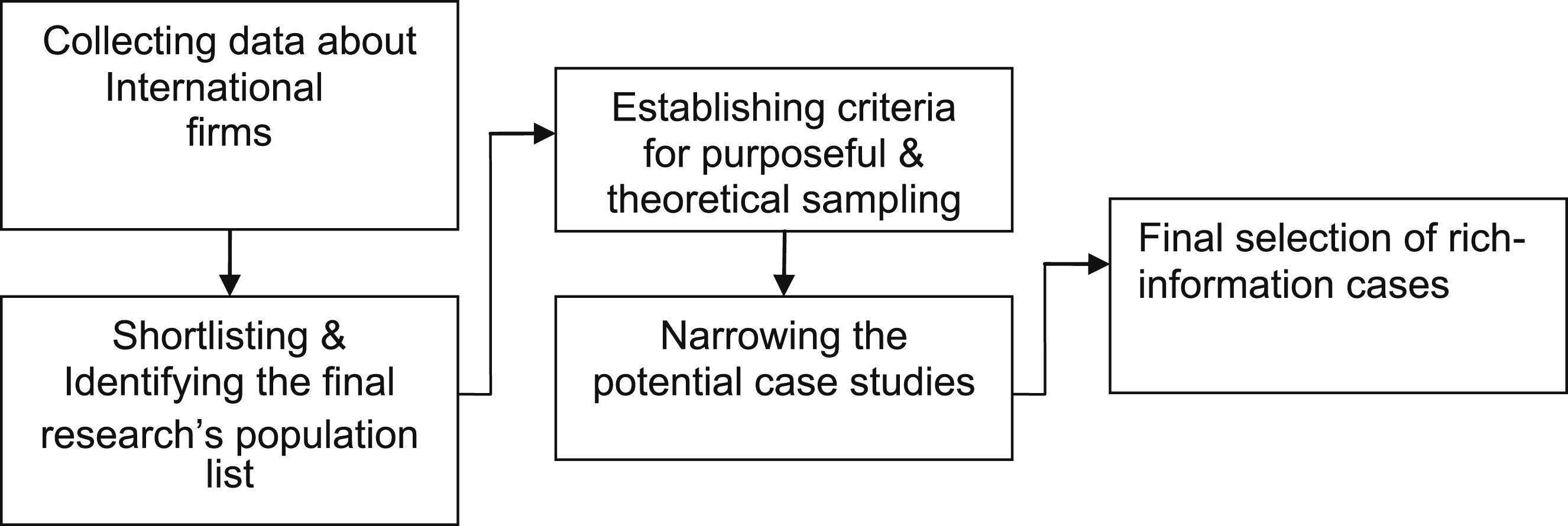
In conclusion, the multiple case design was preferred over the single case design because it provided robust and rigorous grounds for good quality research derived from the triangulation of evidence compared with single case design (Eisenhardt, 1989; Yin, 2003). Further, the evidence abstracted from multiple case research is considered more powerful and more compelling (Herriott & Firestone, 1983) and the approach is a very useful tool to gain insight into all aspects of how an organization addresses complex strategic decision-making (Ulaga & Sharma, 2001). Furthermore, 4 cases were selected in each cross-cultural study. Cases were selected from two different countries and cultures. Further, the selected companies were information-rich, comparative, accessible and small- and medium-size manufacturing and service firms.
Data Collection Methods and Techniques
Case study research can include both qualitative and quantitative data and recent methodologists have identified several techniques of data collection of case study-based research, but it is not necessary to utilize all these methods (Bogdan & Biklen, 1982; Patton, 1990; Yin, 2003). These techniques encompass (1) interviews, (2) questionnaires, (3) archival records, (4) direct observation, (5) participant observation, (6) documentation and (7) physical artifacts. As pointed out by Bogdan and Biklen (1982) interviews can be used either as a major method for data collection in qualitative research or in combination with other sources of data such as document analysis, observation or other techniques. Therefore, the researcher relied on in-depth interviews as a primary data source and method because most of the investigated internationalization decisions of the Arabian and Western firms, were made some time ago hence it was difficult to find documents or archival records related to these decisions in most of the undertaken cases studies, a situation recognized by Mintzberg et al. (1976). As a result, these decision processes were only able to be explored after completion and the researcher, therefore, had to be dependent on supplementary data sources in conjunction with face to-face, in-depth interviews in the research to incorporate the case study database for each single case and mainly triangulate the interview data. In effect, the in-depth interviews were conducted using a semi-structured interview guide because the area of internationalization and foreign market entry decisions is a relatively new area of research and the researcher has good interview skills to manage the interview process effectively (Cavana et al., 2000).
Furthermore, the semi-structured interview technique provides interviewer with more control over time, content, and the sequence of interviews and gives the interviewee some freedom in responding to the questions (Abdeldayem et al., 2021). It also provides opportunities for both interviewer and interviewee to discuss the topics in more detail, allowing the interviewees to freely and fully express their views, beliefs and thoughts (Lofland & Lofland, 1995; Mathers et al., 1998). Moreover, since multiple case studies were conducted and each case study considered as a single experiment (Yin, 2003), the flexibility and elasticity which distinguish semi-structured interviews allowed changing and modifying of interview questions when required to gain rich, reliable, valid and accurate data through directing the interview process and asking the same question in different ways to explain the same issue (Mathers et al., 1998).
Case Study Data Collection Procedures
The data collection procedures for the case study involved two key phases. The first phase began with designing and preparing the case study protocol followed by the collection of field data.
Case Study Protocol
The case study protocol was planned prior to the data collection process and not only included the interview instrument, but also the procedures and actions required to pursue in using the instrument. The case study protocol established the complete data collection process, and it is regarded as a necessary part of the case study research. As suggested by Yin (2003, p. 69), the case study protocol for the research combined four main sections as follows: • An overview of the case study research project (objectives, issues, topics being investigated). • Field procedures (gaining access to sites, sources of information, timetable of data collecting activities). • Case study questions (specific questions that the investigator must keep in mind during data collection). • A guide for case study report (outline, format for the narrative).
Process of Field Data Collection
The data collection process followed the guidelines suggested by Dick (1999): (1) Contact the respondents. (2) Explain the purpose of the research project to respondents. (3) Establish a good unbiased relationship with the respondents. (4) Determine a date, time and venue for the interview course.
At the outset, telephone contact was made with the identified major and most knowledgeable senior managers involved in the internationalization decision. The telephone conversations lasted 5–10 minutes and aimed to explain the purpose of research and interview questions to participants and determine the date, time and venue for the interview sessions. The telephone contacts with the senior managers created a friendly atmosphere between the researcher and the participants and contributed significantly to the success of the interview sessions and the case study field procedures.
Analyzing Case Study Data
Two main stages of analysis are recommended for multiple case study research, that is., within-case analysis and cross case analysis (Eisenhardt, 1989; Yin, 2003). Within-case analysis entails analyzing the collected qualitative and quantitative data of each case study independently after which the researcher concludes the findings about the research issues for each individual case. Yin (2003, pp. 111–115) described three main analytic strategies for within-case study analysis: 1. Relying on the theoretical propositions of the research; 2. Defining and testing rival or contrasting explanations and 3. Developing a detailed description or report for each single case study. Further, Yin (2003) identified the pattern matching technique as one of the most desirable analytic techniques to be used in within-case analysis. The technique entails comparing empirically based patterns with expected or predicted one. Accordingly, both the case study report and pattern matching techniques were employed in the author’s research.
The second stage of data analysis in multiple case study research relates to cross-case analysis which implies searching for cross-case patterns. Eisenhardt (1989, pp. 540–541) suggested three major cross-case analytic strategies. The first is to categorize cases based on certain dimensions and then search for similarities and differences among the group of cases. The second is to choose two cases and list the similarities and differences between them. The final strategy is to break up the data-by-data source such as one researcher works on interview data, while another reviews questionnaire data. In conclusion, within-case and cross-case analyses were carried out in analyzing the data of the current research. Further, the pattern or theme matching was compared with the emerged themes with patterns derived from the literature review. In cross-case analysis, categorizing case studies based on the type of industry such as manufacturing firms vs. service firms and followed by search for similarities and differences among these categories was adopted as an analytic strategy for cross-case pattern.
Analysis of Interview Data

The Quality of Case Study Research Design
Establishing rigor is a crucial element of scientific research in general and of case study research in particular (Miles & Huberman, 1984, 1994; Yin, 2003). Therefore, the author complied with certain established criteria and performed logical assessment during the case study research process to assure the rigor and trustworthiness of the research findings. These coherent tests incorporated validity, reliability and generalization.
Validity
Validity refers to the accuracy and trustworthiness of instruments, data and findings in the research (Bernard, 2000). There are three main types of validity which require to be evaluated in any research, that is, construct, internal and external validity.
Construct Validity
Construct validity refers to establishing correct operational measures for the theoretical concepts being investigated by linking the data collection questions and measures to research questions and hypotheses (Rowley, 2002; Yin, 2003). Construct validity was fulfilled in the current thesis by: (1) designing case study protocol questions and asking questions during the interview sessions which effectively captured a comprehensive and rich understanding about the research main issue relevant to the internationalization and foreign market selection process (Rowley, 2002; Yin, 2003), (2) maintaining the chain of evidence through ensuring the accessibility of the field guide to data collection, the case study notes and providing adequate illustration in the case report to the evidence contained in the database (Bourgeois & Eisenhardt, 1988; Rowley, 2002; Yin, 2003), and finally (3) using multiple sources of evidence (triangulations) such as in-depth interviews, questionnaires and documents (Bourgeois & Eisenhardt, 1988; Rowley, 2002; Yin, 2003).
Internal Validity/Credibility
The terms credibility and internal validity were used interchangeably in the literature (Bryne, 2001) and they imply that the researcher has to ascertain established relationships between dependent and independent variables (Yin, 2003). In point of fact, the internal validity is required and used in explanatory or causal studies and not in the descriptive or exploratory research as was the case in the author’s research (Yin, 2003). However, the author satisfied this criterion by using the pattern-matching through matching and contrasting the emerged themes during the data analysis with the established themes or pattern in the exiting literature reviewed (Bourgeois & Eisenhardt, 1988; Rowley, 2002; Yin, 2003).
Generalization
Overall, generalization/external validity refers to the extent to which the research’s findings can be generalized beyond the immediate case study and applied to other contexts or to other cases of the research entire population (Bryne, 2001; Yin, 2003). Given that “the purpose of the case study is not to represent the world, but to represent the case” (Stake, 1994, p. 245) and case studies have to be selected based on “theoretical sampling‟ and not on “random sampling” as with quantitative research (Eisenhardt, 1989; Glaser & Strauss, 1967; Patton, 1990; Perry, 1998; Yin, 2003), the “analytical generalization” is applied to case study research and not “statistical generalization” as in quantitative research which deals with large randomly selected sample (2003). Analytical generalization means to what extent are the findings of the conducted case studies replicated and constant (Yin, 2003). External validity or generalization was accomplished in the current study by: (1) using replication logic in the multiple case design (Yin, 2003) wherein the findings from the selected cases were replicated (Yin, 2003); (2) adopting the purposeful sampling in selecting the case studies (Patton, 1990), (3) writing information-rich case study description or report for the data of each case study (Bryne, 2001) and finally (4) by the multiple case study design itself.
Reliability
Reliability illustrates to which level the instrument is stable and consistent with measuring the concept to allow repeating the same research using the same method, sample and the data collection produced so as to obtain the same results of those previous study (Sekaran, 1984). Reliability was achieved in the current research by: (1) using case study protocol (Yin, 2003) where all the selected case studies (participating firms) and all participants (informants) were subjected to the same sequence of entry and exit procedures and interview questions (Bourgeois & Eisenhardt, 1988) and (2) intensive documentation of procedures and appropriate recording keeping (Bourgeois & Eisenhardt, 1988; Bryne, 2001; Yin, 2003). Furthermore, collecting the data through in-depth interviews with the most knowledgeable senior managers (informants) who participated in the internationalization decision increases significantly the reliability of the findings of the research (Huber & Power, 1985; Papadakis et al., 1998).
Conclusion Implications and Limitations
Relying on practical reflections, authors shared their past experiences that they gained while conducting case study research. The challenges that were faced by the authors are pointed out in the form of practical solutions. By providing specific examples and experience-based recommendations. As a result, the paper discussed how to design and conduct qualitative case study research in international entrepreneurship using the example of the authors’ previous research on the internationalization process of Arabian and Western firms. This paper makes significant methodological and theoretical contributions through enhancing qualitative case study research in international entrepreneurship by providing a detailed methodology. It offers a practical step-by-step guide for conducting future case studies, contributing to both the methodology and theory of this research area. The paper’s focus is on offering a structured approach to qualitative case study research, which can be particularly useful for novice and early-career researchers and business practitioners exploring the complexities of international entrepreneurship. The paper also has brought to light the advantages of the case study research methodology. Firstly, the multiple case study approach enabled the researcher to bring together the entire vital knowledge and experiences of decision-makers involved in the internationalization process. Secondly, the purposive and theoretical selection of the study cases from among different countries and industries enabled the researcher to compare the findings of these different cases and develop a general model for successful foreign market selection. Finally, the purposive and in-depth interviewing of the most knowledgeable decision-makers provided credible and valuable information about the nature of the international market selection process.
Case study research can produce beneficial insights, but some common mistakes can weaken their success. In other words, when conducting case study research, it is vital to acknowledge limitations like potential biases arising from self-reflection or the lack of triangulation. Self-reflection, while valuable for understanding researcher perspectives, can introduce bias if not carefully managed, as individuals may unconsciously favor information that aligns with their existing beliefs or desired outcomes. Triangulation, involving the use of multiple data sources or methods, helps mitigate bias and enhance the credibility of findings, but its absence can weaken the study’s validity. Another major error is overgeneralization; researchers often draw broad conclusions from a limited number of cases. This can lead to misleading interpretations, as the unique contexts of specific cases may not reflect wider trends. Ensuring an unbiased approach to selecting cases through establishing objective criteria for selecting cases as discussed earlier to ensure representativeness. To counter these missteps, maintain objectivity throughout the entire research process. This can involve the use of a case study protocol and guidelines to analyze data without allowing personal biases to influence findings. In addition, it is important for novice researchers to get appropriate training from experienced researchers in relation to interviewing skills and data analysis of various sources such as interview, field and secondary data. Moreover, being mindful of ethical issues is critical and, thus, researchers must ensure that participant confidentiality and informed consent are prioritized, preventing ethical gaps that could compromise the integrity of the study. By confronting these common drawbacks, researchers can achieve more reliable and fruitful case study research results.
Footnotes
ORCID iD
