







Abstract
Introduction
User needs are increasingly diverse, often leaving existing products unable to meet them. The state of a product refers to its physical structure and spatial relationships with its components when performing specific functions. 1 The mainstream engineering approach is to improve or redesign the product state based on newly identified needs. Although this approach meets current user needs, product development itself is lagging behind. Therefore, by the time the new product is launched, the user’s needs may have further developed. Approximately 80% of a product’s cost is determined during the conceptual design stage, 2 and the success or failure of the conceptual design is a key factor in the product’s market performance. A systematic, standardized conceptual design process can help enterprises develop products that meet market needs.
In product design, pursuing adaptive systems is equally important. Products must constantly change to meet dynamic market needs. This challenge exists in various product domains: mobile phones have evolved from single-function communication devices to multi-purpose smart terminals to cope with dynamic user scenarios. Similarly, agricultural machinery has developed from basic implements to intelligent equipment with automatic control systems. These share a common strategy: enhance a product’s adaptability to dynamic needs through systematic evolution. In this context, dynamic market adaptation refers to a product’s systematic capability to expand its functional states under constantly changing market conditions. Unlike reactive improvements, this approach enables preemptive adaptation during conceptual design, endowing products with inherent flexibility to address forecasted changes in user needs. Therefore, it is necessary to propose a theoretical framework for preemptive adaptation, where a product’s inherent state is systematically expanded during its conceptual design to anticipate and align with forecasted market changes. This approach to designing inherently adaptable products establishes a foundational capability that can seamlessly integrate with operational adaptation strategies, such as those referenced above, opening new opportunities to create truly resilient, market-responsive engineering systems throughout their entire lifecycle.
Many scholars have studied the elements of need, and the need evolution idealization in TRIZ describes the objective development trend of need. 3 The extracted need elements can not only meet users’ current needs but also meet future needs. Extenics provides the formal methodology to enable this forward-looking capability. It is a theory that studies the laws of expansion, which can be used to describe things and elements, as well as to expand them. 4 Since user needs are essentially composed of various elements, they can be systematically described and predicted using extensibility. This implements an active design strategy known as product state expansion. Product state expansion refers to the process of evolving a product’s fundamental physical architecture. The formal forecasting of changes in user needs drives this evolution. This approach can improve existing products to adapt to unexpected new scenarios. Therefore, product state expansion provides an important implementation path for achieving dynamic market adaptation.
Using a company’s existing products as improvement targets facilitates the integration of internal resources and enables rapid design, manufacturing, and commercialization. New needs often require changes to the work environment, target audience, and other aspects that existing products cannot accommodate. The application of TRIZ’s Substance-Field model and 76 standard solution tools can solve these problems.
In general, this article proposes a framework for defining need elements based on the trends of need evolution and standardizes their expression using Extenics. It also establishes extension principles and rules for merging need elements. Finally, it develops a modeling method based on the Substance-Field model and applies standard solutions to derive new product states for emerging needs.
Literature review
General design methodology
Establishing a basic understanding of general design processes is important to find the specific limitations that need to be overcome. This section examines foundational methodologies of modern product design. Product design is divided into four stages: design planning, conceptual design, technical design, and detailed design. The systematic design theory proposed by Pahl and Beitz in the 1970s, also known as P&B theory, detailed the specific steps of the four stages mentioned above and is currently one of the most widely used design models in the field of design,5,6 The “
The entire product development process is included in the above model, and designers can design the product based on the whole process or a part of it. Conceptual design is a key stage in product design. Product design cannot be separated from the support of design methods. The academic community has suggested different conceptual stage design methods, offering a systematic and practical basis for R&D personnel. Mapping functionality to structural layers is a key research direction in conceptual design. Pahl and Beitz view functionality as a black box, defined as the transformation of three streams of material, energy, and information.
The axiomatic design proposed by Suh 8 divides the design space into four domains based on the design sequence: the requirement domain, the functional domain, the structural domain, and the process domain. Each adjacent domain is mapped in a “zigzag” shape to decompose product functions, completing the conceptual design of the product.
Axiomatic design includes two axioms: the independence axiom and the information axiom. The Axiom of Independence emphasizes the independence of functional requirements, which not only helps designers solve functions but also analyzes the functional and structural coupling of the system to optimize design. The Axiom of Information stipulates that, under the premise of satisfying the Axiom of Independence, the design with the smallest information content is the optimal design, and the size of the information content is related to the probability of achieving functional requirements. 9 Axiomatic design can be applied independently or integrated with other theories to assist designers in product development,10,11 and can also be applied to the design of manufacturing systems. 12 Axiomatic design highlights the connection between requirements, functionality, and structure. The direct mapping from functionality to structure can sometimes make it difficult to find a suitable solution. Gero and Kannengiesser 13 proposed the “Function Behavior Structure (F-B-S)” model based on function structure mapping, which considers behavior as a ladder to improve the reliability of mapping from function to structure. Conversely, it can also abstract physical products into functions through behavior. Based on the F-B-S model, several scholars have proposed models such as “function-behavior-state” 14 and “F-B-S” based on environmental constraints,15,16 which have improved the mapping from functions to structural layers.
Quality Function Deployment (QFD) is a quality management method that translates customer needs into different product development stages through the House of Quality (HOQ). Through collaboration among the departments involved at each stage, customer requirements are jointly implemented. HOQ is essentially a correlation matrix, where the roof represents the correlation between two indicators. 17 QFD is often integrated with other design methods to guide the design process. The integration of the Kano model with QFD can help designers better understand users’ actual needs, shorten design time, and enable the simultaneous design of multiple products. 18 To reduce decision-making subjectivity and improve design accuracy, mathematical methods such as fuzzy set theory, grey decision theory, and cumulative prospect theory have been introduced into QFD for the design of traditional and intelligent products.19–23
While QFD, FBS, and Axiomatic Design are powerful in their fields, they still have gaps: they lack the ability to proactively forecast and adapt to evolving market needs. This limitation requires a method to directly integrate predictions into the design process.
TRIZ
In contrast to the general methods, TRIZ is reviewed here for its unique strength in providing systematic patterns for innovation. Its evolutionary trends are particularly relevant to predicting future product states. TRIZ is a set of general principles and objective trends in technological system development, derived from over 2.5 million patents, for solving problems. Its three most important scientific discoveries are: problems and solutions are repeated across different fields; trends in technological system development and evolution are repeated across various fields; effects used to solve problems are repeated across different fields. Based on this, a solution process has been established that can acquire knowledge and experience from other disciplinary fields. Firstly, the domain problem is transformed into a general problem; Then, a universal solution is found in the general knowledge domain; Finally, the general solution is mapped to the domain solution. 24
TRIZ can also be applied beyond conceptual design, such as in the fuzzy front end for idea generation. 25 With the development of computer technology, TRIZ also relies more on modern technological means, such as automatically extracting technological evolution trends from patents, 26 combining with problem-solving networks to improve design efficiency, 27 and combining with fluid dynamics to solve contradictions in fluid dynamics. 28 TRIZ combined with case-based reasoning technology to guide design in both mechanical and non-mechanical fields. 29 After improving the functional model, it can be applied to digital twin modeling 30 and can also solve problems encountered in manufacturing and assembly.31,32 Even when combined with the theory of dominant thinking (OTSM), it can solve non-engineering issues such as supply chain optimization. 33 When combined with patent avoidance strategies, it can bypass competitors, break their monopoly in the market, 34 and be used for the design and development of product service systems. 35
Need is always in a dynamic process of change, and this objective change is called the trends of need evolution, which can be summarized into the following five principles: idealization, dynamism, integration, specialization, and coordination. 36
The powerful solution-generation capabilities of TRIZ are undeniable, it mainly focuses on solving existing technical problems rather than anticipating future need scenarios, which reveals a key gap. This limitation positions TRIZ as an important but incomplete component for accurately adapting to dynamic markets.
Extenics
In order to address the limitations of modeling in TRIZ and general methods, Extenics is introduced as a complementary theoretical foundation designed explicitly for formal modeling and systematic expansion of elements. Extension theory can be used in the field of product design to expand the structure of products and solve the contradictory problems.37,38 The extensible set, 39 extensible logic theory, 40 and extensible primitives 41 are the core parts of Extenics, which mainly focus on the research and application of modeling methods for events, objects, information, relationships, and problems in engineering. The existence of events and objects is dynamic, and they have oppositional and systematic characteristics. Conjugate analysis of product structure can be conducted based on these characteristics. 42 The basic element model in Extenics consists of three elements: object, feature, and feature value. It can be expressed as follows:

Among them,

The construction of the basic element model provides a formal modeling foundation for extension studies and offers usable models for quantitative and qualitative analysis of objects. 43
The combination of Extenics and the analytic hierarchy process entropy weight method has formed a decision-making method for heavy-duty machine tools, which reduces ambiguity in the process. 44 The material elements and their hierarchical relationships in the state evaluation of transformer valve side bushings can also be used to construct qualitative and quantitative analysis methods using extension theory. 45 The combination of standard solutions and causal analysis modules with Extenics can reduce the complexity of the design process.46,47 The field of integration between TRIZ and Extenics has undergone in-depth exploration, spanning from theory to practice. Research has not only fundamentally demonstrated the intrinsic connection between Extenics and TRIZ, which provides formal theoretical support for TRIZ, 48 but also developed an effective integration application process based on this. Its effectiveness has been verified in engineering cases such as the innovation of grinding equipment for disk castings, 49 which improved the efficiency and superiority of solving contradicting problems.
Extenics provides a tool for modeling and expanding need elements that are missing in general design methods and TRIZ. However, its theoretical expansion principles need to be combined with solution generation tools to form a complete adaptive design method.
Research gap
The review of established design methods reveals a result that, although each method is valuable in its field, there are certain limitations in adapting to a dynamic market. The general methods offer systematic processes but treat user needs as static inputs. TRIZ offers solution patterns and evolutionary trends, but lacks tools for need modeling and expansion. Extenics offers a formal tool for need element expansion, but it is still disconnected from problem solving of actual technical problems.
This reveals a key gap. The challenge lies in the lack of a closed-loop framework that links need forecasting with design implementation. The previous method integration often involved simple combinations rather than theoretical synthesis.
This research fills this gap through an integrated TRIZ-Extenics framework that creates new methodological capabilities. A closed-loop process was established by embedding formal extension operations of Extenics into TRIZ logic. This is not just a simple combination of tools, but creates a workflow. This workflow expands need contexts, transforms them into technical problems through Substance-Field modeling, and uses TRIZ’s standard solutions to solve.
The resulting methodology provides a foundation for product state expansion, linking need forecasting with technological implementation, which cannot be provided by independent methods. This provides operational tools and structured methods for designers to meet the challenges of dynamic market adaptation.
Proposed method
Structured expression method of needs
The concept of heterogeneous needs addresses the diversity in different usage scenarios of the product. The evolution of product needs is fundamentally driven by the pursuit of higher ideality, as captured by TRIZ’s Trends of Need Evolution. 36 This pursuit is reflected through predictable changes in a product’s operational context, which can be described by four fundamental related elements: Subject (different user groups), Object (different operational targets), Time (different time backgrounds), and Location (different environmental conditions).
The Subject element defines the user. Evolution has expanded or specialized the user group, for example, from professional farmers to agricultural cooperatives or hobbyists, thereby driving new requirements for usability or safety.
The Object element defines the target of the product’s function. Evolution has expanded or specialized this target, as seen in a sprayer designed for rice evolving to handle wheat and corn, or specializing from general spraying to targeted seedling transplantation.
The Time element defines the temporal scope of utility. Evolution has expanded this scope, enabling a product used only during a spraying season to become useful during sowing or harvest seasons.
The location element defines the environmental scope of operation. Evolution has expanded this scope, allowing the operation to expand from flat paddy fields to sloped orchards or public roads.
The acquisition of these four related elements and the TRIZ trends of need evolution provide an important starting point for expansion. The elements of subject and object are driven by the trend of ideality, as the pursuit of a more ideal system often involves expanding the user base and the targets of the product’s function. The elements of time and location are driven by the trend of dynamization, which emphasizes the evolution of systems towards greater flexibility and adaptability in their timeline and environment. 36 While other trends, such as integration, specialization, and coordination, can influence the core need elements, the framework prioritizes ideality and dynamization for defining the initial contextual boundaries. This makes forecasting future needs by anticipating the systematic evolution of these four contextual dimensions. So, needs must be structured. The elements of need are divided into two categories: core need elements and related need elements. Core need elements refer to specific requirements for the product itself, including functionality, quality, performance, appearance, economy, and other aspects. And the related need elements refer to the requirements for the relevant factors—Subject, Object, Time, Location—when the product undergoes external interaction. This structured model is conceptualized in Figure 1.

Related elements from the trends of need evolution.
The related elements of need include the subject of the need and all external factors of the corresponding product, which influence and even determine the core elements of the need. The subject is different, and the core elements are also different. Customer groups have certain subjective emotions towards product functionality, quality, performance, appearance, and economy, which lead to different requirements for products among different groups. Similarly, the different objective conditions, such as the object, time, and location of the product, may result in different product states. Therefore, the expression of need should include the subject, object, time, location, and core elements. Referring to the definition of basic element model in Extenics, 42 the expression of need is as follows:
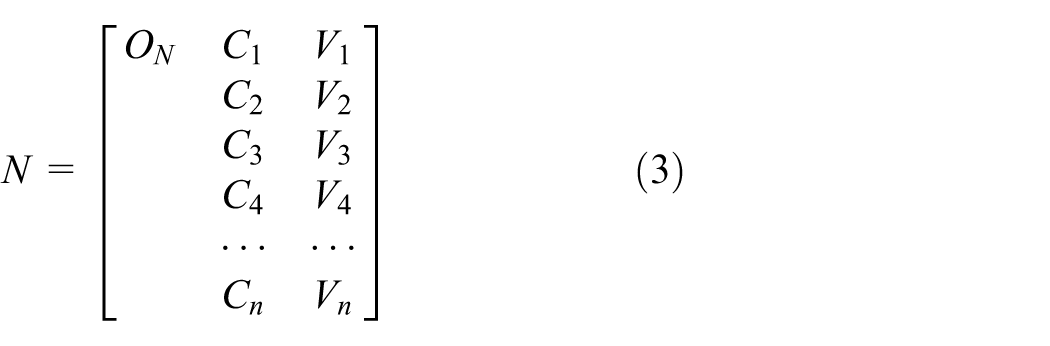
Where
The predicted need can be transformed into a product state through product design activities, achieving product state expansion. In the related elements of need, the subject is subjectively determined by the enterprise based on market conditions. The object, time, and location are objective conditions of need, and their choices are also influenced by the need subject. Therefore, when analyzing the objective related elements such as the object, time, and location, the possibility of the subjective emotion of the subject should be considered. The subject of need refers to the owners and users of the product, that is, the enterprise itself or the sales and usage objects after producing the product. The object elements of need refer to the object of action of the product when meeting specific needs. The product is the physical carrier that realizes the need and can change or maintain the parameters of the object. The time element of need refers to the specific stage in the object’s lifecycle when the product acts on the object. The lifecycle of an object refers to the entire process of its connection with the outside world. The location element of need refers to the space in which the product is located, and the impact of spatial factors on the product varies depending on the space in which the product is located.
Expansion method of related elements
After the subject, object, time, and location are determined, the core elements of the needs are also determined. So, the key step in need forecasting is to expand the possible related elements along the trajectories defined by TRIZ’s Trends of Need Evolution. To this end, six formal expansion principles derived from Extenics theory have been adaptively modified and introduced, providing a mathematical basis for generating potential variations. These principles are not applied arbitrarily; their application is strategically guided to explore how the related elements (Subject, Object, Time, Location) can evolve to manifest more ideal, dynamic, integrated, or specialized systems, as forecast by TRIZ. The specific implementation method of need forecasting is based on expanding the related elements. As shown in Figure 2.

Needs forecasting based on the expansion of related elements.
The elements and feature values related to need can be expressed in the form of a basic element model, which still has decomposability. For instance, if the object element of the need is a person, its features may include height, weight, language, health status, etc. Therefore, each element within the need can also be expressed in the form of a basic element model as follows:

Where
The extension principles adopted in this framework represent an adaptive application of Extenics. While these principles share conceptual foundations with Extenics, they have been refined to explore how need elements evolve in the product design environment. This enables abstract need evolution trends to be transformed into concrete and actionable need scenarios, thereby expanding the product state. The expansion principle helps to explore potential changes in the four related need elements. The six expansion principles of need related elements are as follows.
Principle 1: Multi-dimensional need element expansion
This principle supports the development of multiple product states by enriching individual need elements with multiple feature dimensions. It maintains core element identity while enabling comprehensive requirement specification through systematic feature diversification. As shown in the following:

For example, an electric vehicle’s charging system, this principle identifies distinct charging features including power requirements, connector specifications, and charging speeds, supporting the development of multiple product variants.
Principle 2: Cross-element need feature transfer
This principle achieves unified product development by determining how needed features are applied to different need elements. It establishes consistent design standards throughout the product architecture through systematic feature transfer. As shown in the following:

For example, in medical device design, safety requirements defined for operational functions extend to data management systems, user authentication processes, and maintenance procedures.
Principle 3: Need feature value analysis
This principle facilitates product state variation by investigating acceptable value ranges for need features. It defines performance boundaries and operational thresholds through systematic value spectrum exploration. As shown in the following:

For example, in smart home climate systems, the operating temperature range expands from the basic 18°C–26°C to include 16°C–18°C for energy savings and 26°C–28°C for rapid heating scenarios.
Principle 4: Need specification elaboration
This principle improves product state definition by adding more features to the needed elements. It develops precise need profiles through feature accumulation and integration. As shown in the following:

For example, video conferencing systems evolve from basic resolution requirements to include frame rate stability, bandwidth efficiency, latency tolerance, and background processing capabilities.
Principle 5: Strategic need element consolidation
This principle simplifies the need architecture by integrating relevant need elements while retaining basic features. As shown in the following:

For example, audio performance requirements encompassing frequency response, distortion rates, and dynamic range consolidate into integrated acoustic quality needs.
Principle 6: Focused need element simplification
This principle supports targeted product development by identifying and retaining critical features for specific contexts. It enables need optimization through strategic feature prioritization. As shown in the following:

For example, emergency equipment design focuses on deployment speed and operational reliability, and these key needs will take priority over secondary needs.
The need expansion process described so far assumes that future changes can be defined with certainty. However, forecasting real-world market needs inherently involves uncertainty. To make this method more robust, it can be expanded to formally account for this uncertainty using probabilistic and fuzzy reasoning.
The approach is to consider the feature value

Where
In probabilistic forecasting,
In fuzzy forecasting,
It is not a simple list of possibilities, but rather generates a risk-aware prediction that designers can rank scenarios based on probability or reasonableness. This provides a quantitative basis for determining which product states to develop first, ensuring that resources are invested in the most promising and possible directions.
The selection of the six expansion principles is not a simple subjective process. This process requires specific quantifiable selection guidelines that define triggering conditions. When the relevant conditions are met, the relevant principles will be recommended. Designers can use it as a reference to decide what principles to use. The guidelines for selecting extension principles is shown in Table 1.
Guidelines for selecting extension principles based on need element states.

It must be noted that the quantified judgment values are only suggestions for assisting decision-making. Designers should make adaptive adjustments based on specific design scenarios. By using this guide, designers can objectively choose the most suitable extension principles.
The six expansion principles are applied to the four related need elements to systematically explore how they could evolve towards more ideal states, as guided by the trends of need evolution. This process transforms the abstract goal of “ideality increase” into concrete, actionable need scenarios.
By applying the above principles, the expanded need subject, object, time, and location elements can be obtained. And there may be correlation, implication, and composability relationships between the internal elements of each type of expanded element set. Analyze whether there are three types of relationships among the elements, and use different operations such as merge, delete, add, etc., according to the different relationships. The specific meanings and operating rules of the three types of relationships are as follows.
If the features of elements

If the features of element

If the features of element

If the features of element


Different element relationships correspond to different operational strategies, as shown in Table 2.
Operation strategies.

This relationship analysis provides the first mechanism for the resolution of contradictions. When the expansion of need elements leads to contradictory or redundant possibilities, the operations in Table 2 guide the designer to merge or delete them. This step ensures the final set of needs is coherent and feasible before the design process begins.
Merge different types of related elements to obtain a related need set. Then infer the core elements of the need. Formulate new needs to complete need forecasting. Changes in need factors can alter the usage environment and object of existing products, leading to product state inability to meet new needs. This is mainly reflected in the relationship between the environment and the product, as well as the relationship between the product and the object.
Design method for the new state of the product
Changes in need can lead to harmful or insufficient effects between the product and the usage environment and object. Mapping the relationship between needs in the user domain and the product domain, as shown in Figure 3.

Mapping relationship between needs in the user domain and the product domain.
The integration of TRIZ’s problem-solving tools is the critical step that transforms the output of need expansion into actionable design directives. While Extenics excels at predicting what new needs might emerge, it does not prescribe how to technically fulfill them. The Substance-Field Model serves as this translation mechanism. It provides a formal language to model the unexpected effects that arise when an existing product is placed into a new scenario defined by the expanded need elements. Thus, the integration tangibly enhances the process by ensuring that need forecasting is inherently linked to feasible engineering innovation.
The Substance-Field Model can be used to express function, that is, the interaction between two substances. There are interactions between product components, the product usage environment, and the product object. After the expansion of the need related elements, the subject of the need has put forward different requirements for the product’s usage environment and object, which may lead to unexpected effects between product components, usage environment, and object, such as insufficient effects and harmful effects. These effects can be expressed using the Substance-Field Model, and different standard solutions can be selected based on different models to improve these effects. Therefore, the process of designing new states of products is divided into five steps: analyzing problems, constructing problem models, conceptual solving, specific solution solving, and new state designing.
The selection of an appropriate standard solution is a structured reasoning process based on the specific problem context. The initial classification (e.g., choosing Class 1.1 for an insufficient effect) provides a directed subset of potential solutions. Subsequently, multiple conceptual solutions from the relevant TRIZ classes are evaluated against a set of criteria to select the most appropriate one. This ensures the selection is objective and repeatable.
For example, an insufficient effect would lead the designer to consult Class 1.1 (Improving System Completeness with Minimal Change: 1.1.1–1.1.8). Several solutions from this class might seem initially plausible. A structured evaluation is then performed. If the problem is a harmful effect, the designer is directed to Class 1.2 (Elimination of Harmful Effects: 1.2.1–1.2.5) and follows the same evaluative process.
It should be emphasized that in the specific approach provided by the standard solution here, careful consideration should be given when it comes to the deletion and replacement of environmental factors and target factors. Both are objective conditions in the current design scenario and are difficult to easily delete in most cases.
Multiple conceptual solutions from the relevant TRIZ classes are evaluated against the criteria outlined in Table 3 (Feasibility, System Change, and Predicted Ideality Impact). For example, if several Class 1.2 solutions are proposed, they are compared based on their potential to eliminate the harm with minimal complexity and maximum feasibility. This structured evaluation ensures the selected solution is not only theoretically sound but also practically superior.
Systematic mapping of problem contexts to TRIZ standard solution classes and evaluation criteria.

It is also at this stage that inherent technical contradictions are resolved. A technical contradiction arises when improving one parameter causes another to worsen. To solve this, the designer should apply classic TRIZ tools, specifically the contradiction matrix and the corresponding inventive principles. This two stage process, refining needs first and then solving technical contradictions, ensures a systematic path from expanded market requirements to practical design solutions.
The process of designing the new state of the product is shown in Figure 4.

Design process of new product state.
The unexpected effects between existing products and need factors can be improved by applying the above process. Furthermore, the product state can also be expanded.
Process of the integrated product state expansion method
The overall process of the proposed method, integrating need expansion and product state design, is summarized in Figure 5, which provides a visual overview of the workflow from sections “Structured expression method of needs” to “Design method for the new state of the product.” This flowchart highlights the key stages and essential evaluation points that ensure the practical applicability of the generated solutions.

Flowchart of the integrated product state expansion method.
The flowchart illustrates the complete process: (1) the formal expression of needs based on Extenics, (2) the systematic expansion of related need elements, (3) the analysis of new scenarios and problem identification, (4) the application of TRIZ’s Substance-Field analysis and standard solutions with solution evaluation, and (5) the final implementation of the adapted product state.
Towards a computational design support system
The proposed method, as outlined in sections “Structured expression method of needs” to “Process of the integrated product state expansion method,” is built upon formal models and explicit rules, which makes it inherently suitable for partial or full automation. This structured nature provides a direct pathway for implementing the methodology within a computational design support system, a key direction for future scalability.
The core elements for such a system are already embedded in our framework. The basic-element model of needs (section “Structured expression method of needs”) provides a standardized schema for representing need information. The expansion principles and rules (section “Expansion method of related elements”) offer a clear set of logical operations that can be codified into a rule engine. The mapping from needs to problems and the TRIZ solution patterns (section “Design method for the new state of the product”) establishes a retrievable knowledge base of problem-solution mappings.
This framework can be operationalized through an ontology-based or knowledge-graph-driven architecture. Need elements, product components, and TRIZ resources would be defined as entities within an ontology. The expansion and transformation rules would be implemented as inference rules. A reasoning engine could then automate the need expansion process and suggest relevant TRIZ solution patterns for identified problems, significantly accelerating the design process.
The structured output from this automated workflow offers a significant opportunity: it can be directly fed into a digital twin of the product. The components and their interactions, which are formally defined in the final Substance-Field model, provide the necessary blueprint. This connection would allow designers to not just generate innovative concepts, but also to observe and evaluate how these expanded product states would perform under a wide range of simulated, real-world conditions. It bridges the gap between conceptual innovation and engineering validation.
This method may be applied to large-scale software driven product development. It can create an integrated environment where automated concept generation, real-time simulation based validation, and quantitative decision support can work together, as shown in Figure 6.

Conceptual architecture for a computational design support system based on the integrated TRIZ-Extenics framework.
The architecture comprises three main layers: A Central Knowledge Base at the core, containing a Domain Ontology for structured concepts and a Rule Engine encoding the methodology’s logic. An Automated Workflow where initial needs are systematically expanded via Extenics principles, transformed into problem models (Substance-Field models), and solved by TRIZ solutions, with each step interacting with the Knowledge Base. Extension Interfaces that allow the generated solutions to be validated in a Digital Twin environment or refined using Multi-Objective Optimization algorithms, ensuring the framework’s scalability and practical applicability for complex, software-driven products.
Case study
Design of a boom sprayer
This case study serves to concretely demonstrate the concept of dynamic market adaptation in practice. A boom sprayer is a small-scale automatic plant protection machine used for spraying pesticides. It has high spraying efficiency, high safety, and average spraying volume, and has been widely used in Europe, America, and many regions in China. The expansion of its states from a single-purpose device to multiple configurations exemplifies how the method enables dynamic adaptation to diverse market needs. At present, most of the common boom sprayers are self-propelled. There is no need to obtain pesticides from outside the equipment during operation. The boom sprayer needs to load pesticides at the designated place, travel to the operation site to spray pesticides, and return to the designated place after the pesticides are exhausted or the spraying operation is completed. The commonly used boom sprayer for paddy fields is shown in Figure 7. 50

The general boom sprayer.
According to the design problem and background of the boom sprayer, the need model of the boom sprayer in the current use scenario is constructed. The owner and user are farmers, so it is determined that the subject of the need is farmers, and the object is rice. The general boom sprayer is mainly used in the stage of spraying pesticides during the growth of rice, so the need time is the spraying period, and the current product work place is paddy field, so it can be determined that the need place is the paddy field, so it is determined that the need related elements of the general boom sprayer are determined, as shown in follows:

The expression of the subject, object, time, and location elements is shown in equations (19)–(22).


According to the six principles of element expansion, the four related elements of existing needs can be expanded. By analyzing the relationships between the expanded elements of the same type and adopting corresponding operational strategies, the expanded related elements can be obtained. As shown in Table 4.
Expanded need related elements.

The set of related elements is merged, and a new set of needs is obtained. The change in subject has not had a significant impact on other elements. The change in the subject is no longer distinguished. During the process of merging objects and locations, it was found that rice does not grow in dry fields, and similarly, corn, soybeans, and cotton do not grow in paddy fields. This repulsive relationship should be considered in the process of generating need sets. In addition, when the location element of the need is on the road, the type of objects and the growth cycle are not important. Therefore, the state of walking on an expressway can meet the needs generated by all element sets. As shown in Table 5.
Expanded need set.

The function model of the general boom sprayer is constructed as shown in Figure 8.

Functional model of the general boom sprayer.
The general boom sprayer performing functions in the environment of need 21 may have unexpected harmful effects that interfere with normal function, as shown in Figure 9.

Functional model of the general boom sprayer in the use environment of need 21.
The harmful effect of wheel
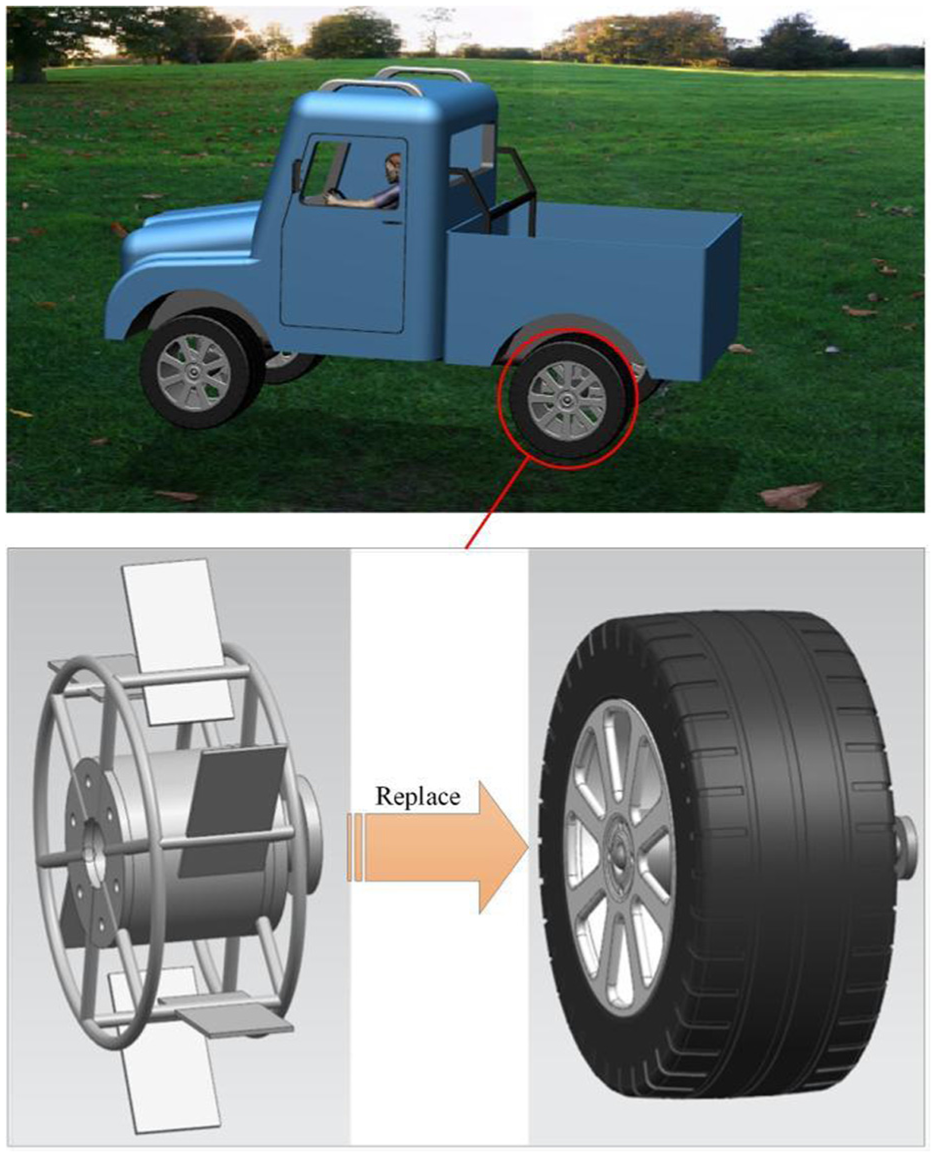
New product state of need 21.
The general boom sprayer performing functions in the environment of need 3 may have unexpected, insufficient effects that interfere with normal function, as shown in Figure 11.

Functional model of the general boom sprayer in the use environment of need 3.
As the object of the general boom sprayer, seedlings cannot be affected by existing systems. At this point, the Substance-Field Model in which the seedlings are located is incomplete. By searching for the standard solution, it was found that this situation applies to the Class 1 standard solution. Standard solution No. 1 is explained as: when the system has only one substance
Consider adding a transplanting mechanism to the existing system. The proposed method requires the evaluation of multiple solutions. For this problem, two different concepts were developed and compared. The first concept was to add a new, dedicated transplanting unit. The second concept was to modify the existing spray mechanism to also perform transplanting. A structured comparison was made using the evaluation criteria from our method. The results are shown in Table 6.
Comparison of solution concepts for need 3.

Solution A was selected because it was better in every category. It is easier to build, safer for the current design, and performs better. This shows our method helps select the strongest solution through clear comparison. The new design is shown in Figure 12.

New product state of need 3.
The above methods can be used to achieve state expansion in other need scenarios. The application of the six expansion principles in this case successfully generated a wide spectrum of novel need scenarios (e.g., operation on highways, action on seedlings). This demonstrates the principles’ efficacy in operationalizing TRIZ’s evolutionary trends by systematically expanding the related need elements. The subsequent design of feasible product states for selected scenarios (Needs 21 and 3) further validates that the output of this expansion process is not merely theoretical but directly actionable for product innovation.
The general boom sprayer represents a baseline model with a singular design state, optimized only for its original scenario. The new product states for Need 21 and 3 are not mere modifications; they constitute a state expansion that enables the product platform to adapt to heterogeneous and evolving market demands. This transition from a single-state to a multi-state product Series is the core outcome of the proposed method.
Evaluation of design results
This section evaluates the newly generated product states using the TRIZ ideality metric. The assessment compares the new product states for Need 21 and 3 with the original boom sprayer operating in the same non-native scenarios. This comparison provides a quantitative measure of the performance improvement achieved by the proposed design modifications.
The quality of a design result can be evaluated based on its level of idealization. The higher the degree of idealization, the better the result. Conversely, it indicates that the result still needs improvement. By comparing the degree of idealization between the design result and existing products, the quality of the result can be assessed. The calculation method for the degree of idealization is shown in equation (23). 51

Where ∑
The functional value of components in the product can be calculated by the computer-aided innovation software TechOptimizer (version 3.0), which can be used to measure ∑
Rules for functional rank definition and calculation in TechOptimizer.

Based on these rules, the functional models of the product states were analyzed. The total useful functional value
The quotation for typical paddy field sprayer equipment ranges from 1600 to 28,000 yuan, with functional values distributed from 21 to 110. The functional values and product selling prices are standardized according to equation (24). 52

Where
Useful function, harmful function, cost, and idealization.

The results clearly show that the new product state for Need 21 achieves an ideality of 0.8, a significant improvement over the 0.33 ideality of the original product operating in the same scenario. Similarly, the state for Need 3 reaches an ideality of 0.32, compared to the original 0.08. The ideality improvements result from specific design changes. For Need 21, the increased ideality comes from eliminating the harmful effect of metal wheels on paved roads through the addition of pneumatic tires and removing the obstructive spray lance. For Need 3, the improvement comes from adding a dedicated transplanting mechanism that provides a previously missing useful function. These modifications directly address the limitations identified in the problem models. This improvement also yields superior adaptability, enabling effective operation in novel scenarios without incurring disproportionate cost increases, particularly when compared to the baseline model operating beyond its intended design scope.
Evaluation of proposed methods
To verify the effectiveness of the method, five scientific researchers with a background in design methodology research were organized to evaluate the process uncertainty (PU), method operability (MO), extension innovation degree (EID), and output value (OV) of the proposed design method compared to other design methods. The specific explanations of the evaluation indicators are shown in Table 9.
Meaning of evaluation indicators.

Using the proposed method has generated 21 new needs in section “Design of a boom sprayer.” Using System Dynamics Modeling, Scenario-Based Design, QFD, Product platform design, and Axiomatic design, 8, 15, 10, 9, and 12 needs were generated respectively. According to equation (25), the above 6 values can be normalized to between 1 and 5.

The normalized EIDs are 5, 1, 3.2, 1.6, 1.3, and 2.2 respectively.
For the calculation of indicators PU, MO, and OV. Five researchers were instructed to apply the methods to improve the design of the boom sprayer, and were required to fill out a system usability scale based on the design results. The system usability scale is shown in Table 10.
The system usability scale.

The calculation of the degree of idealization in equations (23) is introduced to quantitatively evaluate methods, Where ∑
The comprehensive method evaluation data.


Radar chart of comprehensive method evaluation results.
In terms of process uncertainty, the proposed method scored the lowest, indicating that structured method can reduce the ambiguity of the design process. In terms of method operability, proposed method is close to the other five methods. This is mainly because the other five methods have simpler steps compared to the proposed method. However, with the development of subsequent automation software, this difference will be narrowed. In terms of extension innovation degree, the proposed method obtained 21 needs, significantly more than other methods, indicating its strong ability to explore new need spaces. In terms of output value, the proposed method received the highest rating, indicating that it is considered capable of obtaining high value solutions. In terms of the degree of idealization of the method, the proposed method has significant overall advantages compared to other methods.
This comprehensive evaluation includes both expert qualitative assessment and objective quantitative indicators, indicating that the proposed method provides a more systematic, predictable, and effective method for product innovation in dynamic market.
Conclusions and discussion
This study introduces a need forecasting and product state design method synergizing TRIZ and Extenics, laying a theoretical foundation and actionable strategies for product improvement in constantly changing need scenarios. A significant challenge in this research was the non-trivial integration of these two distinct theoretical paradigms into one workflow and establishing a robust mapping between the extended need elements and problem-solving tools. The combination of TRIZ’s evolution trends and Extenics’ structured modeling not only expands the knowledge of problem-solving, but also makes the innovation process more systematic. The main contribution of this study includes:
A structured need model enabling systematic identification and expansion of user needs.
A cross-theoretical framework linking TRIZ’s technical solutions (e.g., Substance-Field Analysis) with Extenics’ expansion principles.
The case study of the boom sprayer verifies the effectiveness of this method in transforming need evolution into design improvement.
The proposed method has strong scalability. It is not only suitable for simple mechanical products, but also for complex systems such as mechatronics products. The structured need model is a scalable framework to decompose and organize dynamic market needs into manageable elements.
However, this method also has certain limitations. These limitations provide direction for the necessity of future work. Developing AI assisted tools for automated extension and evaluation will greatly enhance the industrial applicability of this method. Transforming the integrated TRIZ-Extenics framework into an ontology based computational design support system can reduce design complexity. Strengthening decision-making requires going beyond qualitative evaluation. Integrating Multi-Objective Optimization algorithms represents a logical next step. Using the ideality metric as a foundation, techniques such as NSGA-II can identify Pareto-optimal solutions, providing a quantitative and clearer basis for balancing functionality, cost, and adaptability. The proposed product states require more complex validation methods. Developing high-fidelity digital twins would enable comprehensive virtual testing in various conditions. Engineering analyses, such as structural and fluid dynamics simulations, could verify the performance and robustness of key components like the modified chassis and transplanting mechanism. Integrating this method with agile and iterative methodologies could ensure relevance to modern development environments. Adjusting the framework will align the methods with dynamic market needs and address integration issues with iterative design. Further work can enhance the ability to predict real-time markets. Finally, applying this method to software intensive products and other fields can promote its applicability.
Footnotes
Handling Editor: Chenhui Liang


Funding
The authors disclosed receipt of the following financial support for the research, authorship, and/or publication of this article: This research is funded by Science Research Project of Hebei Education Department (QN2024284), and the Innovation Capacity Enhancement Project of XingTai (2023ZZ094, 2023ZZ099), China.
Declaration of conflicting interests
The authors declared no potential conflicts of interest with respect to the research, authorship, and/or publication of this article.