







Abstract
Introduction
Symmetry is a common phenomenon in the world, with wide existence in various natural systems and artificial systems. Both natural systems, such as mountains, rivers, birds, and animals, and artificial systems, such as buildings, bridges, airplanes, and motorcars, have symmetry. Due to its important effects, symmetry is researched in biology, 1 physics, 2 philosophy, 3 mathematics, 4 computer science, 5 architecture, 6 and so on. The studies of symmetry in above fields show that symmetry is widely existent and has close relationships with system functions. As reference, the study of symmetry in other fields is very useful for mechanical symmetry research.
In mechanical systems, symmetry is also a common phenomenon. From abstract functions to specific structures, from large systems to small standard parts, symmetric properties can be observed. In all kinds of mechanical symmetries, structure symmetry is the most common form, which is important to realize the function, improve the performance, and satisfy the restriction of the mechanical products. For example, in a clamp as shown in Figure 1, there are two sets of fix spots (3) translation symmetrically located on the pole (4). When clamping jaws ((1) and (2)) are fixed on different spots, the clamp can grasp materials with different sizes, which results in the conclusion that the performance range of the clamp is extended by the translation symmetric structure. In a guide mechanism as shown in Figure 2, two sector gears and poles (AC and BC) have a mirror symmetry, which leads point C to facilitate the vertical linear motion. In a feedway as shown in Figure 3, the rotation–translation symmetric lamina can carry materials from spot “a” to “b.” In mechanical structure design, reasonable application of structure symmetry can help to better realize design requirements and improve the technical, economic, and social performance of the mechanical products.

A clamp.

A guide mechanism.

A feedway.
How to scientifically apply structure symmetry in mechanical design? Here is a good solution that by establishing design knowledge and abstracting application rules, the application of structure symmetry can be facilitated. There are plenty of design knowledge in design instances. Using the technology of knowledge discovery, useful design knowledge can be developed from design instances. Therefore, we collected and analyzed more than 1000 mechanical structure design instances. Based on these instances, we established a standardized instance database, mined association rules from the database, analyzed and abstracted the mining results, and proposed the design knowledge of structure symmetry in realizing design requirements (including functions, performances, and restrictions). The proposed design knowledge can guide the application of structure symmetry in mechanical design.
Related works
Mechanical structure symmetry
The earliest systemic research of mechanical symmetry was proposed by Barrenscheen, 7 who studied the existent type, functions, and application methods of structure symmetry. From 2006, Feng and colleagues8,9 began to do further systemic research on mechanical symmetry, built a whole concept system of mechanical symmetry, and researched the existence, expression, and application of function symmetry, structure symmetry, and technology symmetry.10–12 Besides systemic research, many people carried out the research on some specific symmetry. Zhu et al. 13 proposed a machining method aiming at large symmetric free-form surface using symmetric knife tools and the experiments show that this method is very effective. Prasadj et al. 14 built an estimation method of machining errors using the concept of cyclic symmetry, which can availably reduce the machining errors. Tate et al. 15 researched the detection method of symmetric structure in proactive design for assembly and they pointed out that the symmetry degree of assembly parts is an important factor which can impact the level of assembly complexity. Li et al. 16 established a method for detecting component boundary in computer-aided design (CAD) by combining the symmetry information and function information together.
Knowledge discovery in database
Knowledge discovery in database is used for mining “interesting” knowledge from databases. The research of knowledge discovery began in 1980s; Fayyad et al. 17 pointed out that knowledge discovery is a nontrivial process of identifying valid, novel, potentially useful, and ultimately understandable patterns in data. Knowledge discovery includes the following steps: data preparation, data mining, pattern evaluation and presentation, knowledge application, and knowledge maintenance. In all the steps, data mining is a core process. 18 With the continuous development of knowledge discovery, it is applied in more and more domains, such as medical science, biology, and business. Horev-Azaria et al. 19 adopted knowledge discovery to research the performance of cobalt-ferrite nanoparticles in different cellular models. Liekens et al. 20 built a knowledge discovery platform to explore and discover the biomedical information and achieved many progresses. Trappey et al. 21 mined consumer dialogs using text mining technology to acquire customer satisfaction and dissatisfaction. Kusiak 22 adopted different data mining algorithms to mine the rules from manufacturing data to support decision-making processes. Liao et al. 23 obtained the product map with the relationships among customer demands, product characteristics, and transaction records by mining association rules from product database.
Object of knowledge discovery
Mechanical design mainly includes two processes: conceptual design and technological design. 24 The input of conceptual design is the design requirements, and the output is the structure scheme. Structure is used for realizing design requirements, which can be divided into function, performance, and restriction. In conceptual design, the function, performance, and restriction are uniformly described as “function.” There are many mapping models from function to structure, such as function–structure (FS), 25 function–effect–structure (FES), 24 and function–behavior–structure (FBS). 26 Pahl and Beitz established a set of structure design principles, which are used for designing better structure to realize functions. The principles can also be used in the mapping model from function to structure. In this article, the proposed design knowledge is based on two mapping models, such as FS and function–structure design principles–structure (FPS), as shown in Figure 4:
The design knowledge based on FS: it is used for describing what design requirements can be realized by certain structure symmetry. This kind of design knowledge can be described as the association rules of “structure symmetry ⇒ design requirements.”
The design knowledge based on FPS: it is used for describing what structure design principles can be realized by certain structure symmetry and what design requirements can be realized by certain structure design principle. This kind of design knowledge can be described as three association rules, including “structure symmetry ⇒ structure design principle,” “structure design principle ⇒ design requirements,” and “structure symmetry ⇒ structure design principle, design requirements.”

Mapping models from function to structure.
According to the above design knowledge, we adopted the technology of knowledge discovery to mine association rules from the design instance database and the results were the association rules among symmetry structure, structure design principle, and design requirements. By analyzing, summarizing, and abstracting the mining results, we proposed the design knowledge of structure symmetry in implementing design requirements. The proposed design knowledge can guide the application of structure symmetry and help to improve the technical, economic, and social performance of the mechanical products. The system framework is shown in Figure 5.

System framework.
Knowledge discovery from symmetry instances
Process of knowledge discovery
Based on the common steps of knowledge discovery, the process of knowledge discovery from design instance database is designed as follows:
Instance collection: to collect enough mechanical structure symmetry design instances. To the practicability and universality of the mining results, the collected instances should be typical and comprehensive.
Instance standardized analysis: to analyze the information of the instances, such as the symmetric structure, design requirements, structure design principles, and achievement effect. For the unification of the mining results, standardized systems of structure symmetry, design requirements, and structure design principles should be built to unify the analysis.
Database establishment: to design the structure of database and store the analysis result of instances into database. A suitable database structure is necessary for data mining.
Association rule mining: according to the mining objects shown in section “Object of knowledge discovery,” to mine association rules from instance database using association rule mining algorithm.
Association rule analysis and evaluation: to analyze the mining results and eliminate the unpractical and un-universal results.
Design knowledge establishment: to analyze the mining results and relevant instances and to build design knowledge of structure symmetry in realizing design requirements.
Instance collection
We collected more than 1000 mechanical structure symmetry design instances from specialized books, patents, academic articles, reference manuals, and design drawings.27–31 The instances include basic mechanisms, machine equipment, lifting equipment, mining machines, transport equipment, measurement equipment, and agricultural machinery equipment. In all instances, there are 12 kinds of structure symmetries, 157 kinds of design requirements, and 6 kinds of structure design principles. The distribution ratios of structure symmetries in all instances are shown in Figure 6. According to Figure 6, the translation symmetry, rotation symmetry, and mirror symmetry are the most widely used symmetries; the distribution ratio of these three symmetries is almost 75%. Besides, rotation–translation symmetry, scaling–rotation symmetry, and reversal symmetry are also common. The distribution ratios of design requirements in all instances are shown in Figure 7. Because the kinds of requirements are very large, the requirements as shown in Figure 7 have been abstracted. According to Figure 7, in all instances, structure symmetries are commonly used for realizing the requirements of “transferring material,” “transferring energy,” “transforming energy,” and “improving performance.” The distribution ratios of structure design principles in all instances are shown in Figure 8. According to Figure 8, the principle of the division of tasks for identical functions is adopted by 88.25% of the instances which indicates that this principle is the most important principle in mechanical structure symmetry design.

Distribution ratios of structure symmetries.

Distribution ratios of design requirements.

Distribution ratios of structure design principles.
Instance standardized analysis
Standardized analysis is a crucial prepositive step in knowledge discovery. When analyzing instances, we need to describe the information of instance, including symmetry type, symmetric structure, function, performance, restriction, structure design principle, and achievement effect. There are many descriptive methods to obtain the above information. For the standardized analysis, we need to unify the descriptive method of every kind of information. So when mining from instance database, the same kind of information will be handled uniformly. Since the mining targets are the association rules among structure symmetry, design requirement, and structure design principle, we established the standardized systems of structure symmetry, design requirement, and structure design principle, shown as follows.
Standardized system of structure symmetry
A complete classification system has been built by Ma et al. 9 We established the standardized system of structure symmetry according to this classification system, as shown in Table 1. In all symmetries, translation symmetry, rotation symmetry, and mirror symmetry are the three basic symmetries. There are five kinds of combined structure symmetries which are the combinations of the three basic symmetries. The scaling structure symmetries are formed by applying scaling changes on the basic symmetries and combined symmetries. In Table 1, we also stated the abbreviations of all the symmetries in the third layer, which would be used in the following.
Standardized system of structure symmetry.

TS: translation symmetry; RoS: rotation symmetry; MS: mirror symmetry; RTS: rotation–translation symmetry; GS: glide symmetry; ReS: reversal symmetry; RMS: rotation–mirror symmetry; RRS: rotation-reversal symmetry; STS: scaling–translation symmetry; SRoS: scaling–rotation symmetry; SMS: scaling–mirror symmetry; SRTS: scaling–ro–translation symmetry; SGS: scaling–glide symmetry; SReS: scaling-reversal symmetry.
Standardized system of design requirements
The design requirement of the mechanical product can be divided into function, performance, and restriction. Although the concept and effect of performance and restriction are different from that of function, we adopt the same model to describe function, performance, and restriction to get a uniform description of design requirement.
There are many express methods of mechanical function including some popular ones, such as natural language method, 24 input–output method, 32 and function character method. 33 In the natural language methods, using a pair of verb–noun to describe a function is the simplest method and is easy to be understood. In this article, we used the verb–noun pairs to express functions. By referring to the research results of Pahl et al. 24 and Stone and Wood, 34 a standardized system of mechanical function was established based on the analysis of design instances. The standardized system has many layers: in the first layer, there are three verbs (“transfer,” “transform,” and “provision”) and three nouns (“material,” “energy,” and “signal”). Thus, nine basic functions are formed by these three verbs and three nouns. The standardized system of mechanical function is shown in Table 2.
Standardized system of mechanical function (part).

Similar to the function system, we also built a standardized performance system which has three layers. In the first layer, there are three basic performances including “improve performance,” “improve economics,” and “improve sociality.” The standardized system of mechanical performance is shown in Table 3.
Standardized system of mechanical performance (part).

The standardized system of mechanical restriction is demonstrated in Table 4. In the first layer, the restriction is divided into five types consisting of restriction of material, restriction of energy, restriction of signal, restriction of economics, and restriction of sociality.
Standardized system of mechanical restriction (part).

Standardized system of structure design principle
In structure design, many people set out preferential principles to design reasonable structures. Kesselring proposed the principles of minimum production costs, minimum space requirements, minimum weight, minimum losses, and optimum handling; Leyer researched the principle of lightweight construction. 24 Pahl and Beitz set out a series of structure design principles, relating to force transmission, task division, stability, and self-help, as shown in Table 5. In Table 5, we also stated the abbreviations of all the principles in the second layer, which would be used in the following.
Standardized system of structure design principle.

FFPUS: flowlines of force and the principle of uniform strength; PDSFP: principle of direct and short force transmission path; PMD: principle of matched deformations; PBF: principle of balanced forces; PDTDF: principle of the division of tasks for distinct functions; PDTIF: principle of the division of tasks for identical functions; PSR: principle of self-reinforcing; PSB: principle of self-balancing; PSP: principle of self-protecting; PS: principle of stability; PPI: principle of planned instability.
Database establishment
Database is used for storing the information in design instances and is the basis of knowledge discovery. A fine database should store the information of instances clearly and completely, should convey the relationships among the information definitely, and should be propitious to information extraction. Based on the concept of relational database, we built a physical database using SQL Server 2008. There are seven basic tables, which can store all the information of design instances, such as the basic information of instances, the structure symmetry information, the design requirements realized by structure symmetry, the structure design principles realized by structure symmetry, the standardized system of structure symmetry, the standardized system of design requirements, and the standardized system of structure design principle. The physical database design is shown in Figure 9.

Physical database design.
Association rule mining
Mining association rules is an important problem in data mining and many people have focused on it for years. There are many association rule mining algorithms and the most important algorithms are Apriori 35 and FP-growth. 36 In this article, we used the CPM algorithm to mine association rules from database of mechanical structure symmetry design instances. The CPM algorithm is proposed by Ma et al., 37 which is designed for mining association rules from databases of engineering design instances. The mining results are association rules among structure symmetry, design requirement, and structure design principle.
Mining results
Association rules between structure symmetry and design requirement
To get the information of what design requirements can be realized by certain structure symmetry and its frequent degree, the association rules of structure symmetry ⇒ design requirement were mined. The main mining results are shown in Table 6.
Association rules of structure symmetry ⇒ design requirement.

TS: translation symmetry; RoS: rotation symmetry; MS: mirror symmetry; ReS: reversal symmetry; STS: scaling–translation symmetry; SRTS: scaling–ro–translation symmetry; RTS: rotation–translation symmetry; SRoS: scaling–rotation symmetry; GS: glide symmetry; SReS: scaling-reversal symmetry.
Association rules between structure symmetry and structure design principle
To get the information of what structure design principles can be realized by certain structure symmetry and its frequent degree, the association rules of structure symmetry ⇒ structure design principle were mined. The main mining results are shown in Table 7 (the numbers in the table indicate the support degrees and confidence degrees).
Association rules of structure symmetry ⇒ structure design principle.

TS: translation symmetry; RoS: rotation symmetry; MS: mirror symmetry; SRoS: scaling–rotation symmetry; SRTS: scaling–ro–translation symmetry; PDTIF: principle of the division of tasks for identical functions; PBF: principle of balanced forces; PMD: principle of matched deformations; PDTDF: principle of the division of tasks for distinct functions; PS: principle of stability.
Association rules between structure design principle and design requirement
To get the information of what design requirements can be realized by certain structure design principle and its frequent degree, the association rules of structure design principle ⇒ design requirement were mined. The main mining results are shown in Table 8.
Association rules of structure design principle ⇒ design requirement.

PDTIF: principle of the division of tasks for identical functions; PBF: principle of balanced forces; PDTDF: principle of the division of tasks for distinct functions; PS: principle of stability; PMD: principle of matched deformations.
Association rules between structure symmetry and structure design principle, design requirement
To get the information of what design requirements can be realized by certain structure design principle and this principle can be realized by certain structure symmetry, the association rules of structure design principle ⇒ structure design principle, design requirement were mined. The main mining results are shown in Table 9.
Association rules of structure symmetry ⇒ principle, requirement.

TS: translation symmetry; PDTIF: principle of the division of tasks for identical functions; MS: mirror symmetry; PBF: principle of balanced forces; RoS: rotation symmetry; GS: glide symmetry; SRTS: scaling–ro–translation symmetry; STS: scaling–translation symmetry; PMD: principle of matched deformations; ReS: reversal symmetry; SMS: scaling–mirror symmetry.
Design knowledge
We mined a lot of association rules from instance database, but not all association rules were interesting. Useful design knowledge must be based on the analysis and abstraction of association rules which should be practical and universal. However, the specific and practical design knowledge always lacks universality; in contrast, the abstract and universal design knowledge lacks practicability. The mined association rules come from the bottom of the information of instances and lack universality. As a result, the association rules at a higher level need to be abstracted. For the practicability of association rules, we needed to analyze the related instances to judge their practicability. The association rules with both practicability and universality can become the design knowledge.
Association rule abstraction
The mined association rules lack universality, since they come from the bottom of the knowledge of instances. The association rules need to be abstracted to higher layers based on the standardized systems in section “Instance standardized analysis.” The symmetries and structure design principles in association rules are in the suitable layer, so we only need to abstract the design requirements in association rules. For association rules shown in Tables 6, 8 and 9, the abstracted results are, respectively, demonstrated in Tables 10–12.
Abstracted association rules of structure symmetry ⇒ design requirement.

MS: mirror symmetry; RoS: rotation symmetry; TS: translation symmetry; RTS: rotation–translation symmetry; ReS: reversal symmetry; SRoS: scaling–rotation symmetry; STS: scaling–translation symmetry; SRTS: scaling–ro–translation symmetry; GS: glide symmetry.
Abstracted association rules of structure design principle ⇒ design requirement.

PDTIF: principle of the division of tasks for identical functions; PDTDF: principle of the division of tasks for distinct functions; PBF: principle of balanced forces; PS: principle of stability.
Abstracted association rules of structure symmetry ⇒ principle, requirement.

TS: translation symmetry; PDTIF: principle of the division of tasks for identical functions; RoS: rotation symmetry; PS: principle of stability; PDTDF: principle of the division of tasks for distinct functions; PBF: principle of balanced forces; PMD: principle of matched deformations; MS: mirror symmetry; ReS: reversal symmetry; GS: glide symmetry; RTS: rotation–translation symmetry; STS: scaling–translation symmetry; SRoS: scaling–rotation symmetry; SRTS: scaling–ro–translation symmetry.
Design knowledge statement
According to the abstracted association rules, structure symmetries are mainly used for realizing the requirements of “transfer material,”“transfer energy,”“transform energy,” and “improve performance,” and also principally used for realizing the principle of the division of tasks for identical functions. The principle of the division of tasks for identical functions is most widely applied in mechanical structure symmetry design and can realize the major requirements. By analyzing relevant instances, the association rules that are not practical and universal can be eliminated, and the design knowledge is proposed based on the remaining association rules. The proposed design knowledge can guide the application of structure symmetry in realizing the design requirements and can help to improve the technical, economic, and social performance of the mechanical products.
Design knowledge of structure symmetry in realizing the functions with space symmetry
According to the theory of conceptual design, a function can be decomposed into multiple sub-functions. If the sub-functions are all the same or change regularly, when the positions of sub-functions work in space symmetrically, the function has space symmetry. A space symmetric function can be realized by a structure with corresponding static space symmetry (Figure 10). Each component of symmetric structure realizes a sub-function. If the sub-functions vary regularly, the realized structure should have scaling symmetry and the components of the structure should vary regularly too.

Symmetric structure and space symmetric function.
Taking a supply equipment, for example, as shown in Figure 11, to improve the efficiency, the supply equipment needs to carry multiple materials at one time. So the function of transfer material needs to be decomposed into multiple same sub-functions, and the space positions of these sub-functions are translation symmetrically arranged above the pedestal. Due to the space symmetry of the function, there are multiple translation symmetric bevels (b) and push rods (a) in the supply equipment; each set of bevel and push rod can transfer a material independently.

A supply equipment.
Design knowledge of structure symmetry in realizing the functions with time symmetry
If a function needs to be continuously realized or to be realized with a regular intermittence, the function has time symmetry. We can use a structure with dynamic symmetry or continuous static space symmetry to realize the time symmetric function, as shown in Table 13. The end-to-end translation symmetry, rotation symmetry, and rotation–translation symmetry are all continuous static space symmetries. In an excavator as shown in Figure 12, multiple digging buckets are translation symmetrically set end-to-end, which can realize the function of “excavate material” continuously.
Symmetric structure and time symmetric function.


An excavator.
Design knowledge of structure symmetry in transferring material
The function of transfer material is time-continuous and can be realized by a structure with continuous static space symmetry. There are two methods to realize the function of transfer material. The first one is to design multiple parts with same geometry and set them on the path of transferring material. These parts cannot realize the function separately, and they must work together to achieve the material transferring function. The second method also consists of many designed parts which are fixed on the path of transferring material. However, every part can realize the function separately. Thus, the material can be transferred by these parts one by one. According to the form and shape of the material as well as the transferring distance, there are different structure symmetries for material transferring, as shown in Table 14. In a gear pump demonstrated in Figure 13, the function of “transfer liquid” is realized by two rotation symmetric gears with the cooperation of rotation symmetric shell. In a feedway shown in Figure 3, the function of “transfer granule” is realized by a rotation–translation symmetric lamina.
Symmetric structure and transferring material.


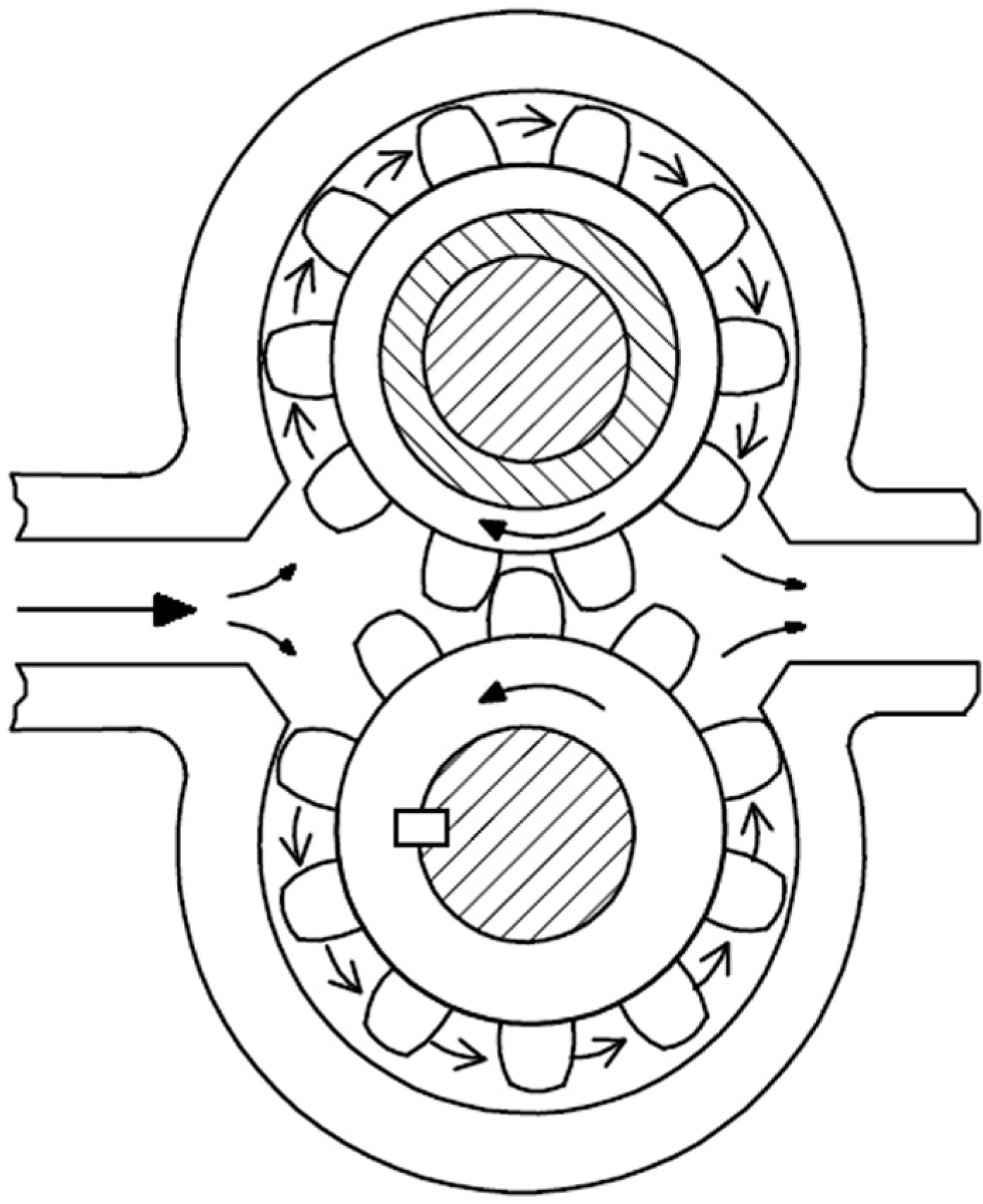
A gear pump.
Design knowledge of structure symmetry in scattering load uniformly
If a load is large enough to exceed the bearable range of the supporter, the supporter will be damaged. By scattering load uniformly, a large load can be converted into many small loads within the bearable range of the supporter, and the uniform loads can make the supporter to sustain force equably. By designing many parts with same geometry, arranging these parts in symmetric locations, and making them to output or transmit the load together, a large load can be scattered uniformly. According to the different surface shapes of the load works on, there are different structure symmetries used in scattering load uniformly, as shown in Table 15. In a flatcar shown in Figure 14, there are 32 double translation symmetric wheels which can scatter the load uniformly and reduce the damage for the road.
Symmetric structure and scattering load uniformly.


A flatcar.
Design knowledge of structure symmetry in reducing vibration
In a running machine, the vibration is unavoidable. Too much vibration can cause negative influence on the working of the machine and even can damage the parts of the machine. The appropriate application of symmetric elastic parts can effectively dampen the vibration. By designing multiple parts and arranging them symmetrically, the force that causes the vibration can be dispersed, reduced, or counteracted. In Table 16, some common structures that can weaken or dampen vibration are listed. In a viscous frictional absorber as shown in Figure 15, multiple isolate chambers, which are filled with viscous liquid, are rotation symmetric. These symmetric isolate chambers can make the axle and the shell to sustain force equably and reduce the vibration during the axial rotation process.
Symmetric structure and reducing vibration.


A viscous frictional absorber.
Design knowledge of structure symmetry in improving strength of part
Although the strength of a part mainly depends on its material, the structure of the part can also influence its strength. There are many methods to improve the strength of a part. From the view of structure design, there are mainly two methods to achieve the improvement of strength. The first one is to design a part with symmetric structure, such as rotation symmetry and mirror symmetry. Thus, the strength of the part can be distributed uniformly and the weakest area of strength can be avoided. As a result, the bearing capacity of the part can be improved. The second method is to add the assistant structures symmetrically (such as strengthening rib) on the part which can also improve the strength effectively. Figure 16 shows a strengthening rib design, which consists of three sets of strengthening ribs arranging mirror symmetrically and translation symmetrically. These symmetric ribs can improve the strength of the part significantly.

A strengthening rib design.
Design knowledge of structure symmetry in improving strength of function
By setting repeated structures to synchronously work on the object, the strength of function can be improved. According to the different surface shapes of the function works on, the positions of multiple structures can be arranged as forms of translation symmetry, rotation symmetry, and glide symmetry, as shown in Table 17. If the working surface is very large, combined symmetric structure should be applied. In an expansion clamp shown in Figure 17, by pulling pole 1 upward, expansion forces on poles 1 and 5 can be generated through pole 2 to grip object 6. There are three translation symmetric poles (poles 2, 3, and 4) between poles 1 and 5. Under the synchronous effects of poles 2, 3, and 4, the expansion forces can be enhanced evidently, so the strength of the function of “grip material” is improved.
Symmetric structure improving strength of function.


An expansion clamp.
Design knowledge of structure symmetry in expanding working range of function
The working range of function includes space range and time range. To expand the working space range of function, we can design many repeated structures and set them on several discrete or continuous locations, which can expand the working space range by letting the structures working together or sequentially. The type of symmetry of the structures is determined by the shape of working space and usually is translation symmetry or rotation symmetry, as shown in Table 18. There are multi-layer translation symmetric brackets in a crane as shown in Figure 18. By varying the quantity of bracket layer, the height of the crane can be changed, which can expand the working space range. To expand the working time range of function, we can design many parts with same geometry, locate them translation symmetrically or rotation symmetrically, and let them work sequentially. In a digging bucket in Figure 19, multiple buckets are arranged rotation symmetrically, which come to the working spot one by one during operating process. Their continuous work style can expand the working time range effectively. Although some design knowledge of structure symmetry in realizing design requirements was introduced, other design knowledge still exists which can be summarized from association rules and will be introduced in other articles.
Symmetric structure expanding working range of function.


A crane bracket.

A digging bucket.
Conclusion
Symmetry, a commonly observed phenomenon, is widely researched in many fields. In mechanical systems, there are also many existences of symmetry, especially for structure symmetry. Reasonable application of structure symmetry can make design requirements to be better realized. In this article, the technology of knowledge discovery is used to mine association rules from mechanical structure symmetry design instances, and some design knowledge is proposed to guide the application of structure symmetry. The authors collected more than 1000 of structure symmetry design instances; built standardized systems of structure symmetry, design requirement, and structure design principle; and analyzed the instances on the basis of the standardized systems. A physical database was designed and the information of design instances was stored. The association rules including structure symmetry ⇒ design requirement, structure symmetry ⇒ structure design principle, structure design principle ⇒ design requirement, and structure symmetry ⇒` structure design principle, design requirements were mined from instance database. By analyzing mining results and relevant instances, the practical and universal design knowledge of structure symmetry to meet the design requirements was proposed, which can conduct the application of structure symmetry and improve the technical, economic, and social performance of the mechanical products.