







Abstract
Introduction
‘I learned about the Crips from right here, from hanging around the neighbourhood. Later on, I found out that you also have Crips in Los Angeles, in the United States’. Kerim, a 20-odd years old Turkish youngster, told me this during the final stage of my three years of fieldwork. In line with Van Gemert’s (1998: 48) expectations about the global dissemination of the Crip brand, for some youngsters from the Netherlands the Rollin 200 Crips are seen as a local phenomenon rather than a simulacrum (Baudrillard, 1983) of the infamous American street gang. When I asked Kerim if he is proud of the neighbourhood, he uttered, almost immediately, ‘No doubt, it’s my neighbourhood, I feel at home here’. After remaining silent for some seconds, he continued: ‘It’s a feeling, you know I also got the neighbourhood tatted on my arm’. Rolling up the left sleeve of his jacket, Kerim showed me a tattoo on his forearm reading ‘Rollin NH200D Crip’.
In this article, I will elaborate on the relationship between gangs, space and identity captured in the statements of Kerim. Since the early 1990s, groups of youngsters calling themselves Crips and Bloods have been reported in the Netherlands (Abels and Dwarkasing, 1994). The Hague, the third largest city in the Netherlands, has been the stomping ground of several Crip ‘gangs’, following the global commercialization and commodification of gang styles from the late 1980s (Van Gemert et al., 2016: 157–158). These examples of American-style gangs in Europe are indicative of the ‘changing contextual orbit of gang’, with gang cultures becoming global and transnational (Brotherton, 2008: 63). In addition, several larger developments have affected the ways young people understand and construct both space and identity. Firstly, Ilan (2013) describes the urban environment present in the research of the Chicago School, but also in most gang studies since then, as a ‘Solid City’. The solidity does not connote a fixed city, but entails ‘a sense of cohesion within particular groups and communities, a sense of connection between geographical space and stable sources of industrial employment, and a reification of locality as a marker of place and identification’ (Ilan, 2013: 5). However, Ilan urges scholars to be sensitive to the understanding of lived experiences under the more complex conditions of ‘liquidity’. Drawing on the discourse of Bauman, Ilan coins the term ‘Liquid City’ to capture how the post-Fordist economy in global cities has created flows that erode solidity (Ilan, 2013: 6–7). Moreover, technological developments facilitate the rapid movement of people throughout the city and across nations and continents. Fraser (2013: 972) also notes how processes of globalization ‘reshape and reconfigure inner-city areas’, with gentrification and displacement resulting in ‘shifting boundaries and more fluid conceptions of “turf” (…) while deindustrialization and ghettoization have intensified the spatial immobility of many’. Furthermore, flows of information have resulted in the emergence of global styles that impact local practices (Brotherton, 2008: 63; Massey, 1998). Lastly, the virtualization of everyday live, blurring the boundaries between online and offline (Leander and McKim, 2003: 223), also challenges notions of place, locality and identity (Ilan, 2015: 72–73; Lane, 2016; Lauger and Densley, 2017). For example, Storrod and Densley (2017: 1) note how ‘the emergence of smart phones and social media have enabled gangs to exist in a virtual world where face-to-face interactions in geographical and social space are not necessarily required to foster collective identity and collective action’.
In light of these developments Fraser (2015: 220–221) calls for a reoriented perspective on gangs and a more detailed focus to account for the reconfigured relations between space and identity. In order to grasp the meaning and practices of gang and gang life, Brotherton (2015: 64) argues that it is imperative to understand the construction of space over time. In this article, I will do so by focusing on the relationship between space and identity in the ‘h200d’, a small neighbourhood in the city of The Hague that the Dutch Rollin 200 Crips claim as their ‘territory’. Firstly, I will elaborate on the importance of space and identity in the study of gangs and street culture in both the United States and Europe. Secondly, the three years of fieldwork – part of an ethnographic study on the embeddedness of crime and identity (Roks, 2016) – underlying the current article will be outlined. Lastly, I will focus on the intersections of space and identity, but also on the interplay between global forces and local practices, present in the subcultural mannerism of the Dutch Rollin 200 Crips.
The intersection of space and identity
Hagedorn (1988: 134) notes that our perspective on gangs has been framed by ‘understanding them as “corner groups” of youth from the same neighbourhood’. Analyzing the spatial configuration of gangs in the city has been central to the early research of the Chicago School (Park et al., 1967 [1925]). In his landmark study, Thrasher zooms in on ‘gangland’: ‘an interstitial area, pertaining to spaces that intervene between one thing and another’ (Thrasher, 1963 [1927]: 20). Some of these ‘cracks, crevices, and crannies’ of neighbourhoods in the inner city become home territories for youngsters, ‘which they regard as exclusively their own and will defend valiantly again invaders’ (Thrasher, 1963 [1927]: 93). Suttles (1972: 34) elaborates on ‘the obvious earmarks of the defended neighbourhood’ where street-corner gangs ‘claim a “turf” and ward off strangers or anyone else not a proper member of the neighbourhood’.
‘Turf’, or the notion of territory, can be understood as ‘a static, geographically delimited and defended space, in which control is exerted over activity and access’ (Fraser, 2015: 129–130; cf. Conquergood, 1994; Klein, 1995; Moore et al., 1983; Spergel, 1990; Suttles, 1968; Thrasher, 1963 [1927]; Whyte, 1943). In both popular and academic accounts, gangs are portrayed as tight, organized groups ‘exerting violent territorial supremacy for the purposes of economic gain’ (Fraser, 2015: 130). From this perspective, gangs are involved in what Sack (1986: 19) describes as ‘territoriality’: ‘the attempt by an individual or group to affect, influence, or control people, phenomena, and relationships, by delimiting and asserting control over a geographic area’. The imagery surrounding these defensive and oftentimes violent mannerisms in which gangs claim and defend their ‘turf’ constitutes a prominent part of the public angst surrounding gangs.
Adamson, in analyzing the history of the American street gang (Adamson, 1998; 2000: 237), stresses the importance of the defense of territory, but he also points to other community functions gangs perform. Under the rubrics of ‘defensive localism’, Adamson (2000: 237) notes less demonic aspects of gangs like ‘the policing of neighbourhoods, the upholding of group honour, and the provision of economic, social, employment, welfare and recreational services’. Moreover, as Papachristos et al. (2013: 419) state, various studies ‘attest to the significance of neighbourhoods for group formation, identity, meaning-making, and individuals’ behavioral patterns in disadvantaged communities, especially for young men’. Territoriality, rather than resulting from (violent) attempts to control resources, therefore can also be seen as a means of creating space and differentiating identity (Conquergood, 1994: 39–40; Fraser, 2015: 121; Ilan, 2015: 74–75). Gangs tend to venerate their local surroundings (Papachristos et al., 2013: 419), for instance by taking their name(s) from street(s) of origin (Conquergood, 1994; Garot, 2007; Ilan, 2013: 6; Ilan, 2015: 75; Katz, 1988: 156; Ley and Cybriwsky, 1974: 495).
However, the spaces of the inner cities occupied by gangs are ‘highly charged, socio-political domains’ (Brotherton, 2015: 63). With the notion of ‘situated space’, Brotherton (2015: 63) draws attention to the ways gangs seek space for themselves, often in competition with policing authority. In the United States, the state and its agents ‘have created a plethora of interlocking legal devices to control the autonomous behavior of the working class and the poor’ (Brotherton, 2015: 63). Moreover, policy on and policing of outsiders using, occupying or intruding urban spaces has evolved in a harsh and dramatic fashion (Ferrell, 2001: 164). For instance, Goffman (2009: 341) shows how: the past few decades have seen the war on crime, the war on drugs, a blossoming of federal and state police agencies and bureaus, steeper sentencing laws, and a near unified endorsement of ‘zero-tolerance’ policies from police and civic leaders.
Ferrell (2001: 164) notes how ‘those identified as gang members face neighbourhood roundups, civil injunctions prohibiting public gatherings, even deportation’.
A gaze beyond the gang (Hallsworth, 2013) shows that the contested nature of urban space – in which ‘powerful adults attempt to define and impose cultural space’ (Ferrell, 1997: 22) – is not confined to gangs. Furthermore, the importance of space for people’s identities in general has, as Pickering et al. (2012: 946–947) show, been rather well documented. Physical space, as Ferrell argues (1997: 32), can be ‘constructed as a relatively independent zone of identity through symbolic displays, stylized details, and ritualized activities’. In a study of six cities in the United Kingdom, Kintrea et al. (2008) observe that territoriality is an integral part of the everyday life of young people. Territoriality emerges as ‘super place attachment’ and stems from close identification with local surroundings. Kintrea et al. (2008: 49) conclude that ‘young people feel their estates or inner urban areas are the places that they belong to and, in turn, the places belong to them’, regardless of the neighbourhoods’ lack of attractive features. In fact, as Robinson (2000: 441) notes, young people sometimes also create spaces as ‘violent, scary or chaotic’ to construct and confirm aspects of their identities.
In these cases, the ‘super place attachment’ pertains to embracing ‘territorial stigmatization’ (Wacquant, 2007). With this notion Wacquant (2007: 67) refers to parts of the urban environment that ‘are publicly known and recognized as those urban hellholes in which violence, vice, and dereliction are the order of things’. Whereas Wacquant (2008) stresses the implications of territorial stigmatization for the emergence of ‘advanced marginality’, studies on street spatial practices show how territorial stigmas are emphasized or even created by young people in the process of constructing their identities. Anderson, for instance, notes that ‘people are likely to assume that a person who comes from a “bad” area is bad’ (Anderson, 1999: 77). Similarly, Harding (2010) describes how youngsters from Boston use the violent reputation of their neighbourhood in constructing their own identity. These street spatial practices illustrate how local spaces are intertwined with identity and space becomes an important ‘badge of selfhood’ (Fraser, 2015: 118).
The current study examines the ways these street spatial practices take shape in the European context. Youth all around the globe are attracted to ‘the styles, imagery and messages of gang cultures, seeing in them individual and collective vehicles for identity, social solidarity, and place-making’ (Brotherton, 2008: 63). In a few European studies on gangs and street culture these global influences are noticeable. For instance, Slooter (2011), in an ethnographic study of ‘4000sud’ – a suburban neighbourhood north of Paris – shows how young people sometimes embrace the stigma of being from ‘the banlieu’ as their identity. Next to describing themselves as ‘banlieusard’ or ‘jeune de banlieu’ and the usage of their own slang (‘verlan’), these French youth also draw comparisons between American ghettos and their own neighbourhoods (Slooter, 2011: 52). Van Hellemont’s (2012, 2015) research on youth from the Belgium capital of Brussels serves as a powerful example of the way global street and youth styles influence local identities and spatial practices. By referring to their city as ‘Bronxelles’, mixing Bruxelles with The Bronx, these youth portray their local surroundings as a ‘ghetto’ or ‘hood’ to provide a believable context for Belgium gang life (Van Hellemont, 2012: 176). On a similar note, Moroccan Dutch youth studied by De Jong (2007) refer to the Western part of Amsterdam as ‘Westside’, using both the phrase and the accompanying hand sign – the ‘W’ – made famous by rapper Tupac Shakur (De Jong, 2007: 103–107).
Fieldwork among members of the Dutch Rollin 200 Crips
Crips, and gangs in general, are not indigenous to the Netherlands. In official accounts and scientific publications in the Netherlands, the word ‘gang’ is avoided or used ‘only with reluctance’ (Van Gemert, 2012; Van Gemert et al., 2008: 8). Since the early 1990s, however, there have been growing concerns about youngsters from the city of The Hague who refer to themselves as ‘gangsta’ or as part of either the Crip or Blood gangs. Unlike the transnational linkages Brotherton (2007: 372–373) describes between global branches of the Latin Kings and Queens in various countries throughout Latin America and Europe, the dissemination of the Crip and Blood gang culture and symbolism was brought on by global flows of gang and street styles. One of these Dutch Crip ‘gangs’ 1 in particular has been in the spotlight of both local and national media: they have featured in articles in popular magazines (Van Stapele, 1998; Viering, 1994), have appeared on various Dutch national television shows and are the focus of a book written by a journalist (Van Stapele, 2003). Some years after this, media attention culminated in ‘Strapped ‘n Strong’ (Van der Valk, 2009), a 90-minute documentary on the criminal life style of the gang.
The current article builds on an ethnographic study on the embeddedness of crime and identity in the Forgotten Village, a small neighbourhood in The Hague and the home base of the Dutch Crips since the late 1980s, which followed from my first contact with leader Keylow. 2 During three years of fieldwork, between January 2011 and December 2013, I built a network of 150 informants consisting of (former) members of the Crips, residents, youngsters hanging around the neighbourhood and a Youth Centre, social workers and local police officials. I used interviews, informal conversations and observations to collect in-depth information about the lives and/or criminal careers of 60 of these informants. Additionally, I monitored and analyzed the activities on social media (Facebook, Twitter and Instagram) of 40 youngsters (Roks, 2016).
The Forgotten Village – as the neighbourhood is popularly known – was the site of my fieldwork and constitutes one of the smallest neighbourhoods in The Hague with approximately 600 houses and 1400 residents (Kars Advies, 2006). It is enclosed by a busy main road, the train tracks between Rotterdam and Amsterdam and two small inland waterways. However, the municipality of The Hague also incorporates the newly built apartments on the opposite side of the main road as part of the neighbourhood, resulting in 3838 inhabitants as of 1 January 2011. A report by the Municipality The Hague (2009) shows that the Forgotten Village has a rather high percentage of non-Dutch residents (73.7% compared to the 47.1% city average), from Surinamese, Moroccan, Antillean or Aruban descent, and a small nucleus of native Dutch residents. The majority of the dwellings are social housing (61.6%), and residential mobility in the Forgotten Village (21.6%) is higher than the average for The Hague area (16.2%).
Because of low incomes, social tensions, vulnerable groups, a high prevalence of health issues among residents and high numbers of school drop outs, the municipality states that the Forgotten Village shows some the characteristics of a disadvantaged neighbourhood (Municipality The Hague, 2011: 13). Furthermore, 40 percent of residents report feelings of unsafety, with graffiti and problematic youth groups – and one active criminal youth group in particular – reported to be the main problems in the area (Municipality The Hague, 2009: 8). In 2011, a report by the local police stated that the Forgotten Village had 69 known members of ‘criminal youth groups’ 3 out of 385 members for the total city of The Hague. In reports of the municipality about the Forgotten Village (Municipality The Hague, 2007, 2009, 2011), the presence of the Crips is only addressed once, by stating that ‘this criminal youth group has roots in the Forgotten Village’ (Municipality The Hague, 2011).
During the start of fieldwork in 2011, the Rollin 200 Crips consisted of some 50 members from a predominant Surinamese background, ranging in age from 15 to 40 years old. Several members were incarcerated over the course of the research, because of their involvement in stabbings, an assault on police officers, possession of illegal narcotics and weapons charges. Furthermore, during this period the Rollin 200 Crips were involved in the cultivation of marijuana in residential housing, whilst several members sold various illegal narcotics on the street. However, several gang members combined their criminal activities with (often low paying) jobs, school or unemployment benefits to make ends meet.
The history of the ‘h200d’
Historically, the Dutch Crips were a local group of brothers, relatives and friends from the Forgotten Village or adjacent neighbourhoods. During the 1980s, before they called themselves Crips or even could be seen as a gang, a local group of youngsters hung out in and around a Youth Centre in the Forgotten Village. The book
Because of their increased involvement in criminal activities, both in frequency and severity, the spot the Crips have hung out at in the Forgotten Village has changed over the years. When I frequented the hood in 2007, members of the Crips could be found hanging around the house of the parents of leader Keylow, approximately 100 metres from the wall in front of the Youth Centre. At the start of my fieldwork in 2011, few Crips could be found in the Forgotten Village due to the incarceration of a handful of members. The summer of 2011, however, saw the return of leader Keylow to the hood, with several Crips in his wake. During the remainder of my fieldwork, most of the time was spent in front of the home of Keylow’s brother Rick (see Figure 1).

Bench in the h200d, 25 January 2014.
Whilst the term ‘hood’ has been a commonplace reference to the Forgotten Village for these Dutch Crips for many years, the usage of ‘h200d’ is more recent. More so than with the generic ‘hood’, a sense of territoriality is communicated with ‘h200d’. It refers to a square approximately the size of a football field, which is situated behind the Youth Centre and is surrounded by blocks of low-rise houses. By mixing the number ‘200’ with ‘hood’, the Rollin 200 Crips follow the example of American-style black gangs like the Rollin 40 Crips from Los Angeles who use ‘h40d’ to distinguish their ‘hood’ from other ‘hoods’. ‘H200d’, thereby, holds both a reference to the name of the set or gang – the Rollin 200 Crips – but also to the house number (252) of the Youth Centre. For the latter interpretation, the words ‘turf’, ‘blocc’ or ‘clocc’ are used interchangeably.
Over the years, walls and houses in the Forgotten Village have faced problems with graffiti (Municipality The Hague, 2011: 117), especially during the shooting of the documentary ‘Strapped ‘n Strong’. The removal of most of these tags has left white marks on various walls. From a distance, one can still make out ‘200’ or ‘Crips’. During my fieldwork, the Rollin 200 Crips were, with a few exceptions, not involved in spraying graffiti or tagging. However, in January 2014, finishing up my fieldwork with some last visits, I came across a wall that was used by two members of the Rollin 200 Crips as the urban decor for their rap video (see Figures 2 and 3).
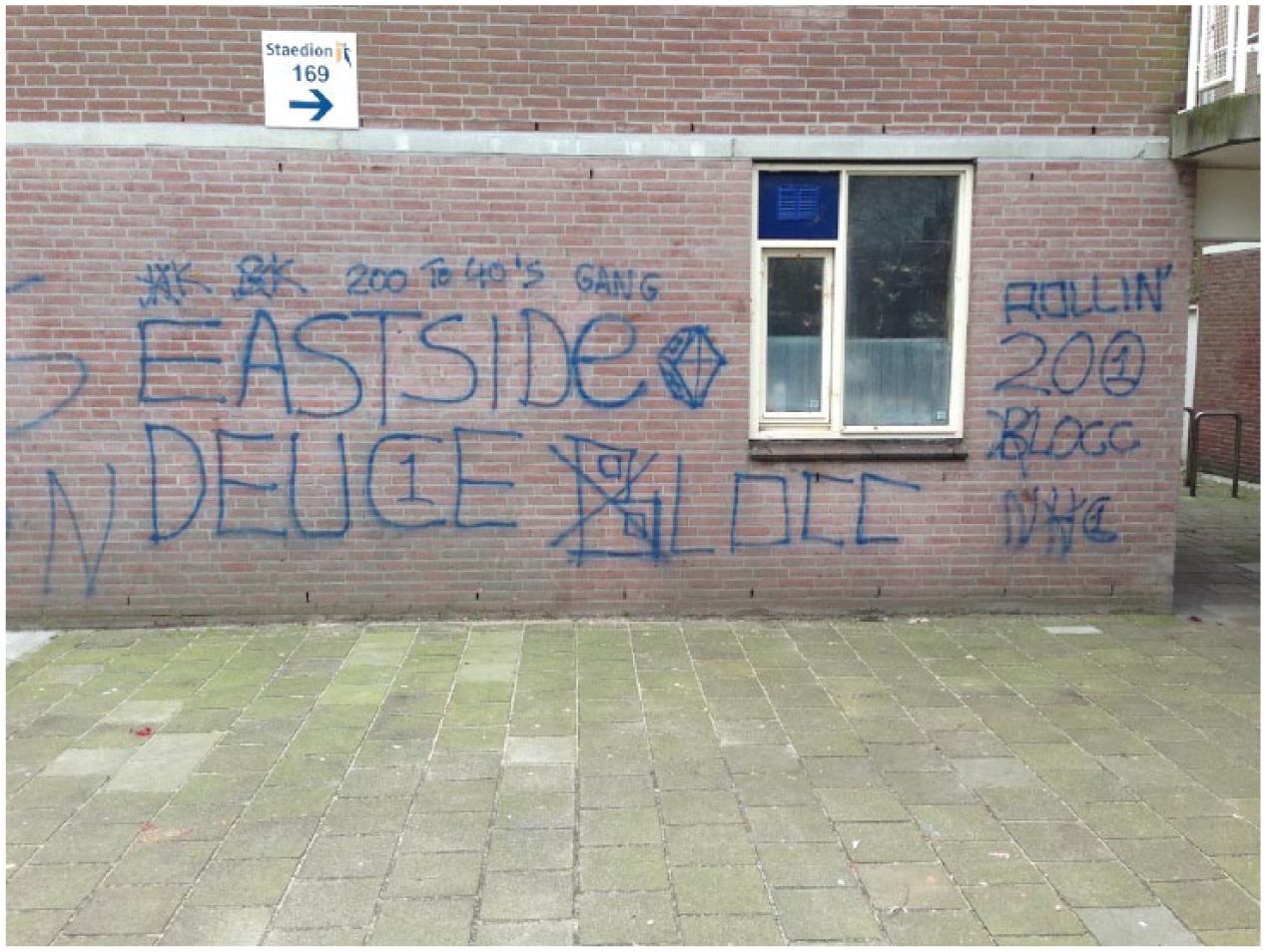
Wall in the ‘h200d’, 25 January 2014.

Wall in the ‘h200d’, 25 January 2014.
Deciphering the symbolism on these tags reveals the influence of American gang culture on the local style of the Dutch Rollin 200 Crips. The crossed-out letter ‘B’, a sign of disrespect towards Blood gangs, is driven by the stereotypical rivalry between Crip and Blood gangs in the United States. Next to this symbolic connection, the graffiti-covered wall also indicates a more personal relationship, in particular with the Rollin 40 Crips of Los Angeles. For some years now, leader Keylow has been in contact with members of the Rollin 40 Crips, which kickstarted the rebranding from ‘Main Triad Crips’ – as these Crips were know during the early 2000s – to Rollin 200 Crips. In 2007, some members of the Rollin 200 Crips visited their American gang role models as part of the earlier mentioned documentary. Since then, the connection between ‘200s to 40s gang’, as is featured in Figure 2, shines through in the communication of the Rollin 200 Crips. The crossed-out letter ‘H’, for example, is a way of representing so called Neighbourhood Crips – like the Rollin 200 Crips – by siding in an ongoing, very local conflict between Neighbourhood Crips and Hoover Crips in Los Angeles. However, the Netherlands lack similar conflicts between Crips and Bloods or between Crip gangs, particularly since no other Crip or Blood gangs could be found in the city of The Hague, or even in the Netherlands in general. In this case, the crossing-out of the ‘B’ and ‘H’, or the avoidance of the letter combination ‘CK’ – which could be interpreted as ‘Crip Killer’ – should not be read as disrespecting other gangs, but rather as an appropriation of the subcultural symbols of the global Crips brand and identity.
In this brief history of the term h200d, the intersection of space and identity, but also the interaction between the global and the local, becomes apparent. In the remainder of this article, I provide a more detailed overview of this intertwinement between space and identity, both in terms of how physical space relates to the construction of personal and collective (gang) identities, but also how the gang identity of these Dutch Crips influences their usage of space. To contextualize these narratives of territoriality, I draw on the perspectives of residents and local police about the street spatial practices of the Rollin 200 Crips. Lastly, I will focus on the interplay between virtual space and local identities.
The h200d as a home (away from home): Space as identity
For members of the Rollin 200 Crips, especially those members who have been around since the late 1980s or early 1990s, the h200d is considered a sacred place. From their perspective, it is a place to relax, to kick back, to meet up with fellow gang members; a space where the Crips feel safe and protected. As Sánchez-Jankowski (1991: 211) argues, there are certain benefits to gangs in becoming embedded in a particular locality or community, because gangs ‘need a sanctuary, a safe place to regroup and operate in’. However, this requires some effort on the part of the gang since relationships with local residents and merchants can be fragile and have to be reaffirmed on a frequent basis. An increase in the nuisance of crime might put a strain on the implied covenant between the community and the gang (Sánchez-Jankowski, 1991: 211–212). During the time I spend in the ‘h200d’, it struck me that the Crips seemed, apart from the occasional noise because of members talking or music coming from mobile phones, to be actively engaged in limiting nuisance to local residents. ‘Keep the h200d clean’ was a phrase that was uttered (verbatim) on several occasions during my fieldwork and reflected one of the unwritten codes of conduct of the Rollin 200 Crips: crime and nuisance were to be kept to bare minimum whilst within the boundaries of the ‘h200d’.
In his pioneering study on gang communication, Conquergood (1994: 39) notes how gangs are ‘galvanized communicatively through the figurative and physical deployment of space’. Both practices are prominently noticeable in the h200d. Graffiti represents ‘the visible manifestation of a gang’s control of social space’ (Spergel, 1990: 209) and is utilized to communicate the borders of neighbourhoods (Conquergood, 1994: 26–27, 49–50). As well as covering walls and houses with gang graffiti, the Rollin 200 Crips also make their presence known in the Forgotten Village by hanging out in groups in the h200d, wearing blue-coloured clothing. As such, the Rollin 200 Crips are engaged in what Conquergood (1994: 39) describes as the transformation of ‘marginal, somewhat forbidden urban space into a hood – to make a world of meaning, familiarity, adventure, and affective intensity through ritual, symbol, and dramaturgy’. The h200d can be seen as a prime example of a ‘home territory’: [a] relatively small piece of public space which is taken over – either by individuals acting independently or by an already formed group acting in concert – and turned into ‘a home away from home’ (Lofland, 1973: 119).
Various aspects of the communicative practices of the Rollin 200 Crips reveal the creation of a home in the public realm. Frequently used terms as ‘h200dsta’ or ‘homie’ call to the fore an ‘imagery of home and family’ (Conquergood, 1994: 40). The familiarity and intimacy associated with these words also can be found in the often used ‘cuzz’, one of the most well-known markers of Crip affiliation and identification. A sense of brotherhood is communicated through the use of these notions of fictive kinship, whilst simultaneously contributing to the strengthening of loyalty between members (Bourgois, 1995: 82; Conquergood, 1994: 39–40). The stylized rites of handshaking showcase similar levels of bonding: members of the Rollin 200 Crips greet each other by holding up both index and middle finger of their right hand – thereby symbolizing the number two – and bringing the backs of both fingers together with their greeting partner, followed by a brief, but strong embrace. This elaborate ritual, however, is not reserved just for members of the Rollin 200 Crips: because the symbolized number two in the handshaking ritual also refers to the locality; youngsters who were born or currently live in the Forgotten Village but are not part of the Crips are allowed to greet members of the Rollin 200 Crips in this way. Moreover, the Forgotten Village was also ‘represented’ (Conquergood, 1994: 40) during digital communication in emails, texts or messages via WhatsApp or BlackBerry. These chats usually start with ‘all “h200d”’, whereas the number ‘200’ is used to mark the end of a conversation.
Furthermore, the meaningful numbers ‘200’ and ‘252’ can be seen as ‘inscriptions of embodied locality’ (Appadurai, 1996: 179) or ‘mirrors and mobile extensions of graffiti-inscribed walls’ (Conquergood, 1994: 49–50) on the bodies of members of the Rollin 200 Crips. Getting these tattoos is considered an integral part of the process of showing loyalty as a gang member. Rishi and Faisel, two new members who joined the Crips during the last months of 2011, let Steven, an older member who used to work as a tattoo artist, put a large number ‘200’ on their respective forearm and stomach. Other members went bigger: Carlito choose a ‘200 hand sign’ over the breath of his chest and Roger picked the number ‘200’ to cover his entire stomach. In the case of these four members, it is remarkable to note that none of them were actually born in the Forgotten Village or lived there at any moment in time. In fact, Carlito and Roger were kicked out of the gang just before the start of my fieldwork. Rishi and Faisel, although showing their dedication by immortalizing the symbolism of the Rollin 200 Crips on their bodies, left after no more than six months.
At the start of my fieldwork, but also well into my first year visiting the ‘h200d’, I assumed – in line with what Moore et al. (1983) describe about scholars studying gangs – that the members of the Rollin 200 Crips lived within the territory that they claim as their ‘h200d’. This was first and foremost because several members always seemed to be hanging out in or around the Forgotten Village. However, like the two Chicano gangs Moore et al. (1983) studied, there seemed to be a difference between the territory and the domicile of the gang members. Aside from Rick, one of the Original Gangster (OGs’) 4 , most of the members of the Crips I met in the ‘h200d’ never lived in the Forgotten Village, but came from different parts of The Hague or even from the surrounding cities of Zoetermeer or Rotterdam. For most members, the h200d seemed to be a home territory away from home. However, following the rapid departure of 20 active gang members in a period of 18 months, their relationship with the physical space of the Forgotten Village showed to be contingent upon membership. Facilitating this process of gang disengagement, set in motion because of conflicts about the inner workings of the gang and growing disillusionment with Dutch gang life, was the fact that most members that left did not live in the Forgotten Village.
‘H200d patrol’: Performing gang-ness
Most of the above-mentioned street spatial practices illustrate the ways in which physical and figurative space influences both personal and collective identities. However, some of the territorial tendencies of the Rollin 200 Crips went beyond symbolically claiming the h200d as their turf. This first became apparent in the months following leader Keylow’s release from jail in the spring of 2011: Bradley is the only one present in the h200d and since I don’t really know him, I decide to wait for other people. Because it’s raining, I seek cover under the branches of a large tree next to the Youth Centre. However, big raindrops still fall onto my coat and fitted cap. After a few minutes of heavy rainfall, I notice that Bradley did not seek shelter from the rain at all. In fact, it looks like he’s enjoying the stream of raindrops falling from the sky, standing untroubled with his hands tucked away behind his back. He seems to want to give off the impression that the raindrops do not faze him. Also with his position on the square, right in the middle of the pathway to the playground, he seems to want to make a statement, as if he’s keeping watch over the h200d. After about 15 minutes of heavy rainfall, Bradley asks ‘cuzz?’ as he points to a pack of Marlboro cigarettes. ‘No thanks, man’, I reply. Still not diverging from his original position in the pouring rain, Bradley lights a cigarette. After finishing his smoke, he leave his spot and walks across the square. He moves ever so slowly: from a distance, I can notice the prominent movement of his hips. I also get the impression that he is flexing his muscles in both his chest and upper arms. Watching Bradley, I get the feeling he’s on some sort of neighbourhood patrol. (22 August 2011, observation)
Eventually, Bradley – one of the Crips who did not live in the Forgotten Village – wound up standing in the pouring rain for well over an hour. On meeting up with leader Keylow later that day, I asked about what Bradley was doing, in part because I was trying to grasp the meaning of this practice. Keylow stated that ‘he was trying to earn his stripes’. In the months that followed, other, often younger Crips would engage in this practice dubbed ‘h200d patrol’: they would position themselves around the various entry points between blocks of houses and ‘guard’ the h200d, but especially Keylow and other OGs.
During summer time, ‘h200d patrol’ was generally not perceived as an unpleasant activity because of the good weather. However, younger members were also forced to patrol the h200d in rain, sleet and even in the snow, standing underneath umbrellas waiting until Keylow or Rick sent them home. The hours I spent with the Crips ‘on the block’, 5 and especially my presence during the colder months or even in pouring rain, seemed to have a positive effect on our relationship. In fact, they would comment on my courage in spending that much time around them in the ‘h200d’. During a conversation with Steven, he referred to making some powerful enemies and the possible blowback this might have. Because of his rather cryptic description, I asked what he meant. He responded: ‘For example, people who retaliate and bring straps to the h200d. You can get into serious shit being around us, so I think you show a lot of guts. You’ve got balls, man’.
Initially, Steven’s remarks made me feel uneasy. Hanging out in the h200d, I rarely – if ever – experienced the threat of violence Steven hinted at. In part, this had to do with the fact that I was not up to date on their recent criminal endeavours or conflicts; nor did I want to be, as I stressed repeatedly during my fieldwork. 6 However, I was aware of the violent history of some of my informants, facing manslaughter charges and convictions for various violent offences. Sometimes I was warned with phrases like ‘the block is hot’ sent via Blackberry Messenger, or more concrete messages that I should stay at home. Other times, upon arriving in the h200d, I found no one there and stood for several hours waiting for Crips members. There were consecutive days, and sometimes even weeks, that passed when no Crips could be found in the Forgotten Village.
Although street life is characterized by excitement and thrills, especially in its representation in both popular and (gangsta) rap culture, there are also moments when little to nothing happens (Hallsworth, 2013: 134, 147). Besides some small altercations with passersby, often triggered by hands tucked away in jackets or people using parts of the neighbourhood as a public toilet, most days nothing went down and the h200d was on the verge of becoming a boring space. During these moments, especially in the absence of the OGs, younger Crips openly started questioning the function of ‘h200d patrol’. As a consequence of these emerging doubts, patrolling the block and surveillance was carried out in a less strict way. 7 These experiences, as Van Hellemont (2015: 324) concludes, ‘validate and test the participant’s identity as well as their understanding of gangs as a fictional concept and as a fantasy’. Watching the Crips patrolling the h200d, I often found myself trying to make sense of the meaning and function of this activity which almost epitomizes the idea of ‘defensive localism’ (Adamson, 2000). Both the term and the practice could be interpreted as a reflection of the impact of the stereotypical depiction of gangs in media and popular culture. From this perspective, the h200d patrol – albeit executed for a period of no longer than a year – showcases the ways ‘the screen scripts the street’ (Ferrell et al. 2008: 129), and could be seen as an example of performing ‘gang-ness’ (Katz and Jackson-Jacobs, 2004: 92). Seen through the lens of this imagery, claiming a hood and defending one’s turf is something ‘real gangstas’ (Lauger, 2012) do.
‘They just hang out there’: The perspectives of residents and local police officers
On a winter’s day in early 2012, while pointing at the surrounding houses, Keylow said: ‘they all know what we do’. The fact that none of the residents reported any nuisance or called the police was interpreted as evidence of the control the Crips had over Forgotten Village. Papachristos (2013: 420) notes that ‘possession of gang turf is entirely contingent on the recognition of such ownership claims by others and the actions taken by a gang to reinforce its claims of ownership’. Members of the Crips believed that most residents considered their presence in the h200d to be positive. Rick, for example, told a story about speaking to an older resident from Surinamese descent about moving from the Forgotten Village. Rick claimed that the man told him that ‘everything would get out of hand if he moved’. In speaking to (former) residents, however, I seldom heard similar stories. A notable exception was a local youth worker who, during the first months of my fieldwork, indicated that she saw the Crips as a form of security in the neighbourhood and that Rick, the only member of the Crips that actually lived in the ‘h200d’, always kept an eye on things.
These positive experiences about the presence of the Crips in the Forgotten Village – often told by members of the Crips – coincided with stories about the fear the Crips instilled into residents and passersby. However, in speaking to residents I also got different perspectives on the Crips in the Forgotten Village. Many of the original residents of the Forgotten Village moved away because of increased social and economic mobility. The new(er) residents of the Forgotten Village were largely unfamiliar with the Rollin 200 Crips: both with their individual members and with the imagery surrounding them. Many of these new residents had jobs, friends and social networks that transcended the boundaries of the Forgotten Village. One female resident said, ‘I saw the documentary a few years ago and thought to myself: isn’t that my neighbourhood? If I had never seen the documentary, I still wouldn’t know about the Crips’. Next to dwellers being unfamiliar with the Crips, their presence was tolerated or (outright) ignored, trivialized or ridiculed, but was also met with respect from some residents. In general, more positive perspectives on the Crips were often the result of growing up together in the Forgotten Village, or were related to age, ethnicity or common interests.
Apart from some tumultuous interactions, the way the Crips were met by the police and social control agencies in the h200d was substantially less repressive and severe than the way gangs in the United States are approached and combated (cf. Rios, 2011; Siegel, 2003). The role of two different community police officers in the Forgotten Village is especially noteworthy in this respect. They approached the Crips in the h200d in a friendly manner, shaking hands and making small talk. John, who was the community police officer during the first part of my fieldwork, said: It has also always been like that there [in the Forgotten Village] and there is no real nuisance to be honest. They do not litter, there don’t make much noise. It’s just a spot where the guys meet up and talk about all sorts of things and also probably plan their criminal activities, but it doesn’t really bother the residents. So, there is not much we as police officers can do. They just hang out there. (12 April 2011, interview with John)
Ronald, John’s successor, told me a very similar story, emphasizing that the Crips call it their ‘hood’ and that they occupy part of the public space of the Forgotten Village by just being there, but that there is very little nuisance. In addition, he said, ‘I don’t care if they claim the physical space, as long as they keep the nuisance within the legal boundaries’. In addition, no ‘banning orders’ (Schuilenburg, 2015) or comparable forms of urban governance were exerted in the Forgotten Village. The reactions, both from residents and local police, indicate that the h200d is not considered contested space. In fact, the presence of the Crips in the h200d is, to some extent, woven into the local tapestry of the Forgotten Village.
#200: The interplay between local identities and virtual space
The presence of the Crips in the h200d did have an impact on the ways youngsters from the Forgotten Village – but also in the Netherlands in general due to the media presence of the Rollin 200 Crips – constructed their identities. Most of the youngsters I met at the Youth Centre, or occasionally on the streets of the neighbourhood, spend very little time in the neighbourhood in part due to the fact that their friendship networks transcended the local neighbourhood or even the city. They seemed to move with ‘speed and confidence’ (Ilan, 2013: 16) through the city of The Hague. However, they would also stress the importance of the neighbourhood they came from. Growing up, these youngsters spent time in the neighbourhood and they would, on occasion, interact with members of the Crips. As they grew older, their interactions became more frequent and more personal, and resulted in the transmission of some of the gang symbolism used by the Rollin 200 Crips. The word ‘h200d’ offers a good example. Although it might seem to be reserved for insiders, the usage of ‘h200d’ is not restricted to members of the Crips, as the following tweet illustrates: ‘RT @Dxxxx_: RT @Kxxxx: 2 to 3 years ago everybody wrote hood like this >> H200D #dailyroutine’ (17 December 2011, 17.43, Carlito’s Twitter account). Carlito, a former member of the Rollin 200 Crips, retweeted this message posted by a girl from the Forgotten Village.
The term ‘h200d’ spread across the physical boundaries of the Forgotten Village and became part of the street slang of youngsters in The Hague as a word that indicates particular ‘insider knowledge’ (Geertz, 1983) about the Crips and that, subsequently, meant its users could be classified as being streetwise or in the know. Simon, a young, skinny white man who was about 16 when I first saw him in the Youth Centre, combined various symbols associated with the Crips in his self-presentation. He would wear a blue cap, a blue bandana tied around his neck, an oversized blue t-shirt beneath a large blue hoody covered by an even bigger blue jacket, while a blue bandana would stick out of the left back pocket of his sagging pants, matching the blue laces in his shoes. Based on his appearance, one might assume that Simon was part of the Crips. However, Simon had no direct contact with members of the Rollin 200 Crips. He went to school with Railey, someone who lived in the Forgotten Village and was part of the set when he was about 13 years old. Through hanging out with Railey and other youngsters from the Forgotten Village, but also through seeing the documentary ‘Strapped ‘n Strong’ and video clips online, he became familiar with the particular style, dress and language of the Rollin 200 Crips. On Twitter, Simon gave the impression that he spent a lot of time in the h200d, even though he didn’t live in the Forgotten Village or hang around with the Crips in the h200d. For instance, on various occasions he would post that he was ‘walking towards the h200d’ or was ‘on h200d patrol’. At times, I did see him passing through the h200d on a bicycle or hanging around a night shop at a crossway near the railroad that divides the Forgotten Village from the city centre of The Hague.
Lauger and Densley (2017) state that the presence of the internet has altered how gangs interact and present themselves to peers. In the case of the Rollin 200 Crips, the spreading of specific symbols and styles was facilitated through the use of social media by youngsters from the Forgotten Village. For instance, in addition to ‘h200d’, also the numbers ‘200’ and ‘252’ would feature prominently in online presentations of young people from the Forgotten Village who are not part of the Rollin 200 Crips. Wesley (Figure 4), like other youngsters, posted pictures on Instagram from the time he hung around the Crips, dressed in the Crips’ typical blue attire, whilst making gang signs. The number ‘252’ in the caption beneath the picture illustrates his knowledge of the symbolism used by the Rollin 200 Crips. In a similar vein, Railey throws up a so called ‘200 hand sign’ (Figure 5) as a testimony to the locality where he is from.

#252 post by Wesley on Instagram, 12 August 2013.

#200 post by Railey on Twitter, 26 December 2013.
Concluding remarks
Most of the research on gangs in Europe, as Fraser and Hagedorn (2016: 2–6) observe, has been preoccupied with the global landscape of gangs and common definition criteria, obfuscating a more detailed account of the local history of these street-based groups in a global context. In this article, I have elaborated on the relationship between space and identity in the case of the Rollin 200 Crips. In the history of these Dutch Crips, their deeply rooted connection to the locality of the Forgotten Village is evident, whilst simultaneously the influences from global street and gang cultures resonate in both the name of the gang and their street spatial practices. By showcasing the intertwinement between physical, figurative and symbolic deployments of space, this case study explores some of the larger ongoing developments in the ways (young) people understand and construct both space and identity. In particular, the case of the h200d also illustrates how both space and identity and the global and the local intertwine and interact, resulting in ‘glocal territorial identities’ (Massey, 1998).
In this process, the impact of ‘large and complex repertoires of images, narratives, and ethnoscapes’ (Appadurai, 1996: 35) is evident, specifically as it relates to the territorial tendencies and symbolic deployments of the space of the h200d. As Appadurai (1996: 35) postulates: the lines between the realistic and the fictional landscape they see are blurred, so that the farther away these audiences are from the direct experiences of metropolitan life, the more likely they are to construct imagined worlds that are chimerical, aesthetic, even fantastic objects. (Appadurai, 1996: 35)
Representing and defending a hood (or h200d in this case) – ‘a strip or reality’ as Appadurai would argue, since gangs do engage in defensive localism (Adamson, 2000) – forms a base ‘out of which scripts can be formed of imagined lives’ (Appadurai, 1996: 35). From this perspective, the example of the execution of ‘h200d patrol’ could be seen as a powerful example of the ways American gang stereotypes and myths are (re)produced in modern mediascapes (cf. Fraser, 2017: 219).
Feeding into this dynamic of simulacra (Baudrillard, 1983) is the fact that these Dutch Crips, through their media presence, have created a powerful imagery of their own. The documentary ‘Strapped ‘n Strong’ is a clear example of a loop becoming a spiral: ‘the screen scripts the street and the street scripts the screen’ (Van Gemert et al., 2016: 169). Part of the symbols and mannerism described in this article have seeped into the local street culture, explaining why specific Dutch gang symbols are part of the social media repertoire of youngsters from the Forgotten Village – or other parts of the city or the country – who are not part of the local gang. As a result, the (in)visible boundaries of the ‘h200d’ are (re)affirmed and (re)constructed both online and offline, and no longer exclusively by members of the Rollin 200 Crips.
Lastly, the territoriality discussed in this article challenges the more stereotypical portrayal of the violent ways gangs attempt to control urban spaces. The narratives of territorialism outlined here have to be juxtaposed with the perspectives of the local and larger community within the Forgotten Village. No other gangs, groups or residents, not even the local police, would question or contest the territorial claims made by the Rollin 200 Crips. Although this speaks, first and foremost, to the social control of gangs and youth groups in the Netherlands, it can also be traced to the predominantly figurative and symbolic deployment of the h200d. Rather than being a contested space, the street spatial practices discussed in this article highlight the importance of space in constructing and articulating gang identity.