







Abstract
Introduction
In September 2015 (UNDESA, 2015), a bold new agenda was unveiled at the Sustainable Development Summit held at the UN headquarters in New York City. Titled ‘Transforming Our World: The 2030 Agenda for Sustainable Development’, and adopted by 193 Member States of the United Nations, these 17 transformative Sustainable Development Goals (SDGs) call to end poverty, improve the lives of people, and protect the planet. Amongst these is SDG 8 (decent work and economic growth), with its indicator Target 8.7: “Take immediate and effective measures to eradicate forced labour, end modern slavery and human trafficking and secure the prohibition and elimination of the worst forms of child labour, including recruitment and use of child soldiers, and by 2025 end child labour in all its forms”.
In specifically measuring the progress of nations towards ending child labour by 2025, the world renewed its commitment to eradicate this global crisis which exposes an estimated 160 million children around the world (International Labour Office and United Nations Children’s Fund, 2021) to physical/mental/moral hazard, sacrifices their future welfare for immediate benefit (e.g. Posso 2017). The increase in child labour worldwide as a result of the COVID-19 pandemic further reinforces the relevance of this commitment to protect and restore children’s childhood and future (e.g. ILO, 2018, ICI, 2020).
The measurement of child labour is internationally bounded by three United Nations conventions around two context-sensitive elements: age and the nature, duration and conditions of productive activities performed by the child. 1 The ILO (2018) defines working children as any child below the age of 18 engaged in an activity falling within the general production boundary as defined by the System of National Accounts (SNA), including production of goods and services for own use, work performed for pay or profit, unpaid trainee work, and volunteer non-compulsory work. While context sensitive, this encompasses (i) any economically active child under the age of 12; (ii) children 12–14, engaged in productive activities outside permissible light work; (iii) children aged 17 and younger engaged in ‘hazardous’ activities (those affecting the child’s safety, physical and mental development) or the ‘worst forms of child labour’ (e.g. commercial sexual exploitation, armed conflict). It should be noted that not all work done by children is considered child labour.
Unlike children’s participation in activities that develop life-skills and knowledge, child labour harms children and interferes with their right to education through
While child labour impedes education, the reverse may also hold true – education may pull children out of child labour. Education is one among the constellation of policy and legislative tools that governments have deployed to disrupt the equilibrium
The persistence of this problematic phenomenon suggests the need for novel approaches. With less than a year to achieve Target 8.7, we forward that nations need to accelerate legislative and practical actions to eradicate child labour worldwide and reach Target 8.7. The International Labour Organization (ILO) projects 121 million children will still be enmeshed in child labour by 2025 (ILO, 2017). Our research aims to inform this conversation by understanding how
If school quality indeed deters child labour, this would represent a value-added outcome to the growing global investments in education quality. While there is much research on how child labour interrupts school attendance and constrains learning, evidence on schools disrupting child labour is sparse. A recent report from the International Cocoa Initiative (2019) suggests school quality, as measured by a range of indicators (school infrastructure, school environment, teaching materials, and human resources), may reduce child labour. The strongest associations between education quality and child labour pertained to toilet facilities and school canteen programs. Abou (2021) and Guarcello and Rosati (2007) suggest such a link, but acknowledges that research on the connection between education policy and child labour reduction is sparse.
Given that our understanding of the reciprocal relationship between child labour and education is nascent, our school-based study specifically investigates this emerging new lever of school quality in the context of rural cocoa-growing communities of Côte d’Ivoire. Côte d’Ivoire is one of the fastest growing African economies, with an unsustainable confluence of high rates of youth and adult illiteracy and high rates of child labour in its key economic sector (nearly a million Ivorian children work in cocoa agriculture). It is a young nation (42% of the population 14 years and younger; UNDESA, 2019) in the lowest quintile of the Human Development Index (rank 162 out of 189 countries and territories; Conceicao, 2020). We focus specifically on children who experience the dual demands of school and labour; a population that represents the majority of children active in the agricultural cocoa industry in Côte d’Ivoire. 38% of children in agricultural households are involved in cocoa production, and 80% of children in agricultural households attend school (Sadhu et al., 2020). Understanding the relationship between school quality and child labour in this context will shed light on how to support the development of this population.
Cocoa labour in Côte d’Ivoire
Côte d’Ivoire is the third largest economy of West Africa and has been the world’s largest supplier of cocoa since 1977/1978 (AfDB, 2018). Cocoa forms the backbone of the Ivorian economy (Kanga et al., 2019; UNDESA, 2021). Known as ‘brown gold’, this commodity is of extraordinary importance to the national economy (United Nations Children’s Fund, 1997; AfDB, 2018) and economic development (IFC, 2020). In 2020, cocoa represented approximately 35% of Côte d’Ivoire’s total commodity exports (UNDESA, 2023) and accounted for 74% of total income for the average cocoa-growing household (Fairtrade International, 2018).
Most Ivorian cocoa production is done by approximately one million small household cocoa farmers concentrated in the South and South-West of the country (AfDB, 2018). Children often work on these small family cocoa farms as part of their household’s normal economic activity (United Nations Children’s Fund, 1997; Nkamleu and Ndoye, 2003). 78% of children in these agricultural households are economically active (Sadhu et al., 2020). Of the children in cocoa farming regions of Côte d’Ivoire, 80% are enrolled in school – the typical child working in cocoa agriculture manages labour activities alongside attending school. A subset of these children (38% or approximately 791,000 children between the ages of 5 and 17; Sadhu et al., 2020) are considered child labourers. These children are exposed to a variety of hazards at a critical time in their physical and mental development (Sadhu et al., 2020) performing activities that fall under the seven categories of child cocoa labour. Some examples of these activities include lifting heavy weights, clearing land, making charcoal, using sharp tools to harvest and break pods, interacting with agricultural chemicals such as fertilizers and pesticides, and working long hours in the sun, or working during school hours (Sadhu et al., 2020). Based on the total population of children in Côte d’Ivoire (UIS, 2019), this means approximately 1 in 10 children are engaged in child labour in the cocoa sector.
In addition to high rates of child labour, and despite a policy of compulsory education lasting 10 years from ages 6 to 15, Côte d’Ivoire maintains one of the highest levels of youth and adult illiteracy (Jasińska et al., 2023; Jasińska and Guei, 2022): an estimated 82% of 10 year olds in Côte d’Ivoire cannot read and understand simple text by the end of primary school (Azevedo et al., 2021). As of 2019, 42% of 15–24 year olds in Côte d’Ivoire and 53% of adults aged 15+ are estimated to be illiterate, compared to SSA at 30% and 41%, respectively (UNESCO Institute for Statistics, 2019). This is a problematic combination for sustainable economic development: participation in child labour hinders learning and educational attainment with substantive negative impacts ranging from lower reading and mathematics scores (Lee et al., 2021) to age-grade distortion (Patrinos and Psacharopoulos, 1997) and school dropout (Guarcello and Rosati, 2007; Wortsman et al., 2024).
School quality matters for student learning
School quality is one aspect of the multi-dimensional concept of education quality (e.g. Cheong Cheng and Min Tam, 1997; Conn, 2017). Aspects of school quality, as laid out in the targets of SDG-4, include the school’s infrastructure, the school environment, quality of teaching materials, and human resources (i.e. teachers). Indeed SDG 4A recognizes the importance of adequate physical
Studies investigating the
Mechanisms linking school-quality and child work activities
A multitude of interdependent mechanisms link schooling and child work, including children’s school engagement, parental-level decisions regarding work and education, to teacher-level factors. In rural cocoa-producing communities in rural Côte d’Ivoire, many households experience poverty and live on $1–2 per day (Fonds monétaire international, 2009; Institut National de la Statistique du Côte d’Ivoire, 2015). Families are left with the decision of whether to send their child to school or contribute to the family income (Jasińska and Guei, 2022; Rosati and Rossi, 2003). Child labour is often used as a strategy to gain economic resources to meet schooling cost (Ango et al., 2022; Human Rights Watch, 2005; Jensen and Nielsen, 1997; Kruger, 2007; Mohammed, 2023). Paradoxically, families in poverty may meet the cost burden of schooling by using child labour, despite the fact that child labour pulls children out of school and places child at greater risk of dropout (e.g. Ango et al., 2022; Jensen and Nielsen, 1997; Kruger, 2007; Mohammed, 2023; Wortsman et al., 2024).
‘In many countries around the world, school fees and related education costs create formidable barriers to children’s right to education’ (Human Rights Watch, 2005). Following the global Education For All movement in 1990, many countries including Côte d’Ivoire have abolished formal tuition fees to primary and secondary education, however, indirect costs (i.e. books, uniforms, supplies, and transportation) still act as a substantial barrier to those in poverty. In fact, the Human Rights Watch (2005) found that ‘in many countries where formal fees have been lifted without an effective reallocation of resources, local schools have imposed additional ‘informal’ fees to make up for the lost income’ (p. 6). Worse, some research in Africa (Evans and Mendez Acosta, 2021; Glewwe et al., 2009; Lauwerier & Akkari, 2015) found that trends towards increasing access has lowered quality as government expenditure was spread more thinly and the increased demands for teachers could not be met.
Consider Côte d’Ivoire: government school fees are 6,000 FCFA (∼10 USD); the cost of school uniforms and supplies (school textbooks are not provided by the school) range from 30,000 FCFA over 50,000 FCFA (∼50–90 USD) according to the child’s grade; and there are fees applied by COGES (School Management Committee consisting of parents of students, teachers and the principal, akin to a parent-teacher association) ranging from 5,000 over 20,000 FCFA (∼9–35 USD), which is typically allocated for funding construction of new school buildings, latrines, etc., or other needs, depending on the school. Therefore, schooling costs for each child can range from 70 to 135 USD. Given the average annual cocoa farmer income of 3,000 USD (World Bank, 2019) and the average number of school-age children in these households being between 5 and 8, this sum can represent over 35% of the average household income. This cost burden has been suggested by prior research (e.g. Abou, 2014). Despite parents making the decision (and investment) to send their child to school, many children remain functionally illiterate even after completing six grades of primary education (UNESCO Institute for Statistics, 2019).
Here, we posit that this cycle may be interrupted if schools are of higher quality. If schools are of higher quality, then parents may see a greater benefit in sending their child to school (i.e. having relevant education leading to functional literacy, numeracy and overall positive learning outcomes). Consequently, there may be a shift in the fine balance between economic value from child work and the longer-term multi-dimensional social, economic, and community-building value of an educated child with a higher earning potential.
Current study
Our school-based exploratory research study explored whether improved school quality, a component of education quality (SDG 4), may be a potential lever to reduce child labour (SDG 8.7). While evidence of such a potential mechanism is starting to accumulate (e.g. Abou, 2021; ICI, 2019), it is not yet clear if school quality reduces all forms of child work activities, if all aspects of school quality matter, or what underlying mechanisms link school quality and child labour and work activities.
We contribute to the emerging evidence by quantitatively examining the relation between school quality and children’s participation in work activities across different domains: domestic (i.e. chores or helping with child care), economic (i.e. non-agricultural), and cocoa agricultural activities. We further examine distinct components of school quality, as defined within the UN’s SDG-4 targets: school infrastructure and environment (target 4.a), teaching materials (targets 4.6 and 4.c), and human resources (target 4.c). Specifically, we address the following research questions: (1) How does school quality relate to children’s work activities? (2) Does school quality similarly influence different forms of children’s work activities (domestic, economic, and agricultural activities)? (3) What aspects of school quality have the strongest relationship to children’s work activities? We test the hypothesis that higher school quality is associated with lower rates of work activity, and that higher school quality may specifically predict lower child agricultural cocoa labour activity.
To directly examine the link between school quality and children’s participation in work activities, our study focuses on the effect of school quality on rates of work activity for children who both work and attend school. If higher school quality is associated with reduced cocoa farming-related activities performed by the children, we expect to observe this direct link among children who attend school. Thus, we do not consider the entire child work force which includes out-of-school children. We hope the insights from our research will inform practitioners’ and policy-makers’ ideation and implementation of novel interventions to reduce and ultimately eradicate child labour, while maximizing their investments in quality education, and arguing for increased funding for education systems.
Method
Participants
2168 students and 38 teachers in 41 public schools across rural cocoa-producing communities of South-Eastern, Central, and South-Western Côte d’Ivoire 2 (specifically, Adzope, Sikensi, Thiebissou, and Soubre) participated in this study between 2019 and 2021. Students and teachers were participating in a larger research program aimed at understanding children’s development and learning outcomes (Jasińska et al., 2021).
Children
2168 fifth-grade students (NFemale = 1024) ages 8–16 years (Mage = 11.02, SD = 1.420) participated in the study. Children with disabilities (developmental disorders, hearing, and vision impairments) were not eligible for the study. Our sample also excludes children who are out-of-school; this exploratory study specifically examines the relationship between school quality and children’s work activities in a demographic which represents the experience of the majority of children in (80% of children in Cote d’Ivoire balance the dual demands of school and work activities; Sadhu et al., 2020).
Teachers
Thirty-eight fifth-grade teachers participated in this study (Mage = 43.19; SD = 8.39; range = 30–58; NFemale = 10, NMale = 26; 2 teachers did not report their gender on the questionnaire). 41 teachers from participating public schools were invited to participate, and three however did not complete a questionnaire. Of the 38 teachers surveyed, all taught in French (35 teachers used French as the exclusive language of instruction (LOI); three teachers taught at schools which incorporated a local language as LOI in Grades 1–3).
Procedure
The data was collected on-site in Côte d’Ivoire by our research team. This study was authorized by the Ivorian Ministry of Education and received ethics approval from the University of Toronto research ethics board. During school hours, children participated in one-on-one interviews conducted by a trained researcher who, at a minimum, had an undergraduate degree in a relevant field (sociology, education, and development). Testing took place on school property outside the classroom. Children received small gifts (e.g. books) for their voluntary participation in the study. The teachers’ questionnaires were distributed by an experimenter from the research team at the beginning of a school day; teachers completed the questionnaires during school hours, at their respective schools, later the documents were collected at the end of the research team’s visit to the school (i.e. at the end of the day or within a 1–2 days). Consent and data collection procedures were conducted by researchers who spoke Ivorian French and the local languages of the community. Consent was verbally obtained from village chiefs, elders, and community members following culturally appropriate procedures (see Jasińska and Guei, 2018 for details about informed consent procedures for low-literacy rural communities in Côte d’Ivoire). Data were collected and managed using REDCap and were hosted at the University of Toronto (Harris et al., 2009, 2019). Though the larger research program was preregistered, the current study was not.
Measures
Demographic and socioeconomic characteristics
Children completed questionnaires eliciting information about child-level characteristics (e.g. age), SES, child work activities in three categories (economic, domestic, and agricultural; detailed below in
Children’s household SES was measured using a questionnaire developed as part of the EGRA which included a household inventory of specific items in the home (e.g. toys, books, radio, phone, electricity, and indoor plumbing) (Gove and Wetterberg, 2011). The household SES measure yields a score between 0 and 15 where a higher score indicates higher SES. This previously validated and widely used measure of SES is common for low- and middle-income countries (LMICs) such as those in sub-Saharan Africa (SSA; Gove and Wetterberg, 2011). In LMICs like Côte d’Ivoire, measuring SES using a household inventory is more appropriate than using additional factors such as income which can fluctuate highly (Filmer and Pritchett, 2001; Howe et al., 2012; Diamond et al., 2016). Using a sum of household inventory items, similar to a poverty scorecard, gives a total child-reported score and is a common measure for the World Bank (Diamond et al., 2016; World Bank, 2019). Children also reported whether or not their mother was literate, a proxy for education level, which is often used as an additional measure of SES (e.g. Chen et al., 2018; Khan et al., 2024). Maternal literacy was highly positively correlated with household inventory (
School quality
Individual teachers completed a 30-item teacher questionnaire previously used as part of the Tulane University’s Survey of Child Labour in West African Cocoa Growing Areas (Tulane University, 2015) and the Early Grade Reading Assessment (EGRA) used in West Africa (RTI International, 2015). The questionnaire elicited information about teachers’ professional demographics (e.g. number of years of experience, professional degrees, and educational rank in teaching), and several parameters related to their perception of classroom and school quality (e.g. presence of toilets and school canteens, child-appropriate pedagogical materials; see Supplemental Materials for full list of measures).
Child Work Activities
The ILO (2018) states that ‘statistics on working children should distinguish between the categories of children in economic production, children engaged in unpaid household services, and children in other work activities’ (p. 31). Tulane University’s Survey Research on Child Labour in West African Cocoa Growing Areas (Tulane University, 2015) divides work activities into three major categories: economic, domestic, and agricultural. Economic activities cover all market production (paid work) and certain types of non-market production (unpaid work), including the production of goods for own use (Hagemann et al., 2006). Economic activity in relation to age and time spent working is a primary condition of child labour. Domestic activities involve personal services, including unpaid household work, which are commonly called ‘household chores’ (ILO, 2018). Household work is considered to be a hidden form of child labour because it is unpaid and often goes unreported (e.g. Gibbons et al., 2005; Webbink et al., 2012). Child activity surveys have shown that domestic activities may take a considerable amount of children’s time and may reach thresholds that define it as ‘hazardous’, making it child labour. Agricultural activities include any work related to cacoa farming. Agricultural work is prevalent in our research context and amongst child labourers.
This measure considered children’s responses, in a ‘yes/no’ format, to 42 items from Tulane University’s Survey Research on Child Labour in West African Cocoa Growing Areas (2015). Items referred to children’s participation in specific
Eight items pertained to
Nine items pertained to
Twenty-four items pertained to
Demographic, School Quality, and Work Descriptive Statistics.

Data analysis
Separate generalized linear mixed models with random intercept of school were used to examine whether age, gender, household SES, and school quality significantly predicted child domestic, economic, and agricultural work using the open-source statistical software R (Bates et al., 2015; Kuznetsova et al., 2017; Lüdecke, 2021; Pearson, 2020; Pinheiro et al., 2020; R core Team, 2021). Research analyses of work activities and/or child labour in research literature based in Côte d’Ivoire, and more broadly in SSA and beyond, are typically separated into the three domains we outline in the above ‘Child Work Activities’ section (e.g. ILO & UNICEF, 2021; Kembou et al., 2022; Moyi, 2011). School quality was computed as an index representing distinct quality indicators (school infrastructure, school environment, teaching materials, and human resources) constructed following the protocol applied by the International Cocoa Initiative (ICI, 2019), see Supplemental Materials for full details.
Generalized linear mixed models were fitted by maximum likelihood estimation for domestic and economic work data. Zero-inflated Poisson regression model was fitted with both a count model (Poisson) and zero-inflation model (binomial) for agricultural labour data, given the over-representation of zero scores, that is, children who did not work on a cocoa plantation and therefore did not complete any cocoa agricultural tasks; this analytic approach has previously been used to model child work (e.g. Dendir, 2007). The zero-inflated Poisson regression model showed an improved model fit as compared to a linear mixed model for agricultural activities (χ2(5) = 4837.6,
Please see Supplemental Materials for a detailed description of the coding of school quality and child work indices, and specific R packages used.
Results
Descriptive results
Additional descriptive results are presented in Supplemental Materials.
Child domestic, economic, and agricultural work activities
The proportion of children who reported each type of domestic, economic, and agricultural work activity is shown in Figure 1(A). The majority of children reported completing domestic and economic activities (e.g., >90% reported household chores such as cleaning and doing laundry, 86% reported fetching water). We explored the correlations within and between the three different work activity categories using Goodman–Kruskal τ. Our results indicate a moderate positive correlation between domestic and economic activities (r(2156) = 0.422, (A) Proportion of total children who reported performing work activities within each work category. (B) Goodman–Kruskal τ associations between each cocoa agriculture activity. (C) Relation between age, gender, and child work across domestic, economic, and cocoa agriculture activities. (D) Probability of working on a cocoa plantation as a function of school quality.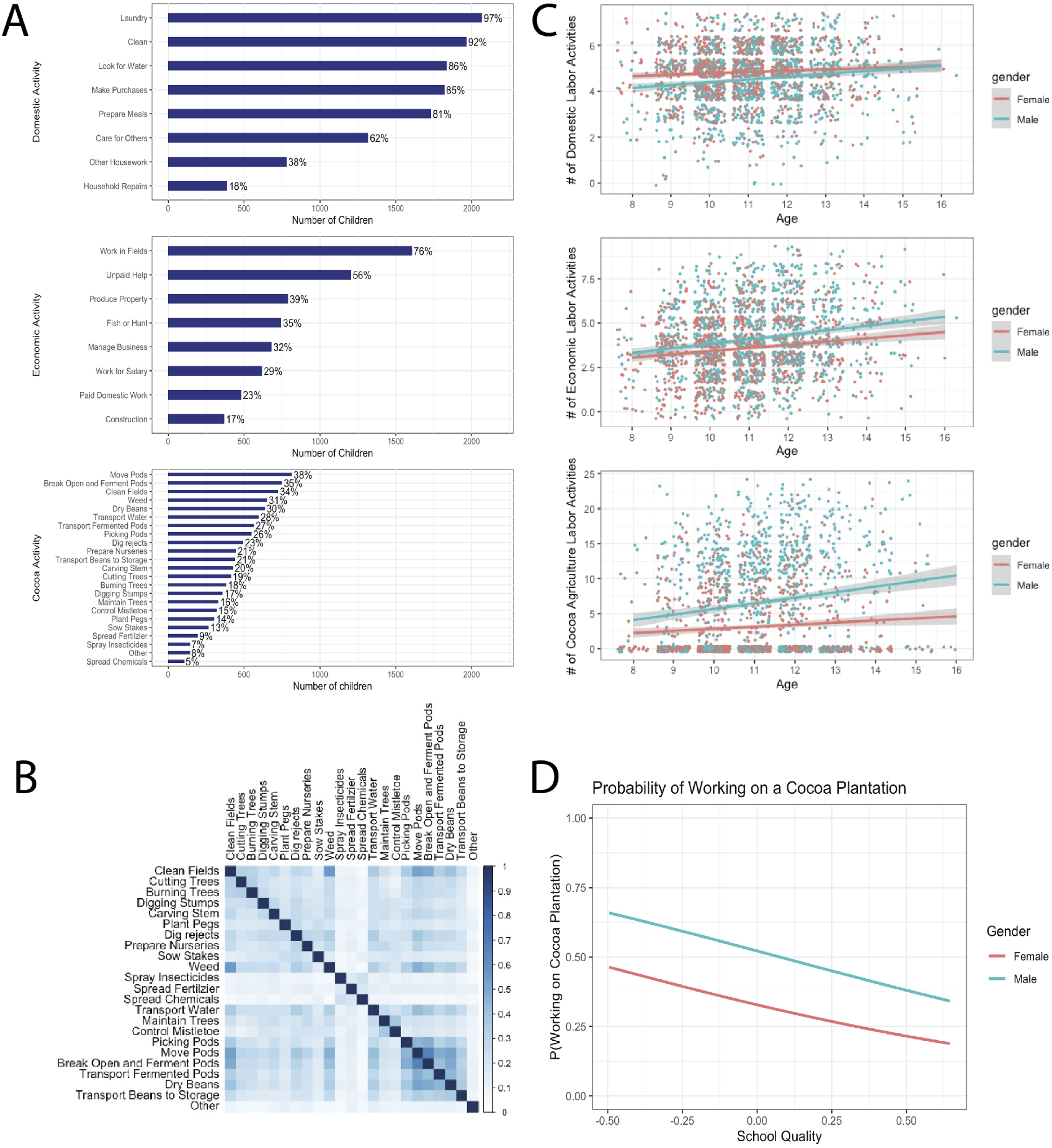
Associations within agricultural activities
The most commonly reported cocoa agricultural activities were related to the cocoa harvest (moving pods, fermenting pods) and farm maintenance (cleaning fields, weeding). 35% of children reported breaking open and fermenting pods and 19% reported cutting trees; both tasks require the use of a sharp tool, and are considered hazardous forms of labour for children. While the least commonly reported activities were spreading fertilizer, insecticides and other chemicals, up to 9% of children self-reported being engaged in these hazardous tasks. A number of cocoa agricultural activities were moderately to strongly associated, see Goodman–Kruskal τ results in Figure 1(B). For example, children who reported doing one harvest-related activity, such as picking, moving, and fermenting pods, transporting fermented pods, drying beans, and transporting beans to storage, were more likely to report doing other harvest-related activities (τ = 0.26–0.66).
Demographics and child work activities
Older age was associated with more domestic, economic, and agricultural activities. Boys reported more economic and agricultural activities, whereas girls reported more domestic activities, see Figure 1(C). Higher household SES was associated with increased domestic and economic activities, but not agricultural activities.
School quality and child work activities
Parameter Estimates of Age, Gender, Household SES, and School Quality Predicting Work Outcomes: Domestic and Economic Work and Agricultural Labour (Count Model for Number of Cocoa Labour Activities and Logit Model for Probability of Working on a Cocoa Plantation).

Note: +
Parameter Estimates of Specific School Quality Indicators Predicting Agricultural Cocoa Labour Outcomes: Count Model for Number of Cocoa Labour Activities and Logit Model for Probability of Working on a Cocoa Plantation.

Note: +
Discussion
This study examined the associations between school quality and children’s domestic, economic, and cocoa agriculture work activities in rural Côte d’Ivoire. Our results indicate that children who attended schools with a better infrastructure and better teaching materials had a lower probability of working on a cocoa plantation relative to their peers who attended lower quality schools; these results support our hypothesized link between school quality and child labour.
Côte d’Ivoire currently invests approximately 3.3% of its GDP on education (World Bank, 2018). Our findings suggest that focussing these investments on school quality, against the backdrop of a larger continental focus on the importance of quality education for Africa’s future (African Economic Outlook report, 2020) and the shift in global discourse from education access to quality (e.g. Britto et al., 2011; Mundy and Manion, 2021; Piper et al., 2006; United Nations Children Fund, 2019), may produce gains beyond school access and academic achievement: improving school quality may also address the systemic issue of child labour. Our findings may also inform conversations on increasing investments in education, to be at par with the world average education expenditure of 4.5% (World Bank, 2018). With a reduction in child work, Côte d’Ivoire might more fully realize the gains from the education reforms implemented. Together, our findings begin to reveal a complex system in which child- and family-level characteristics (i.e. gender, age, household SES) and children’s access to quality education impact child work.
Child work activities
Approximately 1 in 3 children (38%) self-reported working in cocoa agriculture, consistent with previous reports of child cocoa agricultural activities in Côte d’Ivoire (Sadhu et al., 2020). Furthermore, children who reported working on a cocoa plantation were likely to be engaged in multiple cocoa agricultural tasks. Nearly one-fifth of children reported that they were obligated to work, signalling that children may want to attend school but are faced with the difficult position of supplementing family income. Older children worked more relative to their younger peers across all three domains of activities (domestic, economic, and cocoa agriculture), and girls reported more domestic tasks while boys reported more economic and cocoa agriculture tasks, corroborating existing literature. For example, Del Carpio and Macours’ (2010) findings in Nicaragua: intrahousehold allocations of child labour prior to a social protection program is heterogeneous, with older children (boys in their context) more involved in child labour activities than their younger siblings. Across multiple contexts, girls are more likely than boys to work inside the home doing domestic work such as household chores, childcare, and elder care (e.g. Allais, 2009; Bonke, 2010; Del Carpio and Macours, 2010; Fares and Raju, 2007; Pells, 2011).
School quality
Our findings are situated within existing literature on school quality in Côte d’Ivoire and in SSA more generally. In line with our findings, primary schools, particularly in rural areas, face challenges in implementing high-quality primary education due to worn building infrastructure, a shortage of motivated and educated teachers, large class sizes, and insufficient and inappropriate teaching materials and classroom resources (Friedman et al., 2016; Heneveld, 1994; Lauwerier and Akkari, 2015), and insufficient teaching and learning materials in local languages (e.g. Ball et al., 2022; Muthwii, 2004; Piper et al., 2018).
About a third of schools lacked drinking water, almost half did not have latrines, and about a third lacked electricity. These results corroborate the statistics of the Ivorian Ministry of National Education: in La Mé region (Adzope), 38.9% of schools do not have electricity, 43.5% do not have functional latrines, and 54.9% of schools do not have drinking water. Given the lack of latrines and water in many schools, it is perhaps not surprising that over half of teachers reported public health problems in their schools. Class sizes were as high as 76 children, a number substantially higher than the Ivorian target class size of 40 students as per the Ivorian Ministry of Planning and Development’s Strategic Education Plan for 2015–2025 (2021), and higher than the observed average student:teacher ratio of 43:1 in Côte d’Ivoire (Ivorian Ministry of Education, 2021). This average Ivorian student:teacher ratio is very high compared to, for example, rates amongst OECD countries which average 21:1 (OECD, 2019). Most, but not all, teachers in our study reported completing a Pedagogical Aptitude Certificate (the Ivorian requirement for teaching), suggesting that many under-qualified teachers are working in rural schools. 3
Theorized mechanisms by which school quality impacts child work activities
Children’s participation in work activities, their education, and household economics connect through multiple and complex pathways, and the link between working and school quality may be explained by several mechanisms, see Figure 2. Our findings show that children who attend higher quality schools (with smaller class sizes, more qualified teachers, child-appropriate materials, a sufficient canteen program, and access to water and electricity and latrines) were significantly less likely to work on a cocoa plantation (and also reported less involvement in the number domestic and agricultural activities; Supplemental Table 3). The quality of school infrastructure and teaching materials related significantly to the probability of a child working on a cocoa plantation. In other words, the higher the school quality, the fewer the number of children who reported cocoa agriculture activities. As we did not observe any associations between school quality and domestic or economic activities in our main models, our results seem to uniquely relate school quality to cocoa agricultural activities. These results linking child work and school quality should be considered in the context of children’s participation in agricultural cocoa labour in Côte d’Ivoire being primarily a household-level decision. Potential mechanisms by which school quality impacts child work activities. We consider the multitude of pathways by which school quality and child work activities are interconnected. The circles represent the constructs examined in the research and rectangles represent factors that may play a role in the relation between the two. Though many mechanisms may be at play in this relation, our following discussion focuses on three overarching ideas: family factors such as decisions on child work and parental decisions about schooling, teacher factors as they relate to the quality of the school, and child factors such as interest in schooling and motivation to choose education over work.
Family-related mechanisms
One potential powerful mechanism linking school quality and child labour may be parents’ (or caretakers, or other family members) opportunity-cost decision to send children to school, rather than to cocoa plantation, when school quality improves. In poor households faced with severely limited options, parents may weigh the future benefit of sending children to school against the immediate economic survival of the household (e.g. Basu and Van, 1998; Grootaert and Kanbur 1995; Guarcello and Rosati 2007; Nkamleu and Kielland, 2006; Ranjan 1999; Rosati and Rossi, 2003). The parents may prefer their children to go to school, but when faced with higher costs of schooling or low quality of schools, may prefer that their children either combine school and work or only work (e.g. Edmonds and Pavnick, 2005; Webbink et al., 2013). These decision mechanisms may underpin our findings.
The choice to send a child to school or have the child work on a family cocoa plantation is even more significant in the context of the cocoa crop cycle with respect to the start of the academic school year. There are two cocoa harvests each year, a main harvest typically in October, and a second smaller harvest in April (Mull and Kirkhorn, 2005). Cocoa farming households typically earn their entire year’s income after beans are harvested and sold. The start of the school year in September and October coincides with the main cocoa harvest – a time period when cocoa farming families typically have their lowest cash reserves and the highest need for children’s work in an activity that generates much of their household income until the next harvest. The pressure for children to work on the cocoa plantation is greatest at precisely the moment when parents are faced with the decision to send their child to school. Indeed, our results show that children mostly engage in harvest and post-harvest activities, which start at the beginning of the school year. Therefore, schooling and work decisions may be intimately linked to the cocoa crop cycle and the financial constraints that households may face at the start of the school year. This may also be the reason that the economic and household work, which are not a main source of farmer livelihood in cocoa farming households, is not significantly linked to school quality.
In this context, for school quality to deter child work, the opportunity-cost of a child attending school rather than working on a plantation must shift to favour schooling. From the perspective of the parent, some features of quality schooling may be more salient than others. For example, if a child’s literacy and numeracy skills improve noticeably after attending school, parents can infer that schooling is effective and may be more inclined to support their child’s continued attendance
Interestingly, we found small positive associations between household SES and domestic and economic activities, but only a marginal association with agricultural labour. This positive relationship between household SES, schooling, and potentially hidden forms of child work such as domestic activities (e.g. Boutin, 2012; Rosati and Rossi, 2003) may indicate the complexity of the micro-relationships underlying this phenomenon. One mechanism by which household SES specifically impacts child work may be that children who engage in domestic and economic activities (non-agricultural income-generating work) indirectly contribute to household SES. For example, in replacing parental household work, they allow their parents to pursue more income-generating activities, which in turn may contribute to higher household SES. It may also be, as suggested by De Hoop et al. (2019) in the context of a cash transfer program in the Philippines aimed at increasing school attendance through a soft nudge, that working children help their households to fully cover the cost of education. Emerging programs and research in Africa has shown similar effects of cash transfers (Evans and Mendez Acosta, 2021) in improving school enrolment. These recent findings illustrate that the trade-off between a parent’s decisions between immediate reward from children’s participation in child labour and long-term success from schooling, is moderated by the costs associated with access to school. Therefore, in addition to quality schooling, factors such as SES must be considered in efforts to improve schooling outcomes.
Teacher-related mechanisms
School quality may also influence child work through teachers, specifically teacher absenteeism as a result of inadequate school facilities and infrastructure or classroom structure (e.g. Chaudhury et al., 2006; Lee et al., 2015). If the school lacks a latrine, water, and/or electricity, a teacher may be less inclined to come to work and stay for the entire duration of the school day. Similarly, if teachers face overwhelmingly large class sizes, or if there are insufficient learning and teaching materials available and limited school supplies, then teachers may feel ill prepared to teach to a classroom which frequently has children of different ages and skill levels. This would diminish teachers’ motivation and contribute to lower education quality in the classroom and increased teacher absenteeism. An absent teacher may result in cancelled classes, and children may return to their homes or to work in the fields with their parents. In turn, this schooling disruption may shift household perceptions of the opportunity-cost of sending children to school in favour of keeping them working at home for the household’s immediate benefit. The impact of poor school facilities and unavailability of teachers as a reason for student attrition has been previously suggested (e.g. Momo et al., 2019).
Child-related mechanisms
The child may also be agentic in the relationship between school quality and child work through either the
Implications for policy and practice
Our findings that higher school quality is associated with lower rates of child work has implications for both education and child labour policy formulation and implementation. Though there is no singular mechanism for examining school quality, issues related to educational attainment such as participation in work activities (examined here) as well as parent, school, and community factors are interconnected, nested within broader societal contexts, and differ by school (e.g. Evans and Mendez Acosta, 2021; Wortsman et al., 2024). We posit that the following contextual factors should be considered in both the improvement of school quality and the reduction of child labour.
First, school quality can be a nuanced policy tool to reduce child work which nudges the largely household decision about children working on family farms. This novel approach can augment existing mandates such as child labour bans or compulsory attendance, which may be blunter instruments against the breadth of reasons why individual families may be noncompliant (e.g. Basu and Tzannatos, 2003; Brown, 2001; Krueger, 1996). Bans, assuming adequate resources to enforce them, can have dire consequences for poor households (and their children) who resort to child work out of desperation to make household ends meet. Similarly, trade policies and consumer boycotts, while spotlighting child work, are unlikely to alter the household decision of a typical child cocoa labourer helping their parents on the family farm. We forward that child labour policies can be strengthened by including and measuring school quality, with consideration given to quality infrastructure that provides access to basic services alongside materials and human resources.
Second, our findings highlight the importance of strengthening, expanding, and evaluating high-quality infrastructure. The Ivorian government’s National and Education Sector Plans under the Global Partnership for Education (2017) aims to improve the quality of education and calls for quality school infrastructure and improved school safety, hygiene, and health in rural areas by constructing more latrines, hand washing systems, and drinking water points at schools. The government also plans to reduce class sizes and improve student-teacher ratios by constructing 3,000 additional classrooms per year and rehabilitating 5% of existing classrooms. We forward that aligning new high-quality school infrastructure, and updates to infrastructure, around
Third, in alignment with the myriad mechanisms through which school quality likely acts on parents and children (see Figure 2) to influence the household decision around child cocoa labour, multiple entry points are needed to nudge households along the continuum of children-only-working to children-only-going-to-school (e.g. Kembou et al., 2022). The pivot to remote learning, as a result of the COVID-19 pandemic, has illustrated that learning at scale can occur outside a restricted number of hours of the day at a physical school plant. We forward that the Ivorian plan to implement and expand high-quality infrastructure can be an opportunity to strengthen life-wide learning through a high-quality out-of-school education ecosystem, with adequate and appropriate infrastructure, material, and human resources.
Fourth, the effect of material resources on child cocoa labour supports the importance of high-quality human resources and teaching-learning materials, which make learning relevant. The National Development Plan (Ivorian Ministry of Planning and Development, 2021) recognizes teachers as important to school and education quality: many teachers are under-trained, lack professional support, and have access to limited teaching material for teaching students. The Ivorian government plans to increase teacher training from 2 to 3 years, conduct regular pedagogical monitoring of teachers, and improve teaching and learning materials. We forward that attention should be given to the material resources to align with the needs of the community so that households perceive the learning in schools as relevant. Though our study did not examine whether teaching materials were relevant in the community, teaching materials aligning with the language of instruction have been found to impact learning outcomes (Ball et al., 2022, 2024); therefore, we posit that relevant teaching materials may increase school quality and thereby decrease child labour. It may be that if parents (and children) see their learning as immediately relevant to their lives and understand the material, it may motivate higher engagement with school in lieu of immediate household benefit. Investing in school quality as a lever against child work represents value added to this government investment (The Department for International Development, 2013). A quality education will develop human capability irrespective of whether the long-term outcome for this education is coupled with the labour market. We urge policy-makers and practitioners to consider that investments in high-quality education in Cote d’Ivoire can lead to not only higher levels of literacy and numeracy, but also improved health outcomes, from a combination of access to clean water and sanitation at schools, as well as reduced exposure to physical, chemical, and social hazards while engaged in child labour. Coupled with an economic environment that facilitates and encourages private sector development in these areas, such as through successful microentrepreneurship, or the establishment of fair-trade co-ops which engage in better farming practices, investments in high-quality education that draw children out of child labour has the potential to break the cycle of persistent intergenerational poverty and unleash the human capital and sustainable development of the nation.
Fifth, the direct and indirect costs of accessing education must be considered. Direct costs refer to tuition and enrolment costs, while indirect costs refer to external costs such as books, uniforms, supplies, and transportation. In general, education costs tend to be higher for those in rural than urban areas because access is a driver of higher costs. Urban areas are often more abundant with educational resources like schools, libraries, and other educational facilities, while rural areas are sparsely supported (UNICEF, 2023; Wood, 2023). This lack of access in rural areas leads to higher indirect costs. One such rural penalty is higher transportation costs due to longer travel distances or lack of quality or reliable transportation infrastructure (e.g. AU/UNECA, 2005; Gertler and Glewwe, 1990; Porter, 2010). Rural costs are further compounded by indirect opportunity-cost of children’s time. In the context of LMICs and households in poverty, children’s work, including housework and agricultural labour, is often a significant contribution to family income (e.g. Gertler and Glewwe, 1990).
Estimates from the 2021 Rural Development Report found that globally, 70% of people in extreme poverty and 74% in moderate poverty live in rural areas. As families in rural communities tend to be more impoverished, especially in Côte d’Ivoire (Fonds monétaire international, 2009), ‘reaching the poorest children will necessarily involve higher costs because their learning needs are greater than richer children and require substantial support from education systems’ (UNICEF, 2023: 5). For these reasons, it is recommended that governments take an equitable approach to educational spending (UNICEF, 2023; United Nations Children Fund, 2019). In other words, additional funding targeted specifically at increasing access to quality education to support learners with the greatest schooling needs, especially in rural areas.
Limitations and future directions
Our findings reveal important links between school quality and child agricultural cocoa labour and suggest potential mechanisms by which improved school quality may reduce child labour. However, it should be noted that our findings reveal
Future studies can also narrow down the specific aspects of school quality that pull children into school and away from labour – for example, pinpointing the specific aspects of school infrastructure (e.g. WASH facilities) that have the greatest impact on child labour reduction may allow for more targeted and impactful educational investments within LMICs.
As costs associated with schooling in Côte d’Ivoire can be prohibitive, this is also an important area of future research. As families with higher SES and those with more educated parents may allocate more financial resources towards schooling (Buchmann, 2000; Davis-Kean, 2005; Wolf and McCoy, 2019), future work can investigate whether SES and parental education and investments moderate the relation between school quality and child work activities.
Child work data was reported by children in this study. Since the effect of the type of respondent (parent, child) on child work statistics is not clear a priori (e.g. Dammert and Galdo, 2013), we must interpret these findings with caution. However, child-reported information may be more accurate than proxy responses (e.g. parent) if the child knows best what work activities(s) he participates in (Lichand and Wolf, 2022). While we did not use proxy respondents, a proxy respondent may be familiar with the children’s activities and the frequency and continuity of work activities. The broader measurement error literature highlights relevant factors such as the salience of work activities, and recall decay bias (e.g., Bound et al., 2001). This literature, however, also suggests that our reports of child work might be downward biased, providing a lower bound for the effect of school quality and other predictors. In fact, given the already high prevalence of child labour in our study area (>30% according to recent estimates), the recall bias will likely only reduce the propensity that the child reports being engaged in child labour. Furthermore, proxy respondents (i.e. parents) may be also inaccurate; for example, social desirability biases may lead parents to under-report their child’s work. Further, there is no reason to expect that biases in child work reports would differ from high to low quality schools.
We emphasize that this study focuses on the type of child agricultural cocoa labour that is common in rural cocoa-growing communities of Côte d’Ivoire: a majority of these children who are enrolled in school are faced with managing the dual demands of attending school and child work activities, whether domestic, economic, or agricultural. Our exploration stops at the border of school quality being a push-pull factor for those children who are enrolled in school while engaged in work activities. Since our sample excludes those children who are not enrolled in school, we do not know if poor school quality can push children out of schools entirely (although recent research in Côte d’Ivoire suggests that school quality is protective factor against dropout; Wortsman et al., 2024). Yet our study may impact out-of-school children; if school quality is high, parents’ and students’ incentives to attend school may increase (i.e. if WASH facilities and canteens are adequate and learning outcomes afford children more opportunities, parents may deem a school as safer and more valuable) – high-quality schools may
Lastly, though our work focused on several broad dimensions of school quality, additional measures pertaining to education in Côte d’Ivoire could shed more light onto the domains in which governments and education professionals can intervene in order to bolster children’s academic achievement. Teacher-quality, for example, was limited to professional demographics such as years of teacher satisfaction, experience, and education level. However, we believe there are valuable additions that could better inform research into high-quality teachers. For example, though the current study focuses on primary school where one homeroom teacher teaches every subject, research has shown that it is common for teachers in sub-Saharan Africa have not mastered the teaching curricula or have weak subject knowledge, a factor that contributes to poor student outcomes (Bainton et al., 2016; Bold et al., 2017). Additionally, significant linguistic diversity within Côte d’Ivoire (Assanvo, 2017) may affect a teacher’s ability to provide sufficient instruction. In the current study, only one-third of teachers spoke the Ivorian language of the village in which they taught. Future work should use additional measures of teacher quality such as subject-level knowledge, didactic skills, professional goals and values, and burnout (Bietenbeck et al., 2023; Buckler, 2015; Madigan and Kim, 2021) to better understand this important dimension of education quality. Further, a combination of teacher-reported data, classroom observations, government indicators, and children’s learning outcomes would provide more informed insights into education quality (including school quality). Given the important links we have observed, an important next step in this research agenda is the inclusion of a broader range of school and education quality measures. Further, a combination of teacher-reported data, classroom observations, government indicators, and children’s learning outcomes would provide more informed insights into education quality (including school quality). Given the important links we have observed, an important next step in this research agenda is the inclusion of a broader range of school and education quality measures.
Conclusion
While there is extensive research showing
Note
Child labour is a complex phenomenon and many factors promote or maintain this phenomenon including the unavailability or prohibitive cost of schooling, gender-based cultural norms, and individual family needs. Dammert et al. (2018) typologize five common policy and legislative approaches to combat this are: (1) increasing labour market access through labour-oriented programs (e.g. micro-entrepreneurial activity, public works); (2) increasing household income for the unbanked or under-banked through microfinance programs (e.g., business loans); (3) cash transfers programs (cash, in-kind non-fungible goods, and services such as food for education) to households either with no-strings-attached, or conditional upon compliance with schooling and health requirements (e.g. school enrolment, health visits); (4) targeted child labour programs (e.g. information campaigns to parents, employers, children, and policy makers about the negative consequences of child labour, integrated interventions to reduce risk of working such as incentivizing school attendance through take-home rations alongside raising parental awareness); and (5) schooling incentives (e.g. reducing cost of education, expanding pre-schools). They also point out that these have met with varying success and in some cases increased child labour rates, pointing to the complex set of factors that influence this phenomenon.
Supplemental Material
Supplemental Material - Accelerating progress towards eradicating child labour (SDG8.7) with quality education (SDG4): School quality is linked to reduced child cocoa labour in Côte d’Ivoire
Supplemental Material for Accelerating progress towards eradicating child labour (SDG8.7) with quality education (SDG4): School quality is linked to reduced child cocoa labour in Côte d’Ivoire in Brooke Wortsman, Jasodhara Bhattacharya, Joshua Lim, Fabrice Tanoh, Shamina Shaheen, Amy Ogan and Kaja Jasińska in Research in Comparative and International Education
Footnotes
Acknowledgements
Declaration of conflicting interests
Funding
ORCID iDs

Supplemental Material
Notes
Author biographies
References
Supplementary Material
Please find the following supplemental material available below.
For Open Access articles published under a Creative Commons License, all supplemental material carries the same license as the article it is associated with.
For non-Open Access articles published, all supplemental material carries a non-exclusive license, and permission requests for re-use of supplemental material or any part of supplemental material shall be sent directly to the copyright owner as specified in the copyright notice associated with the article.
