







Abstract
Keywords
Background
As the evolving healthcare delivery landscape is increasingly impacted by digital technologies and the transformations they bring (World Bank, 2023), a competent healthcare management workforce, confident in their capabilities to employ and effectively incorporate digital health technologies into health service delivery, is imperative (Australian Government, 2023; Brommeyer et al., 2023b; Laukka et al., 2022; Monkman et al., 2023). Yen and Anderson (2023) suggested that digital health is increasingly becoming a dominant knowledge area in the healthcare industry, thus warranting distinct prominence in health services management courses.
There have been a variety of pathways for health service managers to develop knowledge and skills, including university programs tailored for health service managers and programs developed by professional associations, such as the Australasian College of Health Service Management. It is essential to understand the existing structures and factors that can enable competency development and education in digital health management, particularly the extent to which organisational factors, institutional elements and postgraduate healthcare management education in Australian universities facilitate the development of knowledge and skills for digital health competency development. Competency mapping of the existing Australasian College of Health Service Management (ACHSM) Master Health Service Management Competency Framework competencies to the existing health informatics competency statements from the Australian Health Informatics Competency Framework (AHICF) was undertaken to investigate whether postgraduate healthcare management education in Australian universities facilitated the development of informatics competencies (Brommeyer et al., 2021). The mapping indicated that some of the competencies for health informaticians may be important for health service managers, but no research to our knowledge has confirmed to what extent they are relevant to health service managers. Furthermore, previous research has confirmed that integrating infrastructure, frameworks, systems, processes, resources and strategies is required to develop digital health competencies (Fernández-Luque and Ramírez-Montoya, 2024). Within the changing context of digital health, health service managers should demonstrate a clear understanding of the interdependent elements of roles, responsibilities and competencies. Managers must also recognise the growth in their organisation’s local digital technology expertise and how to access these resources. This is particularly true for how these needed competencies and capabilities translate into contextual competence in a digitally transforming environment (Borges do Nascimento et al., 2023b; Iyamu et al., 2025). In addition, with these digital health capabilities come increased responsibilities for the manager’s role associated with leading and managing in a digital health context, both regarding digital information systems and the transformation of data into decision-making for various aspects of their health system context.
Competencies now require health service managers to be cognisant of this rapidly changing digital environment in which health care is delivered and managed. Existing health service management and digital health competency frameworks need to be contemporary, contextual and aware of the increased complexity in the changing landscape to more accurately reflect these changing work priorities (Bouwmans et al., 2024; Jarva et al., 2024; Khan et al., 2025). A recent study elucidated the organisational barriers confronting health service managers in the Australian public hospital sector in realising digital transformation benefits, noting that these barriers require system, organisational and local investments, assuring that benefits can be transformed into value within the healthcare environment (Brommeyer et al., 2024b). Addressing these barriers includes institutional investment in workforce digital capability development and individual health service management competency enhancement.
The current research
The current study focussed on identifying the additional requirements, responsibilities and competencies for managers working in the digital health context. The study was situated in the Australian context, focusing on mid-level health service managers who have the operational responsibility to manage the overall provision of service in the public hospital setting. Acknowledging the increasing investment in digital health during and post the COVID-19 pandemic, particularly in the public healthcare environment (D’Anza and Pronovost, 2022; Sturgiss et al., 2022), there are important implications for healthcare management in the global context of digital transformation. Contextualisation of the findings against other territories and environments would require calibration with local priorities and prevailing jurisdictional settings. The study adopted the following definitions to conceptualise the key terminologies of the complex human behaviours required to enable digital healthcare to support the outcomes required from “multiple person-centred care requirements” (Brice and Almond, 2020: 1375) as applied to mid-level health service managers in the Australian context. Competency is seen as “The observable ability of a person, integrating knowledge, skills and attitudes in their performance of tasks” (Mills et al., 2020: 12). Capability can be considered as a broader concept that describes the ability to use transferable skills in both new and familiar situations (Brunner et al., 2018; Rimpiläinen, 2024). Responsibilities are conceptualised as the obligation or duty to ensure that particular tasks are performed to achieve specific results (McGrath and Whitty, 2018). Roles are viewed as “A category that characterises certain groups of activities . . . that serve a common purpose . . . (and) determines scope of practice” (Mills et al., 2020: 12).
The aim of the study was to explore perceptions and experiences of middle-level health managers regarding changing responsibilities and competency requirements in the digitally transforming context, and to develop recommendations for how to support health service managers in demonstrating the required competencies for digital transformation. In addition, implications for the Health Information Manager (HIM) Professional Competency Standards version 4.0 (Health Information Management Association of Australia, 2023) were explored, with an aim to complement the existing literature by academics and researchers in the field of digital health by adding the lived experiences of middle-level managers who implement the digital health systems in real life practice on a daily basis. The article presents key findings from data collected from responses to three questions addressed at focus group discussions (FGDs):
As a manager, what
As a result of adopting digital technologies, have you noticed any
In the last 5 years, as a result of introducing digital health into your organisation, have your
Method
Six online FGDs were conducted, guided by the protocol detailed in Brommeyer et al. (2023a), each with an approximate duration of 90 minutes. Mid-level managers were recruited across Australian public hospitals. The discussions were digitally captured using the recording and transcription features of the Microsoft Teams videoconference call. The FGD participants’ characteristics are detailed in Box 1.
Focus group discussion participant characteristics.
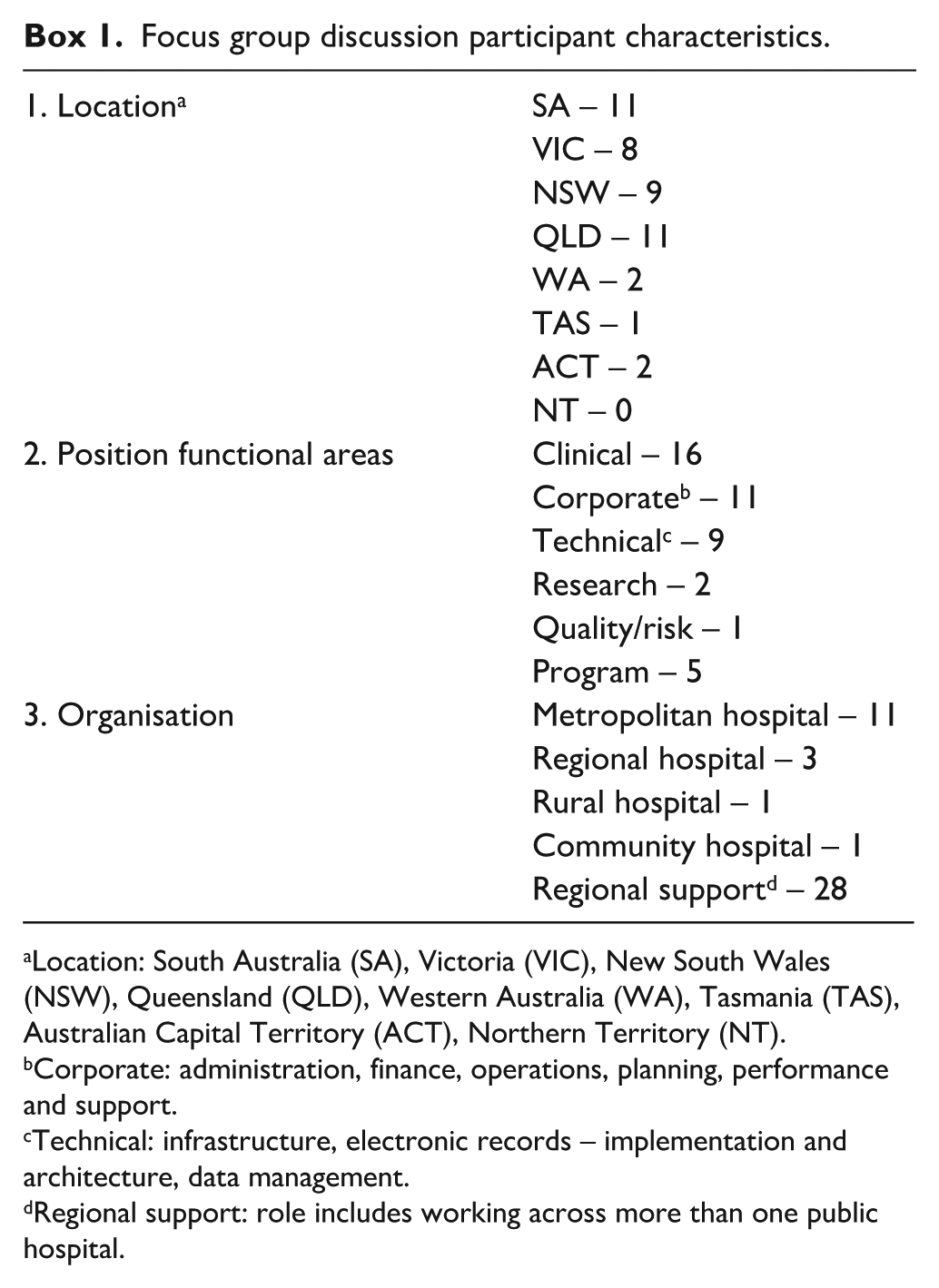
Location: South Australia (SA), Victoria (VIC), New South Wales (NSW), Queensland (QLD), Western Australia (WA), Tasmania (TAS), Australian Capital Territory (ACT), Northern Territory (NT).
Corporate: administration, finance, operations, planning, performance and support.
Technical: infrastructure, electronic records – implementation and architecture, data management.
Regional support: role includes working across more than one public hospital.
Middle-level health service managers were selected as the focus of this study as they provide an important understanding of the knowledge and skills required in the implementation of digital health, as well as the link between strategic and operational decision-making with the day-to-day use of digital health. Demographic details collected included participant name, position title, name of organisation, and the Australian state or territory in which they work. As the number of FGD participants was small (44) and in a small and identifiable community, it was important to maintain anonymity and ensure participants could not be identified based on this sample size. Eligible participants were contacted directly via email to provide a formal invitation to participate in the FGD, which contained a copy of the Project Information Sheet and Consent Form. Each participant responded to the email invitation with confirmation of participation and consent to participate in the research project.
To avoid any participant terminology confusion, during the FGDs, the terms “skills” and “knowledge” were used instead of “competency.” During the analysis, previously confirmed core competencies were used to group the identified skills and knowledge (ACHSM, 2022; Australasian Institute of Digital Health, 2022; Liang et al., 2018). Those that could not fit into the existing core competencies were itemised and grouped into new competency statements. Deductive data analysis was then undertaken against empirically validated and industry-based competency frameworks, including the 2022 ACHSM Master Health Service Management Competency Framework, the AHICF Second Edition, and the management competency assessment tool (ACHSM, 2022; Australasian Institute of Digital Health, 2022; Liang et al., 2018).
Braun et al (2019) reflective thematic analysis process guided the data coding and analysis. As previously detailed in a published protocol (Brommeyer et al., 2023a), the stages included: (i) familiarisation, (ii) generating codes, (iii) constructing themes, (iv) revising themes, (v) defining and (vi) producing the report. This refined the themes as meaning-based patterns in both explicit and conceptual ways, supporting the development of patterned meaning across the dataset (Braun et al., 2019). Transcripts of all FGDs were analysed using NVivo software (Lumivero, version 14). Thematic analysis was conducted iteratively, with data from the FGDs to inductively develop concepts, categories and themes. These initial themes were thematically coded in NVivo 14 software by the lead author, then compared and contrasted with the two co-investigators (ZL and MW) to search for coherence of the themes in addressing each research question. Analysis was undertaken to categorise competencies against current national and international health service management and digital health competency frameworks (ACHSM, 2022; Australasian Institute of Digital Health, 2022; Liang et al., 2018). Braun et al (2019) six-phase, reflexive thematic analysis approach was used to distinguish, explore, organise and advance insight into themes and categories of the factors emerging (Braun et al., 2019).
Ethical considerations
This research received ethics approval from the James Cook University Human Research Ethics Committee on 20 October 2022 (approval H8877). Before commencing the FGDs, personal information, including participant name, position title, name of organisation and email address, was collected. However, participants’ names were replaced with a code in the FGD transcript to maintain anonymity. Identifiable information was not included during data extraction and analysis. Participants did not receive any type of payment or compensation for their participation.
Results
Changed responsibilities as a result of introducing digital health into the organisation
Twenty-two broadened responsibilities were raised by FGD participants as a result of adopting digital technologies, which were grouped into six initial major themes: (i) accountability, (ii) confidentiality, (iii) decision-making, (iv) expectations, (v) governance, and (vi) staff training. These themes were then aggregated into four major themes, namely (i) governance and confidentiality, (ii) digital expectations, (iii) accountability and digital decision-making, and (iv) staff training. This reduction was necessary because there were insufficient data in some themes; some themes were actually subthemes of another, and the iterative process helped to identify a manageable and meaningful set of significant themes that were clearly distinct from each other and reflected clearly the key patterns and meanings from the data (Nowell et al., 2017). See Figure S1, online supplement.
Governance and confidentiality
Many of the FGD participants described how adopting digital technologies has increased their responsibilities for governance and confidentiality. This included balancing the need to access and share personal and organisational data, relying on the integrity of the data for collaborative problem-solving and assuring the confidentiality of the digital data. Additional digital governance responsibilities articulated by the participants reflected the juxtaposition between digital innovation, digital strategy and digital system integrity requirements. Participants also discussed the increasing need to support executive management’s capability for digital health strategy and governance.
Digital expectations
Most FGD participants noted an increased requirement to be contactable 24/7 for both urgent and emergency situations, and to work out-of-hours on the “business-as-usual” operational matters such as catching up on routine emails and electronic communications, so as to keep up with day-to-day work requirements. These have caused constant interruptions to the home-life-work balance. Participants were also expected to engage in organisational digital technology workshops and meetings, and to be available, informed and digitally omniscient to represent multiple stakeholder views and technology requirements.
Several participants illustrated the increased responsibilities experienced with digital decision support that was often seen as not being fit-for-purpose, not supporting contextual decision-making, and increasing, not decreasing, the manager’s responsibility for manually having to remember additional information. These participants also discussed the challenge of balancing the increased day-to-day tactical decision-making required from increased digital information availability, with the need to strategically innovate and operationally resource digital technology adoption. Participants discussed the growing expectations also being experienced with understanding the health and management information implications of increased access to digital technologies for patients, staff and the organisation. Participants noted that the more information that was available to the individuals and the organisation, the more communication and clarification obligations the managers experienced, particularly if they had a clinical background. Participants identified increased complexity in needing to balance the greater accountability expected of prioritising digitally augmented business and clinical decisions with the organisational goals of technology innovation. In addition, participants discussed concerns regarding executive expectations of them to be able to implement digital technologies used in other hospitals, for example, and to support executive decision-making for innovation investments without an in-depth understanding of the digital landscape.
Accountability and digital decision-making
Many of the FGD participants perceived that a number of increased accountabilities were required, including having to balance conflicting organisational imperatives and priorities for ensuring the digital information available for decision-making (strategic and client levels) is contemporary, contextual and trusted. This demanding environment was often exacerbated by the increasing rapidity of decisions required, often with insufficient information. The urgency and reprioritisation of operational activities by external agents, including health department executives and government ministers, were highlighted by many of the participants as challenging to navigate, particularly when the constant need to embrace digital innovation is seen as a strategic imperative by the organisation and departmental executives.
Increased accountabilities were also discussed by some participants, who saw escalating amounts of digital information available and a growing concern about the quality of data used to make decisions and the accountability for such decisions. As FGD participants expressed, this sense-making of the data coming from digital systems was demonstrated in practice with the ability to clearly present this digital data in a format that can support both executives and clinicians in their decision-making. These participants discussed increased expectations of being a digital innovation expert to answer executive, strategic questions on-the-fly and the growing expectation that with every new digital technology comes increased performance expectations to manage resources, risks and outcomes. For example, one participant explained that when a new virtual care service was rolled out across an organisation, there were additional governance and accountability measures expected of the manager to ensure that the clinical benchmark of the 30-minute timeframe to service was achieved. The sense that with every new technology comes a new personal health manager’s performance measure was verbalised, as well as the growing number of digital health performance measures that managers increasingly need to manage on a day-to-day basis.
Staff training
Increasing responsibilities for staff training were explained by the FGD participants, including supporting skills and knowledge acquisition for team members in being able to use the available digital tools in real time. Participants also discussed how they are now experiencing an increased responsibility for educating staff about proper governance arrangements for all digital assets used, as well as feeling an obligation to mentor executive management about digital health capabilities. This is in addition to the increased need for managers to train staff in real-time reporting and developing digital dashboards for executive reports.
Changes in the skills and knowledge required to perform health service management work in a digital health context
When FGD participants were asked about the
Applying digital system knowledge
As a result of adopting digital technologies, knowledge of the various health system workforce requirements for digital data, technology and literacy was highlighted as an additional skill that is increasingly required by many of the FGD participants. As the participants explained, they are often the “go to” person to support the various healthcare professionals in their workplace being able to access, use and manage the digital tools available, particularly where timely clinical and management decision-making is needed. A few participants acknowledged that the digital governance of these systems is not always clearly delineated, particularly when using multiple systems from different vendors to provide integrated information required for business and clinical decision-making. For example, which system is seen as the source of truth in the fast-paced, dynamic healthcare environment?
Data management
Data management was highlighted as an enhanced skill by many FGD participants. This included driving and supporting the need for a common language and an understanding of transdisciplinary data requirements across the organisation. Importantly, the accuracy, provenance and reliability of the data were discussed by some of the participants. The ability to contextualise the data to explain the meaning of the aggregated information, made visible in performance indicators and dashboards, was emphasised as part of this discussion. Several participants observed that an increasing breadth of data literacy is required to manage effectively, with evidence-informed decision-making being predicated on access to timely and accurate digital data. A few participants observed that managing healthcare performance also requires dealing with additional ambiguity when using multiple datasets from various digital systems that may not have standard data definitions to populate performance dashboards.
Change management
As a result of adopting digital technologies, change management was highlighted as an enhanced skill requirement needed to lead and manage in the workplace by some of the FGD participants, particularly across different staff with digital literacy levels, to provide additional support through the digital changes occurring in the workplace. As the FGD participants described, there was a consistent message that change management was broader in scope than before and that this entailed the integrated application of change, project, stakeholder, and risk management in the digital health setting, which was required to support digital transformation across multiple digital projects.
Supporting digital development
Increased skills and knowledge are required to educate staff, which was emphasised by a few of the FGD participants, including the changing role requirements of the various practitioners operating in the digitally transformed workplaces. Seen as the “go to” person, the participants also illustrated the increasing need to support staff with digital and data literacy education across the multidisciplinary team. These participants further discussed the need to lead and support a standard digital vocabulary across the workforce to facilitate a shared understanding.
Vendor management and negotiating
The adoption of digital technologies also required additional skills for vendor management and negotiating in the technology field. This was elaborated by a number of FGD participants in describing the need for self-sufficiency in supporting local digital solutions to meet the information requirements for rapid, data-informed decision-making. The importance of being able to negotiate with digital technology vendors and acknowledging the need for a heightened awareness of contract management in the digital environment was also expressed by these participants. The increased complexity of technology, terminology and timeframes for digital health procurement included an additional understanding of the commercial nuances required across the digital system development lifecycle.
Governance and security
Increased knowledge and skills supporting digital governance and security are essential, as was brought to light by some of the FGD participants. As the FGD participants expressed, there was a recurring message that digital security was now broader in scope for two major reasons. The rising number and impact of health-related cybersecurity breaches (Argyridou et al., 2023; Salama et al., 2024), along with the unwanted and increased media scrutiny, posed a deeper concern to the participants. These omnipresent cybersecurity threats are additionally amplified due to the electronic personal health information privacy, security and governance requirements. One of the major issues recounted by a few of the participants was the need for individuals to have heightened awareness of cyber-hygiene, and that cybersecurity is everyone’s business.
Contextual skills and knowledge required to perform health service management work
When FGD participants were asked about the skills and knowledge they needed to perform their healthcare management work in the digital health context, 23 key skills and knowledge domains were identified. Nine initial codes emerged from the FGD participants’ responses, these were (i) agility, (ii) change management, (iii) common language, (iv) data management, (v) decision-making, (vi) governance, (vii) project management, (viii) risk management, and (ix) system capability. To address the need for more coherence and inadequacy of data in some themes, these initial themes were then aggregated into five major themes, namely (i) change project and risk management, (ii) contextualising digital system functionality, (iii) data management, (iv) governance and decision-making, and (v) digital agility and shared digital language. Under each of the five major themes, three to six key skills and knowledge characteristics were categorised through iterative coding. Key skills and knowledge characteristics under each of the themes are outlined in Figure S3, online supplement.
Change, project and risk management
Change, project and risk management were highlighted as significant requirements by some of the FGD participants. They discussed the need for applied knowledge of related digital capability frameworks and maturity models required to manage the digital ecosystem in the workplace. Knowledge of organisational data provenance was underscored by these participants when describing the need to have sound knowledge in the application of digital governance to manage business and clinical risk.
Contextualising digital system functionality
Contextualising digital system functionality was highlighted by most of the FGD participants as an essential skill increasingly required to manage in the workplace. Many of the participants reinforced the business and technical knowledge required, including a necessary understanding of the link between decision support and digital knowledge.
Data management
Most of the FGD participants highlighted that the skills and knowledge required for data management were increasingly needed. Discussions with the participants explored the complementary roles necessary to manage a discipline-based workforce, supported by the broad ability to position data in context. Many of the participants emphasised this discussion by describing the data definitions needed to ensure data quality to support decision-making, further illuminating the importance of data literacy skills. In ensuring the consistency and accuracy of data used to inform contextual decision-making, some of the participants again observed that foundational knowledge of data provenance is essential, not only from a risk management perspective (as mentioned in
Governance and decision-making
Accountabilities required in the current health service management context necessitate a heightened awareness of governance and decision-making, particularly when it comes to improving the safety and surety of digital decision-making in the workplace. There was also the expressed need to bridge the divide between business, clinical and technical domains, with digital knowledge and technical dexterity to support real-time decision-making based on the various digitally generated information. The ability to support key stakeholders in digitally applying organisational knowledge was also discussed by several participants as an important skill needed in the healthcare manager’s toolkit, to assist in strategically influencing corporate digital decision-making.
Digital agility and shared digital language
Some FGD participants emphasised a manager’s adaptive ability and digital agility as a required capability. With the rapid pace of digital transformation, disruption to existing work practices requires managers who can demonstrate agility in adapting to these emerging challenges and opportunities for sustainable health care in the digital age. These participants discussed the strategic link between data quality to supporting business and clinical decision-making, and using the proper digital tools to provide accurate management information. Acknowledging the strength in diversity of multidisciplinary teams, a few of the participants also recognised the importance of having an operational understanding of various healthcare roles across the organisation, and the need to champion a standard, shared digital language.
Competency requirements for health service managers working in the digital context
Previously confirmed core competencies were used in this study to group the identified skills and knowledge, from both the changing and contextual skills and knowledge required, to perform health service management work in a digital workplace (ACHSM, 2022; Australasian Institute of Digital Health, 2022; Liang et al., 2018). Those that could not fit into the existing core competencies were itemised and grouped into new competency statements. Table 1 categorises the competencies identified with their associated competency statements developed from the study findings, for health service managers working in the Australian public hospital context.
Digital competencies for health service managers.

Discussion
Changing competency requirements for health service managers working in the digital context
The findings of this study indicate that the digital competencies managers need require demonstration of much broader competence across eight identified competencies (Table 1). It should be emphasised that the purpose of the AHICF is to define competencies required for healthcare workers more generally to specialise as health informaticians (Brommeyer et al., 2024a); hence, it is important that this study identifies the required competencies for health service managers working in the digital health context. Our findings are also relevant to HIMs who take on leadership and operational management roles in healthcare organisations, which require them to possess competencies not only relevant to their own profession but also as health service managers. While a number of these eight identified competencies are reflective of health service management and digital competencies more generally (Laakkonen et al., 2024), the unique attributes identified in this study highlight and underscore the importance of enhancing digital competencies for health service managers. Therefore, refinement of these manager skills and knowledge domains, under each of the existing competencies, is required for health service managers to lead and manage in the digital health context. The unique attributes identified can augment existing competency frameworks to ensure they remain contemporary and comprehensive, reflective of the dynamic digital environment in which health care is managed and delivered. The recent and rapid adoption of generative artificial intelligence at scale in the health sector further highlights the dynamic nature of the work of health service managers and the need for competency frameworks to be amended as work practices change and evolve.
The results of this study point to two main areas of management competency enhancement required. First, competence in digital data management and security, and second, the management of digital technologies in practice. These findings indicate that institutional management competency frameworks may need to be upgraded, and continuous professional development may need to be provided within the institutional or accreditation authorities to managers and the healthcare provider users of digitally enhanced information systems. Implications for HIMs have been included in relevant sections, in relation to the HIM Professional Competency Standards version 4.0 (Health Information Management Association of Australia, 2023). Consequently, the following elements need to be considered to empirically enhance existing competency frameworks.
Digital data management and data security
Managing information in health care is fundamentally important in supporting practitioners to achieve the required clinical and business outcomes. Personal health information, which is a highly valuable resource requiring security and sensitivity, is created, captured, communicated and considered across provider disciplines and service locations (ACHSM, 2022; Australasian Institute of Digital Health, 2022; Chidambaram et al., 2024; Pool et al., 2024; Woods et al., 2023). Participants in this study highlighted the complementary roles that are required to be able to work with a multidisciplinary workforce, including the ability to position digital data in context for different members of the team. The accuracy, provenance and reliability of the data, along with the ability to contextualise the data to explain meaning, particularly when using performance indicators and dashboards, were identified as important skills to possess in the digital health environment. This has potential implications for HIM competencies, including
In health service management, data-led decision-making is one of the critical contributors to effective and efficient management and supports the provision of safe, quality care (Enticott et al., 2021; Pool et al., 2024; Travaglia and Debono, 2023; Woods et al., 2023). In the digital environment, this decision-making ability is transformed by the veracity and volume of digital data used and the surety required in practice to deliver quality data, which is predicated on managers’ digital health literacy and awareness of advances in digital health technologies (Brommeyer et al., 2023b; Stoumpos et al., 2023; World Health Organization, 2023). As this study highlighted, public hospital managers need influence and agility to support digital integration and governance across multiple digital systems and technologies, while ensuring that digital governance principles are promoted and applied locally. This will assist in improving the accuracy, provenance and reliability of the data being used to support data-led decision-making. Potential implications for HIM competencies include the
The language of health care is complex and presents communication and interpretation challenges for patients and practitioners alike (Arias López et al., 2023; Ghorbanian Zolbin et al., 2022; Kim et al., 2023; Wang et al., 2022). A shared digital language is vital in the digital health workplace and is recognised as an important instrument in supporting the sharing of digital transformation knowledge across organisations (Cresswell et al., 2021; Kaihlanen et al., 2022; Srivastava et al., 2023). This study reiterated this need, underpinned by an operational understanding of various healthcare roles across the organisation. As others have noted (Duvivier and Gupta, 2023; Mainz et al., 2024; World Bank, 2023), managers will have to “champion” the need for and use of standard data definitions, which are supported by appropriate data provenance for effective decision-making. This has potential implications for HIM competencies, including
As this study elucidated, managers found that the ability to demonstrate digital system knowledge included the technical knowledge of how the system works in practice, operational knowledge of business and clinical needs for digitally enabled decision-making, and strategic knowledge of digital governance was important. The implications for managers include developing additional knowledge in the data, technology and strategic domains. Further, there was a need to support local and executive system users in harnessing the power of digitally enabled clinical and business decision-making in a safe and efficient manner. Potential implications for HIM competencies include
Our results also identified that increased skills and knowledge in supporting digital governance and security are essential. Healthcare service delivery is premised on the availability of information, when and where it is needed, to make effective business and clinical decisions (Petrakaki et al., 2025). The surety of this digital information is also premised on managers’ knowledge of data custodianship and the digital stewardship required with digital systems. This study found that data custodianship is important in ensuring the responsibility for managing and approving the use of specific data in the digital environment, which is overseen by a senior responsible officer who understands the legislative and data privacy obligations. Further, managers’ awareness of digital stewardship is critical to safely acquiring, managing, organising, protecting and granting appropriate access to digital information in health care. Stewardship is increasingly being seen as a governance requirement in the digital world (Kolawole et al., 2025; Sama et al., 2022), with the importance of stewardship protocols being posited in mitigating against the misuse of digital healthcare data, which can result in potential harm. These stewardship protocols establish safeguards against the incorrect use of digital data and unintended consequences (Abernethy et al., 2022; Bartlett, 2025). Implications for health service managers include developing increased skills and enhanced knowledge in data stewardship in the digital environment. This has potential implications for HIM competencies, including
Managing digital technologies in practice
There is a range of associated challenges that must be concomitantly addressed during digital transformation, including supporting workplace change for practitioner and consumer access to personal digital health records and online communication, as evidenced in this study. This challenge is also manifested when presented with digital data of unknown integrity, quality and provenance, from which just-in-time business and clinical decisions are routinely made. Digital information improves communication between patients and practitioners, which supports shared decision-making that can reduce the risk of suboptimal patient outcomes (Song et al., 2025). The enhanced patient engagement seen with access to personal digital health records was also associated with improved health outcomes and greater patient and provider satisfaction (Alomar et al., 2024). Considerations for health service managers include increasing knowledge of consumer digital access requirements and the skills required in supporting patients to securely access personal health information. Implications for HIM competencies include
Supporting the digital transition of evidence-into-practice is becoming increasingly important as a managerial competency required in the digital age (Cross and Adler-Milstein, 2022; Knight, 2025). Being able to effect integration and the usage of evidence-informed clinical guidelines and protocols in the workplace is crucial to delivering quality, safe care using digital health systems. This study highlighted the need for health service managers to develop knowledge translation skills in the digital health context to assist in evidence contextualisation (Khatri et al., 2025). Developing these skills has been shown to benefit workflow efficiencies and improve patient outcomes (Campione et al., 2025).
Findings from this study demonstrated the need for health service managers to have an expanded awareness of governance and decision-making, particularly to improve the safety and surety of decision-making in the workplace. This spanned the need to bridge the divide between the business, clinical and technical domains with digital knowledge and dexterity, to supporting governance over the digital health systems. Compliance needs to be evidenced in the way data are digitally captured, stored and shared. How data are then digitally aggregated to translate into information for informed decision-making (Butler-Henderson et al., 2020) is an essential skill for managers to support healthcare practitioners. Further, the increased need to effectively employ and support the use of data analytics in the digital health context is an important skill to develop in the digital age (Pang et al., 2023). This has potential implications for HIM competencies, including
To be successful in adopting digital technologies, health service managers recognise that additional skills are required for vendor management and negotiating. This is reflected in this study when participants described the need for self-sufficiency in supporting local digital solutions to meet the information needs of business and clinical decision-making. As explicated in this study, being able to manage technology contracts and negotiate with digital technology vendors is a specific skill set required by managers. A manager’s ability to accurately represent organisational business and operational requirements in digital system design and delivery is becoming increasingly relevant in navigating the rapidly changing digital healthcare environment (He et al., 2023). Potential implications for HIM competencies include
Developing the health service management workforce in the digital health context
The participants confirmed that there are increased responsibilities, skills and knowledge needed for contemporary practice that require systemic changes across policy and regulation, organisational, governance, technical, commercial and people factors. As previously reported, investments are required to facilitate these changes (Brommeyer et al., 2024b). The implications include supporting workplace change for practitioner and consumer access to personal digital health records and online communication. In addition, being able to effect integration and usage of evidence-informed clinical guidelines and protocols in the workplace is crucial to delivering quality, safe care using digital health systems. As health care is traversing digital transformation with the associated decentralisation of data, there is an increasing expectation of the public, patients, consumers and carers to be able to access personal health information (Hendl and Shukla, 2024; Saelaert et al., 2023; Topp et al., 2023). The implications are profound, as is the importance of exposing the value residing in the data while ensuring the necessary levels of governance and control remain (Williams et al., 2024). This has potential implications for HIM competencies including
The study findings also revealed the importance of increased skills and knowledge needed in digital decision support. An important component of health service and health information management is managing key stakeholders, including the organisation’s executive (Butler-Henderson et al., 2021; Haller and Reynolds, 2025; Recendes et al., 2024). In the digital world, this now includes the ability to demonstrate the central role of digital health in supporting real-time strategic, operational and tactical decision-making (Alhashmi, 2025; Katapally and Ibrahim, 2023). Implications for health service managers include developing digitally enabled problem-solving prowess and the demonstration of this performance in practice. The potential implications for HIM competencies would include
As evidence-informed decision-making is predicated on access to timely and accurate data, this is an increasingly required skill set for health service managers. Being innovative, digitally dextrous and agile are necessities required during times of transformation to promote knowledge sharing and experimenting, rewarding consumer-focussed innovation and demonstrating flexibility, resilience and determination to change (Muduli and Choudhury, 2024; Quinhões et al., 2024). As this study revealed, the need to demonstrate digital agility, as well as influencing and understanding the importance of a shared digital language in the transforming landscape, is indispensable (Borges do Nascimento et al., 2023a; Longhini et al., 2022; Ruh, 2025).
At an organisational level, there needs to be alignment between corporate, clinical and information governance to ensure that digital health investment reinforces the strategic value being sought. Corporate and clinical governance in the digital world must also be underpinned by, and increasingly dependent on, the integrity and surety of electronic data and digital assets availability (Hanisch et al., 2023; Mehanoor and Ahmed, 2024; Zarour et al., 2021). Acknowledging the strategic importance of, and the associated investment required in, digital health governance is increasingly needed to drive organisational and service delivery value (Saheb and Saheb, 2024; Thatcher, 2024; Zhang et al., 2025). Implications include being able to provide public assurance of effective governance for sustainable healthcare management in the digital environment. Potential implications for HIM competencies include
In the digital world in which we now work, practitioners are witnessing enhanced digital expectations of anywhere, anytime information availability (Petrakaki et al., 2025; Alves et al., 2024; Győrffy et al., 2023). Health service managers have a responsibility for managing resources and risk, which includes the contemporary need to ensure that information and digital health technologies are available to support the delivery of healthcare across 24/7 operations (Alawiye, 2024; Abernethy et al., 2022; Osipov and Skryl, 2021). Study findings emphasise the increasing responsibility health service managers have for ensuring the workforce is capable of managing information and service provision in the event of a disruption to digital health services and data availability. The resultant organisational capabilities for digital continuity, as found in this study, incorporate the need to manage digital downtime and the business continuity planning necessary for digital governance. Implications include empowering the workforce across business continuity planning and management of digital downtime in practice.
At an individual level, health service managers need short-term training opportunities to enhance their skills and knowledge in managing digital technology contracts and negotiating with technology vendors. Study findings highlighted the increasing need for managers to navigate the digital health vendor landscape and the commercial nuances required in representing the local healthcare context and needs when negotiating contracts and performance expectations. This includes the enhanced skills needed in digital health technology lifecycle contract management. The implications are far reaching and require investments in enhancing knowledge in collaborative innovation and shared value, negotiating skills and the ability to realise contract accountability across the digital health technology lifecycle (Avinash and Joseph, 2024; Callens and Hans Klijn, 2024; Smith et al., 2024). This has potential implications for HIM competencies, including
Limitations and future research opportunities
There are some limitations associated with this research. FGD participants may have had a particular motivation to contribute specific insights into the study, which could have generated bias. As this research was undertaken throughout and shortly after the global COVID-19 pandemic, any future research could focus on the continuing impact of managing digital health in the rapidly changing, dynamic technology environment. This will necessarily include addressing the rapid uptake of various clinical and corporate artificial intelligence tools, which will require human intelligence oversight to ensure appropriate governance, ethical decision-making and implementation guardrails are instigated to equitably manage the safe and effective use of artificial intelligence in healthcare. Future research could also consider how the evolving nature of health service managers’ competencies will continue to unfold to support digital transformation in this rapidly innovating environment.
Conclusion
With increasing complexity in the digital workplace, this study confirmed the changing responsibilities and competencies that health service managers need to exhibit, along with the need to acquire additional skills and knowledge to complement existing competencies developed, based on six FGDs held in 2023. Findings revealed two key areas of management competency enhancement required: firstly, competence in digital data management and security; and secondly, the management of digital technologies in practice. These findings yield important insights for health service managers to demonstrate and develop skills and knowledge differently in a digitally transforming health context. Recognising organisational capacity, health service workforce capability and individual health service manager digital health competencies as synergistic necessities was established. This research contributes to the corpus and health service, digital and information management prevailing practice environment by elucidating the enhanced competencies required to effectively manage in the Australian digital health context, which can guide professional credentialing, industry certification and competency framework validation activities. This requires system, organisational and local support, including institutional investment in workforce digital capability development and individual health service management competency enhancement.
Supplemental Material
sj-docx-1-him-10.1177_18333583251396573 – Supplemental material for Digital competencies for health service managers and health service implications for Australia
Supplemental material, sj-docx-1-him-10.1177_18333583251396573 for Digital competencies for health service managers and health service implications for Australia by Mark Brommeyer, Maxine Whittaker, Mark Mackay and Zhanming Liang in Health Information Management Journal
Footnotes
Author contributions
Declaration of conflicting interests
Funding
ORCID iDs

Supplemental material
References
Supplementary Material
Please find the following supplemental material available below.
For Open Access articles published under a Creative Commons License, all supplemental material carries the same license as the article it is associated with.
For non-Open Access articles published, all supplemental material carries a non-exclusive license, and permission requests for re-use of supplemental material or any part of supplemental material shall be sent directly to the copyright owner as specified in the copyright notice associated with the article.
