







Abstract
Keywords
The degree and quality of citizen participation is an important symbol of social progress and effective national administration (Smith, 2009). With the rapid development of social and economic systems, the gradual improvement of the social class structure, and an overall trend toward increased social mobility, the social status of individuals can incrementally increase through hard work and willingness and motivation to actively participate as citizens in social development (Tan et al., 2019). Previous studies have reported that citizen participation exhibits clear characteristics of class differentiation (Beeghley, 1986; Jen, 2018). Additionally, it has been reported that two subjective indicators of social stratification (social status and social mobility) affect citizen participation, but conclusions about the effects of social status and social mobility on citizen participation have not been consistent among such studies (Daenekindt, 2016; Piff et al., 2010; Wiepking & Breeze, 2012). These discrepancies may have arisen because previous studies have treated social status and social mobility independently, ignoring the potential interactive influence of the two variables on citizen participation. To address this issue, the current research investigated the influence of social status and social mobility on citizen participation to clarify the specific relationships between the two variables and citizen participation, as well as the interactive influence of the two variables on citizen participation.
Social Status and Citizen Participation
Individuals’ perception of their social position is an important aspect reflecting cognition of the social stratification structure (Savage, 2000). Social status, a static cognition of the social structure, is often measured not only by objective social indicators (e.g., income, wealth, educational attainment, or professional prestige; Drentea, 2000; Oakes & Rossi, 2003; Snibbe & Markus, 2005), but also by self-identification of social status, which is an individual’s perception of their rank, relative to others, in a hierarchical system (Adler et al., 2000; Callan et al., 2017; Kraus, Tan, & Tannenbaum, 2013). Two previous studies have reported that individuals’ subjective perception of social status was not necessarily consistent with objective indicators, and was more directly related to their social mentality and political attitudes (Kraus, Adler, & Chen, 2013; Kraus et al., 2011).
Citizen participation refers to the ways in which citizens participate in the life of the community to improve the living conditions of others or to help shape the future of the community (Adler & Goggin, 2005). In general, citizen participation is a broad concept of participation that includes political and social participation. Citizenship is reflected not only in acts of political participation—such as contacting officials of public organizations to achieve one’s own political demands, participating in electoral activities, and donating money to campaigns—but also in acts of social participation—such as participating in public welfare activities, voluntary organizations, and various associations, and donating money to charitable organizations (Berger, 2009; Ekman & Amnå, 2012).
Although many previous studies have examined the impact of social status on citizen participation, the results have been inconsistent. Some studies have reported that individuals with a positive understanding of their wealth and income status pay more attention to public issues, such as community safety and environmental protection, and are more generous in donation activities with their greater resources (Wiepking & Breeze, 2012). However, a series of experimental studies on college students found that low-status individuals were more generous in charitable-giving situations and showed a higher level of trust and willingness to help others compared with high-status individuals (Piff et al., 2010). Compared with high-status individuals, low-status individuals have been reported to be more dependent on external conditions, make more effort to build good relationships with others, and exhibit more prosocial behavior (Kraus et al., 2010). Moreover, when dealing with issues involving social norms, individuals with lower social status are reported to have a stronger sense of principle and morality, and to be more willing to abide by social norms (Zapolski et al., 2014).
Subjective Social Mobility and Citizen Participation
Social mobility is a dynamic analysis of social structure that represents changes in an individual’s social position in a certain social stratification system as an indicator of whether individuals benefit under the existing institutional conditions (Lu, 2003). Objective social mobility refers to individuals objectively changing from one social status category to another, while subjective social mobility pays more attention to individuals’ subjective evaluation of their own experience of actual social mobility and their perception and beliefs about the likelihood of moving up or down the social status ladder (Day & Fiske, 2016; Sagioglou et al., 2019). Subjective social mobility plays a more important and profound role in individuals’ social attitudes, social evaluation, and behavioral performance than objective social mobility (Gugushvili, 2016; Turner, 1992), making people more likely to believe that the boundaries between social classes are open and permeable, enhancing their sense of social justice, and promoting social stability (Day & Fiske, 2016).
In recent years, social psychologists have paid increasing attention to the psychosocial effects of social mobility and its relationship with citizen participation. However, the results have also been inconsistent across studies. Day and Fiske (2016) found that when individuals perceived a higher level of social mobility, their willingness to maintain political and social systems (e.g., supporting government policies) was also stronger. Other studies have reported that individuals expressed a stronger sense of social equity and satisfaction when they moved from an agricultural household status to a non-agricultural household status and achieved a higher level of mobility through increased educational attainment (Chan, 2018; Sears & Funk, 1991). In turn, a strengthened sense of social equity has been reported to promote individuals’ sense of social trust and participation in various social activities (Levi & Stoker, 2000; Rankin & Tyler, 2008). However, other studies have found that social mobility leads to a stronger sense of social isolation and utilitarian individualism (Daenekindt, 2016), making it difficult to adapt to new living environments (Manstead, 2018). A study by Wakslak et al. (2007) revealed that individuals’ sense of moral outrage and willingness to help others were significantly reduced with a higher level of subjective social mobility. A further study reported that some individuals holding the view that “mobility is uninfluential” believed that social mobility only reflected the distribution of mobility opportunities, but failed to reflect whether social opportunities were fair and did not affect individuals’ psychosocial and social behavior (Swift, 2004).
Interactive Influence of Social Status and Subjective Social Mobility on Citizen Participation
Recent studies examining the effects of social-hierarchical-structure-related cognition on human behavior have reported interactions between social status and subjective social mobility. A previous study found that, in the process of social mobility, with the rise of social status, people show a higher sense of subjective well-being (Schuck & Steiber, 2018). Meanwhile, higher levels of social mobility do not enhance subjective well-being or life satisfaction among those in the lower classes (Rheinschmidt & Mendoza-Denton, 2014). When high levels of social mobility are perceived, individuals with lower social status tend to have lower levels of self-esteem, less adaptability, and more negative emotions (Chen et al., 2015; Stephens et al., 2019), as well as a greater risk of chronic diseases such as diabetes, heart disease, and cancer (Destin & Debrosse, 2017).
Taken together, the inconsistent social consequences of either social status or social mobility are often closely related to people’s subjective perception of the other variable. Therefore, we argue that a dynamic perspective of social status (i.e., the interactive influence of social status and social mobility) with regard to citizen participation would help clarify the inconsistent consequences (Phillips et al., 2020). Considering both of these factors at the same time may improve current understanding of the social stratification system and its influence on citizen participation. On the one hand, social mobility not only reflects individual changes in social status (i.e., income, education level, and occupation), but also involves the gain and loss of related interests, resources, and reputation (Wang, 2011). Although individuals with a high subjective status after social mobility are real “recipients” and “beneficiaries,” their physical and mental aspects are less affected by mobility, and they are still likely to participate in civic organizations or voluntary activities (Chan, 2018). On the other hand, individuals with high social status are the primary beneficiaries of the socioeconomic system, and their acquired resources will not typically be greatly affected, regardless of whether they experience high or low social mobility. Therefore, their participation as citizens in social development and construction may not be affected by social mobility.
However, for people with low social status, subjective social mobility may strongly affect citizen participation behavior. First, in situations where subjective social mobility occurs at a high level, such individuals may be more likely to attribute their current low social status and unsatisfactory life situation to their own lack of ability, which results in learned helplessness (Abramson et al., 1978; Fincham & Hokoda, 1987) and a loss of interest in participating in social activities. Second, those who perceive a higher level of social mobility but still feel that they are in a lower position are reported to be more prone to negative emotions and social attitudes about inequality, which creates a strong sense of relative deprivation (Callan et al., 2017; Ellemers et al., 1993; Wilkinson & Pickett, 2007) and potentially weakens their internal motivation to engage in citizen participation. Third, in accord with the ancient Chinese saying, “Preserve your dignity as a nobody; promote social welfare as a somebody,” even if high-level mobility perception gives low-status individuals the confidence to change their low status, they may make an increased effort to continuously satisfy their desire for material wealth, becoming overly self-focused at the expense of engaging in other social activities. Therefore, in the current study, we tested the hypothesis that
Overview
The current research involved two experimental studies designed to explore the interactive effects of subjective social mobility and social status on citizen participation. Study 1 and Study 2 used experimental methods to further verify the main interactive effects of subjective social mobility and social status on citizen participation by manipulating subjective social mobility and social status, respectively.
Study 1: An Experimental Study Examining Interactive Effects by Manipulating Subjective Social Mobility
Methods
Participants
We used G*Power 3.1 to determine the sample size required for the effect size, (
Materials and Procedures
Social Status
The participants’ social status was measured using a 10-level ladder scale (Adler et al., 2000). The participants were asked to choose a number to indicate their current status position—the larger the number, the higher their subjective social status.
Manipulation of Subjective Social Mobility
Based on the experimental paradigm (Day & Fiske, 2016; Sagioglou et al., 2019), the participants were instructed to read a piece of online material about the China Social Science Network that had been prepared in advance. The theme of the material for the high subjective social mobility group was “The social hierarchy shows flexible changes,” whereas the theme of the material for the low subjective social mobility group was “The social hierarchy is in a rigid state.” The text content and number of words in the material were controlled between the two groups. After carefully reading the material, the participants completed a written assignment. They were instructed to take their time to think about what the social hierarchy described in the research report meant for their future and to take 2 minutes to provide a written response in a text box. The participants were then asked to answer two questions about manipulation: “According to the views in the material, is the social stratification system becoming (a) increasingly flexible or (b) increasingly inflexible?” and “Personally, do you think today’s social stratification system is fixed or flexible?”
Citizen Participation
A revised measure with seven items (Tan, 2017) was used to measure citizen participation. Each item (e.g., “Donating money and materials to help people who are affected by negative circumstances”) was scored on a 7-point scale (1 =
Results
Manipulation Check
For the first question, all of the participants in the high subjective social mobility group chose Option A, and all of the participants in the low subjective social mobility group chose Option B. Additionally, the score of the second question of the manipulation check was tested using an independent-samples
Regression Analysis
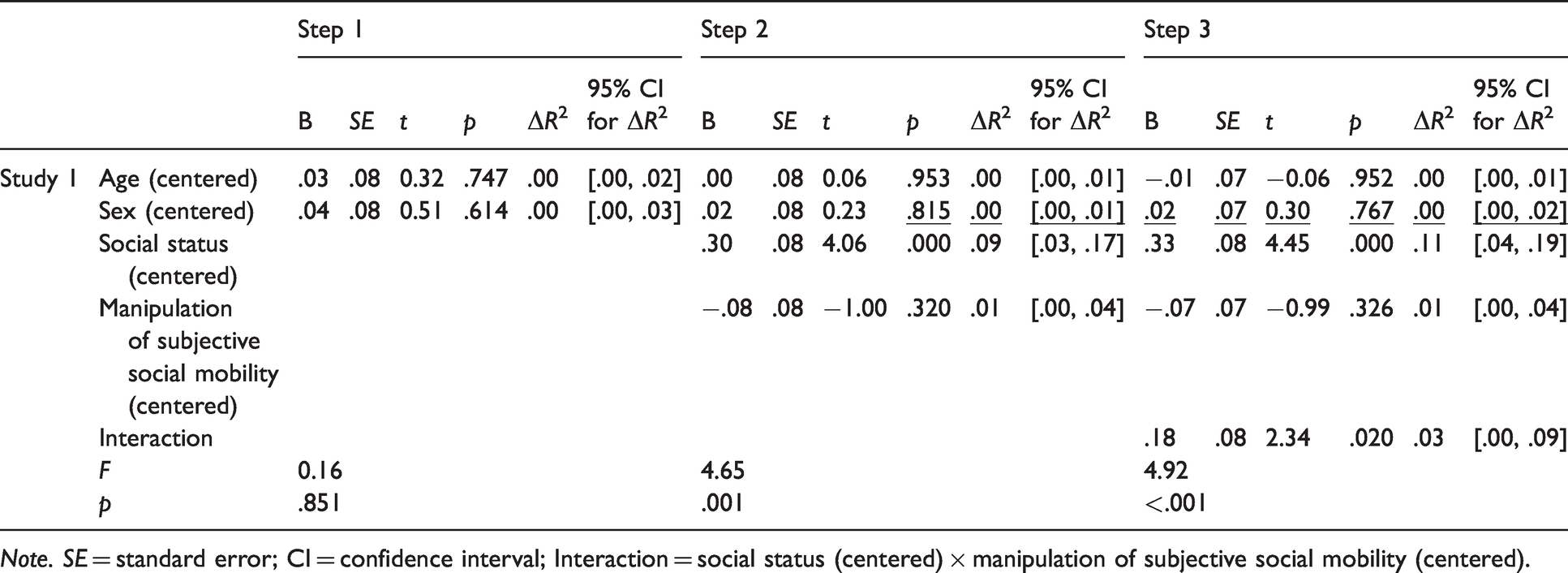
In the regression equation, citizen participation was included as a dependent variable; the interaction between social status and subjective social mobility was included as an independent variable; and sex and age were included as control variables (all of the variables were standardized). The main statistical analysis involved three steps. In Step 1, sex and age were entered. In Step 2, centered social status and centered subjective social mobility were entered. Finally, the two-way interaction was entered in Step 3. The results are shown in Table 1. The main effect of social status was significant, B = .30,
Regression Analysis of Social Status and Subjective Social Mobility and Their Interaction With Citizen Participation (Study 1).
The results of simple slope follow-up analyses are shown in Figure 1. For individuals with higher social status (+1

Interaction Between Subjective Social Mobility and Social Status (Study 1).
Study 2: An Experimental Study Examining Interactive Effects by Manipulating Social Status
Study 2 used an experimental method to manipulate social status as a variable. Additionally, subjective social mobility was measured using both a four-item scale and a social status ladder measure.
Methods
Participants
We used G*Power 3.1 to determine the sample size required for the effect size, (
Measures and Procedure
Subjective Social Mobility
The revised four-item Social Mobility Scale (Day & Fiske, 2016) was used to measure the level of subjective social mobility. Each item (e.g., “A person’s social status may improve or decrease in their life”) was rated on a 7-point scale (1 =
Manipulation of Social Status
Based on a previous study by Callan et al. (2011), the participants were told that the current study was a survey comparing people’s social status, requiring them to complete a series of questionnaires that served as a measure of their social status. To improve the credibility of this false test, the participants were asked to provide information about their education level, income and financial distribution, consumption behavior, and personality characteristics. They were then instructed that the system would calculate their social status score. The participants were told that if their score was lower than −20, this indicated that they had lower social status than others in the database; if their score was higher than +20, this indicated that they had higher social status than others in the database. The screen then displayed a GIF animation to indicate that the system was loading and that the analysis process was underway (“Your social status score is being calculated. Please wait”). After completing the false test, the participants received different feedback: the participants with low social status scored −55, whereas the participants with high social status scored +55. To test the effectiveness of the manipulation, the participants were immediately asked to write down their scores and why they thought they had received that score.
The participants were then required to assess their present social status and their social status 10 years previously, using a 10-level ladder scale (the same as Study 1). This method was used to examine whether the manipulation of social status in this study was successful, and also to calculate subjective social mobility. Subjective social mobility is represented by the difference between the present social status and the social status 10 years earlier, with a higher difference indicating stronger subjective social mobility.
Citizen Participation
The same citizen participation scale (Cronbach’s α = .80) that was used in Study 1 was used to measure the participants’ citizen participation.
Results
Manipulation Check
The scores of the two manipulation check items were tested using independent-samples
Preliminary Analysis
Table 2 shows the descriptive statistics and correlations between social status, the two levels of subjective social mobility, and citizen participation.
Descriptive Statistics and Correlational Analysis for All Variables (Study 2;

*
Interaction Analysis
In the regression equation, citizen participation was included as a dependent variable; the interaction between social status and subjective social mobility (four-item scale) was included as an independent variable; and sex and age were included as control variables (all of the variables were standardized). The main statistical analysis involved three steps. In Step 1, sex and age were entered. In Step 2, centered social status and centered subjective social mobility (four-item scale) were entered. Finally, the two-way interaction was entered in Step 3. The results are shown in Table 3. The main effects of social status and subjective social mobility (Four-item scale) were not significant. However, the effect of the interaction was significant, B = .16,
Regression Analysis of Social Status and Subjective Social Mobility (Scale) and Their Interaction With Citizen Participation (Study 2).

A simple effect analysis was conducted with citizen participation as the dependent variable, subjective social mobility (four-item scale) as the independent variable, and social status as the regulating variable. The results are shown in Figure 2. For the high social status group, citizen participation was largely unaffected by subjective social mobility, B = .08, 95% CI = [−.13, .29],
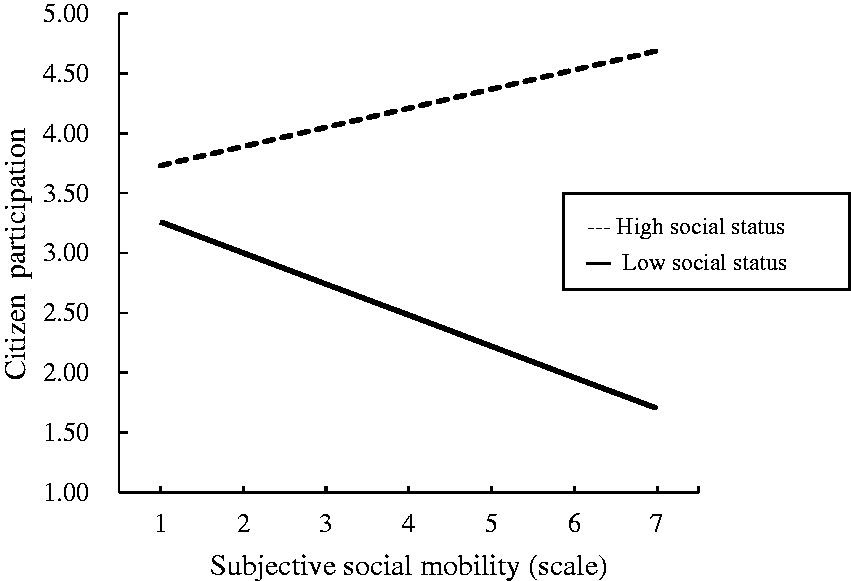
Interaction Between Subjective Social Mobility (4-item scale) and Social Status (Study 2).
Additionally, we replaced the subjective social mobility four-item scale with the subjective social mobility ladder-measure score and performed the same regression analysis. The results are shown in Table 4. The main effects of social status and subjective social mobility (ladder-measure score) were not significant. However, the effect of the interaction was significant, B = .21,
Regression Analysis of Social Status and Subjective Social Mobility (Ladder) and Their Interaction With Citizen Participation (Study 2).

*
A simple effect analysis was conducted with citizen participation as the dependent variable, subjective social mobility (ladder-measure score) as the independent variable, and social status as the regulating variable. The results are shown in Figure 3. For the high social status group, citizen participation was largely unaffected by subjective social mobility, B = .15, 95% CI = [−.05, .35],
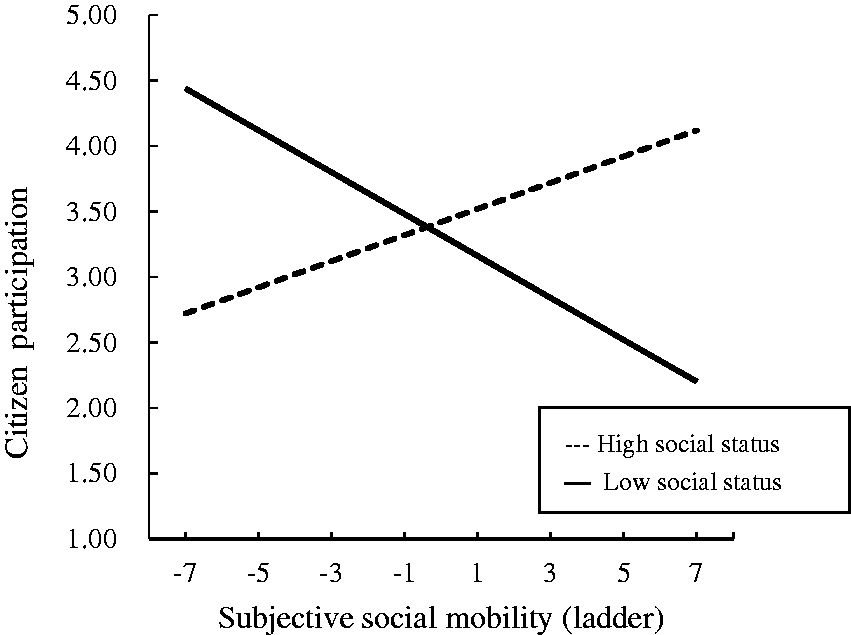
Interaction Between Subjective Social Mobility (ladder) and Social Status (Study 2).
General Discussion
In two studies, the current research analyzed and empirically tested the interactive effects of social status and subjective social mobility on citizen participation. The results reveal the significant interaction effect of these two variables on citizen participation. For individuals with high social status, subjective social mobility did not affect citizen participation. Conversely, for individuals with low social status, subjective social mobility negatively predicted citizen participation.
The current findings, in terms of the effect of the interaction between social status and subjective social mobility on citizen participation, provide some insight regarding the inconsistent results of previous studies examining the influence of these two variables separately on citizen participation. Similar to previous studies, the current research reveals that social status can promote citizen participation (Wiepking & Breeze, 2012; Study 1). However, the current results also reveal that, depending on the circumstances, social status can have no effect on citizen participation (Study 2), in accord with previous studies reporting that subjective social mobility had no effect on citizen participation (Wang, 2010) or an inhibitory effect (Daenekindt, 2016; Kraus et al., 2012). Based on these findings, considering social status or subjective social mobility alone cannot explain the social and psychological impacts of individuals’ cognition regarding social hierarchies.
However, when the two variables are combined, for individuals with high social status, subjective social mobility did not affect their acquired resources or physical and mental characteristics; thus, these individuals may still be willing to participate in civic organizations or voluntary activities (Chan, 2018). Conversely, for individuals with low social status, citizen participation exhibited an obvious downward trend with increased subjective social mobility. This finding could have resulted from these individuals experiencing cognitive dissonance between the high mobility of their social status and their own current low status, giving them a strong sense of system justification (Day & Fiske, 2016), self-blame following the failure of their efforts (Manstead, 2018), high personal relative deprivation (Callan et al., 2017), or learned helplessness (Abramson et al., 1978), and thus causing them to lose interest in citizen participation. Based on these findings, future research should explore the mechanisms underlying the inhibiting effect of high subjective social mobility on citizen participation behavior among people with low social status, which could help to elucidate the complexity of citizen participation from the perspective of dynamic and static social status interaction.
The findings also extend current knowledge regarding subjective social mobility and its psychosocial effects. Study 2 examined two subjective social mobility indicators (the likelihood of social mobility and individuals’ mobility experience), producing results that partially confirm the credibility of the two indicators. At the same time, we believe that there are also some differences between these two measures. For example, individuals’ mobility is strongly based on their own real-world experiences and often involves the direction of mobility (e.g., the experience of downward mobility for high-status individuals and upward mobility for middle- and low-status individuals; Chen & Fan, 2019). Conversely, social mobility represents more openness and permeability between social classes (Day & Fiske, 2016; Guo et al., 2019). This suggests that subjective social mobility based on individuals’ experience does not directly correspond to the subjective social mobility of the whole society—that is, individuals do not necessarily perceive changes in their own status to the same degree as they perceive higher social mobility. Although the current results indicate that the two have the same effect, determining whether they have different effects on other psychosocial behaviors will require further examination in future studies.
Revealing a structural dilemma of citizen participation in terms of the interaction between social status and subjective social mobility has practical significance for initiatives seeking to actively promote global social governance. The uncertainty of global development has generally increased in recent years, and humans face an increased risk of future events similar to the COVID-19 epidemic. At the same time, the degree of social inequality continues unabated, and polarization between the rich and the poor is prominent in various countries, with serious threats to human health, well-being, and social participation (Chen & Fan, 2019; Kolczynska, 2020). The current study has explained the changing mechanisms of public social participation under the influence of the interaction of social class and mobility. These findings are relevant for the development of approaches for promoting citizen participation at all levels and healthy human communities. Thus, all sectors of society should pay more attention to improving the sense of acquisition of middle and low social status in sharing the benefits of social development and continuously enhancing individuals’ sense of self-worth and social responsibility. By effectively guiding and cultivating healthy and progressive social attitudes, and promoting enthusiasm for citizen participation, a new pattern of social governance in which everyone participates with enthusiasm can be constructed.
Some limitations of the current study should be considered. First, citizen participation is related to, but distinct from, prosocial behavior, and its implications are complex and extensive. The current study did not distinguish between different participation types and prosocial behaviors, and the measurement method was relatively simple, which limits the external validity of our analyses. Second, unlike social psychology studies, sociologists are accustomed to dividing objective social mobility into three types: upward, downward, and horizontal. The psychological impacts and mechanisms produced by different forms of social mobility may differ. In future studies, it may be useful to consider the specific impact of distinguishing the direction of subjective social mobility. Third, the current research confirms an interaction between social status and social mobility but does not explore the specific psychological processes involved. Previous studies have suggested that attribution of the gap between rich and poor and system justification may be influential mediators. This possibility should be further explored in future studies.
Footnotes
Acknowledgements
 ),for editing the English text of an earlier draft of this article.
Declaration of Conflicting Interests
Funding
ORCID iD