







Abstract
Introduction
Smart composites have gained attention to a wide range of industrial applications in the areas of civil, mechanical, and aerospace engineering due to their potential in sensor-integrated systems with simultaneous environmental sensing, such as sensing of changes in strain, pressure, and temperature. They also make it easy to construct a lightweight structure integrated with various functionalities without additional equipment.
Carbon-based materials, such as carbon nanotubes (CNTs), carbon black, and graphene, have been widely used as fillers in different types of matrices in order to achieve smart composites. 1 –4 In particular, CNTs are one of the promising materials that can provide excellent electrical, thermal, and mechanical properties. Because CNTs have much higher aspect ratios compared to other carbon-based materials, a relatively small amount of CNTs can make the composite electrically conductive. 5 –7 Therefore, CNT-reinforced composites have been widely used for different applications, such as structural components and sensing and heating elements. 8 –11 For example, Shindo et al. 12 have examined the electromechanical response of a cracked CNT/polymer composite under tensile loading for crack detection based on the relationship between the electrical resistance and the crack length. Lee and Jeong 13 synthesized a sulfonated poly(1,3,4-oxadiazole)/multiwalled CNT composite film for a thermally stable high-performance composite and showed high electric heating efficiency.
In addition to strain sensing, composites reinforced with carbon-based materials can be used as temperature sensors and self-heating elements. 14 –18 These composites belong to a type of electrical resistor that is sensitive to temperature and can transform electrical energy to thermal energy. For instance, Blasdel et al. 19 have characterized a fabric, which consisted of multiwalled CNTs and polypyrrole, for temperature sensing. They found that the nanocomposite materials acted like a temperature detector based on the resistance change that was linearly proportional to temperature change. Galao et al. 20 have investigated carbon fiber-reinforced concrete for deicing applications when used as a heating element although it required relatively long heating time. However, the abovementioned results were limited to a single function that is either temperature sensing or heating.
In this study, we introduce CNT-reinforced composite as a smart coating system that can be applied to civil infrastructures for simultaneous sensing and actuation by detecting the freezing temperature and by self-heating, respectively. CNT-reinforced polymer composites with different CNT concentrations and film thicknesses were fabricated by high shear mixing. Then, influences of the film thickness and the CNT concentration on both the electrical conductivity and the temperature sensitivity were investigated. The self-heating capability of the composites by Joule heating was also examined. The results showed that CNT-reinforced polymer composites have the ability to serve as a promising smart coating material in civil infrastructures for sensing the freezing temperature and deicing by self-heating simultaneously in a cold weather.
Experiments
Materials
Multiwalled CNTs produced by thermal chemical vapor deposition were obtained from Nanolab (Waltham, Massachusetts, USA), which showed an average length and a diameter of 15.0 μm and 10.0 nm, respectively. For matrix, polydimethylsiloxane (PDMS, Sylgard 184 Silicone Elastomer) consisting of a base elastomer (part A) and a curing agent (part B) was purchased from Dow Corning (Midland, Michigan, USA). All the materials were used as received.
Fabrication of CNT/PDMS composite films
CNT/PDMS composite films were fabricated by high shear mixing. Different concentrations (approximately 0–10.0 wt%) of CNTs were carefully weighed with a precision weight scale and directly mixed with part A of the PDMS using a centrifugal mixer (ARE 301, Thinky Corporation, Tokyo, Japan) at a rotation speed of 2200 r min−1 for 3 min. Part B of the PDMS was added into the mixture with a weight ratio of 10:1 and then mixed again using the same mixer for another 3 min. Then, the mixture was painted layer by layer onto a glass substrate with a brush, followed by degassing under vacuum for 20 min in order to eliminate the air bubbles captured in the matrix that generally could cause low electrical conductivity than desired. This layer-by-layer process facilitates fabrication of multilayered CNT composite films, yielding high electrical conductivity and high mechanical strength due to the increased density of the CNT microstructure. This process was repeated until the desired thickness or the desired number of layers was achieved. Finally, the mixture was cured at 100°C for 1 h in a convection oven. Then, the cured CNT/PDMS composite films were left at room temperature for further cooling and curing for a day.
Characterizations
The thickness of the CNT/PDMS composite film was measured by a digital caliper. The microstructure of the composite film was observed using a scanning electron microscopy (FEI Sirion 600, JEOL, Tokyo, Japan).
The electrical resistance of the composite was measured by a two-point probe method using two different digital multimeters at room temperature. The high resistance above 109 Ω of the composites was measured by a high resistance meter (Keithley 6517B, Solon, Ohio, USA), whereas nominal resistance of the composites was measured by a precision multimeter (Fluke 8845A Everett, Washington, USA). Then, the electrical conductivity of the composite was calculated as
For heating performance by Joule heating, a direct current power supply (Sorensen XPH35-4D, San Diego, California, USA) was used to provide heat by controlling the input voltage. Figure 1(a) shows the experimental setup. Two pieces of copper tape (25 × 25 mm2) were attached to both ends of the CNT composite film to be used as electrodes, and the input voltage (approximately 0–50 V) was applied to the composite to induce heat, creating uniform heat distribution, as shown in Figure 1(b). A temperature profile was obtained using a digital thermocouple logger (SL500TC, Supco, Manasquan, New Jersey, USA). In addition, thermal images of the samples during Joule heating were recorded using a thermal infrared camera (FLIR A325sc LWIR Wilsonville, Oregon, USA) for heat distribution.

(a) Experimental setup for Joule heating and (b) uniform heat distribution of CNT/PDMS composite film. CNT: carbon nanotube; PDMS: polydimethylsiloxane.
For the defrosting performance, Joule heating was applied to the CNT/PDMS composite films (7.0 wt% CNT with 0.75 mm thickness) coated on a glass slide in the area of 50 × 50 mm2. Then, the sample was immersed into a water bath and frozen at −15°C in a refrigerator for 24 h to clearly form the frost on the surface. The initial resistance of the CNT/PDMS film was approximately 500 Ω, and a voltage of 30 V was applied to the film to internally increase the temperature by Joule heating.
Results and discussion
Electrical conductivity
Figure 2 shows the electrical conductivities of the CNT/PDMS composite films as a function of CNT concentration. At low concentration, lower than 5.0 wt% of CNTs, the composites showed no conductivity due to lack of conductive networks of CNTs. The electrical conductivity of the composites rapidly increased by six orders of magnitude when the CNT concentration reached 5.0 wt% based on the increase in the CNT networks, as shown in Figure 3. The percolation threshold is a region where the composites transform from an insulator to a conductor through the connected CNT networks, which has been observed in the previous research. 21 –23 After the percolation threshold, the electrical conductivity of the CNT/PDMS composite films gradually increased approaching 1.5 S m−1 as the CNT concentration increased. Based on our result, the CNT/PDMS films showed high electrical conductivity at 7.0 wt% of CNTs. Therefore, the CNT concentration was maintained at 7.0 wt% for further experiments.

Electrical conductivity of CNT/PDMS composite films with varied CNT concentrations. CNT: carbon nanotube; PDMS: polydimethylsiloxane.

Microstructure of CNTs in the matrix. CNT: carbon nanotube.
Influence of films’ thickness on electrical conductivity
To check the influence of the film thickness on the electrical property (i.e. resistance or conductivity) of CNT-reinforced polymer composites, we prepared composite films with different thicknesses of 7.0 wt% of CNTs using the layer-by-layer fabrication. Figure 4 shows the resistance and conductivity change of the CNT/PDMS composite films as a function of thickness. As expected, the resistance of the films significantly decreased as the thickness of the CNT/PDMS composite films increased. The electrical conductivity of the film was calculated by
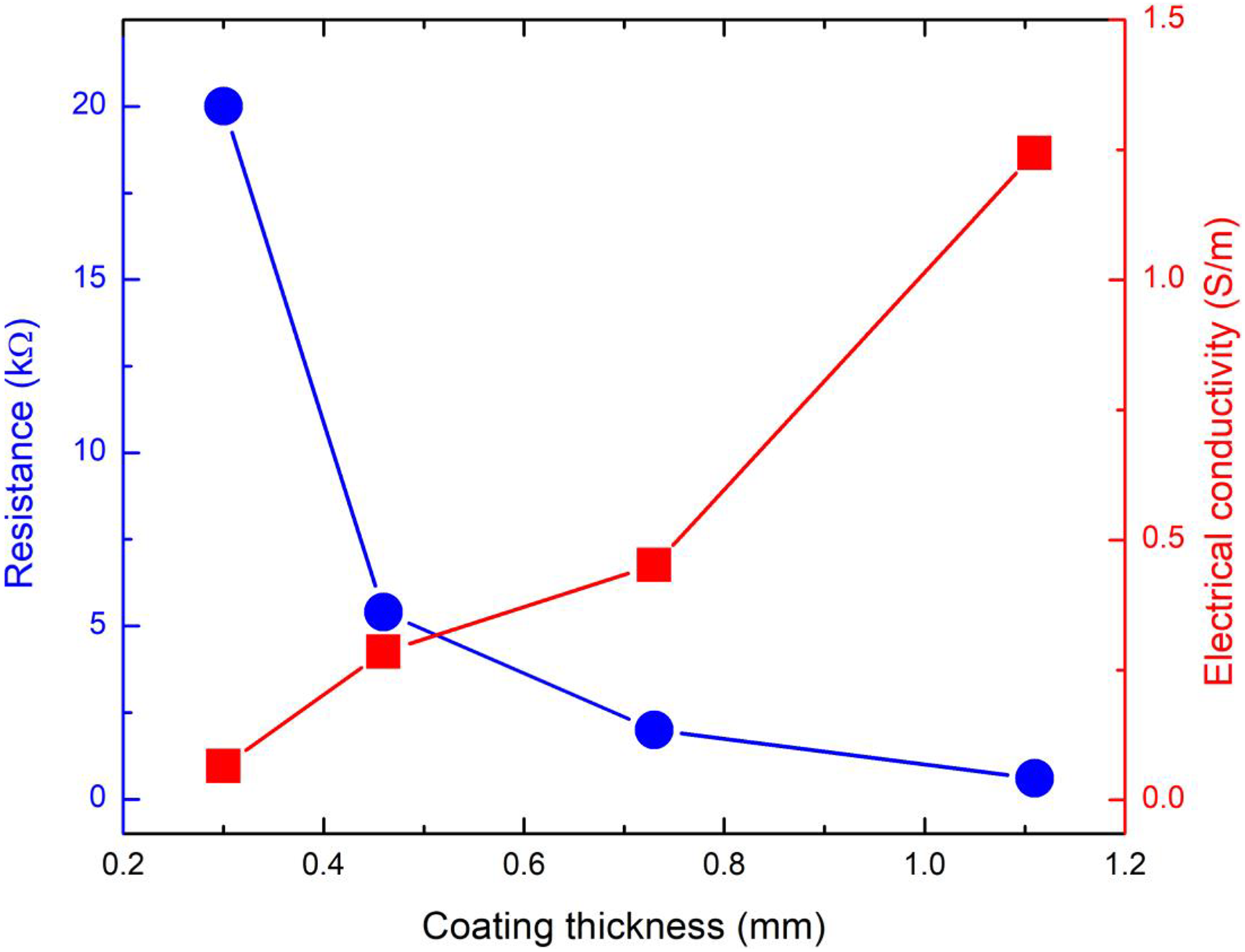
Resistance change and electrical conductivity of CNT/PDMS composite films with varied thicknesses. CNT: carbon nanotube; PDMS: polydimethylsiloxane.
Detection of freezing temperature
The resistance change of the CNT/PDMS composite films was investigated. Figure 5 shows that temperature decreased from room temperature to −5°C for simulating the weather during winter. All CNT/PDMS films with different thicknesses showed nonlinear electrical responses with the given temperature changes and decrease in resistance with temperature drops at certain rates, which is called a negative temperature coefficient (NTC). NTC is often reported in CNT-reinforced polymer composites, which depends on several factors, such as the characteristics of the polymer and the aspect ratio of CNTs. 26 –28 Therefore, NTC of the CNT/PDMS films can be used as a metric of smart coating materials for detecting the freezing temperature during winter.

Change in resistance of CNT/PDMS composite films as a function of the temperature for different thicknesses. CNT: carbon nanotube; PDMS: polydimethylsiloxane.
Figure 6 shows the temperature sensitivity of the CNT/PDMS films with different thicknesses at different temperature ranges. The temperature sensitivity of the CNT/PDMS film was calculated by

Temperature sensitivity of CNT/PDMS composite films with varied thickness. CNT: carbon nanotube; PDMS: polydimethylsiloxane.
Self-heating performance
To demonstrate the potential as a heating element, the self-heating performance of the CNT/PDMS composite films was characterized in terms of the temperature profile in relation to the applied voltage. The power increased according to
Figure 7(a) shows the temperature profiles of the 0.47-mm-thick CNT/PDMS composite films. It was clearly seen that the temperature of all the CNT/PDMS composite films increased with increased voltages due to Joule heating. Maximum temperatures of 27 and 35°C were obtained at voltages of 30 and 40 V, respectively. Also, moderate temperature increases such as 42°C were observed at a higher voltage of 50 V. However, dramatic temperature increase was observed in the 1.10-mm-thick CNT/PDMS composite films, as shown in Figure 7(b). For instance, the maximum temperature of over 110°C was obtained at 30 V, which is much higher than that of 0.45-mm-thick CNT/PDMS film at the same voltage. This is attributed to the high electrical conductivity of the thick CNT/PDMS film supported by Figure 4. Moreover, the CNT films were able to reach high temperature, such as 100°C, without any change in resistance. Therefore, the CNT/PDMS film with high thickness may be useful for providing more heat at a relatively low voltage. In our experiments, the temperature went up rapidly compared to other conventional heating methods. 32

Temperature profiles of CNT/PDMS composite films with varied input voltages: (a) 0.47-mm CNT film and (b) 1.10-mm CNT film. CNT: carbon nanotube; PDMS: polydimethylsiloxane.
The temperature evolution of the CNT/PDMS composite films by Joule heating can be theoretically modeled, which could be divided into different stages, such as heating, equilibrium, and cooling, that can be shown with the following equations 33


where

Analytical modeling for heating performance of CNT/PDMS composite films. CNT: carbon nanotube; PDMS: polydimethylsiloxane.
Characteristics of heat model for CNT films with different thicknesses.

CNT: carbon nanotube.
Figure 9 shows the defrost performance of the CNT/PDMS composite films. The thickness of the ice on the CNT film was about 5 mm, and the temperature was −8.5°C. Then, the 30.0 V was applied to both electrodes of the CNT/PDMS composite film. At 7 min of heating, the amount of heat was initially observed at the interface of the CNT/PMDS film and the electrode due to the higher electrical conductivity of the electrode. Also, it is noted that the nonuniform heat distribution during Joule heating attributed to different frost thicknesses. At 20 min of the heating, it was clear that the frost on the CNT/PDMS film was completely melted to water. Finally, Figure 10 shows the resistance change of the CNT/PDMS composite films by cyclic heating up to 30 cycles. All the CNT/PMDS films showed stable resistance retention at 30 heating cycles. Also, it was clearly seen that the CNT film showed stable heat resistance at an even higher heating temperature (approximately 100°C).

Defrost performance of CNT/PDMS composite film coated on glass. CNT: carbon nanotube; PDMS: polydimethylsiloxane.

Change in resistance of CNT/PDMS composite films at heating cycle. CNT: carbon nanotube; PDMS: polydimethylsiloxane.
Conclusions
This study showed the feasibility of CNT-reinforced polymer composites for smart coating systems capable of detecting the freezing temperature and self-heating. Electrically conductive CNT/PDMS composite films were fabricated using a centrifugal mixing method. The results confirmed that the electrical conductivity of the CNT/PDMS composite films increased as both the CNT concentrations and the thickness of the film increased. It was also shown that the nonlinear change in resistance of all CNT/PDMS composite film samples was observed with decrease of temperature. Moreover, the CNT/PDMS composite films with a lower thickness showed a higher temperature sensitivity in the freezing temperature range from −5 to 5°C. The self-heating performance of the CNT/PDMS composite films was investigated by the Joule heating effect. The thickness of the CNT/PMDS films significantly affected the temperature profile when a constant voltage was applied. The Joule heating effect was modeled using an analytic solution to predict the temperature profile of the CNT/PDMS composite films. Finally, we demonstrated the defrost performance of the CNT/PDMS composite film coated onto a glass slide which was covered with 5.0-mm-thick ice. The CNT/PDMS composite films successfully melted the ice on the glass in a short period of time. Therefore, we believe that CNT/PDMS composite films have a potential in various types of smart coating systems for detecting the freezing temperature and deicing by self-heating in civil infrastructures.