







Abstract
Introduction
In less than 30 years, Chile experienced one of the most dramatic declines in party identification ever recorded. After almost 20 years of military rule (1973–1990) and fueled by an historic referendum that peacefully defeated the dictator Augusto Pinochet (1988), citizens of this nascent democracy showed exceptionally high levels of party identification. According to data from the Centro de Estudios Públicos (CEP), in the early 1990s, almost four of every five Chilean adults identified with a political party. However, the contemporary political reality could not be more distinct. In 2016, less than one-fifth of Chileans identified with a political party, the lowest level ever recorded. Considering both the highest and the lowest point recorded by the CEP surveys, party identification experienced a downturn of more than 60 percentage points during this period.
The context in which this decline took place challenges much of what we know about party erosion. While conventional wisdom would claim that party loyalties should fade in the wake of poor performance by incumbent parties, this decline coexisted with a period of outstanding economic development. Likewise, even though previous research has shown that stable party systems provide a fertile ground for the development of partisan attachments (Dalton and Weldon, 2007), this decline took place in one of the most stable party systems of the world (Valenzuela, 1995) and one of the strongest and most cohesive party systems in the region (Diamond et al., 1999).
More importantly, this collapse challenges what is probably one of the most dominant explanations of party system erosion: ideological polarization. According to this view, aggregate levels of partisanship among the mass public are strongly related to the degree to which political parties diverge in the ideological spectrum. While ideological polarization allows the development of partisan attachments (Bornschier, 2019; Lupu, 2015b), ideological convergence erodes them (Lupu, 2013, 2014, 2016).
In sharp contrast with these explanations, the Chilean postauthoritarian political landscape shows very weak signs of ideological convergence during the period of partisan decline. While data from the Manifesto Project shows some signs of ideological convergence (Madariaga and Rovira Kaltwasser, 2019; Rovira-Kaltwasser, 2019), both political elite and expert survey data show that polarization remained largely constant, or even increased, throughout this period (Singer, 2016).
I argue that the decline of partisanship in Chile can be better understood by focusing on nonprogrammatic aspects of electoral competition. 1 From this perspective, the decline in partisanship is not associated with programmatic convergence, which shows low levels of variation during this period, but with nonprogrammatic convergence between the two main political coalitions.
My argument builds on previous work showing that since the restoration of democracy, political competition in Chile has been predominantly structured by the political cleavage 2 between supporters of the military dictatorship (1973–1990) and advocates for democracy (Bargsted and Somma, 2016; Bonilla et al., 2011; Huneeus and Maldonado, 2003; Tironi et al., 2001; Tironi and Agüero, 1999; Torcal and Mainwaring, 2003; Toro Maureira, 2008). According to these accounts, the authoritarian period gave rise to two distinct, antagonistic political identities: the supporters of the military dictatorship and the advocates for democracy. Clearly established by the 1988 plebiscite that marked the transition to democracy and embodied in the two main political coalitions (Concertation and Alliance), these two distinct political identities served as the key drivers of political conflict throughout the transition to democracy. 3 Most of this research not only highlights the importance of these political divisions, but also the centrality of political elites as key drivers of this conflict (Torcal and Mainwaring, 2003). My argument is a natural extension of this claim. If political elites can contribute to the creation of political divides, they can also play a major role dissolving them. I argue that the consolidation of Chilean democracy coupled with efforts from right wing parties to distance themselves from the military dictatorship systematically eroded the capacity of this narrative to link citizens and parties. Pushed mostly by electoral considerations, the right wing rejection of the authoritarian past led to a elite agreement over the condemnation of the authoritarian period, dissolving the main source of conflict among political elites. Once the authoritarian/democratic conflict disappeared, the Chilean party system lost an essential driver of party identification. While this was a significant steppingstone toward becoming a consolidated democracy, it entailed the dissolution of the main cleavage through which political competition was articulated.
Building on Levitsky et al. (2016), this explanation puts conflict in the center as a key mechanism behind both processes of party building and partisan erosion. According to this perspective, partisan identities emerge from episodes of intense polarization and conflict. While political conflict can certainly run along programmatic divides, partisan identities can be also rooted in sociological and personalistic divides (Ostiguy, 2009), and democratic/authoritarian experiences (Mitchell, 2010). Accordingly, this view is not necessarily at odds with brand dilution theory (Lupu, 2014, 2016), but it relies on different mechanisms. Theories of party brands and brand dilution claim that ideological polarization clarifies political competition, making political choices clearer for voters (Bornschier, 2019; Lupu, 2013, 2014, 2015b, 2016; Zechmeister and Corral, 2013); conversely, conflict-centered approaches highlight the importance of intense, violent conflicts as mechanisms for the generation of political identities (Balcells, 2012; LeBas, 2006; Lebas, 2011; Levitsky et al., 2016). Accordingly, from this perspective, what is behind party building and partisan erosion is not the clarity of choices, but the formation and dilution of the political identities, and the efforts of elites to articulate these identities, that ultimately drive partisan attachments.
Using the Diego Portales Survey (2005–2015), I find patterns that are largely consistent with this claim. The analysis shows that a massive migration away from any party identification process took place between the years 2005 and 2015. While in 2005 the likelihood of identifying with a political party was around 50% for both supporters of democracy (democrats) and advocates of the military dictatorship (authoritarians), the differences between these two groups and the rest of the population were almost nonexistent by 2015. Accordingly, the process of partisan erosion observed during this period is marked by the increasing unwillingness of both authoritarians and democrats to identify with a political party, by the decline of the association between democratic/authoritarian attitudes and partisanship. Although due to data availability I am not able to test this hypothesis for earlier periods of time, my interpretation suggests that the decrease of party identification in the early 1990s can also be, at least to some extent, understood as a consequence of the same process.
This argument is not necessarily at odds with other explanations of partisan erosion in contemporary Chile. Previous research has highlighted that trust (Bargsted and Maldonado, 2018; Carlin, 2014), party vibrancy (Rosenblatt, 2018), and increasing disconnection with society are all associated with this decline (Castiglioni and Rovira-Kaltwasser, 2016; Luna and Altman, 2011; Luna and Mardones, 2010). On the contrary, this argument can be seen as consistent with these explanations, as one additional contributory factor behind this complex phenomenon.
The Chilean dramatic decline in party identification has two important implications for our understanding of party building and party erosion in other contexts. Firstly, this case highlights how political divides must be constantly reinforced to remain as a stable source of political, that partisan identities need continuing political agency from above to persist. In this respect, political elites play a major role not only in the formation of cleavage structures as have been previously shown by Torcal and Mainwaring (2003), but also for their preservation (Elff, 2007). Secondly, this case highlights how processes of party erosion can be set in motion not only by ideological or programmatic convergence, but also by nonprogrammatic convergence. Accordingly, this case highlights how the salience of political conflicts is an essential driver of partisanship. Finally, it stresses the relevance of political legacies in the process of partisanship formation and erosion.
The Collapse of Partisan Identification in Contemporary Chile
General Political Context
The end of General Augusto Pinochet's dictatorship (1973–1990) marked the beginning of a series of four consecutive center-left coalition governments that ruled Chile from 1990 to 2010. Originally meant as a political grouping intended to defeat Pinochet in the national plebiscite of 1988, the Concertation of Parties for Democracy (Concertation) was a multiparty coalition that grouped the Christian Democratic Party (PDC), the Party for Democracy, the Social Democratic Radical Party, and the Socialist Party (PS). This coalition governed Chile through the consecutive administrations of Patricio Aylwin (PDC, 1990–1994), Eduardo Frei Ruiz-Tagle (PDC, 1994–2000), Ricardo Lagos (PS, 2000–2006) and Michelle Bachelet (PS, 2006–2010). The Concertation period ended when Sebastián Piñera, supported by the center right wing coalition Alliance for Chile (Alliance), 4 defeated ex-president Eduardo Frei Ruiz-Tagle in the runoff presidential election of 2010. After that election, the Concertation of Parties for Democracy coalition dissolved and gave birth to the New Majority coalition, which included the Communist Party. The defeat of the Concertation has been followed by alternation in power between these two coalitions. Michelle Bachelet handed the presidential band to Sebastián Piñera in 2010, who returned it to her in 2014. Finally, Piñera was elected once again in the 2017 presidential election.
The Decline of Party Identification
According to data from the Centro de Estudios Públicos (CEP), levels of partisan identification in the early 1990s were exceptionally high. While there is some degree of variation, between the year 1990 and 1994, during Aylwin’s administration (1990–1994), the levels of party identification remained over 60%, reaching 86% in December 1992. Figure 1 shows that the subsequent downward trend in partisanship can be divided into three different periods. Firstly, there is an initial decay from 1994 to the early 2000s, a period that corresponds to Eduardo Frei's government, then a second stage of stabilization around mid-levels of partisanship between the years 2000 and 2006 during the Ricardo Lagos administration, and finally, a third stage characterized by the total collapse of the levels of partisanship between 2006 and 2018. This downward trend hit a record low level of 17% in July 2016, during Michelle Bachelet second term in office.
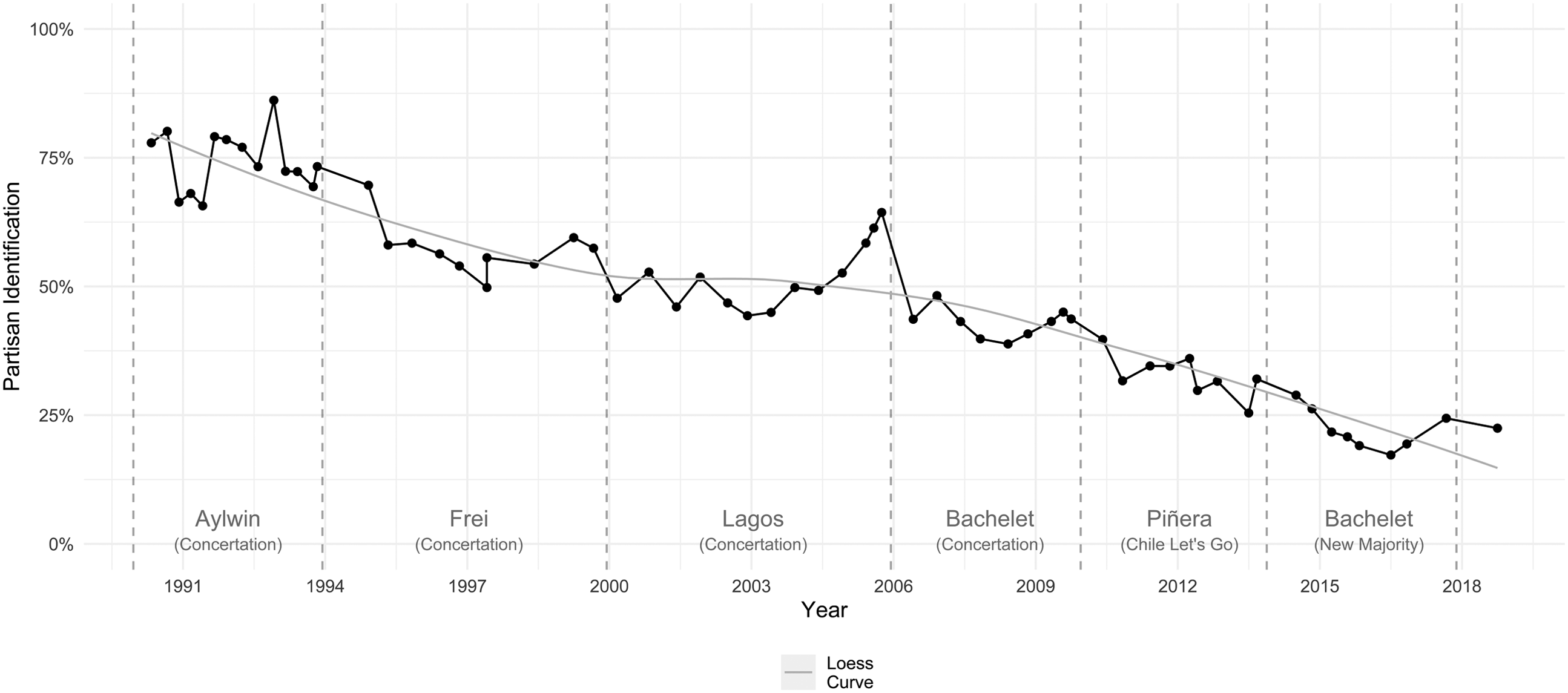
Partisan Identification 1990–2018.
Thus, according to the CEP data, between 1990 and 2016, Chile experienced a dramatic 69 percentage point drop in the levels of partisanship across the country's population. 5
Although partisanship declined in many places in the world during this period, the extent to which partisan erosion in Chile took place vastly exceeds the levels recorded elsewhere. For example, the highest levels of partisan erosion reported by Dalton (2002) are recorded in Ireland between 1978 and 1996. During this period, partisanship declined by 30.6 percentage points. This is less than half the observed decline in Chile during a similar timespan. 6 Furthermore, Chile consistently ranks among the countries with lowest levels of partisanship in Latin America (Lupu, 2015a).
A Puzzling Decline
The sharp decline of party identification in Chile during the 1990–2018 period challenges much of what we know about party erosion. Broadly speaking, the comparative literature has addressed the problem of party building/party erosion from three different perspectives: economic and political performance, democratic experience and party system institutionalization, and ideological polarization.
Economic and Political Performance
Previous research has argued that party identification is strongly associated with economic and political performance (Fiorina, 1981; MacKuen et al., 1989). This perspective understands party identification as a summary judgment that relies both on past experiences and future expectations. Accordingly, aggregate levels of partisan identification should respond to issues, performance and, above all, movements in the economy. While aggregate levels of party identification should increase in contexts of good economic and political performance, economic crisis, and political downturns, such as corruption, should decrease those levels.
Since the restoration of democracy in 1990, Chile has experienced outstanding levels of economic and political performance, especially in comparative Latin American perspective. 7 Figure 2 shows Chile's performance in four key development indicators: GDP, poverty rates, tertiary education enrollment, and inequality. Between 1990 and 2018, the country's GDP per capita almost tripled, poverty rates dropped from 36% to 8.6%, tertiary school enrollment rose from 21% to 88%, and the Gini index decreased by 12.6 points. Although income inequality is still a pervasive issue in Chile and across the region, the degree to which income inequality was reduced during this period is quite substantial. Between 1990 and 2018, the highest Gini recorded was 65.8 (Malawi, 1997), while the lowest one was 20.7 (Czech Republic, 1992). This means that, although the Gini index can theoretically range from 0 to 100, its total range throughout this period is only 45.1 points. During this time, Chile decreased its Gini index by 12.6 points, which is equivalent to 28% of that range.

World Development Indicators.
Although Chile has not been fully immune from corruption scandals involving top political leaders during this period, Chile is viewed as having one of the best, if not the best, performance in the region in terms of over-all corruption control. According to Mungiu-Pippidi (2017), Chile has the highest Control of Corruption Index score in Latin America. 8 Additionally, the center-left Concertation coalition, which governed the country continuously from 1990 to 2010, managed to make major breakthroughs toward democratic consolidation and democratic strength. During Ricardo Lagos’ administration, the government was able to dismantle several authoritarian enclaves that the military regime had incorporated into the constitution approved in 1980 (Luna and Mardones, 2010).
It is worth highlighting that although Chile ranks consistently well in terms of these indicators, perceptions regarding the way in which governments were handling the economy, corruption, and inequality could have deteriorated throughout this period. In the supplemental appendix section Perceptions of Economic and Corruption Performance, I evaluate the extent to which this is the case. The analysis conducted there shows that evaluations of the way in which corruption was handled improved, perceptions regarding the management of the economy remained largely stable, and perceptions of inequality deteriorate.
Taking into consideration both the economic and political successes of the Concertation coalition, theories that associate partisanship with performance would predict a rise or at least steady levels of party identification throughout this period. However, Chile experienced a sharp decline in partisanship levels during this time. Moreover, given the outstanding relative performance within the region, Chile should have one of the highest aggregate levels of partisanship in Latin America. Yet, levels of partisanship in Chile rank among the lowest in the region (Lupu, 2015a).
Democratic Experience and Party System Institutionalization
Another approach has argued that the levels of partisan identification should increase as a function of the experience with a party system and parental socialization (Converse, 1969). Accordingly, democratic experience, measured as continuous years of democratic rule, should play an essential role in developing party attachments (Dalton and Weldon, 2007). From this perspective, the comparatively low levels of partisanship recorded in Latin America are a consequence of the short history of continuous democratic elections. Party system stability is thus an essential element for party building, a stable party system provides a steady ground for the development of party attachments, a context in which partisanship can be “learned” both through experience with democracy and parental socialization.
While most of Latin America's party systems are extremely fluid and volatile, the Chilean party system has been considered one of the strongest and most cohesive in the region (Diamond et al., 1999), one of the few institutionalized party systems in Latin America (Mainwaring and Scully, 1995), and even one of the most longstanding and stable in the world (Valenzuela, 1995). As several scholars have argued, since 1925, and even following the period of military rule and interrupted democracy (1973–1990), the Chilean party system has had a remarkable consistency in voting patterns (Angell, 2003; Valenzuela et al., 2018; Valenzuela and Scully, 1997). Likewise, the Chilean party system has been characterized as one of the few programmatically structured party systems in Latin America (Kitschelt et al., 2010).
Consequently, within the Latin American context, the Chilean party system is a most likely case for the development of partisan attachments. But contrary to these expectations, using age-period-cohort analysis of data from 1994 to 2014, Bargsted and Maldonado (2018) find no evidence of “partisan learning” since the democratic restoration. Furthermore, they find that the decline in the aggregate levels of partisanship is driven by period effects, thus affecting all cohorts simultaneously. Despite providing an ideal context for partisan development, the Chilean postauthoritarian landscape shows no evidence of partisan “learning” throughout this period.
Ideological Polarization
Recent research focused on Latin America has argued that while links between parties and voters strengthen in contexts of ideological polarization, ideological convergence and ideological inconsistency are associated with partisan erosion (Bornschier, 2019; Lupu, 2014, 2016). Declines in partisan self-identification are provoked by both the implementation of policies that are inconsistent with the traditional ideological position of the party and by the creation of new political alliances with historical rivals, which decrease the ideological distance between parties. These actions can blur the perception of the parties’ brand, understood as the party prototype, thus weakening the links between a party and its partisan base. In summary, brand dilution is the result of processes of policy inconsistency, shifts of the parties’ policy position, or convergence, any of which can cause party brands to become indistinguishable from each other.
The Chilean postauthoritarian political landscape shows very few signs of ideological convergence during the period through which the collapse in the levels of partisanship took place. Figure 3 shows three different measures of ideological polarization in Chile after the military dictatorship. The first rows shows expert level data from the V-party project (Lührmann et al., 2020), the second row shows parliamentary elite level data from the Parliamentary Elites of Latin America project (Alcántara Sáez, 2018), and the third row shows mass public perceptions of ideological polarization. Of these three different measures, only one shows some weak signs of ideological convergence during this period. According to public opinion surveys, the distance between the Concertation and Alliance coalition decreased by 0.4 between 1990 and 2010. Considering that the scale goes from 1 to 10, this decrease in polarization is of less than 4 percentage points during a 20-year period. This is consistent with evidence provided by Madariaga and Rovira Kaltwasser (2019), who, drawing from the Manifesto Research on Political Representation Project (Krause et al., 2019), claim that ideological moderation of the right wing coalition lead to some degree of ideological convergence.

Ideological Convergence in Contemporary Chile.
Conversely, evidence from the V-party project and the PELA project show no signs of ideological convergence during this period. In fact, both sources present some minor evidence pointing in the opposite direction, a slight increase in the ideological distance between the right wing coalition Alliance and the left wing coalition Concertation. This evidence is consistent with previous claims that polarization in Chile has remained largely constant, and even increased, throughout this period (Singer, 2016).
Even assuming a certain degree of ideological convergence among political elites, this explanation has at least one additional limitation in the Chilean context. The degree and extent of this ideological convergence process is certainly not comparable with the ones experienced by other countries in the region. Brand dilution theory was developed to explain cases such as Venezuela and Argentina at the end of the 1990s (Lupu, 2014, 2016). In both cases, the processes of brand dilution were significantly more pronounced than in Chile. For example, in the Argentinian case, the Partido Justicialista carried out a process of total policy reversal from left wing policies to a neoliberal agenda and engaged in a series of political alliances with historical adversaries. In Chile, however, there have been two stable coalitions since the democratic restoration. While it can be argued that the Concertation coalition engaged in some policy inconsistence, the degree of these inconsistencies is not at all comparable with what was experienced in Argentina. Thus, it is difficult to see how comparatively low levels of political inconsistency can explain the impressive decline of party identification since 1990.
Existing Explanations
Previous research focused on Chile has also tried to understand the decline in party identification. Most explanations emphasize that, although the party system is remarkably stable during this period, it is increasingly unresponsive and disconnected from the civil society (Bargsted and Somma, 2016; Castiglioni and Rovira-Kaltwasser, 2016; Luna and Altman, 2011; Luna and Mardones, 2010). According to these views, the constitution inherited from the military dictatorship provided artificial safeguards to the party system which allowed parties to remain in power while getting increasingly detached from voters and the civil society.
A second potential mechanism behind this decline is that the uprootedness of the Chilean party system has led to high levels of distrust in political parties. Bargsted and Maldonado (2018) show that political parties are the least trusted institution in Chile, and Carlin argues that distrust in political parties is associated with higher levels of participation in protest, but lower levels of participation in elections (2011). Finally, Navia and Osorio (2015) show that the decline in party identification is fundamentally driven by the decline in the levels of identification with the centrist Christian Democratic Party.
The argument presented in the next section is not necessarily at odds with these explanations, but it can be seen as an additional contributing factor for the decline of partisanship in contemporary Chile.
Theory: A Conflict Centered Approach to Partisanship
Why did party identification experience such a dramatic decrease in a context of relatively good economic performance and ideological consistency? I argue that this decline can be, to some extent, understood by focusing on the nature of the political divides in postauthoritarian Chile. More generally, my central claim is that partisan identities emerge from periods of intense polarization and conflict in which political elites channel these conflicts into the political arena (LeBas, 2006; Lebas, 2011; Levitsky et al., 2016). I also argue that their persistence overtime largely depends on the agency of political actors (Torcal and Mainwaring, 2003).
Conflict is an effective identity generation mechanism because it creates clear boundaries between opposite camps without which identities simply cannot exist. Boundaries are essential components of identities in general, and political identities in particular, because they create an image of who is part of a group and who is not. Boundaries give meaning to membership; they define and separate who belongs in the ingroup from who does not. Thus, they help to define the membership category (Brewer, 1991; Huddy, 2001). Drawing sharp boundaries between groups is a constitutive part of the creation and reproduction of political identities.
Sharp boundaries can be used by political entrepreneurs to mobilize the mass public, reconfiguring politics around new cleavages (LeBas, 2006; Torcal and Mainwaring, 2003). In this sense, strong social conflicts are not a sufficient condition for the development of partisan attachments, but a necessary one. In the presence of strong social conflict, political elites play an essential role in translating these tensions to the political sphere. These cleavages can not only allow politicians to mobilize their constituencies, but they can also increase the organizational cohesion of political parties. Intense conflicts can make defection from party structures more difficult and prevent divisions within parties under periods of crisis (LeBas, 2006; Levitsky et al., 2016). Thus, political cleavages are generated at the political level and then translated to social and political conflicts. This particular way of understanding cleavages differs substantially from the one originally advanced by Lipset and Rokkan in their seminal 1967 article. 9
Citizens need relevant reasons to feel emotionally attached to a party, which political conflicts provide. As a consequence, partisan attachments should thrive in contexts of disagreement, tension, and conflict, while fade and disappear in the absence of it.
While political conflict can certainly run along programmatic divides (Bornschier, 2019; Lupu, 2013, 2014, 2015b, 2016; Zechmeister and Corral, 2013), conflicts can also configure around a wide array of dimensions such as culture, ethnicity, historical legacies, and charismatic leadership (Mitchell, 2010; Ostiguy, 2009). In terms of their capacity to effectively generate and reproduce political identities, there is no particular reason to expect programmatic divides to have priority. On the contrary, outside Western Europe, programmatic divides seem to be more the exception than the norm.
If conflict creates favorable conditions for the formation of partisan identities, then at least two natural consequences can be deduced. First, periods of extraordinary tension, marked by violent conflict, such as dictatorships and civil wars, provide very favorable conditions for the formation of political identities (Balcells, 2012; LeBas, 2006; Lebas, 2011; Levitsky et al., 2016; Mitchell, 2010; Torcal and Mainwaring, 2003). Second, that political entrepreneurs play an essential role in both process of identity formation and in their survival in the long run. While boundaries between groups can be both produced and reinforced by political entrepreneurs (LeBas, 2006; Posner, 2004), it can be also be the case that, through their actions, political elites can deactivate cleavages, making some political identities more salient than others (Lebas, 2011). As a consequence, the salience of a cleavage can increase or decrease as a response to choices made by political elites and how parties choose to appeal to voters (Elff, 2007; Torcal and Mainwaring, 2003).
The decrease of party identification in contemporary Chile is a clear example of how this last mechanism works. The observed decline in party identification is associated with decisions made by political elites that ended up eroding the conflict between supporters of the authoritarian past and advocates for democracy. In turn, the dissolution of this conflict undermined the link between partisans and their parties, resulting in the collapse of party identification. Without this strong conflict driving political identities, a process of systematic erosion was set in motion which led to the total collapse of party identification in Chile.
This argument is consistent with explanations that put ideological polarization at the center (Bornschier, 2019; Lupu, 2015b, 2016) in the sense that it highlights the role of political elites in the erosion of partisan loyalties. Moreover, it underlines that a social-identity understanding of partisanship does not necessarily imply that partisan attachments should be stable overtime. But it departs from these other explanations by primarily focusing on political salience. While ideological polarization explanations center on the nature of political alliances and policy positions, this theory highlights how the prominence of political cleavages can play an essential role fueling or depressing partisanship. Second, while for brand dilution theory (Lupu, 2013, 2014, 2015b, 2016) partisan attachments weaken when party brands are difficult to distinguish for voters, I claim that even with clearly distinct brands, partisanship can erode when political tensions cease to exist. At a broad theoretical level, this means two things: first, that political identities need more than distinct brands to foster identities, and second, that political actors play a key role in creating and reinforcing political identities. If political conflicts are not constantly reinforced at the elite level, it is unlikely that they will be able to remain a stable source of party identification.
The Democratic/Authoritarian Cleavage
In Chile, the political legacy of the military dictatorship (1973–1990) played an essential role in shaping two salient political identities. There is wide scholarly consensus around the idea that the divisions inherited from the last years of the military dictatorship, between supporters of the military regime and advocates of democracy, are a fundamental characteristic of the postauthoritarian Chilean political landscape (Bargsted and Somma, 2016; Bonilla et al., 2011; Huneeus and Maldonado, 2003; Tironi et al., 2001; Tironi and Agüero, 1999; Torcal and Mainwaring, 2003; Toro Maureira, 2008).
The authoritarian period (1973–1990) forced Chileans to decide between two opposite poles: those who previously support the military dictatorship and its political and economic legacy, and those who oppose authoritarian rule (Tironi and Agüero, 1999; Torcal and Mainwaring, 2003). This divide clearly materialized in the 1988 national plebiscite where the authoritarian camp was represented by the “Yes” option which granted another 8 years to the rule of General Augusto Pinochet, while the political opposition to the autocratic regime was represented by the “No” option, which favored the end of the dictatorship.
After the plebiscite, electoral competition became fundamentally bipolar, structuring both the party system and the mass public around the authoritarian/democratic divide (Tironi et al., 2001; Tironi and Agüero, 1999; Torcal and Mainwaring, 2003). At the party system level, this cleavage was materialized in two distinct political coalitions, on one side, the Alliance coalition grouped all the parties that supported the legacy of the military dictatorship, on the other, the Concertation coalition grouped the opposition to the military regime. At the mass public level, there is strong evidence that supports the idea that support for either of these coalitions was to a large extent grounded in attitudinal differences associated with the military and the authoritarian past (Bargsted and Somma, 2016; Bonilla et al., 2011; Tironi et al., 2001; Tironi and Agüero, 1999; Torcal and Mainwaring, 2003).The authoritarian period had these important identarian and attitudinal effects in the mass public because it constituted a dramatic collective experience for a whole generation, forging collective memories and a common political framework through which citizens viewed and understood politics (Tironi and Agüero, 1999; Torcal and Mainwaring, 2003).
However, during the next 25 years of electoral competition, these identities underwent a process of systematic erosion. As the Chilean democracy consolidated overtime, the struggle between democracy and authoritarianism has consistently lost its significance. The erosion of this divide is grounded in several factors. Some have argued that the authoritarian/democratic divide should diminish as the memories of the conflict fade overtime and generational replacement takes place in the electorate have (Luna and Mardones, 2010; Torcal and Mainwaring, 2003). However, age/period/cohort analysis for this period shows that the decline in partisanship is not driven by generational replacement (Bargsted and Maldonado, 2018). Others have focused more on the fact that during the 1990s and especially during the 2000s, the right systematically sought to distance itself both from the military dictatorship and the figure of the dictator Augusto Pinochet. This effort, originally meant to boost the electoral performance of the right wing coalition, also actively contributed to the dissolution of the main opposition that fueled the ties between citizens and political parties.
As was noted at the time, the 2000 presidential election between Ricardo Lagos (Concertation) and Joaquín Lavín (Alliance) played an essential role diluting the divide between democracy and autocracy. As Tironi et al. (2001) discussed, the 2000 presidential election revealed some key changes within the right wing coalition. It was the first campaign by the rightist coalition that distanced itself from Pinochet, advocated for the resolution of pending issues regarding the infringement of human rights during the military dictatorship, and was open to reform some nondemocratic features of the 1980 Pinochet-era constitution. Another analyst, Fontaine Talavera, highlights the role of this election in weakening the tensions between the authoritarian and the democratic pole: “While maintaining lines of continuity, Lagos and Lavín have begun to put the ghosts of Allende and Pinochet to rest” (2000: 77).
Evidence from both expert and parliamentary elite surveys are consistent with this last view. According to both sources, the authoritarian/democratic divide began a process of systematic erosion since almost the beginning of the democratic restoration. Both V-Party and PELA data show a growing elite agreement over the rejection of the authoritarian elites and the military period.
Figure 4 shows the extent to which there is disagreement among political parties and parliamentarians around the democratic and authoritarian divide. Data from V-Party 10 shows that the degree to which parties that supported the military dictatorship showed a lack of commitment toward democratic rules decreases substantially during the 1990–2005 period. By the time the 2000 presidential election took place, the differences between the parties in the Alliance and Concertation coalition are minimal. Just five years later, there are no longer any differences between parties in terms of their degree of illiberalism.

Democratic/Authoritarian Divide at the Party Level.
Data from parliamentary elite surveys shows a consistent trend toward a universally pro-democratic view among Chilean parliamentarians. Following Alcántara Sáez (2003), I coded the number of parliamentarians that have an unambiguous acceptance of democracy as democrats and both who do not, as authoritarians. Figure 4 shows the percentage of parliamentarians that have an ambiguous acceptance of democracy (authoritarians). Accordingly, a higher percentage represents a higher proportion of parliamentarians that have an ambiguous acceptance of democracy within each party and coalition. While parliamentarians from the center-left coalition Concertation show an almost unanimous democratic consensus since the democratic restoration, within the right wing coalition, more than 30% of the parliamentarians interviewed showed an ambiguous support for democracy in the survey's first wave in 1993. Most notably, parliamentarians from the Unión Demócratica Independiente (UDI) show very high levels of nondemocratic commitment especially in the early 90s, were more than 70% of them showed an ambiguous commitment to democracy.
Consistent with the trends observed in the V-party dataset, data from the PELA project shows that the difference between the two main political coalitions, Concertation and Alliance, decreases during the 1990s and are minimal by the mid-2000s.
In summary, both datasets show that during the 1990s, but especially during the early 2000s, political elites reached an implicit agreement over the rejection of the authoritarian elites and the military period, and an unambiguous support of democracy. This agreement was driven by the increasing rejection of authoritarian values by the right wing coalition. While it is important to highlight the significance of these changes for the consolidation of the Chilean democracy, these changes also put in motion a process of systematic erosion of the main conflict that drove partisan attachments in contemporary Chile.
I understand this process of convergence as nonideological for both theoretical and empirical reasons. At a theoretical level, following Kitschelt (2000), I understand programmatic policy conflicts as those that revolve around policy alternatives. The democratic/authoritarian divide is not programmatic, in the sense that it is not directly articulated in terms of competing policy programs, but in terms of the way in which the military dictatorship is interpreted. At the empirical level, the fact that the dissolution of the democratic/authoritarian cleavage is not associated with ideological convergence is also a strong sign that these are two different phenomena.
Hypotheses
My main claim is that the dissolution of the democratic/authoritarian divide at the elite level, mostly caused by efforts by the right wing coalition to distance itself from the military dictatorship, had an important role in the collapse of partisan identification at the mass level. Previous research in Chile has largely agreed that after the military dictatorship, the Chilean political landscape was organized in terms of two opposing camps: those who supported the military regime, and those who advocated for democracy (Alcántara Sáez, 2003; Bargsted and Somma, 2016; Bonilla et al., 2011; Siavelis, 2009; Tironi et al., 2001; Tironi and Agüero, 1999; Torcal and Mainwaring, 2003; Toro Maureira, 2008).
I argue that these two distinct political identities were to a large extent fueled by the authoritarian/democratic conflict. Accordingly, I expect that the elite level erosion of the democratic/authoritarian cleavage to have consequences at the mass level. In practical terms, I expect the process of partisan decline to be characterized by the migration of individuals with authoritarian and democratic values from party identification to nonidentification. In other words, the association between democratic/authoritarian preferences and partisanship should decline overtime. This claim can be formalized in three different hypotheses: Hypotheses 1: The likelihood of being a partisan should be higher among democrats and authoritarians compared to the rest of the population.
Hypothesis 2: The probability of being a partisan among both authoritarians and democrats should decrease over time.
Because the dissolution of the authoritarian/democratic cleavage was mainly driven by efforts from right wing parties to distance themselves from the military dictatorship, I expect that the decrease on partisan identification to by higher among authoritarians than democrats.
Hypothesis 3: Compared to democrats, the decrease in partisan identification should be higher within the authoritarian population.
Data, Variable Operationalization, and Methods
To test the hypotheses, I employ the Diego Portales University National Survey (ICSO; DP, 2015), A nationally representative survey that was conducted in Chile between the years 2005 and 2015. 11
I use a standard measure of party identification which presents an exhaustive list of political parties. For the first set of models, this question was coded as 1 if the respondent indicated a preference for any political party and 0 otherwise. For the second set, the variable was coded with four different values: 1) Concertation, which grouped all the parties that belong historically to that political coalition, 2) Alliance, which grouped all the right wing parties that formed part of that coalition 3) Other: for the residual parties, and finally, 4) None: for those citizens that claimed no preference.
I use regime preferences to measure the division between democrats and authoritarians. The question asks “Which of the following statements do you agree with most?” and has three alternatives: “Democracy is preferable to any other kind of government,” “In certain situations, an authoritarian government can be preferable to a democratic one” and “To people like me, it doesn't matter whether we have a democratic government or a nondemocratic government.” This allows me to divide the respondents into three groups: supporters of democracy, supporters of authoritarianism and undecided. While access to a more extended battery of questions to generate an identity scale would be preferable, I am constrained by questionnaire limitations in this or other overtime surveys in Chile. This strategy has been previously used in Chile numerous times and has shown remarkably robust results (Bargsted and Somma, 2016; Tironi et al., 2001; Tironi and Agüero, 1999; Torcal and Mainwaring, 2003; Valenzuela et al., 2018).
I tested several model specifications for the age/cohort variable. As there is no substantial difference between any of them, following Bargsted and Maldonado (2018), I use 5 years cohorts for all the models reported below. Supplemental appendix shows the model fit for each of the seven specifications I tested: age, age squared, year of birth, 5 years cohorts, 10 years cohorts, a voted in the plebiscite dummy, 12 and a voted in the plebiscite dummy plus age.
Logistic Regression Models.

*p < 0.1; **
To measure income, following Córdova (2009) I use a measure of relative wealth using household asset indicator. Given that income-based measures suffer from both under and over reporting, and high nonresponse rates, 13 households assets present a more precise measure of well-being for a larger proportion of respondents. More details on how the measure was constructed are provided in the supplemental appendix.
Finally, the models include several standard sociodemographic control variables such as gender, education, religion, and region. Although a rural/urban dummy would have been better suited for these estimations, I use region because there is no urban/rural variable available in the survey.
The main results are presented in two different tables. Table 1 shows the results of the logistic regression models. In this case, party identification is coded as a binary variable, 1 if the respondents identify themselves with a political party and 0 otherwise. The first logistic regression model includes all predictors but regime preferences, the second one includes regime preferences, and the third one includes all predictors plus interaction between year and regime preferences. I include this third model because I expect the relation between democratic/authoritarian orientations and party identification to change overtime. The three models include region fixed effects. To illustrate the main findings of this set of models, I plot predicted probabilities based on the third logistic regression model in Figure 5.

Predicted Probabilities of Party Identification by Opinion of Democracy.
Table 2 shows the results of the multinomial regression model. In this case, the dependent variable is coded with four values noted above (Alliance, Concertation, Other and None). The model includes all the variables used in the third logistic regression model. Given that multinomial regression models are hard to interpret, I provide a graphical interpretation of the effects of interest on Figure 6.
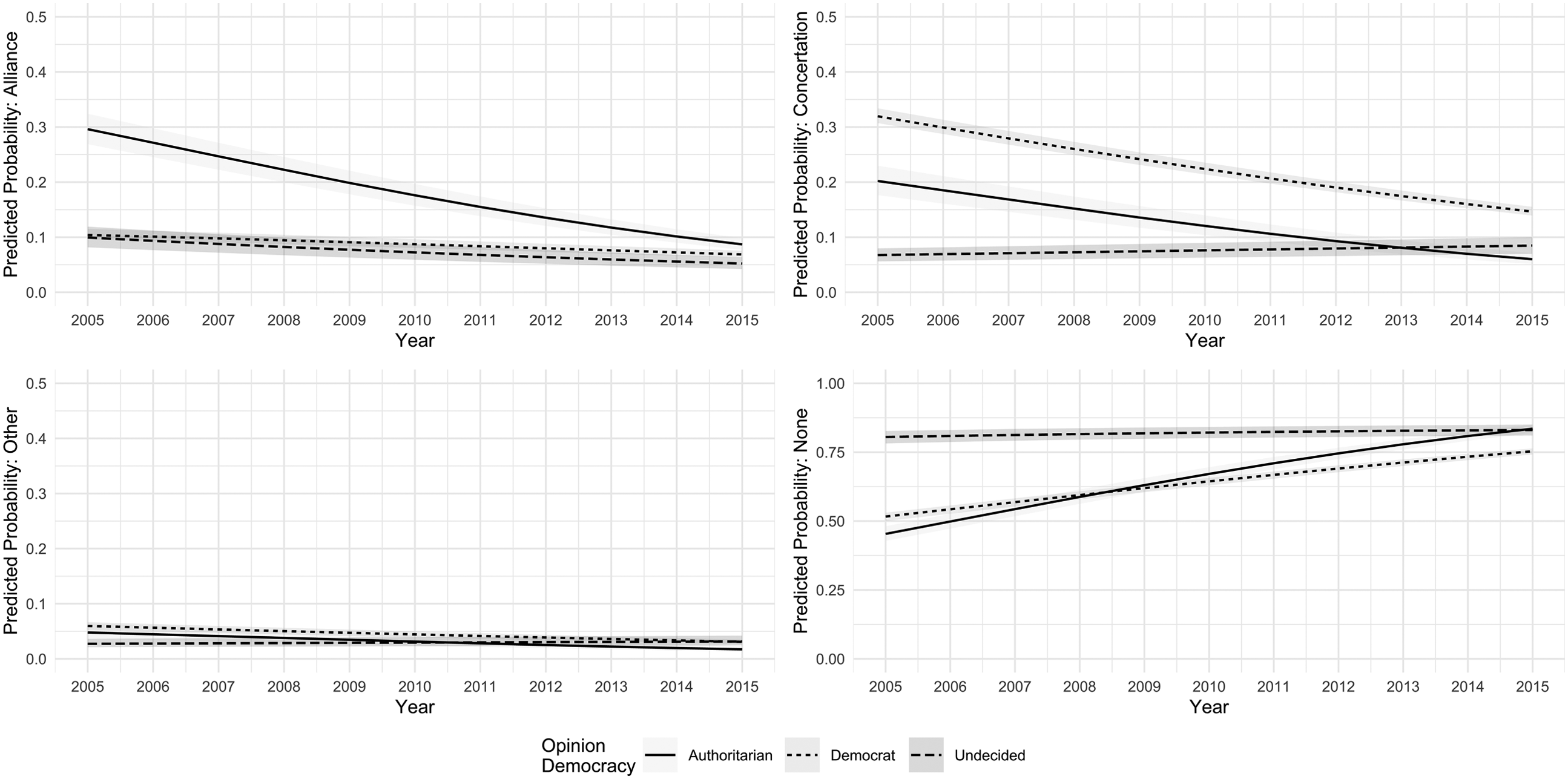
Predicted Probabilities of Party Identification by Opinion of Democracy.
Multinomial Regression Models.

Results
The Authoritarian/Democratic Divide
Table 1 shows the results of the logistic regression models. Model 2 shows that once regime preferences are included in the estimation, the model fit increases substantially. McFadden
Model 3 includes an interaction term between regime preferences and year. This interaction term captures differences in the association between regime preferences and partisanship across time. Figure 5 shows a graphical representation of this effect. According to the estimates presented there, the probability of identifying with a political party in 2005 was 48% for democrats and 54% for authoritarians. While in that year the likelihood of identifying with a party was somewhat higher among authoritarians than for democrats, the subsequent rate of decline was much higher for the former than for the latter group. Consequently, democrats had a greater probability of identifying with a political party than authoritarians by 2009.
Even though there are significant differences in the rate of decline between these two groups, they both experienced a sharp and dramatic decline during this period. By 2013, the differences in partisanship levels between undecideds and authoritarians is no longer statistically significant at a 95% confidence level. Likewise, differences between democrats and the rest of the population are substantially smaller at this point.
These findings are consistent with hypotheses 2 and 3. The probability of being a partisan among both authoritarians and democrats decreases sharply overtime. Conversely, for the rest of the population, the probability of identifying with a party remains constant throughout this period. According to this model, the decline in the levels of party identification is mainly driven by the migration of democrats and authoritarians from party identification to nonidentification.
As predicted in hypothesis 3, the authoritarian population shows the sharper decrease during this period. At the time, the right wing parties actively worked to distance themselves from the military dictatorship. Even though this strategy improved the electoral success of the right, finally leading to the election of Piñera in the 2010 presidential election, these findings indicate that, at the same time, it weakened the ties between the right wing parties and their core supporters.
In the long run, the ties of the center and left-wing parties of the Concertation coalition to their core supporters were also harmed because of the distancing actions of the right wing parties. Given that the authoritarian/democratic divide played a major role linking both the left and the right with their supporters, as the conflict eroded, the narrative of the support of democracy and opposition to the dictatorship ceased to make sense to the mass public.
Accordingly, we can see that the democratic supporters follow a similar trajectory to that of the authoritarians, though at a more gradual pace. All these findings provide strong support for hypothesis 1, 2 and 3.
Differences by Coalition
Table 2 presents the results of the multinomial regression logistic model. The base category for the estimation of this model is identification with the right wing Alliance coalition. Given that the results of multinomial regression models are difficult to interpret without a graphical representation. Figure 6 summarize the main findings regarding the variables of interest The results support my argument. In the year 2005, right and center left-wing partisans were sorted according to their views regarding the military dictatorship. Concertation partisans were mainly composed by individuals who stated that democracy is the best form of government while the core supporters of the right wing coalition stated that an authoritarian government can be preferable to a democratic one. Figure 6 also shows that overtime the levels of partisanship among both coalitions weakened as a consequence of the migration of their core constituents toward nonpartisan preferences.
Among the right wing partisans, the levels of partisanship decreased primarily as a consequence of the migration of those supportive of the previous authoritarian regime toward nonpartisan preference. A similar movement can be appreciated among center-left partisans. Supporters of democracy decrease their levels of party identification with the Concertation coalition overtime.
Conclusions
I argue that a relevant contributing factor to the decline in partisanship experienced in Chile between the years 1990 and 2018 is the dissolution of the main political division between supporters and critics of the military regime. At an elite level, data from both the V-Party dataset (Lührmann et al., 2020) and the Parliamentary Elites of Latin America Surveys (Alcántara Sáez, 2018) show that after the democratic transition in 1990, a process of systematic erosion of the democratic/authoritarian cleavage was set into motion. According to both sources, by the middle of the 2000s there was almost a universal elite level consensus over the unambiguous support of democracy. In turn, at the mass level, using data from 2005 to 2015, I show that the decline in partisanship is mainly driven by the migration of democratic and authoritarian citizens from partisan identification toward nonidentification. During this period, the association between democratic/authoritarian preferences and partisanship declined overtime. I interpret this migration process as a consequence of the decrease in salience of the authoritarian/democratic divide and the increasing consensus over the democratic pole of the distinction at the elite level. This process took place in a context that presented weak signs of ideological convergence. This means that the decline is not directly associated with programmatic aspects of party competition, such as policy positions and proposals, but to the relationship of the party system with the authoritarian legacy.
At a broader theoretical level, these findings imply at least two things. They highlight the importance of elite level conflicts in the process of political identity formation and preservation. Individuals need relevant reasons to feel emotionally attached to parties, and conflicts provide a strong basis for the development and maintenance of those bonds. At the same time, these findings point to the important role of elites in the stabilization of partisan identities. Without parties continuously reinforcing political opposition and key divides within the public, partisan identities can become politically irrelevant, thus dissolving overtime.
The theoretical argument I advance here is consistent with theories that focus on ideological polarization, such as brand dilution theory, and concurs that political elites play an essential role in shaping the stability of partisan attachments. However, it differs in two relevant ways. First, by emphasizing the role of conflict, this theory does not rely on processes of policy convergence or inconsistency as key drivers of partisan decline. Instead, if focuses on the capacity of conflict to both activate and deactivate political identities. Second, while theories of ideological polarization assume that divisions run along programmatic lines, a more general conflict approach opens the possibility for other forms of sources of political division such as symbols, charismatic leaderships, and historical political legacies.
It is also worth highlighting that a sharp decline like the one observed in Chile during the period studied probably responds to a number of different causal factors. Previous research has highlighted the role of trust and trustworthiness (Bargsted and Maldonado, 2018; Carlin, 2014), party vibrancy (Rosenblatt, 2018), and the unresponsiveness and detachment from society of the main political parties (Castiglioni and Rovira-Kaltwasser, 2016; Luna and Altman, 2011; Luna and Mardones, 2010), as possible factors behind this decline. The explanation offered here is not necessarily at odds with any of these other accounts, but it can be seen as an additional contributing factor.
Partisanship plays an important role in democratic politics; in many ways it is functional to democracy. Partisan identities allow individuals to organize the political world, and partisans follow party cues which allows them to develop and structure their belief system (Campbell et al., 1960). Partisanship also mobilizes individuals into the political process; as has been shown by Carlin, individuals who trust parties are more likely to turn out to vote (2011). Partisanship encourages party system stability while raising barriers for political outsiders (Lupu, 2016; Mainwaring and Scully, 1995; Mainwaring and Zoco, 2007). Finally, and probably most importantly, partisan ties connect individuals to the political system, providing the political system with legitimacy. Moderate levels of partisanship can improve democratic accountability and are desirable for a well-functioning democracy. The findings presented in this paper highlight some of the dynamics that underlie the process of both formation and dilution of partisan identities.
Furthermore, the findings presented here have important implications for the political events that are currently taking place in Chile. Over the last couple of years, Chile has experienced intense social conflict. Should we expect partisan identification to rise as a consequence of these episodes? The argument presented in this article predicts that this will be the case only if political elites are able to successfully translate these conflicts into the political realm. Thus, political entrepreneurs will play a central role managing these tensions and translating the powerful political experiences from this period into partisan attachments. The extensive challenges they face in doing so are beyond the scope of this article, but if they were to be successful, we could expect partisanship to grow in the near future.
Finally, the findings presented here have substantive political implications for the understanding of political phenomena in other contexts, particularly in places where democratic consolidation is still an ongoing process and the shadow of previous authoritarian experiences still plays a role shaping the party system. Likewise, it has broad applications in places where strong political legacies are today shaping the political landscape. Chavismo in Venezuela, Kirchnerismo in Argentina, and Petismo in Brazil are all cases where sharp divisions in the political sphere can be strongly associated to political identities at the mass level.
Supplemental Material
sj-docx-1-pla-10.1177_1866802X211069378 - Supplemental material for Unstable Identities: The Decline of Partisanship in Contemporary Chile
Supplemental material, sj-docx-1-pla-10.1177_1866802X211069378 for Unstable Identities: The Decline of Partisanship in Contemporary Chile by Nicolás de la Cerda in Journal of Politics in Latin America
Footnotes
Acknowledgments
Declaration of Conflicting Interests
Funding
ORCID iD

Supplemental Material
Author Biography
References
Supplementary Material
Please find the following supplemental material available below.
For Open Access articles published under a Creative Commons License, all supplemental material carries the same license as the article it is associated with.
For non-Open Access articles published, all supplemental material carries a non-exclusive license, and permission requests for re-use of supplemental material or any part of supplemental material shall be sent directly to the copyright owner as specified in the copyright notice associated with the article.
