







Abstract
The genus
In Western literature,
The most important chemical constituents of
There are reports on the chemical composition of
In the stem oil, 85 components were identified, representing 94.6% of the total oil (Table 1). The most abundant compound was limonene (23%). Other important compounds were methyl eugenol (5.4%), β-cubebene (5.0%), and δ-cadinene (3.3%). The oil of fresh fruits (64 identified components) contained germacrene B (28.7%), shyobunol (16.7%), and α-humulene (8.4%) as major components. There were 4 major constituents of the oil (63 identified components) from mature fruits: germacrene B (31.3%), α-humulene (11.8%), δ-cadinene (3.2%), and γ-murolene (2.9%). However, the chemical composition of the stem oil was different from those of the fresh and mature fruits because it contained almost the same amount of monoterpenes (47.0%) and sesquiterpenes (42.9%), whereas the percentages of sesquiterpene compounds in the oils from fresh and mature fruits were very high (85.8% and 73.8 %). Also, the content of monoterpene compounds in oils obtained from fresh and mature fruits were very similar (2.5% and 2.7%).
Chemical Composition of Essential Oils of Stem, Fresh Fruits and Mature Fruits of
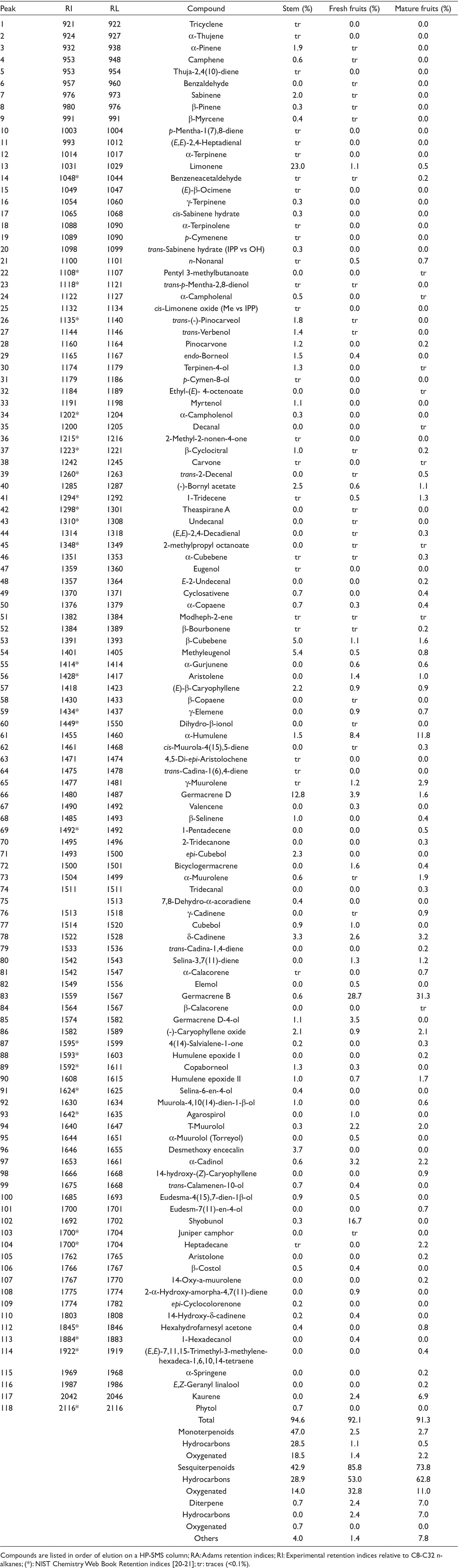
Compounds are listed in order of elution on a HP-5MS column; RA: Adams retention indices; RI: Experimental retention indices relative to C8-C32
The concentration of germacrene B was significantly lower in the stem oil (0.6%) than in the oils obtained from fresh (28.7%) and mature fruits (31.3%). On the other hand, the relative amount of d-limonene was found to be 23.0% in the essential oil of stem, whereas in the fruit oils the concentration varied with the stage of maturity (1.1%, fresh; 0.5%, mature). Shyobunol was one of the most abundant compounds in the oil from fresh fruits, but was not detected in mature fruits.
In a report on the phytotoxic activity and chemical composition of the essential oil of
Limonene is the most abundant component in the stem oil from Serbia, as well as in the oils from Corsica 7 and China. 8 Another similarity is noticeable with the oils from Corsica. 7 Like the Serbian fruit oils, those from Corsica had a high number of oxygenated compounds, particularly sesquiterpenes. The examined oil from China 8 was rich in monoterpene hydrocarbons (60.7%), as was the Serbian stem oil.
Experimental
Plant Material and Sample Preparation
Gas Chromatographic and Gas Chromatographic-Mass Spectrometric Analysis
Gas chromatographic/mass spectrometric analyses were performed on an Agilent 7890 gas chromatograph with a 7000B GC/MS/MS triple quadrupole system, operating in MS1 scan mode, and equipped with a fused-silica capillary column (Agilent HP-5 MS [30 m × 0.25 mm i.d. ×0.25 µm film thickness]). The chromatographic analyses were carried out under the following conditions: He as carrier gas at a flow rate of 1.0 mL/min; GC oven temperature was kept at 45°C for 2.25 min and programmed to 290°C at a rate of 4°C/min; split ratio was adjusted at 40:1; injection volume 1 µL. Post run: back flash for 1.89 minutes, at 280°C, with helium pressure of 50 psi. The injector temperature was set at 230°C. Ionization mode was electronic impact at 70 eV. Mass range was set from 40 to 440 Da.
For gas chromatography with flame ionization detection analysis (GC/FID), the same column and chromatographic conditions were applied as described for GC/MS. FID temperature was 300°C. The percentage amounts of the separated compounds were calculated from the GC peak areas using the normalization method without correction factors.
The data are reported as mean value of 3 sample injections.
Identification of Components
Oil constituents were identified by comparison of their linear retention indices (relative to C8-C20 and C21-C44 alkanes 9,10 on a HP-5MS column, with literature values), and their MS with those of authentic standards, as well as those from Wiley 6, NIST11, Agilent Mass Hunter Workstation B.06.00 software, 11 and a homemade MS library with the spectra corresponding to pure substances and components of known essential oils by the application of AMDIS software. 12