







Abstract
Keywords
Introduction
Public service broadcasters differ from other mass media insofar as they don’t just face oversight of the content of their programming but also expectations, or even prescriptions from policymakers about what they should be broadcasting. This often includes expectations of a more proactive contribution to the functioning of a democratic political system. One of the core ways in which public broadcasters are seen to and envisage themselves contributing to the health of democracy is in “public access” or “public participation” broadcasting (Ekström and Firmstone 2017; McNair and Hibbert 2003; McNair et al 2002, 2003; Patrona 2017; Thornborrow 2007, 2010, 2014). This type of broadcasting centers around three core aims: providing critical scrutiny of political elites by the public; representing the citizens in the public sphere; and engaging the public in the political process (McNair et al. 2003). Citizens are viewed as not just a passive audience but given an active role in discussing the pertinent issues of the day among themselves or with elites.
The BBC has played a pioneering role in developing public participation broadcasting in the UK, with its flagship political entertainment program BBC Question Time (BBCQT) having now been on the air for over 40 years. The weekly program features a panel of invited guests, including politicians from the main UK political parties, as well as individuals from outside of politics such as journalists, authors, and businesspeople. Members of the public submit questions that will be discussed by the panel, and can also apply to attend the in-studio audience to take part in the live debate. The show attracts high viewing figures, as well as substantial debate on social media (Anstead and O’Loughlin 2011). 1 The program also has a broader impact beyond those who choose to tune in, as talking points from the broadcast often become news stories in and of themselves, attracting widespread media attention (McNair et al. 2003: 70–71).
As long as the program has been on the air, it has continually faced accusations of “bias” in various forms. This includes issues with how the show selects its guests, audience, and questions. Accusations have been aimed at the program from all sides of the political spectrum, with complaints that certain parties, ideologies, regions, or issue positions receive unfair treatment by the broadcaster. Accusations of bias were put to senior BBC staff during a Westminster Media Committee in March of 2024, with Labour MP Rupa Huq noting: “One barometer people have of impartiality is the panels that you see on Question Time.”
2
BBC Director of Editorial Policy, David Jordan, responded with assurances that the Question Time team make significant efforts to:
. . .make sure that its panels are gender representative, are ethnically diverse, are geographically disparate, are socioeconomically representative, are politically representative of all of the different political parties in the country. . . . . .all of those factors are taken into account on a weekly basis and over time, the Question Time team aspires to get a genuinely representative range of people with all sorts of different views on their panel.
3
This paper contributes to this ongoing debate by presenting an original dataset of BBC Question Time guest appearances between 2001 and 2019, to examine: Who gets represented in BBCQT panel selection? According to the BBC, panels are meant to represent not just political balance but also “a breadth of viewpoints.” Here, it is important to note how descriptive representation links to substantive representation: different social groups have specific interests, preferences, concerns, and perspectives that can only be adequately represented and voiced when group members (especially those from traditionally marginalized groups) are being platformed (e.g. Bratton and Ray 2002; Hänni 2017; Preuhs 2007; Reher 2022; Reynolds 2013). We begin by illustrating the degree to which certain demographic groups are represented on the program, in terms of guests’ sex, ethnicity, and educational background.
We then move on to the more complex problem regarding accusations of issue bias against the program. Here we explore how political viewpoints were represented on the show during periods where the most salient political issues divided UK parties and the public alike: the 2003 UK invasion of Iraq, and the 2016 EU referendum. To what extent did the BBC represent different sides of these debates, whilst also attempting to ensure adequate representation of demographic groups, as well as UK political parties?
This article makes several contributions to the study of representation in public broadcasting. Public broadcasters put significant efforts in place to address concerns of political bias at the institutional level across a range of programming. BBC Question Time provides a unique analytical opportunity to directly observe this process in action. The continuity of the show’s structure over such a long period, alongside the directly observable outcome of who appears on the program, allows us to evaluate how program makers approach the representation of different viewpoints and groups in changing political contexts.
We therefore add to the relatively small body of academic literature that has examined BBC Question Time, which is a paradigm example of political broadcasting that mediates the link between the public and political elites. This allows us to gain insights not only about the program itself—its core focus on public participation, direct access to political elites, and its impact on political culture and the wider news agenda in the UK—but also about how public broadcasters approach the issues of representation and bias more generally.
We introduce a novel dataset that will be of interest to scholars of both media representation and UK political elites. It provides fine-grained systematic data on program appearances over an 18-year period. Beyond our current project, these data open several new avenues for research in this area. The availability of objective measures of representation in this type of programming allows for comparisons against different groups’ perceptions of bias and representation. This includes how other media outlets evaluate BBC outputs, how political parties view their treatment in its programming, as well as how the public perceives whether specific interests and viewpoints are adequately reflected.
This research also has broader implications, not just for other countries who have commissioned similar programs (e.g., Ireland and Australia) but also for the role of public broadcasters in society more generally. Exploring the regulations and responsibilities that are imposed on public broadcasters, as well as their expressed aims of providing a public good is a crucially important first stage before evaluating the extent to which this potentially impacts public attitudes and engagement toward political affairs.
To address our core research questions, the article is structured as follows: First, we provide an overview of the literature on descriptive representation in the media, with particular reference to public participation broadcasting. We then explore previous accusations of bias leveled at the program and place this within the broader context of how media bias is conceptualized within the academic literature, as well as the role and responsibilities of public broadcasters. The next section outlines the data collection process for BBCQT guest appearances and the measurement of our key variables of interest. We then present the data on the demographic makeup of panel appearances, as well as the distribution of viewpoints regarding both the Iraq war and the 2016 Brexit referendum. Finally, we also offer statistics from relevant segments of both the UK public and UK parliamentarians, as reference points for which to compare representation on the program.
Descriptive Representation in Public Participation Broadcasting
An elite-audience debate format like BBC Question Time often takes into account multiple dimensions across which at least some level of representativeness needs to be accomplished. This includes how it selects: panelists, audiences, locations, and questions. In this paper, we focus on the aspect that appears to receive the most systematic sampling—panel selection.
Much of the existing literature regarding public participation broadcasting focuses on qualitative assessments of how broadcasters design the format of programs (McNair et al 2002, 2023), examinations of individual episodes (Bull and Simon-Vandenbergen 2014), or discourse analysis of how audiences overcome structural deficits compared with elite contributors in establishing their positions and authenticity in debates (Ekström and Firmstone 2017; Thornborrow 2014). What we know much less about is how broadcasters accomplish meaningful representation in these elite-audience participation formats. Our first aim, therefore, is to illustrate which groups appear on BBCQT panels, and the extent to which representation on the program is reflective of the broader population of the UK public and political elites.
One concept that is central to the issue of who gets platformed in political public broadcasting is descriptive representation, which refers to the idea that representatives possess characteristics that correlate with those of the population they represent, producing a body that “corresponds in composition with the community” (Pitkin 1967: 62). The primary focus of descriptive representation is on visible demographic characteristics, including gender, age, and ethnicity, as well as other non-visible social identities such as class.
The visibility of diverse identities in the media and the political arena sends a strong message that a wide range of opinions are considered in political decision-making, and may help foster greater political satisfaction, trust in political institutions, government legitimacy, and the belief that citizens’ voices are being heard and considered (Atkeson and Carrillo 2007; Johannsen et al. 2022). When the media broadly reflects diversity within the population and ensures that different groups have a platform to express their views, it can also help counteract negative stereotypes and biases (Żerebecki et al. 2021, 2023). Moreover, by advancing a more accurate and nuanced understanding of diverse and marginalized perspectives, the media can help lessen the marginalization of certain groups and promote a more equitable and inclusive society (Fürsich 2010).
Although the focus of this paper is on the platforming of specific individuals, rather than the substantive content of the program itself, the literature on political representation explicitly links descriptive representation to greater substantive representation, that is, a more accurate representation of interests, preferences, concerns, and perspectives of different social groups (e.g., Bratton and Ray 2002; Hänni 2017; Preuhs 2007; Reher 2022; Reynolds 2013). Mansbridge (1999) argues that descriptive representation improves the substantive representation of underrepresented interests by improving the quality of deliberation, thus facilitating the articulation of minority interests, promoting effective communication, and spreading the awareness of minority issues.
The role of the media in promoting wider representation and visibility is of particular importance since audience exposure to diverse viewpoints through media outlets has been shown to have a positive effect on their receptiveness to and tolerance of new and diverse ideas (Van der Wurff 2011). According to Fürsich (2010), the media is responsible in producing shared cultural meaning, and when it accurately represents reality, it can lead to the normalization of world views and ideologies. However, when media representation is limited, it may contribute to sustaining inequalities (Fürsich 2010). Moreover, by advancing diverse perspectives toward the analysis of political issues, the media can help citizens understand complex issues and make informed decisions, thus fostering an active and engaged civil society and greater political awareness (Fürsich 2010).
Issue Bias in Public Broadcasting and BBC Question Time
BBC Question Time has been regularly accused of bias in its panel selection, 4 audience selection, 5 and even location selection 6 . This has become all the more common since the UK’s referendum on EU membership in 2016, with former BBC chairman Richard Sharp, noting that Brexit coverage on BBC Question Time had been “unbalanced.” 7
Media bias is most commonly defined in the academic literature as a deviation from balanced and equal coverage, which is seen as being reflective of a media outlet favoring a certain political side, ideological leaning, or argument (Eberl et al 2017; Hönnige et al 2020; Stevenson and Greene 1980). Other definitions incorporate the need for bias to be systematic and intentional in nature, where one side of a debate is disproportionately favored over a sustained period (Groeling 2013; Williams 1975). Bias can present itself in various forms, such as visibility and agenda bias (D’Alessio and Allen 2000; Groeling 2013).
The BBC is vociferous about its commitment to bias-free coverage, stating in its impartiality guidelines: “We must always scrutinize arguments, question consensus and hold power to account with consistency and due impartiality.” 8 Crucially, the key qualification here is the notion of “due” impartiality which explicitly does not mean “an equal division of time has to be given to every view.” 9
Most accusations of bias against the program are based on anecdotal evidence, but some studies claim to have uncovered systematic unfairness in issue representation, particularly around Brexit. Three such tallies, from the Institute of Economic Affairs (2016–17), 10 the blogger Joel Rodrigues (2017–19), 11 and the anonymous Question Time Watch (2016–2021), 12 all report a “bias against Brexiters,” with roughly twice as many Remain versus Leave supporters having featured on the program, compared to the 52–48 victory for Leave.
The problem with such accusations of media bias is that they inherently involve value judgments in comparing normative criteria (what media ought to present), against real-world distributions (what media do present). As such, claims of bias rely upon often contentious ‘arbitrary benchmarks’ (Althaus 2012), about what the ideal form of representation should be. Previous accusations leveled at the show, particularly around its Brexit coverage, imply that this criterion should be a direct and accurate representation of public attitudes (e.g., that while Brexit was dominating UK politics, panels should be split equally among Remain and Leave supporters). The BBC’s own guidelines meanwhile set a far less strict benchmark of merely representing a broad range of views. Such accusations also ignore Bennett’s argument at the heart of his “indexing theory,” namely that any curtailing of viewpoints which some regard as ideological bias is “nothing more (or less) than a professional responsibility to highlight important conflicts and struggles within the centers of power” (Bennett 1990: 110).
The purpose of this article is therefore not to set out what the ideal form of public media representation should take, but to provide systematic, long-term data that can inform debates around these issues, and illustrate patterns of actual representation in public broadcasting. What we do offer is two additional reference points: the distribution of relevant social groups and political views among the UK public (the baseline most often relied upon in terms of accusations of bias against the show), as well as these same distributions among political elites (UK Parliament). While we do not maintain that BBCQT should necessarily mirror the views of UK MPs, providing comparable statistics for both the public and political elites provides a more complete repertoire against which bias accusations and the BBC’s stated aims can be compared. Moreover, this allows us to analyze panel selection as a sampling process and evaluate bias in the statistical sense of
The majority of guests are politicians, and that group of politicians is predominantly sampled from the Westminster Parliament (77% of political guests are MPs). We therefore treat politicians on Question Time as a sample, and the UK Parliament as the primary population from which they are drawn. We can then compare the distribution of demographic characteristics, party membership, and issue positions among our sample with those in the population. The remaining guests who are not politicians come from a range of walks of life, and we don’t have enough information about sub-populations that are being sampled from (journalists, comedians, scientists, entrepreneurs, representatives of think tanks or NGOs, etc.), so in their case we resort to treating the general population as our baseline.
In the following sections, we assess how the BBC chose to represent diverse political viewpoints in this context of competing representative demands, and we compare how the breakdown of views on divisive political issues matches up with those of the public and UK politicians. We illustrate this using two dominant issues in twenty-first century UK politics: Brexit and the Iraq war.
Data
This article presents an original dataset on all BBC Question Time panelist appearances between 2001 and 2019. 13 The initial process involved collecting information via web scraping from a Wikipedia page that lists all episodes of the program since its inception. 14 The data was then manually cleaned and validated (full data collection and coding scheme information included in the Supplemental Information file). Occasionally, the show broadcasts “special episodes,” such as party leader debates or general election specials. Episodes were excluded from the final dataset if they featured only one panelist, consisted solely of leadership or mayoral candidates, or were held outside the UK with no direct focus on UK politics. This left us with a total of 668 episodes between 2001 and 2019, featuring 3,433 appearances from 996 unique guests.
We then began the process of manually collecting data on a range of features for each guest appearance, including demographic background, party affiliation, Brexit attitudes, and views on the 2003 UK invasion of Iraq. Information was obtained from a variety of sources, including panelists’ Wikipedia pages, MP voting records, personal websites, biographies, media interviews, and social media posts. The first part of coding focused on panelists’ sex, ethnicity, occupation, whether individuals were privately educated, attended university, and attended Oxford or Cambridge University. The next stage gathered information on the specific role and party affiliation of all politicians who have appeared on the show. This was completed by collecting information from guest Wikipedia pages using the “WikipediR” package and the statistical software “R,” which was then cross-referenced to ensure that guests who had ever changed parties were coded correctly, with any remaining cases being coded manually.
Guest information was then linked to political preferences, first focusing on the 2003 UK invasion of Iraq. For those who were MPs during the 2001 Parliament, coding was based primarily on parliamentary voting records. The same variety of online sources outlined in the previous section were used to identify whether all remaining guests had made any public statements in favor or against the UK government’s decision to join the US-led invasion of Iraq in March 2003.
We then moved on to the issue of the 2016 EU referendum. Guests’ Brexit positions were coded for all episodes that fell between the 2015 and 2019 UK General Elections. These two time points were chosen as they spanned the period between the first announcement that an EU referendum would take place, and the final stages of the Brexit process, while also coinciding with significant political events marked by the elections themselves. The coding of Brexit attitudes was split into two separate measures. The first coded each guest’s stance on the EU referendum based on whether they supported the “Leave” or “Remain” side in the 2016 vote. This measure is used for all guest appearances between the 2015 and 2017 UK general elections.
To capture the more nuanced positions that emerged following the referendum, each guest was then also coded to distinguish between different Brexit preferences, such as support for: a second referendum or revocation of Article 50, leaving the EU with a Brexit deal, or exiting the EU with no deal in place. For coding MPs, we used parliamentary voting records (e.g., the “indicative votes” held in 2019), while for others we again used online sources to identify public statements that allow identifying their specific Brexit policy preference. The coding scheme for this measure, which is based on party positions in the 2017 election manifestos, included the following five categories:
In favor of second referendum with remain as an option/revoking Article 50
Seeks Brexit deal, but willing to support a confirmatory vote on the deal
Seeks Brexit deal, against second public vote and no deal
Seeks Brexit deal, but willing to leave no deal on the table
In favor of hard Brexit/no deal
This allowed us to capture the full range of political viewpoints on the issue, while also being able to map this onto the positions taken by the main UK parties during this period. It is important to note that the unit of analysis is individual guest appearances. As guests can appear multiple times, and may change their issues positions or even party affiliation, coding categories refer to the guest’s attitudes and positions at the time of appearance. The full coding scheme for both variables is listed in the Supplemental Information file.
Results
Descriptive Representation
Figure 1 displays the demographic breakdown of all panelist appearances on Question Time between 2001 and 2019. Each bar represents the total number of appearances on the program each year, with the shaded areas signifying the proportion of panelists who belong to each group. Two additional data points have been overlaid on the plots: a solid white line that represents the proportion of MPs in the House of Commons who belong to the group in the bottom category of each plot; 15 and a dashed line indicating the proportion of the UK population in these same groups (with the exception of the second panel on ethnicity, where instead point estimates from the UK census are represented by white circles). 16

Demographic background of all BBC question time appearances (2001–2019).
First, when it comes to gender representation on the program, the figures are relatively stable between 2001 and 2010, with around 35 percent of appearances featuring female panelists. The proportion of female guests rose to 45 percent by 2015 and remained at this level through to 2019.
The second panel of Figure 1 illustrates the degree of ethnic diversity on the program. The groups displayed in the figure have been aggregated to align with the available statistics on ethnic diversity in Parliament to compare the proportion of guests from white, and minority ethnic backgrounds. In 2001, around 7 percent of appearances featured panelists from a minority ethnic group. By 2010, this figure had risen to 10 percent. The biggest increases have been seen in more recent years, as in 2018 just under a quarter of all appearances were from panelists from ethnic minority groups.
In terms of panelists’ educational background, the proportion of guests who had attended private schools fluctuated between 38 and 56 percent, with a mean over the full time period of 47 percent. While there appears to be a slight reduction in privately educated panelists since 2010, 2019 saw a return to the higher figures of earlier periods, with 51 percent of all appearances featuring guests who attended fee-paying schools.
Turning next to university education, over the full time period an average of 85 percent of appearances were from guests that had attended university. Across all appearances between 2001 and 2019, an average of 38 percent of panel slots went to guests who had attended Oxford or Cambridge University for their undergraduate studies. This figure rose from 36 percent in 2001, to a high of 43 percent in 2006, and remained at this level until 2015, when we began to see a decrease to a low of 29 percent in 2017.
While Figure 1 illustrates the trends in representation over time for all panelist appearances, it is important to note that the program over-samples political elites, with 63 percent of all guests being politicians. To appropriately evaluate representation on the program, it is necessary to split the panelists in the same manner and assign relevant target populations for comparison. Table 1 displays the mean percentage of panelist appearances from different demographic groups over the 2001–2019 time period, after splitting appearances between politicians and non-political guests. This allows for more direct comparisons with the reference points of the demographic make-up of the UK Parliament, and the public (columns labeled “Baseline group”). The final two columns of Table 1. display the percentage point difference between guests who appeared on the program from a specific group, minus the proportion of this group in the reference population (politician guests vs. UK MPs; non-politician guests vs. UK public). In general terms, positive values here indicate that a group is relatively overrepresented on the program compared to the target population, with negative values meaning a group is underrepresented.
Demographics of BBCQT Appearances Compared to UK Parliament and Public (Mean Values for 2001–2019 period).

Looking at the net difference columns in Table 1, we can see that in terms of gender and minority representation, on average, BBC Question Time samples are not far from the baseline populations, with slight over-representation of female MPs and slight underrepresentation of women in the wider population, and slight overrepresentation of ethnic minorities among MPs and in society at large.
In contrast, we find substantial overrepresentation of the privately and Oxbridge-educated. Even in comparison with general educational background of MPs, political guests are considerably more likely to come from an elite educational background.
Issue Representation
We now turn our attention to how the program chose to represent the competing viewpoints that were present during both the Iraq war and the Brexit referendum, in light of also attempting to balance demographic representation, as well as the regulatory constraints of fair party representation.
The UK Invasion of Iraq
Figure 2 below displays the distribution of views regarding the UK invasion of Iraq for all guest appearances on BBC Question time between 2002 and 2005. It is important to note that due to a lack of publicly available information for certain panelists, we were unable to code attitudes at the time of the invasion for a significant portion of non-political guests. Bearing this limitation in mind, when we look at the combined total for all guests for which we have information during this period, 42 percent of appearances featured panelists who supported the UK’s military action, compared to 36 percent against the invasion.

Iraq war attitudes of all BBC Question time appearances (2002–2005).
When it comes to non-politicians on the show, for 46 percent of these appearances there was either no publicly available information on the guest’s stance toward the invasion, or they did not indicate a clear preference for either side. Non-political panelists for whom we have evidence of their position split about 2:1 against UK military action, while a clear majority of the politicians who appeared on the program were in favor of UK involvement in the invasion (56% for, 36% against).
Perhaps the most notable feature of Figure 2 is the way in which different panelists appear to have been used to reflect distinct viewpoints during the initial years of the Iraq war. With most politicians being in favor of the conflict, non-politician guests appear to have been a counterweight in the panel selection process, to provide a more balanced range of views. This also matches the views expressed during an interview we conducted with a former Executive Editor on the program: that given the restricted range of ideology and issue positions that come with quota places for party representatives, non-political guests are used to sometimes counter-balance or widen the range of perspectives. 17
While both sides of the debate featured on the program, a second question is to what extent did these viewpoints reflect the distribution of attitudes among the wider UK public and political elites? Initial comparisons between representation on the show and the views of British citizens raise two immediate issues: First is the limited data available regarding the preferences of non-political guests on the show; and second, public opinion polling on the Iraq war varied substantially both over time and depending on the specific wording of the question being asked.
Polling by ICM Research and the Guardian in the two months leading up to the war placed support for military action at around 30 percent, with 50 percent of citizens against it (Everts and Isernia 2005: 321). UK public support peaked in April 2003, shortly after the invasion began, with 63 percent for, and 23 percent against (Everts and Isernia 2005: 321). From this point onwards, however, as it became clear that the pretext for the invasion regarding weapons of mass destruction was unfounded, support gradually dwindled back to the levels seen in the pre-war period (Everts and Isernia 2005: 275).
When it comes to politicians on show, while party representatives from the devolved nations, local councils, and European Parliament frequently appear on the program, the overwhelming majority of politician guests are members of the UK Parliament. Table 2 displays the breakdown of views on the Iraq War for all UK MPs in the 2001–2005 Parliament, which offers an approximate baseline for which to compare politician appearances on the show. The ratio of politician appearances on the program (56% pro-invasion, 36% against) maps relatively closely to the proportion among all MPs (66% pro-invasion, 34% against) during this period.
UK MP Positions on the 2003 Invasion of Iraq.

Figure 3 illustrates in further detail the distribution of views for politician guests split by political party. Here, we can see that politician appearances matched the views of their parliamentary party relatively closely when it came to the Conservatives (86% of guests pro-invasion, compared to 91% of MPs), as well as the smaller UK parties (83% of guests were anti-invasion, compared to 86% of all other MPs). The biggest discrepancy between representation on the program and Parliament, however, arises from the Labour Party. While 83 percent of all Labour politician appearances were pro-invasion, only 66 percent of Labour MPs supported military action at the time.

Iraq war attitudes for politician BBCQT appearances by party (2002–2005).
2016 EU Referendum
The following section outlines panelists’ attitudes toward Brexit for all BBC Question Time appearances between 2015–2017, and 2017–2019. Figure 4 illustrates the Brexit views of panelists in the two-year period surrounding the referendum. Across all appearances, the ratio of Remain to Leave supporters was around 2:1; however, once we split the panelists based on whether or not they were politicians, clear differences emerged.

Brexit attitudes of BBC question time panelist appearances (2015–2017).
From the middle set of bars in Figure 4 that looks at only politicians, we can see that the ratio of Remainers to Leavers widens to around 3:1. While this vastly differs from the outcome of the referendum (52% Leave, 48% Remain), it almost perfectly reflects the distribution of viewpoints in the 2015 Parliament, where 74 percent of MPs supported Remain. 18 Non-politicians, on the other hand, were almost evenly split, with a 2 percent margin in favor of Remain (however, no information was available for around 4 percent of the non-partisan guests).
This points to the BBC reflecting the balance of opinion in Parliament through their political guests, and wider public opinion through their non-partisan panelists. With around two-thirds of guests being politicians, this inevitably skews the overall representation of Brexit views away from the referendum result.
Considering the evolving nature of the UK’s exit from the EU, and the fragmented viewpoints that emerged following the referendum result, from 2017 onwards, we measure both BBCQT guests’ and MPs’ Brexit attitudes using our expanded categorical variable based on the main parties’ positions at the 2017 General Election. 19 Figure 5 displays the distribution of Brexit viewpoints for all guest appearances between the 2017 and 2019 UK General Elections, as well as splitting the data by political and non-political guests.

Brexit attitudes of BBC question time panelist appearances (2017–2019).
Here we can see that 39 percent of politicians on BBC Question Time displayed a clear preference for holding a second referendum, while a majority advocated for delivering Brexit in one form or another. The most extreme version of this position—leaving the EU with no deal in place—was supported by 13 percent of politician guests on the show. Of the 48 percent of political guests whose main preference was a Brexit deal, 12 percent were still open to the idea of holding a second confirmatory vote, while 17 percent supported keeping “no-deal” Brexit on the table during negotiations, and 19 percent ruled out either of these two alternative options entirely.
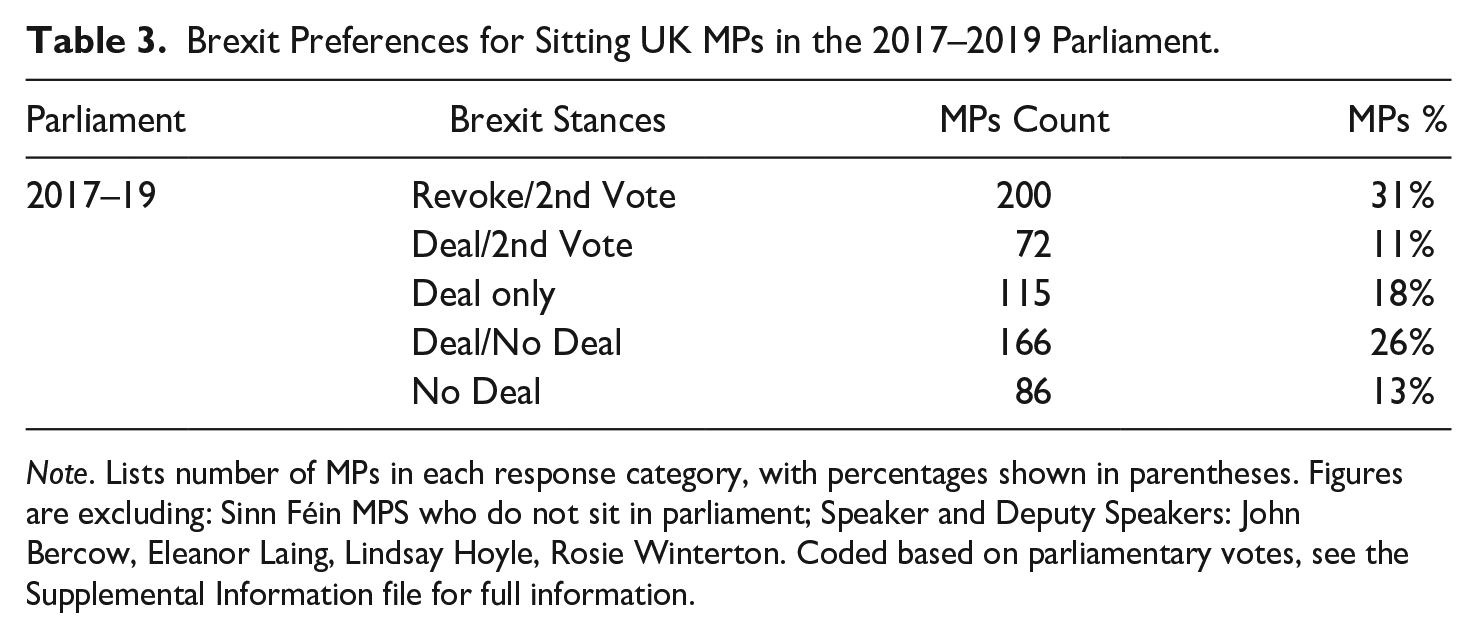
In terms of how this compares to the distribution of views in Parliament at the time, Table 3 displays the Brexit preferences for all MPs in the 2017–2019 Parliament, using the same coding scheme applied to the BBC Question Time appearances. 20 The ratio of individuals in favor of a second referendum was higher on the show compared to Parliament (39% of appearances vs. 31% of all MPs), while those who preferred a deal but were still open to the concept of a no-deal outcome, appeared less frequently on the show (17% of appearances vs. 26% of MPs). For the remaining three categories, the distributions of views on the show and in Parliament were remarkably similar. This included those in favor of a “no deal” Brexit (13% of appearances, vs. 13% of MPs), preference for a deal but remaining open to a confirmatory referendum (12% of appearances, 11% of MPs), and those whose only preferred outcome was a Brexit deal (19% of panelists, 18% of MPs).
Brexit Preferences for Sitting UK MPs in the 2017–2019 Parliament.
YouGov polling from October 2019 21 indicated that around 38 percent of the public was in favor of remaining in the EU, 17 percent supported leaving the EU with no deal, and 30 percent supported leaving the EU with the Government’s currently negotiated deal. Comparing this to the non-politician group in Figure 5, we can see that 28 percent of guests had a clear preference for a second vote (with 11% also open to this option), 17 percent favored a no-deal outcome, and 41 percent preferred at least some form of Brexit deal. As with the previous measure, this indicates that non-partisan guests were broadly in line with wider public opinion.
Conclusion
One of the core ways in which public broadcasters are seen to and envisage themselves contributing to the health of democracy is in “public access” or “public participation” broadcasting (Ekström and Firmstone 2017; McNair and Hibbert 2003; McNair et al 2002, 2003; Patrona 2017; Thornborrow 2007, 2010, 2014), which centers around three core aims: providing critical scrutiny of political elites by the public; representation of citizens in the public sphere; and engaging the public in the political process (McNair et al. 2002, 409; McNair et al. 2003).
In this article, we examine one of the longest-running political debate programs on television and a paradigm example of public participation broadcasting: BBC Question Time. Due to the unique features of the show’s format, the program offers an opportunity to explore how broadcasters mediate public access to political elites: that politicians face direct interrogation by not only their peers and experienced journalists but also crucially, members of the public. We contribute to the growing body of research on BBCQT, complementing previous interview and case study work (Anstead and O’Loughlin 2011; Bull and Simon-Vandenbergen 2014; McNair et al 2002, 2003) by providing long-term systematic data on how socio-demographic groups and political viewpoints are platformed on the show. We introduce an original dataset containing information on 18 years of appearances on BBC Question Time, which allows for more direct evaluations of how panel selection matches up with the program makers’ aspirations of representing the people in the public sphere (McNair et al. 2002: 409); BBC guidelines on due impartiality; and accusations of bias leveled against the show.
We analyze this link between the public and political elites to illustrate: Who gets selected to appear on BBC Question Time panels? Which views get platformed when the most salient political issues divide both parties and the public? And how does representation on the program compare to that of the UK public and political elites?
Our analysis shows that the program’s efforts to reflect gender and ethnic diversity were relatively successful, with the show consistently platforming female guests and panelists from ethnic minority groups at higher rates compared to the breakdown of these groups within Parliament, and either matching or coming relatively close to the rates in the wider UK population. By far the biggest divide we see in how the make-up of the panel differs from both Parliament and the UK public is in the educational background of those who appear on BBC Question Time. The proportion of panelists who attended fee-paying private schools and attended Oxford or Cambridge University were vastly higher than the proportion of the UK population who attended these institutions. Even when compared with the UK Parliament, where MPs are far more likely to come from these types of educational backgrounds relative to the wider public, the show also platforms privately schooled and Oxbridge-educated guests at substantially higher rates.
When it comes to issue representation, and how competing political viewpoints are platformed on the show, we explored the breakdown of guests’ attitudes toward two major events in UK politics: the 2003 invasion of Iraq and the 2016 EU referendum.
Looking at aggregate appearances for all politician guests between 2002 and 2005, guests’ attitudes toward the invasion of Iraq mapped relatively closely to the breakdown of views within Parliament at the time. After disaggregating appearances by party, however, we find that Labour politicians on the program were significantly more likely to support the invasion in comparison to Labour MPs. These figures imply that while the program broadly appeared to try and match the views of political guests with those of political elites at the time, there seem to be some clear differences in how parties approached the program. With the governing Labour Party being more likely to have pro-invasion members make appearances, this may well be a result of party discipline or strategy during a time of national crisis.
Regarding the 2016 referendum on EU membership, we find that across all panelists, the program featured more guests in favor of the Remain side of the referendum compared to Leave. When we split the panelists between politicians and non-political guests, however, the breakdown of views matches extremely closely between politicians and the view of Parliament, and non-political guests and the outcome of the referendum.
We also examine the more fragmented viewpoints that emerged between 2017 and 2019 regarding the preferred Brexit outcomes of the main UK parties. We find that again, appearances on the program tended to broadly reflect the views of Parliament and public opinion once accounting for the type of guests (non/politicians), with a majority favoring some form of Brexit, but huge divisions across what form this should take, and a plurality in favor of holding a second referendum.
These results have clear implications for future work in this area. Having data on who is given a platform and the types of views represented by public broadcasters, along with evidence of any apparent bias, enables us to compare this reference point against perceptions of bias expressed by the public through social media and by the media through news reporting. Furthermore, dialogue with broadcasters themselves, as well as survey research involving the public, can shed light on both the intended aims of public access programming, as well as the extent to which it is successful in fostering interest and participation in political affairs.
Our results also raise important issues for wider society, as the dominance of a small minority of the population (in terms of educational background) across both politics and journalism in the United Kingdom (Sutton Trust 2019: 3), seems to be compounded even further within a form of media that is supposed to act as a bridge between the public and political elites.
It is also important to note the inherent limitations of the current study. First, while we have an extremely rich source of information on who and what issues get platformed on the program, this is only one of several forms of representation and potential avenues for bias. Other key features, such as the actual content of the questions and discussions during each broadcast, as well as the selection of audience members, and the host’s treatment of guests, cannot be examined via the current research design. Future research that collects data on episode transcripts or submitted audience questions could help speak to the further substantive representation of specific viewpoints and ideas. These additional features have clear implications for other relevant forms of bias, such as issue framing, and how descriptive representation carries over into substantive issue concerns.
In conclusion, we do not find clear evidence of systematic issue bias on BBC Question Time. The BBC appears to employ relatively robust sampling methods for their panelists. This is frequently reported as bias due to the use of an arguably inappropriate initial baseline—the show samples guests from political and other elites, not from the general population. Panelist sampling does, however, give a disproportionate voice to educational elites, even when compared with Parliament, and especially with regards to non-political guests which tend to be drawn from a small minority that is privately educated and often also went to Oxbridge, which dominates economic, social, and cultural life in Britain.
Supplemental Material
sj-docx-1-hij-10.1177_19401612241292716 – Supplemental material for Brexit and the Iraq War on BBC Question Time: Demographic and Political Issue Representation in UK Public Participation Broadcasting
Supplemental material, sj-docx-1-hij-10.1177_19401612241292716 for Brexit and the Iraq War on BBC Question Time: Demographic and Political Issue Representation in UK Public Participation Broadcasting by Heinz Brandenburg, Brian Paul Boyle and Yulia Lemesheva in The International Journal of Press/Politics
Footnotes
Declaration of Conflicting Interests
Funding
ORCID iD

Supplemental Material
Author Biographies
References
Supplementary Material
Please find the following supplemental material available below.
For Open Access articles published under a Creative Commons License, all supplemental material carries the same license as the article it is associated with.
For non-Open Access articles published, all supplemental material carries a non-exclusive license, and permission requests for re-use of supplemental material or any part of supplemental material shall be sent directly to the copyright owner as specified in the copyright notice associated with the article.
