







Abstract
Introduction
Lack of nutritional education during training is often highlighted as the cause for insufficient nutrition knowledge among physicians. In fact studies assessing the residency and fellowship programme in America and Europe have repeatedly shown deficiency in nutrition training across medical provider.1–3
Considerable efforts have since been made by the nutrition societies and the nutritional task force to improvise the training and curriculum. In Singapore, the Accreditation Council for Graduate Medical Education (ACGME-I, USA) approved training system was introduced in 2013, with an aim to provide a structured training. The residents and fellows get evaluated regularly based on the six ACGME-I core competencies. However, their proficiency in clinical nutrition is not specifically assessed. It is therefore important to know if the training programme has addressed the previously reported deficiencies and implemented the nutrition training recommendation in the curriculum.
The objective of this study was to assess the nutrition knowledge, attitudes and practice of residents, fellows and teaching faculties in a tertiary teaching hospital in Singapore.
Methods
Setting and participants
We conducted an anonymous survey at Singapore General Hospital in December 2016. We involved residents and fellows from the medical and surgical residency programme, and the teaching faculties trained in the pre-ACGME-I training model to participate in the survey. We distributed the questionnaire during hospital meetings, and the participants were not informed before the survey administration. The institutional review board approved the study (registration number: 2016/3021)
Questionnaire development
We reviewed the list of common clinical nutrition contents covered by the training curriculum and studied the education resources (American Society for Parenteral and Enteral Nutrition adult nutrition support core curriculum, second edition) made available to the residents and fellows.4–6 Utilising these resources, and prior published studies as a reference, the authors (RA and ES) developed the study questionnaire.7,8 The survey comprised common clinical scenarios that are frequently encountered during daily practice (see online supplementary file).
We assessed four domains: (a) recognition, (b) knowledge, (c) application of basic principles of nutrition and (d) attitude towards clinical nutrition during residency and fellowship training. Each domain had five multiple choice questions and the attitude section was assessed using a five-point Likert scale (1 = strongly agree to 5 = strongly disagree). We derived the questions for attitude section from the validated Nutrition in Patient Care Survey. 9 The Nutrition in Patient Care Survey comprised 45 questionnaires which looked into nutrition in routine care, clinical behaviour, physician–patient relationship, patient behaviour and physician efficacy. For our questionnaires, the authors modified one questionnaire from each domain to be part of the five questionnaires in the attitude survey (see survey questionnaires).
Statistical analysis
We calculated the scores obtained by the participants in the three domains (recognition, knowledge and application). These results were expressed as mean ± SD. We used analysis of variance (ANOVA) and t-test to calculate differences between the groups. For attitude domain, the result was expressed in percentages. We used IBM-SPSS Statistics 23.0 software for analysis.
Results
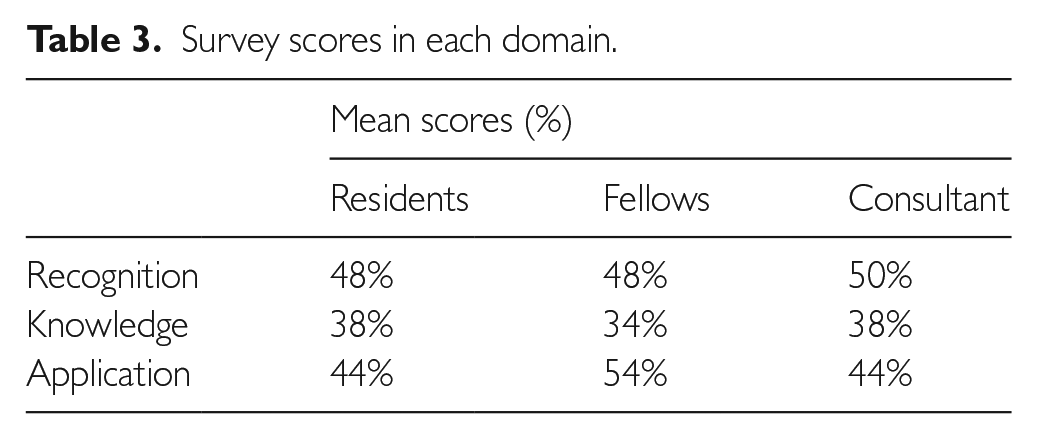
We distributed the survey to 305 doctors: 265 completed the first three domains and 259 completed all the domains. The details of the participants are shown in Table 1. We found no difference in the overall mean score between residents (6.5 ± 1.9), fellows (6.8 ± 1.8) and teaching faculties (6.5 ± 2.2) (Table 2). All scored similarly in the recognition, knowledge and application domain of the survey (Table 3). When subcategorised, we found that the gastroenterology sub-speciality (
Characteristics of the participants.

Comparison of the mean scores between the different groups and subgroups (ANOVA and t-test).

ANOVA, analysis of variance.
Survey scores in each domain.
Most felt that there is lack of adequate focus on clinical nutrition in residency (63%) and during daily ward rounds (44%). One-third (33%) performed nutrition assessment on admission and very few (10%) felt confident in providing nutritional counselling and treatment for undernourished/ malnourished patients. Only half (49%) agreed to make a nutritional plan after discussion with a dietician.
Discussion
Our study shows that the current training programme lacks effective nutrition education as evidence by the dismal performance of the residents and fellows. Even the teaching faculties performed sub-optimally.
Several factors may have contributed to this suboptimal performance. These include: (a) inadequate time for teaching, (b) absence of qualified faculty member trained in nutrition, (c) lack of collaboration with nutrition support service and (d) absence of regular assessment in nutrition competency during residency. The majority of the participants felt the residency programme lacks adequate focus on nutrition which implies the nutritional curriculum guidelines are not strictly adhered.
We observed higher scores among residents and fellows from gastroenterology. A similar finding was also observed in a European study. 10 This implies that supervised training with a faculty trained in nutrition, like in gastroenterology, and attention to nutritional disorders during practice may improve the approach to clinical nutrition. However, a long-term change in attitude can only be achieved by continuous reinforcement throughout training.
Newer approaches are required to overcome these challenges. Measures like interactive case-based clinical discussion and short courses on clinical nutrition may improve understanding of the basics and speciality-specific fundamentals of nutrition.
11
The e-resources like
Our study is the first survey to evaluate physician knowledge, attitudes, and practices on clinical nutrition, since the introduction of ACGME-approved training in Singapore. A relatively large number of trainees and teaching faculty participated and the response rate (87%) was very high. We adapted the KAP survey model and modified questionnaire to include common clinical scenario to reflect the real world practice. Our study, however, is limited by its cross sectional design. We did not record the years of experience and place of undergraduate education. This may not have influenced the results as the overall performance was similar between the groups.
In conclusion, the current the current training programme, despite recommendations, lacks adequate emphasis on clinical nutrition. Increased adherence to curriculum guidelines and regular competency assessment may improve the overall nutrition knowledge of doctors.
Supplemental Material
Questionnaires – Supplemental material for Nutrition training in residency and fellowship programme: time for a change
Supplemental material, Questionnaires for Nutrition training in residency and fellowship programme: time for a change by Ravishankar Asokkumar and Ennaliza Salazar in Proceedings of Singapore Healthcare
Footnotes
Authors’ contributions
Availability of data
Declaration of conflicting interests
Ethical approval
Funding
Informed consent
ORCID iD

Supplemental material
References
Supplementary Material
Please find the following supplemental material available below.
For Open Access articles published under a Creative Commons License, all supplemental material carries the same license as the article it is associated with.
For non-Open Access articles published, all supplemental material carries a non-exclusive license, and permission requests for re-use of supplemental material or any part of supplemental material shall be sent directly to the copyright owner as specified in the copyright notice associated with the article.
