







Abstract
History
BVDU was originally synthesised in the laboratory of Richard T. (‘Dick’) Walker, led by Prof. Stanley (‘Stan’) Jones at the University of Birmingham in the UK, by a PhD student called Phil Barr. It was part of a project aimed at developing radiosensitizing agents.
Following the conversation between R.T. Walker and E. De Clercq at the Symposium on Synthetic Nucleosides, Nucleotides and Polynucleotides (Max-Planck-Institut für Biophysikalische Chemie in Göttingen on 3–5 May 1976) (Figure 1), R.T. Walker passed BVDU as part of several other related analogues onto E. De Clercq, for antiviral evaluation. Anita Van Lierde was the technician working with Erik De Clercq. She routinely tested antiviral activity for three viruses: vaccinia virus (VV), herpes simplex virus (HSV) and vesicular stomatitis virus (VSV). At his first visit to the lab, when R.T. Walker inquired about the antiviral results, A. Van Lierde had those obtained for VV and VSV at hand. There was no activity against VSV, only weak activity against VV and those were the data communicated to R.T. Walker, before he flew back to Birmingham. The next day she also obtained the results for HSV, and here potent activity was observed.

Group picture (private collection E. De Clercq) taken at Symposium on Synthetic Nucleosides, Nucleotides and Polynucleotides, Max-Planck-Institut für Biophysikalische Chemie, Göttingen, Deutschland, 3–5 May, 1976.
The anti-HSV data of BVDU were so overwhelming, that E. De Clercq decided to deliver a communication of the results, entitled ‘Comparative study of the potency and selectivity of anti-herpes compounds’, in Prague at a meeting organised by Peter Langen and Jan Skoda (Twelfth Meeting of the Federation of European Biochemical Societies (FEBS), Post-Congress Symposium on Antimetabolites in Biochemistry, Biology and Medicine, Prague, Czechoslovakia, 10–12 July, 1978). R.T. Walker also presented the first results of BVDU 1 shortly after E. De Clercq did. The conference in Prague took place in 1978, a few months after the antiviral activity for acyclovir had been reported in Nature 2 (a few months earlier Gertrude Elion and coworkers had announced that acyclovir was specifically recognised as a substrate for phosphorylation by the HSV-encoded TK 3 . Acyclovir was then further developed as an anti-HSV agent by Burrough Wellcome and would become the ‘gold standard’ for the treatment of HSV infections.
In 1979 (7–18 May), E. De Clercq together with R.T. Walker and Fritz Eckstein organised a NATO Advanced Study Institute (ASI) in Sogesta (close to Urbino in Italy). The meeting was also organised as a FEBS symposium, so as to allow participants from Eastern Europe (behind the iron curtain). One of these participants was Peter Langen from East Berlin (Berlin-Buch), who presented at this symposium antiviral data on the 1-bromovinyl-2’-deoxyuridine (Figure 2) that were remarkably similar to the antiviral data we had obtained for BVDU ((

Structural formulae of BVDU ((
On 4 November 1981, I presented a talk on the antiviral potential of BVDU in Berlin-Buch with Peter Langen as my host, after I had given similar presentations at Johns Hopkins University (Baltimore, 15 May 1981), Sophia Antipolis (France, 3–4 June 1981), Harvard University (Boston, 29 June 1981), Stanford University (18 August 1981), University of Alberta (Edmonton, 21 August 1981), G.D. Searle Company (Chicago, 24 August 1981), and Yale University (New Haven, 26 August 1981). On 12 May 1982, I talked on BVDU at the Searle branch of G.D. Searle in High Wycombe, UK. While the East-Germans had started the clinical development of BVDU that led to the commercialisation of BVDU by Berlin-Chemie for the treatment of herpesvirus infections, we published our first paper on the activity of BVDU against HSV-1 in 1979 in PNAS 5 , followed by the first clinical results on the activity of BVDU in the treatment of VZV infections (herpes zoster) in 1980 6 .
In 1979, we licenced the antiviral activity of BVDU to G.D. Searle UK (host: Dr A. J. Hale), which assured me of their interest in the clinical development of BVDU. From the gathering in Chicago on 24 August 1981 (host: Dr D. Azarnoff), I sensed that the UK interest was not shared by the US headquarters of G.D. Searle. A few months later (12 May 1982), when we (Prof. Piet De Somer and I) were summoned for a meeting in High Wycombe, we were told by Daniel Azarnoff that Searle would discontinue the further development of BVDU. To appease the ordeal, they agreed to provide us with the whole stock (raw material and gelatin capsules) of BVDU that they had prepared in the meantime.
Then started the search for a new partner for BVDU development, but all of our attempts to finalise a partnership (e.g., Beecham, Astra) failed. In the meantime, the East-Germans (Peter Langen, Hans Rosenthal) had become more successful and had brought BVDU, under the trade name of Helpin® (Berlin-Chemie), to the market in the former DDR. Berlin-Chemie would later be taken over by Menarini (Italy).
Activity spectrum and mechanism of action
From the antiviral activity spectrum of BVDU (Figure 3), it is evident that it is exquisitely active against HSV type 1 (HSV-1) and VZV, while minimally active against HSV type 2 (HSV-2) 7 . This is due to the fact that the thymidine kinase (TK) encoded by HSV-1 and VZV readily phosphorylate BVDU onto BVDU diphosphate (BVDU DP), whereas the HSV-2 TK phosphorylates BVDU onto the monophosphate (BVDU MP) 8 , from where cellular thymidine kinases have to take over the phosphorylation process. Anyway, the active metabolite of BVDU is the 5’-triphosphate (BVDU TP), which can act as both an inhibitor and substrate of the viral DNA polymerase (Figure 4). Consequently, BVDU TP, if incorporated as substrate or acting as inhibitor of the viral DNA polymerase, serves as inhibitor of the viral DNA synthesis.
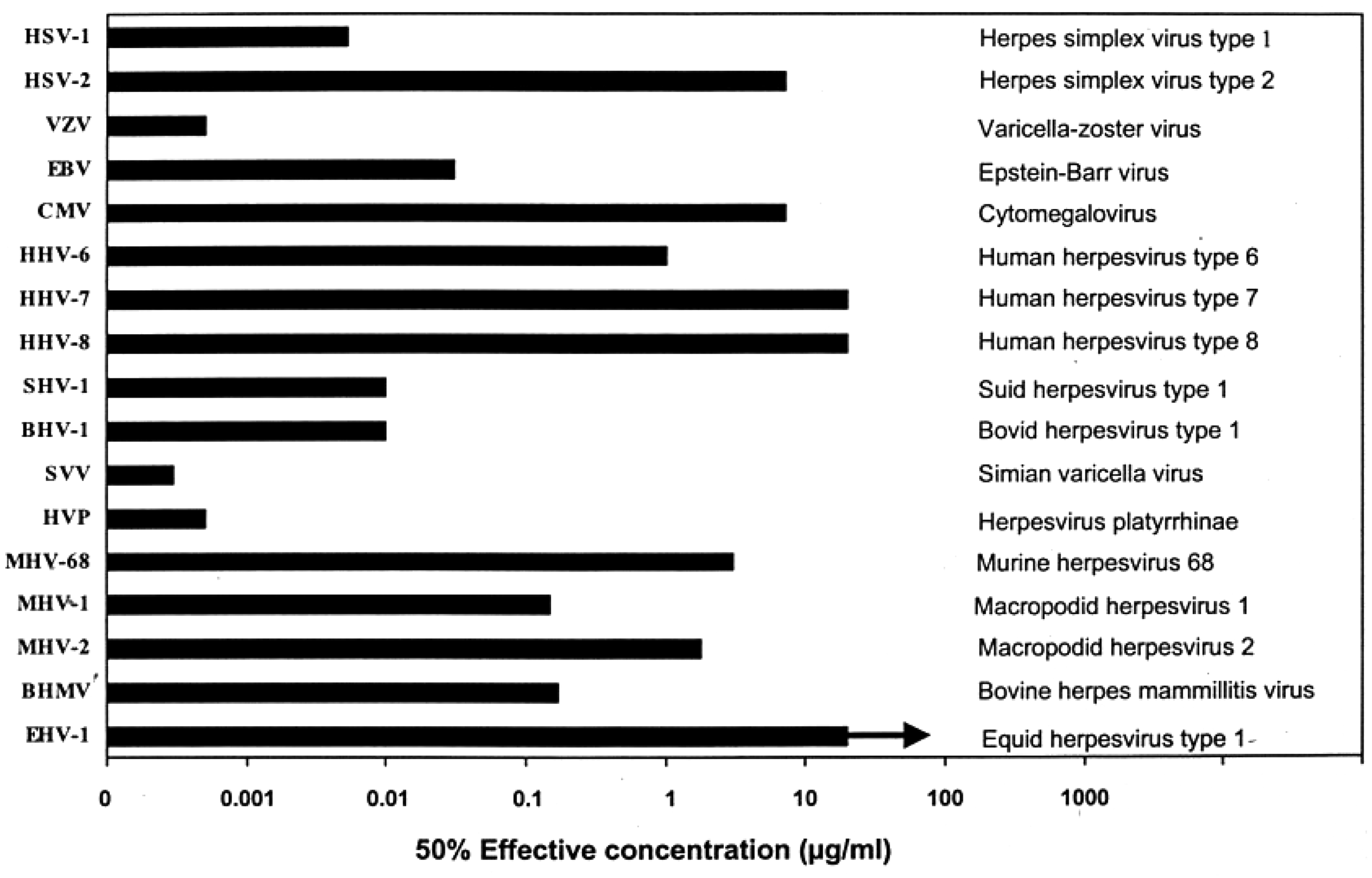
Antiviral activity spectrum of BVDU 8 .

Mechanism of action of BVDU 8 .
BVDU in the treatment of herpes zoster
At his visit to Leuven in 1984, Prof. Hans Rosenthal and I decided to carry out a comparative clinical study of acyclovir versus BVDU in the treatment of herpes zoster. This study would be performed under the auspices of Prof. Peter Wutzler. I bought acyclovir for this study, whereas BVDU would be delivered by the East-Germans as the compound was synthesised in East Germany. BVDU would be administered perorally (p.o.) at the dosage which we had used in our previous study 6 , whereas acyclovir would be administered by the intravenous (i.v.) route, as at that time, only intravenous administration had been approved for the treatment of herpes zoster. It took a decade before the comparative clinical study of i.v. acyclovir versus p.o. BVDU was completed, but when it was 9 , it clearly showed that at the indicated dosages and routes of administration, both acyclovir and BVDU were clearly effective in suppressing herpes zoster, as particularly evident from the shortened time for new lesion formation (Figure 5).

Mean pain scores in patients treated with brivudine () or acyclovir ( )
9
.
)
9
.
BVDU proved superior to acyclovir in reducing the time to blistering (from 18 h (acyclovir) to 13.5 h (BVDU)) (Figure 6) 10 . When the treatment (BVDU 125 mg once daily for 7 days, or acyclovir 800 mg 5 times daily for 7 days) was terminated, monthly prevalence of postherpetic neuralgia (PHN) for several months thereafter also showed a clearly faster response with BVDU than with acyclovir (Figure 7) 11 . As compared to famciclovir (Famvir®) in the treatment of herpes zoster, median duration of PHN, BVDU clearly achieved a shortened duration, both in the overall population and subgroup of elderly patients (Figure 8) 12 .

BVDU is superior to acyclovir in reducing the time to blistering 10 .

Monthly prevalence of postherpetic pain after termination (

Median duration of post-herpetic neuralgia (PHN) in the overall study population and in the subgroup of elderly patients 12 .
BVDU should not be administered concomitantly with 5-fluorouracil (Fu)
The arabinofuranosyl counterpart of BVDU, BVaraU, is roughly equally or slightly more potent than BVDU
8
. It was administered in Japan for the treatment of herpes zoster in patients. It was thereby ignored, that at the same time, some of these patients were treated concomitantly with 5-fluorouracil (FU) (or a prodrug thereof) for underlying cancer. BVaraU was administered orally, and through the (gastro)intestinal flora degraded to ( BVU + 2’-Deoxythymidine)
13
, so that the BVU levels generated by BVDU may not be sufficient to exceed the FU toxicity threshold.

Inhibition of the degradation of 5-fluorouracil by BVU.

Degradation of BVDU to BVU by thymidine phosphorylase.
Fermavir (Fv-100), prodrug of Cf-1743, a bicyclic nucleoside analogue (BCNA)
Although BVDU is exquisitely potent in inhibiting VZV replication in cell culture, its potency can still be superseded by Cf-1743 14 . A prodrug thereof, the 5’-valine ester, has been developed which is still awaiting phase III clinical trials, before it could be further envisaged for marketing. Unlike BVaraU and BVDU, the BCNA Cf-1743 cannot be converted (by a phosphorylase) to a free base, and, hence, it would not inhibit DPD, thus excluding the possibility of enhancing FU toxicity. The BCNA Cf-1743, FV-100 or any other prodrug of Cf-1743 may represent serious drug candidates for the treatment of VZV infections such as herpes zoster, but whether they would be ever developed (and commercialized) for this purpose can only be guessed upon.
Epilogue
In May 2003, with lectures in Palermo (27 May 2003), Messina (28 May 2003), and Catania (29 May 2003), I made a big tour through Sicily. As my host, Prof. Giovanni Romero took me on a Saturday morning to his home village. He introduced me to his friend, the local pharmacist, thereby explaining (in Italian) that I had discovered a compound that the pharmacist was certainly selling in his own pharmacy, I clarified that the compound concerned was BVDU, used in the treatment of herpes zoster, but this clarification did not satisfy the pharmacist. I then reviewed all possible names known for herpes zoster, including zona, shingles, and varicella-zoster, but all in vain, until my choice fell on what is known in Flemish as ‘St Antonius vuur’, and in Italian as ‘Fuego di San Antonio’, and now the pharmacist reacted instantly: ‘Si signore, we call the compound Brivirac’, which he then dug up from his collection. He was so excited that he wanted to celebrate our encounter with a cup of grappa, but this was at 11 am, and I was not accustomed to drinking grappa that early in the morning. He then gave me the whole bottle of grappa, which I took home and savoured during the following weeks. The Italian trade name for BVDU (Brivirac®) (Table 1) has since this Sicilian adventure (and hospitality) remained firmly fixed in my memory.
List of countries where BVDU is commercially available[15]

Footnotes
Acknowledgments
Declaration of conflicting interests
Funding
ORCID iD
