







Abstract
Introduction
Since riots and demonstrations began across the Arab world in December 2010, dictators and their regimes have fallen. Zine El Abidine Ben Ali in Tunisia, Hosni Mubarak in Egypt, Muammar Gaddafi in Libya, and Ali Abdullah Saleh in Yemen were all forced to resign from power, albeit in different ways. Despite their differences, a common characteristic of the uprisings that brought down those dictators was their relatively short durations. Internal and external observers alike have been surprised by the speed with which old regimes fell, even as the stability of their successor regimes is far from being secured.
The insurgency in Syria constitutes a special case in this context. After nationwide demonstrations began in March 2011, the dispute between the protest movement and the government did not lead to a quick end, either by opposition victory or Bashar al-Assad securing his power. Instead, the conflict evolved into what fulfils all the criteria of a full-scale civil war or insurgency 1 (Gleditsch et al., 2002; see also Lyall, 2010): it takes place within a state; it involves the central government as one of the principal actors; it results in a minimum of 25 battle-related combatant fatalities within a 12-month period; and all parties involved demonstrate military activity that causes battle-related deaths suffered by either side. In total, Price et al. (2013) estimate 92,901 casualties (both battle-related and civilian) between March 2011 and April 2013. The most recent figures released in April 2014 by the Syrian Observatory for Human Rights suggest that at least 150,000 people have been killed since the beginning of the uprising.
At the time of writing this article, it seems unclear when the fighting will come to an end, and estimates have varied widely. On one hand, some experts have suggested that “the Syrian civil war may well turn out to be shorter than generally anticipated” (Balcells and Kalyvas, 2012a) and that “the regime appears to have only a few weeks left [as of December 2012] before it collapses” (White and Tabler, 2012). On the other hand, the International Crisis Group has indicated that “the conflict’s evolving dynamics do not suggest a quick denouement” (International Crisis Group, 2012a) and that the conflict will continue, as a decisive military victory for either side is unlikely (International Crisis Group, 2013). The group’s most recent report (International Crisis Group, 2014) underlines this again.
To the best of our knowledge, however, there are no systematic predictions of the length of the Syrian insurgency, despite the importance of such an exercise for policymakers and scholars alike. 2 For example, insights on the duration of the Syrian insurgency could help us anticipate whether we will see military intervention by Syria’s neighbours (Biddle et al., 2012), or whether neighbouring countries will be destabilized through continuous refugee flows or ethno-sectarian polarization along Sunni–Shia lines (see International Crisis Group, 2012b).
We address this uncertainty by systematically predicting the length of the Syrian insurgency. This is in line with Ward et al. (2010: 364) who highlight that scholars should “be willing to make predictions explicitly – and plausibly be wrong, even appear foolish – because our policy prescriptions need to be undertaken with results that are drawn from robust models that have a better chance of being correct. The whole point of estimating risk models is to be able to apply them to specific cases.” Methodologically, we follow and expand on Bennett and Stam (2006) who predicted the length of the 2003 war between the US and Iraq. 3 To this end, using out-of-sample techniques, we first assess the predictive capacity of 69 explanatory variables on insurgency duration, employing insurgency data from Lyall and Wilson (2009) and Lyall (2010) as a starting point. After determining the final model with the highest predictive power, Syria is categorized according to those variables in this model. Based on in-sample approaches, we then predict the length of the Syrian uprising for three different scenarios. The most realistic point prediction for the length of the Syrian insurgency is 5.12 years since its beginning, which suggests an end date between the end of 2016 and early 2017.
Predicting insurgency durations: Data setup
To identify the most important predictors, we use data from Lyall and Wilson (2009) that cover 286 insurgencies between 1800 and 2005 (see also Lyall, 2010). The advantage of these data is that they offer a wider variety of variables relating to the combatants’ military capabilities and strategies than other comparable sources. Note that despite our interchangeable treatment of the terms ‘civil war’ and ‘insurgency’, it may seem that Lyall and Wilson (2009) focus exclusively on insurgencies in which rebels resorted to guerrilla warfare as defined through ‘hit-and-run’ tactics and the attempt to win the allegiance of the civilian population (Lyall, 2010: 175). However, Kalyvas and Balcells (2010) show that the data do in fact include a significant number of conventionally fought civil wars.
We first dropped all civil war cases that: (1) were fought by foreign counterinsurgents or as anti-colonial wars; 4 and (2) started in the pre-1945 period 5 in order to create a more homogenous data set of cases. We also exclude Lyall’s (2010) 21 right-censored observations, i.e. all insurgencies that were ongoing by the end of 2005. Ultimately, after accounting for missing values, we obtained a data set of 98 insurgencies that started and ended between 1945 and 2005.
We use Lyall and Wilson’s (2009) coding of insurgency start and end dates (see also Lyall, 2010). The former is defined as the first large-scale insurgent attack or open declaration of hostilities, while the latter is coded once the government or the insurgents have achieved their objectives. This also includes the last day of war-related fatalities or once a peace deal has been reached. On average, in our data an insurgency lasted about eight years.
Theoretical considerations and out-of-sample predictions
Which factors influence the duration of civil wars and insurgencies? Studies dealing
with this question primarily rely on the idea that conflicts continue if at least
one set of belligerents believe a dispute is more beneficial than peace (e.g. Balch-Lindsay and Enterline,
2000; Brandt et al.,
2008; Collier et al.,
2004; Cunningham,
2006, 2010;
Fearon, 2004; Fearon and Laitin, 2003;
Hegre and Sambanis,
2006; Lyall,
2010; Mason and Fett,
1996; Regan,
2002). We therefore deal with issues of willingness and opportunity
(Most and Starr,
1989; Starr,
1978). First, willingness is generally “concerned with the processes and
activities that lead men to avail themselves of the opportunities to go to war”
(Starr, 1978: 364).
In the civil war duration literature, one can find this willingness aspect
particularly when scholars discuss existing (or new) grievances. Second, Starr
defines opportunity as the ‘possibility of interaction’: “interaction exists between
individuals of one nation state so that it is possible for conflict to arise – and
to arise over values potentially important enough to warrant the utilization of
violent coercive action” (Starr,
1978: 368). Put differently, ‘opportunity’ refers to a set of
possibilities and constraints in the context of conflict duration and describes
those factors that increase the likelihood that belligerents
After setting up our data and consulting the relevant literature on insurgency and civil war duration, in light of the willingness and opportunity framework, we identified 69 explanatory variables that were likely to affect the duration of these types of conflicts. These variables fall into the clusters of: (1) physical terrain and geography; (2) cultural terrain; (3) insurgency power; and (4) state power. 6 Note that Lyall (2010: 187) actually examines the duration of insurgencies and civil wars, as well; thus, his core model might constitute an obvious choice for predicting the length of the Syrian insurgency. In fact, we also considered his core model and the explanatory variables therein as the base for our predictions. However, all our calculations demonstrate that the predictions based on Lyall’s (2010) explanatory variables are less accurate than those stemming from our final model that (partly) differs from his setup. We therefore concentrate on our results, but point to Lyall (2010) for comparison.
In order to assess the predictive accuracy and strength of our 69 variables for the duration of insurgencies, we conducted out-of-sample predictions via a cross-validation exercise of 69 bivariate models (Ward et al., 2010: 364). Cross-validation relies on dividing existing data into subsets, using random assignment of the cases to the different sets. All except one of the subsets are then pooled together and routinely estimated by applying the preferred model specification. 7 The remaining subset, called the ‘test set’ (Ward et al., 2010: 370), subsequently serves to assess the predictive power of the model estimated on the pooled subsets – in our case, only one explanatory variable at each time.
Specifically, we performed a five-fold cross validation exercise for each variable, which we repeated ten times (Ward et al., 2010). To this end, we randomly divided our sample into five equally-sized subsets, pooled four in order to ‘train the model’ (i.e. to estimate the coefficients and parameters of interest), and kept one as the test set. After this exercise, we assessed the out-of-sample predictive power of each variable by following Bennett and Stam (2009: 259), who rely on Costner’s (1965) measure of the proportional reduction of error (PRE) for duration models, which is defined as

We repeated this procedure five times for 10 different partitions of the sample, yielding 5 × 10 = 50 different PRE values for each variable, from which we finally calculated the average PRE. 8
Out of the 69 variables, we then: (1) identified those 10 predictors with the highest PRE values; and (2) calculated the PRE measures when dropping each of these 10 variables from the model separately and combinations thereof. Ultimately, we obtained the highest average out-of-sample PRE with a value of 0.2369 (SD of 0.0305) when estimating a model that relies on eight covariates. 9 This PRE value of 0.24 of our final model can be interpreted as an average 24% reduction in total error in the 10 rounds of out-of-sample prediction when compared to an empty model. In comparison, note that the model based on Lyall (2010) yields a negative PRE-measure of −0.005 (with a SD of 0.031), indicating an out-of-sample performance that is on average worse than that of an empty model.
Our final eight variables are defined theoretically and empirically as follows.
First, there is
Second, there is
Third, insurgents might rely on contraband to finance their campaigns. Fearon (2004), among
others, argues that “cocaine, precious gems, or opium” constitute another source of
rebel income (next to, for example, foreign states or diasporas) that can be used to
purchase weapons, other resources, draft and train fighters, etc. Given that
contraband then raises the capabilities of the insurgents, it is likely to increase
the duration of civil wars. We denote this binary variable as
Fourth, we employ the dichotomous variable
Fifth, there is
Sixth, in terms of governmental support, Regan (2002) coded a variable that captures
economic interventions in favour of the government by a third party. The underlying
theoretical rational for the
Seventh, the government might make use of helicopters. This variable
Finally, we include
In-sample predictions
Based on our results from the out-of-sample predictions, we now turn to the in-sample predictions that bring us closer to estimating the length of the Syrian insurgency. We estimated the full model using the eight strongest predictors along substantive quantities of interest and calculated the PRE measure of this Weibull regression model to illustrate its in-sample predictive power. In this estimation, which is summarized in Table 1, the sign of the coefficient indicates how a covariate affects the hazard rate: a positive coefficient increases the hazard rate and, therefore, reduces the expected duration, while a negative coefficient decreases the hazard rate and therefore increases the expected duration. While all covariates have the expected impact on the duration of insurgencies, our calculation of this model’s in-sample PRE yields a value of 0.295: i.e. we achieve a 30% reduction in total error from the full model relative to an empty model. This result seems promising in comparison to other studies that seek to predict the duration of wars. For example, Bennett and Stam (2009: 266) achieved a slightly lower PRE of 0.20 for their final model, while the model estimation based on Lyall (2010) achieves an in-sample PRE of 0.073.
Final model for prediction: Weibull regression model.

Table entries are coefficients in column (1) or the average simulated change in predicted duration (in months = 30 days/month) in column (2) when moving from the minimum towards the maximum of a respective variable while holding all other variables at their means; robust SE in parentheses; 95% confidence intervals in brackets; *significant at 10%; **significant at 5%; ***significant at 1% (two-tailed).
Figure 1 plots the predicted
insurgency duration against the observed durations of insurgencies. Evidently, the
relationship is highly positive with a pairwise correlation of 0.65
(

Observed and predicted insurgency durations. Dashed line pertains to estimated linear fit.
Predicting insurgency durations: How long will the Syrian insurgency last?
What does this model predict for the case of Syria? We calculated the predicted duration of the current Syrian civil war for three different scenarios that are based on a general uncertainty among experts and scholars with regard to two factors: (1) an irregularly fought insurgency with economic support for the government by a third party; (2) a conventional insurgency without governmental economic support; and (3) a conventional insurgency in which the regime receives economic support from a third-party state. Covering all possible scenarios in this regard, instead of ignoring current controversies and opting for a somewhat deterministic assessment, would increase the value of our research. Put differently, the values for six out of our final model’s eight variables are held constant throughout the calculations, reflecting their invariable character in the context of the Syrian insurgency. First, the Syrian territory is contiguous. Second, Shia (i.e. Alawites, Ismailis, and other Shia combined), as the second-largest ethno-religious group, comprise about 14% of the population. Third, the insurgents cannot and do not use finances from contraband. Fourth, the insurgency takes place after the Cold War. Fifth, Assad can still rely on rotary-wing assets and the regime’s command of the skies is given – particularly since a no-fly zone has not been imposed at the time of writing this article. Finally, the insurgents are externally supported in the form of sanctuary and material support (e.g. Holliday, 2012).
Our scenarios consequently focus on variation in two variables: whether the Syrian insurgency is fought irregularly or conventionally, and whether the government receives economic support from a third party. Table 2 summarizes the predictions for these scenarios. First, when assuming an irregular insurgency, i.e. guerrilla warfare in which the rebels and the government do not predominantly use heavy armour and weaponry (Kalyvas and Balcells, 2010: 419), our model suggests a point estimate of 6.34 years in length. Adjusting for the systematic underprediction in our model, we obtain a point estimate of 8.52 years. Hence, depending on the possible codings for the start date of the Syrian insurgency, which could be in March 2011 (when the demonstrations started), on 29 July 2011 (when the former Syrian Army Colonel Riad al-Asaad announced the formation of the Free Syrian Army), or in early September 2011 (when the first major clashes between the Syrian Army and the armed opposition occurred in the Idlib province), our model predicts that the fighting might even continue until early 2020.
Predicted durations of scenarios.

SE in parentheses.
However, there are reasons to believe that the situation might not turn out that badly. While the Syrian civil war may have started as an irregularly fought insurgency, it seems to have turned into a conventional conflict due to growing rebel capabilities (Balcells and Kalyvas, 2012a), which are (partly) caused by the foreign support they receive (Borger, 2012). Moreover, after about three years of fighting, the economic capabilities of the Syrian regime are decreasing, with international support increasingly vanishing as well. Put differently, if the Syrian insurgency is actually a conventionally fought civil war and Assad’s regime cannot rely on (much) economic support from an outside party, our model gives a point prediction of about 2.01 years, which leads to a prediction of 4.19 years when adjusted for the model’s tendency to underpredict durations. According to this scenario, we thus might see the end of this dispute at the end of 2015 or the beginning of 2016.
Still, even if there is evidence that the Syrian insurgency is now a conventionally fought conflict, it seems more realistic to assume that Assad can still rely on economic support from a third party. Although it is rarely acknowledged or confirmed, several sources suggest that the Syrian regime receives economic support from the Russian government in the form of grants, loans, and non-military equipment or expertise, etc. (Grove, 2013; Peel and Clover, 2012). Therefore, a more realistic scenario from our vantage point at the present time is a conventional insurgency in which the regime can rely on the economic support from a third-party state. According to our model, we obtain a point estimate of 2.94 years in length for the Syrian insurgency in this scenario, which leads to an adjusted point prediction of 5.12 years. Hence, this finding suggests an end date of the Syrian civil war between the end of 2016 and early 2017.
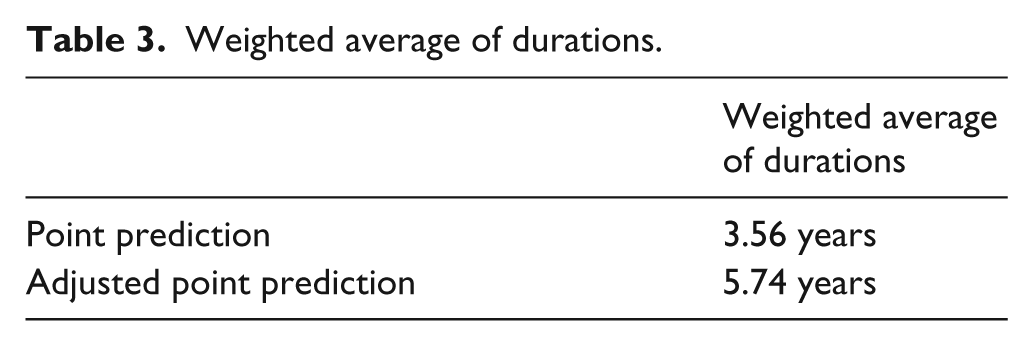
In light of this, finally, if we explicitly address the probabilities we assign to each of the three scenarios for which we estimated the duration of the Syrian insurgency, in our view scenarios 1 (irregular insurgency) and 2 (conventional insurgency without economic support) are equally likely, but less so than scenario 3 (conventional insurgency with economic support). Hence, we assign probabilities of 0.25 to scenarios 1 and 2, while the third scenario receives a value of 0.50, which in turn allows us to calculate a weighted average of the resulting predictions. Table 3 summarizes the results. While the weighted average of the point prediction is fairly close to the non-weighted point prediction of scenario 3 (Table 2), the weighted average of the adjusted point prediction suggests a duration of 5.74 years. Depending on the start date of the Syrian civil war, this could imply an end in late 2017. The prediction is fairly similar to our most realistic scenario even when using a weighted average of predicted durations across all scenarios.
Weighted average of durations.
Conclusions
We built our work on out-of-sample and in-sample prediction techniques, which allowed us to identify the strongest predictors of insurgency durations and to assess the predictive power of a model that uses these variables. Ultimately, we predict the length of the current Syrian insurgency for three different scenarios. The most realistic scenario suggests a length of 5.12 years (when adjusted for the model’s tendency to underpredict durations).
Aside from providing an estimate of the duration of the Syrian insurgency, this article makes two additional contributions to the scientific discourse. Methodologically, we further develop Bennett and Stam’s method to enable the out-of-sample assessment of duration models’ predictive capacities (Bennett and Stam, 2006; see also Slantchev, 2004). This approach also helps us to build a model whose predictions outperform recent work on insurgency durations (Lyall, 2010). The model that we summarize in Table 1 might consequently be used in future research as a baseline model against which to assess new variables of theoretical interest.
Substantively, the majority of variables contained in our final model support a recent finding by Balcells and Kalyvas (2012b) that “technologies of rebellion,” i.e. variables describing relative capabilities of combatants and their type of interaction, are central to understanding insurgencies and civil wars.
There are two potential limitations of this research, however. First, the two
variables we varied for the three prediction scenarios,
Second, and more importantly, conflict begets conflict. Walter (2004), for instance, estimates that about 38% of civil wars or insurgencies between 1945 and 1996 recurred. Even if the current insurgency were to end with the overthrow of the Assad regime in late 2014, this act is unlikely to indicate the end of the Syrian crisis.
Footnotes
 . These data are all publicly available. We used the statistical software package Stata 13 for the estimations,figures,and tables. (StataCorp LP,4905 Lakeway Drive,College Station,Texas 77845-4512USA).
Declaration of conflicting interest
Funding
Supplementary material