







Abstract
Keywords
Introduction
Internationally, women and minoritized racial and gender groups are underrepresented in science, technology, engineering, and math (STEM) fields (Botella et al., 2019; Shannon et al., 2019), despite the demonstrated benefits of diverse teams in innovation, problem solving, and other key aspects of scientific research (Hofstra et al., 2020; L. Hong & Page, 2004; Medin & Lee, 2012; Swartz et al., 2019). For example, in the United States, despite women representing nearly half of the workforce, they only account for 27% of STEM workers (US 2020 Census). Examining the intersection of gender and race reveals the compounding impact of racism and sexism, with US Women of Color giving scientific talks, receiving PhDs, and getting faculty positions at much lower rates than their White female colleagues (Ford et al., 2019; Hurtado & Figueroa, 2013; National Science Foundation [NSF], 2018). Recent studies point to the importance of role models for the development of STEM identity and subsequent retention in STEM of individuals from minoritized groups (Steinke, 2017), especially role models who share their gender (González-Pérez et al., 2020) or race (Johnson et al., 2019). Interactions with role models and mentors with intersectional identities are consistently invoked as priority interventions in improving the diversity of the STEM workforce, especially for STEM graduate students (McGee, 2019). Such interventions have led to some improvements in the racial and gender diversity of STEM graduate students (National Academies of Sciences, 2018). However, women and members of minoritized racial groups remain underrepresented at higher levels, that is, postdoctoral researchers and faculty. For example, though female Earth and ocean scientists in the United States now earn more doctorates than their male peers each year (Bernard & Cooperdock, 2018), only 27% of US geoscience faculty are women (Ranganathan et al., 2021). STEM fields have even more pronounced inequities for Black and Hispanic students (Riegle-Crumb et al., 2019) and faculty (Li & Koedel, 2017).
In the absence of real-world mentors who share key aspects of their identities, STEM graduate students from underrepresented groups may find vicarious role models through socio-cultural representations of scientists, such as those in traditional media (e.g., television, movies, magazine; Fujioka, 1999; Steinke, 2017). Significant attention has therefore been given to the way scientists, particularly women in STEM, are portrayed in traditional media. Such women often suffer from stereotyped representations, depicted as subordinates or assistants to male scientists, struggling to balance familial and/or personal obligations, and with increased emphasis on their appearance, sexuality, and domestic qualities compared with their male counterparts (Elena, 1997; LaFollette, 1982, 1988; Nelkin, 1995; Steinke, 1999; Steinke & Long, 1996). For example, in a study of magazine articles, researchers found that the most common portrayal of famous marine biologist and author Rachel Carson was as a so-called emotional woman (Losh, 2010). Online media platforms exhibit similar representation issues, with hypersexualized representations of women scientists and scientists depicted as mostly cisgendered male, White, able-bodied, middle class, and heterosexual (Mendick & Moreau, 2013). These underwhelming depictions of women scientists also decrease aspiring female scientists’ continued interest in science and technology (Microsoft, 2017). Stereotyped and homogeneous representations of scientists may therefore have a negative impact on the future diversity of the STEM workforce, perpetuating the underrepresentation of groups who cannot identify with the available images of STEM professionals (Steinke, 2017).
Studies have suggested that science educators can weaken these pervasive gender-related stereotypes by highlighting more examples of diverse scientists (Miller et al., 2015), especially via the integration of narrative content (Arya & Maul, 2012; H. Hong & Lin-Siegler, 2012). Social media such as Instagram, YouTube, and Facebook may offer an improved outlet for such depictions of women scientists, particularly in terms of reaching younger audiences who tend to prefer online media content over traditional media outlets, such as magazines, film, and television (Perrin, 2015).
The volume of content on social media is greater than traditional media and posts are not limited to professional journalists. This gives individuals more agency in determining posted content and more opportunity to promote diverse examples of women scientists. As such, STEM content has significantly grown on social media, with science related Facebook posts up 115% from 2014 to 2017 (Funk et al., 2017). Millions of people worldwide follow science-related pages, demonstrating the capacity for STEM-related social media to reach wide audiences (Hitlin & Olmstead, 2018). On Instagram, engagement trends are visible from hashtag usage, with #STEM (3.7 million posts), #womeninSTEM (1 million), #STEMeducation (801k), and #SciComm (391k). With this surge of STEM content comes individual and group STEM content creators, who vary in age, STEM field, race/ethnicity, and career field. Finally, although studies on the impact of social media STEM content are limited, initial studies have identified links to reduced stereotypes: participants who viewed self-portraits, for example, selfies, of female scientists were less likely to perceive scientists as largely male (Jarreau et al., 2019).
There is a distinct need to characterize social media’s potential to represent diverse women scientists, and how aspiring future scientists interact with such representations. Here we investigate these questions using data from the Women Doing Science Instagram page.
In this study, we investigate whether posts on Women Doing Science do reflect a diverse, international community of women scientists, and how followers of the account have chosen to interact with, and have been affected by, such content. Given the active recruitment efforts of the Women Doing Science team, we hypothesized that posts would represent a higher percentage of historically minoritized groups (i.e., Hispanic/Latino, Native American/Alaskan Native, Black—as defined by the National Science Foundation [NSF]) than reported populations. Although we anticipated that most posts featured American scientists with monolingual English captions, many Women Doing Science team members are from outside the United States, and our experience with the page suggested that this was also true of the page’s followers. We therefore hypothesized that Women Doing Science had international reach in terms of both country of origin and language. To investigate how followers interact with the page, particularly which aspects of the Instagram posts drove engagement, we compared normalized post “likes” with demographic information and caption/photo content, surveyed Women Doing Science followers for their perceptions of the page, and investigated case studies of high-engagement (top 1 percentile of engagement) posts. We hypothesized that followers would engage more with, and therefore value, more diverse visual representations of scientists. Here, we considered diversity broadly, including caption content (e.g., talking about outreach, mentoring), racial/ethnic diversity (e.g., posts of Women of Color), and nationality (e.g., non-US scientists, having bilingual captions). This analysis allows, for the first time, an intersectional exploration of how diversifying representations of female scientists on social media can impact role model formation and STEM identity.
Methods
Featured Scientists Survey
A survey designed to collect demographic information was sent to scientists previously featured on the Women Doing Science Instagram page via email. Reminders were sent periodically to encourage participation over a few months. The survey included 17 demographic questions (including seven on race/ethnicity, three on sexual orientation/gender identity, and three on other underrepresented characteristics in STEM like neurodivergence and disabilities) and four questions on career path (including position and field of study).
Racial identity was queried through two questions: whether a respondent was a woman of color (WOC) and whether they were a Black or Indigenous woman of color (BIWOC), allowing scientists to choose one, both, or neither. Responses were separated into BIWOC, WOC who are not Black or Indigenous (hereafter simply “WOC”), and non-WOC (those who responded “no” to each race-related question). 1 Second, scientists in the United States were asked to report their race according to designated US census categories (American Indian/Alaskan Native, Asian, Black, or African American, Native American or other Pacific Islander, or White). Field of study categories were defined from subcategories of the NSF Survey of Earned Doctorates (SED) and were later aggregated to increase the statistical power of our analyses. Academic career stage was similarly collapsed into pre-graduate school, graduate education (including masters, dental, veterinary, and medical students), postdoctoral researchers, and professor/staff scientists. Age groups were adopted following bins used by Instagram’s built-in analytics. Finally, scientists were classified by their self-reported country of origin.
Data From Instagram Posts
Reach data (number of unique views, regardless of whether the viewer follows the Women Doing Science page) were retrieved manually from each post (
Captions from each post were collected using Instamancer and manually coded for themes: outreach (e.g., working with K-12 students), mentoring (e.g., discussing their mentor or mentee), STEM identity (e.g., being a scientist, being a female scientist), science communication or policy (e.g., running a podcast, interning in science policy), racial or ethnic identity (e.g., being a Latina scientist), or the absence of any additional information (i.e., only science). Themes were classified and refined using an iterative constant comparative process with two sequential coders (Glaser, 1965). Any disagreement between coders was resolved by discussion between the authors. Bilingual captions were classified by language using the R textcat package (Hornik et al., 2013). These bilingual captions were excluded from thematic analyses, as adding in a translation often requires scientists to remove other content from their biography to fit within Instagram’s character limit. Images were manually labeled based on the location of the first, featured photo (i.e., field, office, lab, or blackboard) and whether the subjects of the photo were looking directly at the camera or whether the subject was actively “doing” science—a.k.a. an “action shot.” We chose to investigate these aspects of photos to cover other potential drivers of engagement that might interact with demographic variables like race and language, and because previous research has suggested that photos of faces on Instagram receive high engagement (Bakhshi et al., 2014).
Instagram Followers Survey
A second survey was developed for followers of the Women Doing Science Instagram page and was posted periodically to the account’s “stories” over approximately one month. Participants were informed that completion of the questionnaire was voluntary, and that consent could be withdrawn at any time. Following consent, participants were asked an identical subset of demographics questions as those to featured scientists, including race, age, and location. Next, survey participants were asked three free-response questions regarding their engagement with the Women Doing Science Instagram page and seven multiple choice/ “select all that apply” questions on how they engage with posts. There were 10 questions on ranking preferences on Women Doing Science posts and captions, for example, if they preferred to see posts of women scientists who shared their racial identity or who had a range of racial identities.
Statistical Analyses
All analyses were performed in R version 4.0.2 (R Core Team, 2020). Data were visualized across intersections of demographic variables with sufficient sample size: race, age, academic position, and field of study. Two-way ANOVAs (analyses of variance) were performed on normalized engagement data across all demographic variables and caption/ image content classifications, in addition to their interactions, to determine whether there were differences across categories. Significant main effects and interactions were further interrogated using Tukey’s pairwise tests.
Chi-square tests were applied to caption data to determine whether the proportion of posts explicitly mentioning each theme was different across respondent demographics. Follow-up pairwise proportion tests were performed with a Bonferroni correction for multiple comparisons. Women Doing Science posts were sorted by engagement and the top, middle, and bottom 10% (
Responses from followers about why they follow the page were analyzed using χ2 tests to determine whether preferences about page content differed by race. Finally, recurring topics in free response data from the audience were determined using the topic modeling algorithm latent Dirichlet allocation (Blei et al., 2003), which defines topics by defining recurring sets of words within documents. Topic models including between 2 and 20 topics were run to investigate the optimal number of topics for each question. Average topic coherence (a measure of internal consistency of the terms within a topic) and
Results
Featured Scientists Survey
We tested whether the Women Doing Science Instagram page was successful at portraying racial, ethnic, and national diversity in featured scientists. The demographics survey emailed to scientists featured on Women Doing Science had 294 unique responses (~50% response rate). Although the survey questions spanned numerous aspects of identity (e.g., disability, sexual orientation, first-generation status), only four categories had sufficient sample size for statistical analysis: age, race, academic position, and field of study (Figure 1). Some survey respondents indicated non-binary gender identity—we will therefore generally refer to people who have been featured as “scientists” throughout this article, although it should be noted that a majority identified as female. Survey results indicated that nearly three out of four (72%) featured scientists were graduate students (Figure 1a). Undergraduates accounted for 8% of features, post docs for 11%, and professors and staff scientists for 9%. These proportions were similar for WOC, though a significantly higher percentage of featured BIWOC were graduate students (80%, Figure S1). The most frequent age group of featured scientists was 25–34, accounting for 75% of posts (Figure 1b). An additional 16% of posts featured scientists aged 18–24, while 8% were 35–44, 1% were 45–54, and < 1% were 55+.

Results from the demographic survey of scientists featured on the Women Doing Science Instagram page for (a) academic position, (b) age, (c) field of study, and (d) race. (e) Race/ethnicity was also collected for participants from the United States by categories designated by the US Census. Note that unlike the US Census and NSF SED, respondents to our survey could select multiple racial categories. The magenta bars in (e) therefore sum to greater than 100%. Participants were also asked for their country of origin, with results displayed in a natural log (base e) frequency plot in (f).
Respondents indicated a range of fields of study (Figure 1c), with 42% in biological sciences, 22% in Earth, space, and ocean sciences, 8% in physical sciences, 7% in engineering, 7% in health and medicine, 5% in social sciences, 4% in mathematics and computer sciences, and 5% in other fields (e.g., education, communication, interdisciplinary studies). There were also differences between non-WOC, WOC, and BIWOC by field of study (Figure S2).
As expected, many survey respondents were from the United States (40%, 119 posts, Figure 1f). The demographic makeup of this subset was compared with the US 2010 Census and the 2018 NSF SED (NSF, 2018; Figure 1e). The Women Doing Science page over-represented minoritized groups, including Black scientists (26% in posts, 13% in US population, 6% in NSF SED), Latinx scientists (34% posts, 15% US population, 7% NSF SED), and Native American/Alaskan Native scientists (1% in posts, < 1% in US population, <0.5% in NSF SED). Despite the large proportion of respondents from the United States, location was generally geographically varied, with 66 unique countries of origin represented. Frequent countries included the United Kingdom (17 posts), Australia (12), Canada (12), Brazil (8), Mexico (7), and Turkey (7).
Engagement Across Instagram Posts
Normalized engagement (number of likes divided by number of views) was investigated across demographic categories of featured scientists. This allowed us to test our hypothesis that followers engage more with, and therefore value, more diverse visual representations of scientists. There were no significant differences in engagement across age, field of study, or academic position (Figure S3), even when separated by race of the featured scientist (WOC,
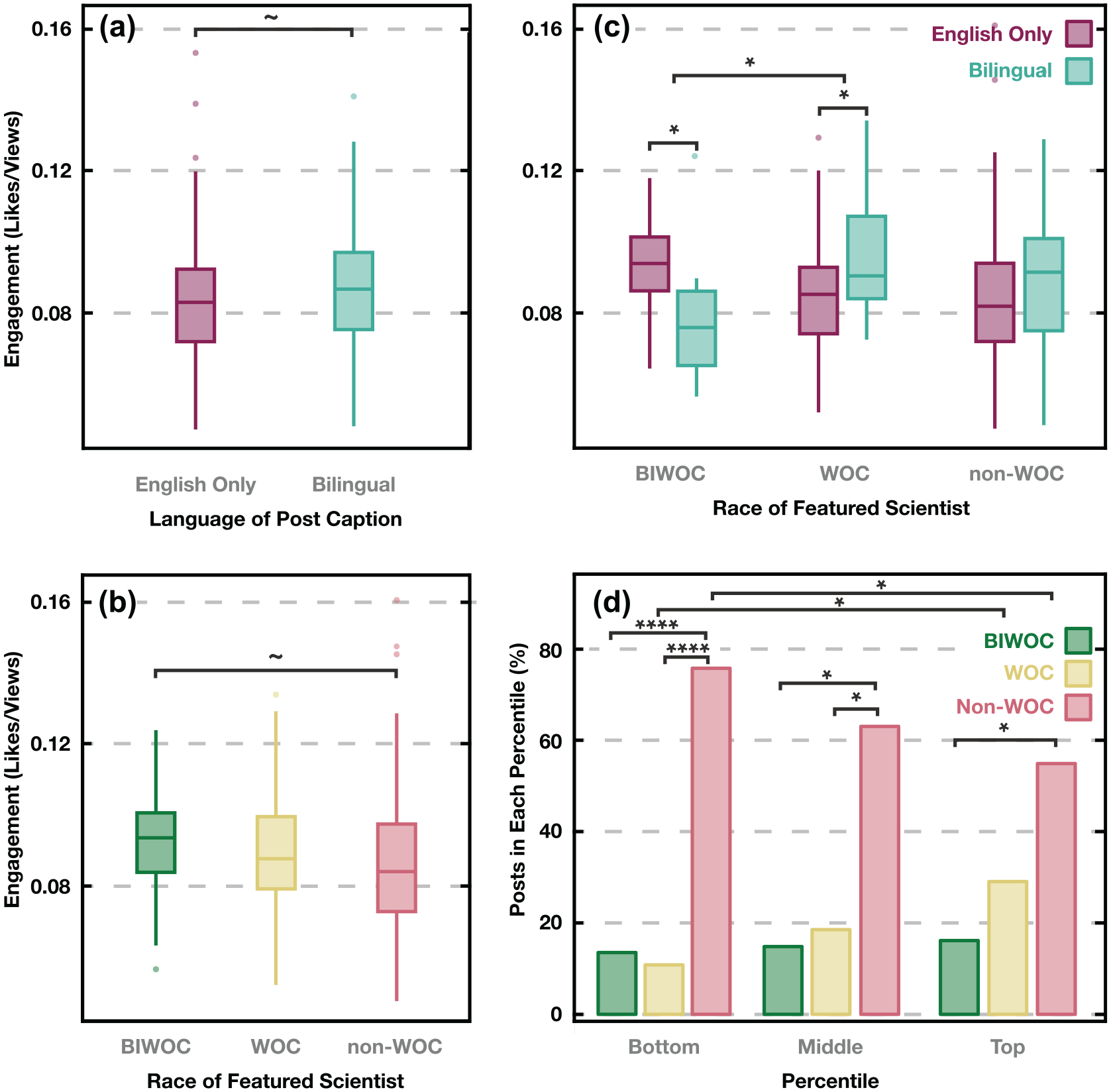
Engagement of Women Doing Science Instagram posts across (a) language (English only vs bilingual captions) and (b) race (BIWOC, non-BIWOC, vs non-WOC). (c) Engagement across the intersection of race and language. WOC had higher engagement for bilingual posts, but posts of BIWOC had the opposite trend. (d) A breakdown of the bottom 10%, middle 10%, and top 10% of posts and their relative proportion of BIWOC, WOC, and non-WOC in each percentile. The proportion of WOC increases from bottom to top percentiles, while non-WOC decreases.
Bilingual captions, which accounted for 30.4% of posts (
It is important to consider, however, that these two effects might interact. When the language of the posts and the race of the featured scientists were entered into a 2 × 2 ANOVA, there was a significant language by race interaction,
Our investigation of caption content in monolingual posts revealed differences across five non-exclusive themes (outreach,
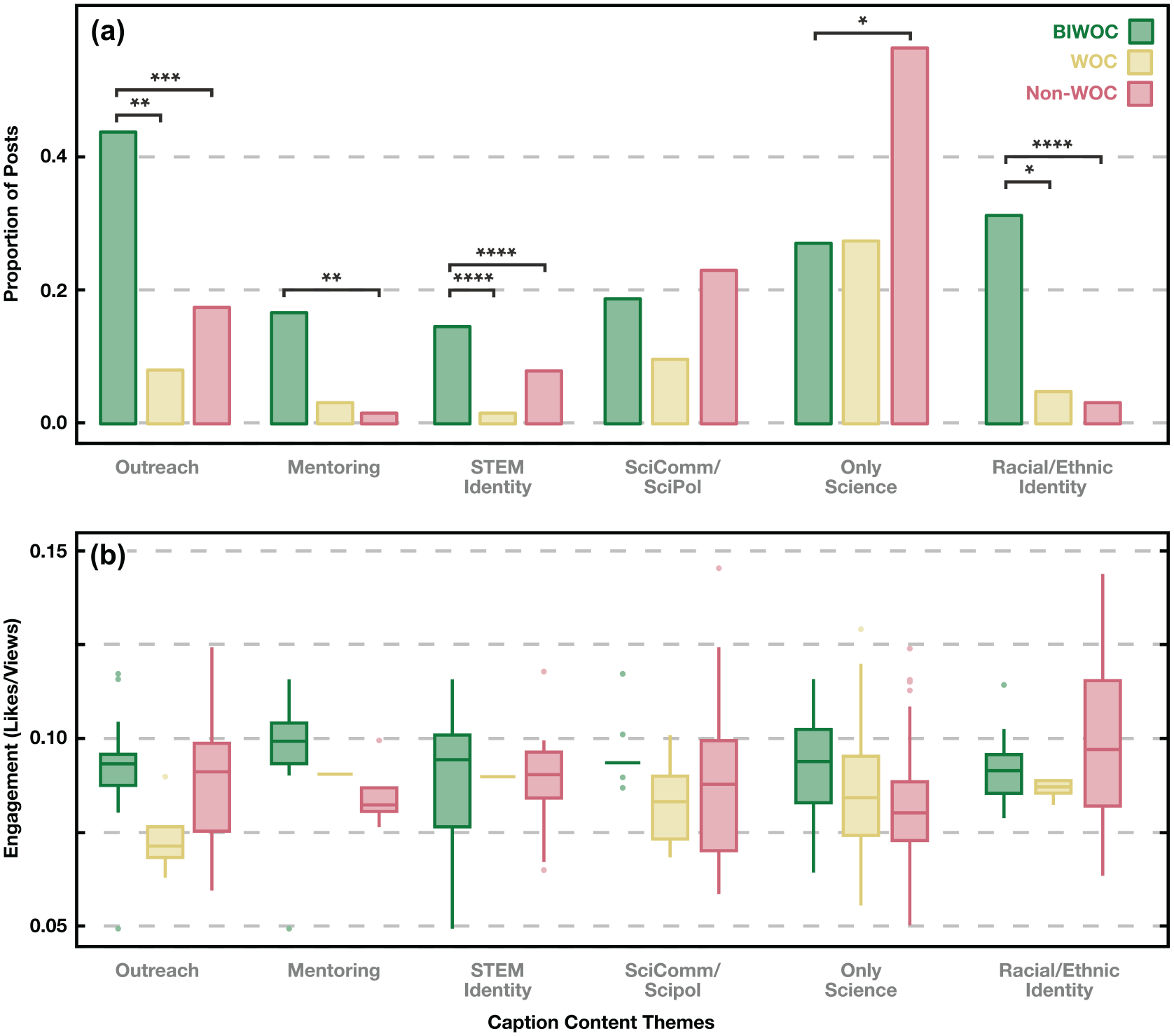
(a) Frequency and (b) engagement of Women Doing Science Instagram posts by aggregated caption themes. Proportions reflect the fraction of posts by scientists in each race, who included the respective theme in their post caption. A significantly higher proportion of BIWOC discussed themes of outreach, STEM identity, and racial/ethnic identity (compared with both non-WOC and WOC), and mentoring (compared with non- WOC). In contrast, a significantly higher proportion of non-WOC compared with BIWOC only discussed their science, as opposed to any additional aspects of their identity. In contrast, there were no differences in audience engagement across race or topic.
Photo locations showed a significant effect on engagement,
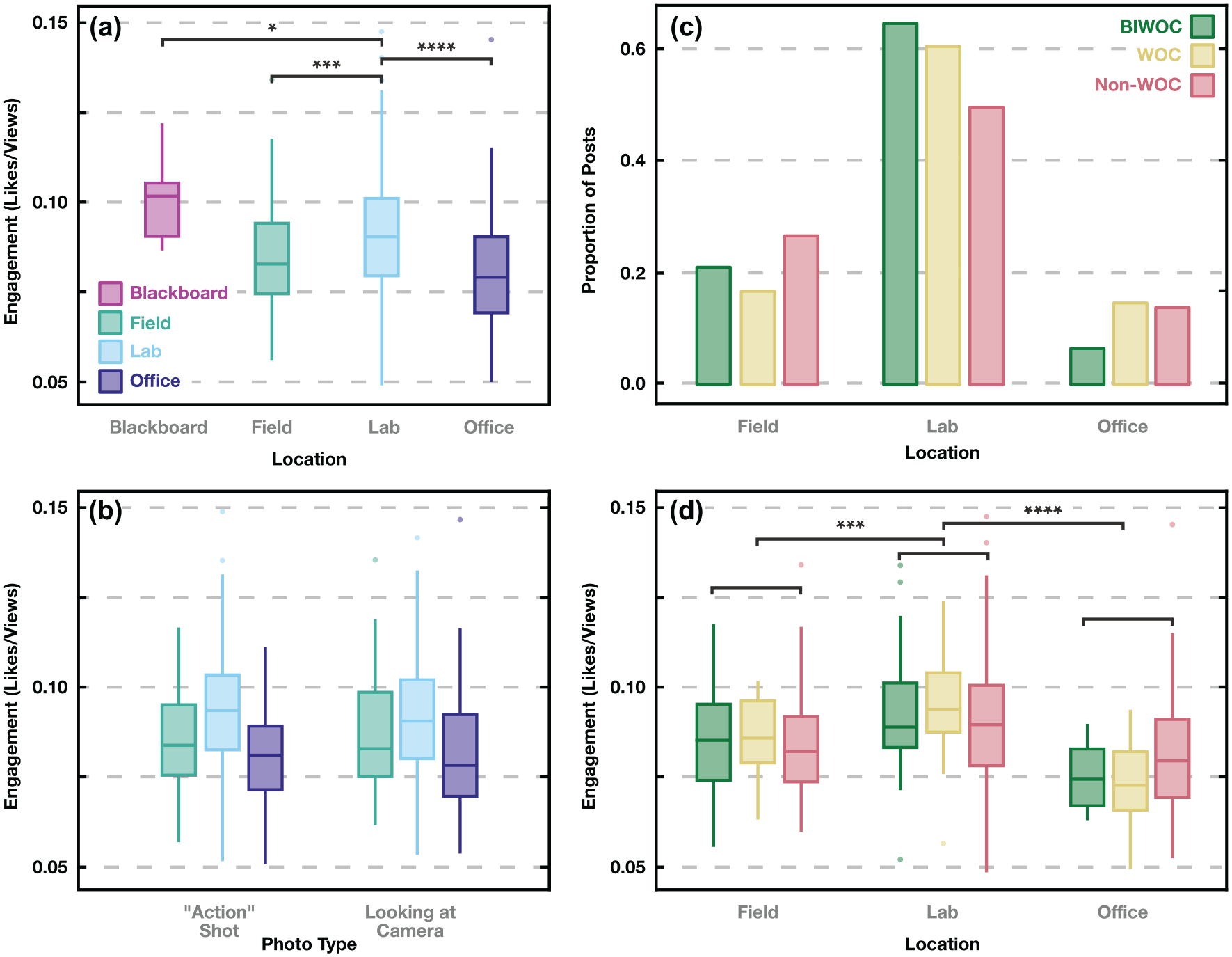
Engagement with Women Doing Science posts where main photos varied by (a) location and (b) type. Blackboard photos had higher engagement than field photos, while lab photos had higher engagement than both field and office photos. Action shots versus looking at camera photos had no significant difference. (c) Proportion of posts by location type for BIWOC, WOC, and non-WOC and (d) their engagement. No new effects were found at the intersection of race and location—only main effects found in (a) were reproduced in (d).
Instagram Followers Survey
Our above assessment of engagement trends allowed an indirect measurement of audience preference. To investigate the impact of Women Doing Science more explicitly, we combined coarse insights available from Instagram analytics with a qualitative analysis on survey responses. At the time of study, the Instagram page had ~ 94k followers, with 37.3% in the United States, 6.2% in Brazil, 6.1% in India, 4.2% in Mexico, 4.1% in Canada, and the remaining 42.1% distributed between other countries. Of the followers, 83.6% were women and 16.4% were men, with a majority of both men and women between ages 25 and 34 (50% of followers). Other age categories included 18–24 (25%), 35–44 (16%), 45 + (8%), and 13–17 (1%). We received 259 unique responses to our Women Doing Science Instagram followers’ survey, which was advertised via Instagram “stories.” There were 112 respondents from the United States (43%). Most respondents were between 18 and 34 years old, matching the demographics of the follower base (as reported by Instagram analytics). Of the respondents, 24% were WOC and 4% were BIWOC. A majority (>95%) of respondents were female.
Most respondents indicated that they often or always read the captions and “like” Women Doing Science Instagram posts (Figure S5a to b). Over 50% indicated that they have followed a scientist after seeing their feature on Women Doing Science (Figure S5c). In addition, 9% of respondents have attempted to contact a featured scientist (Figure S5d).
Participants were also asked for free response answers to “What do you like most about Women Doing Science posts?” and “Why do you follow Women Doing Science?.” Details on coding themes in these responses can be found in the Supplementary Information. Respondents (
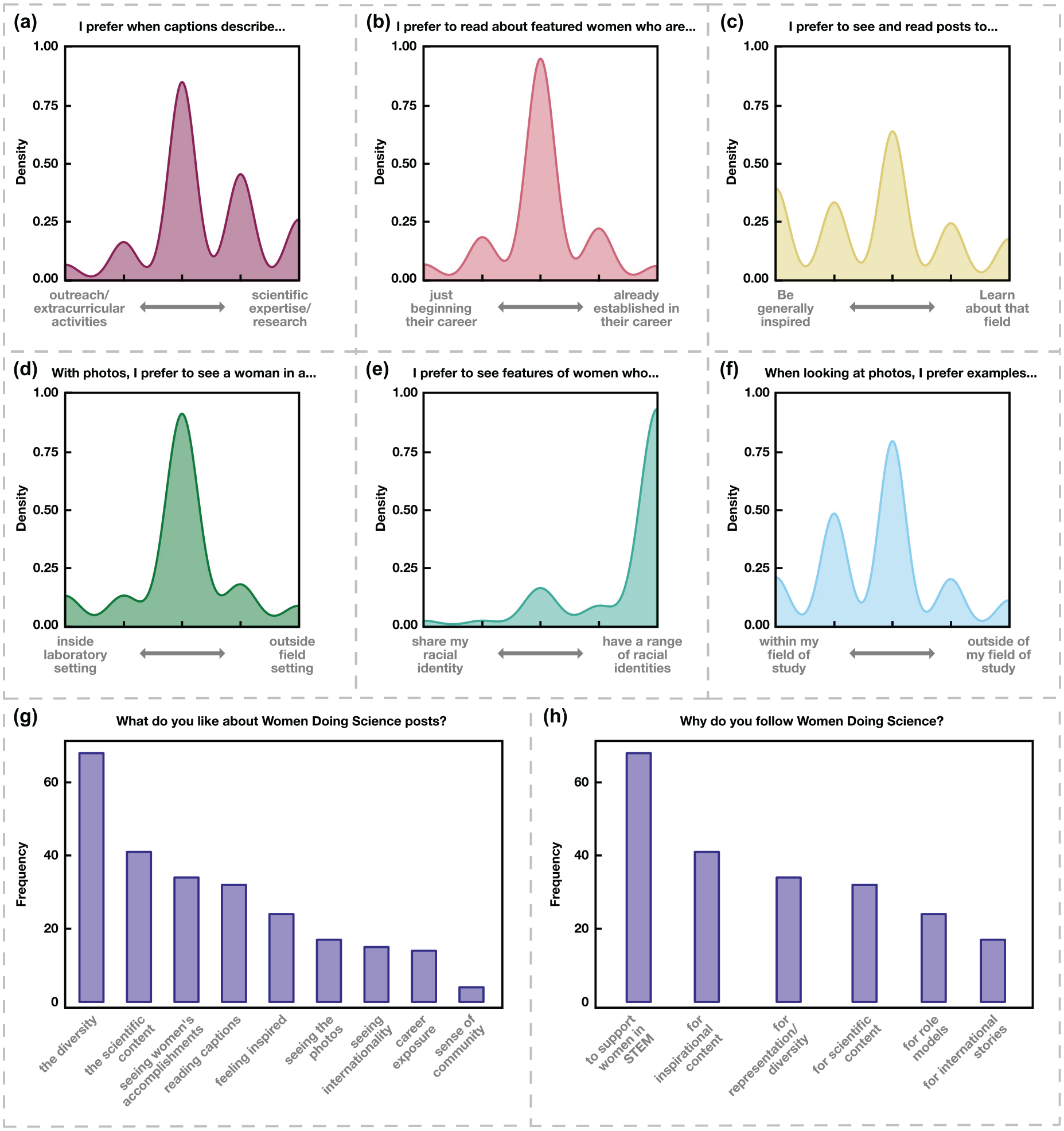
Results from the survey sent to Women Doing Science Instagram followers. Respondents were asked to rank their preference between two options for a series of questions about engaging with posts’ photos and captions (a to f). Participants indicated they were slightly more likely to prefer reading about scientific research over outreach (a), no preference between reading about established versus entry-level scientists (b), no preference between reading for general inspiration over field-specific knowledge (c), no preference between photos of women in the lab versus the field (d), significant preference over seeing women with a range of racial identities rather than sharing the participant’s racial identity (e), and slight preference so seeing photos from women in the participant’s field rather than outside of it (f). Prior to these specific rankings, participants were asked for free responses to (g) why they like Women Doing Science posts and (h) why they follow Women Doing Science. Responses were grouped by theme (identified using a topic modeling analysis) and ranked by frequency.
Following this free-response section, participants ranked their preference between two options for post/caption content (Figure 5a to f). Participants overwhelmingly preferred to see features of women with a range of racial identities, although a χ2 test identified differences in preference across race, χ2(8, 234) = 18.01,
Qualitative Analysis of Highest Engagement Posts
We investigated three case studies of high engagement (i.e., “viral”) posts to further examine how preferences in Women Doing Science followers manifest in interaction with portrayals of women scientists and the broader implications of these reactions for women in STEM. These three posts were in the top 1% of engagement with Women Doing Science posts and had > 50% of views from non-followers. All three of these high-engagement posts featured non-WOC women. Two posts generated highly positive responses, while the third provoked anger. The posts have all been explored with permission of the featured scientist.
The first post featured a postdoctoral researcher studying computational astrophysics, seen at a lecture-style chalkboard filled with complex equations. Comments included: “
The third viral post featured a PhD student in biological sciences, seen in the lab with heels on and her hair down. The post received so much harassment, in both comments and direct messages to the featured scientist that it became necessary to temporarily remove the post from Instagram. The most inflammatory comments were deleted prior to our analysis, but those remaining reflect the general sense of anger invoked by her images: “High school students will think this is the norm. Do we want to pass on unrealistic and potentially unsafe procedures to future researchers?,” “Really? That is how we are showing women in the chem lab? High heels, open long hair? Because being pretty is important! . . . This isn’t reality!”
and “The lab can be a runway sometimes.” Notably, some commentators immediately pushed back:
“If you think that curled hair, heels, and makeup detract from the quality of her science then I think you need to update your idea of what a scientist looks like.”
Discussion
We sought to answer if Women Doing Science Instagram posts highlight diverse, international scientists, and if yes, what impact these features have on our audience, as measured by engagement with posts, audience surveys, and high-engagement post case studies. In the following discussion, we conclude that (1) Women Doing Science does highlight diverse, international scientists, as seen in the racial, ethnic, and geographical diversity of posts. Furthermore, although (2) our largely female Instagram audience both rewarded and sought out these diverse posts, their STEM identities are fragile, which was clear in (3) viral (i.e., high-engagement) posts with both positive and negative reactions to conforming or breaking stereotypes of women in STEM.
Women Doing Science Highlights Diverse, International Scientists
Every scientist’s story is unique—as noted by a respondent in Kitzinger’s (2008) survey of what female scientists wanted from media representations of women in STEM: “you can’t just have one image that would do everything, and one representation that would solve all the problems.” Women Doing Science’s aim in representing diverse scientists is to showcase as many individual experiences in STEM as possible and to build an increasingly broad portfolio of potential role models for aspiring or current scientists. Seeing role models who share key aspects of individuals’ identities enables individuals to see themselves as potential scientists (i.e., to develop a positive STEM identity), which, in turn, can motivate behavior and influence career aspirations and selection (Markus & Nurius, 1986; Steinke, 2017; Strahan & Wilson, 2006). It is therefore critical to the goals of Women Doing Science to span diverse identities—across the intersections of career stage, field of study, geography, language, and race.
A majority of featured scientists were graduate students (Figure 1a), reflecting the audience of Women Doing Science and Instagram itself, both of which are dominantly accessed by young adults aged 18–34 years, a typical range for undergraduate, masters, and doctoral students. Although increasing the diversity of career stages seen on Women Doing Science, particularly at the faculty level, could potentially provide more aspirational role models, there are numerous benefits of primarily showcasing graduate students. The level of commitment, knowledge, and experience in STEM required to undertake graduate study is sufficient to inspire young scientists, while remaining an attainable goal. Followers of Women Doing Science indicated that they have equal preference for posts of established career scientists and the stories of scientists beginning their careers (Figure 5b). One survey respondent stated that they followed the Women Doing Science page because: “Often when you hear of women in STEM they are of exceptional stories (e.g., Madam [
Featured scientists on Women Doing Science span academic fields of study, although with clear biases toward disciplines with higher proportions of female graduate students, such as biological sciences and Earth, space, and ocean sciences (NSF, 2018). The racial diversity of scientists in these frequently featured fields also reflects disciplinary biases. For example, 26% of featured non-WOC are in Earth, space, and ocean sciences, in comparison to 16% for WOC and 13% for BIWOC. The geosciences are the most White-dominated STEM discipline, with BIWOC just 1.5% of US female PhD earners (Bernard & Cooperdock, 2018). Women Doing Science’s order-of-magnitude higher proportion of featured BIWOC in Earth, space, and ocean sciences is the result of a deliberate effort, inspired by the numerous team members who are geoscientists, to actively recruit Black and Indigenous women in these fields to submit their biographies. For Earth, space, and ocean sciences, there is the additional benefit of increased connections through efforts of other active social media accounts like Diverse Geologists, Geo Latinas, and Black in Geoscience. Women Doing Science also sporadically hosts “themed weeks” aimed at specific fields of study that are underrepresented in our posts: for example, “Women in Robotics,” “Women in Computer Science,” and “Women in Science Policy.” These targeted pushes help balance the steady supply of biologists and Earth, space, and ocean scientists that would otherwise more thoroughly dominate Women Doing Science posts.
Although the proportion of featured scientists from outside the US is low, Women Doing Science posts spanned 66 countries and 29 languages countries, representing significant geographical diversity. English has been termed the language of science (Gordin, 2015), but it is not necessarily the most effective language for science communication (Márquez & Porras, 2020). The Women Doing Science team actively seeks to highlight this international diversity by encouraging scientists to translate their biographies. For scientists who wish to translate their biographies but need assistance to do so (e.g., those that speak the language, but do not write in it), the Women Doing Science team includes volunteer translators for Arabic, Farsi, French, German, Hindi, Italian, Mandarin, Portuguese, Spanish, and Turkish. Due to the popularity of Women Doing Science in Latin American countries, the translations team developed submission forms in Spanish and Portuguese (our two most frequent languages) and created an Instagram account, Mujeres Haciendo Ciencia (@mujeres.haciendo.ciencia), for posts solely in Spanish and Portuguese. These efforts seem to have tangible effects for those seeking vicarious role models. One audience survey respondent indicated that they follow Women Doing Science because it
“Inspires me that despite all the discrimination and machismo we live in (in Mexico) I can achieve a job like the one you show. That was always my dream but in Mexico you can’t expect that if you are a woman.”
Another follower, aged 13–18 years from Turkey, mentioned “Ever since I started following your Instagram I have been more passionate about becoming a scientist. In our country, even though they are very talented, many women are reluctant to choose a career in STEM because they are oppressed by the hidebound society.”
Such responses demonstrate that in representing internationally diverse scientists, Women Doing Science is successfully expanding the range of “possible selves” for young women developing their STEM identity.
WOC and BIWOC accounted for about one-third of Women Doing Science posts (Figure 1d). The geographically specific construction of race makes it hard to evaluate our success in displaying racial diversity, particularly based on these broad categories. However, our data from US scientists can be leveraged for direct comparisons, such as to the US Census and NSF SED. Women Doing Science overrepresented minoritized racial groups compared with both metrics, with higher proportions of Black/African American, Native American/Native Alaskan, and Hispanic/Latinx scientists. Notably, Asian American populations in STEM match or exceed their proportion in the US population and are not considered underrepresented by the NSF. The proportion of Asian Americans featured by Women Doing Science exceeds the proportion in the US population, but not the proportion of doctoral degree earners. Both our analysis at the global scale, with 37% of featured scientists identifying as WOC (16% BIWOC), and our comparison of more specific racial and ethnic identities to US census and NSF data, suggest that Women Doing Science posts are racially diverse. It is critical to clarify that this racial diversity is not accidental. Recruitment efforts by the Women Doing Science Diversity team are active and persistent: in periods where our recruitment lapses, non-WOC women dominate the open submissions portal. Features of non-WOC are also purposefully scheduled further behind in the queue to allow space for posts of WOC and BIWOC. Finally, the Women Doing Science team itself is racially diverse; recruitment often starts within a member’s own social media network. Interestingly, this racial diversity impacts caption content significantly: WOC and BIWOC are more likely to mention non-science aspects of their identity in their biographies. Actively choosing to include more than just their science expands scientists self-depiction, highlights the multifaceted nature of identity, and the importance of supporting such multiple identities in attempts to diversify the STEM workforce.
Women Doing Science posts feature predominantly graduate students from around the world, with significant proportions of WOC and BIWOC scientists. As such, Women Doing Science demonstrates the potential for targeted efforts to successfully highlight racially diverse, international women in STEM. Overrepresentation of marginalized groups relative to the general population on social media can inspire a changing view of what a scientist looks like, strengthening the range of visibly attainable STEM identities. The successes and limitations of Women Doing Science also serve as a lesson for other areas of STEM, such as faculty hiring, where active effort in recruitment may alleviate racial gaps. It is crucial that academic systems rise to this challenge, hiring faculty with multifaceted identities to serve as role models for young scientists, and allowing them to bring such identities to the workplace. By proactively choosing to represent a vision of how the science community
Instagram Audiences Reward and Seek Posts of Diverse Women in STEM
With the knowledge that Women Doing Science does highlight diverse and international women in STEM, we turn to investigating patterns of engagement from Instagram audiences. The popularity of the page (~ 100,000 followers) suggests that Women Doing Science fills an important niche in STEM representation on social media. Our audience survey indicated that Women Doing Science followers would most likely reward diverse posts with higher engagement: “representation/diversity” was cited as a frequent reason respondents both “liked” posts and followed the page (Figure 5g and h). Furthermore, the most skewed response to targeted questions about post content was on racial diversity, with a majority of respondents indicating that they preferred to see photos of women with a range of racial identities (Figure 5e). Interestingly, the definition of “diversity” in free response answers varied, with some citing field of study (“What struck a chord is the diversity of women that I see here. I had no idea about some of the fields before Women Doing Science”), some mentioning location (“I like how diverse the science is . . . I want to leave my country to get better conditions in science”) and others citing racial diversity (“Growing up I never saw WOC in the sciences, it’s very empowering to see what other women are doing”). There is no one definition of diversity to Women Doing Science followers—rather they seek posts that represent the multitude of identities expressed across women in STEM.
These multiple definitions of diversity, such as across the intersection of geographic and racial identities, is evident in broad patterns of engagement of Women Doing Science posts. While race and caption language had marginally significant trends, with posts featuring WOC and BIWOC having higher engagement than non-WOC and bilingual captions higher than monolingual captions (Figure 2a, b and d), additional significant interactions were found when groups were not aggregated. For instance, for WOC, bilingual posts significantly outperformed those in only English, but for BIWOC the trend was reversed (Figure 2c). This demonstrates the complex effect of racial identity and the benefit of considering identity in nuanced ways. It is possible that these engagement trends suggest different needs of international audiences for social media STEM representation: US followers that speak English are perhaps more likely to reward posts of BIWOC, whereas non-US followers might engage more with bilingual posts of WOC. Notably, a majority (64%) of featured BIWOC were from the United States, compared with 25% for other WOC, which may influence engagement with the posts.
There is also evidence that our audiences view these representations of women in STEM as vicarious role models. Over 50% of followers indicated that they “followed” a featured scientist on Instagram after seeing their post, while 9% indicated they took the increased effort to reach out to the person directly. “Inspiration” and “role models” were also commonly cited as a reason for liking or following the Women Doing Science page (Figure 5g and h). Several audience responses specifically noted the power of the images of women in STEM in helping them feel more secure in their STEM identities: “Women Doing Science helps with imposter syndrome on bad days,” “I have no adult that took the STEM path to look up to and understand my options in the future” and “Sometimes I need extra encouragement from fellow women who are walking the same path.” Some explicitly mention role-models, for example: “I never knew I could have women role models in STEM.” Similarly, others reported that they follow Women Doing Science to “feel a greater sense of belonging,” “have female role models in science,” and to “feel less alone.”
Women Doing Science followers not only reward posts of diverse scientists but also seek out diverse scientists in their general social media experience. These narratives add to studies that highlight the power and importance of vicarious role models to cultivate a sense of belonging in STEM (Geena Davis Institute on Gender in Media, 2018; Schmidt & Nixon, 1996). Previous studies of STEM identity development have primarily focused on adolescent girls (Hughes et al., 2013; Tan et al., 2013; Thompson & Windschitl, 2005). However, initial results indicate that for racially diverse doctoral students, being able to recognize key parts of their identity in socio-cultural representations of professionals is just as important to their STEM identity as recognition by others (Herrera et al., 2012). The continued need for inspiration and the higher engagement with diverse potential role models from our audience of those largely already committed to science highlights the fragility of STEM identity beyond adolescence.
High-Engagement Posts Reflect Reactions to STEM Stereotypes
Traditional media persistently portrays scientists as stereotypically masculine (e.g., intellectually objective, physically strong, emotionally detached; LaFollette, 1988). Women in STEM are typically presented as passive, dependent, emotional, and more interested in pursuing romance, appearance, or a family than a career (Chimba & Kitzinger, 2010). Unsurprisingly, these gender stereotypes have been shown to decrease young women’s interest and participation in STEM (Starr, 2018; Steinke, 2017). These effects are felt beyond adolescence. A recent study surveyed female STEM students and professionals on their ideal portrayal of women scientists in the media and found that images which challenged stereotypes were preferred, opposing the common false dichotomies which portray female scientists as either “frumpy” or “sexy,” “overly emotional or cold,” or “victimized or bitchy” (Chimba & Kitzinger, 2010). Gender schema theory suggests that children organize information about gender in networks of knowledge that influence how they later interpret new information (Liben & Signorella, 1993). These schema become particularly active when gender is made salient, making the stereotyped incompatibility between femininity and success in STEM a crucial barrier to the development of STEM identity (Steinke, 2017). Furthermore, most depictions of scientists in the media do not include People of Color. A study analyzing scientists and engineers in popular films from 1991 to 2001 found that some progress has been made on gender parity in recent decades, but nearly 75% of scientists were white (Steinke, 2005).
In Women Doing Science posts, we see a trend in which followers “reward” (i.e., engage more with) posts of scientists in traditionally masculine settings and “punish” posts where scientists are depicted as feminine. Broadly, this is manifested in higher engagement for posts at the blackboard or in the lab compared with the field or office (Figure 4). Field photos, such as geologists outside and marine biologists underwater, likely have lower engagement because these disciplines have gender parity at the graduate level (NSF, 2018) and posts therefore do not arouse adequate stereotype nonconformity for viewers. Field photos may also have lower engagement due to photos being closer to landscapes than portraits—a study of one million Instagram posts found that visible faces were a highly significant driver for post likes (Bakhshi et al., 2014). Photos of the lab outcompeting photos in the office may relate to challenging themes of women portrayed as domestic or assistants (Downs, 1981; Moseley & Read, 2002).
To further examine the relationship between followers punishing or rewarding stereotypes on Women Doing Science we turn to our case study of three high-engagement posts. The comments on each post show the emotional engagement of the audience, consistent with studies of virality in online media being driven by either highly positive reactions (i.e., awe) or very negative reactions (i.e., anger; Berger & Milkman, 2012). In one post, viewers rewarded the image of an astrophysicist confidently standing before a sea of equations, an image that usually conjures white, male mathematicians (e.g., Will from the film
In contrast, the responses to the post of a biology student with her hair down demonstrates the challenges women in STEM face with how to present themselves and their appearance, from which male scientists are exempt (Chimba & Kitzinger, 2010; Kitzinger, 2008). These patterns are not unique to Instagram: a study of science communicators on YouTube found that female-hosted channels received higher engagement on videos, but at the cost of more frequent comments on their appearance (Amarasekara & Grant, 2019). Other studies have found that the more people rated a woman as attractive, the less likely they were to believe her to be a scientist (Banchefsky et al., 2016). Such responses reinforce the exact false dichotomy (i.e., beauty vs brains) many women in STEM wish to eradicate from the media (Chimba & Kitzinger, 2010). Scientific expertise and attractiveness are not mutually exclusive, but continued stereotyping of women in STEM in the media will reinforce gender schemas that imply otherwise.
Limitations and Future Work
This is the first study to evaluate the impact of diverse representations of women in STEM on social media audiences. While our sample size is large (
Conclusion
Our results indicate that not only does the Women Doing Science Instagram page show racially diverse international women scientists, but audiences reward these posts with higher engagement and continue to engage due to the page’s reputation for racial diversity and ability to inspire belonging in science. This implies the potential for social media, especially visual-based platforms like Instagram, to host diverse vicarious role models for international audiences developing their STEM identity. We hope these posts expand the range of possible selves for women developing their STEM identities and that lessons from this Instagram project assist other projects in diversifying STEM spaces. Specifically, we hope academic structures can learn from this case study: showcasing accessible and relatable role models at the graduate student level, highlighting the intersectionality of mentor identities, and moving beyond single, tokenized representations of women and/or minorities in STEM. Universities should also think deeply about the representations of STEM portrayed in their online media. These steps will help create a community for emerging women scientists to draw inspiration from while developing their STEM identities.
Supplemental Material
sj-docx-1-sms-10.1177_20563051221113068 – Supplemental material for Diversifying Representations of Female Scientists on Social Media: A Case Study From the Women Doing Science Instagram
Supplemental material, sj-docx-1-sms-10.1177_20563051221113068 for Diversifying Representations of Female Scientists on Social Media: A Case Study From the Women Doing Science Instagram by Alexandra A. Phillips, Catherine R. Walsh, Korie A. Grayson, Camilla E. Penney and Fatima Husain in Social Media + Society
Footnotes
Author Contributions and Identity Statements
Declaration of Conflicting Interests
Funding
ORCID iDs

Supplemental Material
Author Biographies
References
Supplementary Material
Please find the following supplemental material available below.
For Open Access articles published under a Creative Commons License, all supplemental material carries the same license as the article it is associated with.
For non-Open Access articles published, all supplemental material carries a non-exclusive license, and permission requests for re-use of supplemental material or any part of supplemental material shall be sent directly to the copyright owner as specified in the copyright notice associated with the article.
