







Abstract
It has long been recognised by social scientists that music, along with other forms of art, is a product of collective action, involving many participants who interact and form various types of social tie with one another. Howard Becker’s (1982)
Becker (1974, 1982) uses the term ‘network’ to capture the fact and importance of interaction and social ties in his work, as do many of those who have developed his agenda. In most cases, including Becker’s own, this term is used in a loose and non-technical way. However, in recent years, a number of scholars, including ourselves, have developed this focus by way of an engagement with and use of formal social network analysis (SNA) (for general introductions to SNA, see Borgatti et al., 2013; Scott, 2000; Wasserman and Faust, 1994; on SNA and music worlds see Bottero and Crossley, 2011; Crossley, 2015b; Crossley et al., 2015). SNA allows us to explore the patterns of connection constitutive of a music world and the overarching structures which they form, exploring both the effects of these structures and their likely causes. It allows us to quantify claims about connectedness and to test and develop ideas about its importance. Moreover, it affords a useful and straightforward way of handling relational data. Even relatively straightforward patterns of connection within a very small population of actors are difficult to record, store and represent, let alone analyse, with standard qualitative methods, and relations are explicitly precluded by standard quantitative methods. SNA is a solution to the problem this poses for those interested in relationality. It involves various types of matrices for storing relational observations, techniques for visualising network structures (some of which are illustrated later in the article), a range of measures which capture different properties of a network, and a variety of exploratory analytic routines. Its own limitations, which stem largely from its exclusive focus upon ties and its insensitivity to their qualitative nuances and complexity, mean that it can never substitute for a rich, qualitative investigation of a music world. However, the centrality of networks to such worlds and SNA’s aforementioned capacity to handle and analyse relational data make it a powerful addition to the cultural sociologist’s toolbox.
In this article, we extend the use of SNA in music worlds research, breaking new ground by exploring the possibility of using blockmodelling techniques both to distinguish worlds from one another in a network of music festivals and to map their interconnections within a musical universe (for an introduction to blockmodelling see Borgatti et al., 2013: 206–230; Scott, 2000: 123–42). The article is intended both as a substantive contribution to music worlds research and as a methodological exploration which seeks to establish whether blockmodelling can serve the purposes that we believe it can. These points need unpacking. We begin with a very brief introduction to SNA.
Social network analysis and music worlds
A network, as defined by SNA, has two key components: (1) a set of nodes and (2) a set or sets of ties which connect certain of those nodes. It may also involve (3) a set of node attributes. If nodes are human actors, for example, then we may record their gender, age, income and ethnicity (whatever attributes are relevant for our purposes). Anything can count as a node, providing it is a meaningful to define it as such within the context of a particular study. Nodes need not be human actors. They might be organisations, cities, pieces of music, anything that is meaningful in the context of a particular study. Likewise any type of tie may be used, subject to the same proviso about meaningfulness, and several different types of tie (between the same set of nodes) may be included for the same network. However, SNA measures and routines typically assume that nodes and ties are defined in such a way that all nodes are capable,
This does not preclude situations where certain types of node (e.g. members of a particular ethnic group) have a systematic connection preference (e.g. for others of their own group). Such preferences and biases are often a key focus in SNA and one of its strengths is that it affords rigorous ways of testing for and exploring such biases, affording empirical purchase on social closure and segregation. It is only meaningful to talk of bias, however, where unbiased patterns are possible
Ties can be directed or undirected. They are directed if it makes sense to say that they ‘point’ from one node to another and if it is possible for them to be unreciprocated. John may like Jane (a tie of liking), for example, but she may not like him. Liking flows from him to her but not from her to him. Undirected ties are reciprocal by definition and do not point from one party to the other. If John lives with Jane (a tie of living with), for example, then she necessarily lives with him or rather they live together. In addition, ties can be binary or valued and, if valued, they may be valued in an ordinal or continuous fashion. We might ask if John likes Jane, ‘yes’ or ‘no’, a binary tie, for example; we might ask him to rate his liking for her on a scale of one to five, giving their tie an ordinal value; or we might listen into their conversations, counting how many times he tells her that he likes her, giving us a continuous value.
As noted above, SNA affords various means for recording data on nodes and their ties, and also various ways of visualising the structure formed when ties between a set of nodes are taken into account. It also allows us to analyse these structures at different levels. This is not the place to discuss such methods and measures in detail. Suffice it to say that we can analyse a network at different levels, the three most salient, for our purposes, being: (1) the whole network level, (2) subgroups, and (3) the node level. We can illustrate these levels and their use, very briefly, by reference to Crossley’s (2015) punk study.
One property that a network might have at the whole level is cohesion (how well connected it is) and SNA affords a number of measures of this. Crossley used these measures in a comparative investigation of the punk worlds of London and Manchester. Having argued that cohesion is essential to world formation, he was able to explain why a punk world formed in London before Manchester by measuring and exploring cohesion between key players in the two cities. London became more cohesive at an earlier point (for reasons which he also explores). In addition, he was able to track the evolution of the various worlds he investigated by comparing cohesion and other whole network measures over time.
Subgroups might emerge in a music world in the form of competing ‘camps’ of participants. This is both common and important within music worlds, according to Crossley, and again SNA offers various definitions of and routines for identifying such camps. Our analysis below uses one of these.
Finally, nodes take on properties in virtue of their pattern of ties within a network. Some, for example, are more central than others, and we will generally want to know who they are. SNA suggests a number of different ways in which nodes might be more central, with algorithms and routines for measuring each. One interesting finding in Crossley’s work (which also drew upon network-friendly 1 statistical techniques) was that ‘support personnel’ (e.g. managers, promoters etc.) tend to be more central in music worlds, by each of the main measures of centrality, than musicians themselves.
We will conclude this brief introduction to SNA by noting the difference, relevant for our purposes, between single and two-mode networks. We noted above that every node in a network must be capable of enjoying the same type of tie with every other node. Actually this is only true of single mode networks. In a two-mode network, we have two types (‘modes’) of node and ties are only possible across nodes of different types. In the network we begin with below, for example, some of our nodes are music festivals, some are (music) artists and the tie we are interested in, ‘played at’, only hold across modes not within them. Artists play at festivals, but festivals do not ‘play at’ other festivals and artists do not ‘play at’ other artists. There are numerous ways of analysing such networks, and new developments emerge all of the time, allowing for analysis of, for example, networks with more than two node types (multi-mode networks) or networks in which one type of tie holds across modes and another within each of them (multi-level networks). As we explain below, however, we have analysed our two-mode network, following a common procedure, by making it into a single mode network. We have taken festivals as our nodes and deemed any two of them as tied where they share one or more of the same artists (the number of artists shared gives the tie a value).
Networks and music worlds
As noted above, our focus in this article is on music world networks. A music world is a subset of the total musical activity in a society, defined by reference to either style (e.g. ‘the folk world’), geography (e.g. ‘the Liverpool music world’) or both (e.g. ‘the Manchester jazz world’). It is also a social network because, as both Becker and Christopher Small (1998) argue, music is not an object but rather an activity involving interaction within and between sets of artists, audience members and support personnel (e.g. managers, promoters, producers etc.). Participants cooperate, compete and coordinate their activities, forming and mobilising different types of social tie in a variety of ways. From the production and reception of sounds, through their interpretation and evaluation, to the formation of subcultural styles (both sartorial and sonic) and the making and breaking of reputations, not to mention the economics of both recording and live performance, music is interaction; drawing upon and shaped by while simultaneously forming, revivifying and reshaping a network of participants.
Beyond human participants, moreover, music world networks involve corporate actors (e.g. record companies), places (e.g. venues) and events (e.g. festivals and gigs). Pragmatic considerations require that researchers abstract particular parts and aspects of these networks for analysis, neglecting others. However, this is done with an appreciation of the wider, underlying complexity of music world networks.
Researchers have used SNA to investigate a range of music worlds, including punk and post-punk (Crossley, 2015b, 2015d, 2015e; Watson, 2015a, 2015b), Ladyfest and Riot Grrrl (O’Shea, 2014, 2015), classical music (McAndrew and Everett, 2015a,b), jazz (McAndrew et al., 2015), Brit Pop (Widdop et al., 2015), Two Tone (Crossley, 2015c), Opera (McAndrew, 2015), folk (Hield and Crossley, 2015) and northern soul (Leaver and McAndrew, 2015). To date, however, as this list suggests, the focus has been upon specific individual worlds.
This focus is mirrored in wider work on music and networks (e.g. Gleiser and Danon, 2002), as well as both other work applying Becker’s insights to music (e.g. DeNora, 1995; Lopes, 2002; Martin, 2005, 2006) and a large body of similar work framed in terms of music ‘scenes’, a closely related concept to ‘world’ (e.g. Bennett and Peterson, 2004; Cohen, 1991; Fonarow, 2006; Jackson, 2012; Shank, 1994). The analytic focus, in most cases, is upon a specific, geographically or stylistically bounded domain.
Two notable exceptions, which both draw upon Becker’s concept of ‘world’, are Ruth Finnegan’s (1989)
Research focus and questions
This is an important idea. Talk of different worlds and analysis of them as discrete domains presupposes that they are indeed relatively discrete and thus, to some extent, closed. However, Finnegan does not test this idea systematically and because she does not use SNA it is difficult to see how she could. In this article, we explore a way of doing so (with SNA). Inspired by Finnegan’s work but working on a different type of data and in a different way, we seek to move the music worlds agenda forward, substantively and methodologically, by looking beyond single worlds to their combination in a ‘musical universe’. We are interested in the coexistence of multiple music worlds within (in this case) the United Kingdom. We have two sets of research questions.
The first centre upon boundaries and closure. The boundary question, that is, the question of which nodes to in/exclude in a network one is researching, is a perennial issue in SNA and one ordinarily resolved by criteria exogenous to the network: for example, musical style or geography. This is often the only way to proceed, practically, but it is question begging. Do stylistic boundaries coincide, as Finnegan’s work seems to suggest, with network clustering and closure? Would we be able to identify distinct worlds, using SNA, by their patterns of connection within a bigger and more encompassing network? Furthermore, how closed are they? Are some worlds more closed than others and, if so, which? How can we measure closure? To reiterate, these are important questions because network analyses of particular music worlds tend to assume that the networks being analysed are at least relatively closed. This, in part, justifies our regarding them as discrete worlds, amenable to individual analysis. If they are not then this would have analytic implications.
The second set of questions, following on from this, concern the connection between different music worlds. Assuming that music worlds are not completely closed and that there is some overlap and connection between them, how are the connections patterened? What is the network structure of the musical ‘universe’ formed by these interconnecting worlds? Are some worlds more central, for example, and if so which?
We propose to address these questions here using blockmodelling techniques. In a blockmodel we identify clusters of
Festivals
A useful source of data for exploring these questions is provided by the annual cycle of music festivals common to many countries across the world, including the United Kingdom. Historically UK music festivals have grown out of particular music worlds, beginning with the jazz festivals of the 1950s (McKay, 2000, 2005), and they remain important in many music worlds as they constitute occasions for bringing together a world’s often geographically dispersed participants (artists and audiences) in a celebration of their preferred musical style(s) and an experience of the state of the art (Dowd et al., 2004; Hodkinson, 2002, 2004, 2012; McKay, 2000, 2005, 2015). The names of many festivals, from the
Smaller worlds may only involve one annual festival in any country, but bigger worlds often have several, and these different festivals are connected by, among other things, the flow of many of the same artists between them. Such ties are symbolic, in part. Festivals build similar identities by booking the same artists. Beyond this, however, the flow of artists serves as a vehicle for the transmission of aesthetic and other values as well as practices and conventions between festivals. Bands who are innovating with the form of their chosen music or other aspects of their performance transmit that innovation at a series of festivals, for example, exposing audiences at different festivals to the same innovation (e.g. use of a ‘new’ instrument, technique or look). Likewise their experiences at one festival give rise to expectations and demands which they take to the next.
Hypotheses
Assuming that worlds are not completely closed, we would expect some artists to play at and thereby link festivals representing different worlds. The same artist may play both a self-identified jazz and a self-identified folk festival, for example. However, if the concept of music worlds has any ‘sociological reality’ (Gilmore, 1988), that is to say, if such labels as ‘jazz’, ‘folk’, and so on. map onto relatively discrete pockets of collective action and association, then we would expect to find festivals bearing such labels clustered within a network of festivals and artists. Self-identified jazz festivals, for example, should manifest a distinct pattern of connection within the wider network comprising all festivals. They should form structurally equivalent blocks. That, at least, is our hypothesis:
Our purpose is not only to test for an association between the self-identification of festivals and their patterns of connection, however. Using the tools of SNA and blockmodelling in particular, we also aim both to explore levels of closure around particular worlds (determining, for example, whether specific worlds are more cut off from the rest than others) and to map the network formed by connections across worlds.
There are a few complications to this picture that we must briefly consider. First, we would not expect all festivals to adhere to specific musical styles. Many are purely commercial ventures which seek to maximise their potential audience by putting on a wide range of different types of music (Bennett et al., 2014; McKay, 2015). Furthermore, this tendency may be reinforced by an apparent shift in patterns of musical taste, picked up in both the ‘omnivore’ and ‘post-subculture’ literatures, away from exclusivity and the tendency to build identities (individual and collective) around particular musical styles, towards a more eclectic and cosmopolitan stance (e.g. Bennett, 1999; Bennett and Kahn-Harris, 2004; Chan and Goldthorpe, 2007; Peterson, 1992). Audiences increasingly claim to like a wide range of musical styles, not particularly identifying with one, and we would expect festival organisers to respond to this by booking a diverse range of artists. It is our contention, however, that such eclecticism is more characteristic of the mainstream and that other music worlds exist outside of the mainstream, resisting both incorporation into it and what they often perceive to be the corrosive effect of commercial interests; worlds centred upon a particular musical ‘alternative’. Furthermore, while such worlds must be financially viable, they often constitute niche markets with an economic interest in delivering something different and specific. While we would expect to find a bulk of eclectic festivals in any festival–artist network, representing the mainstream, therefore, we would also expect to find evidence of smaller, more specialised festivals representing specific musical styles and their worlds.
It is important to add that we regard the mainstream itself as a music world. It is different from other music worlds in the respect that the label, ‘mainstream’, in contrast to say ‘punk’ or ‘jazz’, does not purport to identify a musical style. It tends rather to suggest widespread appeal and commercial success. Currently, however, in practice, most mainstream music is either ‘rock’ (including ‘indie’), pop or dance. Furthermore, commercial success is often conditional upon adherence to certain conventions which make music accessible to a wide audience and acceptable to the various gatekeepers of the mainstream world: for example, popular magazine and newspaper editors, DJs and, in the United Kingdom, Radio One playlist compilers. As this suggests, commercial success entails endorsement by other actors, circulation of one’s music through restricted (‘mainstream’) channels and moving in ‘showbiz’ circles. Such endorsements, channels and circles constitute the mainstream as a distinct world and lend it a degree of closure. Journalists often speak of artists ‘breaking into’ the mainstream. This metaphor is apt because it captures the sense of the mainstream as a relatively bounded entity, a ‘world’. The mainstream is different in some respects from other music worlds, but it is a music world all the same, and we believe that it forms an important part of the wider musical universe. Indeed, we hypothesise that
The rationale for this hypothesis is both that the mainstream is eclectic and therefore likely to share artists with a wide range of other worlds, who do not share artists with one another, and that, as various ethnographies of more specialised worlds often suggest, there is always a level of movement between such worlds and the mainstream (e.g. Peterson, 1997; Thornton, 1995). Claims to authenticity, common to many music worlds, are often couched in opposition to music deemed ‘commercial’ and ‘mainstream’ (ibid.), but this is partly because most worlds find themselves connected to the mainstream in virtue of its tendency to lure and absorb certain of their artists; a tendency which both reflects and reproduces its centrality within the musical universe.
A related complication is that mainstream festivals in particular are not distinguished on the basis of musical style alone. They work on different scales, with different budgets, and smaller festivals often cannot afford the headline acts which bigger festivals book. We would therefore expect to find that
A further factor concerns the demographics of audiences and age in particular. Older consumers are increasingly playing a key role in music markets (Bennett, 2012; Bennett and Hodkinson, 2012). This impacts in many ways, including the noticeable number of festivals advertising themselves as ‘family friendly’, with ‘quiet family camping areas’ and ‘lots to do for the kids’, but it also impacts line ups. While most festivals focus upon currently popular artists, others, with varying degrees of acknowledgement, focus upon the popular artists and styles of bygone eras, targeting audiences who identity the era(s) in question as their own. This is compounded, moreover, by what Reynolds (2011) calls ‘retromania’, that is, the increasing tendency within popular music to celebrate the music of past eras. Thus, although most festivals focus upon current artists, we hypothesise that
A final complication arises from competition between festivals within the same world. We would not expect two festivals catering to the same world to have an identical roster of artists in any one year because their success depends upon them offering something different to their competitors. Relatedly, artists may find it impractical to play all of the festivals serving their world in the same year. However, festivals within the same world which seek to avoid clashes in a single year will nevertheless book many of the same artists over a 2- or 3-year period because each needs a fresh line up every year, the pool of suitable artists is both relatively small and only changes slowly, and because artists will aim to play different festivals every year in an effort to increase the breadth of their exposure. To allow for this complication, we believe that a survey hoping to capture the clustering of festivals belonging to the same world within a wider network of festivals would be advised to focus upon a 2- or 3-year period.
Data gathering and preparation
To test these ideas, we conducted a survey. We began with an online search of festival websites, seeking out suitable events to survey. To qualify festivals had to describe themselves as music festivals and (for reasons discussed above) had to have run in each of the 3 years between 2011 and 2013 (we made an exception for Glastonbury, 3 which didn’t run in 2012, and two jazz festivals 4 with one year missing each). Festival names and blurbs were content analysed for evidence of identification with a particular music world and data on both number of artists appearing and, where available, audience capacity were also recorded.
We originally intended to include self-identified classical/art music festivals in our study. However, the format of such festivals was found to be very different from other festivals, making meaningful inclusion impossible. We therefore excluded them. This is unfortunate but consistent with our overall view. The profile of classical/art music festivals is so distinct that they do not fit with our survey tool. This is largely a matter of conventions. Art/classical festivals draw upon different organisational conventions to other festivals and this makes them difficult to compare with those others. Our engagement with these festivals was extensive enough, however, to suggest that no artist who appeared at the classical/art festivals which we considered for inclusion also appeared at any of the other festivals we surveyed. We therefore believe that the classical/art music world is indeed a distinct world, albeit not one that we can explore further here (see McAndrew and Everett, 2015a, 2015b).
Self-identified jazz festivals also often employ distinct organisational conventions. Notwithstanding their originating role in the history of open-air rock festivals in the United Kingdom (McKay, 2000, 2005), their contemporary manifestations tend to involve separately ticketed events at different venues, rather than the more usual format, that is, a single ticket affording access to a fenced-off area and everything happening within it over 2 or 3 days. However, we felt that it was important to keep jazz festivals in the dataset, not least because, in contrast to classical/art music, their artist rosters overlapped with those of other festivals.
A total of 106 festivals were included, identified with a range of music worlds. As Figure 1 shows, the largest number (n = 35) either claimed to represent a wide range of types of music or made no claim about musical styles. For the reasons outlined above, we associate this with the mainstream music world. These festivals are aimed at as wide an audience as possible rather than one of the more specific taste communities involved in other, more specialised music worlds. The second largest category (n = 21) involved festivals which claimed to focus upon some combination of ‘rock, pop and/or indie’. Given the generality of such descriptions and the fact that most songs making the UK chart during the period covered would fall under this heading we believe that these festivals too belong to the mainstream music world, as indeed do those festivals which identify with dance music (n = 8). Dance music has its more specialised and esoteric forms (Thornton, 1995), but it is a very popular genre, well-represented in the charts and on Radio One playlists. Given that we found nothing in the names or blurbs of the self-identified dance festivals to indicate that they sought to distinguish themselves from these mainstream forms, we believe that they are mainstream.

Self-classification of the festivals.
Outside of the mainstream, we have a number of festivals self-identifying with jazz (n = 9), heavy metal (n = 7), Folk/Roots/Acoustic (n = 7), Folk-Rock (n = 10), Punk (n = 3), Goth (n = 2) and 80s Retro(n = 2). In addition, we have single festivals representing blues, reggae and tribute acts respectively. Of these,
The festival with the largest artist roster for 2013, was Glastonbury, with 512. The smallest was T4 On the Beach, with only 5 (mean = 67, standard deviation (SD) = 69). Similarly, audience capacity varied markedly. Of those festivals for which we could obtain information (n = 92), the largest (Glastonbury again) had a capacity of 177,500 people, while the smallest (Africa Oye) had a capacity of only 500 (mean = 21,535, SD = 29,014).
For each festival, we observed all of the artists appearing at it over the abovementioned 3-year period. To avoid unnecessary complication, the link between festivals and artists was coded as either present or not, ignoring multiple appearances. A total of 9834 different artists were observed. The majority of them only played one festival, however, and as such did not link any festivals. By selecting only those artists who played at more than one festival, we reduced our list to 2743. For each of them, we gathered additional information regarding their success in the UK Top Forty with both long players (LPs) and singles, distinguishing also between current (2009–2013) and past (pre-2009) success. This information was gathered to give us an independent way of identifying ‘mainstream’ artists (who by our definition have enjoyed chart success) and distinguishing past from present stars. As we see in Figure 2, the majority of the artists enjoyed no chart success.

Chart success of artists: LP and single, past and current.
Collectively, our festivals and artists form a two-mode network of artists linked to festivals (on two-mode networks see Borgatti et al., 2013: 231–248). From this, however, we can derive a single mode network of festivals (see Figure 3) linked where they share one or more artists, with tie values reflecting the number of artists shared (all network manipulations, measures and visualisations were performed using Ucinet software (Borgatti et al., 2002)).

The festival network.
Analysing the network
Preliminary analysis revealed that this network forms a single component, that is, every festival has a path of ties connecting it to each of the others. Furthermore, path lengths are short. Most festivals are linked by numerous paths, but if we focus upon the distance of the shortest path (the ‘geodesic distance’) between each pair of festivals we find that 49.3% comprise a single (direct) tie, 48.4% involve only two ties (‘two degrees’), and the remaining 2.3% are only three degrees. However, ties are not evenly distributed. The average number of ties (‘average degree’) per festival is 51.8, but the standard deviation is high (23.7) and the range is 87 (4–91). Turning to tie values, the mean number of artists shared between pairs of festivals is 3.8 (standard deviation = 8.8). The highest and lowest values are 149 and 0, respectively.
Our main analytic interest, to reiterate, concerns the existence or not of structurally equivalent blocks within the network corresponding to festivals’ identifications with specific music worlds, and in particular, given our data, with jazz, folk and metal. A preliminary inspection of the network graph (Figure 3) gives reason for optimism. Note the cluster of folk festivals to the top left, jazz festivals to the bottom left, and metal festivals to the bottom right. Such visualisations are indicative at best, however. To pursue this further, it was necessary to blockmodel the network.
Before we blockmodelled the network, however, we explored a more basic structural division. Examination of Figure 3 suggested to us that there may be a core-periphery structure in the network. This is a fairly common structure in social networks in which a subset of nodes (the core) enjoy a high density of connection to one another, while the rest (the periphery), taken collectively, enjoy a relatively weak density of connection to the core and an even weaker density of connection to one another. This is important because members of the core can often be interpreted as being at the centre of whatever is going on in the network.
Ucinet provides two ways of exploring core-periphery structures: a (continuous) measure of each node’s ‘coreness’ and a categorical procedure which partitions nodes into a core and periphery, respectively, seeking out the partition which best conforms to a core-periphery structure. We used both procedures. We return to the continuous measure later. For the moment, consider the results of our categorical analysis (Table 1). The core-periphery pattern is clear. Density is much higher within the core (which has 22 members) than either between core and periphery or within the periphery. Furthermore, the periphery is more densely connected to the core than within itself.
Density table for categorical core-periphery analysis.
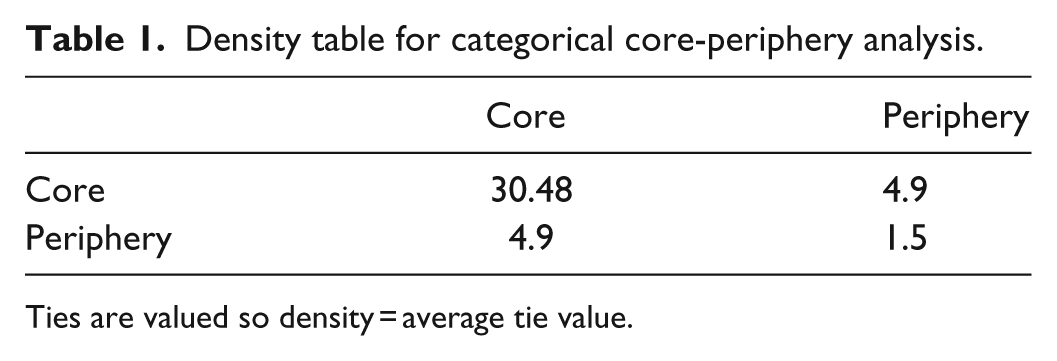
Ties are valued so density = average tie value.
The first significant finding of our analysis, therefore, is that the musical universe, as least as represented by festival interlocks, has a core-periphery structure. This is an important finding and in what follows we will elaborate upon it. To do so, we must further partition our network in a blockmodel.
Structural equivalence was measured by way of correlation, 5 the method most appropriate for valued data, and blocks were identified using Ucinet’s optimising algorithm. Because the theoretical work informing the article did not suggest a hypothesis regarding a likely number of blocks, we approached this matter inductively, trying solutions involving different numbers and comparing their error and R2 scores. We would expect error scores to drop and R2 scores to rise as the number of blocks increases but, following common practice, we sought to find a point at which the rate of improvement begins to level off. That gave us an eight block model.
Key characteristics of the blocks are reported in Table 2. We see, first, that Blocks 2 through 8 have roughly the same number of festivals in them, ranging from 13 to 8 but Block 1 is much bigger, with 42 festivals. Given that we expected to find a big cluster of mainstream festivals, our initial interpretation was that Block 1 captured that or at least part of it. This interpretation was further supported by the much bigger average size of festivals in Block 1, measured both in terms of number of artists appearing and audience capacity (the analysis of variance (ANOVA) measure for audience capacity is not significant, perhaps because numbers in some categories are small, but when we ran a t-test comparing capacity in Block 1 with all other blocks combined, the results were highly significant 6 ). These are characteristics that we would associate with the musical mainstream.
Profiling the blocks.

ANOVA: analysis of variance.
Block 4 is interesting in terms of these figures too, as it has a relatively small average number of artists but a high audience capacity. The high audience capacity suggests that Block 4 festivals are mainstream (and therefore capable of capturing bigger audiences). However, the smaller number of artists suggests that they are run on a less grand scale. Our initial interpretation of this was that Block 4 captures some of the smaller, ‘second tier’ mainstream festivals that we expected to find.
Our final observation on Table 2 is that we were only able to determine audience capacity for 2 out of the 8 festivals in Block 7. This, we later discovered, is because all of the festivals in Block 7 are jazz festivals, 6 of which comprise a series of separately ticketed events, such that they have no overall figure for capacity.
Cross-tabulating block membership with the self-classifications discussed earlier indicates that the former, as hypothesised, reflect the latter. The raw figures are presented in Table 3, but the pattern of associations is clearer in Figure 4, which summarises them by way of a (simple) correspondence analysis. To the right, we see a clear association between Block 7 and jazz; to the top an association between Block 8 and the various specialised festivals for which we only have one example. To the bottom left, we see a strong association between Block 2 and heavy metal, with a partial association to punk too, and to the right of this we see an association between Block 3 and both folk and folk-rock. The remaining data points, situated half way up, to the left, represent Blocks 1, 4 and 5, and the mixed, dance and indie/pop/rock festivals, with Block 6 and the 80s retro festivals just below and to the right.
Block membership of festivals by self-classification.


Correspondences between block membership and festival self-categorisation.
Our preliminary interpretation of this is that Blocks 1, 4 and 5 capture different subworlds within the mainstream world. The abovementioned greater size of the Block 1 festivals, and the large audience capacity of Block 4 festivals also supports this interpretation, while perhaps suggesting that Block 1 festivals represent a ‘top tier’ of the mainstream, compared to the others. Given Block 4’s greater audience capacity we deem it ‘second tier’, and Block 5 ‘third tier’.
Turning to the more specialised worlds, Block 2 captures many of the metal festivals, with some punk involvement. Block 3 captures the folk-related festivals. Block 7 captures all but one of the jazz festivals. Block 8 captures specialist festivals which do not exist in big enough numbers within our survey to form their own block, and Block 6 appears, prima facie, to capture the ‘retro’ element in popular music whose impact we hypothesised.
Table 4, which cross tabulates the data on artist success represented in Figure 2 with the festival blocks in which those artists performed, further supports this interpretation. The majority of artists appearing in festivals in each of the blocks have enjoyed no chart success. However, artists enjoying some form of current success do disproportionately figure in Block 1 festivals and Block 4 scores highly for artists enjoying current joint single and LP success. Our other ‘mainstream’ block, Block 5, has a slightly elevated number of artists enjoying current LP success, but on the whole, successful artists are poorly represented within it, supporting our interpretation of it as third tier. It is also noteworthy that a disproportionate number of Block 6 artists have enjoyed past single and LP success but are not currently in the charts. This supports our interpretation of Block 6 as capturing the retro tendency in popular music. On these bases, we interpret our blocks as follows:
Block 1 captures the ‘top tier’ of the mainstream music world.
Block 2 captures the metal world.
Block 3 captures the folk (and folk-rock) world.
Block 4 captures the second tier of the mainstream world.
Block 5 captures the third tier of the mainstream world.
Block 6 captures the retro tendency in popular music.
Block 7 captures the jazz world.
Block 8 does not capture a single world or subworld but rather a variety of festivals catering to specialist worlds which are not sufficiently represented within our survey to form their own block. We designate it the specialist block.
Chart success of participating artists by block.

The same artist may participate in more than one block.
These findings support our hypotheses 1, 3 and 4 (H2 has not yet been tested). Blocks 2, 3 and 7 demonstrate the clustering associated with belonging to specific music worlds (H1). Blocks 1, 4 and 5 demonstrate the stratification and division of the mainstream music world (H3), and Block 6 is consistent with our prediction that some festivals will cater for older and retro-inspired audiences (H4). The question remains, however, as to the level of closure of these worlds and their connection to one another. This takes us to the next stage of the blockmodelling process.
Linked worlds? The musical universe
Connection between blocks is measured, in a blockmodel, by the density of ties between their constituent members. There are two possible ways of doing this in our case. We can continue to work with valued ties, in which case, density is measured as average tie value. Alternatively, we can ‘dichotomise’ ties, treating festivals as either connected or not. In this case, density measures the number of festivals enjoying a connection, expressed as a proportion of the total number of connections possible. These two methods might potentially create different blockmodels. In our case, however, they do not. The Pearson’s correlation coefficient for the two models is 0.95 (p < .000). Given this, and given that we used the valued data to derive our blocks, we continued with the valued model. Block densities are given in Table 5.
Interblock densities.

Note that every block, except Blocks 5 and 8, is most strongly connected to itself. This indicates that every block, except 5 and 8, is internally cohesive and relatively closed (the density scores and in particular the contrast between a block’s internal and various ‘bridging’ density scores affords a measure of closure), lending weight to our interpretation of the blocks as ‘worlds’ (or subworlds). We would expect worlds to be cohesive and relatively closed. The lower internal density of Block 8 indirectly supports this interpretation too because 8 contains various small festivals representing a number of unconnected worlds (e.g. goth and reggae), and we would not therefore expect it to be cohesive. Block 5’s lower score is perhaps attributable to the fact that it represents a lower tier subworld of the mainstream music world; it is the outpost of another world rather than a world in its own right. This interpretation is supported by the fact that its strongest tie is to Block 1, which represents the top tier of the mainstream world.
Blocks 1, 2, 3, 4 and 5 each enjoy their second (or first) strongest tie to Block 1, and Blocks 6, 7 and 8 have relatively strong connections to 1 too. This indicates that Block 1, the top tier of the mainstream music world, is a hub in the musical universe. It also hints at the core-periphery structure discussed earlier. To test this interpretation further, we cross-tabulated block membership with our core/periphery partition (discussed above) and also compared mean scores for coreness across the blocks. Our cross-tabulation indicated that 21 out of the 22 members of the network’s core are found in Block 1 (the remaining core member is in Block 2, our heavy metal cluster), and our comparison of mean coreness indicated that it is much higher in Block 1 (see Table 2). We can infer from this that our network has a strong core-periphery structure and that Block 1 is or at least contains the core. This very strongly supports H2, outlined above.
The core-periphery idea is also supported by the disproportionately high internal density score of Block 1. It is 15.43 in a matrix where many values are below 1. This points to the disproportionately high level of connection between Block 1 festivals, compared to others (note also that 96% of all pairs of festivals in Block 1 have at least some connection). This is what we would expect of a network core.
Interestingly, Blocks 6, 7 and 8 each have their second strongest tie to Block 3, our folk block. This makes the folk block a secondary hub in the musical universe, and we interpret this as an indication that the folk and perhaps especially the folk-rock festivals form an alternative centre to the United Kingdom’s musical universe or perhaps rather a centre for musical alternatives. Given this we might have expected our heavy metal block, Block 2, to link more strongly to Block 3 than to Block 1. Why it doesn’t is a question which could perhaps be explored in further work.
It is common in a blockmodel to determine a threshold value for density, over which blocks are deemed connected and below which they are not. This is the final stage of blockmodelling: the model itself. There is no single method for determining the threshold at which blocks are deemed connected. This is at the discretion of the researcher and depends upon what is meaningful in the context of a particular analysis (Wasserman and Faust, 1994). We decided upon a threshold value of 1 because anything below 1 would suggest a clear tendency towards lack of connection.
The resulting model is visualised in Figure 5. It illustrates our main observations. In particular, we see the centrality of the top tier mainstream but also the clear secondary hub status of the folk world. We see that all blocks except Block 8 are internally connected (indicated by the circle around the node, linking it to itself) and thus cohesive. Importantly, moreover, we see that the jazz world becomes disconnected from the others at this threshold. This suggests that the jazz world enjoys the highest level of independence from other worlds in the musical universe. Jazz is the most closed of the worlds studied.

The Festival Blockmodel.
Conclusion
There has been a growing recognition of the potential utility of SNA for the analysis of culture and more especially ‘music worlds’ in recent years (Crossley et al., 2015). To date, however, studies have focused upon individual music worlds, defined by reference to either style or geography (e.g. the London punk world (Crossley, 2015a,b)). In this article, we have expanded this agenda by exploring the coexistence of different music worlds within a common ‘musical universe’ and the pattern of connection between them. To do this, we focused upon a network of 106 music festivals within the United Kingdom, claiming to represent a variety of different music worlds and linked where they share one or more of the same artists over a 3-year period (2011–2013).
Our first question was whether different self-identified music worlds would be distinguishable within this network by way of their patterns of connection. Would worlds form structurally equivalent blocks within our network? We found that they did. A cross-tabulation of festival blocks and the self-identification of festivals pointed to a clear association between structural equivalence and musical identification. In particular, the jazz, folk and metal festivals formed separate blocks within our network.
This is important because it suggests that, although music worlds connect to one another in a musical universe, they constitute distinct regions within the network structure of that universe and, as such, merit the individual attention sometimes bestowed upon them by music world scholars. In addition, it points to the potential utility of blockmodelling in other situations where the differentiation and categorisation of cultural worlds is at issue.
As just suggested, however, our focus was not only upon distinct music worlds but also upon the connections between them and thereby the network structure of the musical universe which they collectively comprise. Blockmodelling not only allowed us to distinguish distinct music worlds, as other forms of cluster analysis and/or data reduction might. It also allowed us to explore connections between them, the reticular structure these connections form, and also their individual levels of closure and isolation. We believe that this points to the potential utility of blockmodelling for further studies of cultural worlds.
The discovery of distinct ‘jazz’, ‘folk’ and ‘metal’ worlds was not a surprise. However, it was important to find that they do, indeed, manifest distinct patterns of connection and are, therefore, beyond labels and stylistic similarities, ‘real’ social worlds in Gilmore’s (1988) sense. They are genuinely distinct clusters of musical interactivity.
The greater separation of the jazz world from the other worlds was also somewhat predictable given the elevated status of jazz, its inclusion in the curricula of many university music schools and conservatoires etc. Although all music worlds are distinct jazz is more distinct than many. Again, however, it was important to find this impacting upon network patterns and to be able to put precise measures to it. We were able to demonstrate the relatively high level of closure around the jazz world.
Finally, we believe that our investigation of the musical mainstream is important and revealing. Studies of music worlds (or ‘scenes’) typically focus upon esoteric and specialised cases, and we suspect that many might question whether the mainstream constitutes a ‘world’ as such. We have argued that it is, however, and our analysis suggests that it occupies a distinct and important place within the musical universe. It is the core of the musical universe, in a core-periphery structure; in many respects, a more closed world than the others and yet the world to which all others connect. We hope that this observation provokes further and more sustained analysis both of the mainstream world and its connection to other, more esoteric worlds.